




















insight for executives on the move

august 2024

Lodges offer reasons to both stay inside and venture out

Per Gessle • Executive pay • Empower your team • Staffing solutions • Demi-Leigh Tebow • Slow running • Nik Rabinowitz

Table of Contents

Every woman’s success should be an inspiration to another. We are strongest when we cheer each other on.
- Serena Williams

Airlink’s Celebration of National Women’s Month

In celebration of National Women’s Month, and National Women’s Day on 9 August, Airlink pays homage to all our female customers, Skyways readers, travel trade partners, and particularly, our female employees.

The Airlink Group proudly employs more than 1, 100 women in a variety of disciplines. 287 Cabin Services | 621 General Fields | 76 Management Levels | 51 Pilots | 80 Technical and Engineering

business | trade | industry
SPONSORED

Discover Gauteng’s latest apartment luxury hotel: A new gem on the horizon

Steyn City Hotel by Saxon, operated by Saxon Hotel, Villas and Spa, is an exciting new hospitality venture offering travellers captivating new experiences located at the prestigious Steyn City residential lifestyle estate.

Steyn City has long been known as one of Gauteng’s most enviable residential addresses. In fact, having made several appearances on rankings of the world’s top ten lifestyle estates and Gauteng’s best residential estate, it’s no stretch to say that it’s difficult to find a place that so easily melds beautiful surroundings with stunning recreational facilities and unparalleled luxury and convenience.

That’s thanks to amenities like the 18-hole Nicklaus design championship golf course, a 45km floodlit promenade for walking and running, a 50km mountain bike track, and an equestrian centre, complete with bridle trails. Also on offer are a plethora of eateries (well-known coffee chains and family-style outdoor restaurants, bistros, and al fresco dining options), tennis and padel courts, outdoor workout stations, fitness centres, and children’s play nodes. At the hub of it all is City Centre, with its lively piazzas, stunning art gallery, high-end retailers, buzzing coffee shop, and eateries. Add in the Ultimate Helistop for instant access to your next destination, and this is a place that has it all.

The launch of the Steyn City Hotel by Saxon in October 2024 will attract discerning guests, including those staying with friends or family in Johannesburg, business travellers, and those seeking a break at a destination that’s close to home. It’s also just a short drive (15 minutes) from Lanseria International Airport, making it convenient for travellers from SADC countries and other major cities, as well as international guests looking for the ultimate séjour in Gauteng. As a conferencing destination, you’d be hard-pressed to find another venue that has quite so much to offer.

Like its sister establishment, The Saxon Hotel, Villas and Spa, the Steyn City Hotel by Saxon is all about luxury and comfort. The hotel’s endorsement by The Leading Hotels of the World is yet another assurance that your stay will be without compare, as this prestigious accreditation is reserved for establishments recognised for their unswerving accent on excellence.

Added to this is the joy of having absolutely everything you could need to make your stay relaxing: each of the 50 serviced apartments (with views over the lagoon or treed piazzas) is equipped with a range of appliances, including a fridge, freezer, tea and coffee-making station, washing machine, and iron, so that guests truly feel that they are in a home away from home. You’re able to choose from one- to four-bedroom apartments, with a well-appointed penthouse and presidential suite also available, all with WiFi and concierge service.

With everything else taken care of, it’s time to customise your stay. If you’re travelling with family, be sure to visit Steyn City’s Lagoon. Bringing the best of the coast to Gauteng, there’s endless fun with waterslides, water sports like kayaking and pedalos, beach volleyball, a zero-depth kiddies waterpark, a Mediterranean-inspired family restaurant, braai pods that are fully serviced and catered, and a convenient poolside store. Don’t forget to check out the padel courts, too.

If, on the other hand, you’re travelling on business, remember that the Ultimate Helistop may be scheduled for quick flights to your business meetings. The Helistop is, moreover, equipped with a meeting room and business facilities. You may also wish to make use of the co-working facilities at Guild, where you can also enjoy a scrumptious breakfast or lunch.

Those travelling as part of a convention will be pleased by the post-meeting and social activities on offer. Your gathering will be comfortably accommodated at Guild’s conferencing facilities, which offers an 80-seater conference and event area. Then it’s time to square off against colleagues on the championship golf course or the padel court, followed by a relaxing braai at the Lagoon with some pool activities or drinks at the hotel’s cocktail bar.

Alternatively, hire an e-bike to explore the estate’s magnificent 2,000-acre parkland along the 50km mountain bike track and revive yourself afterwards with a refreshing dip in the hotel’s rooftop pool.

The best way to finish off your stay? With a visit to the Saxon Spa (opening early 2025) to indulge in your choice of pampering treatment or wellness journey amidst a beautiful setting.

The Steyn City Hotel by Saxon truly offers something for everyone and for every occasion to make your stay unforgettable, with hopes of welcoming guests back very soon!

Text and Photography | Supplied

For more information, go to www.steyncityhotel.co.za.

https://steyncityhotel.co.za

Read more

take | off

TRAVEL

More seats, more options, more routes

Airlink has increased seat availability on certain days from both Cape Town and Johannesburg to Skukuza in the Kruger National Park. Two flights per week to and from both cities on this route have been upgraded from a 37-seat Embraer ERJ 135 Regional Jet to the comfortable, spacious 98-seat Embraer E190 E-Jet, offering six Business Class and 92 Economy Class seats.

Airlink customers can now also travel between Cape Town and Maputo. The four-times-weekly flight is operated using the 37-seat Embraer ERJ 135 Regional Jet.

Airlink customers also have more options to travel between Johannesburg and Sishen in the Northern Cape. Additional frequencies have been added on Monday mornings and Wednesday and Friday afternoons. All flights will operate using Airlink’s 37-seat Embraer ERJ 135 Regional Jets.

And until 5 January 2025, Airlink is again offering its peak season service linking Mbombela with Vilanculos in Mozambique, allowing travellers the ability to combine a safari and beach holiday.

Read more
BIZARRE

Fly away now, sir!

A New Zealand woman has taken her long-term boyfriend to a disputes tribunal for breaching a ‘verbal contract’ by failing to take her to the airport, resulting in her missing a flight to a concert and forcing her to delay her travel by one day.

The woman told New Zealand’s disputes tribunal that she had been in a relationship with the man for six and a half years until the disagreement arose. According to an order from the tribunal, the woman had arranged to attend a concert with some friends. Her boyfriend had agreed to transport her to the airport and stay at her house to look after her two dogs while she was away.

She messaged him the day before with a timeframe of 10am to 10:15am in which she would need to be collected. But he never arrived, causing the woman to miss her flight. The woman said she incurred multiple costs as a result, including the cost of travel the next day, a shuttle to the airport, and putting her dogs in a kennel.

Source: theguardian.com

Read more
ENVIRONMENT

Biting back

Millions of mosquitoes are being released from helicopters in Hawaii in a last-ditch attempt to save rare birds slipping into extinction. The archipelago’s endemic, brightly colored honeycreeper birds are dying of malaria carried by mosquitoes first introduced by European and American ships in the 1800s. Having evolved with no immunity to the disease, the birds can die after just a single bite.

Thirty-three species of honeycreeper have become extinct and many of the 17 that remain are highly endangered, with concerns some could be extinct within a year if no action is taken. Now conservationists are urgently trying to save them with an unusual strategy: releasing more mosquitoes. Every week, a helicopter drops 250,000 male mosquitoes with a naturally occurring bacteria that acts as birth control onto the islands of the remote archipelago. Already, 10 million have been released.

Source: theguardian.com

Read more
NATURE

First-line researchers

Wild chimpanzees eat plants that have pain-relieving and antibacterial properties to heal themselves, according to scientists. They described their ‘detective work’ in the forests of Uganda – observing animals that appeared injured or sick to work out whether they were self-medicating with plants. When an injured animal sought out something specific from the forest to eat, the researchers collected samples of that plant and had it analyzed. Most of the plants tested turned out to have antibacterial properties.

The scientists, who published their findings in the journal PLOS One, think the chimps could even help in the search for new medicines. “We can’t test everything in these forests for their medicinal properties,” lead researcher Dr. Elodie Freymann, from the University of Oxford, said. “So why not test the plants that we have this information about – plants the chimps are seeking out?”

Source: bbc.com

Read more
SPACE

Moon meals

Solar Foods, based in Helsinki, is one of the eight companies that has reached the final phase of the challenge to make satisfying food for astronauts. Their remarkable concept: using space waste to create protein.

“We make food out of thin air, quite literally,” said Artuu Luukanen, Solar Foods’ Senior Vice President in Space and Defence. His company discovered an edible microbe in the Finnish countryside that grows by feeding on a mixture of carbon dioxide, hydrogen, and oxygen. The result is a source of protein from bacteria. The protein can be blended with a range of flavours or textures to create various kinds of nutritious food, such as pasta, protein bars, alternative meats, and even an egg replacement.

“We started thinking about space food because in any space habitat, you have two key waste gases available: hydrogen and carbon dioxide,” Luukanen said. “So, what we are talking about here is really not just a food manufacturing technology for space, but something that will be an integral part of the environmental control and life support system.”

Source: bbc.com

Read more
BIRD OF THE MONTH

Gorgeous bushshrike

If ever a bird was appropriately named, it is this one. No birding trip to eastern or southern Africa is complete without encountering it. Though this bird is often heard calling, it is rarely seen because it resides in dense, dry woodlands.

While preparing for an evening braai near the Ndumo Game Reserve in Zululand, I heard its unmistakable call. Hearing it is one thing, seeing and photographing it is a totally different proposition. After about an hour of stalking this guy, he finally made an appearance, long enough for me to capture a few images.

Nearest Airlink airport: Sikhuphe, Eswatini

Source: sacrp.org

Text and photography: Dr Bob Graham

Read more
YOUR QUESTIONS ANSWERED

Have questions around your booking or travelling experience? Here are some solutions to pressing queries

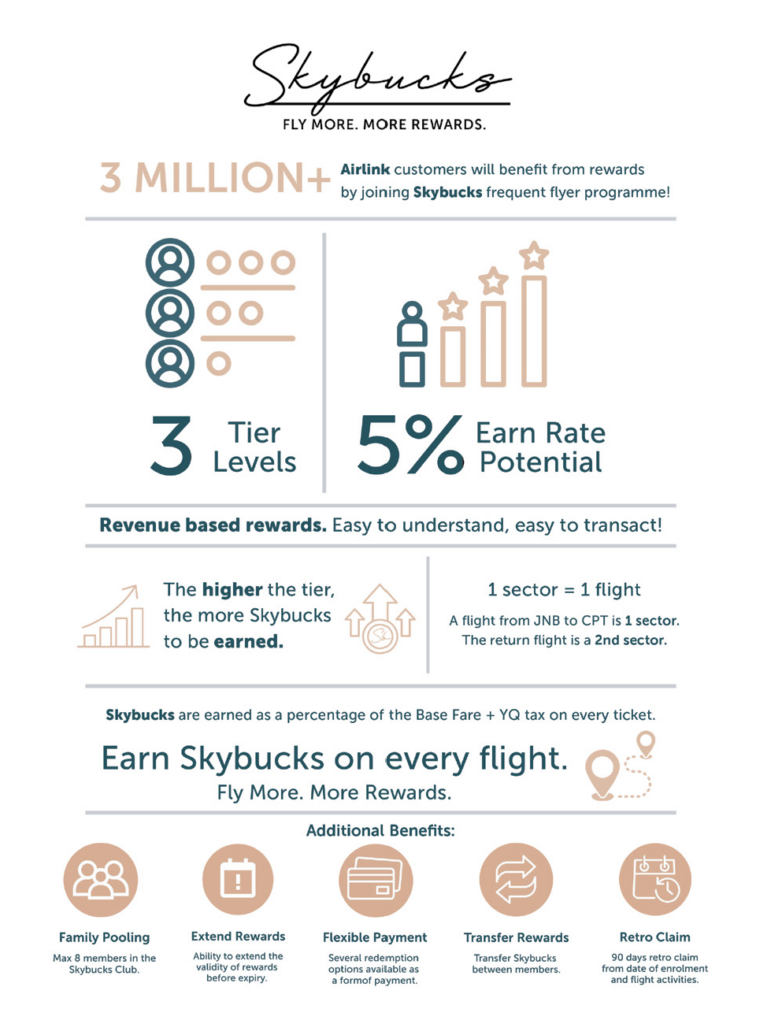
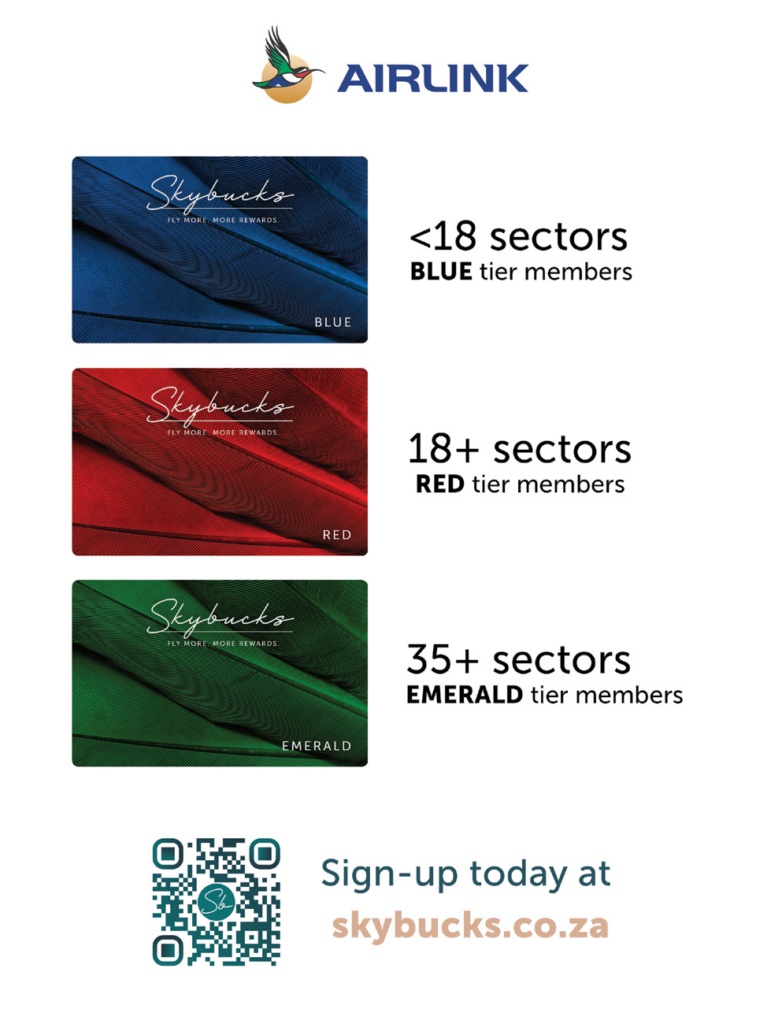
HOW LONG IS MY SKYBUCKS TIER STATUS VALID FOR?

Membership tiers are based on the total of flight sectors flown by a member within a rolling 12-month period.

DO I EARN SKYBUCKS ON THE 4Z8000 FLIGHT RANGE?

Skybucks members who travel on the 4Z8000 flight range, operated by franchise partner FlyNamibia, are not eligible to earn or redeem Skybucks.

HOW DO I MONITOR MY SKYBUCKS ACCOUNT?

By logging into your account via www.skybucks.co.za, it is the member’s responsibility to monitor their account and advise if there are any discrepancies. Email Enquiries@skybucks.co.za.

For more information, go to flyairlink.com

DOWNLOAD THE APP!

Use the FlyAirlink app, which gives you a convenient platform to plan, book and manage flights on your smartphone. Available in Apple App or Google Play stores.

travel | leisure | lifestyle
WATERBURG

Lodge and reserve offer multiple reasons to both stay in camp and head out into the wild

When traveling via or from Johannesburg, it’s wonderfully simple to get to Welgevonden Game Reserve – one road north out of Johannesburg and one road west from that road before the gate to the reserve comes up on your left.

Once you arrive and are fortified by welcome drinks and snacks at the gate, the more complex driving is left to ranger Chad, who doesn’t baulk at our unlikely ‘shopping list’ – honey badger, otter, pangolin, aardvark, and porcupine. “I have them all in cages,” he jokes, “but let’s see if we can find them in the wild first.”

Mhondoro Safari Lodge & Villa is about an hour from the gate, but it doesn’t feel like it. Your arrival is marked by the imposing lodge building, set on a contour line and with a low bunker out front that turns out to be a gorgeous waterhole hide reached by a 65m underground tunnel. The entire staff turns out to welcome guests and are introduced by name, immediately establishing the family atmosphere evident throughout a stay here.

On the patio next to the pool is the legend ‘elephant line’, put there, we are told, because the pachyderms come to drink the water and guests need a guideline as to where to stand or swim to stay out of reach of curious trunks.

The lodge is fairly traditional architecturally but with some sleek add-ons. The walls of the boma, for instance, are constructed of both wood and stone, sloping and connecting at different levels, making for stimulating viewing rather than the feeling of being kept inside a friendly stockade. Exploring the rest of the main building, manager Isaac describes the bar as “your cabinet of delights.” The dining area features an elevated view of the waterhole, where zebra, warthog, waterbuck, wildebeest, and impala are lunchtime companions, along with uniformly khaki-clad foreign guests occupying a long table across the terrace.

The rooms are large and luxurious, reached via gravel paths and stone steps that offer just about enough exercise to help mitigate the consumption of having three delicious courses at every meal. There are fireplaces in both the bedrooms and the lounge, creating coziness that makes you almost hope for a cold snap just so you have a chance to snuggle up in front of one. A private pool in front of the suite is elephant-free and largely secluded for a more peaceful and less observed dip than in the main swimming area. Sunbeds on the outside decks allow for nap options in addition to the king-size bed or couch inside or the therapist’s plinth in the spa.

As becomes clear on a first game drive, the reserve offers a number of different biomes. The southern area features more plains and open grassland than the dense greenery of much of the park’s greener sections. Our first sighting is small but special – a purple roller. It inspires great excitement, as it is an extremely rare visitor, right on the edge of its reported range. Next, unusually, is a solitary black rhino, happily wandering about in an open grassy area. He clearly hasn’t received the memo about being a secretive browser…

Lions and luxury

Lying next to a bush close to a path, Tembe – the reserve’s 12-year-old dominant male lion, held in great affection by the guides – leaves his meal of a young wildebeest to the ministrations of a growing group of jackals and wanders off. While continuing to track him, Chad notes an unexpected bump in a section of a familiar road. Somewhat gruesomely, it turns out to be the fresh-ish skull of an unfortunate warthog, underlining how the peace of such an area is felt more keenly by human visitors (not least when having lakeside sundowners) than it is by the animals resident there.

Dinner in the boma is enjoyed at small individual tables arranged around the edge, facing inward – like the world’s most luxurious TV dinner get-together, with a large bonfire being the entertainment. A braai-heavy menu delights visiting Italians and Canadians, with the pap described as ‘polenta’ to keep them onside with the starch choices. A late visit to the hide reveals only small fish, more or less treading water in formation, which might have something to do with either fresh water coming in via a pipe or the beginning of some Piscean cult.

The following morning is surprisingly cold, but hot water bottles and blankets in the game vehicle mean all the passengers end up looking like snug, smug pupae for the first part of the drive. The animals wake at their own pace – giraffe are some of the early (high) risers. Mumblings over the radio inform Chad that two lionesses have been spotted, and the vocalizations of Tembe’s son Ukuva suggest he’s around. Driving towards the spot where all of this is happening, we nearly miss the huge young male, striding along in an open area parallel to the road, clearly as intent on reaching the lionesses as we are.

It’s not a terribly emotional reunion, with Ukuva simply walking past the lionesses and apparently expecting them to follow him. The females, however, are temporarily distracted by a warthog that they briefly chase but fail to catch before mooching off in a different direction to Ukuva, their opinion of their rude mate clearly not improved by their peckishness.

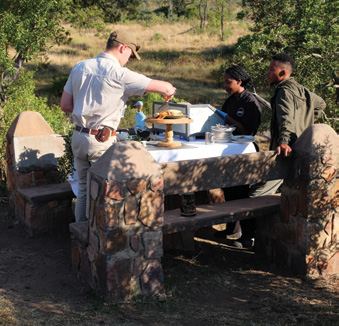
Just in case the guests are feeling a little famished as well, Mhondoro has laid on a small chef’s station next to a lake serving pancakes in the bush – not a crêpe idea at all. Decadent caramel and berry sauces match beautifully with Amarula-fortified coffee.

Pooled pachyderms
Later, while eating lunch, an elephant is sighted, walking in the direction of the lodge. Guests are prompted to be ready, as he may go to the waterhole or come and drink from the pool. Initially, he does neither, taking his time and snacking on various titbits along the way. Finally, though, just before he loses priority to an urgent nap, he makes a beeline for the waterhole. Guests clumsily clamour their way down the tunnel to the hide, where the low perspective and risk-free (theoretically) proximity to the great beast make for fantastic photo opportunities. He plays along, offering his audience a number of different poses.

He later returns with another elephant to sip at the pool, both of them extending their trunks almost shyly into the water as though to acknowledge that they know they are overstepping a line but are endearing enough to get away with it. The privilege of this proximity is complemented by the vista from the top of a hill in the park’s southern sector later that day, inspiring a blissfully overwhelming sense of scale, freedom, and silence. It is the topping up of a fully recharged personal battery.

How to get there

The Welgevonden Game Reserve is an easy drive from Johannesburg, Airlink’s major hub. For schedules, go to page 109.

www.flyairlink.com/flightschedule

Text and photography | Bruce Dennill

For more information or to book a stay, go to mhondoro.com.

https://www.mhondoro.com

Read more
How to get there
The Welgevonden Game Reserve is an easy drive from Johannesburg, Airlink’s major hub. Click to see flight schedules.
travel | leisure | lifestyle
HOEDSPRUIT

Lodge visitors find a special space in rugged wilderness

‘Bundox’ as a name is derived from the word ‘boondocks’, signifying “rough, untamed country.” In Africa, it might be referred to as being “in the bundus.” And indeed, Bundox Safari Lodge is situated in the bundus, but in a good way.

An easy shuttle ride from Hoedspruit’s Eastgate airport, the lodge was recently opened in the Balule Game Reserve, near the park’s Grietjie entrance. Unlike at most lodges, the vehicle that brought me from the main gate did not pull up directly outside the reception area. Instead, it came to a halt a short walk away, just far enough so that the building itself was hidden from view. Walking down the path with a cooling cloth and welcome drink in hand, I gasped in surprise at what lay before me. A luxury tented camp of understated elegance surrounded the vegetation that had not been much disturbed during the venue’s construction.

Situated on a prime spot along the banks of the permanently flowing Olifants River, this recently opened luxury tented destination incorporates style and understated safari design, cocooned by the surrounding vegetation. Constructed with sustainable eco-principles in mind, all structures sit in and not on their surroundings.

The lounge, viewing deck, dining area, and bar are all under canvas, and as they face the river, the sight that awaits guests upon stepping through the doorway defies expectations. It’s a haven of elegance with a clear, uninterrupted view of the slow-flowing Olifants River.

The river, with its origin between Breyten and Bethal in Mpumalanga province, runs for 560km before entering the Indian Ocean at Xai-Xai north of Maputo. Known by various names such as Lepelle (Northern Sotho), Obalule (Zulu), Olifantsrivier (Afrikaans), Rio dos Elefantes (Portuguese), and iBhalule (Southern Ndebele), it carries a rich cultural significance for a number of different communities.

Space to engage

In what would soon become clear was the trademark Bundox style, the lodge stands as a unique marriage of natural organic wood, enduring canvas, and modern, streamlined design. Less is indeed more in every sense of the word, with fine fixtures and fittings ensuring an extravaganza of opulent tented elegance – a homage to the safari days of yore, updated with a 21st-century twist that is breathtaking in its simplicity and overall feel.

The dining area features a long table where visitors sit and share their meals and stories. A tea and coffee station, along with a bar, ensures that guests are offered a variety of beverage options at any time. The inclusive dining experience is a highlight, allowing guests to connect over shared experiences – a stark contrast to hotels where guests rarely find common ground.

The pool captivates new arrivals with its striking blue hue. While the weather didn’t encourage a swim during my stay, I chose to spend my time watching elephant herds parade along the opposite bank of the river.

No stone is left unturned in the established design. A meticulously maintained pebble pathway leads from the public spaces to each luxury tent. The space and vegetation between the different tents creates a sense of seclusion and tranquility. The term ‘tent’ hardly does justice to the accommodation – the only characteristic of the usual definition is that canvas is involved. The doors slide open to reveal a stunning interior, a haven of quietness set on the riverbank and enveloped by surrounding trees and bushes.

The accommodation boasts all the conveniences that modern travelers require. The bathroom, with a basin, toilet, and shower that blurs the lines between indoor and outdoor, provides an immersive experience. The shower, though enclosed, offers a view that makes guests feel like they are in the canopy of the surrounding foliage. An interesting feature is the shower tray, hidden under the wooden decking.

Lying in bed, I could gaze across the river. Elephants on the far bank often entertained me, creating a connection between comfort and untamed nature. To enter and exit the tent, sliding doors have replaced flaps with zips, adding a touch of dignity to the experience.

Sit and watch

Game drives are conducted by a guide and a knowledgeable tracker. The latter makes a great contribution to the overall quality of the sightings. Drives are carried out in the morning and late afternoon, both followed by substantial meals. And if that is not enough food – you certainly don’t need more – a light lunch was also served.

The weather disrupted an afternoon drive, but nature, in a gesture of compensation, provided the opportunity to spend most of the afternoon on the deck, sheltered from the rain, watching a breeding herd of elephants on the opposite bank. Two young bulls playfully tussled, their antics eventually leading to a splash in the water – a ritual of growing up to be elephants of substance.

The camp is a fairly new one, but the owners have already made it an amazing property. As I bid farewell to this extraordinary haven, the memories linger, etched in the canvas of my experiences, creating a timeless bond between man and the wild.

Text and photography | David Batzofin

For more information or to book a stay, go to bundox.co.za.

Read more
How to get there
Airlink connects you to Hoedspruit from Johannesburg and Cape Town. Click to see flight schedules.
travel | leisure | lifestyle
MALDIVES

Expose your sole

Island getaway guests are encouraged to surrender to barefoot luxury

“There’s Bob again!” our waiter exclaims, pointing towards the shoreline. Bob is the resident heron and somewhat of a celebrity at Gili Lankanfushi in the Malé Atoll of the Maldives. He has found something among the granules of sand that he gobbles up before wading over to the water a few metres away to wash his find down.

Bob sports a bit of a comb-it-back fringe and has made his way to our table so that he can find a few scraps when we vacate it. According to our waiter, Bob starts venturing over to the breakfast area at around 6am for everyone to fuss over him.

Toes in the sand

Most meals are served in and around the pristine beaches at the resort and with their ‘No news, no shoes’ ethos, guests sit comfortably with their toes in the silky soft sand. Each morning and throughout the day, a team will rake the sand, returning it to its flawless condition. No effort is spared to make this paradisiacal place what it truly is – a slice of paradise – even pruning the palm trees’ leaves. Imagine effortlessly clambering up the trunk of a palm tree that is between 10 and 30m tall with only a hook-around-the-trunk-and-yourself harness, barefoot and brandishing a machete to rid the tree of any dead branches.

Centre of attention

Parking the Gili bamboo tricycle for the last time, it seems as though the marine life have come to say goodbye. Next to the villa, a black-tipped reef shark flits away into the coral gardens in front of the veranda. A number of humbug damselfish are swimming along the corals just beyond the sundeck – and setting eyes on a cowtail stingray is delightful!

Villa 9 has been home for the duration of my stay. The villas are constructed using sustainable materials while not holding back on the luxury aspect. Six steps lead down to the ocean, where guests spend early mornings and late afternoons snorkelling at leisure, discovering the magical underwater creatures that inhabit the warm waters of the Indian Ocean. For stargazers, the private rooftop terrace of the villas serves as the perfect base to sleep out under the stars and detect a number of constellations while cocooned under a silky or cotton duvet.

Maldivian sunsets are some of the most awe-inspiring sights you will ever see. The colours are absolutely glorious, changing from oranges to reds and cascading into hues of yellows. Gili Lankanfushi’s philosophy echoes how guests feel when leaving this stunning property – arrive as a guest, depart as friends and return as family.

Text and photography | Heléne Ramackers

For more information or to book a stay at Gili Lankanfushi, visit gili-lankanfushi.com.

https://gili-lankanfushi.com

Read more
travel | leisure | lifestyle
SKUKUZA

Expecting the unexpected

Beauty abounds around Greater Kruger lodge, if you know where to find it

“Leopard! There is a leopard!”

Churning the wheels of the game drive vehicle through the soft, dry river sand of the seasonal Mabrak River, Jem Harris, a guide at Dulini Moya, gives the thumbs-up to Chris Mashaba, who, with eagle eyes, has just spotted the beautiful big cat from a distance.

It’s just a few minutes out of the lodge. Having driven down the narrow dirt road from the camp’s entrance, we plunged straight into the riverbed to observe a large troop of baboons. The coincidental appearance of a leopard comes as a total surprise, even to Harris and Mashaba.

“Yes, yes, yes!” Mashaba is fist pumping while Harris accelerates. “Sorry, baboons,” he laughs as he expertly manoeuvres the vehicle through the loose sand. There is Ravenscourt, one of the magnificent, senior, territorial Dulini male leopards.

“The baboons haven’t spotted him yet,” Harris explains, “but he has seen them, which is why he is headed into the bush, to prevent them from alarm barking and betraying his presence.”

Ravenscourt is beautiful. One can see he has grown slightly bushworn with age, but he remains timelessly elegant and brutally powerful at the same time. We are able to follow him for some time before he vanishes into the thick bush. However, by anticipating the direction he is taking, Harris follows a road down a different way and parks. Sure enough, a short time later, Ravenscourt appears from the thicket and ascends a grassy abandoned termite mound to lie down and survey his surroundings.

Close to the creatures

It is completely unexpected encounters like these that make a stay here so special and memorable. Ensconced in a thick patch of ebony and leadwood trees, the exquisite Dulini Moya is nestled along the serpentine meander of the Mabrak River.

Each of the six opulently spacious suites reflects a classic safari decor intermingled with contemporary design that epitomises romance. Floor-to-ceiling sliding glass panels allow for unparalleled views and a connectivity with nature. The private deck, with heated plunge pool, offers an almost meditative intimacy and the chance to relax and savour the serene environment.

An elephant feeds just below the deck. For five exquisite minutes, I watch him and feel ridiculously happy.

Lunch is served on the deck. A swing bridge is suspended across the Mabrak River, and negotiating the bouncy footing to cross halfway allows guests to admire the view of the camp.

With time to spare before the afternoon game drive, it is time to slide into the heated plunge pool and lie back to listen to the orchestra of bird calls.

Pups on parade

The following morning, we come across Ravenscourt again, once more purely by chance. Mashaba spots him in close proximity to the airstrip, where only the previous day I’d arrived in a Bell LongRanger helicopter operated by Mpumalanga Helicopters.

The sun is high overhead by the time Harris steers the vehicle in a dry, narrow tributary of the Sand River, where the two lionesses, known as the Ximungwe females, harbour three young cubs. Their father, one of two impressive brothers known as the Plains Camp Males, is panting in a patch of shade while one of the cubs, a little female, nestles herself between his front paws and subsequently raises her eyes to look at him adoringly. Everyone oohs and aahs.

Later in the day, following a hearty cooked breakfast along with plenty of fresh fruit and pastries plus a late lunch, we are headed further north in the reserve where, rumour has it, wild dogs have been denning. The pups, now a pack of 13 juveniles, are playing and jittering about. They are lightning fast, and it isn’t easy to keep track of them.

Suddenly, the pups all start running at once in a single direction, seemingly chasing something, and almost immediately afterwards, a female impala dashes from the bush. Harris doesn’t get too excited. “The pups are nowhere near large or experienced enough to hunt successfully,” he says. His demeanour changes, though, when one of the adults appears out of nowhere and races after her. There’s a commotion, but fortunately for the impala, she manages to out-sprint the dogs and gets away.

On the last morning of the trip, an elephant celebrity makes an appearance in the vicinity of the lodge. It is Rhandzekile, which means ‘loved’ in Shangaan. We learn that Rhandzekile was born with an enormous, gaping hole in her forehead, which is attributed to a congenital defect. For some 20 years, she has thrived as part of a herd, having adapted to her own unique way of feeding and drinking. She even raised a perfectly normal, healthy calf.

Her unusual appearance is shocking, but the fact that this admirable elephant has triumphed and endured her physical condition is surely a testament to the magnificence and unpredictability of nature.

Text and photography | Fransje Van Riel

For more information or to book a stay, go to dulini.com.
Read more
How to get there
Airlink connects you to Skukuza from Johannesburg and Cape Town. Click to see flight schedules.
travel | leisure | lifestyle
CULTURE

Step into the gap

‘Social fathers’ can make a huge difference to a youngster’s life

The absence of fathers in South Africa is a critical epidemic.

The number of children growing up without a biological father in their lives is among the highest in the world and has severe and far-reaching ramifications. Without present, engaged, and supportive fathers, rates of substance abuse, mental health conditions, teenage pregnancies, and gender-based violence soar.

But you don’t necessarily need to be a biological father in order to play a fathering role and provide the benefits that fathering affords. More and more, social fathers are stepping into the gaps left by absent biological fathers, giving children and teenagers the guidance and encouragement they need to thrive and succeed.

Social fathering goes beyond mentoring. It’s about choosing – intentionally and consistently – to play a fathering role in a child’s life. To be physically present and emotionally supportive. To be curious about their interests and invested in their wellbeing. To show up for things that are important to them. To listen to them, challenge them, and help them know themselves.

Many young boys are growing up with single mothers or grandmothers. They have few male role models in their lives. Often, the men who do exist demonstrate toxic and destructive behaviors that the boys run the risk of learning from, imitating, and repeating. A social father’s responsibility is to dismantle these trajectories, provide safety and security, and give them direction. There are men who prey on children – something that must be condemned without reservation. Social fathers and men in this country must be responsible for protecting children and keeping them away from abusers.

Commit to consistency

Nkosinathi Sixabayi, the Western Cape Lead of Fathers Matter, is both a biological and social father and had several social fathers in his own life growing up. “Those who invested in my life provided guidance and helped me become the best I could be,” he explains.

Today, Sixabayi has committed himself to investing in other children who are not his own because it was modeled to him. “Many call me their father because of the love and care I give to them,” he continues. “Social fathers can make a difference in children’s lives and have a role to play in helping to address and prevent gender-based violence.”

If a contribution as a social father is going to be meaningful and effective, it must be a conscious and deliberate act. And it must be consistent. Be reliable, and don’t create expectations you can’t meet.

The children you are likely to work with have had adults – and especially men – let them down in such profound ways that their trust is fragile. You have a responsibility to keep your promises.

That said, young people aren’t looking for father figures who are perfect. Be available and honest and show an interest in getting to know them. If you have the opportunity to guide, support, and raise a child, do so gently, lovingly, consistently, and patiently. 

The benefits are beyond what you can imagine.

Text | George Mwaura 

Photography | Jacob Lund

George Mwaura is the Director of Isiseko Imara and a Heartlines Fathers Matter ambassador. For more information, contact the Heartlines Fathers Matter WhatsApp Coach. WhatsApp “Hi” to 060 058 2107.

Read more
99 black balloons

Nature photography requires patience to get that perfect shot. Patience paid off for Shane Gross, who captured this image of a family of tadpoles in a lake in British Columbia.

Tadpoles tend to hide in deeper water at night in order to avoid predators like water bugs and leeches. But during the warmer parts of the day, they swim to the more oxygen-rich shallows to feed on plants and algae.

This process is repeated daily for six to eight weeks before they finally metamorphose into Western toads, a common species in Canada and the United States.

“It was a real spectacle to behold,” says Gross. “But it was challenging, photographically. I wanted to capture the whole scene, showing the tadpoles’ habitat as they swam among lily pad stems. Luckily, the tadpoles weren’t shy – in fact, when we floated still in the water, they would nibble on us and our cameras!”

Read more
This article appears in Very Interesting #78. Would you like more content like this? Click here for your 3 FREE issues today!
travel | leisure | lifestyle
BOOKS

X marked the spot

Viral tweet grows into meaningful, moving memoir for South African doctor

Alastair McAlpine is a palliative paediatrician from South Africa, practising in Canada. His book, Prescription: Ice Cream, is a memoir soaked with anecdotes from his intern days at Baragwanath Hospital and crafted around his calling for palliative care.

McAlpine has a large following on X, borne from his viral tweet in 2018, where he shared some inspiring thoughts from the children in his care. He posted:

“I asked some of my terminal paediatric palliative care patients what they had enjoyed in life, and what gave it meaning. Kids can be so wise, y’know. Here are some of the responses.”

Writing a book is a huge commitment. What are the elements that need to be in place if you are going to meet whatever writing goals you set?

Alastair McAlpine: Writing this book has been one of the most challenging experiences of my life! It took me a long time, and I did not have the perfect strategy, but I think you need the following to meet your goals:

A strong “Why” – why are you writing this story? If you aren’t heavily motivated, you will want to quit and you probably will quit. There needs to be a burning flame that your story is important, and only you can tell it.

Time. Writing takes hours. Editing takes hours. You will need to carve out time from other things that are also time-consuming, especially if you have another job and/or family commitments.

Supportive friends, partners, and editors. You will doubt yourself and your story. You need support to guide you through. Surround yourself with people who believe in you and your story.

Conversely, what are the strangest or most creative procrastination techniques you’ve devised to avoid all that work?

Oh, man! So many. When I was supposed to be writing, chores – which I usually hate – suddenly became interesting! Microwaves that hadn’t been cleaned in months suddenly needed a do-over. Backed-up laundry became critically important. Once, I was so desperate to avoid finishing a sticky chapter, I signed up for a course to learn Spanish, even though I had no reason to do so.

Is there a specific author (or writer or journalist) who made you feel, “I want to be an author”? And what was it about them that spurred that feeling – anything from admirable eloquence to an outrageous public persona?

I read a lot, which is a blessing and a curse when you try to write. The author who inspired me most is probably Salman Rushdie. Beautiful prose, challenging topics, serious and funny at the same time. His bravery in writing about ‘taboo’ topics and refusing to back down in the face of serious intimidation inspired me when I was younger.

Do you tend to read the same kind of material (genre- or style-wise) that you prefer to write? If yes, what makes that particular niche so attractive to you? If no, what do you think it is that makes each different area appealing?

I read mostly fiction and very few memoirs, although I enjoyed Barack Obama’s Dreams From My Father and Gabriel Garcia Marquez’s Living To Tell The Tale. So it’s ironic that I ended up writing a memoir!

I read fiction to be transported; to experience things from the point of view of other people; to learn truth by reading a lie. Memoirs are generally interesting insofar as they offer a compelling view of an interesting life, but they hopefully tell the truth to illuminate a deeper truth.

Outside of your profession, what role do books play in your life? Are you constantly reading; is your house lined with bookshelves; are books the ideal gift to give or receive, and so forth?

I don’t ‘enjoy’ reading for the same reason I don’t ‘enjoy’ breathing. It’s such a part of my life that it is incomprehensible to try to exist without it. I read solidly every day, for around 45 minutes to an hour, though less recently, as I have a young infant at home. I usually have two or three books that I’m reading at the same time.

I’ve always said that my ideal home is one filled with books and art. You can never have too many books.

Who is your favourite literary character?

This is like choosing your favourite child! Emma Woodhouse from Emma. Anna Karenina from Anna Karenina. Emma Bovary from Madame Bovary. Tyler Durden from Fight Club. Owen Meany from A Prayer For Owen Meany. And so many more…

Text | Bruce Dennill 

Photography | Supplied

Prescription: Ice Cream by Alastair McAlpine is published by Pan Macmillan and is available now. For more information, go to panmacmillan.co.za.


Read more
travel | leisure | lifestyle
TRAVEL

Reasons to roam

Fly in via Durban to experience a number of fresh tourism ideas

Sustainably exploring the natural world, experiencing authentic culture and prioritising wellness are just some of the preferred outcomes of the modern traveller. On the exquisite KwaZulu-Natal South Coast, new activities are developed every year.

Eco-diving

The KZN South Coast is home to two incredible dive sites that are considered among the world’s best: Aliwal Shoal and Protea Banks. These are both marine protected areas (MPAs), ensuring ocean health, and can be explored sustainably through eco-dive operators that put the environment first. This includes scuba diving, freediving, and snorkelling among the reefs while enjoying the marine life found here. The Devil Ray Conservation Dive takes visitors to the shortfin devil ray cleaning station – one of only two known in the world – at Aliwal Shoal, with part of the funding contributing to ocean conservation.

Astro-tourism

Stargazing is becoming a popular pastime for travellers and, with the beautiful clear skies found in this area, there are many sites to enjoy this astronomical hobby. Astro-tourism is a way to break away from the digital world and replenish the soul by exploring the stars. There are many seaside campsites and open-air venues ideal for stargazing, including the Lake Eland Game Reserve in Oribi Gorge.

The new Wellness Way Route includes astro-tourism opportunities with plans for stargazing at the KwazuluSpirit Festival 2024 (weather dependent) from 9 to 11 August at The Laughing Forest in Elysium. Then, from 15 to 17 November, Secret Sithela in Munster will host a Wild Forage and Feast Retreat during the full moon with a moongazing session. Speakers will include Wild About Weeds author Nikki Brighton and mycologist Jon McGillivray, an expert in foraging and identifying all types of mushroom species.

Rural tourism

This popular travel trend encourages visitors to connect with a region’s natural world and people more authentically. It benefits the traveller while also supporting entrepreneurs in rural areas, creating a more sustainable economy. There are a number of rural tourism offerings for visitors to experience on the KZN South Coast. These include the KwaXolo Caves Adventures, the Agri Tourism Route, the Ntelezi Msani Heritage Centre, the KwaNzimakwe Experience, the KwaNdwalane Adventure Experience, the Umzumbe River Trails, the Weza Hiking Trail, the Mission Tourism Route, and the Gamalakhe Township Experience.

Water-centric travel

Since KZN has the warmest winters in the country, travellers can cool off by booking into ‘water-based’ tourism spots. The KZN South Coast boasts the highest number of Blue Flag beaches and tidal pools in the province, as well as two world-class dive sites, making it a top seaside destination. The many rivers and water sport activities are also a refreshing tourism option, with hikes to waterfalls being a great choice.

The whole family can also enjoy the Wild Waves Water Park at the Wild Coast Sun, with rides ranging from relaxing to extreme.

Adventure travel

This area is where ocean sunrises and hinterland adventures await. In addition to the rural tourism adventures, there is the Beach-to-Beach Adventure Hike, gorge swinging, ziplining, abseiling, suspension bridge crossing, microlighting, shark cage diving, and more.

Wellness tourism

Travel is a great way to reboot and re-energise body, mind, and soul with wellness. The Wellness Way was recently launched, with around 82 practitioners along the route dedicated to therapies of natural health and holistic healing from Amanzimtoti to the Wild Coast. Some 35 of these are available at short notice on the Wellness Way Portal.

Text | Deborah Ludick 

Photography | Stefano Ember

Deborah Ludick is Acting CEO of South Coast Tourism & Investment Enterprise (SCTIE). For more information, go to visitkznsouthcoast.co.za.

Read more
travel | leisure | lifestyle
MUSIC

Plenty per mouth

Roxette frontman explores a new space ahead of a new international tour

Swedish songwriter, guitarist, and singer Per Gessle is the driving force behind the chart-topping group Roxette, fronted from its beginnings in 1986 until her death in 2019 by statuesque vocalist Marie Fredriksson. The band, now featuring Lena Philipsson behind the microphone, will be touring South Africa in February 2025.

Post-Marie, Roxette is obviously not the same, but it is still a superb act with a long list of beloved songs. What is your headspace like now – among other things, you are further extending the life and influence of material you wrote?

Per Gessle: It was very hard when she passed away. I didn’t know what to do; I made some Swedish songs. But I wanted to do something with the Roxette legacy. I was working on an album and reconnected with Lena, who I first worked with in the ’80s. She’s a brilliant singer and able to handle big crowds, but she just about fell off her chair when I asked her. She came over to my studio and we played some songs. She didn’t sound like Marie, but she’s such a big fan that she sings them as she heard them. All through her career, she’s worked with songwriters writing specifically for her, so she’s used to interpreting and delivering. Of course, it’s tough to fill Marie’s shoes, but she’s so experienced, professional, and secure within herself. If she were a younger singer, it’d be much more difficult. And there’s an upside to this tour for her, as she’s not yet really well known outside of Scandinavia. This tour is an homage to the Roxette catalogue, with almost all of the old band in place.

You’ve spoken before about the point of pop music being to reflect its times. What do you think needs to be reflected now?

What I meant is that pop music reflects society and that, before, it was much more about that society. Today, it’s mostly made on laptops and is formulaic – all our industries are like that now. The time we’re living in is narrow-minded, in a way, with everything run by big companies. The music industry is a business, totally different from what it was when I was a kid. That was about romance as well – the smell of vinyl, the detail in the sleeve notes… My son, who is 26 now, doesn’t know what he’s listening to. I used to sit there and try to figure out which guitars were used!

This tour to South Africa is the first international outing with Lena as part of Roxette. There doesn’t currently seem to be too much information about plans beyond that?

As soon as the news came out that we were doing this, Live Nation in Sweden wanted to book shows. For me, it’s a pilot – to see how we fit. Also, I’m not 35 anymore. I want it to be fun, and I want to take it easy. I’m hoping it will be like that!

What remains different, and what’s changed for you when it comes to touring? Times have changed, but there’s also the nostalgia aspect now…

Touring is all about waiting – in airports, in cars, in hotels… The reward is those two-and-a-half hours with an audience, where you want to feel that connection. If that works, it’s a 10/10 situation for me. I know what I like and what I don’t like – I’ve been touring since my teens. I no longer want deals signed for next November or whenever. By then, maybe I won’t want to be there. The blessing is in having an enormous catalogue of songs that people love: I don’t need to sell anything. Over the course of our career as Roxette, we released about 70 singles, so if we ‘only’ play around 25 or 27 of those, you’ll know them all.

Text | Bruce Dennill 

Photography | Supplied and ANNI-SANNI

Roxette will be appearing at the Grand Arena in Cape Town on 26 February 2025 and at the SunBet Arena in Pretoria on 28 February 2025. For more information, go to bigconcerts.co.za.

Read more
travel | leisure | lifestyle
HEALTH

Take it slow

Slow running is a fitness trend with some hard and fast science behind it

Deceleration isn’t really in the runner’s vocabulary. For many of the people who do it, from Olympic champions to 5K enthusiasts, running is the pursuit of speed itself; a sport defined by personal bests, competition, striving, and Strava. Slow? That’s a four-letter word.

Or at least it was, until quite recently. In the last year or two, slow running has become ‘a thing’, backed not just by wellness gurus on Instagram, but also by a growing number of coaches, amateur runners, and exercise scientists. The thinking is that going slow could be a fast way to enjoy the benefits of exercise.

“Slow running helps to reduce resting blood pressure, for example. And it promotes a stronger heart,” says Prof. Dan Gordon, an exercise physiologist at Anglia Ruskin University in southeast England. “You’re still putting your system under stress, but what we’re starting to understand is that you don’t need to put the body under excessive amounts of stress to get a cardiovascular adaptation.”

Slow running is usually defined as a pace at which you can comfortably hold a conversation. Think of it as an effort of 4 or 5 on a scale of 1-10, where 10 is an all-out sprint. If you know your sports science, it’s referred to as ‘zone 2 exercise’ and it’s a physiological sweet spot that can improve and extend your life.

In 2015, researchers in Copenhagen made a surprising discovery when they studied the long-term mortality of light, moderate, and strenuous joggers, as well as non-runners. The light and moderate joggers had a lower mortality rate than either the non-runners or the strenuous runners. The strenuous joggers had a mortality rate that wasn’t statistically different from the non-runners.

So, what makes the unhurried approach so healthful? As well as improving the strength and pumping capacity of your heart, slow running boosts your health at the molecular level. It fends off metabolic disease by improving your insulin resistance. It increases the density of mitochondria (essentially, the batteries) in your cells and encourages your body to use fat for energy.

Slow runners also recover more quickly and are less likely to suffer fatigue or injuries from overtraining. They’re also more likely to feel good. “There are huge positives for emotional health,” Gordon says. “The benefits for things like mood state, depression, and anxiety don’t really decrease any more if we increase the exercise intensity. And then there’s the social aspect. One of the things to emphasise with slow running is that you can actually have a conversation!”

Gordon believes that promoting slow running might encourage more people to exercise and stick with it, partly because you can do it with friends and partly because there’s no pressure to perform. It might be the reason why Parkrun and Couch to 5K running plans are so popular.

“If you’re trying to get people physically fit, there’s no better way of doing it than in a group,” Gordon says. “You have that sense of encouragement. People struggle to meet targets when they’re exercising on their own.”

For runners with one eye on the stopwatch, it might sound like slow running isn’t the way to chase down that personal best. Again, researchers like Gordon think otherwise. “It requires a change of mindset. We’ve fallen into the trap of thinking that high-intensity exercise is best, but you don’t need to get a massive sweat on; you don’t need to feel your heart pounding out of your chest. If you run more slowly, you’ll still get gains.”

He points to research that shows that even elite runners spend up to 80% of their training at a slow, zone 2 pace. This builds what coaches and researchers call your ‘aerobic base’ – the basic engine of your cardiovascular fitness. Improving it means your heart delivers more oxygen to your legs and your lungs with every heartbeat. It ensures that you’ll run further, faster, and at a lower level of perceived effort.

In other words, slow down and you won’t just live longer, you’ll become a better runner too.

“What we’re starting to understand is that you don’t need to put the body under excessive amounts of stress to get a cardiovascular adaptation.”

Text | Ian Taylor 

illustration | Daniel Bright

Ian Taylor is a freelance science writer and the former deputy editor of BBC Science Focus.

Read more
This article appears in Very Interesting #78. Would you like more content like this? Click here for your 3 FREE issues today!
travel | leisure | lifestyle
TRAVEL

Watch your tone

Appropriate behaviour in different cultures enriches any visit to another country

Travelling abroad holds the promise of adventure, and some think of travelling as an opportunity to relax, explore, celebrate, and live lavishly. For others, travelling is as much about these benefits as it is about learning. Being immersed in an unfamiliar culture, belief system, and way of life can be immensely rewarding. The key to making the most out of these kinds of experiences is to practise cultural etiquette.

South Africans, in particular, as members of one of the most diverse societies in the world, will attest to the great joys of experiencing different cultures, traditions, and rituals. Living life to the fullest as part of the Rainbow Nation means being open-minded, willing to learn, and able to see the beauty that lies within each person’s uniqueness. The same applies while travelling. Principles like respect, cooperation, and honesty can go a long way in turning an overseas trip into a truly transformative experience.

Simple gestures of respect can go a long way in bridging the language and cultural gap. When we meet each other halfway, we open up the potential to learn from each other, share our experiences, and be inspired. This is one of the most valuable advantages of travelling abroad.

Be respectful

Cultures vary in terms of acceptable speaking volumes and tones. In some cultures, speaking softly and calmly is valued, while in others, speaking with enthusiasm and animation is the norm. Pay attention to your tone and volume of voice to avoid unintentionally causing offense.

Some folks in other countries, like Thai people, are loved for being polite and gracious in the way they relate to each other. In general, visitors to their country should refrain from shouting or having loud, heated debates in public, which is frowned upon.

In Western culture, physical touch during conversation or a playful moment is not widely regarded as being inappropriate, but in other cultures, it can be. In Thailand, for instance, touching someone’s head or even ruffling a child’s hair can be seen as disrespectful. Thai people revere the head as being the most sacred part of the body, while the feet are thought of as being the lowest or most unclean body part. For this reason, it’s seen as a sign of disrespect to touch someone’s head, to sit in a position where your feet are raised above someone’s head, or to step over someone who is sitting or sleeping on the ground. This is especially true of how you interact with elders and figures of authority and is something to be mindful of when attending traditional gatherings or visiting religious sites.

When travelling, embrace cultural differences with an open mind and a willingness to learn. Recognise that what may seem unusual or unfamiliar to you is simply part of the fabric of daily life for locals. Approach new experiences with curiosity and respect, rather than judgement.

This is one of the fundamentals of travel etiquette – when unsure of what to do, feel free to ask rather than to respond or react without fully understanding the context of the situation.

Before jetting off to a new destination, take the time to research the local culture, customs, and etiquette norms. Understanding basic greetings, gestures, and social taboos will help you navigate interactions with locals respectfully and make your trip truly enriching and meaningful.

Text | Chaiwat Tamthai 

Photography | Rawpixel.com

Chaiwat Tamthai is Director of the Tourism Authority of Thailand in Dubai for the Middle East and Africa. For more information, go to tourismthailand.org.

Read more
travel | leisure | lifestyle
GARDENING

Deerly beloved

Distinctive ferns are a great choice for indoor planting

Staghorn ferns (Platycerium bifurcatum) are one of those plants that most plant lovers either have in their garden or home or wish they did. They have been described as the funkiest of ferns with an out-of-this-world appearance due to the drooping leaves, which resemble the horns of a stag. Although they look majestic and regal when mature, they look funky as baby plants.

Staghorn ferns are more than just a pretty face; they’re air-scrubbing powerhouses. These leafy companions excel at removing toxins like formaldehyde, xylene, and toluene – nasties that lurk in common household items from paints to furniture.

Staghorns love growing both outdoors and indoors in coastal and frost-free regions. Although considered indoor plants on the Highveld, they will grow in positions protected from the frost and cold winds outdoors, such as in evergreen trees or on sheltered patios and courtyards.

Know their needs

Light: Outdoors in the shade, especially in hot, dry climates, and in semi-shade in humid areas. They prefer high-light areas in the home or on the patio but not direct sunlight unless it is early or late in the day.

Humidity: Bathrooms and atriums provide good humidity in regions with dry air.

Watering: Mist the plants weekly on the leaves and a little on and behind the brown basal leaves. In the winter, you can reduce watering to every three weeks. Some gardeners like to remove the plant from the wall, take it to the sink, and let room-temperature water flow over the leaves and basal leaves for about a minute. Allow it to drip dry and put it back in its place. If using this method, be sure to allow the roots to dry out between one watering and the next to avoid rotting the roots. If the ends of the antler-looking leaves begin to brown, you are probably underwatering, and you will need to increase the misting. Keep an eye out for brown or black spots at the base of the antler fronds, which indicate overwatering.

Feeding: These ferns are epiphytes and naturally cling to trees. Their roots serve an anchoring purpose, with water and nutrients mostly being absorbed through the leaves. Add a balanced liquid foliar fertiliser to the water in your spray mister bottle. Do this once a month during the warmer months and once every two months over winter. Your local garden centre can advise you on a good foliar feed. Banana skins, coffee grounds, and tea bags are excellent slow-release fertilisers that you can place behind your staghorn. If the fern is already mounted on a log or piece of driftwood, you can place it on a table or hang it on the wall. You can also grow a young one in its original pot. However, it will later tend to become heavy on the side that the plant hangs over and, unless secured, will want to topple over.

Text and photography | Supplied

For more information, go to grannymouse.co.za.

Read more
travel | leisure | lifestyle
PSYCHOLOGY

Social anxiety - coping strategies

While severe social anxiety is best dealt with by trained professionals, if you find you’re struggling with it on a daily basis, there are a few reliable methods to help you cope with it better.

Gradual exposure

The problem with serious anxiety disorders and phobias is that they trigger such a strong fear response in the brain that it fails to learn that they’re harmless. The fear response itself provides the negative consequences. A typical route to avoiding this fear response is to engage with the source (social interactions, in this case) in small, incremental doses. Say hello to a stranger, or give a brief thank you to a shop assistant, and build from there, giving your brain time to adjust without setting off alarm bells.

Screen interactions

While there will be some negatives to doing so, social anxiety can be mitigated by communicating via screens and online messaging. It’s not as rewarding as face-to-face interaction as far as our brains are concerned, but it comes with fewer risks, more control, and much less uncertainty. Interacting through screens removes a lot of the pressure. Studies even suggest it’s the preferred method of interaction for many neurodivergent people, who have a tougher time than most with socialisation.

Virtual reality

Despite being a more advanced and ‘work in progress’ approach that won’t be accessible to many yet, recent studies suggest that virtual reality therapy shows a lot of promise in this area. After all, given the previous points, it’s a way for your brain to experience social situations without any of the actual risks involved. Over time, your brain may learn to deal with the real thing better.

Reappraisal

A more recent approach involves essentially reframing the nerves and anxiety of social interactions and public speaking as something positive. Modern research suggests much of the emotion we experience is the result of our brains figuring out what the initial activity caused by an experience means, given the context, and producing the relevant emotion. But this means there’s some flexibility and interpretation to emotional reactions. This is used to help people take what’s usually felt as anxiety and instead perceive it as excitement or eagerness, changing the whole experience.

Avoid alcohol

There are many options to help you ‘cope’ with social situations, but many of them will be counterproductive and make the problem worse. The most obvious is alcohol. While alcohol does suppress internal doubts and provide ‘liquid courage,’ it’s a short-term solution at best. Besides the health and mental downsides of regular alcohol consumption, alcohol has these effects because it suppresses the prefrontal cortex, which may already be underpowered in socially anxious people.

Establish boundaries

If social anxiety is an issue for you, you could become guarded and not give anything of yourself away at all – to avoid all risk of rejection. But a totally closed-off approach gives you an impenetrable boundary. Those who share things with you and get nothing in return will learn not to do so in the future, so you’ve not really fixed the issue. On the other hand, you could embrace the ‘face your fear’ approach and force yourself to be as outgoing as possible. But sharing everything with someone, even if it’s only to get over your anxiety, won’t automatically be reciprocated or appreciated. Other people’s boundaries matter as much as yours.

Text | Dean Burnett

Neuroscientist Dr Dean Burnett (@garwboy) explores the nature of dreaming in his latest book Emotional Ignorance.

Read more
This article appears in Very Interesting #78. Would you like more content like this? Click here for your 3 FREE issues today!
travel | leisure | lifestyle
BEAUTY

Crowning achievements

From Miss SA to Miss Universe and now author, Demi-Leigh Tebow wears many hats

What have you been up to since being crowned Miss Universe in 2017?

Demi-Leigh Tebow: Being crowned Miss South Africa and representing my home country on the international stage was one of the greatest honours of my life. I now have a better understanding of cultures and countries around the world, a broadened perspective on business and different industries, and I got to witness and experience the needs of people worldwide. I’ve felt a deep responsibility to use the platform I was blessed with to be a voice for those who can’t fight for themselves.

Over the last few years, I’ve worked alongside the Tim Tebow Foundation to host several fundraisers for initiatives close to my heart. This includes raising funds for Her Song for the expansion of safe homes and holistic care for survivors of human trafficking in the United States, and for the Compassionate Hope Tebow Village of Hope campus for children who are survivors of sexual exploitation in Southeast Asia. Most recently, we raised funds in partnership with Impact Africa to fully build out the TTF Impact Campus to help bring everlasting impact to children and families vulnerable to abuse, neglect, or abandonment in Johannesburg.

In both the United States and South Africa, I hope to continue hosting workshops for women and young girls to empower them to handle everyday life situations, and to go out and empower others to do the same!

From Sedgefield to New York for one year to reign as Miss Universe. What was the experience like living in ‘the city that never sleeps’?

After being crowned Miss Universe, I flew to New York on the first flight to move into the Miss Universe apartment with my three suitcases filled with pageant dresses. While NYC was drastically different from where I grew up, I loved getting to experience living in a world-renowned city! From attending New York Fashion Week shows and speaking at the UN General Assembly to figuring out fast-track trains and going for long runs in Central Park, then heading to the airport for the next trip, it was a fast-paced life that I loved.

The following year, after handing over the crown and getting engaged to my now husband, Tim, I stayed in New York. That year felt very different, like I was always waiting for the next opportunity or wasting time. While this season of life was difficult, uncomfortable, and lonely, I learnt that God can use what might feel like a wasted season and turn it into a winning season for His glory. That waiting season was necessary to point me to my God-given purpose, one that transcends earthly accolades and temporary crowns – like the one I wore.

I read that your mission is to make a difference in the lives of your community, country, and ultimately the world. How are you managing to achieve that?

In 2017, shortly after I was crowned Miss South Africa, I was on my way to an event in Johannesburg when several men surrounded my vehicle, some of them armed. I did what I was trained to do – give up my belongings and flee the situation – but they had other plans. Coincidentally, I had attended a safety driving course just a few days prior, and I bought myself a window of opportunity by punching the guy in his throat and then running down the street for help.

As I was running, I passed many cars, and all turned a blind eye and chose not to hear my pleas for help, until one young girl cut off traffic to let me into her car and take me to safety. That one act of compassion she showed to a complete stranger would change the trajectory of my life. From that moment on, I decided I would do my best to never turn a blind eye to someone in need. I always wanted to be that girl who was willing to be interrupted to make a difference in someone else’s life.

This event served as a catalyst for two things. Firstly, my deeper understanding of gender-based violence in my home country. During my year as Miss South Africa, I launched the #Unbreakable campaign, aiming to educate, equip, and empower women to overcome challenges, break barriers, and realise their full potential through self-defence courses, mental health resources, and empowering keynotes.

Secondly, I learnt about the horrific crimes of human trafficking and have since done my best to educate myself and work alongside organisations that are combating this evil across the globe. I’ve also had the opportunity to join as a board member for several organisations worldwide that are focused on providing long-term residential care to survivors of human trafficking and domestic violence.

Exciting projects on the horizon?

My first book, A Crown That Lasts, is coming out this year! This book has been such a labour of love. When I sat down to write it, I realised I had so much internal work to do to write the message I felt God was calling me to write. So often, we root our identity and our confidence in circumstantial labels, leaving it easily shaken when something isn’t working out like we hoped or when we reach the epitome of our goals and realise it didn’t fulfil us the way we thought it would.

Text | Heléne Ramackers

Photography | Micah Kandros

For more information, go to demileigh.com.

Read more
travel | leisure | lifestyle
TECH

Branch managers

New technology can help plants tell farmers what they need, changing the narrative on climate change

By 2034, environmental issues will be a major threat, with extreme weather events, biodiversity loss, and resource shortages posing significant risks to economies and societies. This is according to a new report by the World Economic Forum. But what if we could harness the Internet of Things (IoT) to listen to the early warnings from the planet? This technology is helping farmers preserve soil, save water, and grow their businesses responsibly.

This is essential in emerging markets like South Africa, where the agriculture and farming industry is a key job creator and provides sustenance for the nation. What is emerging in the case of the ConSenso Project, a coalition of Tanzanian espresso farmers and Italian plant and technology researchers, is a solution that could be economically beneficial for the growers, better for the planet, and excellent news for coffee lovers everywhere. Because getting the growing conditions right, even where water is becoming an ever-scarcer resource, is critical for the cultivation of coffee with the right balance of sweetness and acidity.

“Due to climate change, growers in Tanzania are facing a reduction in the rainy season,” explains Dr. Camilla Pandolfi of PNAT, a think tank of plant scientists and technology designers based in Florence, Italy. “So, they are irrigating to ensure that the plants flower at the right time and give the beans a chance to ripen. That means a lot of water is used.”

Technology is helping farmers know when to irrigate and how much, among other things. The Tunasikia Farm in Utengule, Tanzania, has been fitted with 65 solar-powered IoT sensors that capture a wealth of data on soil, sun, climate, carbon capture, insects, and the plants’ electrical energy fields, which can reveal the state of their wellbeing and needs. After preliminary on-site analysis, the data – six months’ worth so far – is sent to Florence for further study.

These technologies could be scaled in other regions.

Coffee and Carbon

“New technology allows us to understand the language of the plants,” outlines Michele Festuccia, senior systems engineer manager for Cisco Italy. “This is a perfect solution to help the farmers have a more sustainable footprint and the best chance of success.”

At the same time, the ability of coffee plants to store carbon dioxide (CO2), preventing it from entering the atmosphere, is being studied. This could be a significant benefit in the fight against climate change. Dr. Pandolfi believes that coffee plants and carefully chosen shade trees could be particularly adept at capturing carbon, but more research is needed.

Through technologies and connectivity, massive amounts of data can be transferred. When properly trained, AI can extract insights from that data in ways that humans cannot. This approach has vast potential in any field with large datasets, including agriculture. Deploying these solutions beyond coffee is a key goal, especially as climate change continues to disrupt agriculture globally.

Text | Angelo Fienga

Photography | Leonid Sorokin

Angelo Fienga is Cisco’s director of sustainable solutions for Europe, Middle East and Africa (EMEA). For more information, go to cisco.com.

Read more
travel | leisure | lifestyle
HEALTH

Hands-on treatment

Avoiding dry skin in cold weather means more comfort completing everyday tasks

Having cracked hands and fingers in winter is down to the lack of moisture in the air. Indoor heating is increased, which dries out the air, and hands are washed and sanitized more frequently to prevent spreading the flu virus.

It’s important to lock in the moisture in your hands whenever you can. After you wash your hands, apply a moisturizer to seal in the natural oils. At night, you could even wear cotton gloves after applying the moisturizer to enhance absorption.

Prevent your hands from drying by avoiding excessively hot water. It’s tempting to increase the temperature of your bath, shower, or even tap water when washing hands to warm up in winter. The problem is that very hot water will strip your skin of its natural oils, leading to dehydration and fissures. Rather, drop the temperature a bit or shorten showers to prevent this loss of moisture.

Liquid Solutions

In summer, you naturally tend to drink more water as you lose fluids by sweating. In winter, we often forget to drink water, but our skin needs just as much liquid to remain healthy in the cooler months. Remember to stay hydrated by keeping a bottle of water with you at all times, and try to limit alcohol and caffeine, which could impact your water content. If you have a humidifier, consider using it to counteract the nighttime dryness.

There’s nothing better than a roaring fire on cold winter days and nights, but too much of this could really dry out the skin. Artificial heaters are also great for keeping warm, but your hands will feel the effect of too much use. Where possible, try to use warm clothing and blankets rather than artificial heating and fires to increase the temperature – this will benefit your skin and your energy bill!

Despite your best intentions, your fingers could crack this winter, which means administering a fast-acting solution like a good moisturizer.

Text | Lynsey Hammond 

Photography | Andrey_Popov

Lynsey Hammond is MD of Kroko. For more information, go to kroko.co.za.

Read more
travel | leisure | lifestyle
ENTERTAINMENT
There are no sacred cows – or goats – for stand-up comic and actor Nik Rabinowitz.

Do you still crochet your own underpants?

Nik Rabinowitz: It turns out crocheted underpants shrink quite a lot when popped in the tumble dryer, so I’ve had to resort to upcycling underpants I find while doing beach clean-ups. Sustainability is important to me. Alternatively, I knit myself robust waterproof underpants made from recycled milk cartons.

To be honest – my mother prefers me to say “To be frank,” but to be honest that works better for guys called Frank – although I did learn to crochet at The Waldorf School, all I ever managed to crochet was a woolen facecloth for my dad, which he never used. That’s because woolen facecloths are typically a little itchy on the face and he didn’t need that level of exfoliation, despite suffering from seborrheic dermatitis that he picked up at the Battle of Tobruk, which he never actually fought in because he was evacuated to Cairo the day before with sandfly fever and seborrheic dermatitis, which he called “crutch trouble,” which are another couple of words my mom would prefer me not to say in public.

What other pearls of wisdom did you learn at The Waldorf School?

I learnt the answer to this maths literacy problem: “If one free spirit meets another free spirit, how much organic kale would they have to plant outside their off-the-grid, mountain retreat cob house, while simultaneously rubbing their corduroy pants together, to produce sufficient kinetic energy to heat all of the lentils in Kommetjie, Noordhoek, and Scarborough combined?”

As a stand-up comic, are there any no-go subjects for you?

There are a lot of no-go subjects for me prescribed by people who tell me their secrets, but I’ve never made any promises. Except to my mother – I promised not to put her in my last show, but then I spent 15 minutes telling the audience why she made me promise that. So not really, no, although now that you mention it, a few years ago I got fined R10,000 by the Broadcasting Complaints Commission for discussing the romance between a Northern Cape man and his goat Bertha on Radio 702. So, that’s been a no-goat area for me ever since.

Are your shows based on real-life events or is there research involved?

A bit of both. If you’re going to talk about being the subject of a terror threat, then it’s important for authenticity that you do the research and become the subject of a terror threat. Which I have done. If enough time has passed from a real-life event, I have to research my own old diaries and photo albums to figure out whether it actually happened to me or not. Like the time our third child was born and I asked the middle child how he felt about his new baby sister, and he said, “I’m a tree and I don’t talk,” and then, an hour later, the oldest child split his head open to the bone while playing rugby with his father in the passage, and his father had to call his mother and say, “Give the baby to the nurses and meet me at emergency in five minutes.”

Where do you find inspiration for your different shows?

I am inspired by the world around me and the things people tell me in confidence and ask me not to put in my show. That I find truly inspirational. I have a lot of unusual and quite revealing encounters with strangers on a regular basis. I don’t mean I reveal myself to strangers on a regular basis – I mean strangers reveal intimate details of their lives to me and then I share that with the world. I am also inspired by my family. I promised my wife I would say that.

Do you have a serious side?

Yes, but it’s not for in-flight magazine readers. It’s for the other cold water immersioner mushroom journeyers at Dalebrook tidal pool during an early morning Secret Sunrise, or in the teepee at Retreat Yourself, which is like a spiritual super spreader for the vegan-unvaccinated of Villiersdorp.

You are also an actor. What’s the biggest difference between acting and stand-up comedy?

In acting, someone else writes the words down for you, which is a nice break from thinking of them yourself. Actors also have much better green rooms and higher quality snacks. Sometimes when I do stand-up, my backstage area is someone’s 12-year-old daughter’s bedroom, which is not the glamorous rock-and-roll lifestyle I had imagined.

And similarities?

In both of them, my wife doesn’t let me kiss other women.

You’ve performed outside of South Africa. Which place has left a lasting impression and why?

America, because I was detained at customs by a Russian official who asked me to prove if I was a comedian. And Russian-speaking TSA agents are less than ideal audience members. Also Nigeria, where I once performed on the opposite side of a swimming pool from a small audience who asked me to stop talking a few minutes in because they were being distracted from their meal.

What are you currently working on?

I’m currently working on my latest show, Pension Killer. What’s it about? Great question. I’m learning that as I go, as it is with all shows. It’s definitely not about my mother.

Exciting projects on the horizon?

We might get a dog.

Text | Heléne Ramackers 

Photography | Al Nicoll

For more information, follow @nikrabinowitz on Instagram.


Read more
travel | leisure | lifestyle
BOOKS

Strangers in the night

Book explores the complexities of existing alongside other cultures on the outskirts of Johannesburg

The stillness of the night was occasionally punctuated by the sound of the goods train that transported the coal from the Springs diggings to the gold mines on the Witwatersrand. The railway track was about a mile from the house but was still very audible.

Sometimes there was also a disturbance caused by the blasting from the coal mines, which caused the windows to shudder. The blasting was often done at night to reduce the exposure of the workers to the resulting smoke, dust, and fumes, and – doubtless more importantly – so as not to affect productivity during daytime work hours.

Residents had long adapted to these percussive night-time intrusions and mainly everyone slept through peacefully. However, when a blood-curdling yell pierced the wee hours one night, everyone in the close vicinity woke up in terror.

Smita, who hadn’t been asleep – she was up, studying – quickly ran through to her parents’ bedroom, where her father was already swinging his legs out of bed, his hair standing on end. By the time Pitaji had walked through to the front room, switched on the light, and peered through the venetian blinds, the yelling had died down to a keening sound, but it was still very loud. Many of the surrounding houses also had their lights on.

It was obvious to Shankar that the sounds were emanating from the house directly opposite theirs, so he donned a hat and dressing gown to protect him from the winter chill as he ventured out. As the priest, if someone had passed on, it was appropriate that he was there to offer solace and sympathy to the bereaved. Although, he thought, as he crossed the road, he could not imagine who would have passed on in that house, as the couple who lived there and their young adult son, Mahesh, had been hearty and healthy the last time he’d seen them.

Smita, peeping through the blinds, could see, in the unforgiving light of the neighbor’s porch lamp, some people huddled around something on the ground and the lady of the house clutching something to her chest. Unable to contain her curiosity any longer, Smita snuck out the front door and crept across the tiny front garden. Hiding behind the low garden wall, she managed to get a one-eyed view through the gate.

There seemed to be an argument developing.

“He can’t be moved,” someone said. “We must call the ambulance.”

Just then the group of people parted, and Smita’s breath caught in her throat. Mahesh was lying unconscious on the porch, eyes swollen shut, hair and clothes soaked with blood. One of his arms lay limp and at a curious angle by his side – it was clear it was broken.

From the movement and crying that was emanating from the bundle his mother was holding, it was obvious it was a baby, but Smita could not fathom where it would have come from, as there were no young women in the house.

Now Mahesh’s father was explaining in a loud voice to Pitaji what had happened. “A vehicle arrived. Someone persistently knocked on the front door. When I opened it, there were two white men, who thrust this baby” – here the man gestured at the wriggling bundle – “into my arms.”

Next, the man pointed to his son, lying still on the ground. “They told me they could have done worse to him but the ‘stupid whore’ who’d been entertaining him wouldn’t stop screaming. They told me to tell my ‘filthy son’ to keep his pants on and to leave white women alone. They told me not to call the police, as then Mahesh would be charged with being in contravention of the Immorality Act.”

The man pointed back at the crying baby, being held by the woman who was now also crying loudly. “They told me they were ‘good Catholics’ so they couldn’t kill the ‘tiny bastard’ and that my wife and I would have to raise the ‘half breed’.”

Smita, horrified, ran back inside, just as Subha was coming out of her bedroom, clutching Gautam to her chest. “What’s happening?” she asked.

“They beat up Mahesh!” Smita shouted. “He has a baby! No one wants to look after the baby!”

Subha, too stunned to reprimand her eldest daughter for running outside in the middle of the night and minding everyone else’s business, immediately pushed Gautam into Smita’s arms and rushed out to see if she could help. Within a few minutes, she was back, the bawling bundle held tightly in her arms.

“Boil some water, Smita, quick. This baby needs feeding,” she said, digging around in the kitchen cupboards for the tin of infant feeding formula she knew she had squirrelled away there.

Gautam had miraculously fallen asleep amidst all the commotion, so Smita was able to put him back in his cot in her parents’ room. And while the neighbors and Pitaji waited on their front stoep for the arrival of the ambulance, whose siren wails they could eventually hear coming closer, Smita and Subha fed the neighbor’s baby, bathed him, and dressed him in some of Gautam’s baby clothes, which Subha had not yet found the heart to throw out or pass on.

Smita was fascinated with how pale the little boy was, with skin so translucent that the blue veins could be seen through it. His skin reminded her of Pitaji’s, especially on his legs and feet when he put on shorts and sandals during the summer months after being covered up and out of the sun all winter.

Text | Ashti Juggath 

Photography | Jan Faukner

Peaches and Smeets by Ashti Juggath is published by Modjadji Books. For more information, go to modjadjibooks.co.za. This excerpt is published by permission.


Read more
travel | leisure | lifestyle
SPACE

Space oddities

Take a tour of the weirdest spots in the universe, where the ‘normal’ rules don’t apply

Where black holes merge

GW150914

There are places in the universe where space and time are stretched and squeezed beyond ordinary comprehension. Places where months, locally, equate to centuries far away. One such place is where two behemoth black holes pirouette around one another in a so-called binary pair before merging into one.

Einstein told us that just as swimmers, ships, and boats create waves as they move through water, objects moving through the universe create gravitational waves in the fabric of space-time. The closer two black holes get to each other, the more orbital energy they give up. This energy is converted into gravitational waves, which spread out through the universe like ripples on a pond.

The first detection of such waves was made in September 2015 by the Laser Interferometer Gravitational-Wave Observatory (LIGO) in the US, after it picked up the waves produced by the merger of the binary black hole pair christened GW150914. In the final 20 milliseconds before a collision, the black holes would give out more gravitational energy than the total amount of energy radiated by all the stars in the observable universe over the same time period. It’s also more energy than the sun will emit in its entire lifetime. After that collision, the black holes enter a ‘ringdown’ phase and settle together as one.

The planet with glass rain

HD 189733 b

Located some 65 light-years away in the constellation of Vulpecula, exoplanet HD 189733 b is larger than Jupiter and 33 times closer to its star than Earth is to the sun. Its proximity to its star would give the planet a temperature of almost 1,000°C, far too hot for liquid water, so the blue light reflecting off it is likely to be from clouds of silicate particles instead. Silicates, such as sand, have melting points of around 1,000°C, and molten silicates make glass. So, it probably rains glass on HD 189733 b.

But the strangeness doesn’t end there. The extreme temperatures on HD 189733 b drive fierce winds that can howl at over 7,000 km/h. This means the glass rains horizontally.

Text | Colin Stuart

Colin Stuart (@skyponderer) is an award-winning astronomy author, science writer and speaker, as well as a fellow of the Royal Astronomical Society.

Read more
This article appears in Very Interesting #78. Would you like more content like this? Click here for your 3 FREE issues today!
business | trade | industry
MANAGEMENT

Incentivising executives can be valuable – or cause extra challenges

In the world of business, crafting an effective incentive plan for executives can be as nuanced as a gourmet recipe: get the mix wrong and you could end up with something less palatable than expected. It’s a high-stakes game where the ingredients include ambition, strategy, and a pinch of behavioural science.

What is the blueprint for a robust incentive plan? Executives must have a crystal-clear understanding of what is expected from them, akin to providing a well-detailed map in a treasure hunt. This means setting out specific, measurable objectives that align with the strategic goals of the company. Transparency is key. Executives should not only know what the targets are but also understand how these targets contribute to the company’s broader objectives. This could involve regular strategic alignment sessions and detailed documentation that explains how their roles impact company performance. Clarity in expectations prevents misdirection and ensures that executives are pulling in the same direction.

Be realistic

Setting goals that are ambitious yet achievable is crucial for maintaining motivation and engagement. When executives see a target as within their reach and within their sphere of influence, they are more likely to commit fully to achieving it. This is about finding the sweet spot between challenging and realistic. To ensure goals are within the executive’s control, they should be based on outcomes they can influence directly through their actions and decisions. For example, tying bonuses to company-wide performance might seem logical, but if the executive’s role only impacts a part of the business, their ability to influence the overall outcome might be limited, making the goal feel arbitrary and unachievable.

Feedback mechanisms are essential for keeping executives aligned with their goals. Like a navigation app that provides real-time traffic updates and reroutes, a good incentive plan includes regular performance check-ins that allow executives to know where they stand relative to their targets. These updates should be frequent enough to prevent significant off-course deviations and to reinforce positive behaviours continuously. The feedback should also be constructive, providing not just a status update but insights into what is working, what isn’t, and how things can be improved.

Make it matter

The rewards offered need to be desirable enough to motivate high performance. This doesn’t always mean monetary compensation. It can also include non-financial perks such as professional development opportunities, recognition, additional autonomy, or resources to support personal and professional growth. The key is to align rewards with what is genuinely valued by the executives. Also, the size and nature of the reward should be proportionate to the effort required and the importance of the outcome achieved. For instance, major strategic achievements that can significantly impact the company’s direction or financial status might warrant substantial bonuses or stock options.

Finally, while aiming for high performance, it’s critical that the incentive plan discourages detrimental behaviours that could undermine long-term company health for short-term gains. This involves implementing safeguards like clawback provisions or malus adjustments that can reverse bonuses or punish unethical behaviour. Moreover, the criteria for rewards should be structured such that they promote sustainable and ethical business practices. For example, tying part of the incentive to compliance metrics, customer satisfaction scores, or employee wellbeing can help balance the focus between financial results and long-term value creation.

Now, onto incentive criticism.

There’s a perennial whisper in shareholder meetings that goes something like, “Why are we paying them extra just to do their job?” This points to a critical flaw in many incentive designs – they are perceived as either too easy or disconnected from meaningful outcomes. The real problem is when incentives are seen as entitlements. If achieving the target is as likely as finding a parking spot at a supermarket on a Saturday morning, then it’s not really an incentive, is it? The essence of an incentive is its uncertainty – the ‘at-risk’ component. If there is no risk, then it’s just a fancy way of saying, “Here’s some extra cash; don’t spend it all at once.”

Shifting gears, consider whether external governance guidelines on remuneration are the haute couture of corporate governance or just last season’s fads. This is where a board checklist comes into play. It is a litmus test for discerning whether these guidelines are gold standards or just glitter.

  • Is it simple to communicate? If it can be summed up in a snazzy acronym, it might be too simplistic.
  • Is it overly prescriptive? If it leaves no room for tailor-made strategies, it’s like wearing someone else’s suit – uncomfortable and probably a bit awkward.
  • Does it have universal relevance? Just because it works for Silicon Valley start-ups doesn’t mean it’ll fit a century-old manufacturing firm.
  • Is it backed by solid research? If it’s just a collection of buzzwords endorsed by industry celebrities, it might as well be a diet fad.

The goal is to ensure that governance practices are not just a fleeting trend but are actually effective and can withstand the test of time and market volatility. Designing an incentive plan isn’t just about keeping up with the Joneses or blindly following the latest corporate governance fashion. It’s about understanding what truly drives your executives and aligning that with the company’s long-term goals. So, whether you’re a shareholder scratching your head at the AGM or a board member poring over remuneration reports, remember: a well-designed incentive is not just about the pay – it’s about the play. And in the grand theatre of business, the best performances are always those that are well rehearsed, strategically sound, and, most importantly, effectively incentivised.

Text | Chris Blair 

Photography | ESB Professional

Dr Chris Blair is CEO of 21st Century. For more information, go to 21century.co.za.

Read more
business | trade | industry
PSYCHOLOGY

Seeking satisfaction

Unhappiness at work can be turned around by prioritising key behaviours

Most people will, at some stage, feel exhausted or demotivated at work. But when these occasional feelings cross over into permanently feeling stuck in a job you dislike with no idea what to do about it, the situation can quickly lead to a sense of exhaustion and defeat. Employees who feel like this should take action to ensure that they don’t get caught in a downward spiral that will make their future career prospects even worse.

The sentiment ‘I hate my job’ resonates deeply for those experiencing not just a fleeting frustration but a persistent erosion of their professional enthusiasm and energy. This is the harsh reality of being burnt out – a state where stress and disillusionment converge to sap one’s motivation and productivity.

Burnout is characterised by emotional fatigue, cynicism, and a sense of inefficacy. It emerges over time, a product of continuous emotional investment without sufficient recovery. Workers in high-stress environments or those who feel undervalued are particularly vulnerable. The symptoms can be debilitating, impacting not only job performance but also physical health and personal relationships.

Understanding the specific aspects of your job that contribute to feelings of hatred and burnout is crucial. Is it the workload, lack of autonomy, uninspiring tasks, or a toxic workplace culture? Pinpointing the exact factors can help you determine the path forward, whether it involves addressing these issues directly or contemplating a more dramatic change.

Options to Assist

Defining the problem will help you find the solution. These might include:

  • Seeking support by engaging in open dialogues with supervisors or HR to explore possible changes to alleviate stress. This might include adjusting your workload, shifting roles, or addressing interpersonal conflicts.
  • Developing coping mechanisms, for instance, by establishing boundaries between work and personal life. This can mean setting and sticking to strict office hours or carving out time for breaks during the day. Mindfulness and relaxation techniques can also reduce stress.
  • Re-evaluating your career path. Sometimes, the best decision is to move on and start investigating new opportunities in your field. Reflect on what aspects of your job once sparked joy. Reconnecting with these elements can guide you towards a career more aligned with your interests.
  • Pursuing professional development. Your qualification may no longer leave you empowered to grab the best opportunities in 2024. Enhance your skills or learn new ones through courses, workshops, or further study in a new field. This can increase job satisfaction even in your current situation and open doors to new opportunities.
  • Prioritising self-care through regular exercise, adequate sleep, and healthy eating is fundamental in combatting burnout. They maintain your energy levels and increase your resilience against stress, which may change the situation at work for the better.

Sometimes, however, more than the above is needed, and it may become necessary to seek professional help. If burnout is overwhelming, professional counselling or therapy can be beneficial. Mental health professionals specialise in helping individuals develop strategies to cope with job-related stress and can offer support in making difficult career decisions.

Text | Moloko Chepape 

Photography | fizkes

Moloko Chepape is Chief Operations Officer at The Independent Institute of Education’s Rosebank College. For more information, go to rosebankcollege.co.za.

Read more
business | trade | industry
WATER

New technologies can provide layers of data that can help in the management of a precious resource

Data will play an invaluable role in helping the public and private sector across Africa identify ways to increase access to water for all while managing this commodity. From climate and weather forecasting to water monitoring, measuring, demand forecasting, and predictive maintenance on infrastructure, understanding data becomes a key tool in accomplishing water access.

Take disaster management as an example. Municipalities are at risk of flooding from both natural and unnatural events. Whether it is rain, tidal surges, or water main breaks, the complexities of being prepared for floods in the event of a disaster are significant. Further compounding this are climate change, cloud seeding, population growth, concretisation of the urban areas with poor drainage systems, and expanding urbanisation in rural areas. Flood risks in urban areas pose significant challenges, leading to severe losses in terms of human lives, infrastructure, vehicles, and biodiversity. These events can cause widespread devastation, disrupting communities and economies. The impact extends beyond immediate damage to buildings and roads, affecting ecosystems and natural habitats as well. Addressing flood risks in cities requires comprehensive strategies that prioritise both human safety and environmental resilience, emphasising the importance of proactive planning, infrastructure improvements, and sustainable development practices.

Leveraging cloud-based AI technology with sensor data and drone camera feeds presents a promising avenue for mitigating various flood-related risks. By facilitating efficient flood response management, this approach enables municipalities to better address the challenges posed by flooding. Solar-powered sensors and drones, coupled with cloud-based predictive analytics, offer real-time spatial situational awareness, allowing authorities to monitor flood severity and hazard indicators promptly. Critical data – including damage extent, flood depth, flooding arrival time, flooding duration, sediment or contamination load, water height, and flow rates – is transmitted back to the cloud via cellular communications. This telemetry and video feed are then integrated with weather data and predictive models that decide a specific response, enhancing the overall flood monitoring and response capabilities.

Machine learning and artificial intelligence techniques can forecast potential flooding incidents, identify risk zones, attach risk scores to properties, infrastructure, and vehicles, and notify response teams proactively. This data can be incorporated into a mobile application integrating real-time decisioning with historical data, alert notifications, predictive summaries, and key statistics, aiding municipalities and local city administration in optimising their action plans.

Connect the Dots

In the Netherlands, the agency in charge of Dutch public works, roads, and water management is placing advanced IoT sensors throughout the country’s numerous rivers and inlets, monitoring data from bridges, dams, dikes, locks, and storm surge barriers. This is empowering the department to harvest, analyse, and act on real-time insights generated from AI and advanced analytics connected to these sensors. The application of AI helps them understand how many miles of highways are still operational due to rising water levels and plan for adequate sand inventory at the required site.

Additionally, one of the largest cities in Southeast Asia is using AI, machine learning, and streaming analytics on rainfall, water levels, and river flow to better predict and mitigate flooding. Even in smaller communities such as Cary in North Carolina, city leaders are using similar IoT-enabled tools, analytics, and technologies to help protect citizens and local watersheds from stormwater drain flooding due to continuous heavy rains.

From a predictive maintenance perspective, the integration of data and city digital twins can yield significant benefits. As the name suggests, a digital twin is a virtual representation of a physical part, product, plant, or process. City digital twins, integrated with cutting-edge AI technologies, are revolutionising flood response management with a focus on predictive maintenance. By constructing virtual replicas of urban landscapes, these digital twins facilitate in-depth modelling and simulation of flood scenarios. Predictive maintenance algorithms analyse this wealth of information to anticipate vulnerabilities in infrastructure systems such as drainage networks, levees, and pumping stations. By identifying potential points of failure before they occur, predictive maintenance strategies enable proactive interventions, ensuring that infrastructure remains operational and resilient in the face of flooding events. This proactive approach not only enhances the effectiveness of flood response efforts but also minimises downtime and repair costs, ultimately fostering greater urban resilience.

Sharing is Caring

For data to be used as effectively as possible, municipality and city administration departments need to adopt open data sharing as much as possible. For instance, if there is an overlap in scope between the check dams, roads, stormwater, and the transportation team, these units need to coordinate to optimise resources and help execute the optimal plan. This becomes especially significant during crisis times such as flooding or major infrastructure problems.

By using a central hub of data and analytics insights, municipalities can link critical city and rural administration and remote teams better. Benefitting from the same data, they can take a more connected approach to disaster management and water resource optimisation.

Harnessing the power of data is therefore an essential component in dealing with the pressing challenges surrounding water access and management in Africa. As the continent grapples with the complexities of climate change, population growth, urbanisation, and the compounding impact these have on available and planned infrastructure, the integration of data analytics, IoT sensors, and AI will be transformative in promoting and safeguarding access to water for all and well into the future.

Text | Satyajit Dwivedi 

Photography | Chatchawal Phumkaew

Satyajit Dwivedi is Regional Director, EMEAP, Energy Utilities, Mining & Metals, Public Sector, SAS. For more information, go to sas.com.

Read more
business | trade | industry
MINING

The right people in the right places

Sorting out staffing issues can take an entire industry forward faster.

The South Africa mining industry is currently experiencing a resurgence. New mining licenses are being granted, junior mining firms are expanding operations, and innovative practices like extracting minerals from tailings are gaining traction. However, a critical challenge stands in the way of growth: a significant skills shortage.

The demand for qualified workers outstrips the available resource pool. This is where workforce management specialists can step in, acting as intermediaries between mining enterprises hungry for skilled personnel and the workforce seeking opportunities in the sector.

By leveraging expertise and national reach, staffing solution providers can bridge the gap in a number of important ways. The skills required in modern mining are diverse, ranging from engineers and geologists to health and safety specialists and environmental managers, but traditional recruitment methods often fall short in identifying specialised talents. Staffing solution companies, on the other hand, employ targeted recruitment strategies like headhunting and professional networking. Their databases and industry connections allow them to identify qualified candidates, even in remote locations, and connect them with relevant mining opportunities.

Although immediate recruitment is critical, fostering a long-term talent pipeline is equally important for the industry’s sustainable growth. Staffing solution companies can play a strategic role by partnering with industry-relevant training providers. Together with mining enterprises, they can identify relevant upskilling and training programmes to ensure a steady stream of skilled resources entering the workforce. Such collaboration between mining companies and their employment partners can drive innovation in the industry. This forward-thinking approach ensures that the workforce is equipped to handle new technologies and advancements in mining practices.

Aiming for More Range

Staffing solution companies champion diversity and inclusion. Their focus on matching skills to job specifications ensures opportunities are accessible to individuals from various backgrounds. This broader talent pool not only enriches the industry with a wider range of perspectives but also helps meet the need for experience.

Staffing solution companies also offer significant advantages over traditional recruitment methods. Their expertise streamlines the hiring process by handling everything from background checks to qualification verification and onboarding processes, allowing mines to get skilled personnel on board quickly and efficiently. Additionally, staffing solution companies can offer valuable human resources and industrial relations support, particularly for smaller mining firms that lack the resources to establish dedicated departments. This flexibility allows companies to scale their workforce efficiently, focusing their core competencies on exploration and extraction, while fostering greater operational agility.

By offering a national talent pool, fostering diverse recruitment practices, and collaborating on training initiatives, these providers act as a bridge between the industry’s immediate needs and its long-term skills development goals. As the mining boom continues to unfold, a strong partnership between mining companies and staffing solution providers will be essential to ensure a skilled and adaptable workforce that fuels South Africa’s economic prosperity for years to come.

Text | Pierre Bekker 

Photography | vectorfusionart

Pierre Bekker is Director at Quyn International Outsourcing. For more information, go to quyn.co.za.

Read more
business | trade | industry
TECHNOLOGY

Time for restoration

Legislation to counter planned obsolescence would help every appliance owner – and the environment

It’s a frustrating scenario most South African consumers are all too familiar with: you purchase an expensive new electrical item or electronic device, and shortly after the warranty expires, a small part breaks. But when you take it to the manufacturer, they simply shrug and state they are unable to replace the part and that you should buy the newer, updated version of the product.

This keeps happening, and customers have every right to be furious about it. The government should be encouraged to follow in the footsteps of many other countries and start putting ‘right-to-repair’ legislation in place in South Africa. A right-to-repair law would require manufacturers to ensure ‘parts pairing’ – the ability to replace parts of different devices. The European Union has already adopted such a law, and their consumers now have the right to repair common household appliances, including smartphones, even after the warranty period ends.

In South Africa, where regulations regarding the repairability of electronic devices are virtually non-existent, urgent action is needed. As a result, consumers are left with limited options when their devices inevitably malfunction. This leads to a cycle of premature disposal and huge amounts of unnecessary waste.

Consumers may be scratching their heads, wondering why it feels as if their electrical and electronic devices seem to be breaking more frequently and faster. This is no figment of our imaginations, but rather a design strategy by manufacturers called ‘planned obsolescence’. You may, for instance, find yourself with a very expensive washing machine, of which a small electronic part – like a chip or printed circuit board – breaks a few months after the warranty has expired. The manufacturers then claim they can’t replace the part, resulting in the whole machine ending up as waste, partly or wholly in a landfill, with you as a consumer being burdened to buy a new product. Planned obsolescence is emblematic of the mass consumerism culture, but it is also simply not sustainable.

Less Waste

The world is moving towards a circular economy, and local ‘right-to-repair’ legislation would make a massive difference in reducing South Africa’s e-waste problem. ‘Right-to-repair’ legislation would benefit the environment. Also, and importantly, the current status quo affects the poor the most. A massive part of the South African population simply cannot afford to keep replacing electronic devices that are constantly breaking. They need devices like smartphones to be able to find work and to do their jobs. But if they have to regularly fork out large amounts to simply replace these devices, it cuts them out of the economy and opportunities.

In an open economy, people should have the right to look for different replacement options when their devices fail. Currently, South Africans have no choice but to ‘pay and throw away’. We need to stand together to get the right to repair signed into law. It would be an economic and environmental game changer.

Text | Patricia Schröder 

Photography | Veja

Patricia Schröder is spokesperson for Circular Energy. For more information, go to circular-energy.org.

Read more
business | trade | industry
MINING

Moving to machines

Automation has the potential to revolutionise South Africa’s mining sector, improving efficiency and productivity while reducing costs.

Human life is centre stage in the mining industry, fuelled by technology that can help improve working conditions, minimise human exposure to hazardous conditions, and reduce the risk of accidents and injuries.

Automation will enable South Africa to compete on a global scale with international mining organisations, decreasing the lead time on manufacturing and production and improving the efficiency of delivery. Not only will this boost productivity in the mining sector, but it will also attract foreign investment and contribute positively towards education, the economy, and society in general.

Mining is a significant contributor to South Africa’s GDP, accounting for a substantial proportion of economic output. It is also a major employer, particularly in less developed rural areas of the country. The infrastructure developments associated with mining, such as transportation networks, power, and water supply, have historically benefited economic growth and various other sectors. Exporting minerals is an essential revenue generation tool for the country.

However, the industry has been fraught with challenges in recent years, including declining productivity and profitability, labour disputes, safety concerns, environmental issues, and more. Government interventions, industry collaborations, and technological advancements are being explored to enhance productivity, improve safety standards, and ensure the long-term viability of the mining sector. Automation could potentially help address challenges in every one of these areas and needs to be embraced.

Excellence through Upskilling

Automation will assist with economic empowerment and improving participation. Strategically leveraging automation will not only assist in enhancing human safety and productivity and improving the profitability and yield of mining, but it can also contribute to the creation of new job opportunities that necessitate specialised skills for managing automated systems.

To do this, however, it is essential for the government, educational institutions, and industry stakeholders to focus on upskilling and reskilling workers. It is important not only to ensure that skills are strengthened in the existing workforce but that there is a pipeline of skills for the future, which means prioritising science, technology, engineering, and mathematics (STEM) education. It is also important to foster partnerships between industry and academia to help bridge the skills gap by aligning education and training programmes with the needs of the industry.

This transition requires close cooperation and collaboration between the various stakeholders, as well as government bodies and labour groups, to effectively manage change and minimise disruption, as well as to protect the rights and interests of the workforce. In addition, since automation by its nature will replace certain manual tasks and job roles, it is important for all parties concerned to work together to identify opportunities for job preservation and creation and mitigate the social impact of transitioning toward automated mining processes.

Adopting the right strategic approach toward technology, change management, and reskilling is key to successfully making this transition and enabling the country to continue to compete on a global scale.

Text | Maureen Phiri 

Photography | Panchenko Vladimir

Maureen Phiri is General Manager at Oxyon. For more information, go to oxyon.co.za.

Read more
business | trade | industry
LAW

Set the standard

If employees are not up to scratch, changes in management style may be needed.

Consistent poor conduct in a workplace reflects a management that is either unskilled or unwilling to manage employee conduct properly. As a result, employees may:

  • Spend hours chatting on the phone.
  • Fail to work according to quality standards and required deadlines.
  • Refuse to carry out instructions.
  • Abuse sick leave.
  • Misuse the internet and the employer’s email system.
  • Steal from the employer.
  • Waste production materials.
  • Arrive late for work, take long lunch hours, and go home early.

Laziness or lack of caring can be due to the employee’s own character. Where this is so, it is up to the manager to implement corrective measures that must either change the employee’s behaviour or, where this has been properly tried and failed, result in possible dismissal. That is, every manager and supervisor must know how to:

  • Recognise rebellious or demotivated employees and make them aware that their behaviour will not be tolerated, while guiding them along the correct path.
  • Institute timely, firm, appropriate disciplinary action that is not only effective but is also seen as fair by the CCMA or bargaining council.
  • Motivate employees to want to work and behave well.

Ill-equipped

Many managers are unable to deal with errant employees effectively and many are unable to discipline employees within the bounds of the law. This results in employees getting away with serious misconduct that is damaging to the employer. For example, in the case of Faltyn vs Buffalo Flats Community Development Trust (2005, 2 BALR 183), Faltyn was dismissed for losing cash belonging to the employer. The employee alleged that the cash had been stolen from him. He had collected the cash the previous day and, instead of handing it in as he was supposed to have done, he had kept the cash with him and had been mugged the following morning while he still had the cash in his possession.

The CCMA arbitrator accepted that:

  • The employee could have handed in the money on the day it had been collected.
  • The employee deserved to be dismissed.

Despite this, the arbitrator ordered the employer to pay the employee financial compensation. This was because the same manager who had decided to charge the employee also presided over the disciplinary hearing. The fact that the manager made the decision to charge Faltyn meant that the manager would have had knowledge of the incident prior to the hearing. For the same manager to then preside over the hearing rendered him a potentially biased chairperson because his prior knowledge of the incident could have influenced his judgement.

This is one of thousands of cases where such a technical error on the part of a manager has cost the employer money and has benefited an employee who was clearly guilty and deserving of dismissal. Often, this kind of error is the fault of the manager because they should have known better. However, it could be the fault of the manager’s employer for having failed to train the manager in the requirements of labour law.

Text | Ivan Israelstam 

Photography | lunamarina

Ivan Israelstam is Chief Executive of Labour Law Management Consulting. Contact him on 011 888 7944 or 082 852 2973 or at ivan@labourlawadvice.co.za. For more information, go to labourlawvideos.co.za.

Read more
business | trade | industry
MANAGEMENT

Controlling the collaborator

AI’s undoubted benefits need careful regulation at all levels

African policymakers urgently need to create a harmonised regulatory framework that will protect the continent’s data assets and promote the wellbeing of its citizens. Organisations must also commit to the principles of responsible AI by implementing practical steps.

Corporates can dispel the fear that AI innovation will replace employees and reassure them that its main purpose is to enhance human capabilities as part of their commitment to the ethical use of AI. AI holds promise for radically improving healthcare systems with broader access, better patient outcomes, reduced costs and greater healthcare sustainability. However, the absence of effective AI governance can lead to harm, perpetuated biases and manipulation through the spreading of disinformation.

The information collected by AI systems can be used to nudge humans on a subconscious level to make certain decisions. The Cambridge Analytica case study is an alarming example of failed AI governance. Although current legislation in Africa covers aspects of AI to a certain degree, there are substantial gaps that can only be filled by specific laws that will enable regulators to hold AI actors accountable.

Privacy laws seek to put us in control of our personal information, but AI tools can be too complex to allow people to make informed decisions about the information created about them in this manner. Furthermore, datasets that are inaccurate and fully representative of the population can cause adverse outcomes.

Continental challenges

Africa is the lowest-scoring continent in terms of its governance, data infrastructure, and technology pillars. As the most genetically diverse continent on earth, Africa is uniquely placed to benefit from data as a commodity. However, due to foundational barriers, there is a risk that big technological companies from other continents may colonise the digital economy.

AI has the potential to contribute over R300 trillion to the global economy by 2030, including R24 trillion on the African continent, which would significantly contribute to achieving the United Nations’ Sustainable Development Goals.

While there has been a significant increase in the publication of African strategies on AI, only 10 of them have national AI governance strategies. At the same time, there are still countries without any form of data protection legislation and where it is in place, regulators are often not empowered to enforce the laws.

Humans must retain control and make the final decisions where AI models are used. For example, a medical doctor must be able to inform their patient how an AI model works, what the risks are and why it reached a conclusion so that the patient can give informed consent. Where the model is too complex to be fully explainable, this must be clearly communicated upfront.

Text | Odwa Mazwai and Alicia Tait 

Photography | Andrey_Popov

Dr Odwa Mazwai is Managing Director and Alicia Tait is Director of Legal Affairs Risk and Corporate Governance at Universal Healthcare. For more information, go to universal.co.za.

Read more
business | trade | industry
SAFETY

Put hazards on hold

Electricity can be a major safety threat if proper workplace standards are not maintained

Every year, R7 billion is paid out by the Compensation Fund and Rand Mutual Assurance to address occupational injuries and diseases in South Africa. This highlights the need for improved health and safety practices in workplaces, as many of these accidents are caused by overlooked hazards.

Almost all businesses in South Africa rely heavily on electrical equipment, yet exposure to it is one of the leading causes of death locally. With this in mind, employers must ensure that protective measures are in place.

Electrical hazards can cause shocks, leading to a variety of injuries, including burns, damage to internal organs, and muscle spasms. They can also result in secondary injuries from falls due to involuntary muscle contractions, especially dangerous while working on elevated platforms like ladders and scaffolds. Electrical safety threats can also cause fires and explosions that may produce even greater harm to people and property. Even something as innocuous as an incorrectly wired plug can be dangerous.

Despite the lack of readily available South African data, statistics exist from other countries such as the US, where electrical fatalities account for 6% of all workplace deaths, and the majority of these deaths (70%) occur in non-electrical occupations. Yet, electrical accidents are usually preventable.

When too much is bad

Under normal conditions, electricity flows in a closed circuit, traveling from the live to the neutral conductor. A ground fault occurs when this current escapes the circuit and travels to the ground instead. In these instances, the alternate electrical path to ground may be through the user, resulting in serious injuries or death. To prevent these, workplaces must ensure that all necessary circuits are protected by an earth leakage device, also known as a ground fault circuit interrupter. These units are designed to switch off (trip) the electric power in the event of a ground fault in a maximum time of 0.3 seconds. They work by detecting imbalances in current flow between the live and neutral conductors. Additionally, as ground faults are commonly caused by wear and tear on electrical equipment, workers should perform visual inspections before use and decommission any machinery with frayed cords, missing ground pins, cracked casings, or similar.

When too many appliances or machines are plugged into a single circuit, it can become overloaded. This can also happen when appliances or machines with high electrical current demands, like industrial heaters, laser cutters, or copiers, are plugged into circuits not designed for such loads, exceeding the circuit’s capacity. When more electricity is drawn than a circuit can safely handle, it can cause the circuit wiring to overheat, which could melt the wire insulation, damage equipment, and lead to a fire. A circuit breaker, however, is a vital safety device that trips when the rated load current for a circuit is exceeded, thereby shutting off the power to the entire circuit to prevent damage. Over and above installing circuit breakers, overloading could be prevented with proper circuit planning to not only determine which circuits power which devices but also calculate the safe operating load current ratings of each circuit to get an understanding of the number of items that can operate on that circuit.

Electrical devices are designed to handle specific voltages but can be subjected to higher voltages than they are designed to handle, which can damage the equipment. Typical causes include damaged wiring, lightning, and switching, such as when electricity returns after loadshedding. Business owners should ensure that they have adequate surge protection devices (SPDs) in place. In the event of a large electrical spike, SPDs clamp the voltage, providing a path to ground where the excess energy is dumped, limiting it from spreading into the workplace, and thereby keeping the voltage at an acceptable level. These devices must also be checked on a regular basis to ensure that they’re in good working order.

Aim for authentication

Employers must ensure that the electrical products they install are the genuine article as most counterfeit lookalikes are unsafe and can even cost lives since they are typically made from inferior materials and do not meet the necessary conformance standards for public health and safety as well as for the protection of the operating environment. Commonly counterfeited items include terminal connector blocks, timing switches, circuit breakers, and earth leakage devices, as well as multi-plugs and adapters. Buying recognised brands from reputable establishments and using compliant and trustworthy contractors for electrical work are critical for ensuring product authenticity and ultimately system integrity.

When employees are aware of the risks around working with electricity and the safety measures that must be taken, it can go a long way towards ensuring that accidents are avoided. It could even mean the difference between life and death. Training could cover topics like identifying electrical hazards, safe work practices with electricity, and the proper use of personal protective equipment. Injuries to personnel, damage to property, and insurance expenses alone will cost a company more than preventative measures ever will. These accidents can cause life-altering injuries or fatalities, making prevention not just a financial decision but a moral imperative. Investing in mitigating electrical accidents now could save lives, both now and in the future.

Text | Andrew Dickson 

Photography | franco lucato

Dr Andrew Dickson is engineering executive at CBI-electric: low voltage. For more information, go to cbi-lowvoltage.co.za.

Read more
business | trade | industry
MANAGEMENT

Small but smart

Linking technology and service to keeping customers happy leads to growth

Running a small to medium enterprise (SME) is challenging. SMEs have fewer employees, and they’re all wearing multiple hats while navigating a sea of admin and the growing need for exceptional customer service. Customers will leave if they’re unhappy, and customer churn is an expensive problem.

According to Hubspot, it’s five times more expensive to acquire a new customer, and customer-centric companies are 60% more profitable. Existing customers are also more likely to try new products, spend more on their average order, and are more likely to recommend your business to others, tapping into the potential of word-of-mouth growth that may result in more sales and trust.

The challenge is for your business to find a way of connecting with customers and ensuring they remain delighted and engaged while also keeping a thousand other balls in the air. The tools and services designed to build customer engagement, manage admin, or handle complaints are often enterprise-specific or too expensive to purchase and maintain for an SME, especially the contact centre.

Cost is, and always will be, one of the primary motivators for the SME. How can you leverage your budget to gain access to a technology that allows you to provide customers with the same integrated levels of service as an enterprise? Or even provide levels of service and engagement that are better than the competition? In the South African market, cost is particularly important, and yet most of the offerings available locally are delivered by global organisations. These solutions come at a dollar or euro price tag, which is hefty when compared to the rand – and then there are the service and support complications that invariably accompany dealing with an international company.

Reach the customers

If your company is experiencing downtime, customers are having a poor experience, or there are issues with the service, you are dealing with a support team in a different time zone. This means your service provider often can’t resolve issues in real time, and you carry the cost in customer frustration.

The other consideration is value. How much value does the solution offer the business in terms of functionality and return on investment (ROI)? You want a toolset that allows you to communicate with your customers across multiple channels, such as WhatsApp, phone, social media, or email, and that ensures communications from all these channels are consolidated to provide comprehensive customer visibility. Few things are as frustrating for the customer as having to repeat the problem to multiple people on multiple channels before a problem is resolved.

Value and ROI are also felt in how well you compare to the competition. Your technology has to work for you by providing you with the tools you need to retain your customers within a richly layered customer experience.

Text | Natalie Van Der Merwe and James Guthrie 

Photography | Trzykropy

Natalie Van Der Merwe is head of Telephony at Vox and James Guthrie is Managing Director at Smartz Solutions. For more information, go to vox.co.za and smartz-solutions.com.

Read more
business | trade | industry
PROPERTY

Keys to the future

Buying a home is a huge investment, with a number of complex steps involved

Buying a property in South Africa is a significant financial commitment, and the process can feel overwhelming. With the current market leaning in favour of buyers, it’s not a bad time to start a property ownership journey.

The importance of laying a solid financial foundation before you embark on your search cannot be overemphasised. Carefully assess your income and expenses to determine a comfortable monthly bond repayment amount. Factor in additional ownership costs like rates, taxes, levies, as well as moving expenses, potential maintenance needs, and the hidden legal costs that apply when you buy a home.

Don’t underestimate the power of a deposit. Even a small down payment can significantly reduce your loan amount, potentially lowering your interest rate and saving you money in the long run. While some lenders do offer 100% bonds, rather delay your purchase until you have managed to save for a down payment. A deposit demonstrates your commitment to the purchase and can reduce your repayments significantly.

When you apply for a loan, banks will meticulously analyse your financial health before approving a bond. Consistent employment with a healthy track record strengthens your application. Freelancers and self-employed individuals may need to provide additional documentation to demonstrate stable income. Banks look for responsible money management. Evidence of regular savings demonstrates your ability to manage finances effectively. Also, maintain a good credit score by paying bills on time and avoiding excessive debt.

Pre-qualification is key. A bond originator will assess your financial profile and pre-qualify you for a specific loan amount. This strengthens your negotiating position when making offers and demonstrates to sellers that you’re a serious buyer. Your bond originator will negotiate with various lenders on your behalf, ensuring you secure the most favourable interest rate and loan terms. They will guide you through the implications of potential interest rate hikes, give you an understanding of the different loan products you qualify for, and ensure you secure the most favourable financing option.

Know what you want

Now that you’re financially prepared, work with a reputable real estate agent to ensure you get the best advice. Whichever agency you choose, leverage their expertise as you explore neighbourhoods that resonate with you. You’ll also need to decide whether you’re looking for a sectional title or freehold.

Sectional title (for example, an apartment) is ideal for low-maintenance living with shared amenities. It’s generally easier to secure financing for these, but you’ll be subject to body-corporate rules and levies. Freehold offers greater independence and the potential for future expansion. However, maintenance of the home and the entire property falls squarely on the homeowner.

Research areas with a history of property value appreciation. This ensures your investment grows over time. Security impacts growth potential significantly, so find out about the crime rate in the areas you’re considering.

Think about your future plans. If you plan to start a family, a freehold property may offer more space for expansion compared to a sectional title unit. Moving is stressful and costly. Planning for your long-term needs will avoid unnecessary expenses in the future.

Once you’ve found a property, don’t let emotions cloud your judgement. Get a qualified professional to inspect the property for structural integrity, electrical and plumbing issues, and potential problems like pests. If the inspection gives you the green light, ask to see the title deeds of the property. Ensure there are no restrictive clauses or limitations and that all additions to the property have been undertaken with building approvals in place.

If you’re ready to make an offer, your agent will guide you through the process, helping you determine a competitive price and adding any contingencies you wish to include in the agreement (these may include repairs). They’ll then present your offer to the seller’s agent. Negotiation is fairly common practice, so be prepared to engage in a bit of back-and-forth until a mutually agreeable price is reached.

Further costs

Reaching the closing stage is tremendously exciting, but it can be daunting, too, with a significant amount of paperwork involved.

In addition to the purchase price, there are some key costs at this point that you need to be aware of. Transfer duty is a tax levied by the South African Revenue Service when ownership changes hands. Property valued below R1.1 million is exempt from paying transfer duty tax.

Transfer costs are the legal and administrative fees associated with transferring ownership. Bond registration covers the costs associated with registering the bond with the Deeds Office. There are attorney fees for legal services rendered by your conveyancer. Occupational rent needs to be paid if you move into your home before the transfer is complete (once registration at the Deeds Office is completed). If you’ve taken a loan, you’ll need home insurance. Don’t forget that your possessions are not part of this package, so take an additional policy to make sure you’re covered for theft.

Besides paying for a removal company, if you’ve bought a freehold property, you will also have to pay connection fees and deposits for water, electricity, internet, and telephone. For freehold properties, rates for utilities and taxes based on your area and the value of your property will have to be paid. Sectional title properties attract levies.

Don’t forget to open a contract with an approved security provider in the area. It’s a good idea to check in with your neighbours and find out who they recommend. Buying a property can be the first step towards generational wealth creation.

Text | Paul Stevens 

Photography | Trzykropy

Paul Stevens is CEO of Just Property. For more information go to just.property

Read more
business | trade | industry
MANAGEMENT

Fair pay is fair play

The South African government can change the state of the nation for the better by supporting employers to pay living wages

A living wage can turn the tide of the country’s fortunes, bring peace and stability, promote equality, and stimulate economic growth. Many employers believe they cannot afford to pay the lowest-paid employees decently—it’s counter-intuitive to them that, in most cases, the commitment to lifting wages at the lowest level increases financial performance. As humans, our decisions are often driven by anxiety more than facts.

A living wage is sufficient income for an individual and their family to afford the basic necessities of life, have something over for savings, and be prepared for life’s emergencies. This is in stark contrast to the current national minimum wage, which does nothing to lift poverty. A living wage is more than an amount: it’s an approach. Employers should adopt living wages voluntarily, as it is a responsible business practice that promotes an organisation’s financial sustainability and is morally right. Fair wages also need to be accompanied by treating employees decently in all aspects of their work life.

Follow the precedent

The 1919 Treaty of Versailles, Part XIII, Labour, recognised that universal peace could only be established on the basis of social justice. However, harsh labour conditions that deprive large groups of people of the essentials for their wellbeing could result in civil unrest and threaten this peace.

Among other solutions, the treaty emphasised “the provision of an adequate living wage” as a means to reduce that risk. It is a remedy South Africa needs now. While the government need not legislate or enforce employer adoption, it must recognise the living wage as an essential instrument in the preservation of human dignity, social cohesion, and civil stability.

It can also play a critical role in promoting and encouraging this initiative through campaigning, support programmes, and incentives.

Government can:

  • As South Africa’s single largest employer, lead by example by becoming its foremost living wage employer at national, provincial, and municipal levels.
  • Leverage the state’s purchasing power by preferring contractors who pay living wages, thereby incentivising employers to do so.
  • Encourage employers to embrace a living wage approach through payroll subsidies, incentive schemes, or tax breaks.
  • Give special attention to small businesses whose slim profits may dissuade them from offering a living wage by providing extended subsidies, allowances, and tax incentives.
  • Identify and implement sector-specific initiatives that help special-case employers transition more easily to a living wage scheme.
  • Invest in living wage employers through skills development programmes that enhance productivity, efficiencies, and competitiveness.
  • Reward organisations that work with living wage employers throughout their supply chain, promoting peer-based auditing.
  • Partner with organisations that gather, analyse, and disseminate national data that helps employers set a fair living wage in their sectors.

Government actions like these not only alleviate companies’ worry that they cannot afford living wages but also create a self-balancing system that preserves competition across the market.

Text | Ines Meyer 

Photography | Cheryl Savan

Ines Meyer is Chairperson of the Living Wage South Africa Network. For more information, go to commerce.uct.ac.za.


Read more
business | trade | industry
EDUCATION

Reaching further out

Technology enables the easy and effective teaching of much larger numbers of learners than was previously the case

Everyone has the right to basic education and to further education. So says the Bill of Rights, in a nutshell. How do we, South Africa’s citizens and custodians of these rights nearly 30 years later, ensure that the most seminal word—‘everyone’—continues to be our focal point?

When the Bill of Rights was passed in February 1996, PCs were still being introduced into people’s homes, and the internet had only been commercially available for less than five years. We were a long way off the quantity and quality of educational resources and communications and video conferencing platforms we have at our disposal today.

In the nearly three decades that have passed since, technology has democratized access to education and inched us closer to ensuring that this right is possible for everyone. Through their extensive use of technical tools, alternative forms of education such as homeschooling and online schooling are playing an increasingly critical role in this space.

Technology consistently breaks down the barriers that exist in traditional education models. Today, learners can access lessons and learning material from internationally acclaimed teachers and world-class schools and universities easily and freely. They can use these resources to supplement what they are learning at school, deepen their educational experience and understanding, and give them a greater chance of success.

For distance learners, technological advancements have also had a significant impact on the integrity of assessments. Now, learning organizations can control when learners access and upload their assessments and can easily compare marks and distribute reports.

Of course, this is not a universal experience in South Africa and, while there has been progress in the past 30-odd years, there is still room for improvement. Many learners remain hindered by the prohibitively high cost of data and the financial and logistical challenges in gaining access to a reliable device. These obstacles must be overcome as we seek to fulfill the right to education.

Changing model

Homeschooling and online schooling have come to depend on technology to provide high-quality education to learners who don’t attend traditional schools.

As we reflect on the past, it’s worth mentioning how the government’s approach to homeschooling changed in the wake of democracy. Under apartheid, children were mandated to attend registered schools, and there was no provision for alternative forms of education. In 1996, however, homeschooling was officially recognized by law with the enactment of the South African Schools Act, and today, it is a regulated and respected education alternative. In recent years, especially since COVID-19, online schooling has become increasingly common.

While homeschooling and online schooling are still relatively niche, they help serve learners with different educational needs. Some live in remote areas without easy access to brick-and-mortar schools, while others are professional athletes, artists, and entrepreneurs whose work pulls them away from their educational commitments. Some are ill and physically unable to attend school full-time, and some simply learn better in individualized, focused environments.

Technology has helped homeschooling and online schooling providers reach these children, no matter where they are in the country, and to tailor offerings to their unique requirements. Parents have an important role to play here, of course, either facilitating the teaching themselves in the case of homeschooling or providing the technical resources necessary in the case of online schooling. In both instances, virtual support is readily available should either parents or learners require it.

As we endeavor to fulfill the right to education, we need to remember that not everyone has the same educational needs and preferences. Everyone should have the right, in other words, not only to education but also to be educated in the way that best suits them. The provision of robust educational alternatives is critical.

While there are still impediments to education in South Africa, homeschooling and online schooling’s use of innovative technological tools is helping to ensure that no child gets left behind.

Text | Louise Schoonwinkel 

Photography | Ground Picture

Louise Schoonwinkel is the Managing Director of Optimi Home. For more information, go to optimi.co.za.

Read more
business | trade | industry
MANAGEMENT

Clearly out front

Leaders need to empower and inspire employees to get the most out of their business during a tough time

In this world of uncertainty and chaos—geopolitical crises, the skyrocketing cost of living, global and local elections—employees are arguably more distracted and anxious than they have been since the early days of the pandemic.

The combined impact of these factors is being felt in workplaces because, when people are feeling constantly unsettled and fearful over a prolonged period, there is a direct correlation to reduced engagement and productivity at work. It is not business as usual right now, and leaders should take note and take action.

When employees are emotionally distressed and in a near-constant real or perceived state of fighting for survival, their focus shifts away from work tasks. High stress levels reduce cognitive abilities, problem-solving skills, and decision-making capacity.

Worrying research

According to the latest Mental State of the World report, a yearly report from the Global Mind Project released by Sapien Labs in March 2024, data across 64 countries indicates that the effects of diminished global mental wellbeing have become a new normal.

A key insight from the report noted that mental wellbeing remained at its post-pandemic low with no sign of movement towards pre-pandemic levels. An earlier report released by Sapien Labs, Mental Wellbeing, Work and Productivity, made clear the link between mental health and performance. Employees with high mental health quotient (MHQ) scores—that is, on the thriving end of the spectrum—missed on average only 0.4 days of work per month, while those with the lowest MHQ scores (people who are considered ‘distressed’) missed on average 11.5 days of work a month.

The report further noted that productivity is not all about missed days of work. It said when it comes to being present but being less productive—also called presenteeism—a similar picture emerged with employed adults with low MHQ scores having on average 14.3 low productivity days per month in contrast to only 3.2 low productivity days for their high MHQ scorers.

Stand in the gap

The stats show it. The current state of the world is having an impact similar to the early days of COVID, and that has to be accounted for in the workplace. When the lockdowns were instituted, there was a remarkable coming together of minds that saw leadership step in to provide much-needed guidance amidst unprecedented uncertainty. The time for similar action has again arrived. We are at another moment in time when leaders need to step up and apply crisis leadership.

Leaders must take responsibility for providing clarity and certainty to their teams. Even though each day seems to arrive with new and seemingly insurmountable challenges, leaders must now take control in those areas they are able to control. They need to point their teams in a specific direction and lay a culture of clarity. Their role is crucial in maintaining focus and productivity.

Decisiveness, adaptability, and empathy matter. Leaders must recognize that we’re again in—or perhaps we never left—a crisis stage. Business as usual won’t suffice.

Employees also have it in their power to take back some control. It is firstly important to understand that they are not alone. The feelings being felt are real and pretty much universal. Although feelings of powerlessness are common, it is possible to work towards greater feelings of agency.

Now is once again time for leaning in. Career cushioning, or creating safety nets for yourself, is wise. Make yourself indispensable at work and raise your hand for opportunities that present themselves. Go the extra mile—now is not the time for quiet quitting. If your current role or workplace is starting to feel shaky, start building a network outside of your existing one and consider a side hustle. Don’t be tempted to start mass-applying for positions. Rather, invest your time and energy in establishing a routine of engaging with one or two more people every month, outside of your current network. Reach out, but also be sure that you offer value.

And finally, don’t submit to the perception that you are on a sinking ship. Do what you can to right the ship to the best of your ability while digging deep and going all in to ensure that you keep moving forward, which will serve the dual purpose of empowerment and future-proofing your options.

Text | Advaita Naidoo 

Photography | Pond Saksit

Advaita Naidoo is Africa MD at Jack Hammer, Africa’s largest executive search firm. For more information, go to jhammerglobal.com.

Read more

Duty | free

Exclusive gifts for you

Affordable luxury shopping from the comfort of your seat. In addition to offering our passengers a warm, friendly in-flight experience, we aim to provide a range of duty free products at competitive prices, Airlink Skyshoppe connects you to a world of international brands. Now available inflight on selected international routes. Spoil yourself or a loved this month. Ask your cabin crew for more details and purchase on board.


SEKONDA

Multi-Function Gents’ Chronograph Watch
 ZAR 1,195

This Sekonda men’s chronograph watch has a round, silver ion-plated alloy case with a white chapter ring and a black dial. Fastened with a black leather strap and red stitch detail, its features include a 24-hour read-out and a day/date display. Water-resistant to 50m.

Two-year guarantee.

ASHLEY & TAYLOR
Bohemian Watch Set
ZAR 495

This Bohemian-style watch is handmade with woven braided straps and three matching bracelets for a classic stacked look. The gold-plated minimalistic face and dial design make it a timeless piece. The friendship-style bracelet straps turn this watch into a fashion accessory that makes a real statement. Easily adjustable for comfort. A portion of every item sold is donated to charity.

SHAKIRA
Rojo
ZAR 750
Eau de Parfum 80mℓ

ROJO speaks to the courage and confidence of today’s women, appealing to their most daring side. It shines a strong, radiant light on who they really are. Its aroma reflects Shakira’s passion and audacity, her willingness to step boldly into her role as an icon of modern femininity. It incites women around the world to do the same: to own their attributes and feel their power.

VERSACE
Pour Homme Oud Noir
ZAR 1,950
Eau de Parfum 100mℓ

The seduction of a desert sunset with a warm breeze in the air giving a feeling of well-being, Oud Noir has a sensual, almost aphrodisiacal aroma. It’s an intense and regal composition with top notes of bitter orange, neroli, and black pepper that give way to a heart of cardamom, saffron, and olibanum. Intensely dark oud enriches the base, wrapped by the elegant and sensual duo of patchouli and leatherwood.

GROUNDED EGYPTIAN
White Gold Serum
ZAR 595
50mℓ

Glycolic acid anti-ageing serum 10% with vitamin E. A super anti-ageing cocktail made with a premium mix of breakthrough ingredients such as glycolic acid 10%, hyaluronic acid, vitamin E, and marine collagen. Apply a few drops of the silky serum to your hands and massage all over your face at night. Hydrates tired skin, targeting wrinkles, fine lines, redness, dark circles, tired eyes, and all the unwanted effects of ageing! Noticeable results after one use!

travel | leisure | lifestyle
REVIEWS

Reviews

Media

This issue: Revenge, romance, families and flow

I Left Shadows in the Woods

by Joan De La Haye

This is a suspense thriller that shatters the mould of the damsel-in-distress narrative. Sloane, the protagonist, is a survivor, forever marked by a brutal attack in a wooded area. Consumed by a thirst for vengeance, Sloane transforms from victim to hunter, determined to confront the man who had left her for dead.

The isolated woods themselves become a living entity, adding an additional layer of suspense. The author creates an oppressive atmosphere. Every rustle of leaves and snap of a twig becomes a potential threat, heightening the tension. The forest isn’t just a backdrop; it’s a character that both hinders and holds secrets, a silent witness to the horrors that lie buried under the trees.

This is a character-driven novel as opposed to a plot-driven one. A sense of danger permeates every page, leaving you desperate to unravel the secrets hidden within the woods. The lack of specific plot points, however, doesn’t diminish the suspense; it fuels the desire to discover the truth alongside Sloane.

The book is a fast-paced read with an unsettling tone. It explores the psychological impact of trauma and the lengths people go to in pursuit of justice. The story delves into the darkness that lurks within so many people, while showcasing the resilience of the human spirit. Anyone who enjoys strong female leads who defy stereotypes, stories rich in suspense, and settings that feel alive with their own secrets will enjoy this.

Read more

Until August

by Gabriel Garcia Marquez

The posthumously published ‘lost novel’ from one of the most critically acclaimed authors in history, Until August is a relatively slight volume, which is not surprising given Marquez’s struggles with dementia towards the end of his life. Part journey of discovery and part character development exercise, the story, comprising a number of linked episodes, sees a married woman traveling once a year to the island where her mother is buried, and each trip taking a lover (first unplanned, then not).

Marquez doesn’t come to any final conclusions about his character, but his rare writing gift remained until the end in some sublime sentences that bear multiple rereads.

Read more

Belfast (16VL)

This film, available on Netflix, is directed by Kenneth Branagh, whose filmmaking history extends from Shakespeare to the Marvel universe. Belfast takes viewers, and Branagh, back to Northern Ireland at the end of the 1960s, when sectarian violence was a daily threat and the English army was marching through town. Filmed in crisp black and white, the story follows the fortunes of a young family trying to make the most of very little, using all of their wits and a great deal of empathy.

The cast includes Judi Dench and Ciaran Hinds and though themes include war and loss, the piece remains, somehow, subtly uplifting.

Read more

The Beach Boys (PG)

This Disney+ documentary covers much of the same ground as previous films about one of the ’60s’ most famous and influential bands, but it manages to find a middle ground for long-established fans and newcomers to the Beach Boys’ music by not having an agenda. This is not to say it’s wishy-washy, but rather that instead of trying to make a judgement call about the behaviour of members of the group or the cultural events that sometimes overtook them, it simply records what happened using carefully edited footage and leaves viewers to make up their minds. There is enough drama in the real events to keep everything compelling.

Read more

Kariba: Legacy Of A Vision

by Jonathan Waters

As befits a project—a phenomenon—as massive as building an enormous dam and considering all the manifold ramifications of each step of the process, Kariba: Legacy Of A Vision is a large and detailed book. Jonathan Waters’ research delves into material pertaining to a number of different facets: history, engineering, culture, exploration, economics, tourism, politics, and much more.

With this information, it’s possible to understand the true impact—the ‘legacy’ of the title—of Kariba on the collective psyche of Zimbabweans and Zambians, from the 1940s to the present. A clear-eyed overview of an epic achievement.

Read more
travel | leisure | lifestyle
RECIPES

Cheese soufflé

Cheese is a much-loved, everyday staple in every form

Method:

  1. Preheat the oven to 180°C. Grease a deep ovenproof dish with butter. Melt butter in a saucepan over medium-high heat until foaming.
  2. Add flour. Cook, stirring with a wooden spoon, for one to two minutes or until the mixture is bubbling. Remove from the heat. Gradually stir in the milk until smooth.
  3. Return to the heat. Cook, stirring, for two minutes or until the mixture has thickened and coats the back of a spoon.
  4. Remove from the heat. Stir in egg yolks, cheese, and nutmeg. Season with salt and pepper.
  5. Using an electric mixer, beat egg whites until soft peaks form. Gently fold through the cheese mixture. Spoon into the greased dish and bake for 30 minutes or until golden and puffed.
  6. Top with chives and serve with steamed vegetables.

Ingredients:

  • 50g butter
  • 35g plain flour
  • 400ml milk
  • 5 eggs, separated
  • 80g Gruyère cheese, grated
  • Pinch ground nutmeg
  • Finely chopped fresh chives, to serve

Text | Supplied 

Photography | Supplied and Shutterstock

Read more

Stuffed portobello mushrooms

Method:

  1. Preheat the oven to 220°C.
  2. Scoop out the portobello mushroom centers and remove the stems. Spray a pan with non-stick cooking spray and place the mushrooms, caps up, onto the tray. Drizzle with olive oil and use your hands to rub it all over the mushrooms.
  3. Sprinkle salt over the mushroom caps, then bake for 13-15 minutes or until tender. Remove from the oven and drain any excess liquid.
  4. Meanwhile, wash and drain the spinach thoroughly. In a bowl, combine the spinach, scallions, and onions with the plain yogurt, mayonnaise, ¾ cup of Parmesan cheese, tarragon, garlic powder, kosher salt, and black pepper.
  5. Lower the oven temperature to 190°C. Evenly spoon the mixture onto the roasted mushrooms and top with the remaining Parmesan cheese.
  6. Place back in the oven for 10 minutes until the mixture takes on a golden color. Serve immediately.

Ingredients:

  • 6 medium portobello mushrooms (stems removed)
  • 200g spinach, chopped
  • 1 chopped scallion
  • 2 tbsp minced red onion
  • ¾ cup plain yogurt
  • ¼ cup mayonnaise
  • 1 cup grated Parmesan cheese
  • ¼ tsp tarragon
  • ¼ tsp garlic powder
  • ¼ tsp sea salt
  • Freshly ground black pepper
Read more

Should've seen it coming

At some point, for most people, the things of the Earth begin to grow strangely dim.

For your whole life, you have 20/20 vision. Until the day you need glasses. To begin with, it’s not spectacularly urgent – just that the words on the page of your paperback novel are getting a little blurry.

You put that down to tiredness for a while, as you mostly read before going to bed, but when your camera apparently stops focusing as well as it used to and you’re having to zoom in to photographs you took of menus just so you can see what sides the burger comes with, there’s no avoiding the fact that you need to go to an optometrist.

That first visit is quite fun, to be fair, if only for the novelty value. A nice lady keeps switching lenses on each eye until a letter or digit on the wall comes into sharp focus. You know that will be a useful skill once every five years when the motor vehicle licensing department asks you to tell you which way a very small ‘E’ is leaning, but at the optometrist’s, you just want to answer the questions correctly so that the clever people who grind your lenses only need to do it once. Well, this year at least.

While all that information goes off to some laboratory in Switzerland or Brakpan or somewhere, you get to choose the frames you want. This sounds like a simple thing, but because we are all at least partly narcissistic, nobody chooses spectacle frames from a selection of less than 17 different designs, all of which require an assistant to unlock several different cabinets and pull out frames in 11 different colors, eight different shapes, and featuring all manner of terrifying price tags.

Somewhere in that lot are some glasses that would make you look like Buddy Holly if you were as cool as Buddy Holly, which nobody is. There will also be some frameless options – circles of glass that somehow stand in the air around your nose – which almost nobody can pull off. And there will possibly be something in DayGlo orange or yellow, which you really shouldn’t want to pull off, because they’ll just make you look like a punk having a midlife crisis.

That’s all aesthetics, though – what you look like rather than how well you see. The next phase, longer, more varied and inexorably shifting as you go, involves getting used to not only being someone who wears glasses but someone who wears glasses in ways they thought they’d never wear glasses.

Want to read something while also glancing at whatever’s on TV? Not possible, unless you slide your glasses halfway down your nose and look down at the former while peering over the top of the frames at the latter.

Your role model now? Whichever grandparent was most memorably able to disdainfully peer at you in exactly the way you’re now looking at the cricket highlights, with an unconscious smirk as you scrunch up your nose to hold up your specs while angling your head forward.

You should have seen this coming.

Text | Bruce Dennill 

Photography | Anatoliy Karlyuk


Read more
Scroll to Top

Skyways delivers bespoke advertising campaigns for brands to real people. We connect the brand to the passenger at a unique moment in the sky where they have 50% higher recall. These campaigns sit across our award-winning magazines, digital, video and targeted digital solutions.

For all advertising Inquiries, contact Gill Johnston
at +27 83 455 2397 or gill@panorama.co.za