

insight for executives on the move

august 2026

CONNECTING RUGBY'S GREATEST
Zambezi luxury • Mike Nicol • Trip stacking • Beachfront Zanzibar • AI in Africa • Parental leave • Extreme golf •

Table of Contents


Competition as advantage

On page 38 of this issue, we delve a

With Rugby’s Greatest Rivalry (see page 40) in full swing this month and Airlink being the Official Domestic Airline for the 2026 tournament, transporting the Springboks and All Blacks and their entourages around South Africa, it’s possible to pause and appreciate what competition does.

For rugby players – and all athletes – winning is a driving force; a reason to push themselves harder, accepting the pain and sacrifice that inevitably comes with that territory. Happily (if only because being obliterated by a 120kg, seven-foot lock forward is off the table), such intensity and dedication is not for everyone, but the compulsion to do as well as possible means a great deal in many other ways.

Every product you buy is the result of efforts to improve and refine the offering, and if it isn’t, it may struggle to attract and keep customers or fans. Also, competing at any level – from a social padel game to beating your sales target by more than your colleague – often just feels good. So, it’s a case of… good making things better? That’s great!

Consider, if you’re in the mood, pushing yourself a little further at something you enjoy this month. Especially if it doesn’t involve getting flattened…

Have a wonderful flight.

Bruce Dennill

Editor

Read more

PUBLISHER: Urs Honegger
EDITOR: Bruce Dennill
SENIOR SUB-EDITOR: Claire Rencken
SUB-EDITOR: Gina Hartoog
OPERATIONS AND PRODUCTION MANAGER: Paul Kotze
SENIOR DESIGNER: Annie Fraser
DESIGNER: Perpetua Chigumira
ADVERTISING: sales@panorama.co.za, +27 11 468 2090
NATIONAL SALES MANAGER: Gillian Johnston, +27 83 455 2397, gill@panorama.co.za
SUBSCRIPTIONS: subscriptions@panorama.co.za, Tel: 011 468 2090, Fax: 011 468 2091
Digital ezine available from skywaysmagazine.co.za
COMMENTS AND SUGGESTIONS: skyways@panorama.co.za
We value reader feedback. Please get in touch.
FINANCE: accounts@panorama.co.za
ISSN 1025-2657

Skyways magazine is published monthly and distributed via Airlink. All rights reserved. Reproduction of this magazine in whole or in part is prohibited without prior written permission of Panorama Media Corp (Pty) Ltd. Copyright © 1994-2024 Panorama Media Corp (Pty) Ltd. The views expressed in Skyways magazine are not necessarily those of Panorama Media Corp or Airlink, and the acceptance and publication of editorial and advertising material in Skyways magazine does not imply any endorsement or warranty in respect of goods or services therein described, whether by Skyways magazine or the publishers. Skyways magazine will not be held responsible for the safe return of unsolicited editorial contributions. The Editor reserves the right to edit material submitted and in appropriate cases to translate into another language. Skyways magazine reserves the right to reject any advertising or editorial material, which may not suit the standard of the publication, without reason given. Editorial material accepted for publication in Skyways becomes the property of Panorama Media Corp. Executive Briefs, Corporate Briefs, and Knowledge Profiles™ are solicited and paid for advertorial features in this magazine. Skyways magazine is published by Panorama Media Corp on behalf of Airlink.

Airlink expands African connectivity with new Johannesburg- Zanzibar route launch

Tourism and economic collaboration will benefit from new routes

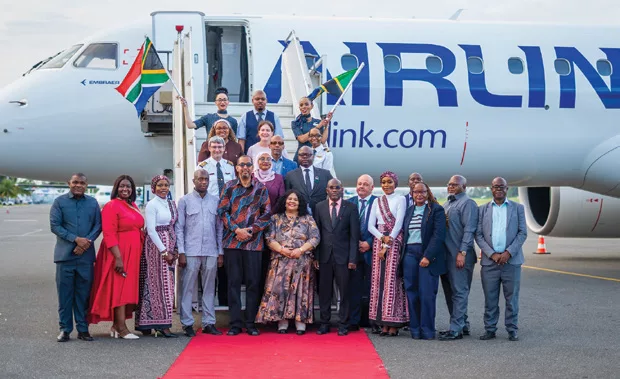
Airlink has officially launched the Johannesburg-Zanzibar route, marking an important milestone in strengthening air connectivity between South Africa and Tanzania. The inaugural flight was celebrated in Zanzibar by key industry stakeholders, partners and dignitaries, reflecting strong confidence in the route and growing demand for both leisure and business travel to the island destination.

Representing Airlink at the launch event was Nambita Mazwi, Executive Manager for Legal. In her address, Mazwi highlighted the strategic importance of the new connection, emphasising its long-standing priority within the airline’s network expansion plans. “The Zanzibar-Johannesburg route has been on our list for some time, as it is strategically important for both Tanzania and South Africa,” she said. “Today’s arrival marks the beginning of a twice-weekly return service, strengthening ties between our regions and opening new opportunities for tourism and trade.”

The new route offers travellers increased accessibility to Zanzibar, one of East Africa’s most sought-after destinations, known for its pristine beaches and rich cultural heritage. Beyond tourism, the service is expected to contribute positively to economic collaboration and regional integration.

Further expansion

In response to encouraging market demand, Airlink has announced plans to expand its operations in Zanzibar. A key development will be the introduction of a direct Cape Town-Zanzibar service, scheduled to commence on 3 October 2026. Initially operating once a week, this will become the first-ever non-stop Airlink service between Cape Town and Zanzibar, further enhancing travel convenience for passengers from the Western Cape.

The expansion reflects Airlink’s confidence in the route’s long-term viability and its commitment to improving intra-African connectivity through efficient and customer-focused services.

Airlink’s Zanzibar flights are operated using modern Embraer E195-E2 aircraft, offering passengers a premium travel experience. The airline provides a full-service offering that includes complimentary meals and refreshments, generous legroom and a choice of aisle or window seating, ensuring comfort throughout the journey.

In addition, flight schedules have been carefully planned to maximise traveller convenience. By avoiding late-night and early-morning departures and arrivals, Airlink enables passengers to make the most of their time in Zanzibar from the moment they arrive. Recognising the diverse needs of modern travellers, including those visiting for leisure, sports and recreational activities, the airline has designed the service to support a seamless and enjoyable travel experience.

Overall, the launch of the Johannesburg-Zanzibar route represents more than just a new flight path. It signals a strengthening of regional ties, supports tourism growth and creates new opportunities for economic engagement between South Africa and Tanzania, reinforcing Airlink’s role as a key connector across the African continent.

Text and photography | Supplied

For more information, go to flyairlink.com

Read more

Your next stop: SuperSport Park

A season of world-class cricket is calling – and Centurion is ready to welcome you

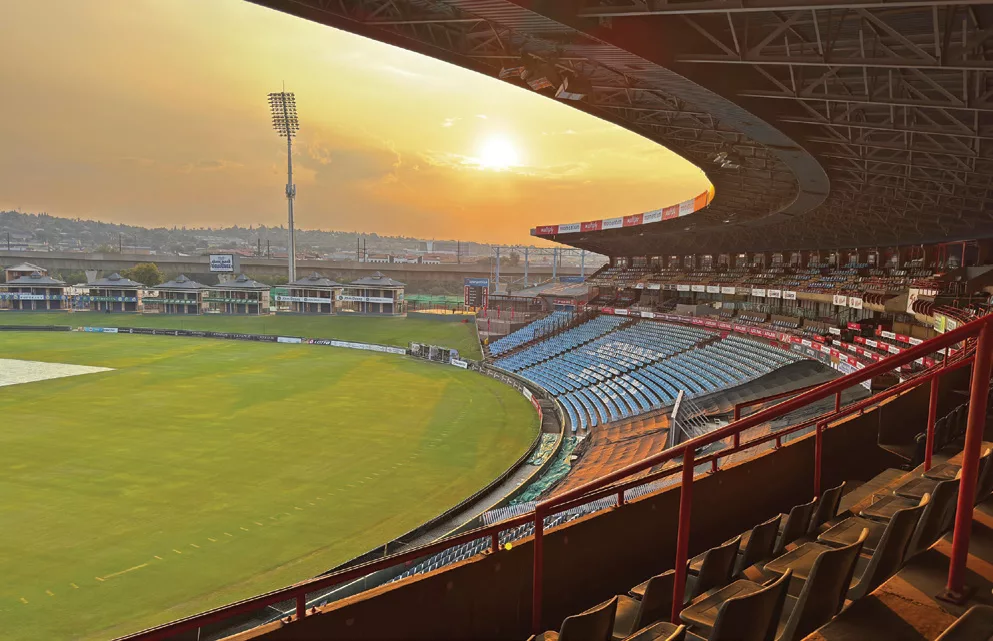
As your Airlink flight touches down and Centurion unfolds beneath you, let us point you in one very exciting direction: SuperSport Park – one of South Africa’s most beloved cricket venues, and this season, one of the most electrifying places on the planet to watch international cricket.

Celebrating its 40th anniversary in 2026, SuperSport Park is more than a stadium. It is a landmark, a gathering place and a venue that families return to year after year – for the sunshine on the grass embankments, the hum of a crowd alive with expectation and cricket that gets talked about for decades.

Three unmissable fixtures in 2026/27

This summer, SuperSport Park sits at the centre of South African sport – and the schedule is a cricket fan’s dream.

South Africa vs Bangladesh – Dafabet Test: 23-27 November 2026

The international season opens with a five-day test against Bangladesh. There is nothing quite like the contest of patience, skill and strategy that unfolds ball by ball. Pack a hat, grab refreshments and settle in for a sporting occasion that rewards the true fan.

South Africa vs Bangladesh – T20 International: 13 December 2026

If you prefer your cricket fast, loud and spectacular, the T20 in December has your name on it. Big hits, electric fielding and a crowd that turns the stadium into a cauldron of noise and colour – and with the festive season just around the corner, it doubles as a pre-Christmas celebration you will not want to miss.

South Africa vs England – Boxing Day Test: 26-30 December 2026

And then there is the big one. The Boxing Day Test against England is as South African as a braai on a summer’s afternoon. This fixture consistently sells out – a rivalry soaked in history, passion and pride. For the Proteas, pulling on the green and gold at home carries a special weight, and every delivery, every wicket, every boundary feels personal when you are in those stands.

Plan your visit

SuperSport Park sits in the heart of Centurion – easy to reach, easy to love. The venue offers great food, parking and a warm atmosphere that no screen can replicate. Whether you are visiting for business or leisure, a day at the cricket belongs on your itinerary.

Text and photography | Supplied

Read more

Airlink to connect Cape Town and Mauritius

TRAVEL

Airlink to connect Cape Town and Mauritius

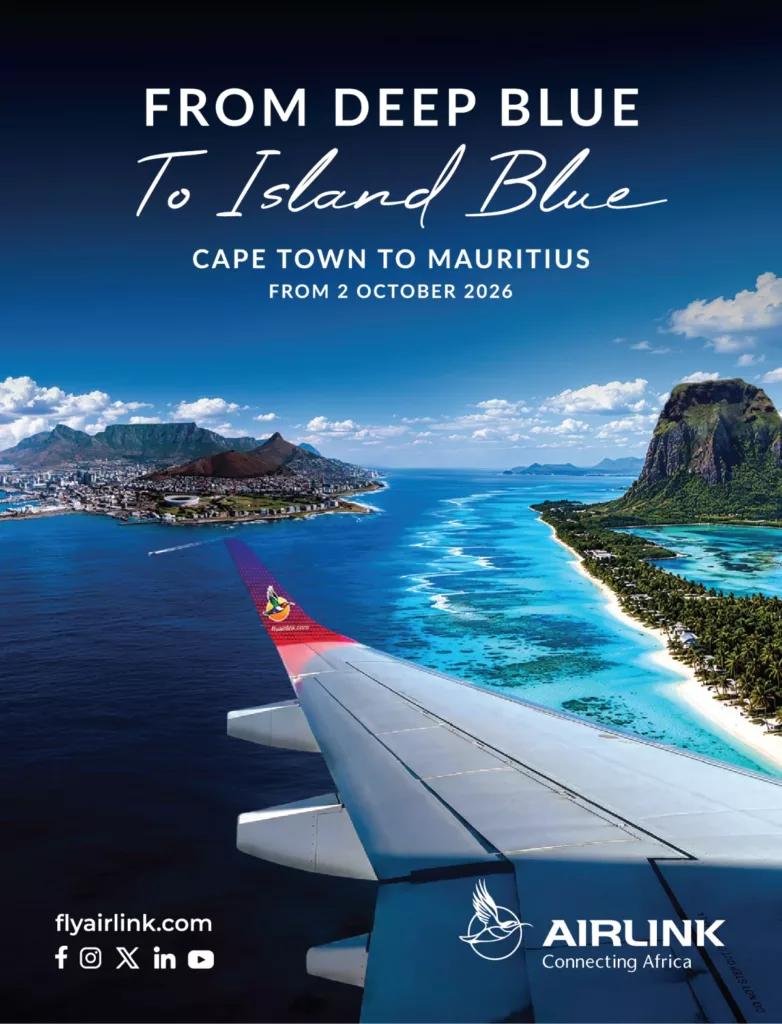
Airlink will launch twice-weekly direct Cape Town-Mauritius flights from 2 October 2026.

Bookings are now open for flights on the route, which will be Airlink’s first to the Indian Ocean island.

Mauritius’s legendary beach resorts, golf courses and visa on arrival system for citizens of over 140 countries continue to make it popular with tourists.

At the same time, the island nation’s thriving, sophisticated economy, which spans IT, financial services, textile manufacturing as well as traditional sugar farming and fishing – along with its tax and offshore business incentives – has transformed it into a key investment and trade centre.

Airlink will operate its brand new, state-of-the-art Embraer E195-E2 flagship aircraft on the new Mauritius service. They accommodate 124 passengers (12 Business Class and 112 Economy) with only window and aisle seats – there are no middle seats on any Airlink flights.

“Our new flagship aircraft, the E195-E2, makes it possible for Airlink to conveniently connect Cape Town with Mauritius. Cape Town is also an important source market and connecting hub for leisure and business travel wanting to travel to the island while avoiding the hassle and additional time connecting in Johannesburg,” said de Villiers Engelbrecht, Airlink CEO.

Cape Town is Airlink’s second hub with domestic and regional flights as well as long-haul connections with Airlink’s partner airlines from around the world.

Source: flyairlink.com

Read more

Music to their ears

TECHNOLOGY

Gravitational wave researchers working on the world’s most sensitive scientific instruments have found a way to tune their detectors using a process akin to the pitch-correction used in music production.

Scientists at the international LIGO, Virgo and KAGRA (LVK) gravitational wave observatory collaboration have employed the technique, which they call astrophysical calibration, to use gravitational-wave signals to measure the response of their incredibly sensitive instruments.

It enables them to ensure that they can clearly ‘hear’ the sounds of colossal cosmic events like the collision of black holes, even when one gravitational wave detector is slightly out of tune. This is crucial to accurately interpret the signals and find their source location.

By combining signals from other detectors with precise predictions from the laws of gravity, researchers can identify and account for subtle distortions in the data. The process is similar to how music production software such as Auto-Tune can correct a singer’s errant pitch to meet the intended note in a melody.

Source: gla.ac.uk

Read more

Bigger than bags

TRAVEL

The International Air Transport Association (IATA) recently announced the launch of ‘Save a Life, Not a Bag’, a passenger safety campaign urging travellers not to take cabin baggage during an aircraft evacuation.

Supported by aviation safety regulators, including the European Union Aviation Safety Agency (EASA) and the Federal Aviation Administration (FAA), the campaign reinforces what passengers must do when instructed to evacuate for their safety and the safety of all on board: follow crew instructions, leave all baggage behind and move quickly to the nearest usable exit.

“Taking bags during an evacuation is not a minor issue. Every second matters. Even taking one bag can affect the safe evacuation of everyone on board. Crew instructions are clear and simple: leave everything behind and move quickly. ‘Save a Life, Not a Bag’ is a message that passengers need to understand and act upon,” said Willie Walsh, IATA’s Director General.

The campaign responds to the growing number of cases where travellers have stopped to collect their baggage or take photos during aircraft evacuations. Evidence of this is seen in many videos posted online.

Source: planetalking.co.za

Read more

Tracing teamwork

TRAVEL

Passengers sharing their bag location through personal devices is becoming a key part of airline baggage recovery. As more travellers choose to share their bag’s location when it is delayed, airlines can use that information inside their baggage systems to resolve cases faster and reduce permanent loss. To support this shift, SITA has integrated Google’s Find Hub share item location feature into WorldTracer, the global system airlines use to find and reconcile delayed and mishandled baggage.

Traditionally, recovery relied on airport scans and airline-to-airline data exchanges. Passenger-authorised location sharing adds an additional source of visibility, helping teams narrow search areas and prioritise cases when a bag does not arrive as expected.

The process remains fully controlled by the passenger. If a bag is delayed, the traveller can generate a secure link in Find Hub and provide it to the airline. Sharing can be stopped at any time. Links expire automatically. Location data is encrypted, and only the passenger decides who can access it and for how long.

Source: google.com/android/find/people

Read more

Landing all the awards

TRAVEL

Airports operated by Airports Company South Africa (ACSA) achieved outstanding recognition at the 2025 Airport Service Quality (ASQ) Customer Experience Awards, the world’s leading global benchmarking system for airport passenger satisfaction. The awards were based on real-time feedback from passengers at over 400 airports in more than 110 countries, providing a robust measure of service quality and operational excellence.

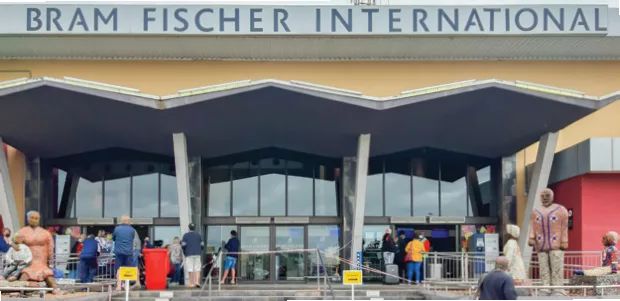
Multiple ACSA airports were celebrated across a range of categories, reflecting excellence in both operational performance and passenger experience. Bram Fischer International Airport (Bloemfontein), Upington International Airport and Chief Dawid Stuurman International Airport (Gqeberha) were recognised as Africa’s best airports in departures among airports serving under two million passengers, with Chief Dawie Stuurman International Airport earning accolades for having the most dedicated staff and providing the easiest journey in Africa.

Among the larger airports, Cape Town International Airport received multiple honours for departures among airports serving between five million and 15 million passengers, as well as for offering the easiest, most enjoyable and cleanest airport experience in Africa. King Shaka International Airport was recognised as one of the continent’s most enjoyable airports.

Source: airports.co.za

Read more

Airlink’s gorgeous green machine

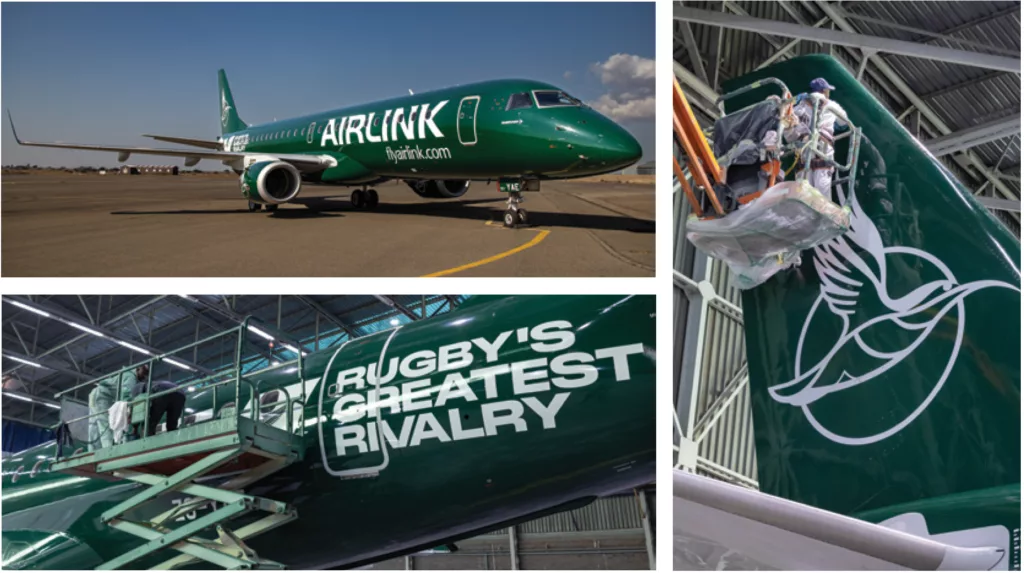
Airlink recently revealed its latest bespoke-liveried aircraft, an Embraer E190, in a gorgeous green getup.

The newly painted aircraft, registration ZS-YAE, made its debut at the end of June and will operate on Airlink’s main domestic and regional trunk services throughout southern and East Africa.

“The aircraft is one of three sporting our Airlink Skybucks customer loyalty programme paint schemes. Its unveiling coincides with Airlink being named the Official Domestic Airline for the Rugby’s Greatest Rivalry 2026 Tour, where we will fly the New Zealand and South African teams and personnel between their matches,” said de Villiers Engelbrecht, Airlink CEO.

The rugby tournament’s official logo is also displayed on both sides of the aircraft and is also displayed on her black sistership, ZS-YDE.

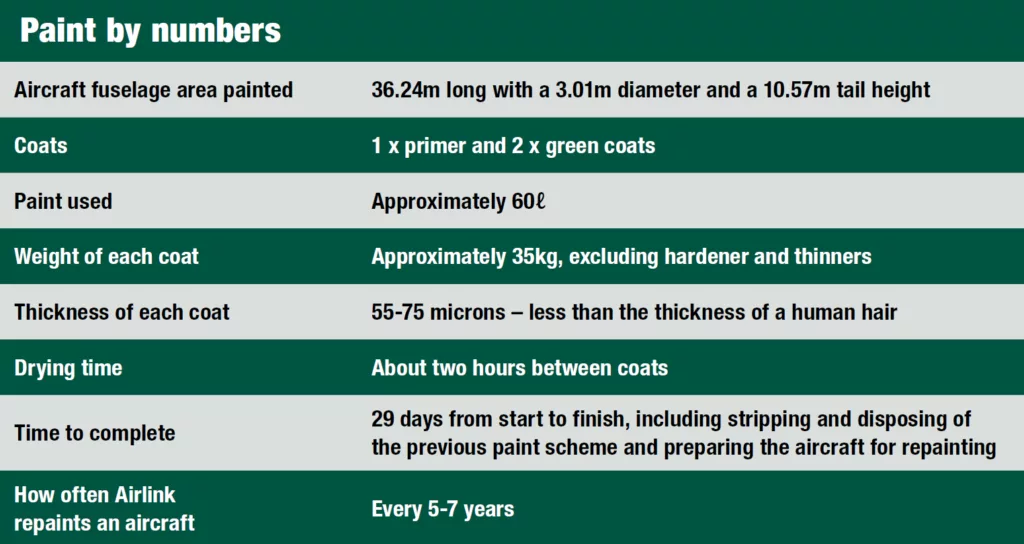
A team of six specially qualified technicians, using electrostatic equipment, painted the aircraft at Airlink’s new maintenance base at Polokwane’s Gateway International Airport in Limpopo Province. The base also incorporates a dedicated 96 x 46m aircraft paint shop, which has the capacity to paint up to 13 aircraft a year.

The paint is certified for aircraft use and imported from AERO Technique in the Netherlands to South Africa.

Text | Supplied 

Photography | Stephen Van Resburg

For more information, go to flyairlink.com

Read more

Capacity for enjoyment

All-inclusive beach resort requires its guests to arrive ready to eat, drink, relax and be merry

The first impression on arriving at Hotel Riu Palace Swahili on Zanzibar’s north-west coast involves its scale. Entire boutique establishments could fit in the wide, pillared reception area, which has a 24-hour restaurant in one corner. Step into the hotel’s central garden and there’s an even fuller sense of the size, with the bulk of the 500-plus rooms arrayed around that space making it feel like you’re entering the Colosseum.

Heading towards the beach, the first of the major facilities appear – a coffee shop, a high-end lounge, a luxury deck and bar and a huge open-sided theatre with a full lighting rig, ready to host artists for the resort’s nightly entertainment slots (acrobats, dance troupes, singers and more). Downstairs, a row of restaurants echo the food districts around prestigious town squares in big cities before you reach the pools – three of them on two levels, one with a swim-up bar, one hosting pool basketball and other activities and another higher up and less bustling. The number of sunbeds is bewildering; regimented relaxation tempered by a sign that forbids the booking of sunbeds and denying someone else prime position if you’re not going to be lying there yourself.

Folks of all ages and shapes and sizes are tanning, napping or scrolling through their phones, with one or two reading books. All suggest no apparent desire to shift – they’re in for the day. That same reaction might occur for guests staying in the hotel’s Elite Club rooms, which come equipped with their own rack of spirits for those who like having a nightcap without needing to ask anyone else to pour it for them.

Sand and streets

In front of the hotel, Nungwi Beach (which becomes Kendwa Beach further along) is an entertainment and business hub – busier when the high tide makes the strip of sand narrower – with local entrepreneurs doing their best to sell crafts and skills to passers-by, paragliders drifting in to land and ridiculous mock sports car jet skis available to hire, should you need a lift out to an equally preposterous inflatable floating playground. The sea is swimmer-friendly here, with long stretches where the seabed is sandy and free of sea urchins and other potential perils, inviting walkers to wander into the water.

For sundowners, guests are spoilt for choice. A gorgeous lounge juts out of the front of the main Swahili structure and there are seats at any of the restaurants, or you can branch out a little, with Hotel Riu Jambo’s iconic jetty just next door and a dozen beach bars in easy walking distance. If you want to feel like you’re inside a postcard (or perhaps, today, an Instagram post), book dinner at one of the restaurants on the Jambo jetty – the distinctive structure is a mainstay of almost all Zanzibar marketing campaigns. Plantain soup, interestingly (if you’ve never had it, you might imagine it’s just a sour banana smoothie), is fantastic.

A walk into nearby Nungwi village reveals a place buzzing with energy. As is often the case in tourist towns, many of the shops offer the same range of stock – football shirts, paintings, carved curios and kikois to wear around the pool. After a while, these outlets become less tempting as shopping destinations, but they provide a riot of colour for visitors to enjoy.

For those relying on their own memories for navigation, there’s a pleasing cheat code: if you get lost, just ask someone for the closest beach access and stroll back along the sand. And toss off your shoes for a cooling, cleansing dip as you arrive back at the hotel.

Relative comforts

The Palace Swahili’s neighbours are also its relatives – the aforementioned Hotel Riu Jambo and, one property further down, the Hotel Riu Palace Zanzibar. Children are allowed at the Jambo, which is older and less luxurious, with the chilled atmosphere around its upper pools reflecting that more relaxed approach. The pool at beach level is a different story, having been commandeered by a fitness instructor, guiding a circle of enthusiastic guests through a planned activity. Close to that, the beach dining area is lovely, directly off a sun-lounging area on the sand shaded by palms and other trees.

The Palace Zanzibar has a completely different feel, with lush, extensive gardens – large trees, flowers, hedges and lawns everywhere. There are spread-out villas and collections of other rooms in larger buildings, some of those around another pool, creating a quiet, private space with a bar helmed by a knowledgeable barman who is on first-name terms with all the guests and who remembers everyone’s orders. It’s a lovely place to hang out away from the bustle closer to the beach, though the pool and restaurant above the sand offer spectacular views.

There’s a tasteful farewell in store at the Steakhouse back at the Palace Swahili, where warm staff and succulent fare are a prelude to a performance by a skilled dance troupe if you have remaining energy after the rich food and a day in the sun.

Text and photography | Bruce Dennill

For more information, or to book a stay, go to riu.com.

RIU Hotels has over 100 destinations in 19 countries.

Read more

Borderline perfect

Safari sanctuary on the edge of two countries is packed with sublime vistas and wildlife action

The short transfer flight from Harare to Mana Pools National Park, right on Zimbabwe’s northern border, takes in the capital’s sprawling urban area, then small-scale farms, larger farms and the endless darker green of protected woodland. Then, on the horizon, a silver strip reflecting the sky – the Zambezi, at this point, sprawled around islands where hippos crop the grass, and the water offers lighter or darker shades of green depending on the sandbanks.

The plane loops briefly over Zambia before crossing back into Zimbabwe to land at the Mana West strip, where guide Faidon awaits with a safari vehicle and a cooler box full of drinks. The landscape is different to many safari areas, with dark, hard tree trunks as much a feature as open grassland, with tall palm trees dotted throughout.

One of the first sightings is ground hornbills – two separate groups – which is a great start, given how endangered the birds are. A young elephant then appears on one side of the road, inspiring happy sighs from guests. One curve in the road later, a rustle of branches announces the arrival of an older brother or uncle, a male in musth who is not keen on any other big creature being in his zone, even if it’s a noisy metal box full of tourists.

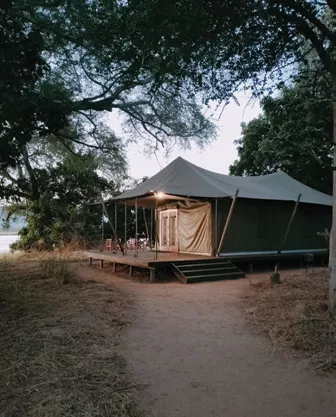
Well into winter, the oncoming evening doesn’t yet require a jacket and arriving towards sunset means being introduced to Wilderness Ruckomechi Camp when it looks like it’s been dunked in amber, with gorgeous golden light on the wide deck of the common area and on the flanks of the safari tents on either side.

Those tents face the river and the Zambian escarpment on the other side, with glorious views from the couch, bed, writing desk… and shower (hopefully fishermen and booze cruisers are focused on what they’re doing).

Into the darkness
A night drive sees Faidon handling a powerful torch with a red filter that makes the light less invasive for wildlife. This is immediately evidenced by a nightjar that sits calmly for inspection until the onlookers are distracted by a shadow in the darkness beyond – a colossal hippo that doesn’t even deign to look over as he heads back to the water.

Large numbers of impassive impala suggest that not much is happening in terms of predator movement, and though a couple of crocodiles have broken the surface at a river crossing, it seems, for a while, like they are correct. However, after seeing first an elephant shrew and then its full-size counterpart, there is a sighting that confirms the need for the pretty antelope to remain steadfastly on alert. Something is crouched beyond a prominent tree root, its profile difficult to make out – a jackal, a hyena? Then the animal stands up. It’s a female leopard, ensuring that the dark bulk of the vehicle was not a threat before revealing herself. She’s svelte and sleek, listening carefully and peering into the gloom as she prepares to hunt.

Our own meal is much easier to track down, arriving at mood-lit tables while a glowing bonfire attracts guests who’ve already dined to share favourite moments from their day. Delicious food, intelligently portioned, arrives with wine, with a refill a great companion to joining the fireside chat and interpreting the night sky.

On the path back to the tent, another guide shares tales of the myriad creatures encountered on this same walk. He’s still reminiscing as another elephant materialises, a few metres off the path and a short distance ahead. The route is altered to include improvised bundu bashing around a neighbouring tent to ensure all parties have enough space.

Safely in the tent, the night is both deliciously peaceful and alive with sound – coughing hippos, bickering frogs, the calling of various birds and the snapping branches nearby as the elephant completes his errands.

Cats and lairs

In the darkest part of the night, a lion roars. Insistently. The story (it transpires in the morning) is that he was calling to communicate with two lionesses who walked through the camp with their cubs. The females didn’t answer – which explains the male’s testiness – suggesting that they may have had concerns about the male’s infanticidal tendencies.

Walking to breakfast involves passing a hippo grazing on the riverbank near the pool. The continental breakfast here, with the continent being Africa, involves sweet scones cooked over glowing coals. With the big cat still in the area, this short fuel stop is attenuated in favour of a long lion linger as the young male – still alone, still calling – lies on a hippo-cropped lawn and enjoys a leisurely tongue bath before ambling into the bush. He stops often to both spray urine and rub his facial glands on clumps of grass and low tree branches: if he can’t impose his will on the lionesses, he can at least make sure everyone knows he’s around and in charge.

Shortly afterwards, there is the first of a number of starkly beautiful bird sightings – two tall, elegant saddle-billed storks. There is, more intriguingly, a huge baobab, towards which Faidon steers with a smile on his face. On inspection, the tree is hollow, with concentric circular steps carved into the inside, going upwards. Faidon explains that it was used by local Shona people to hide from raiding Matabele warriors. As many as 20 people could hide inside the tree, along with supplies, with a branch pulled across the entrance to conceal it.

Generational investment

The final morning includes a bush walk. A trio of lions is waiting in, according to Faidon, the exact spot he was hoping to park. There are, this time, two females and a male, with the ladies playing not-at-all hard to get, which is not necessarily a cuddly affair, involving much cuffing and snarling.

Faidon pulls over just 300m further up the road, where we dismount and follow Faidon, his rifle at the ready, stopping regularly to note and discuss the minutia of the landscape. There are harvester ants and their nests, the night-time business of porcupines and evidence of human settlements from the 1950s and before (Faidon’s father lived there!).

Returning to the vehicle for coffee, we look up at a golden swathe of grassland, the site of the village’s former farm fields. There is a sense of nature returning wherever it is allowed to, with the beautiful poetry of the current generation caring for the same land, but in different ways.

Text | Bruce Dennil 

Photography | Bruce Dennill and Supplied

For more information or to book a stay, go to wildernessdestinations.com.
Read more

Heaven on a hilltop

Open plains merge with a mountainous escarpment in Kenya’s Chyulu Hills

The transfer aircraft is painted to look like a giraffe – is that a sign? Captain Morris holds open the door of the four-seater Cessna 206, with me scooching over to the co-pilot’s seat, the fixed-wing plane is swiftly airborne. Landing at the Ol Donyo airstrip, a few Masai giraffe in the vicinity seem rather perplexed to see their sibling or distant cousin so strangely shaped, let alone making such a racket.

Which begs the question: why do giraffes always have a look of surprise on their faces? Granted that their lanky, statuesque frames provide them with the advantage of surveying their surroundings when towering at between 4.3 and 5.5m tall, so they certainly see more than the rest of us. Have you ever been witness to a tower of giraffes all looking in the same direction? It’s a tell-tale sign of something lurking in the bushes and once the animals start running (the elegance of that is uncanny – it’s all legs galloping with grace), look out for a predator that could be giving chase. On the way to the lodge from the airstrip, there is an adorable foal all on its own in the red oats grass, delivering its species’ trademark stare.

Things are looking up

As part of the Great Plains Conservation portfolio of lodges in Africa, Ol Donyo Lodge occupies a prime location in the rocky outcrops of Chyulu Hills, set between Tsavo and Amboseli National Park, which gives it an air of exclusivity.

Sitting down for lunch, an agama lizard appears on the wooden deck adjacent to the table. He is striking, with an orange head, blue body and bright turquoise tail. Just beyond his reach is a rather drab-looking female, clearly the object of his affection for the moment.

In spite of his continual flirtation – he rears his upper body halfway up to resemble the stance of a body builder, which coincides with a little dance – she appears unimpressed and makes a hasty getaway. The meal of reversed seared chicken with zhoug sauce is delicious and the critters’ antics are entertaining.

Luxurious safari pool suites are dotted across the landscape, with the cherry on top quite literally the suite’s star bed. Spend the night on the rooftop of your suite, where a blanket of stars will illuminate the way to dreamland. Lying up there also offers a wonderful opportunity to listen out for the nocturnal sounds of hyenas whooping close by, or a lion roaring in the distance. With the suite just down the steps, guests can return to all the creature comforts they’d like to make the most of during their stay.

From the private pool deck, the vistas over the twin hills of El Mau are magnificent. Looking out towards the watering hole, a few zebras have congregated to quench their thirst. Once they leave, an elephant sashays over to do the same, while considering whether there is enough water for a mud bath. The answer is simply put: no. Turning away, he heads to a bigger source of liquid refreshment. The larger watering hole is the lodge’s photographic hide and, here, it’s like a scene from Noah’s Ark. On a hot day, this is the place to be for the wildlife – and anyone with a camera or smartphone wanting to capture images at eye level.

Rocking the pride

The resident pride of lions has been spotted recently and guide Seki wants to try his luck in locating them on the afternoon game drive. It’s quite a distance to get there, and his efforts are rewarded with a momentary glimpse of what could be a lion (it might very well be a rock) under a tree. If it starts moving, we have struck pure gold. The sun has begun to set, which hopefully will make whatever is there start to get active. Picking up his binoculars, Seki scans the rest of the escarpment. There is a brief rustle, which could be the wind. As he is squinting to focus properly, the ‘rock’ sits up suddenly – it is, in fact, a lion!

Edging closer in the vehicle, a low-frequency snarl becomes clearly audible. This is closely followed by a spluttering hiss. A sub-adult cub is not taking kindly to the presence of the vehicle, and we remain static to see what unfolds. One by one, the rest of the pride starts waking up, with long languid stretches and yawns in typical cat fashion. A female has her eyes locked on something up ahead – an oryx busy feeding, none the wiser that he has a target on his back. Securing this meal could be exactly what the 26-strong Lesoit (which means ‘rock’ in the local Maasai language) pride needs to sustain itself for a while. As the lioness flattens herself, stealthily advancing on her prospective prey, the cubs mistake her stance for an invitation to play, alerting the antelope to head for the hills. Better luck next time!

Text and photography | Heléne Ramackers

For more information or to book a stay, go to greatplainsconservation.com.

Heléne Ramackers’s international flights on Airlink between Cape Town International Airport and Nairobi International Airport were sponsored by Extraordinary Journeys. For more information, go to extraordinaryjourneys.com.

Read more

Under the mountain

Golf, wildlife and architecture create a multi-faceted country attraction

The Legend Golf & Safari Resort is a pleasant drive from Johannesburg – just far enough to feel remote and exotic. The scale and form of the architecture support that latter perspective. The giant gate structure is a replica of Great Zimbabwe, with Hanglip, the distinctive mountain at the heart of the venue’s visual identity, giving the place an extraordinary atmosphere on entry.

The estate is huge and sprawling, encompassing standalone villas and houses and side roads down to more units (self-catering and hotel rooms) before the driving range area of the Tribute Course opens up to one side. Alongside that – another suggestion that this is not a run-of-the-mill getaway – sits a helicopter, ready to ferry golfers to the upper flanks of the mountain for the venue’s trademark ‘Extreme 19th’ activity.

A meal in the Tribute clubhouse allows new arrivals to orient themselves, with gorgeous views of the landscape through every window and a massive TV screen playing streams of wildlife images to get you in the mood for a visit to the Entabeni Safari Conservancy adjacent to the estate.

Short stories

The Tribute Course comprises 10 holes, all par threes and all copies of iconic holes from famous courses. If you’re unlikely (almost certainly true for most people reading this) to get on the tee at Troon’s Postage Stamp, the tricky eighth at Augusta, the island green 17th at TPC Sawgrass, and other holes from St Andrews and Royal Melbourne, among others, it’s a brilliant way to travel the golf world without needing to sell your house to do so.

The details are given the respect they deserve: the pot bunkers are terrifying, targets are lined up flush with the edge of streams and putting surfaces are variously tiny, massive or interrupted by a bunker in the middle of the green! If you’re lucky, you may hit a great tee shot on the last – the Sawgrass copy – and be offered a beer by a stranger if you sink the birdie putt in front of the gallery (a young mom and her baby, a teenage influencer whose post of her meeting Bryson DeChambeau went viral and the marimba band whose music welcomes arriving guests). In related news, the beer was lovely.

Colossal concept

Stepping off the course and into a safari vehicle is a possibility, and plains game are spotted immediately after entering Entabeni. It’s a Big Five reserve, but the calmness of the impala, zebra and wildebeest suggests nothing dangerous is in the immediate vicinity.

Hanglip and the surrounding mountains are the stars of a sundowners stop, with the sharp line of their crests delineating the edge of the sky. Two large eagle owls are seen but not heard – it’s a good time not to be a mouse.

Our own evening meal is far more palatable and many times more spectacular, served in the Signature Course Clubhouse. It’s a sprawling structure also incorporating the African kingdom concept – this time Zimbabwe’s Fort Nyangwe, with which the clubhouse shares the exact architectural footprint. Drinks are served on the roof, which amazes with its scale, dotted with stone towers and offering 360° views.

Dinner downstairs includes being surrounded by cultural, historic and sporting memorabilia and artefacts. There are paintings, an incredible antique concert grand piano and a wall of photographs and golf bags honouring the 18 professionals who designed the individual holes on the Signatures Course. All of these experiences reflect the almost unboundaried vision of Legend founder Peet Cilliers, who has always wanted to showcase the unique attractions Africa can offer world travellers, as well as blurring the lines between golf (a game often criticised for its environmental impact) and conservation. And post a COVID-19-enforced change in ownership, that dream is now in full flow again, with the property recently fully reopened and welcoming guests again.

High excitement

It rains during the night, so the morning dawns crisp and crystal clear, giving the impression that every aspect of the landscape is closer than it is. The weather is perfect for flying a helicopter, a fact much appreciated by the queue of guests readying themselves for the shuttle up to the Extreme 19th hole. A maximum of five passengers can be included per flight, so a bit of patience is required for large groups.

Seated and belted in, there’s a wait for the temperature gauge to reach the necessary level. Once that happens, take-off is so easy, it’s almost anticlimactic. The initial climb circles over the savannah of Entabeni before the aircraft climbs more steeply as it approaches the escarpment. Climbing over the crest of the cliff, a massive caldera is revealed – even more dramatic than the cliffs facing the resort; like entering a lost world.

Happily, it’s friendly territory, if the wooden picnic tables are anything to go by. The helicopter sets down gently, with the golfers’ drivers drawn out from under the seat. The tee, a rectangle of astroturf positioned right on the edge of the cliff, is thrilling just to stand on. From there, you peer down at the huge Africa-shaped, bunker-fringed green nearly 400m away – and at the awe-inspiring vistas to the right and left. Perhaps it’s the sense of occasion, but every player on the platform hits some great shots that the spotter down near the green keeps a careful eye on as the ball takes an exquisitely long time to fall. It’s an extraordinary – possibly unique – experience, fostering a deep appreciation of the landscape.

The Signatures Golf Course’s 18 designers are all famous tour professionals (past and present) from Retief Goosen and KJ Choi to Trevor Immelman and Bernard Langer. The range of ideas makes for a fascinating golfing experience, if an unpredictable one, as there is not the same sort of flow as there is on a course with a single designer. The par threes are generally gorgeous, and the par fours and fives are dependably long. Higher handicappers will do well to make greens in regulation on the longer holes, though they’re unlikely to worry given that every hole has a version of a spectacular Hanglip-starring view – more proof that a couple of million years of geology is better at branding than an agency.

Text | Bruce Dennill 

Photography | Bruce Dennill and supplied

For more information or to book a stay or golf, go to legendgolf.co.za.

Read more

Improvised adaptation

New Johannesburg jazz club celebrates both what was and what could be

Cities harden long before they admit it. This happens when capital leaves faster than care can replace it, when leadership falters and buildings outlive the systems meant to sustain them. Johannesburg has carried that scar for decades. Empty offices, streets partially lit, pavements that feel negotiable after dark. The inner city has been declared finished more than once.

Braamfontein has absorbed each swing of that story. Once a commercial spine, later shorthand for decline, now a student quarter and steadily reclaiming its creative edge, it has learnt how to reset without pretending nothing happened. That instinct to rework what already stands rather than abandon it sits at the heart of Hugh’s, the jazz club born of a partnership between Adam Levy of Play Braamfontein and the Hugh Masekela Heritage Foundation.

Perched 13 floors above Juta Street, the club looks directly onto the Johannesburg inner city. The skyline does not serve as backdrop; it becomes part of the experience. Music unfolds inside while the lights below continue their own choreography.

The grammar of exchange

For more than two decades, Levy’s work in Braamfontein has resisted the urge to import glossy urban formulas and paste them over local complexity. Instead of replicating London loft aesthetics or New York warehouse tropes, he has worked with the grain of existing buildings and the textures of the streets.

Hugh’s follows that logic. The acoustics favour clarity over spectacle. The stage sits close enough to require presence. The architecture does not compete with the music; it supports it, like a steady line beneath a shifting melody. Jazz offers a language for this aesthetic. It is not only about electric solos. It is about how musicians pay attention to one another, how they respond in real time, how they leave space. The beauty lies in that exchange.

Hugh Masekela embodied that openness. Across exile and return, he moved between township melodies, American soul, protest song and bebop without apology. “He was never interested in being boxed in,” Pula Twala, Masekela’s daughter and foundation board member, reflects. “For him, music was always in motion.”

Braamfontein’s recent history mirrors Masekela’s improvisational instinct to adapt. The work has not only been architectural but psychological, shifting how people move through the precinct, how long they linger, whether they trust it after dark. Repairing a building is one thing. Restoring the habit of gathering is another. A city begins to believe in itself again when people choose to stay.

Johannesburg in 2026 remains contested terrain. Inner city renewal sits alongside scepticism. To ask audiences to ascend 13 floors and truly listen is to ask for trust. Masekela rebuilt identity through sound that never surrendered its source. Levy tests whether space can do the same.

Hugh’s does not promise redemption. It offers a counter melody. In a city accustomed to abrupt shifts, it creates a disciplined pause. A room where listening becomes a collective act, and adaptation is recognised as strength.

Text and photography | Ryan Enslin

For more information, go to hughs.co.za

Read more

Throwing shade

Cape Town author Mike Nicol explores police and political corruption in tense thriller

Why are you ruining the whole of Cape Town for me? Must the nasty characters in this story operate in places I love to visit?

Mike Nicol: Ha – sorry! It’s in the fabric of the stories. I have no experience of crime there other than a house break-in, but I know it can be wild if you’re in the wrong place at the wrong time.

I also experience subliminal influences. I was editing The Shadow State [by Jeff Wicks] and Confessor Cop [by Michael Behr] while I was writing Falls The Shadow, so some of that could have translated into my story. I also wrote two books at the same time, going straight into the second one. That’s like it was at the beginning of my career, when there was no pressure. There are no guarantees in this business, so we just carry on – hope that someone wants it!

Your use of language: present tense; short, sharp phrases; often cynical observations from the narrator. It’s not ‘normal’ – in terms of the way people talk or even in too many books or genres – but it works on many levels (tension, pace, rhythm, tone). Do you need to continually work on it when writing?

That technique was not in the earlier books. I only really became aware of it while writing the book after this one, in which there’s even more narrator interference. It organically grew without me noticing. For the narrator, I wanted someone outside of the character to give another dimension to the story. It’s useful – it allows you to fill in backstories and changes how the book is structured, so it doesn’t need to run chronologically.

Police, politicians and wall-to-wall corruption – the whole story is mired in criminality and greed, with even the good guys living more or less adjacent to the rules. All of this makes a powerful statement – there is no getting away from the stats and what is revealed by investigative journalists – but it also gives the whole story and series a pretty inescapable darkness. Why do you think readers are drawn to such stories?

I have a theory. I looked at a lot of fictional crime beforehand and thought that maybe this kind of thing qualifies as a sort of fairy story. You start with chaos, add more chaos, and then let things end a bit better. People are okay with that. In the middle, you’re manipulating people to want to get to the end. Crime fiction in particular involves a huge amount of manipulation – you need the anxiety to drive the compulsion.

I think also knowing it’s fiction helps readers. Though for me, when I started writing in the seventies, it was almost all political writing, so I’ve always felt that what I write needs to be socially relevant.

Research: you have all parts of Cape Town (and other locations), you have weapons, you have police and government structures, you have wheelchairs and paralysis, you have a touch of bondage… You’ve mentioned in other interviews that you don’t do too much planning, so is that just a normal Tuesday for you?

Once a journalist, always a journalist! There are people who are happy to talk about guns or corruption. I also get sent piles of manuscripts I can learn from. And I live in the city. For the dialogue, I’m an inveterate listener to other people’s conversations and how they put words together. For me, the way things sound and the way they look on the page is all-important.

Killing your darlings is something you’re not afraid to do. It helps to keep readers on their toes, and it allows you to invent a new character to fill the gaps. Have you, though, sometimes found that such attrition has made a storyline you really like impossible because it only lands once you’ve eliminated a character that would have been involved?

I have regretted killing characters before – in one case, I did a Dallas thing and brought her back to life. In this one, we have Colonel Vula, who was shot in a previous book but returns in a wheelchair. I’m not contractually obligated to keep characters alive, which keeps me interested.

How much are you willing to trust what unfolds as you’re writing, in the sense that you only discover what’s going to happen to a character as you’re putting in the hours each day?

I trust it all the time. It’s that Raymond Chandler thing: “If you’re stuck, bring in a man with a gun.” Make something happen, then figure out the backstory and the consequences. I look at these books as having a sort of ‘Y’ structure. The stories can be separate to a point, but once they join, you need to follow that through to the end.

Think of it as a crucible – you put your characters in a spot where they have to resolve the story.

Text | Bruce Dennill

Photography | Estée de Villiers and supplied

Falls The Shadow by Mike Nicol, published by Pan Macmillan, is available now. For more information, go to panmacmillan.co.za.

Read more

Sustainable sanctuary

African rainforest is a treasure to explore and to support conservation

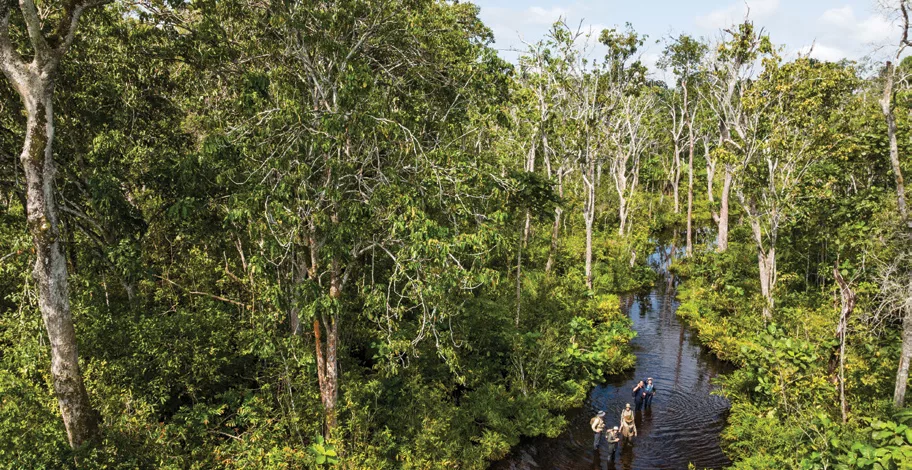
The Republic of Congo – not to be confused with its larger neighbour, the Democratic Republic of Congo – is an often overlooked, yet welcoming, breathtaking and peaceful destination that lies truly off the beaten track. As part of the world’s second-largest rainforest after the Amazon, it boasts the stunning Odzala-Kokoua National Park, celebrated for its spectacular landscapes, immense biodiversity, and endangered wildlife, including the western lowland gorilla.

Covering vast tracts of pristine rainforest, savannah and swamp, the Republic of Congo forms part of the Congo Basin, one of the planet’s most vital ecosystems. This region plays a pivotal role in regulating the Earth’s climate, acting as a crucial carbon sink. The country alone absorbs an estimated 1.5% of the world’s annual carbon emissions, making it one of the most ecologically significant nations on Earth. The country offers a rare chance to experience nature in its purest form, with wilderness areas largely untouched by tourism, providing an authentic and immersive experience for travellers seeking discovery and connection.

Culture and conservation

Visitors can explore a landscape shaped by rivers, ancient forests and remote clearings teeming with life, from forest elephants and buffalo to dazzling birdlife and a kaleidoscope of insects. The jewel in the crown is the Odzala-Kokoua National Park. Spanning over 13,000km², it is one of Africa’s oldest national parks and a sanctuary for thousands of species, many found nowhere else on Earth.

Travellers can trek through dense rainforest in search of gorillas, observe forest elephants bathing in mineral-rich bais (clearings) and encounter rare species such as bongos, chimpanzees and flocks of grey parrots. But the Republic of Congo offers more than wildlife – it offers perspective. This is a place where light and sound pollution are virtually non-existent, where nights glow only with starlight and fireflies, and the sounds of the forest replace the constant hum of modern life. It’s an environment that invites reflection and a deep appreciation for the natural world.

Visitors to the Congo Basin can also experience a unique blend of culture and conservation. Local communities play a vital role in protecting the forest and its wildlife, with initiatives supporting education, sustainable livelihoods and environmental stewardship. Travellers can engage meaningfully with these communities, learning how traditional knowledge and modern conservation coexist to preserve this fragile ecosystem. With only around 300 visitors each year and small group sizes capped at just 12, exploring the Odzala-Kokoua National Park feels truly exclusive, a journey back to nature’s untouched origins. Days are spent tracking gorillas or boating through ancient forests, while evenings are filled with the sounds of frogs, monkeys and birds echoing through the canopy.

For those seeking a destination that combines raw natural beauty, ecological importance and authentic connection, the Republic of Congo offers one of the last great frontiers of adventure, a place where every moment feels intimate, transformative and profoundly alive.

Text | Supplied 

Photography | Scott Ramsay and Felix Studios

For more information, go to kambaafrica.com.

Read more

The modest exemplar

New book about Walter Sisulu recalls leader’s remarkable qualities

Asked by George Houser and Herbert Shore how he would like to be remembered, Walter replied: “As a man dedicated to the struggle of the people. I think that is what I was. That is what I did.” His daughter Lindiwe recalls him as the “ultimate revolutionary”. He certainly saw himself as having been involved in a momentously successful revolution.

Some people did not recognise it as such, he complained, because the apartheid regime had not surrendered on the battlefield. But this not only underestimated what had been achieved but misread how its victory had been won. Given the forces ranged against the people’s demand for democracy, the election of the ANC in 1994 was “a miracle of the 20th Century”, won by the strategic combination of passive resistance and non-violence with armed struggle. He remained adamant that armed struggle had been necessary and justified and stressed that the ANC had never said that the struggle had to be carried on only by violent means. The one mode of struggle had complemented and reinforced the other.

Ultimately, the South African revolution “was one of the greatest”, not only because the people had won, but because it had ended on 27–28 April 1994 at the ballot box, by people voting and with the triumph of democracy.

“This achievement is one of the greatest assets of South Africa. It is the beginning of something new.” Yet he also ascribed the victory to leadership – by men like Oliver Tambo and Mandela and many others in history – who had guided the movement in proper ways.

This takes us back, ultimately, to the argument made in the preface that the individual contributions of Nelson Mandela, Oliver Tambo and Walter Sisulu to the struggle against apartheid cannot and should not be considered in isolation, for, as Luli Callinicos has observed, “Their vision was indivisible.”

They had forged it together through nearly half a century of struggle and political experience, and each had made his own specific contribution to the final victory. Mandela had proved able to win over his enemies with his message of reconciliation, his common touch and his charisma. Tambo, perhaps the most loved of the three, had guided the movement in exile by his passion, his wisdom, his ability to listen and, above all, his capacity to bring people together.

Sisulu, “the perceptive kingmaker and modest exemplar”, had always had a tireless and unrivalled capacity for organising and enthusing ordinary people on the ground. While their styles of leadership were different, their contributions were complementary and ultimately they cannot be separated one from the other. Together, they had been united in their selfless commitment to the winning of a non-racial and democratic South Africa.

Text | Tom Lodge with Roger Southall

Photography | Supplied and Dylan Barnes

Walter Sisulu: A Sense Of Outrage by Tom Lodge with Roger Southall, published by Jacana, is available now. For more information, go to jacana.co.za. This extract is published by permission.
Read more

Journey of discovery

Much-admired author recounts ‘geriatric gap year’ in new book

My Year Of Freedom And Fear by Marita van der Vyver tells of a gap year she and her French husband, Alain Claisse, took as COVID-19 was fading. They travelled through Europe, the US and South Africa.

The book was born out of the dregs of the pandemic. Her income had reduced, and her husband was battling the effects of depression and addiction. He had been unable to work for a year and was then retired with less money than they thought they would have. There was no way they could keep their beautiful house in Provence and had to make the difficult but necessary decision to sell their home. When it sold more or less immediately, they made the decision to go on a ‘geriatric’ gap year (they are both in their sixties).

The 15-month journey took them through France, Italy, Switzerland, Greece, the southern States of the US and then through the Karoo in South Africa. Previously, Claisse had not been able to take extended breaks to see the country, but without work, this was now possible.

There were all sorts of doubts as the couple set off – would this enforced closeness make or break their relationship? There was no way of knowing, but they leapt off the deep end and made their plans. Early in the book, contemplating the journey, Van der Vyver writes, “This journey, this expedition, this quest, whatever you want to call it, is increasingly becoming a journey towards acceptance of all the things I cannot control. I no longer want to dwell on what I have lost. I rather want to appreciate what I still have.”

In that spirit, they take off in their old Renault Kangoo, and the result is a travelogue that touches gently on the personal, which also brings alive the sights and the author’s impressions of the places they visit. The book is also suffused with quotes from other writers, woven into these impressions. In the US, for example, John Steinbeck’s 1960 road trip around the United States in the company of his standard poodle Charley, titled Travels With Charley, becomes a travel guide companion, while there are also references to Olive Schreiner, Andre Brink, Joan Didion, DH Lawrence and more.

Culture curation

Van der Vyver describes Paris as an “old friend you’ve known long enough to forgive her all her sins, her pretension and conceit, her fake façade and her shameless flirtation with every American tourist. … I’ve lived close to her for long enough to know that her breath often stinks.”

She also muses that the more languages you know, the more you change with every language. Having studied French and lived in Paris since the turn of the millennium, Van der Vyver finds she is reserved in that language, less likely to joke, while in English, she is self-assured, and in Afrikaans, you might think she is an extrovert.

In the US, the couple hire a hand-painted camper van to tour through the southern States. It’s painted with yellow and orange flowers; a distinctive way to drive through the country. They often stay on farms or in State Parks. Through Tennessee and Mississippi and onto New Orleans – an exuberant city, garlanded with women on expensive hen parties – Van der Vyver brings both her sense of humour and descriptive powers to bear. The American road trip ends in California, after a drive along the wild beauty of Big Sur before hitting San Francisco.

Van der Vyver, asked if she kept a diary while travelling, says, “While I was travelling, I was writing a monthly column for LitNet. And I was doing food travel columns for Daily Maverick in English. Newspapers would ask me to write, so that helped. That was almost a way of keeping a diary. I did also, of course, make notes. I didn’t know if I was going to write a book. I didn’t know if this trip was going to work. It might have been a complete disaster. As we progressed, the idea started taking shape that this could actually become a book. Then, the biggest problem was deciding what to put in.”

Measuring time

While not a fan of technology – Van der Vyver describes Claisse as a lover of his Kindle, but it’s a device she can’t get used to – she does say that the timeline on a phone when using the GPS was a good way to recollect where they had been on such and such a day. So the book came together, told in a chronological way, with fresh, immediate present tense that puts you right in the action.

In South Africa, Claisse wants to see wild animals, and the journey takes them through Addo Elephant National Park and rattling into Cape St Francis, to dining in Cradock and visiting Olive Schreiner’s home there. Also on the agenda is Helen Martins’s magical Owl House. But the heart of the South African journey is the contemplative time they spend in the Karoo.

Through the journey, there is the ever-present thought of home, or of being ‘homeless’ and wondering where they will end up. Was there a single impression that remained from the trip?

“There are so many, and I think if you ask me tomorrow, I’ll probably give you another answer. There’s a quote by Steinbeck where he says he’s setting down his truth, and when the next traveller comes along, she will find another truth.”

Text | Arja Salafranca 

Photography | Supplied

My Year Of Freedom And Fear by Marita van der Vyver, published by Jonathan Ball, is available now.

For more information, go to nb.co.za.

Read more

Parent-teacher meeting

Having a school scenario that is a meaningful part of the village it takes to raise a child is valuable

You know that moment when you’re sitting in traffic, staring at brake lights, and your mind is racing through the list: Did I pack the lunchbox? Did I pay the electricity bill? Will I make it to the office on time? And then: Am I even doing enough for my child?

This is the reality for many South African parents. We are carrying an invisible weight that no one sees, the emotional load that comes with raising children in a country where safety concerns, economic uncertainty and relentless work-life pressure collide every single day.

Beneath the surface, many of us are running on fumes, trying to be present for our children while silently wondering if we’re failing them. Parenting here is not about perfection. It is about survival. And yet, in the middle of this chaos, something powerful often goes unnoticed: the role of early childhood education in lightening that load.

When parents feel supported, children thrive. High-quality early childhood education does not just teach ABCs; it becomes an emotional anchor for families. It is the teacher who notices your child’s anxious face and gently reassures them. It is the predictable routine that gives your little one stability, so you can breathe a little easier. It is the educator who greets you by name, shares a small win about your child and reminds you that you are doing an excellent job, even on the days you feel like you’re barely holding on.

Easing concerns

There’s a kind of ‘heart culture’ involved in collaborating with a school: a way of being that says, “We see you. We are with you.” It is the quiet reassurance that you are not alone in this. It is sending a photo of your child’s joyful moment during the day so that, while stuck in traffic, you feel connected instead of guilty. It is creating spaces where children feel loved, and parents feel seen.

Imagine this: a mom who has been up all the previous night worrying about bills walks into a centre where her child runs into the arms of someone who truly knows them. The teacher smiles and says, “He told me the funniest story today,” and suddenly, for a moment, the weight lifts. That moment matters. It is not just childcare; it is care for the whole family.

You don’t need a Pinterest-perfect routine to ease the emotional load. Start small. Create one predictable ritual, like a bedtime story or a morning hug. Name feelings aloud, for yourself and your child. “I’m tired today, but I’m happy to be with you.” Lean on your child’s educators, share what is hard and celebrate what is working. Partnership starts with honesty.

Text | Kelly Eyre 

Photography | SeventyFour

Kelly Eyre is Quality and Pedagogy Lead at Dibber South Africa.

For more information, go to dibber.co.za.

Read more

The art of the matter

Attracting visitors using creativity and culture leads to economic opportunity

Arts and culture have long played a role in shaping South Africa’s identity, but their economic potential is often underestimated. Inclusive economic development requires models that harness cultural assets while creating equitable pathways for participation. Arts-based tourism can become a tool for shared community prosperity.

Traditional tourism models often concentrate revenue in established businesses, creating limited trickle-down benefits for surrounding communities. However, arts-driven township tourism reimagines local residents as active partners in the tourism economy. By using homes as galleries and neighbourhoods as cultural districts, communities become central to the experience. This expands economic opportunities to families who may not have access to formal employment.

One of the key strengths of arts-based tourism is its ability to create multi-layered value. Visitors engage with artistic expression, learn about community histories and participate in immersive cultural encounters. At the same time, artists gain access to markets, entrepreneurs develop services to support tourism flows and households earn income through hosting or selling complementary products.

The diversity within township communities becomes a strategic advantage. From painters and sculptors to musicians, dancers, poets and designers, multiple creative disciplines converge to create a vibrant cultural ecosystem. These artistic expressions are not only aesthetic but also economic: they attract visitors, stimulate spending and reinforce community pride.

Working together

Partnerships play a critical role in scaling inclusive economic development. Collaborations between cultural organisations, government departments, development agencies and private sector entities can expand visibility, provide training and bring investment into township creative economies. When partnerships are designed with community ownership in mind, they promote sustainable growth rather than short-term, extractive engagements.

Inclusive development through this kind of tourism also aligns with global trends. Travellers increasingly seek experiences that are ethical, socially conscious and rooted in authentic narratives. This shift positions South Africa’s township arts sector as a competitive destination in the global cultural tourism landscape.

The long-term impact extends beyond economics. Arts-based tourism helps to build social cohesion, preserves cultural memory and bridges divides between communities and visitors. It also creates opportunities for young people to see themselves as innovators capable of shaping their own futures, contributing to reduced unemployment and improved community resilience.

As conversations around inclusive economic development continue nationwide, models like the Maboneng Township Arts Experience demonstrate that culture is not a peripheral sector – it is a powerful economic engine. By centring creativity, community ownership and storytelling, arts-based tourism offers a path toward a more equitable and economically vibrant South Africa.

Text | Supplied 

Photography | Rich T Photo

For more information, go to maboneng.com.

Read more

Never face the flames alone

Few business owners consider that a single spark could stop their business in its tracks

Whether operating a restaurant where equipment could catch alight or a supermarket where a fire could devastate not just the infrastructure but also all stock in the storerooms and fridges, the risk of fire is a real one to consider when putting in place a business insurance policy.

An unexpected spark

Fire doesn’t just destroy infrastructure and production – it can cause injuries, loss of life, operational downtime and huge financial losses. Workplace fires can be caused by a variety of sources, including electrical faults, flammable materials, human error, heating and kitchen equipment, poor housekeeping and even alternative power sources like lithium-ion battery storage systems. Ageing infrastructure and unrest can also lead to fires through no fault of a business, its staff, customers or machinery.

Proactive care

Of course, insurance is just one way to protect a business against losses from fire – the best fire safety measures are proactive and preventative.

Regular fire risk assessments, maintenance of fire detection and suppression systems, the provision of comprehensive staff training and fire safety regulation compliance checks are the best way to provide fire safety and help protect employees, assets and ensure business continuity.

Never Not There

Comprehensive business insurance policies – like those tailored for individual businesses by Auto&General – take into account many of the unforeseen risks a business can face.

Auto&General has exclusively partnered with private fire safety services provider Fidelity SecureFire to add ‘Fire Assist’ to its Business Assist offering for clients who have cover for fire, office contents and buildings combined cover, so you’ll never face the flames alone.

Fire Assist gives an insured business direct access to Fidelity SecureFire response units to contain and reduce potential losses in the event of a fire at the insured business premises, covering the callout and costs for a private fire brigade service.

Fidelity SecureFire’s expert rapid-response teams can take quick action to control and extinguish fires – with no limit to the number of fire-related callouts at the insured address in the major metropolitan areas served by Fidelity SecureFire.

Auto&General is the insurer that actively works to limit your risk, ready to step in when the unexpected happens, standing with you to keep your business moving forward – and ‘Never Not There’.

Text | Supplied 

Photography | Shutterstock

Read more

Get an Auto&General business insurance quote

Get protection for your business with Auto&General insurance. For more information or a quote, visit autogen.co.za or contact us on 0861 333 877 to speak to a dedicated team of experts.

Auto&General is a licensed non-life insurer and financial services provider. Terms and conditions apply.

Case dismissed… differently

Updates to legislation promote fairness when employees need to be shown the door

People are the beating heart of every business. They bring the perspective, ingenuity, skills and experience that help organisations excel and deliver. But it doesn’t always work out. A person might not be suitable for their role and duties, they might not align with the company culture or they could conduct themselves poorly. In such cases, dismissal becomes an option.

Dismissals are rarely pleasant, and they can become complicated, sometimes collapsing into finger-pointing and accusations of unfairness. The Code of Good Practice on Dismissal (Dismissal Code) guides employers and employees on this process, clarifying expectations for each party and promoting fairness.

In late 2025, South Africa’s Minister of Employment and Labour gazetted an amended version of the Dismissal Code with important new updates. Many of the updates are geared towards modernising the Code, especially around practicalities that have come up recently, particularly post-COVID. The amendments try to ease that by putting in place guidelines for certain instances. For example, incompatibility or probation.

Bad fits

South Africa’s labour laws are based on fairness, and the amended version brings more clarity and scope to that principle. One of the most notable shifts focuses on people employed during a probationary period.

Employees cannot simply be let go after a probationary period. They deserve due process – a fair hearing, being presented with grievances and time to respond. The employer must demonstrate that they supported a probationary employee to develop their skills and address shortfalls in their performance.

Employers now have more leeway when dismissing probationary employees. Expanding from performance issues, they can now include gross misconduct and compatibility. If the employee is not a good fit, it can now be grounds for dismissal. Somebody can be superb at their job, but they’re just not a good fit in the culture or there are personality issues. Companies shouldn’t be prohibited from dealing with that kind of thing, as it can change the culture of an entire team or organisation if one person is not compatible.

Rights both ways

The amendments also consider smaller companies that struggle to manage dismissals formally. There is a heavy relaxation for smaller businesses that don’t necessarily have an HR department. Small businesses now have the leeway to handle things informally according to the Code and the Labour Relations Act’s requirements.

The amended code also strengthens employees’ rights to proper notice, disclosure of evidence, keeping of proper records of proceedings and demonstrable efforts to correct and support employees through warnings, counselling and performance management. 

Dismissal should always be a last resort. The amended code provides clearer guidance for all parties involved and reinforces consistency over cases being treated differently. Thus, the quality of records and witnesses will have the biggest impact on any settlement or verdict.

Text | Merlisha Haripal 

Photography | People Imaages

Merlisha Haripal is Executive for Employment & Litigation at CHM Legal.

For more information, go to chmlegal.co.za.
Read more

Raising the floor

Wage adjustment makes a real difference, but needs careful oversight

From 1 March 2026, South Africa’s national minimum wage increased to R30.23 an hour, a 5% rise taking the rate past the R30 mark for the first time. For millions of low-paid workers, the increase offers modest relief against rising living costs. But in an economy with stubbornly high unemployment and weak growth, the adjustment also raises an important question: how do we protect vulnerable workers without putting further pressure on job creation?

In the bigger picture, the wage increase is important. While the adjustment is modest, it forms part of a series of annual increases aimed at keeping wages in line with inflation and rising household costs. For low-income workers, even small changes can make a difference. Higher transport, food and housing costs continue to put pressure on household budgets, and this increase helps prevent wages from falling further behind.

It is important to understand what the national minimum wage is meant to do. It is not designed to dramatically improve living standards overnight. Its purpose is to set a basic level of protection – a wage floor that helps safeguard vulnerable workers.

Higher wages also have an impact on how businesses operate. For labour-intensive companies working with tight margins, rising wage costs are a major expense. This doesn’t mean employers are against fair pay but, in a weak economy, every increase in costs means tough decisions.

Businesses need to stay competitive, especially those that compete in global markets. To manage higher labour costs, some may invest more in automation, mechanisation or new technology. Others may slow down hiring, restructure their operations or reduce their reliance on lower-skilled roles.

Predictable future

In South Africa’s past, the availability of affordable labour had been one of the factors that attracted investment. As labour costs increase, this advantage becomes less certain. If higher wages are not supported by improvements in productivity, skills and economic growth, businesses may become more cautious about expanding or investing. This is why minimum wage increases cannot be looked at on their own. Protecting workers is important, but lasting wage growth is only possible if the economy becomes stronger and businesses remain competitive.

One important shift since the introduction of the national minimum wage is predictability. Employers now expect an adjustment each year from 1 March and build this into their budgeting cycles. While the exact percentage may vary, the increase itself is no longer a surprise.

Not all sectors are equally affected. Industries covered by bargaining councils or sectoral determinations often operate above the national minimum. The greatest pressure falls on smaller and labour-intensive employers that rely heavily on entry-level workers. As wage costs rise, workforce flexibility is becoming an essential strategy. Many businesses experience fluctuating demand, with periods of peak activity followed by quieter cycles. Maintaining a full-time workforce through these changes can be difficult, particularly as labour costs increase each year.

Flexible staffing approaches, including the use of temporary employment services (TES) providers, allow employers to scale their workforce in line with operational needs.

Text | Donné Nieman 

Photography | Hyejin Kang

Donné Nieman is Sales Director at Workforce Staffing.

For more information, go to workforcestaffing.co.za.

Read more

Pile it up!

Trip stacking is a strong strategy for saving money and ensuring the wellbeing of employees

The kind of work travel that sees your team make three separate trips within a six-week period, book flights with less than five days’ notice or add unnecessary expense, complexity and stress to already-packed schedules? It must go.

It’s time to master trip stacking: the art of grouping client visits, piggybacking on trade shows, clustering commitments by region and slashing travel budgets while protecting a team’s energy.

The true cost of a business trip extends beyond airfare and accommodation. It’s time away from family, productivity lost to airports and the mental fatigue of constantly being on the go. Bundling different commitments into one well-planned journey just makes good business sense. On so many levels.

Trip stacking can boost productivity and engagement. It seems obvious, but combining trips reduces travel days, meaning team members are more available, more productive and a lot less tired – even when on the road. Rather than dreading another ad-hoc trip, it pays to plan ahead. Of course, you can build in flexibility, but ‘stacking’ means you’ll become more mindful about each trip and more protective of your energy and productivity.

Research presented at the GBTA’s Southern Africa Conference in 2025 showed that over and above the demands of business travel (which include length, frequency and intensity of business trips), the number one stressor for frequent travellers is ‘making family arrangements’. Business trips don’t happen in a vacuum. They often require a serious support network in the background. Someone at home is handling school runs, childcare and everything else that doesn’t stop just because you’re travelling. When you stack trips strategically, you’re not just saving on airfare; you’re respecting the people covering for you and giving yourself the headspace to be actually present for the work that matters.

Lead time

When trips are planned weeks ahead rather than days, your team gains something valuable: the option to extend their stay. That might mean catching up with friends in the destination city, exploring somewhere new over a weekend or simply decompressing before heading home. Bundling business and leisure is a key retention tool. You’ve saved on flights; they’ve gained an experience, and everyone wins. It’s great for team morale, balance and personal development.

Fewer trips equal a lighter footprint. Bundled stays cut costs and carbon. South Africa’s Climate Change Act 22 of 2024 introduces legally binding climate actions for anyone doing business in South Africa. It includes carbon budgets, caps on greenhouse gas emissions and mandatory reporting. Businesses, big and small, are going to have to consider, measure and report on every trip. The wins stack up quickly. Advance booking secures lower airfares and better hotel rates, while one extended stay replaces multiple car rentals and premium last-minute prices.

But the real advantage goes beyond the budget: instead of three fragmented two-day trips stealing six days from the office, one strategic four-day visit accomplishes more while keeping the rest of the fortnight productive. You’re also ‘in the zone’ for consecutive meetings, building momentum that opens unexpected doors – the colleague who suggests lunch, the prospect available tomorrow, the site visit that happens because you’re already there. And when travel becomes purposeful rather than reactive, everyone benefits: smaller carbon footprint, better work-life balance, sharper focus on the work that actually matters.

Prioritise what matters

Start with the anchor. Identify your non-negotiables – the conference, quarterly review or industry event you’re definitely attending. Build everything else around these fixed points rather than booking trips in isolation.

Map by region, not urgency. When a Durban meeting request lands, ask what else you could accomplish on the east coast. Stack client visits in Umhlanga with supplier meetings in Pietermaritzburg and that networking event you’ve been postponing. Geographic clustering turns one journey into multiple wins.

Book early and stay flexible. Advance bookings secure better rates and sidestep last-minute premiums. But book flexible fares and leave breathing room in your schedule for opportunities (or challenges) that surface once you’ve landed.

Choose proximity strategically. Pick venues where you can meet, eat and sleep within walking distance. Hours saved on airport transfers and traffic multiply across multi-day trips. Sometimes, a slightly pricier central hotel beats budget accommodation that demands constant car rentals.

Think in purposes, not trips. Before clicking ‘book’, ask: what else needs to happen in this city or region? Can you schedule the team workshop alongside client meetings? Could one extra day accommodate that overdue site visit?

Partner with a travel management company (TMC). A good TMC will have strong supplier relationships and booking tools, which make bundling a breeze. Flights, hotels and cars – savings compound when it’s all co-ordinated. But ultimately, the shift from reactive to strategic travel isn’t just about cutting costs; it’s about respecting the most limited resource any business has: time. Companies that master bundling don’t just save money; they create competitive advantage by being smarter about when, where and why they travel.

Text | Herman Heunes 

Photography | New Africa

Herman Heunes is GM of Corporate Traveller South Africa.

For more information, go to corporatetraveller.co.za.

Read more

After the fact

Courts may condone employee lateness when following up on disputes

South Africa’s labour laws that existed pre-transformation were replaced with revolutionary legislation in the late 1990s and early 2000s. The trade union movement, which by that time was very strong and growing in size, was integrally involved in revolutionising labour legislation.

In particular, COSATU, a large, left-wing union movement, was, and still is, in an alliance with the ANC, which further strengthened the hand of the labour movement. Furthermore, the legislation has been revised several times over the past 25 years.

As a result, the current labour legislation heavily favours the rights of employees and trade unions and poses a major challenge to employers. Arbitrators and court judges are obligated by the law to watch over the rights of employees, who are seen as having less power and resources than employers and therefore as vulnerable and in need of strong protection. And many of these arbiters are happy to oblige.

This state of affairs has prompted many employers to use technical issues as a weapon for avoiding litigation. And many employers have the money and the access to legal expertise to wage this type of legal battle. Technicalities that employers might use in this way include applying for reviews and rescissions of arbitration awards and rulings and dragging cases through the Labour Appeal Court, Supreme Court and Constitutional Court.

Another tactic is opposing applications for condonation of lateness. Where the employer succeeds with opposing condonation applications, the effect is that the CCMA or bargaining council effectively throws out the employee’s case before arbitration can take place.

Tardy winner

However, this tactic is not always successful. In the case of Tunzi vs UPS South Africa (Lex Info, 30 January 2026; Labour Court case no JR158/22), the employee was dismissed for fraud in that he allegedly filled in an attendance register wrongly. His defence had been that he had filled it in correctly, but someone else had amended the record.

He referred his dispute 124 days late and had to apply for condonation of lateness. The employer argued that this degree of lateness was excessive and that Tunzi had failed to explain certain of the periods of lateness in that period. The employer added that the employee had failed to argue prospects of success in his application for condonation. The employee’s response was that he had indeed argued prospects of success and that his lateness had been due to his union being remiss. As the arbitrator turned down the employee’s condonation application, the employee took that ruling to court.

In the Labour Court, the employee was not represented. The Court found in the employee’s favour, basing its ruling on the point that the employee would be greatly prejudiced if his unfair dismissal case was not heard and ordered the bargaining council to set a date for arbitration.

This outcome reflects the ongoing shift of court decisions to the left and emphasises the importance of employers making sure that their managers are able to understand and implement labour law in a way that is unassailable in court.

Text | lvan lsraelstam Photography | Pressmaster

lvan lsraelstam is Chief Executive of Labour Law Management Consulting.

Contact him on 011 888 7944 or 082 852 2973, or at ivan@labourlawadvice.co.za.

For more information, go to labourlawadvice.co.za.
Read more

Digitalising digging

Africa’s mining sector is stepping into a new era, driven by the accelerating pace of digital transformation

From autonomous vehicles and robotics to AI-powered analytics and drone surveillance, the adoption of advanced technologies is fundamentally altering how minerals are discovered, extracted and processed. While progress is uneven across the continent, there’s no doubt that digital tools are making operations smarter, safer and more efficient – laying the groundwork for a more competitive and sustainable industry.

Technologies such as automation, robotics, drones, artificial intelligence (AI) and machine learning (ML) are leading the charge in adoption across Africa. These tools offer the highest immediate impact on productivity, operational safety and cost efficiency. Autonomous systems are being deployed in open-pit operations to minimise human risk, while drones support rapid surveying and terrain analysis, offering cost-effective alternatives to traditional methods. AI and ML are transforming exploration and predictive maintenance, enabling companies to optimise resource planning, reduce downtime and make faster, data-driven decisions. Robotics, particularly in southern Africa, are now a common sight in operations looking to reduce labour-intensive processes and human exposure to hazardous environments.

While these technologies are advancing quickly, others are still in the early growth stages. Collision avoidance systems (CAS), for instance, are gaining traction across various sites. These systems are proving to be crucial for preventing accidents in underground and open-cast mining environments, particularly where large machinery operates in close quarters. Although adoption is still growing, their impact on safety metrics is already noteworthy, particularly as mines invest more in risk mitigation strategies. Augmented reality (AR), virtual reality (VR), 3D modelling and digital twins are supporting real-time monitoring, remote collaboration and predictive scenario planning. Blockchain, internet of things (IoT), 3D printing and wearable technology are still in their infancy in the African mining context.

IoT could transform operational efficiency by interlinking devices and machinery for real-time feedback and automation. Yet, high upfront costs, underdeveloped infrastructure and inconsistent power supply continue to constrain their uptake. 3D printing and wearables, although useful for remote part fabrication and monitoring worker health, are not yet broadly integrated, often hindered by lack of technical capacity and cost justification at scale.

Continental curve

Southern Africa stands at the forefront of digital mining. The region boasts the most mature adoption of AI and automation, supported by relatively stronger infrastructure, more established mining players and better access to digital skills. However, scaling up these innovations across the sector presents serious challenges. High operational costs, legacy systems and slow change management often limit broader implementation.

Across the continent, infrastructure remains the most significant barrier to full-scale digital adoption. Patchy electricity, limited broadband access and poor transport connectivity compound the challenge of integrating complex systems into remote and rugged mining environments. Alongside this, skills shortages – particularly in data science, systems integration and automation – further restrict implementation, while geopolitical instability in some regions continues to dissuade investment in long-term transformation.

The African mining sector is clearly on a digital trajectory. While adoption is uneven and barriers remain significant, the progress already made – particularly in southern Africa – demonstrates the value of a tech-driven future. The potential for smarter, safer and more responsible mining is no longer hypothetical. It is, increasingly, the reality.

Text | Johan Coetzee 

Photography | Shutterstock Gen AI

Johan Coetzee is Strategy and Consulting Lead for Resources at Accenture, Africa.

For more information, go to accenture.com.

Read more

Tweaking of talent

With human skills and AI becoming more integrated, hiring patterns may change

The trend of companies cutting back on staff and teams getting leaner has been accelerating as AI quietly infiltrates entire layers of junior and specialist roles that once existed to support the experts.

We are witnessing an era wherein pure specialisation is in decline, while the most valuable professionals are those who combine deep expertise in one domain with broad, applied competence across many. The winners are no longer the narrow PhD or the single-skill technician; they are the specialist generalists or the modern jack-of-all-trades who is master of one.

For example, 10 junior analysts of the past have become two versatile strategists, relationship builders and executors, with AI handling the rest. Four paralegals have been replaced by one commercially sharp lawyer who knows how to prompt, validate and apply AI-generated research. The pattern is repeating itself across marketing, finance, operations, tech and even HR.

But it’s not just about reduced hiring. The organisations that will thrive going forward will be those that stop treating AI as a headcount-reduction tool and start using it to amplify versatile, high-judgement humans. And the professionals who thrive will be the ones who deliberately build T-shaped skill sets: a strong vertical spike of genuine expertise, sitting on a wide horizontal bar of data fluency, financial acumen, tech literacy and the ability to learn anything fast.

Ask the right questions

For years, companies have been drowning in data, yet most have failed to leverage it. That is rapidly changing. Five years ago, few roles required serious data skills. That figure has been rapidly growing since, and soon, few roles will not require substantial data literacy. That means everyone, from marketers and HR professionals to operations and finance staff, must become data-literate. The shift is not about producing endless, pointless insights but about zeroing in on the specific business questions to be solved.

Modern analytics dashboards and AI tools have commoditised access to information, which means the new competitive edge lies in knowing which questions to ask, how to interpret results and how to turn insight into action. In short, data is no longer the domain of a dedicated analytics team but is becoming the common language of business.

With AI tools now cheap, abundant and embedded in everyday software, artificial intelligence is filtering into every corner of every company.

The implication is that every employee will be expected to use AI to make their own job more effective and efficient. Roles that remain entirely manual (outside certain artisan crafts) will be the exception rather than the rule. This is not about replacing whole jobs overnight but about augmenting them. A social-media manager will still need judgement and creativity, but AI will handle scheduling, basic copywriting and performance analysis. The human’s value will lie in discernment and strategy.

Keep the future in mind

The most substantial shift will be the decline of pure technical specialists. Companies are deliberately moving away from narrow experts toward a tighter talent complement, as access to expert knowledge via AI becomes instantaneous. The result is that teams will become leaner, especially at entry level.

There is danger in being swept up with the tide before considering the consequences of rapid downscaling of junior roles. While the short-term efficiency gains are obvious, the unintended consequences could wreak havoc. Companies that do away with junior appointments for the most part should be aware that they may emerge in five to 10 years’ time with no mid-career or senior talent bench because no one came through the ranks.

The roles that traditionally served as training grounds, such as writing basic code, conducting routine legal research, building sales pipelines and producing financial reports, will still remain the best place for graduates to develop sound judgement and decision-making skills and should therefore still form part of the talent pipeline strategy.

Companies that want to remain competitive in the long term should resist the temptation to over-automate junior roles and instead find ways to accelerate real-world experience for high-potential talent. Yes, AI will do the easy stuff brilliantly. But ultimately, the winners will be those organisations that train humans to do the hard stuff even better.

Text | Advaita Naidoo 

Photography | Fabrika Simf

Advaita Naidoo is Africa MD at Jack Hammer Global.

For more information, go to jhammerglobal.com.

Read more

Harvesting higher value

Artificial intelligence could help farmers in Africa keep more of their profits on the continent

Artificial intelligence has rapidly shifted from a distant technological aspiration to a concrete driver of economic transformation, and its relevance for Africa, particularly South Africa, has grown significantly over the past year.

As global value chains become more digital, more transparent and increasingly governed by data-rich compliance requirements, the continent stands at a crossroads. Either African economies integrate AI strategically to reposition themselves within these value chains, or they risk further marginalisation in an era defined by technological acceleration. The agricultural sector, long considered Africa’s economic backbone and a significant employer across southern, East and West Africa, presents one of the clearest opportunities for meaningful change.

Recent research on AI in African agriculture, with a focus on cocoa, coffee and sugarcane value chains, highlights a structural reality long familiar to South African agribusiness: value is disproportionately captured outside the continent. While Africa supplies much of the world’s raw commodities, high-value processing, branding and retail largely remain offshore. For South African business leaders, the emerging AI landscape provides both a warning and an opportunity. Without digital traceability, climate-aligned verification and AI-enhanced logistics, African exports risk exclusion from premium markets such as the EU, where sustainability regulations have tightened sharply in recent times.

Increased opportunities

AI-enabled tools are already demonstrating impact across Africa’s agricultural chains. Predictive analytics are being used to forecast climate risks, machine learning models support yield prediction and computer vision technology aids in quality grading. For South Africa, these applications are particularly relevant as the country works to enhance competitiveness under continued loadshedding pressures, rising input costs and intensifying climate volatility.

In the sugar industry, for instance, Mozambique and South Africa remain pivotal exporters, yet value capture still leans heavily towards commercial mills rather than smallholder growers. AI-driven traceability and digital payment systems can close this gap by improving transparency, enabling certification and strengthening bargaining power for growers who have historically operated on the margins.

Yet the success of AI adoption extends beyond technology deployment. It depends on inclusion, governance and skills development. Across Africa, women, youth and persons with disabilities remain at risk of exclusion as the agricultural sector digitises. In southern Africa, women form the backbone of labour in sugarcane and horticulture but remain underrepresented in leadership and have lower rates of smartphone ownership, reducing their access to AI-enabled tools.

South Africa has an opportunity to design inclusive AI strategies that recognise these disparities and deliberately bridge them. Youth unemployment, for example, remains one of the nation’s most pressing challenges, yet young people benefit from higher digital literacy and a strong interest in emerging technologies. Positioning youth as digital intermediaries or agri-tech innovators could simultaneously enhance AI adoption and drive broader economic participation.

Text | Varaidzo Mureriwa 

Photography | Gan Chaonan

Varaidzo Mureriwa is Managing Director, Health & Public Service at Accenture, Africa.

For more information, go to accenture.com.

Read more

Pay attention to interactions

Family members communicate in many ways in the digital world, which provides many opportunities for scams

Kaspersky’s latest research shows that, in South Africa, 91% of people communicate with family via messaging apps, 68% have regular video calls and 53% have joint streaming service accounts. While digitalisation offers unprecedented convenience and flexibility in family communication, increased online connectivity demands a heightened awareness of digital safety practices and the protection of devices.

Communication in the digital sphere has become an integral part of everyday life. Thanks to video calls and instant messaging, we can maintain connections with our loved ones, no matter where we are. Digitalisation has reshaped not only how we communicate, but also how we spend our free time together.

In the survey, regular messaging via WhatsApp, Telegram, Signal, Viber and other messenger apps were top of users’ choices when communicating with their families. Globally, people in the 35–54 age group were the most likely to engage this way, with 89% of respondents choosing this option. Video calls were a much less popular option among all survey respondents as a way of keeping in touch with relatives, with only 58% choosing this digital solution.

Another popular way of staying connected online for many families is exchanging posts and memes on social media and messengers (51% in South Africa). The 18–34 age group globally leads this trend with a 58% participation rate. The older generation (above 55 years old) is in general less digitally engaged than other ages, though the share of those globally who chat with their families in messengers is on par with the average (85%). Despite the fact that older people are more active in the digital sphere, they may still not be ready to face cyber threats and scams.

Stay safe

Even for advanced users, communication online carries potential cyber-security risks. From phishing attempts disguised as legitimate messages to sophisticated social engineering attacks, the digital battlefield operates within our most personal communication channels. To ensure complex protection for messengers, it’s highly recommended to enable two-factor authentication where possible, use unique, complex passwords for each account, remain sceptical of unexpected links or attachments, use a reliable security solution with anti-phishing protection for messengers and follow security tips from experts.

The survey shows that in their free time, 70% of all participating families choose to watch movies together, with 44% having family streaming accounts. Online games do not have such popularity as a family pastime, with only 35% of general respondents opting for them. In South Africa, 78% of families choose to watch movies together, 53% have family streaming accounts and 35% choose online games as a family pastime.

While sharing streaming subscriptions and gaming accounts may seem like a cost-effective solution, it opens the door to a host of digital vulnerabilities that can compromise your family’s security and privacy, especially when an account is used by different family members under the same login and password. If one family member’s device is compromised, hackers gain access to the entire account.

Text | Marina Titova

Photography | LightField Studios

Marina Titova is Vice President for Consumer Business at Kaspersky.

For more information, go to kaspersky.co.za.

Read more

Speaking in code

Cyber criminals are aiming to dupe consumers using scannable codes

Detections of phishing emails containing malicious QR codes jumped from 46,969 in August 2025 to 249,723 in November 2025 – a more than fivefold growth – as cyber criminals increasingly exploit QR codes, a trend that will likely continue this year and beyond. Attackers use QR codes in emails more frequently because they provide a simple and cost-effective way to conceal malicious URLs, evading detection by many protective solutions.

These QR codes are often embedded directly in email bodies or, even more commonly, within PDF attachments – an evolution that both masks phishing links and encourages users to scan them on mobile phones, which may have weaker security than work PCs.

Malicious QR codes commonly appear in mass phishing campaigns as well as targeted ones. Links embedded within them may lead to:

  • Phishing forms impersonating login pages for services like Microsoft accounts or internal corporate portals, designed to steal usernames, passwords and other credentials.
  • Fake HR notifications urging employees to review or sign documents, such as vacation schedules, or even view lists of terminated staff, ultimately directing them to credential-stealing sites.
  • Fraudulent invoices or purchase confirmations in PDF attachments, often combined with vishing (voice phishing) tactics that prompt victims to call provided phone numbers to ‘cancel’ or clarify the transaction, enabling further social engineering attacks.

These tactics exploit trust in routine business communications, leading to credential theft, account takeovers, data breaches and financial fraud.

Difficult to ignore

Malicious QR codes have evolved into one of the most effective phishing tools, particularly when hidden in PDF attachments or disguised as legitimate business communications like HR updates. The explosive growth recently highlights how attackers are capitalising on this low-cost evasion technique to target employees on mobile devices, where protection is often minimal. Without advanced image analysis at the email gateway and safe scanning practices, organisations are left vulnerable to credential compromise and downstream breaches.

To defend against this escalating threat, companies should educate employees around cyber security and deploy a mail server security solution that provides a trusted and secure corporate email exchange, countering spam, email-borne infections, all forms of phishing, business email compromise (BEC), QR code attacks and other threats.

Text | Roman Dedenok 

Photography | Jack_the_sparow

Roman Dedenok is an Anti-Spam Expert at Kaspersky.

For more information, go to kaspersky.co.za.

Read more

Practising purpose

Brands that truly stand for something are more likely to attract attention

In a landscape crowded with products, promises and polished marketing, one truth has become non-negotiable: brands with purpose earn trust faster, last longer and grow deeper than those without it. Whether you are a business competing for market share or an NGO competing for attention and funding, purpose has become the new currency of credibility.

Today, the result of standing for something clear, meaningful and consistent will gain the most attention. Purpose has moved from being a ‘nice-to-have’ statement on a website footer to being the foundation of brand authority.

The question is not whether your organisation has a purpose. The real question is whether the world can feel it. Brands must articulate their purpose in ways that resonate emotionally, build credibility and inspire action, ensuring that purpose is not just declared, but felt.

Markets have shifted. Consumers and stakeholders are no longer persuaded by product features or business claims alone. They want to back brands that reflect their values, solve real problems and make a meaningful contribution. Purpose provides the narrative context that allows people to understand why you exist beyond what you sell. It is also the filter that shapes decision making, communication, partnerships and culture.

When articulated clearly, purpose does three things: it creates trust, builds visibility and drives authority. In other words, purpose gives your brand a reason to be believed.

Why are you here?

Purpose is not a tagline. It is not a mission statement. It is the guiding belief that drives every part of your business. Every brand, business or NGO should answer three questions with clarity and honesty.

  1. What problem do we exist to solve? This is the anchor of purpose. A brand’s authority grows when it can clearly articulate the need it meets: social, emotional, functional or economic.
  2. Who specifically benefits from what we do? Purpose becomes powerful when it is tied to a real community or niche group whose lives are improved by your work.
  3. What change do we want to see because of our existence? This focuses on impact rather than activity. It shifts communication from selling outputs to championing outcomes.

Purpose beats product because products can be copied, services can be replicated and technology can be matched. When businesses compete only on product, they compete on price, features and speed factors that fluctuate and are often out of their control. NGOs face a similar challenge: programmes and initiatives can look similar across the sector.

Purpose builds emotional loyalty, not transactional loyalty. It gives teams a shared direction, not just tasks to complete. It strengthens resilience when markets shift. And it turns marketing from persuasion into service.

Build belief

When a brand’s purpose is clearly expressed, something powerful happens: customers move from buying what you do to believing in why you do it. Belief is the driver of long-term loyalty, word-of-mouth advocacy, community building, reputation resilience and higher perceived value.

People stay loyal to brands they feel aligned to. The greater the alignment, the deeper the trust and the more resilient your brand becomes against competitors, crises and market noise. This is where brand authority is truly built.

Across sectors, some of the world’s most recognisable brands have proved that purpose is not just a moral compass, it is a strategic growth engine.

Unilever: Its Sustainable Living Brands from Lifebuoy to Dove grew faster and more profitably than the rest of the portfolio by anchoring their campaigns in authentic social purpose.

LEGO Foundation (NGO): Rooted in the belief that play drives learning, the foundation’s purpose has made it one of the world’s most influential non-profits in early childhood development.

These examples prove one thing: purpose is not a cost; it is a multiplier.

Be seen

Visibility without purpose is noise, and purpose without visibility is a missed opportunity. When both work together, you create a brand that stands out, stands for something and stands the test of time. Brands with a clear purpose communicate more consistently, attract the right audiences, build stronger partnerships, earn media more easily, strengthen leadership positioning and create internal alignment and culture.

The key takeaway is that purpose is the new currency of brand authority. It builds trust faster than any marketing tactic and provides the context for everything you communicate. Growth is driven when purpose is authentic, lived and visible.

When stakeholders can feel your purpose, they begin believing, not just buying. Clarity starts with three questions: What problem do you solve, who benefits and what change do you create? The answers define your strategic direction.

Text | Nadia Hearn 

Photography | Mdisk

Nadia Hearn is a brand strategist, founder of Get Published and co-founder of Brand Growth Track.

Re-focus

If your purpose feels vague, outdated or inconsistent, here are three ways to regain clarity:

  1. Audit your public message: Look at your website, social channels, campaigns and internal communications. Ask: “Would someone understand why we exist after seeing this?” Action tip: Align your top-line brand message with your purpose in one clear sentence.
  2. Speak to your stakeholders: Purpose is validated through the people you serve. Ask: “What do our customers, donors or partners believe we stand for?” Action tip: Conduct short interviews or surveys to uncover how your purpose is perceived.
  3. Reconnect with your founding intent: Why was your organisation started? What need triggered its creation? Action tip: Write a one-page purpose summary linking your founding story to your current mission.
Read more

Twice as caring

When both parents require time off to nurture a baby, workplace practices are affected

When the Constitutional Court introduced shared parental leave in 2025, South Africa celebrated a major equality victory. But inside workplaces, the shift has been more complex, happening in HR offices, management meetings, WhatsApp family groups and at kitchen tables.

For the first time, South African law has said clearly and unapologetically: caregiving is not a woman’s job. It belongs to parents, all of them. And suddenly, workplaces built on decades of unspoken assumptions are being forced to catch up.

Consider the following: A Cape Town-based logistics manager recently shared his story. When his daughter was born, he took 10 days of paternity leave, as many fathers before him had done. This time, however, things were different. His wife had just been promoted into a demanding executive role and they made the decision together: he would take the primary caregiving role.

When he submitted a request for extended parental leave, the response was polite but uneasy. There were questions about operational impact. About whether this was “temporary”. About whether his career would be affected. None of it was said directly. But the discomfort was palpable. The Constitution may have settled the question of fairness, but culture is still negotiating with itself.

Changing the narrative

For decades, workplaces were structured around a predictable worldwide narrative: women take long leave, men return quickly, caregiving is maternal and earning is paternal. The Constitutional Court has now dismantled that narrative. The categories of ‘maternity’ and ‘paternity’ leave have given way to a single idea. Parental leave: flexible, shared and driven by family choice. But organisations do not change simply because policies do. They change when people feel safe enough to live differently inside them.

Many employers now face a new reality. There is a father who takes two and a half months of leave, a mother who returns after six weeks, two parents in the same company splitting leave, small teams carrying extended absences and managers dealing with unfamiliar dynamics. This is an identity shift for parents, for managers and for organisations.

While the judgement is rightfully celebrated for its human impact, employers may be grappling with quieter, less discussed pressures. How do you plan for operational continuity when leave is split unpredictably? How do you prevent resentment from teams who feel the strain of prolonged absences? How do small businesses, already stretched, absorb months of shared parental leave? How do you administer UIF when the framework itself is still being rebuilt?

Updating parental leave policy is only the first step. Employers must actively address perception, bias and career fear, especially for men taking extended leave and women choosing to return early. Manager training, internal communication and visible leadership support are essential to prevent subtle discrimination from replacing formal inequality.

Shared leave introduces flexible but uncertain absence patterns. Employers should review succession planning, cross-training, temporary placements and job-sharing models now, rather than reacting ad hoc when multiple parental leave requests arise simultaneously.

Text | Cwenga Gogodla 

Photography | Monkey Business Images

Cwenga Gogodla is a Dispute Resolution Official at CEO SA.

For more information, go to ceosa.org.za.

Read more

Looking downstream

Contemporary viewing habits are being fed by ever more options

Every new year brings a fresh wave of predictions about where streaming is headed, with experts peering into their crystal balls (or smart screens) to try to foretell where audiences will go. As South Africa celebrates 50 years of broadcasting in 2026, it’s rapidly becoming one of the most dynamic markets in the world, with mobile-savvy viewers who are quick to experiment and to adopt new habits.

The biggest current trend this year starts with a simple idea: viewers aren’t just watching anymore; they’re creating. They’re making fan videos and recreations, playing with and remixing their favourite shows and characters. The next step? Fan-made, AI-assisted content going mainstream. Disney’s partnership with OpenAI shows how seriously streamers are starting to treat this shift, with the studio calling it a move toward “new possibilities in imaginative storytelling”. The challenge for these legacy brands will be walking the tightrope between protecting their intellectual property and giving fans free rein.

As attention spans become shorter and shorter, the days of hour-long episodes might be over. Sometimes, viewers just want to finish a story while in the taxi or on a break. That’s why short and vertical formats, such as phone-native videos built for quick viewing, are gaining ground. These formats work because they’re fast, addictive and deliver an instant hit of dopamine-fuelling entertainment. This doesn’t mean that long-form viewing is over. But viewers increasingly want both slow and fast viewing to fit their mood and diary, and the streamers who serve both will be the ones audiences return to.

New goals

After years of non-stop growth and expansion, the streaming universe is starting to streamline and mature. Companies are consolidating and looking for better ways to grow audiences and revenue, with bundle deals, shared platforms and content partnerships offering viewers more bang for their buck. In South Africa, there are partnerships as well as mergers, especially when it comes to billing. This makes subscriptions easier to manage and gives the streamers who make it easy for their viewers a competitive edge.

If there is one thing that pulls in live viewers, it’s sport and, up until recently, it’s been the edge that traditional TV has held over streaming.

This year, streamers are going to get into the action in a big way. Netflix is moving into live sports, including coverage of events such as the Africa Cup of Nations. DStv has the English Premier League. Disney is streaming ESPN channels. 

All these outlets hope to hook loyal and loud sport fans who watch together, comment in real time and keep talking and debating long after the final whistle. By stepping into this space, streamers gain access to an audience who shows up consistently and spends generously. This year, viewers can expect more sports rights deals, as well as the kind of around-the-game content fans love, such as the build-up, behind-the-scenes moments and post-match analysis.

Live on screen

Who would’ve thought that watching someone else play a video game would be such a lucrative and fast-growing format in entertainment? Live streaming has shot out of niche viewing straight into the mainstream. YouTube Live, Twitch and TikTok Live have normalised real-time broadcasting, including musicians doing live studio sessions, sport watch-alongs and lifestyle creators doing interviews in real time. For brands, it offers a space where audiences show up primed to engage and interact.

Connected TV (CTV) has moved from taking a smaller, experimental part of the media spend pie to something brands now budget for in a serious way, with research from Kantar showing strong gains in purchase intent linked to the medium. Covering any television that streams via apps – whether that’s a smart TV or a screen connected to a PlayStation, Chromecast or Apple TV – CTV is how many households watch their shows today. It combines the impact of traditional television with the accuracy of digital targeting, which matters in a market where people hop between streaming apps but still gather around the main screen at home. In many ways, it is becoming the place that brands are directing more and more of their TV spend to – and no longer just what is left over from the digital bucket.

Text | Leslie Adams 

Photography | Proxima Studio

Leslie Adams is Sales Director at Reach Africa.

For more information, go to reachafrica.com.

Read more

Invisible architecture

Technology and thoughtful design help travellers to have more satisfying experiences

Something has shifted in how South Africans think about getting away. Travellers are prioritising experiences that feel meaningful, restorative and rooted in place, rather than ticking off yet another generic resort.

At the same time, the old divide between ‘business trip’ and ‘holiday’ is fading fast. A midweek conference in Gqeberha or Cape Town easily becomes a long weekend. Hybrid work means it’s normal to add a laptop to the packing list and stay on for a few extra days. Guests are looking for hotels that make it easy to plug into work when they need to and unplug into leisure as soon as they can.

Wellness has moved into the centre of the picture too. It’s no longer a spa voucher bolted onto a hotel stay – it’s baked into decisions about where to go and how to travel. For many, the point of getting away is to come back feeling better in body and mind, not simply more tired and more broke.

None of this happens without infrastructure that most travellers will never consciously notice. Biometric gates that process boarding passes at speed. Algorithms that rebook disrupted journeys before passengers arrive at the desk. High-speed connectivity and hardware that allow a guest to present to their global team from a quiet corner of the hotel, then meet friends at the bar 20 minutes later. The best travel experiences are now being built on systems that work simply and silently in the background.

Flexible options

The same invisible architecture is what allows people to treat work trips as part-holiday instead of a grind between airports: reliable WiFi, comfortable spaces to join a call and rooms that feel more like compact apartments than overnight boxes. When those elements are there, guests can choose one hotel that serves both the business and leisure parts of the trip, instead of paying twice for separate stays.

High-speed connectivity and flexible spaces mean guests can stay in the same room while their pattern changes: two nights of meetings, then a partner or family joins for three more days of safari and sea. Instead of paying for a business hotel in the week and a leisure resort over the weekend, one stay can stretch across the entire trip, which is a far more cost-effective way to travel and far kinder on work-life balance.

International travel is undergoing similar transformation. Airlines are pushing behind-the-scenes tech that aims to make journeys smoother and more personalised.

Health and wellness have become non-negotiable. Wellness, in this case, is not just about massages. It’s about creating spaces that work for how people actually live and work. That means a proper gym you don’t have to fight to access, outdoor areas designed for families and Instagram, and rooms where you can clear email in the morning, head to a meeting and still make time for the beach or the wine farm by the afternoon.

Text | Marc Wachsberger and Lisa Sebogodi 

Photography | 4045

Marc Wachsberger is CEO of The Capital Hotels, Apartments & Resorts and Lisa Sebogodi is MD of Batsumi Travel.

For more information, go to thecapital.co.za and batsumitravel.co.za.

Read more

Is it worth going the distance?

Executives needing to attend meetings far and wide are making new demands

The business travel agenda is increasingly set by those on the front lines. Employees aren’t pushing back against travel itself, but they’re asking harder questions. Is this trip worth my time? Will I be looked after? Does it support my work and my wellbeing?

Smarter, more selective travel is now the name of the game. A flight every other week to attend a half-day lunch-and-learn? That’s increasingly hard to justify. Today, big isn’t necessarily better; more often means less and being away from your desk now needs a solid reason.

This shift is driven by carbon budgets and travel costs, but there’s more to it. As the 2025 Deloitte Corporate Travel Study shows, today’s business travellers expect more purpose, better tech, less admin and more care.

The pandemic proved that remote collaboration works. Obviously, that’s not true for all sectors. Energy, mining and many others still need to move teams around the world, but in the main, corporate employees now expect business travel to clear a higher bar: demonstrable value, reasonable conditions and respect for their time and wellbeing.

While business travel spend is up (Deloitte reports that three in four corporate travel managers reported bigger budgets this year), some big players are quietly pumping the brakes. Around 20% of companies spending more than R120 million a year on business travel say they’re planning cuts, twice the number from 2024.

Even where budgets are stable or growing, trip frequency is going down. That’s especially true among frequent flyers. They’re not ditching their suitcases entirely, just skipping the third trip of the month. Because people have lives. And also, Teams exists.

The latest FCM Travel State of the Market survey shows that 46% of companies in Europe, the Middle East and Africa plan to increase their travel spend. This is up from 39% last year. At the same time, though, traveller experience reigns supreme, and corporate flexibility remains essential, with organisations adopting more adaptive frameworks to accommodate shifting traveller needs.

Adjust policies

Put simply, employees aren’t allergic to travel. They just want it to be worth the effort. Waking up at 4am, spending 10 hours flying to sit in a meeting that could’ve been an email isn’t winning anyone over, especially when they’re conscious of their carbon footprint and can video call from the comfort of their home office.

People want choice. They want control. And they’d rather not be treated like walking invoices. Beneath the spreadsheets and policies, your travellers are just people trying to do good work without losing their minds.

Today’s employees want more say in how they travel, for good reason. It’s not about dodging policy; it’s about making it work for real life. That means better flight and hotel options, some wiggle room in the schedule and yes, maybe tacking on a weekend now and then for a ‘bleisure break’ in a new destination.

It’s not that difficult to accommodate a traveller’s needs. You can widen property selection by adding favoured hotels or serviced apartments into your travel programme, updating traveller profiles with preferred airlines and travel times, allowing travellers more say in their journey.

Plan for the whole

Employees want clear safety measures, support for their mental health and policies that don’t treat constant travel like a badge of honour. Think rest between trips, time for family and the kind of backup support that says, “We’ve got you,” not just “Good luck.”

Business travellers are pushing for acknowledgement that constant travel takes a mental and physical toll. This means creating policies that limit excessive travel, mandate rest periods between trips and provide practical support for managing family responsibilities. Treating frequent travel as a status symbol rather than a burden has become a recruitment and retention risk.

Business travellers are done struggling with clunky platforms and endless tabs. They want tech that just works: simple booking tools, mobile apps and chatbots that actually help and real-time updates. Throw in instant, 24-hour travel support when things go wrong, and you’re speaking their language.

If employees are hopping on planes for work, they want to know it’s worth it. Every trip should have a clear purpose – and the chance for some downtime. And if they have to stay productive, make it easy. That means good WiFi, decent workspaces and expense tools that don’t feel like a second job.

Business travel is evolving into something far more positive and intentional.

Companies that recognise this shift have an advantage. They can build programmes that reduce unnecessary travel while improving the experience of trips that matter, creating systems and policies that employees trust rather than resent.

Text | Mummy Mafojane 

Photography | People Images

Mummy Mafojane is GM of FCM South Africa.

For more information, go to fcmtravel.co.za.

Read more

Striking an extension chord

Keeping WiFi signal strong throughout a property involves making some choices

You can have a blazing-fast fibre line and still struggle with buffering, laggy Zoom calls or no signal in the back bedroom. That’s because fibre is only the internet pipe coming into your home: what really determines your day-to-day experience is how well that WiFi spreads from your router to every corner of your house and to every device. This is where mesh systems, repeaters and extenders come in.

Mesh WiFi is a system of multiple WiFi ‘nodes’ (think: mini routers) that work together as one unified network. You have a main router connected to your fibre optical network terminal (ONT) – the small fibre box – and you then have two to three (or more) mesh nodes around the home. These nodes communicate intelligently, automatically choosing the best path for your connection as you move around with your mobile devices.

With mesh, you have one WiFi name (SSID) across the whole house, which means you get seamless roaming. Your phone or laptop shifts from node to node without dropping and you get smart routing, which means the mesh adapts around walls, interference and congestion.

Mesh is ideally suited to medium-to-large homes, double-storey houses, long or oddly shaped homes, homes with many devices (smart TVs, streaming, gaming, smart home tech and phones) and so on. It’s the best solution for homes with fibre speeds of 50Mbps and above, where you want to actually feel and experience this speed performance throughout the house.

Mesh provides the best overall experience for whole-home WiFi with seamless roaming (no manual switching), handles lots of devices and heavy usage well, and the app-based setup is usually straightforward. Mesh is more expensive than single boosters and placement still matters – mesh nodes still need decent signal or a wired backhaul option.

And again…

A repeater is the simplest type of WiFi booster. Simplistically, it ‘listens’ to your router’s WiFi signal and then rebroadcasts it further away. The big catch, though, is that because it typically uses the same WiFi channel to receive and retransmit, a repeater often halves your effective throughput (speed) and adds significant latency (delay), which affects gaming, video calls and responsiveness. Speed drop is common (and often significant) and can be frustrating when the whole point of getting fibre is to increase your speed.

The best application for repeaters is typically for a small, specific dead spot (one nearby room) and low-usage areas, like a guest room or garage, and homes on lower fibre speeds or where usage is mostly browsing, using WhatsApp or email.

While it may be the cheapest option with a simple set-up and a quick fix for light usage, it comes with the aforementioned, making roaming clunky with devices that ‘stick’ to the weaker signal. It’s not the ideal solution if you’re paying for fast fibre and want that speed everywhere.

More points

People often use ‘repeater’ and ‘extender’ interchangeably but, in practice, many extenders are more flexible than basic repeaters. An extender can be a wireless repeater or a wired access point, which provides much better performance than a repeater when it connects back to your router via an ethernet cable. When wired, the extender behaves like a second WiFi access point, which means far better speeds, more stability and often near-full fibre performance in that area when compared to a repeater. Some modern extenders also support same-SSID and limited roaming assistance (better than old-school repeaters, but not as seamless as mesh).

The best applications for extenders (especially wired) include a far room where you can run a cable, like a garden office, an upstairs study or a flatlet. It’s ideal for rooms that need strong, stable WiFi (or even LAN ports) but you don’t need a full-home mesh system.

It can provide excellent performance when wired and is a good option for a specific high-importance area and more cost-effective than full mesh if you only need one strong zone. On the downside, when wireless only, it behaves much like a repeater (with the same speed and latency penalty) and wired setups may require cabling and a bit more configuration.

Fitted to purpose

It’s important to point out that not all equipment brands are compatible with every router, so speak to your internet service provider (ISP) before investing in a solution.

Scenario 1: Small flat or townhouse with one or two minor dead spots: Before buying anything, if you have a separate router that can be moved, try moving your router to a more central location using a longer cable to your ONT. If you still need help, a single repeater or small extender can solve a corner dead zone (like a spare room or study). A repeater or extender can be a good fit, depending on budget and speed needs.

Scenario 2: Medium-to-large home, lots of walls, upstairs/downstairs: This is where single boosters usually disappoint. A mesh system is almost always the best experience because you get one WiFi name everywhere, smooth and seamless roaming across your connected devices and better handling of streaming, Zoom, gaming and multiple devices.

Scenario 3: You can run a cable to another area (garden office or outside room): If you can, run ethernet, add a wired extender or access point in that area. This gives near-full fibre speeds at the far end and is a much better option than a wireless repeater trying to ‘catch and rebroadcast’ signal. Your best fit is either a wired extender or access point, or mesh with wired backhaul.

Scenario 4: Budget is tight and speed isn’t critical: A basic repeater can be a quick and affordable solution – as long as you accept the speed and latency compromise.

Text | Brett Russell 

Photography | DC Studio

Brett Russell is Head of Product and Chief Information Security Officer at MetroFibre.

For more information, go to metrofibre.co.za.

Read more

Weathering the inevitable

Climate change is no longer a distant threat – it’s a present-day disruptor reshaping industries, economies and ecosystems

In Africa, few sectors are as exposed – or as vital – as mining. Intensifying droughts, erratic rainfall and rising temperatures are placing growing pressure on water availability and operational stability. For mining companies, the compounded risks of environmental volatility and resource scarcity demand urgent attention.

Climate variability has shifted from rare disruptions to an operating baseline, reshaping how the mining sector plans and protects its people. Weather extremes are no longer outliers but a reality that must be engineered into every decision to ensure operational stability and long-term value.

For many African countries, mining is not just a sector – it’s an economic backbone. In South Africa, for instance, mining contributes approximately 6% to the national gross domestic product (GDP). Any disruption to operations – such as those triggered by the early onset of the COVID-19 pandemic and lockdown measures – can reverberate across the economy, affecting employment, exports and fiscal revenue. Recovery from such shocks is often slow and complex, underscoring the sector’s critical role in economic resilience.

Plan for the extraordinary

Unlike sudden disruptions, the risks posed by climate change are largely predictable – yet the risks are intensifying in both frequency and severity. The Lloyd’s Register Foundation Global Safety Evidence Centre reports that mining workers are increasingly on the frontlines of this growing threat, facing extreme weather events and rising temperatures that compromise safety and productivity. The Foundation’s World Risk Poll reveals that one in five workers worldwide (18%) faced harm at work in the past two years – a number that rises to 21% in the mining and quarrying sector. Workplace health and safety conditions are further compounded by operational challenges – especially in water-scarce countries like South Africa, where the ongoing water crisis adds another layer of complexity to mine sustainability and resilience.

One of the most significant and complex climate-driven challenges facing mining operations across Africa is the need to manage water effectively. Water risk in mining is no longer just about scarcity; it’s about volatility. Sudden stormwater surges, prolonged dry spells and shifting water quality demands require adaptive systems that can capture, store, treat and reuse water efficiently and safely.

During extended drought periods, mines struggle to secure the water necessary for core functions such as mineral processing, dust suppression and equipment cooling. This is especially problematic in arid regions where water scarcity is already a concern.

In a country as water-stressed as South Africa, long-term performance relies on circularity, such as protecting catchments, designing for reuse and treating water as a shared resource to sustain both operations and communities. Additional rainfall would not resolve mining’s water challenges. When high-intensity or out-of-season storms do occur, they frequently overwhelm mine infrastructure, flooding pits, tunnels, haul routes and waste areas, disrupting operations and introducing substantial safety hazards.

Out with the extra

Managing excess water becomes a delicate balancing act: mines must determine not just how to remove it, but where and how to discharge it without breaching environmental regulations or causing downstream harm. Failure to do so can result in contamination, legal consequences and reputational damage.

Compounding these challenges is outdated or insufficient infrastructure that was often built in an era when climate volatility was not a design consideration. Many mining facilities weren’t designed to withstand today’s extremes, let alone meet evolving regulatory standards.

This means that the infrastructure was not designed for extreme events or even for the current design requirements being stipulated by global standards. Regulatory requirements have also improved over the decades, and design criteria for climate impact must be revised from the original design requirements.

Whether it is underground, opencast or open-pit mining, the act of mining has an impact on water resources and water quality, while inflow from rain, runoff, recharge and lateral groundwater ingress is inevitable.

Find the middle ground

To stay resilient, mining companies must strike a careful balance – adopting innovations in production and methodology to improve water efficiency, while also developing strategies to capture and store excess water during the wet season for use in the dry.

During high rainfall events water availability is not an aspect of concern for communities and industries, but during the dry season, that’s when water quantity and quality become an issue.

In many African countries, the relatively low cost of water – particularly in regions where pricing models fail to account for scarcity or environmental stress – can diminish the financial incentive for mining companies to invest in robust water management practices.

While water stewardship has often been deprioritised in favour of more immediate profitability, this is changing. Mining companies should reassess their risk profiles, operational plans and environmental commitments. This includes reviewing infrastructure against best practice design standards by conducting design reviews, reliability assessments and risk analyses. There should be a risk-based action plan that identifies vulnerabilities and prioritises upgrades, particularly for critical systems and facilities.

Infrastructure upgrades are gaining momentum, with emphasis on building resilience into tailings storage facilities, haul roads and processing plants.

Text | Kierra Chetty and Nirvishee Juggath 

Photography | Bilanol

Kierra Chetty is a Principal Consultant, Climate Change and Nirvishee Juggath is Director: Water Management at WSP in Africa.

For more information, go to wsp.com.

Read more

Caramelised butternut and lentil curry

Combining the exotic and the healthy in a tasty meal

This recipe serves two.

Ingredients

  • 1 cup of jasmine rice
  • Salt to taste, for rice boiling
  • 70ml olive oil (you can use normal vegetable oil)
  • 1 medium butternut, peeled, seeded and chopped into rough chunky bits
  • 1 medium onion, diced
  • 1 bay leaf
  • 1 stick of curry leaves
  • 50g lentils, brown or black
  • 20g ginger
  • 10g lemongrass
  • 1 tin coconut milk
  • 45g garam masala
  • 2 tbsp tomato paste (you can use whole, grated or peeled tomatoes too)
  • 2 red chillies, pipped
  • Salt to taste
  • 10g fresh basil
  • 50g butter, for rice finishing
  • Lemon zest and wedge
  • 5g fresh coriander

Method

  1. In a small pot, add your jasmine rice, salt and about double the amount of water. Bring to the boil on a medium to high heat for about 12 minutes. Once done, strain the rice and run it under cold water to stop the cooking process. Make sure to do this step, as jasmine rice may overcook fast, and you can end up with a sticky, mushy mess.
  2. Add oil, butternut and onions into a medium-sized pot on medium heat. Add the bay leaf and curry leaves and cook until the onions are fully caramelised.
  3. In a separate pot, boil your lentils until half done so that you do not have starchy lentils in your curry. Once done, strain and set aside for finishing off your curry.
  4. Blend your ginger, lemongrass and coconut milk until the flavours are fully bonded and then strain to remove any stringy bits.
  5. By now your onions should be ready, so add garam masala, tomato paste and chillies. Cook on medium for about five minutes. After the time has passed and the spices are fully cooked in, add in the coconut milk mixture and let the mixture cook on a low heat for 30 minutes, stirring every 10 minutes to make sure your food does not burn. At this stage, you can also season your curry. Once done, add in your fresh bruised basil and stir through.

To plate:

  1. Warm rice in a pan with butter and fresh lemon zest. Portion into two bowls or deep-dish serving plates.
  2. Spoon on some of the curry and garnish with fresh coriander and a lemon wedge.

Text and photography | Supplied

For more information, go to grannymouse.co.za.

Read more

Airlink young storytellers’ competition

Do you know of a budding young writer?

Airlink wants to hear their stories!

As part of our The Link programme, Airlink invites children between the ages of 10 and 18 to write a story themed ‘If I could fly to any Airlink destination in Africa…’

Airlink is calling on businesses, schools, NGOs and community organisations to help inspire the next generation of innovators through its Young Storytellers’ Competition. Open to children and teenagers aged 10-18, the competition invites entrants to submit an original aviation-themed short story for the chance to have their work published and win exciting prizes.

More than a creative writing exercise, the initiative encourages young people to explore themes of science, technology, innovation and problem solving through storytelling. Airlink believes that today’s imaginative storytellers could become tomorrow’s engineers, pilots, scientists and business leaders.

By sharing the competition with employees, customers, learners and community networks, organisations can play a meaningful role in nurturing creativity, literacy and STEM-related thinking among South Africa’s youth.

The challenge

Airlink is inviting young people aged 10-18 to write an original short story inspired by air travel in southern Africa.

Participants are encouraged to imagine boarding an Airlink flight and embarking on a journey of discovery. Their stories might explore the region’s diverse destinations, cultures, wildlife, people and landscapes, while showcasing creativity, imagination and problem solving.

Young writers can draw inspiration from exciting destinations, unexpected adventures, remarkable wildlife encounters, fascinating fellow travellers or even innovative ideas that could shape the future of aviation and travel.

Eight young writers will have their work published in a printed magazine and win some amazing prizes, too.

Schools and NGOs are welcome to get involved! Let’s encourage our youth to use their creativity.

The Link is a programme created by Airlink in 2016. It identifies bright young minds that have the potential to become excellent STEM mavericks. This group is mentored by Airlink while in high school for a period of three years and stands a chance of being awarded an Airlink bursary for completion of their tertiary studies.

Read more

The measure of a marriage

You can’t always expect to win a cup for your efforts

I was ordering something on Takealot when I remembered that the half-cup measuring thingy I use for my morning oats had gone missing in action. Rather than convening a summit or opening an investigation into its disappearance, I simply navigated to ‘kitchen utensils’ and ordered a set of measuring cups that appeared to meet my oatmeal-related requirements.

A few days later, the package arrived. I opened it, walked into the kitchen where my wife was busy, and announced proudly, “Look what I ordered.”

I removed the brightly coloured plastic measuring cups from their dusty packaging and tossed them into the drawer with all the other measuring implements that have accumulated over the years. I’m not saying that I expected a standing ovation. But I did feel that a small acknowledgement of initiative would not have been entirely inappropriate.

As I closed the drawer, I was already composing my acceptance speech. “It was nothing,” I would say modestly. “No need to make a fuss. Your measuring cups are my measuring cups. And if we cannot order measuring cups for the kitchen, then who are we?”

When I turned around, however, I was confronted by something unexpected. My wife appeared to be engaged in an internal struggle of epic proportions. Her body language was a riot of contradictions. She was trying very hard to look grateful while simultaneously looking like someone who had just watched a stranger try to brush her child’s hair.

The wheels were grinding as they turned. Years of marriage manuals. Decades of relationship advice. Thirty-five years of rabbinical wisdom gathered from classes, sermons and conversations. All of it was being rapidly reviewed before she responded.

Rather than forcing her into the awkward position of pretending everything was fine, I decided to help. “Let me put this into words for you,” I said.

She nodded.

“The plastic multi-coloured measuring cups are not what you would have chosen. You want them in metal. You would not have put them into the drawer without washing them first. And you definitely would not have tossed them in the way I just did.”

I paused.

“You want to be appreciative because I was trying to help. But at the same time, your irritation is winning.”

“Yes!” she said.

After 35 years of marriage, it is clear that men and women don’t look at measuring cups in quite the same way. To me, the measuring cups represented a problem to be solved. We had a missing measuring cup. We now had measuring cups. To my wife, these measuring cups represented a series of new problems. They were the wrong colour. They didn’t match the existing set. They were in plastic. They had bypassed the mandatory washing phase. And they had been introduced into the drawer with all the subtlety of a military invasion.

I suspect this explains a great many things about marriage. Neither approach is wrong. And ‘helping’ is sometimes in the eye of the beholder.

Text | Howard Feldman 

Photography | Life Morning

Follow Howard Feldman on X: @HowardFeldman

Read more
Scroll to Top

Skyways delivers bespoke advertising campaigns for brands to real people. We connect the brand to the passenger at a unique moment in the sky where they have 50% higher recall. These campaigns sit across our award-winning magazines, digital, video and targeted digital solutions.

For all advertising Inquiries, contact Gill Johnston
at +27 83 455 2397 or gill@panorama.co.za