





insight for executives on the move
December 2024
Celebrate love this festive season
PUBLISHER: Urs Honegger
EDITOR: Bruce Dennill
SENIOR SUB-EDITOR: Claire Rencken
SUB-EDITOR: Gina Hartoog
OPERATIONS AND PRODUCTION MANAGER: Paul Kotze
SENIOR DESIGNER: Annie Fraser
DESIGNER: Perpetua Chigumira
ADVERTISING: sales@panorama.co.za, +27 11 468 2090
NATIONAL SALES MANAGER: Gillian Johnston, +27 83 455 2397, gill@panorama.co.za
SUBSCRIPTIONS: subscriptions@panorama.co.za, Tel: 011 468 2090, Fax: 011 468 2091
Digital ezine available from skywaysmagazine.co.za
COMMENTS AND SUGGESTIONS: skyways@panorama.co.za
We value reader feedback. Please get in touch.
FINANCE: accounts@panorama.co.za
ISSN 1025-2657
Skyways magazine is published monthly and distributed via Airlink. All rights reserved. Reproduction of this magazine in whole or in part is prohibited without prior written permission of Panorama Media Corp (Pty) Ltd. Copyright © 1994-2024 Panorama Media Corp (Pty) Ltd. The views expressed in Skyways magazine are not necessarily those of Panorama Media Corp or Airlink, and the acceptance and publication of editorial and advertising material in Skyways magazine does not imply any endorsement or warranty in respect of goods or services therein described, whether by Skyways magazine or the publishers. Skyways magazine will not be held responsible for the safe return of unsolicited editorial contributions. The Editor reserves the right to edit material submitted and in appropriate cases to translate into another language. Skyways magazine reserves the right to reject any advertising or editorial material, which may not suit the standard of the publication, without reason given. Editorial material accepted for publication in Skyways becomes the property of Panorama Media Corp. Executive Briefs, Corporate Briefs, and Knowledge Profiles™ are solicited and paid for advertorial features in this magazine. Skyways magazine is published by Panorama Media Corp on behalf of Airlink.
Pearl Island, a sort of luxury city within a city, is a massive man-made area (four million square metres, with 32 kilometres of coastline) reclaimed from the sea on the edge of Dohan, the capital of Qatar. It replicates, for residents of the Middle East, some of the attractions of European cities like Monaco (for its elite feel and five-star shopping offerings) and Venice (for its canal network and a replica of the famous Rialto Bridge). Residents and visitors can also explore culinary options from all over the world, from Lebanon to Mexico and Portugal to India.
Airlink participated in the recent Wonderboom Airshow.
Captain Jaco Henning explains what was involved.
Air traffic is generally very tightly regulated. What changes when it comes to airshows—flying close to the ground, in formation, circling over urban areas, and so on?
Captain Jaco Henning: Airspace around the event is often temporarily restricted, with special no-fly zones or specific airspace restrictions. This prevents commercial or general aviation traffic from entering the area and gives the display teams a block of airspace, called the “box,” to operate in freely during the display. This includes altitude limitations to ensure the display aircraft are clear of any conflicting traffic not part of the airshow.
Low-altitude flying at airshows increases risks, so stringent safety protocols are put in place. Pilots follow pre-approved sequences, and the performances are designed to minimise risk for both spectators and pilots. Event organisers work closely with the SA Civil Aviation Authority (SACAA) to ensure safety. They submit detailed plans covering all flight routes, manoeuvres, and emergency procedures.
Pilots must have specialised training and certification to perform low-altitude aerobatic stunts. Only highly experienced pilots participate, and they require a display rating or display authorisation issued by the SACAA.
As part of the planning for the Airlink flyby, we practised the display in our E-Jet Level D flight simulator and submitted the display sequence, including a comprehensive risk analysis, to the SACAA. They reviewed all the relevant documentation and issued the approval to perform the required flight sequence, including certain altitude restrictions or additional limitations as necessary.
There is also a compulsory safety briefing for all participating pilots, where the airshow organisers discuss the day’s plan, including emergency procedures, before the official opening of the airshow.
What did you want to do with the Airlink/E-Jet flyby? And what are the constraints when piloting a larger aircraft in such a context?
We always plan to provide maximum entertainment within the allowable aircraft limitations. We have G-load limitations and bank angle limitations we must comply with to ensure the safety of the aircraft and crew during the display.
We fly well within the aircraft manufacturer’s limitations but still allow the crowd to see the airliner perform outside of “normal” flight envelope operations while staying well within safety margins.
Aerobatic airplanes are designed for full aerobatic manoeuvres and inverted flight, whereas airliners are restricted to “flat displays.” Our turning rates are slower, and turning circles are bigger. Being heavier, we need to compensate for the inertia during the display.
Our aim is always to keep the display as close as possible to the spectators within allowable boundaries so they get maximum value. Our display began with a take-off that featured a climb much steeper than a normal commercial flight take-off. We immediately entered the display with various flybys, orbits, and turns, showing the aircraft in different flight configurations and spectator angles to highlight the real performance of a commercial aircraft.
What, for you, is the value of airshows?
The value of an airshow lies in its ability to inspire people to be part of aviation, showcasing precision and skill while entertaining audiences. Whether they are inspired to become pilots or engineers or are just curious about aviation, an airshow can mark the beginning of a lifelong dream.
Text | Bruce Dennill
Photography | Trevor Cohen
For more information, go to wonderboomairport.co.za.
Visit the Forevermark Store in Gaborone to experience the allure of these iconic gems and shop for a loved one this festive season.
If you’re passing through the Sir Seretse Khama International Airport in Gaborone, treat yourself to an unforgettable diamond experience. Take a moment to visit the Forevermark Store, conveniently located in the airport’s main concourse.
The diamonds on display are mined by the De Beers Group and the Government of Botswana in a 50/50 joint venture (Debswana) and are used to craft exquisite jewellery pieces exclusively in Botswana.
The jewellery in the store is proudly local. Each diamond has taken a direct journey—from the mine to your finger!
These diamonds originate from mines operated by Debswana in Botswana.
They are then sorted and selected for their exceptional 4Cs (cut, carat, colour, and clarity) by DTC Botswana in Gaborone.
Finally, they are polished and set into jewellery by KGK Diamonds, a jeweller and manufacturer also based in Gaborone.
At the end of this meticulous journey, these remarkable diamonds, displayed in the flagship Forevermark boutique, carry a promise of beauty, rarity, and responsible sourcing. As some of the world’s most selected diamonds, their mining benefits women, communities, and the environment in their country of origin.
Launched in 2018, the Forevermark Store in Gaborone is the only store of its kind on the African continent. Thanks to the dedication of the De Beers Group in establishing this retail operation, the store has gained popularity among locals, tourists, and business visitors from across the globe.
Elegant and sophisticated brand collections featuring Botswana diamonds are highly sought after in Gaborone, an internationally recognised diamond hub. Following a recent revamp, the store now offers a broader range of diamond sizes and jewellery collections. Each design is modern, distinctive, and timeless, with the diamond taking centre stage in every piece.

Locals take pride in these diamonds, treasures of Botswana’s natural beauty, development programmes, and economy. Many visit the store to immerse themselves in the allure of diamonds or to source engagement, wedding, and anniversary gifts. Increasingly, local women are indulging in luxury by purchasing jewellery for themselves, celebrating personal milestones and career achievements.
Tourists, too, appreciate the opportunity to purchase a diamond so close to its source—a true piece of Botswana. Many of the diamonds in the store are sourced from Jwaneng, the world’s richest gem-quality diamond mine, located just two hours from Gaborone.

Visitors from all over the world appreciate that in Botswana the Group is committed to growing the communities around its operations, with healthcare, education and various development programmes focusing on women. The Group is also very active in protecting the natural world. Among various initiatives, it supports rhino rescue and is involved with preserving the source waters of the Okavango Delta alongside National Geographic. With all this in mind and embracing a spirit of responsibility, tourists commit to a purchase that has tremendous significance and has helped the cause.
Whether you’re searching for a special gift or a personal treat, visit the Forevermark Store at the airport in Gaborone. Be captivated by its inspiring diamonds and exquisite jewellery.
At the end of your in-store experience, you’ll be shown the famous Forevermark diamond inscription—a unique mark proving that each diamond has been cared for along its journey. With unparalleled craftsmanship, each piece becomes a treasure you’ll be proud to gift, own, and wear forever.
Text and Photography | Supplied

The surge in travel to Antarctica started well before the post-COVID travel boom. The International Association of Antarctica Tour Operators (IAATO) has been tracking the number of tourists to visit the white continent since the early 1990s. Back then, around 7,000 people would visit every year.
The numbers have really exploded in the past half decade or so.In the winter of 2017, just under 44,000 tourists visited Antarctica. This year, that number surpassed 122,000 visitors.
And they’re coming in such numbers because travel to the Earth’s coldest continent has never been easier – or more luxurious. A couple of decades ago, Antarctic travel meant visiting on smaller ships, many of them former ‘ice cutters’ from Russia, Canada and other polar nations. It was anything but a luxury experience.
Robin West, Seabourn’s vice president and general manager of expeditions, took his first trip to the region in 2002. He says many of the boats back then were equipped with bunk beds and shared bathrooms. “You put your name on a board for spaghetti or lasagna every night,” he said.
Few of the ships even had windows to see outside. The experience today is quite different.
Colleen McDaniel, editor-in-chief of Cruise Critic, credits Lindblad and National Geographic cruise lines with opening up Antarctic travel to more visitors about a decade ago.
Source: edition.cnn.com
Poverty and the desire for a better life are leading causes for why people become victims of human trafficking. Human trafficking is a demand-driven model.
Trafficking victims require little overhead. Traffickers face a mere 1% chance of being prosecuted, making it a low-risk and high-profit criminal industry.
Cultural norms can be used to justify human trafficking and criminal activity. Norms that maintain inequality and violence against women are associated with both sex and labour trafficking.
It is more difficult for governments to make efforts to prevent human trafficking when the crime is socially accepted. Victims are sometimes kidnapped and forced into modern-day slavery.
The truth is that a victim can be anyone, anywhere, at any time. Traffickers frequently recruit victims through false advertisements for jobs. In addition, traffickers charge the victim additional recruitment fees and/or confiscate their legal documents. It is common for traffickers to lure victims by appearing to meet an emotional, physical, or relational need.
Organisations like A21 work to stop human trafficking. Contact them via their website a21.org.
Source: a21.org
Texpand, a South African youth robotics team, recently made history by winning the 2024 FIRST Tech Challenge (FTC) World Championships.
According to team director and mentor, Greg Buckle, the victory not only highlighted the potential of South Africa’s youth in the global robotics arena but also showcased how the collaboration between industry and education can lead to extraordinary results.
The FIRST Tech Challenge is a prestigious international robotics competition designed to ignite a passion for STEM (science, technology, engineering, and mathematics) among high school students. Teams of young school-going “engineers” are tasked with building and programming robots to perform specific tasks in competitive matches, which are designed to mimic real-world engineering challenges.
Each season, teams face a brand-new robotics game and are given about four months to design, build, and refine a robot to outscore their opponents. The 2024 FTC World Championships had over 200 teams from across the globe vying for the coveted title.
Texpand is a community team based in Cape Town, South Africa, consisting of students aged 12–17 from a diverse range of backgrounds.
Source: igus.co.za
Experts studying animals, from wild deer to insects, monkeys, and birds, have revealed a host of insights into the relationship between age and social connections.
“Overall, it’s looking like there’s a general pattern of individuals becoming less social with age,” said Dr. Josh Firth from the University of Leeds, adding the research also explored possible causes and consequences, as well as showing that the trend not only has costs but benefits, too.
Firth said it was possible older individuals were less socially connected because they did not need to share information in the same way as younger individuals did, while the approach could also help them dodge infections – something that could be important if their immune responses become less robust with age.
“As such, while it is [worth] still trying to mitigate the obvious disadvantages that might come with people reducing their social connections as they age, we should also consider the potential benefits,” Firth said, adding that new technologies – such as virtual interactions – could help humans get the best of both worlds.
Source: theguardian.com
An unknown waltz by Chopin, written nearly 200 years ago, has been discovered in the vault of the Morgan Library and Museum in New York.
The score, on a card bearing Frédéric Chopin’s handwritten name, was found by a curator, the New York Times reported on Sunday.
“I thought, ‘What’s going on here? What could this be?’ I didn’t recognise the music,” curator Robinson McClellan said.
He was at first unsure that the piece was actually Chopin’s after photographing the score and playing it on a keyboard at home. He conferred with an academic at the University of Pennsylvania, who is an expert on the Polish composer, before the Morgan concluded the find was genuine after testing the ink and paper.
The penmanship was also found to match Chopin’s, including the reproduction of a stylised bass clef symbol as well as doodling characteristic of the composer.
“We have total confidence in our conclusion,” McClellan said.
Source: theguardian.com
Japanese-produced whisky, nihonshu (sake), and beer are popular around the world. But one bar in Tokyo has been trying to reintroduce to locals and visitors alike a taste of doburoku, one of the oldest and most controversial drinks in Japanese history.
Heiwa Doburoku Kabutocho Brewery is in the Nihonbashi neighbourhood in eastern Tokyo. During the Edo period (1603–1868), this area flourished with activity due to boats carrying shipments of sake.
With that in mind, Heiwa Shuzou (Brewery), which since 1928 had been producing sake in Wakayama prefecture, chose to open this rare doburoku specialty bar in one of the city’s upscale neighbourhoods.
Often considered to be the ancestor of today’s sake, it is no coincidence that the characters comprising the word signify ‘cloudy’ or unrefined liquor.
To distinguish this type of turbid Japanese alcohol from that of the ubiquitous and transparent sake, there are two distinct, if slightly misleading, categories: seishu (clear sake) and doburoku.
Source: edition.cnn.com
Beautifully renovated camp in the northern reaches of the Okavango Delta is nirvana for wildlife enthusiasts.
Hanging on for dear life, the bird’s bright orange legs are firmly wrapped around a thin reed. Swaying back and forth, the reed has gained momentum from the warm evening breeze, but the tiny creature is not in the least bit deterred by the motion it has to endure.
Sitting pretty is the most striking malachite kingfisher and, at only 13cm in length, it is not an easy bird to find amongst the foliage of the Maunachira River. With no distinct size difference between male and female, Ker & Downey Botswana Guides manager Thuso is unable to pinpoint its gender. He turns to specialist guide and boat captain Robbie, whose answer is the same, though he explains that the winged species where the females have to be larger, such as the African fish eagle, have that characteristic in order to protect their chicks.
We sit for a while, taking in the magnificence of this sighting. The malachite’s upper parts are bright metallic blue, its head features a short crest of black and white feathers, and rounding off the picture is a sharp, reddish-orange bill. Flitting effortlessly and swiftly to another reed on the opposite side of the channel, all we see is a blur of iridescent plumage. The bird seems to be looking for a meal, indicated by bobbing its body up and down.
Upgrading utopia
Okuti, meaning ‘an island’ in the Botswana Bayeyi tribe’s ShiYeyi language, is situated in the Moremi Game Reserve, part of the Okavango Delta. Featuring twice-daily activities that include either a game drive or a boat cruise, Okuti is a unique camp in terms of infrastructure. The building resembles Botswana’s House of Parliament and guests are accommodated in luxury tented masasas, which translates to ‘houses of reeds’ in an ancient tribal language.
An elevated wooden walkway leads to Masasa 1. With just seven masasas, two of them being family suites, peace and tranquillity prevail. Masasa 1 has a view of the river, and the birds are eager to start serenading guests sitting out on the deck before the sun has made its appearance. Known as the honeymoon suite, it is the only room with an outdoor bath and other luxurious aspects – a large bedroom, an inside lounge area, a bathroom with double vanities, and indoor and outdoor showers.
Meals are a melting pot of nationalities congregating around the firepit for breakfast, while brunch is enjoyed at a long dining table and dinner is served in the same setting. Conversations flow between a lovely family from Amsterdam, a couple from Seattle, two couples from Utah travelling together, and a family of four from Paris. They all have one common denominator – it is their first time in Botswana and they are making the most of their time here.
Sunsets and snorkels
Deciding on a boat cruise seems like a great idea – it’s cooler on the water and there is the possibility of seeing wildlife along the way. Boating into the sun, Thuso glances over to Robbie, who slows the boat down and switches off the engine. A large shape comes into view in the Xakanaxa channel – it’s an elephant!
Robbie assumes the animals would be at their favourite feeding spot amongst the papyrus reeds, but this imposing elephant bull is taking advantage of the deep water and submerges himself with only the tip of his trunk visible. Red lechwe are safely ensconced on one of the islands, an African fish eagle takes flight, and we see much more – including two spotted-necked otters, pygmy geese, a few African jacanas, a lesser jacana, and a pied kingfisher with a double black band (possibly a male) visibly looking for fish.
The sunset is extraordinary, and the clouds from earlier in the day have formed one of the best visual vistas imaginable. Two elephant bulls add to this magical moment by swimming across the river as the sun is sinking beneath the horizon.
Picky pachyderms
The first game drive begins with a sighting of a small breeding herd of elephants, one of them being a female with no tusks.
“It’s a genetic mutation,” Thuso points out. “She could have inherited it from the generational gene pool, either from her mother or her grandmother.” He goes on to explain that she is able to feed successfully and uses her trunk, which is a crucial part of an elephant’s anatomy, to gather food and drink water. Female elephants do well even without tusks, although they do help with breaking branches if need be. Males, on the other hand, need their tusks, especially if they get into a physical altercation.
An interesting fact is that female elephants wouldn’t want to mate with a tuskless male – even in the animal kingdom, they rely on good genetics (and looks, it seems) for the best possible survival of the species.
A highlight for most of the guests is seeing a pack of seven African wild dogs, consisting of a pregnant alpha female and six pups born the previous year. Feeding on what is left of an impala, the youngsters become playful, targeting a pup by relentlessly trying to grab his prized possession – the head of the antelope. After lots of squealing, they eventually leave him in peace to enjoy his meal.
Text and photography | Heléne Ramackers
For more information or to book a stay, go to kerdowneybotswana.com.
Heléne’s flights between Cape Town and Maun on Airlink were sponsored by The Luxury Safari Company. For more information, go to theluxurysafaricompany.com.
Nowhere is the distinct topography of the Okavango Delta more apparent than from the air if you explore Botswana using air transfers or enjoy a helicopter experience.
As the Robinson R44 Raven II helicopter skimmed the grassy verge of a large lagoon and swooped up over the treeline, there was a moment of pure exhilaration and then awe at the unfolding wonder far below. An elated glance at pilot Ruben Timmermans from Maun-based Helicopter Horizons confirmed that the thrill was shared; we were birds – eagles – and this was the start of our dance with water, earth and sky.
When taking off from the helipad (a grassy clearing) near the dirt runway closest to Kwando Safari’s Four Rivers Camp, how unique an experience this is can’t be anticipated. Strapped in, with the cockpit providing 270° vistas, we surged upwards over the watery wonderland, over the seasonal floodplains and permanent lagoons of the Okavango Delta.
Drone imagery has made people more familiar with views from the air, but it can’t prepare you for the sensory thrill of flight.
The well-trodden, interlinked animal pathways spread out like the lines on the palm of a human hand, connecting dry forest areas to the Delta’s waterways, floating papyrus stands and islands teeming with wildlife.
“Elephants, three o’clock,” said Timmermans. These seven are part of Africa’s largest free-roaming, connected population; a 2022 aerial survey suggests around 230,000 elephants move seasonally between Angola, Botswana, Namibia, Zambia and Zimbabwe.
Then he pointed out a pod of hippos in a still pool edged with a large flock of pelicans. A giant crocodile swam through the crystal-clear water. A small herd of giraffes cast long shadows across an open field.
The Delta is unique because it’s formed by a river – the Okavango – that spills into the desert, not the sea. When the bushveld in central southern Africa gets drier in winter, the Delta fills with water from Angola’s highlands. The result? This wild green haven for elephants, lions, wild dogs, buffalos and many other species, including those specially adapted for the wet conditions, like the elusive sitatunga.
“The water’s just coming in now. We’re expecting another surge,” said Timmermans, commenting on the ever-changing yet eternal landscape.
Found via flight

All too soon, we saw the camp nestled on the verge of a permanent lagoon. Guests here enjoy exclusive use of the western side of the renowned Kwara Private Concession.
The flight to Four Rivers was my second of the day. That morning, I’d left Nxai Pan Lodge in a small Moremi Air charter. Pilot Ungwang Makuluba flew the plane as though it were an extension of her body.
“If I make any funny moves, don’t worry. There’s been a lot of bird activity in the area, and I’m just avoiding them,” she said during her safety briefing.
There are about 30 airstrips in the Delta within a 50-nautical mile range and plenty of traffic, so pilots must stay on top of their radio communication and be taught to always maintain situational awareness.
We flew over the runway and then turned to line up for our approach. The next group of passengers were waiting in the game drive vehicle. Loaded into the small plane just after we landed, Makuluba was off again within minutes.
“The safari vehicles always arrive well before the planes land in case they need to chase off roaming animals,” explained Nxai Pan guide JR Maphane.
Flying in these wild areas, most pilots will have a story to tell about encountering lions, elephants or other animals on the short bush runways.
This jet-setter approach – where you’re on safari spotting animals from the air almost before your holiday has started – has always been a part of Botswana’s safari culture. The country celebrated 100 years of powered flight in 2020. As glamorous as it seems, it’s rooted in practicality. Planes make it relatively quick and easy to reach remote destinations – a 40-minute flight instead of a 10-hour overland trip via 4×4 in some cases. In areas of the Delta, boats can be used seasonally, but air is the fastest way to get where you need to go.
Kwando’s marketing manager, Lindi van Rensburg, explained that she was ferried from Johannesburg to Maun in a tiny charter plane at just a few weeks old because driving would have taken her mom days. Her dad flies, too, and it’s as normal to her as getting an Uber in the city. Many of the staff from the lodges also fly in and out as a matter of routine, and all groceries arrive by air.
“In the peak season [roughly June to August], Maun becomes Africa’s second busiest airport in terms of flight movements after Johannesburg,” noted Michael Weyl, owner and CEO of Mack Air, speaking about their charter service.
We flew from Four Rivers to Kasane in one of their Cessna 208 Grand Caravans. Most small planes fly low enough to spot a large herd of buffalos or groups of elephants.
Flying also opened up Botswana to scientists, like the ones involved in the aerial elephant survey, a feat that could never have been performed on the ground.
Veteran pilot, award-winning filmmaker and passionate conservationist Mike Holding from AfriScreen Films knows firsthand how important flying is to sharing Botswana’s stories. For about 35 years, he’s been the principal wildlife cameraman on numerous high-end blue-chip natural history films and TV series. He also volunteers his time and plane for conservation-related work.
“I have been flying here for years,” says Holding, “and the wonder of the Okavango from the air never loses its thrill. There’s really no other way to appreciate the immense complexity of this fragile wetland – it really comes alive when you experience it from the air. I use the plane extensively for film projects, monitoring the flood, finding new areas to film and watching animal movements – it’s a vital component. And I volunteer to help with research activities – tracking collared animals, wildlife surveys and monitoring the flood and fires. Experienced eyes in the sky are vital for conservation.”
Hopping about
Don’t underestimate a helicopter’s agility in a skilful pilot’s hands. Maun-based Helicopter Horizons serves the whole Delta, working with different lodges and operators to provide a range of bespoke experiences.
As well as transfers between lodges, there are ‘doors off’ scenic flights, romantic champagne setups and conservation and coexistence experiences that let you meet the people of Botswana living on the fringes of some of its wildlife areas.
Botswana offers young helicopters and fixed-wing pilots a dream environment to hone skills and record hours. According to civil aviation data, at any one time, about 70 general aviation aircraft are based in Maun, flying 365 days a year. The hops between camps mean pilots can easily do half a dozen takeoffs and landings daily.
Text | Dianne Tipping-Woods
Photography | Supplied
For more information, go to kwando.co.bw and africaseden.travel.
Exploring the Kruger National Park on foot is an unforgettable experience
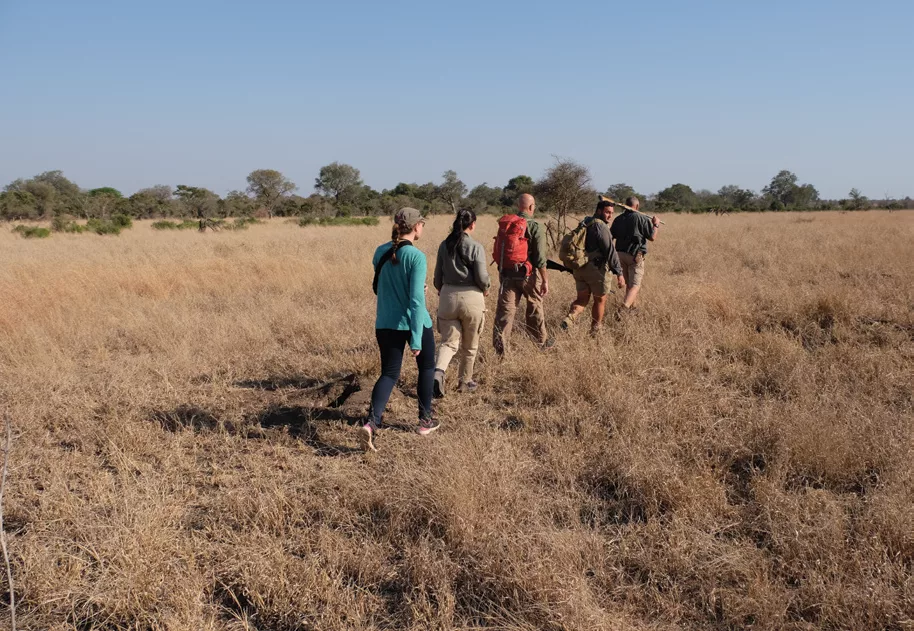
Marius Renke, a former Kruger National Park (KNP) section ranger now working at Kruger Untamed’s seasonal Satara Plains Camp, has spent decades walking around in the park’s wild spaces, but this is a privilege afforded to relatively few visitors and, when such an opportunity arises, having someone like Renke at the front of the line gives great comfort.
After alighting from the game vehicle a few kilometres from the camp, the walk starts alongside a small river fed by a spring, its pools deep and flow strong even after long periods of no rain. A pod of hippos moves past as we stand on the bank and watch. Further on, there are signs of their nighttime activities – flattened grass where they have rested and scattered faeces where territories have been marked.
The birdlife is beguiling. Within a few hundred metres, sightings include a green-backed heron, a Goliath heron, a giant kingfisher, an open-billed stork and a Verreaux’s eagle-owl. A blue wildebeest, lying down some distance away, snorts as it notices that we have strayed into the edge of its area of concern, but doesn’t move just yet.
Treasure retrieved
Lying on the ground is the snapped-off tip of an elephant’s tusk. Renke picks it up and gives it to his ranger colleague, CJ, who puts it in a bag he is carrying. The location of the discovery of the handful of cracked, worn ivory will be recorded and the fragment will join all other ivory found in the KNP in a vault in Skukuza. The incident feels like a metaphor for the sanctity of the place; the value of it being protected and precious.
Later on, having just crossed the river at a narrow point, we look back and see a small herd of elephants on the bank we have just vacated – both parties are happier with this outcome. Renke smiles. He has been pointing out their tracks all morning and knew that we were some way behind them, but he knows better than most that caution and knowledge are only part of the equation and that wild animals are capable of surprising anyone, so this situation – with the elephants feeding peacefully, and us, aware of our presence in their home and grateful to be temporarily allowed to be there – is a best-case scenario.
A walk in the wild is so much more immersive than a game drive, though there are fewer sundowners on offer. Visitors get a chance to try to identify spoor before Renke confirms it – elephant, giraffe, baboon, lion, leopard and even ostrich (it’s an odd one; out of context, it takes you a while to visualise what could have formed that pattern).
As the vehicle arrives to fetch us, a secretary bird, disturbed by our presence, stalks off in some long grass just off the road, waggling its rear like a ’50s Hollywood starlet.
Text and photography | Bruce Dennill
For more information or to book a stay, go to krugeruntamed.com.
There is as much to see from the camp as there is out on game vehicles in a beautiful wilderness area.
Umkumbe means ‘white rhino’ in Shangaan. Nevertheless, it seems that the scientific community is now adopting the term square-lipped rhino instead of white rhino, with the black rhino referred to as the hook-lipped rhino. Both designations are more accurate, considering both species’ actual colour is grey! Umkumbe Safari Lodge Riverside offers visitors a relaxed and laid-back ambience.
The lodge is conveniently located, just a short shuttle ride from Hoedspruit’s Eastgate Airport. The tranquil sound of trickling water in the fountain at the entrance harmonises with the symphony of birdsong and other bush noises, creating a sensory experience.
The meticulously landscaped garden, reminiscent of an English country haven transplanted into the heart of the African wilderness, sets the stage for an extraordinary first impression. Indigenous art punctuates the neutral tones of the lodge buildings, introducing a captivating feature.
The area surrounding the pool could aptly be referred to as the ‘heart’ of the lodge. It serves as a central gathering place for many guests before and after meals, as well as for after returning from exhilarating game drives. Lounging in the pool, guests can gaze at the seasonal Sand River, where fortunate sightings of the Big Five are not uncommon. Guests can enjoy the privilege of witnessing both lions and elephants from the safety of this deck, alongside antelope and various bird species.
Servings in serenity
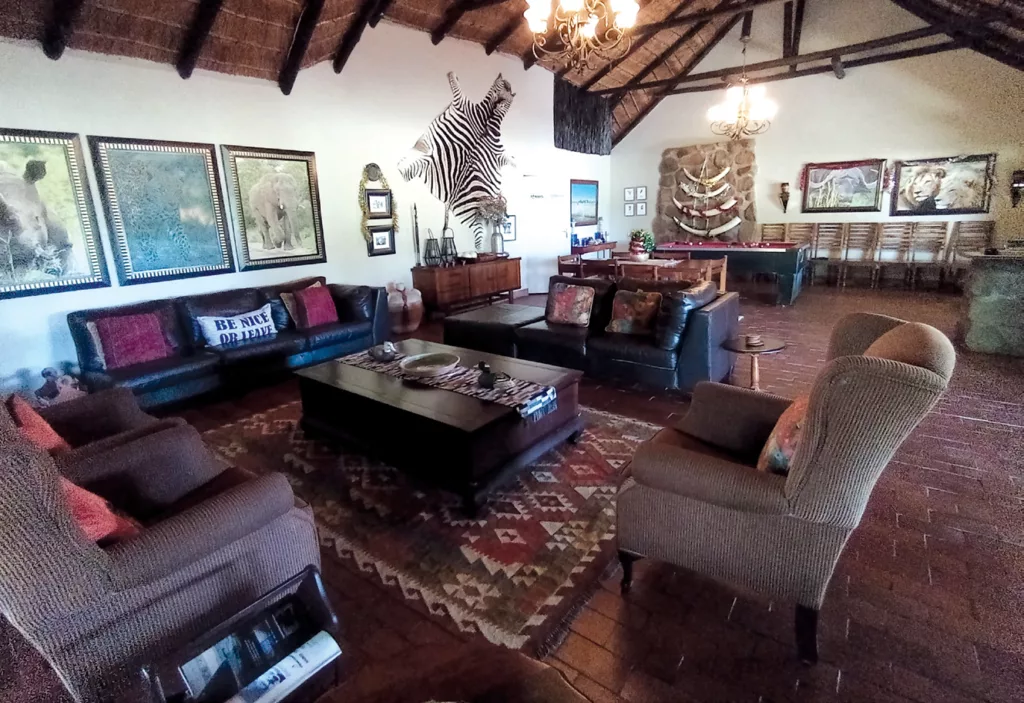
To the left of the pool is the dining area, with a boma behind the fence providing the backdrop for buffet-style meals. An indoor space accommodates a lounge, an intimate dining area and a surprising addition (for a game lodge, at least) – a pool table; a first for me!
The outdoor lounge is where guests and guides convene before setting out on a drive. A tea and coffee station ensures guests remain caffeinated during their stay, bridging the gap between meals and excursions.
All meals, except one boma dinner, are enjoyed on the deck adjacent to the pool and overlooking the river. Given the fact that the meals are prepared in the middle of the bush, it’s incredible that the food on offer would not be out of place in any acclaimed urban restaurant. Served buffet style, all the meals include a vegetarian option for the non-carnivores, a must for today’s health-conscious travellers.
Highly qualified field guides carry out the morning and afternoon game drives, and on the evening drives, there is also a knowledgeable tracker on the vehicle. Given that the lodge is situated in the Sabie Game Reserve, one of the best wildlife areas for leopard sightings, it was not as surprising as it might have been to spot these elusive cats on more than one occasion. The highlight of the visit was certainly spending time with a female leopard and her two cubs.
Sit and see
The Superior suites are situated along the riverbank, each boasting a deck that allows guests to savour private game viewing or perhaps just some relaxation before joining the rest of the guests for meals or drives.
There are echoes of Victorian England seen in the pole lamps interspersed between the rooms, creating an enchanting blend of eras in the heart of the wild.
The interior of the Zebra Superior suite contains everything a visitor could desire and more. Sit inside on the sofa and observe passing game when the weather outside refuses to cooperate or, when waking in the morning, embark on a mini safari from the comfort of your bed before preparing for the morning drive.
The privacy of the suite decks affords a view of the Sand River, providing a front-row seat to observe various game species quenching their thirst or feeding on the lush vegetation along the riverbanks.
An outdoor shower should always be a highlight of any lodge visit – a unique experience every guest should embrace, even in the dead of winter.
Boma dinners are often the introduction to meat prepared on a braai for international tourists. Bomas are known as gathering places for guests to share tales and experiences beneath a star-filled sky. The crackling fire enables international guests to perhaps experience the African bush as it might have been in the early days of local pioneers.
As the night descends, it is time to slip under the mosquito net and settle in for the night, enveloped in superb linen with the sounds of the bush serenading as a lullaby before slipping into the embrace of Morpheus.
The transition from day to night is seamless; an immersive experience in the heart of the wild.
The lodge is a place to create memories of vibrant landscapes, tranquil moments by the pool and distinctive decor. With its welcoming ambience and attention to detail, it provides an enchanting retreat in the heart of the African wilderness, blending comfort with the untamed beauty of nature.
Text and photography | David Batzofin
For more information or to book a stay, go to umkumbe.co.za.
Rich wildlife experience takes place with a major city in the background
As your aircraft descends into Nairobi and prepares to land, a look out of the window might give the impression that the airport is in the middle of the countryside, as you see open green plains, rivers and lakes on the descent.
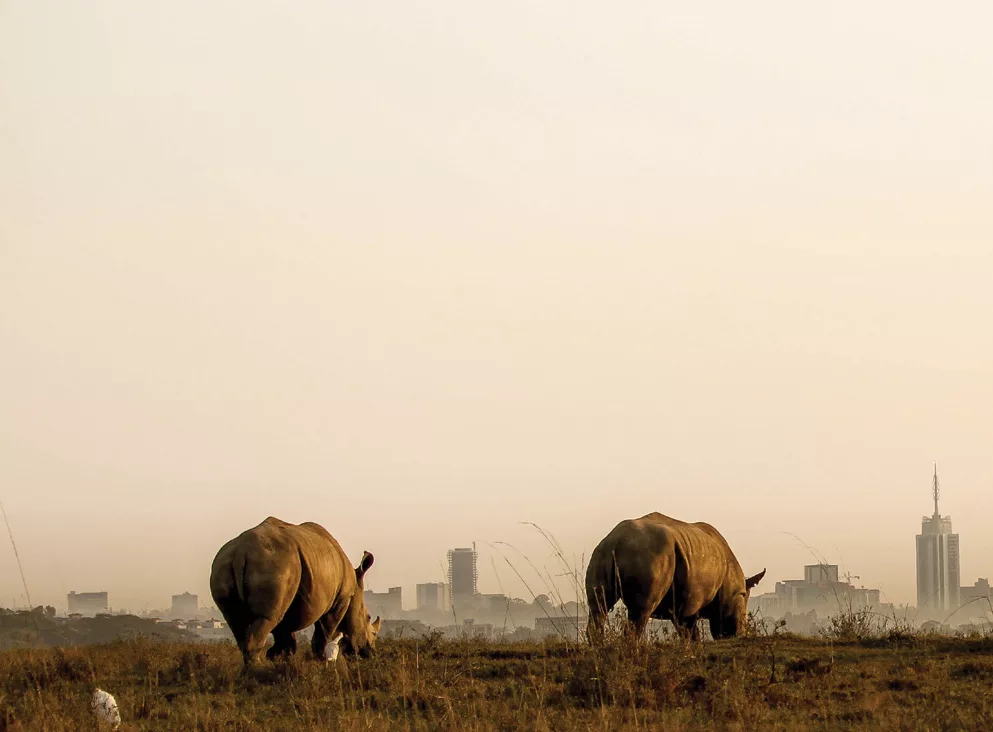
In fact, the approach to Jomo Kenyatta International Airport often comes in over the unique and wonderful Nairobi National Park, with the Kenyan capital being the only African city to have a real wild space populated by four of the Big Five in addition to a huge range of other intriguing bush dwellers.
Within 10 minutes of leaving the airport, it’s possible to be checking in at the East Gate and undergoing the remarkable transition from a noisy, sprawling urban hub to pristine rural bliss where the grass dances in the breeze and the zebras swish their tails to keep the flies off.
This is no urban park as most would know it. Walking here is strictly prohibited, as an encounter with male buffaloes is a real likelihood, as is the possibility of encountering one of the resident lion prides. The park remains unfenced on the side furthest away from the city, allowing the movement of animals through the corridors that connect it with other reserves and which act as a buffer zone against the city.
Often viewed as a stopping-off point for visitors arriving or departing from a safari across the country, it’s no surprise that some visitors have their best sightings right here in this oasis. To make it even better, visitors are blessed with some great options when it comes to their stay in the park and shouldn’t be in any rush to move on to the next stop.
The habitat of 117km² comprises a combination of forest, open plains with dams and rivers, and even hippo pools where you can stretch your legs and take a walk with one of the rangers to look for a wallowing hippo or basking crocodile.
Safari on site
Within the park forest, Nairobi Tented Camp is simple but well-appointed, the essence of the safari experience under canvas with an evening campfire and the opportunity to hear (and sometimes even see) the lions claiming the territory nearby or the sawing leopards’ bark playing as the bush orchestra serenades the visitors.
This is more glamping than camping, with professional chefs whipping up three-course meals, a selection of drinks, hot showers, and flushing toilets. There is plenty to do through the day, with the traditional morning and evening game drives with one of the driver guides being just one activity.
There are many stories of guests emerging from their tents to see a black rhino with its calf outside, calmly browsing on the trees, providing the memory of a lifetime.
Bordering the park is the Ololo Lodge. Crossing the footbridge from the parking area on the park side of the river, a few steps bring visitors up to the immaculate lawn surrounding the swimming pool, the perfect place to spend a leisurely couple of hours with a pair of binoculars, a book, and a cold drink.
It’s not at all unusual to see a black rhino strolling carefree on the other side of the river. In fact, this is one place where these special creatures are thriving, and it’s just a short hop to go and visit Anselm Kitengela Glass and see the talented craftsmen creating an array of glassware – and maybe pick up a souvenir for the family.
Accommodation options range from the tower room – with its rooftop terrace offering stunning vistas across the park towards the city skyline – to the tented and stable rooms, which offer a more budget-friendly alternative.
Across the Mbagathi River lies Emakoko, the life’s work of Anthony and Emma Childs, who spent a long time identifying the right place to create their vision of the perfect home away from home in the bush. Crossing the footbridge from the park, it’s not uncommon to see a crocodile warming itself on the river’s edge below.
The main mess area with the bar greets the arrival of the thirsty, and the house special, a chilli dawa (‘medicine’ in Swahili), is a guaranteed thirst quencher. This is where the hosts mingle with guests by the fireplace in the evening chill and maybe share some of Anthony’s hair-raising encounters with snakes (he is also a director of Kenya’s Taylor Ashe Antivenom Foundation).
The rooms are dotted around the extensive grounds. At the top of the hill sits the newest addition, a private house. Available to families or small groups, this location has its own private pool, bar, and kitchen.
Those with energy can build up an appetite by taking a stroll up the steps to the house or alternatively relax and let a unique funicular do the work and take you up in style.
Safe spaces

Nearby, there are a couple of extra essential options. Visit the giraffe sanctuary, where it’s possible to feed endangered Rothschild giraffes and learn about these giant, graceful creatures.
Another favourite is the Sheldrick elephant orphanage, which rescues orphaned young elephants from around the country and rehabilitates them for release back into the wild as adults.
This magnificent ecosystem has not quite avoided the impact of bordering one of Africa’s fastest-growing cities. A railway bridge now crosses through it, and new roads needed to alleviate congestion have sliced off the edges, while the dream of owning land has led to a significant increase in human/wildlife conflict in neighbouring areas.
In order to ensure its survival, the Nairobi National Park needs to have paying guests who make it viable and provide the resources for the rangers who protect it, the guides who bring it to life, and the critically important ecosystem that it supports.
Text | Simon Marsh
Photography | Simon Marsh, Hemanshu Contractor
For more information or to book a stay, go to emakoko.com, porini.com and olololodge.com
At this time of the year, most South Africans have just one thing on their minds: that big year-end break.
After a hard year of deadlines and trying to keep up with a rapid pace, holidaymakers are looking for the perfect destination – a getaway spot that offers luxurious accommodation, keeps you entertained with endless answers to the question “What should we do today?” and a setting that leaves your heart feeling full.
The good news? You don’t need to look far for this piece of paradise. You’ll find it in the heart of Johannesburg’s new north, where the recently opened Steyn City Hotel by Saxon is redefining ‘urban’ staycations.
What makes this apartment hotel so special? For a start, it represents the confluence between two of South Africa’s most powerful brands. The Saxon Hotel, Villas and Spa is known as one of the most prestigious boutique hotel establishments in the country, offering a level of hospitality that cannot be surpassed.
The Steyn City Hotel continues this proud tradition; indeed, it is already endorsed by Leading Hotels of the World in recognition of the hotel’s commitment to excellence. Steyn City, meanwhile, has been ranked as one of the top 10 lifestyle estates in the world.
One of the factors behind Steyn City’s success is the dedication to creating an unparalleled lifestyle. This begins with the estate’s setting on a 2,000-acre indigenous parkland; a spectacular backdrop that forges an instant connection with nature and makes it impossible to remember that Johannesburg’s major arterial routes, shopping malls and hospitals are just minutes away.
The parkland also sets the scene for a range of activities that delight, entertain and challenge hotel guests. For instance, those who love keeping up their exercise regime while on holiday will be thrilled with the possibilities offered by the 45km promenade that is floodlit, so that you can enjoy sundown jogs or walks.
There’s also a cycle route, along with numerous outdoor exercise stations and even play nodes for children; not to mention floodlit tennis courts, fitness centres and, of course, the 18-hole Nicklaus-design championship golf course.
One of the most stand-out features of Steyn City is the lagoon precinct; the highlight that turns every day into a holiday and transforms Johannesburg into a beach destination to rival the world’s best. Spend the day soaking up the rays before making a splash in the sparkling 300m lagoon… then, try your hand at paddle watersports like kayaking or SUP boarding.
There are waterslides for the kids and padel courts (with an amphitheatre for spectators and change rooms with shower facilities) for the whole family. And, when you need to refuel, the Mediterranean-inspired Family Table restaurant is waiting to delight you.
This is just one of several eateries you’ll find throughout the estate. You can also enjoy bistro-style fare, complete with beautiful views over the golf course, at 19 by Michael, along with family dining at The Farmhouse.
At City Centre, the home of Steyn City Hotel, you’ll find even more options: indulge in sweet treats at Paul’s Homemade Ice Cream, grab a cappuccino at the Seattle Coffee Company, or settle in for a long, lazy Italian-inspired meal at Café del Sol Steyn City, where the much-loved local brand serves authentic pizzas and pastas.
Afterwards, wander around the shops that line the bustling piazza, including Le Creuset and The Gallery at Steyn City. Then, cool down at the hotel’s rooftop pool.
Guests can also enjoy breakfasts and light lunches at Guild, the hotel’s bistro-style restaurant with a well-appointed shared workspace and conferencing facilities. Office assignments may be the last thing on your mind right now, but it’s good to know that the space is also equipped with meeting rooms.
As for the hotel’s accommodation, get ready to enjoy a home away from home. The 50 one-to-four-bedroomed apartments at Steyn City Hotel by Saxon (each offering stunning vistas over the lagoon or treed piazza) have been furnished in a way that ensures that guests want for nothing.
From a kitchen boasting all the appliances you would need at home – including tea- and coffee-making stations, fridges and washing machines – to WiFi. A penthouse and presidential suite are also available, and guests are welcome to make use of the hotel’s concierge service.
Guests will have even more to look forward to from April, when the Saxon Spa at Steyn City opens its doors but, until then, Gautengers can look forward to enjoying their best December yet, without leaving the province!
Text and Photography | Supplied
For more information, go to www.steyncity.co.za
Creating a physical and psychological environment in which a child feels encouraged to study and problem-solve will help them achieve better results.
Academic success at school is becoming more critical than ever in the current economic environment – locally and globally – as competition for jobs and higher education access grows ever more demanding and more challenging.
While schools are essential in shaping a child’s education, parental involvement can significantly enhance their academic performance.
Parents are pivotal in nurturing an environment that fosters learning and growth and should, especially in the foundational years, ensure that their children are provided the correct support to mould and cement their approach to their learning and educational journey.
Developing this environment of educational attainment doesn’t amount to rocket science. However, it is essential to be reminded of the elements that support the successful academic development of children. Parents who are serious about supporting their child’s learning journey can put a helpful framework in place.
The home environment is where a child’s learning journey truly begins. Creating a space conducive to studying is essential. A positive learning environment also extends to the emotional atmosphere at home. Encourage open communication, celebrate achievements and approach challenges with a problem-solving mindset. Children who feel supported are more likely to be motivated and engaged in their studies.
Stay involved
Academic success is not just about grades; it’s about cultivating a lifelong love of learning. Children’s academic performance will naturally improve when learning is a joy rather than a chore.
Encourage your child’s natural curiosity by exploring subjects that interest them beyond the classroom. Whether reading books, visiting museums or engaging in science experiments at home, fostering a sense of wonder and excitement about learning can help children develop a passion for knowledge.
While encouraging your children to strive for excellence is essential, setting realistic expectations is equally important. High pressure can lead to stress and burnout, which are detrimental to academic performance. Work with your child to set achievable goals and break them into manageable tasks. Celebrate milestones along the way, no matter how small. This approach builds confidence and teaches valuable time management and organisational skills.
Active parental involvement is a cornerstone of academic success. This is why attending parent-teacher conferences, monitoring homework and staying informed about your child’s progress is important. Engage in regular discussions about what they’re learning at school and show interest in their assignments.
When parents are actively involved, children are more likely to take their studies seriously and strive to meet the expectations set for them.
Maintaining solid communication with your child’s teachers is also crucial. Regularly check in with educators to understand your child’s strengths and areas for improvement. When parents and educators work together, they create a consistent support system that enhances academic performance.
Question everything
Critical thinking is a vital skill that extends beyond the classroom. Encourage children to think critically by asking open-ended questions and discussing various topics and perspectives. Teaching your child to approach challenges analytically will equip them with the tools they need to excel academically and in life.
Children often mirror the behaviours and attitudes of their parents. So, we should, from our side, show enthusiasm for learning and intellectual curiosity in our own lives. Whether reading books, discussing current events or pursuing a hobby, demonstrating a commitment to personal growth can inspire your child to adopt similar attitudes toward their education and life in general.
Academic success is closely linked to emotional wellbeing, so it is also important to encourage your child to develop strong social skills and emotional intelligence. Teach them how to manage stress, build resilience and develop a growth mindset. Children who feel emotionally supported are more likely to thrive academically, as they are better equipped to handle challenges and setbacks.
Building confidence by celebrating your child’s effort, not just their results, is important. Praise the hard work and determination they put into their studies, regardless of the outcome.
This approach reinforces that persistence and dedication are crucial to success and helps build a resilient mindset. When children understand that effort is valued, they are more likely to persevere through challenges and strive for excellence.
Text | Linda Meyer
Photography | Monkey Business Images
Dr Linda Meyer is MD at IIE Rosebank College. For more information, go to rosebankcollege.co.za.
Physical books and magazines stimulate the brain in ways that digital platforms can’t.
In this digital age, where screens dominate daily life, the idea of reading a physical book, magazine or newspaper may seem old-fashioned. But reading paper-based material can be compared to maintaining a healthy diet.
Print and paper provide unique benefits that nourish the mind in ways that digital formats can’t replicate. Reading paper books feeds the mind through a more captivating experience where readers can absorb ideas and develop a deeper understanding of the material.
Digital platforms are notorious for their distractions, such as ads, hyperlinks and notifications that draw focus away from the core content. In contrast, paper books provide an uninterrupted reading experience, allowing for deep engagement with the content, avoiding the mental equivalent of empty calories.
Digestion is an important function that breaks down food into smaller components so that the body can absorb essential nutrients. In the same way, the slower, deliberate pace of reading paper-based material enhances comprehension and retention of information.
Numerous studies indicate that readers tend to comprehend and retain information significantly – up to eight times – better when engaging with physical books rather than digital screens. The physicality of paper enhances spatial awareness and allows for pen-to-paper annotations.
Good for one, good for all
Regularly reading paper books cultivates strong mental habits such as concentration, memory and critical thinking. And these books tickle our senses in a way that digital books fail to do.
There’s something about the sensation of running your hand over a beautifully illustrated or embossed cover or leafing through the pages. There is also the appealing smell of a new novel or even yellowed, ageing parchment. By judging a book by its cover, its colours and size, we whet our appetites.
Paper books store carbon. Since paper is derived from wood, it acts as a carbon sink, storing the carbon dioxide absorbed by trees during their growth. This sustainable cycle continues as harvested trees are replaced with new saplings, ensuring that wood and paper remain renewable resources.
Digital devices are often considered ‘eco-friendly’; however, e-readers and tablets require significant resources to produce, and irresponsible disposal contributes to electronic waste. Additionally, the energy used to power and recharge digital devices can add up over time.
Better for your brain
Text | Jane Molony
Photography | Monkey Business Images
Jane Molony is executive director of PAMSA, For more information, go to thepaperstory.co.za.
Stevan Wilken, founder and CEO of specialised outdoor advertising company Face First Media, talks to us about being an entrepreneur, a rally driver and a dad.
Can you tell us about yourself and Face First Media?
Stevan Wilken: I’m the founder of the company, which specialises in large-format billboard advertising. We create bold, impactful visuals that grab attention and leave a lasting impression. I started the company from humble beginnings in the small town of Greytown, KZN, and it has grown into something I’m incredibly proud of.
I’ve always believed in the power of great design and storytelling, and Face First Media lets me channel that passion into helping businesses stand out. Of course, none of this would be possible without my incredible team – their hard work and dedication are the backbone of everything we do.
Besides running Face First Media, I have a deep love for motorsports. Wilken Motorsport is more of a hobby than a business – just a way for me to stay connected to something I’ve always been passionate about. (Haha!)
What inspired you to start Face First Media?
I’ve always been fascinated by both the creative and technical sides of advertising. The idea of turning a concept into a massive, larger-than-life billboard really excited me. It’s about capturing someone’s attention in just a few seconds as they pass by, which is powerful.
I wanted to build a company that could deliver that level of impact for clients. I also love working with brands that have big visions – helping them bring their messages to life in a bold way is what drives me.
How do you balance your work and personal life?
As a single dad of two amazing kids – a son and a daughter – balance is everything. My kids are my biggest motivation, and I want to show them the value of hard work and perseverance. Running a business while raising them is challenging, but it’s also incredibly rewarding.
I stay active outside of work, and that helps a lot. My hobbies have taught me discipline and focus. I have a black belt in karate, raced rally cars nationally and, in 2023, I had the unforgettable experience of competing in the Dakar Rally on a motorbike. These experiences remind me that life is about pushing boundaries, both personally and professionally.
What are your plans for the future of Face First Media?
I’m focused on expanding Face First Media’s reach, working with bigger brands and continuing to push the limits of what we can do in billboard advertising. I want to keep creating bold campaigns that truly resonate with audiences.
At the same time, I’m committed to staying humble and grounded. For me, success isn’t just about the business – it’s about being the best version of yourself in every area of life.
Text and Photography | Supplied
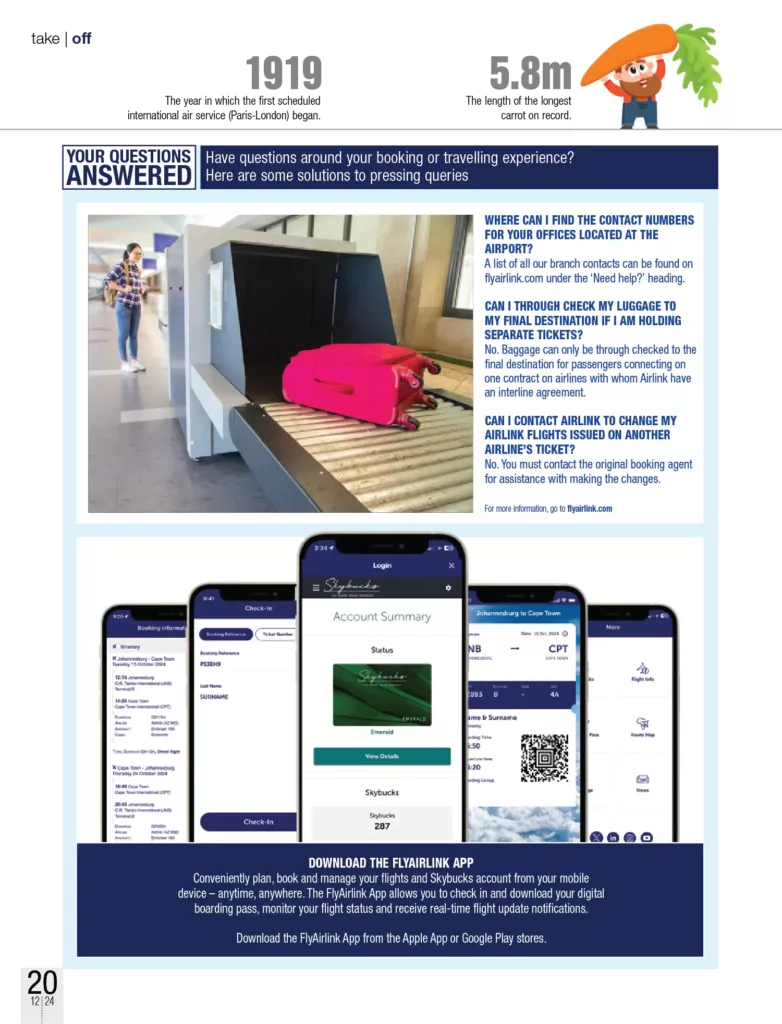
Ross Learmonth embraces where he’s come from and where he’s going as a solo artist.
When did your love for music originate?
Ross Learmonth: I grew up in a home that always had The Beatles or The Rolling Stones playing, and at the age of 16, I overheard a group of kids playing music in the school hall. It was in this moment that I realised that’s what I wanted to do – be a musician.
When did you first realise you have a distinctly amazing singing voice?
That’s a bit of a difficult question to answer, but when people started to tell me that they could pick up my voice in a line-up, it made me realise that perhaps I had something unique and distinctive about my voice. I didn’t know if that was a good or a bad thing, but I knew I loved the act of singing and that I wanted to explore where it could lead.
You play both acoustic and electric guitar. Is there a favourite of the two and why?
I’ve always favoured the acoustic, just for its quick application and the ability to write on it anywhere. I love to pull out the electric for those big songs, but these days I’ve even been playing the bass and piano a lot more live and, through that, exploring my edges.
Throughout your musical journey, what are the other skills you’ve developed?
I always like to think I have the heart of a drummer, but I’ve never acquired the skills – though I’ve been known to slam a good bongo drum! I’ve really started to enjoy the piano more, which I learned to play during lockdown and have actually started using it as my base for a lot of my songwriting over the last few years.
Who have been your musical inspirations and why?
That is a hard one to pinpoint or summarise as it is constantly changing, and depending on where in the world I am, an album just sounds different. Walking down the streets of London, you’ve got to put on a Rolling Stones album, as it’s just so fitting.
But I love a variety of genres, from soul to pop to R&B. I love everything from Leon Bridges, Black Pumas and Chris Cornell to The Killers and Coldplay, with a huge appreciation for Sia and Billie Eilish as songwriters. And surprisingly for some, I’m a Swiftie too.
When and why did you embark on a solo career?
I started experimenting with my solo sound in 2019 and 2020 when I travelled to London and the USA to do some songwriting. I’d only written for Prime Circle. I wanted to explore other sounds, genres, musical directions and avenues, as I felt like I had a lot of music within me that wasn’t necessarily the Prime Circle sound.
It was an exciting time to test my boundaries. I was sitting in rooms with individuals from all different genres, from cowboys to rappers, and I could feel this natural progression. As an artist, I was evolving. I released my first solo single in 2022, followed by a full album in 2023, and then went completely solo as of January 2024.
Are there benefits to ‘flying solo’?
Yes, there are. Although I loved my time being in a band – the good times were really good – as a solo artist, I have a lot more freedom from a creative perspective as well as in a mental health place. There is a different type of pressure and expectation that I put on myself, as there are fewer dynamics at play.
As a solo artist, I also have the opportunity to be selective with where or how I perform.
You are a songwriter. What is your process?
I see myself as a songwriter before being a musician. I talk about this a lot in my shows. I truly believe that if you pay attention to what is floating around a room, you can capture magic.
I love to write in different places and spaces and to see what comes out and up. Writing music is a form of therapy for me, but it is also such an exciting process watching a song come together.
A second solo album! Please tell us a bit more about that.
It’s really exciting! It’s been done in a way that I have never recorded an album before. It’s a bit similar to the process of how they make comic books.
I write a lot at home and then head through to record the basics at Mark Beling’s studio in Johannesburg, who then sends it over to my producing team in the UK, and they work on it there. The big focus for this album is my voice, and as Brendyn ‘Rusti’ Rossouw, my executive producer, says, “trying to honour that initial magic which is captured and not lose it.”
It’s given me an objective approach to the songs, and I don’t overthink them as I tend to do.
The song Honey is written from a personal perspective. Please share the meaning of the song.
Honey started out as your typical love song, but the more I started to develop it, it turned into a self-love song about my own journey of recovery. So, it is an extremely personal and vulnerable song.
I cannot stress how scary that is, but when you hear from people who listen to it that it has helped them or inspired their own decisions to face their own demons, it reminds me of why it is all worth it.
If you watch the music video, it will give a deeper context to the nature of the song. The message is that whatever it is that you’re facing, you need to do it for you.
Exciting projects on the horizon?
Always! Working on new collaborations, gearing up to hit the road again, and, of course, the excitement of performing alongside the Goo Goo Dolls this December!
Text | Heléne Ramackers
Photography | James Reynolds
Follow Ross Learmonth on Instagram: @rosslearmonth.
Buy tickets for the Goo Goo Dolls at Webtickets.
With measles, plague, and cholera all rearing their heads again, are we seeing an unprecedented level of disease re-emergence? And what would it take to start another pandemic?
The first quarter of 2024 heralded outbreaks of measles in the US and the UK, a global shortage of the cholera vaccine, and even a case of bubonic plague for the unlucky owner of an infected cat in Oregon. Infectious diseases we thought were long gone are resurfacing, thanks in part to global conflict, international travel, and climate change. But how much disease re-emergence is normal?
To find out, we spoke to Paul Hunter, Professor in Medicine at the University of East Anglia’s Norwich Medical School.
How normal is it for diseases that we think are gone to come back?
Paul Hunter: The issue is whether they’ve actually gone or not. A lot of infections that were common once and still spread within society can come back with force in the future. Globally, we typically see one or two significant emergences or re-emergences every year, on average.
For many of the classic infectious diseases that seem to re-emerge, they’ve probably been around pretty much the whole time. Re-emergence is usually more on a regional level, such as when cholera spreads into an area that it’s not caused problems in for decades.
Is it possible to fully wipe a disease from the face of the planet?
We did it with smallpox. We thought we might do it with poliomyelitis too, although it’s not looking good. So generally, no, we don’t expect to eradicate most infections. Once the infection spreads globally and through society, you can manage and control it, but they’re almost impossible to eradicate.
With smallpox, the vaccine was highly effective. There was also a lot of will to get rid of the disease, and we could diagnose it fairly easily, so you could quickly tell whether it had spread.
Nowadays, there are a few problems. Many infections are infectious before somebody gets sick. As we saw with COVID, trying to eradicate an infection when people who can spread it are otherwise well is nigh on impossible.
It’s also difficult to do in parts of the world where there’s conflict. While we’ve got vaccines for Ebola now, we weren’t able to control the outbreak in the Democratic Republic of Congo as well as we could have done as a result of conflict there.
What are some of the main ways a virus might return?
The first is that the virus might evolve. We see this particularly with influenza. Sometimes you can get a big step in evolution, which makes that virus spread more rapidly – those are called ‘escaped mutations’. We saw this with COVID, where we got the various mutations coming along.
The other is how the disease spreads into humans. There are some diseases, like plague, that are there all the time in the environment. Sylvatic plague, for example, spreads through rodents. Something might happen to the environment that suddenly brings people into contact with those animals.
We see the occasional case of plague in the US in people who are hunters or who get too close to prairie dogs thinking they look cute. In Madagascar, there was a big outbreak of plague a couple of decades ago, primarily because there was a lot of environmental degradation. Rats living close to humans were also coming into contact with other animals infected with the plague.
The changing climate is also affecting the distribution of many diseases, leading them to spread into areas where they’ve never, or rarely, been seen before. Along the European coast of the Mediterranean, we’re starting to see small outbreaks of dengue fever because of warming.
And another big reason for disease re-emergence is a reduction in vaccination availability or uptake. That’s been driving the problems we’re seeing with measles in the UK at the moment. I had measles when I was a child, and most people in my generation did. But if you’re a lot younger, you’ve never seen a case of measles, so you might think, “Why would I want the vaccine?” Once vaccine uptake drops in a society, measles can start to spread.
Text | Paul Hunter
Prof Paul Hunter is a professor in medicine at the Norwich Medical School, University of East Anglia.
This article appears in Very Interesting #79.
Please click here to receive the current VI issue digitally for FREE!
Trail running is a healthy and exciting activity for both serious and part-time enthusiasts
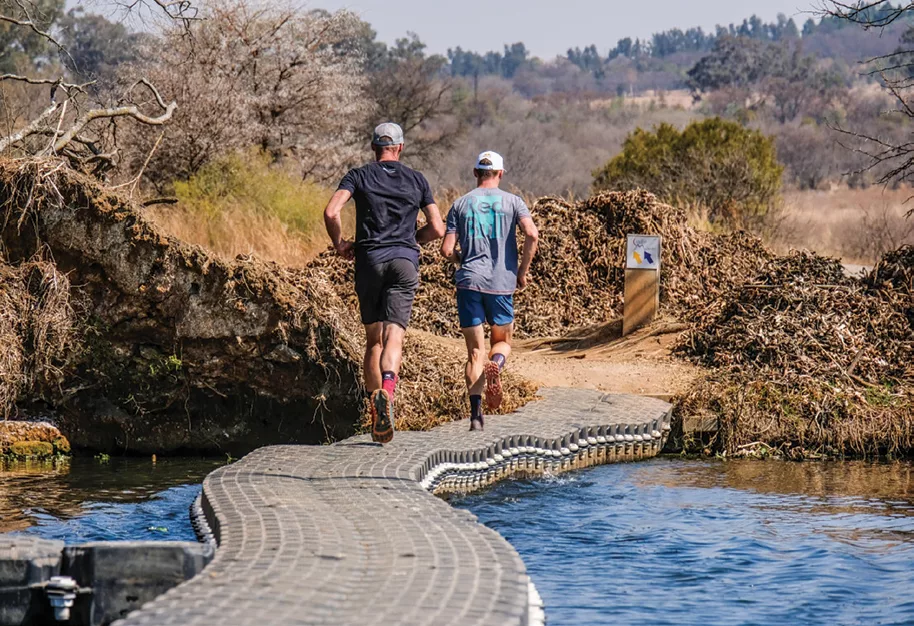
Trail running is one of the fastest-growing sports globally. Yet, in South Africa, there seems to be a misconception that you need to live at the coast to get into it. The truth is that Gauteng offers a range of exciting and accessible trails for both beginners and experienced roadies looking to venture off-road.
Trail running is about connecting with nature and challenging yourself on varied terrain. It’s also a fantastic way to build endurance, strength, and mental focus while exploring beautiful landscapes.
Gauteng might not have the towering mountains of the Cape, but it’s packed with fantastic trail options. The trick (especially for beginners) is to look for well-marked trails with moderate elevation.
Cradle Moon Lakeside Game Lodge offers a variety of trail distances, covering a range of terrain. Hennops Hiking Trail, outside Pretoria, has scenic, well-marked routes that are relatively flat. Groenkloof Nature Reserve provides shorter trails with beautiful wildlife sightings. And Hartebeespoort Trails wind through true mountain conditions for all skill and fitness levels.
Begin the race
The growth in trail running globally can be attributed to a host of things, but one crucial driving force is the low barrier-to-entry cost. Trail running requires a few key pieces of gear that differ from your usual road running kit. Investing in the right equipment can make your runs more enjoyable and safer.
Trail running shoes offer better grip and support for uneven terrain. Look for shoes with aggressive treads for rocky or muddy trails. For longer runs, a hydration vest or belt allows you to carry water, snacks, and essentials such as your mobile phone. And as is the case with other outdoor activities (and road running), lightweight, breathable layers are best for trail running.
If you’re transitioning from road running, it is important to approach trail running with a different mindset. Trails are uneven, rocky, and hilly, which requires different muscle groups and more concentration. Start with shorter, easier trails before working your way up to more challenging routes. Listen to your body and take breaks when needed.
Trail running engages your core and stabiliser muscles more than road running, making it a full-body workout. Elevation changes are common. Begin incorporating hill workouts into your weekly routine to build strength and stamina for climbs and descents.
One of the best ways to stay motivated is by setting a goal, like entering a trail race. Many events have beginner-friendly 5km and more challenging 10km options. Running with others can make the experience more enjoyable and help keep you accountable when it comes to training. Gauteng has several trail running clubs and communities that welcome newcomers.
It doesn’t have to be a big group: a friend or neighbour can make all the difference. Having someone to run with keeps it fun and safe, especially when starting.
Text | Thomas van Tonder
Photography | Dino Lloyd/XTERRA
Thomas van Tonder is a world champion obstacle course racer. For more information, go to xterraplanet.com
Babies making a mess as they eat is part of their learning to function independently
When you first introduce solids to your baby, it’s usually easy to keep things clean because they aren’t very mobile yet. However, as the months go by, they will start swiping the spoon and blowing raspberries into their food, which can quickly become a mess for everyone.
This can be overwhelming, and letting babies get messy might seem like more work than it’s worth. Some parents feel that allowing their children to sit with food all over them, even during meals, is neglectful. But there are good reasons to embrace the mess – to let them get food on their hands, in their hair, and all over their face.
Mealtimes with babies are more than just about eating. They also provide their first experience with active sensory play. Babies are born with five times as many nerves in the brain devoted to receiving and organising sensory information compared to those responsible for movement. This means babies use their senses to explore the world around them. While you can’t let a seven-month-old play in a sandbox or use finger paints because they might eat them, messy textures during mealtime offer meaningful tactile stimulation that helps their brains process and respond to new information. Babies will actively seek out these sensory experiences as part of their curiosity and exploration.
Hand to mouth
When babies get their hands messy with food, they eventually realise that putting their fingers in their mouth results in food. This revelation helps them understand that they can feed themselves. Although it may take months before they can spoon-feed themselves, those early tastes from their fingers lay the foundation for this skill and can lead to quicker progress. This process helps develop fine motor skills as they learn to use their hands and fingers in a controlled manner. If your baby is getting messy but not bringing their hand to their mouth, gently show them how to do it.
Without exposure to different textures, children can become sensitive to new or unfamiliar sensations over time. If you keep your baby very clean during meals, they might find getting messy uncomfortable because it’s a new sensation for them. While tactile defensiveness is not always learnt – some children are naturally tactile defensive – constant wiping and keeping them clean can contribute to discomfort. Allowing them to experience different textures helps prevent this sensitivity.
Allowing babies to get messy can make mealtimes more relaxed and enjoyable. Introducing solids should be a positive experience, fostering a healthy relationship between your baby and food. If you’re constantly fighting to keep them clean or trying to pin them down to wipe their face after each bite, mealtimes can become stressful for both of you. Aim to make mealtimes a positive and enjoyable experience.
Text | Jen Spiro
Photography | Juice Flair
Jen Spiro is co-founder of nurtureOne. For more information, go to nurtureone.co.za.
Author reflects on his time spent in a psychiatric clinic in 2016

Group Room 3 is much bigger than Group Room 2 was, and there are many more people inside speaking in hushed tones. The class hasn’t started but the chatter keeps to a strict shape. It is flat and dull, and there is no laughter. The nine people from Group Room 2 are all here. It’s a shame that some of these people will be here for three weeks.
There’s a large whiteboard on one side of the room. There is a giant circle scribbled onto it with the words ‘WHO AM I?’ written inside. What a concept. I could easily finish this class and check out of the clinic tonight.
Who am I? An atheist. No, “I’m agnostic!” is my go-to response at a braai, should someone ask. But who am I? Lee. I am Lee Molefi. But Lee isn’t even my real name. Is that who I am? When someone searches for Lee Molefi on the internet, do the results that surface make up ‘me’? Zuri doesn’t think so.
“Hello, everyone!” A short, slightly overweight white woman walks into the room with a bounce in her step and some charm to her voice. “I’m Joan, and I will be taking you through this afternoon’s session. How is everyone?” Joan scrubs the large whiteboard.
Whenever Zuri asks where I come from, I grow tense. My bones contract and a rapid heartbeat roots me to the spot. I usually manage to mouth a sorry obfuscation that deflects her attention. “I am a stranger to myself,” isn’t something to say to your girlfriend without inviting being dumped. She thinks I’m from a good family; why would I change her mind? So, I don’t lie to her. I keep silent instead.
Knowing about my past could propel us back to being strangers. There are things I struggle to think about. She has no clue how ugly ‘ugly’ can truly get. I was raised by a single mother of three. The irony is, we wandered through the world in search of safety, but our movements restricted it. As a result, I have never lived somewhere long enough to be a part of something I think of as important. I’ve grown cynical because of this. I believe that, ultimately, nothing matters. Nothing I say matters. Plans don’t matter either; they could change in the middle of the night. The thief in the night – for years on end – was my mother. With a sudden change of mood, she could steal the warm glow of newfound stability with a swift punch to the chest dealt by the sentence, “Pack your things.” And so here I am, because nothing that happened mattered, until my universe overlapped with Zuri’s.
“What was for breakfast? Did you enjoy it?” Joan asks the class to break the ice.
A groan moves across the room.
“The same,” says a woman in the farthest corner of the room. “Oh? What do you think they’re serving for lunch? Will it be chicken or beef? Or both – again?”
Some laugh, others simply stare back at her.
“Today’s session is called ‘Who Am I?’ and I want this to be an interactive session. So, I will start by challenging you to answer the question in the simplest terms you can find. Who wants to go first?”
Silence.
At the far end of the room, a hand flies up as if reaching for the ceiling.
“Yes?”
“Ahem, well I think I am… an individual?” The statement trails into a question.
Joan draws an arrow that shoots out from the circle on the whiteboard and scribbles ‘Individual’ at its tip. A mind map.
Joan doesn’t think it’s a stupid answer. I do. Of course you’re an individual, idiot, but how do you separate yourself from others at a time when your choice of mobile device and whether or not you smoke menthol cigarettes are considered personality traits?
“Please remember, there is no right or wrong answer,” Joan declares, sounding predictably self-helpy.
“Yes?” Joan points encouragingly at another brave patient.
An elderly white woman looks into the distance the way people do when they search for words. It’s impossible to tell how old she is. “I think who you are is measured by the things you do. The things that I do,” she says.
Joan jots it down: ‘Who I am = What I do.’
“That’s a good answer, thank you.”
If who you are is what you do, then I am an awkward dancer who’s terrible at making weekend plans. Can that be absorbed into my identity?
“Once, while I was at work, one of my patients asked who I would be if I had no gender, no race, no name and no job.”
The man speaking is pale and red-haired. He appears short, even when sitting down.
“That really made me think. Maybe I’m the sum of my experiences and not my parts.”
Text | Lesedi Molefi
Photography | SeventyFour
Patient 12A by Lesedi Molefi, published by Pan Macmillan, is available now. For more information, go to panmacmillan.co.za. This excerpt is published by permission.

Feeling time poor isn’t an inescapable part of today’s world. With a few science-backed strategies, it’s possible to reclaim lost hours and finally feel in control of your day.
Just say no
Modern society tells us that saying yes to everything is at the heart of being a good friend, parent, or employee. Whether it’s taking on more at work or organising another hobby for your child, it can soon eat into your time.
Saying no can be daunting. You may worry people will think you’re impolite or inconsiderate. So it may require some practice. What’s the best way to say no calmly and assertively? Research suggests you won’t look particularly likeable if you cite a lack of time (the thinking is everyone is in control of their own time and you’re choosing not to use yours). Instead, consider a) asking for more time, b) being clear you’re saying no due to circumstances out of your control, or c) not giving an excuse at all.
Do a time audit
Mapping out how you use your time is a great way to see where you might be able to find some more. Start by doing a ‘time audit’: log all your activities over a period of time, a week, for example. Note: record all your activities – the meetings, doomscrolling, cooking, even sorting socks.
Don’t worry, you don’t need to track your time to the millisecond. Breaking down your day into 30-minute windows will keep things manageable. And it needn’t be every day – just pick one weekday and one weekend day (avoid Mondays and Fridays as these tend to be atypical days). Once you have your time audit, you can start to take control. For some, time auditing can reveal small changes in routines that can free up extra time. For instance, something simple like batch cooking could help you claw back the 30 minutes per evening you usually spend preparing dinner. For others, however, a wholesale reappraisal of life beckons.
Write an ‘I did’ list
We all want to look back on our days and feel like we accomplished a lot. However, life is so hectic, and we’re so busy adding things to our to-do lists, that we rarely take stock of just how much we have achieved. This can leave us with a constant sense of ‘needing to do more’.
Keeping a diary of your daily achievements is one way to help you develop that much-needed sense of triumph. Try setting aside five minutes every few days to acknowledge just how much you have done. Seeing this all down on paper also gives you the confidence to say no to new requests, helping you to free up future time.
Your ‘I did’ list could also make it feel like you’ve fitted more into your days. It’s all down to how we perceive time: in general, periods that contain many memories are remembered as much fuller than those with few memories. Keeping a diary of your activities may therefore help you to remember the days, weeks, and years as longer – there’s some evidence that marking our time like this even combats the feeling that time passes more quickly as we age. Ultimately, though, it’s a strategy best used to help confirm that you are doing enough – that your time, no matter how much you have, is being well spent.
Text | Prof Ruth Ogden
Illustration | Daniel Crespo
Understanding how you function in relationships has a massive impact on how you choose your job and your potential for success.
Sticking with just one career or life path is, for many, becoming a thing of the past. A better understanding of your personality type can help inform wiser decision-making and a healthier mental state.
Personalities play a major role in work and personal relationships, influencing various key aspects of emotional intelligence, such as how we communicate, how we perceive our world and receive interaction from others, and our ability to resolve conflict and cope with stress. This is central to how relationships play out – from the romantic to the platonic and professional – and impacts the types of careers we choose.
Multiple factors, such as technological developments, economic and geopolitical disruptions, and growing social and environmental pressures, are driving rapid changes in the job market.
Different strokes
Everyone has enduring characteristics that make up their unique approach to life, such as major traits, interests, drives, values, abilities, emotional patterns, and how you see yourself. This makes personality one of the more complex aspects of human behaviour, all the more so because it is moulded by a combination of genetics, life experiences, culture, beliefs, parenting styles, brain structure, and environment.
While today it is commonly accepted that there are 16 core personality types, made up of a combination of psychological and functional archetypes, the simplest and most recognised classification gives us three basic personality types – introversion, extroversion, and ambiversion – as categorised by psychiatrist Carl Jung some 100 years ago.
Introverts focus on their inner world, are reflective and thought-orientated, and tend to prefer solitude. Extroverts are individuals who focus on the outer world, are action-oriented and social. According to Jung, no individual is solely introverted or solely extroverted; instead, personality is on a spectrum between these two dominant types, with ambiverts falling somewhere in the middle.
While extroverted people are likely to thrive in a social, team-based or customer-facing workplace, introverts fare better with independent, analytical tasks. When it comes to romantic relationships, the old saying ‘opposites attract’ can often ring true, but is not necessarily the case.
Management of challenges
Unfortunately, there are cases where the mixture of genetics, life experiences, parenting styles, and environment has been detrimental to an individual’s development, resulting in them having a personality disorder.
Personality disorders tend to negatively impact work and relationships to the extent that clinical intervention is required. That, however, does not mean that people with personality disorders cannot have successful careers.
Borderline personality disorder, for example, makes it difficult for a person to regulate their emotions, putting strain on their relationships with others. This impacts how they cope in stressful situations and how they relate to colleagues and loved ones.
For individuals with borderline personality disorder, a creative or hands-on career path in a supportive and flexible environment would be a good choice. Implementing boundaries and avoiding stressful situations is crucial, as is a continued effort to develop greater self-awareness and understanding.
Text | Tendani Netshilata
Photography | Rawpixel.com
Psychiatrist Dr Tendani Netshilata practises at Netcare Akeso Arcadia. For more information, go to netcare.co.za.
Hyperpigmentation is one of the most common skin concerns in South Africa.
Hyperpigmentation can affect men and women of all ages and all skin tones. It can sometimes be difficult to treat, and those who are prone to it will likely have to manage it continuously.
Hyperpigmentation happens when the skin’s melanin (pigment) production is increased, and this excess melanin takes the shape of dark marks on the skin. There are various reasons why the skin may produce excess melanin, one of which is sun exposure. When skin is exposed to the sun, it produces more melanin to protect itself (which becomes a suntan), but sometimes the skin doesn’t produce melanin evenly, which results in dark patches. Sun-induced hyperpigmentation is especially common in fair skin tones.
Sun exposure can result in dark marks, but it can also worsen hyperpigmentation caused by hormones or injury (including acne scars). Hormonal changes, certain medications or acne may also be to blame. A dermatologist or skincare therapist can help find out what is triggering it and how it can be treated.
To prevent hyperpigmentation from worsening, it is important to stay out of the sun during peak hours (from around 10am to 2pm). This is when the sun’s UV rays are at their strongest and capable of doing the most damage. Cover up with protective clothing, a wide-brimmed hat and sunglasses, and apply sunscreen to all exposed areas.
If you have unwanted dark marks, use skincare products that are formulated for hyperpigmented skin. Vitamin C is widely used for its brightening benefits. It protects the cells in the skin from being injured by free radicals from sun exposure.
Know what works
If you follow Instagram or TikTok, you may be familiar with some of the home remedies people use in an attempt to treat hyperpigmentation. From lemon juice to bicarbonate of soda, social media is filled with DIY skincare recipes. Steer clear of these trends, as they are not proven to be successful and many of them are harmful to the skin.
A common myth is that exfoliating your skin regularly with a scrub will help remove stubborn pigmentation. This is entirely untrue. While exfoliation forms an important part of a healthy skincare regime, mechanical scrubs have a tendency to create microtears in the skin, plus if you overexfoliate, you may actually damage your skin barrier, cause sensitivity and end up worsening the hyperpigmentation.
Post-inflammatory hyperpigmentation (PIH) is the dark marks that remain behind after a pimple has healed. When you pick at blemishes, you not only put your skin at risk of infection, but you also increase your chances of developing PIH. As difficult as it may be, avoid picking at blemishes or touching them unnecessarily.
Text | Supplied
Photography | LADO
For more information, go to lamelle.co.za
Looking after your teeth well involves starting early and staying the course.
Neglecting oral care is not just risking cavities and gum disease – poor dental hygiene can potentially open the door to severe healthcare issues like heart disease, diabetes and respiratory infections.
The oral health journey begins in infancy. Cleaning your baby’s gums is essential even before the first tooth erupts to prevent bacterial buildup. Celebrate the arrival of your child’s first tooth at around six months of age. This is the ideal time to introduce a brushing routine using a soft toothbrush and a tiny bit of infant toothpaste. Early visits to the dentist, ideally by the child’s first birthday, are not only to check for cavities and developmental issues but also to educate parents on proper oral hygiene.
Bringing your child to the dentist early lays the foundations for a lifetime of good oral care habits and helps them get used to the dentist’s rooms. Ultimately, children with healthy teeth can usually chew food easily, learn to speak clearly, smile confidently and retain their teeth to a ripe old age.
Ongoing commitment
From early childhood to adolescence is an exciting time in your child’s development. Children start losing their baby teeth at around six years, and by the age of 12, most of their permanent teeth will have erupted.
The first permanent tooth to appear is usually the first molar, right at the back of the mouth. This makes it particularly important to ensure your child gets right to the back of their mouth when brushing their teeth.
It is vital to encourage children to brush their teeth twice daily and clean each tooth’s front, back and chewing surfaces. It is also advisable for children to start flossing between all teeth at least once a day. Regular dental check-ups every six months are key during this stage of rapid change in the mouth.
The teenage years bring their own dental challenges, such as orthodontic treatments and increased risk of cavities due to dietary choices. Braces or removable appliances are often recommended during this period to correct misalignments and ensure proper bite function.
It is important to be aware of the impact that lifestyle choices such as smoking and diet have on oral health. The use of tobacco can lead to gum disease, tooth decay and oral cancer. Consuming sugary drinks and snacks can result in enamel erosion and cavities.
Getting older does not mean the end of your oral health journey – no matter your age, good oral hygiene habits are always important. Stay vigilant for issues such as gum disease and tooth loss that can arise with age.
According to Harvard Health, as people age, they face new challenges in maintaining oral health. Medications can cause dry mouth, increasing the risk of cavities and gum disease. Older individuals are also more susceptible to oral cancer, which requires regular screenings. Maintaining a diet rich in calcium and vitamins can help keep teeth and gums healthy and it is important to continue visiting the dentist regularly for cleanings and check-ups to address these issues promptly.
Text | Rahul Gathiram
Photography | Yuri A
Dr Rahul Gathiram is dental director of Netcare Medicross medical and dental centres. For more information, go to netcare.co.za.
Going on holiday should be a joy, and taking sensible precautions can help make that the case.
Holidays are a wonderful time to celebrate South Africa’s rich cultural heritage, stunning landscapes and vibrant communities. With December ushering in a season of festivities and outdoor adventures, the number of both international and local travellers steadily increases. And while this boost is great for tourism, it also means more vehicles on the road and a greater risk of accidents.
To stay safe, drivers are urged to be on high alert.
Ensuring your vehicle is in good condition is as vital as practising safe driving. Check your car’s oil, water and fuel levels and confirm that your spare tyre is properly inflated and puncture-free. It’s also useful to have a few basic tools on hand to use in the event of an accident or emergency stop. These include a jack, a jump starter kit, a first aid kit and a warning triangle.
Even seasoned drivers can lose concentration on extended excursions. Plan to take regular breaks, stopping every one to two hours to stretch your legs and have a rest or a snack if you’re the designated driver. Staying alert is crucial, especially on highways where you’ll be sharing the road with large vehicles, buses and trucks.
Hydration is equally important, so balance your caffeine intake with regular water breaks. Driving with the window down can also help keep you refreshed, while engaging podcasts or audiobooks can maintain your mental sharpness during long journeys.
Watch others
Driving safely isn’t just about your own habits; you need to be aware of others on the road too. Reckless or drunk drivers pose significant risks, especially during busy periods. Keep aware of your surroundings by regularly checking your rear and side mirrors, even on long stretches of road. This helps you anticipate potential hazards and avoid drivers behaving unpredictably.
Additionally, keep in mind that foreign visitors might not be familiar with South Africa’s road safety rules. Exercising extra caution around other motorists can make all the difference in avoiding accidents.
One of the most effective ways to protect yourself on the road is to have comprehensive vehicle insurance. Before setting off, review your policy to understand what you’re covered for. In the event of an accident, insurance can prevent significant financial loss, making it a crucial investment.
If you’re travelling with valuables, consider portable possessions cover as well. Think about keeping items like keys, jewellery, phones and handbags protected while on the move.
And while you’re out enjoying your road trip, don’t forget about the security of your home. Before you leave, check that all doors and windows are securely locked and set your home alarm if you have one.
Text | Siyakha Masiye
Photography | Yta23
Siyakha Masiye is a spokesperson at MiWay Insurance.
For more information, go to miway.co.za.
The holidays can be a joyful time for togetherness, but they can also reignite family tensions. Political debates, old grudges and unspoken frustrations often find their way to the dinner table.
In a Crucial Learning survey, 85% of respondents said family gatherings include at least one heated argument. Instead of strengthening bonds, these conflicts can erode relationships over time.
Heléne Vermaak, Director at The Human Edge, says our inability to remain on our best social behaviour during the holidays lies not in the holidays themselves, but in the fact that we’re not very good at holding crucial conversations.
The holidays just bring us together, where we then bring our imperfect social skills into play. How about your family?
Which of the following unhealthy conversational strategies is present in your family gatherings?
If you answered yes to some of these profiles, then your family gatherings are probably less joyful than they could be. But it doesn’t have to be this way.
We’re not going to fix uncomfortable family dynamics over one dinner, and that’s okay. By being mindful of our reactions to stress and practising compassion, we can navigate family drama without getting caught up in it.
We suggest you add a Crucial Conversations Programme to your 2025 to-do list.
Crucial steps to turn family gatherings from a tense and explosive forum into a healthy and nurturing environment:
Start with heart: In a crucial moment, our intent often falters before our behaviour. Focus on what you really want, ask yourself: “What do I really want? For myself? For the other person? For the relationship? For the whole family?”
Manage your emotions: Step back and separate facts from your story. In a crucial moment, we tend to store feelings and conclusions, but not the facts that created them. Before reacting, pause to gather facts and assess the basic information that led to your feelings.
Go public and speak up early: Be open about how you communicate with each other. If someone slips into debate tactics, plays the martyr or uses guilt, pause to address it. Most people weigh the risks of speaking up, but those skilled in dialogue consider the risks of staying silent. By speaking up early and often, they prevent issues from worsening and avoid the need to work around unresolved problems.
Text | Heléne Vermaak
Photography | Supplied
For more details, contact The Human Edge at hello@humanedge.co.za or call 012 345 6281
Bestselling author John van de Ruit has returned with another instalment of his popular Spud series.
Writing a book is a huge commitment. What are the elements that need to be in place if you are going to meet whatever writing goals you set?
John van de Ruit: Writing a book, and here I refer to a novel rather than a non-fiction book, isn’t at all what many people think it is. The process has been romanticised for centuries in popular culture and that’s why so many people believe they have a bestselling novel in them, despite the vast divide between an incredible story and a novel. Beyond the obvious elements of the craft, it requires human elements too: tenacity, endless belief, imagination, trouble-shooting skills, a strong team around you who back you, a willingness to step away from your life and friends for years at a time, the ability to live with constant doubt and receive firm critique with open arms, while exploring every corner of yourself – particularly the ones that you tend to keep to yourself. To be able to negotiate all this and not lose yourself or your story or your gees along the way is probably the most challenging aspect.
Conversely, what are the strangest or most creative procrastination techniques you’ve devised to avoid all that work?
I’ve made a living out of my writing – and previously acting – since leaving university. Just like writer’s block, I don’t do procrastination, because I set my own deadlines according to a greater plan set out by my publisher. If I find myself procrastinating, it’s usually because the work is still settling in my brain or I’m puzzling over a dramatic or comedic shift and figuring out whether it will work.
Like any human, I’m not immune to gross acts of procrastination. I once hit the pause button to do a birding year. I saw over 550 species, but non-birders – most of the population – would surely regard this as egregious slacking off!
Is there a specific author (or writer or journalist) who made you feel “I want to be an author”? And what was it about them that spurred that feeling – anything from admirable eloquence to an outrageous public persona?
There were two authors and a playwright whose work not only inspired me to write but made me believe that I could write too. The playwright was Paul Slabolepszy. I read Saturday Night At The Palace as a drama setwork as a young lad and it blew me out of my shoes. Aside from the brilliance of the work, the way Slab captured the character and the authentic speech of ordinary people triggered something.
Hemingway came next. He’s a divisive character in literary circles but a great writer whose work taught me that brilliant writing didn’t have to be poetic and obsessively descriptive – but rather pared down to its essence. This is important if you’re writing a comedic novel.
Finally, Joseph Heller’s Catch-22 added the elements of humour rooted in the absurdity of humankind. I believe if it wasn’t for this novel, I wouldn’t have written Spud.
Do you tend to read the same kind of material (genre- or style-wise) that you prefer to write? If yes, what makes that particular niche so attractive to you? If no, what do you think it is that makes each different area appealing?
I have developed a rule over my years as a writer: I never read books while I’m writing a novel. If you’re consumed with a novel, working all day and reflecting about it at night, there isn’t that headspace, for me at least, to step into another world and escape the one you’re creating. When I hit a break in writing, I tend to read broadly.
I’ve been through phases with genres, and of course I’m always looking for the next Catch-22 – a genuinely funny book that climbs under your skin too. I also read books I’ve missed while writing my own – so there’s an element of catch-up too. The other reason I don’t read books while writing one is that I’m a helpless mimic. If I’m reading Stephen King before going to bed, Spud would no doubt find a way to sound just like Stephen in the morning.
Outside of your profession, what role do books play in your life? Are you constantly reading; is your house lined with bookshelves; are books the ideal gift to give or receive?
I have many bookshelves filled with books, so I guess not seeing books every day would be strange. Recently, I’ve done a slimming down of the shelves, keeping the books that I value or that captivate me. There are also other important books, like classics, that you treasure.
But unless it’s a limited edition of a classic or favourite or an absolute must-read slam dunk, I wouldn’t suggest choosing a book for me as a present because I am selective – a book voucher would be much wiser.
Text | Bruce Dennill
Photography | Supplied
Spud: The Reunion by John van de Ruit is published by Pan Macmillan South Africa and is available now. For more information, go to panmacmillan.co.za

Good mental health in the workplace includes validating the work you are doing.
The past few years have seen a turnaround in the awareness of mental health conditions and how they affect us in the workplace. Phrases like ‘trigger warning’, ‘PTSD’ and ‘workplace toxicity’ are becoming commonplace, and a wider acceptance of the importance of nurturing mental health has been found.
The key to building positive and inclusive workspaces that feed resilient mindsets is ensuring communication remains open. The way for a leader to do that is by facilitating a ‘coaching culture’ – putting the team ahead of yourself and remaining open to learning. The first thing to understand is that a workplace’s policies and procedures should guide the behaviour within that space. Businesses with well-established values generally have healthier cultures and happy employees. This reinforces the need to establish a foundation of values that guide an organisation.
Nobody can force anger out of you. If you find that a certain manager or coworker continually brings out frustration in you, there may be some internal work you need to do ahead of approaching the HR department to file a complaint. Journalling to better examine the scenarios that have been playing out by questioning and answering yourself honestly:
An emotional space
The best thing to do is to rely on existing policies and procedures to guide the process. Anyone who is bullying or harassing employees will be taken to task if the organisation is invested in their growth.
As difficult as it may be, it is worth looking at if the job is vital to your overall career growth and if there could be better options available.
The hardest part can be the self-awareness journey when individuals realise that perhaps their boss was acting within reason, but they have allowed their own emotions to control and guide the situation. It can be normal for workplaces to be stressful and demanding; the difference lies in how an individual copes with the demands of a job.
A toxic work environment is different from an environment in which an individual may not thrive, and recognising this is key to recovering from workplace trauma. People tend to spotlight the negative elements of their workspaces, which seems to heighten their feelings of insecurity and anxiety.
Having a ‘crucial conversation’ with a manager is tough, but the best start is having a hard conversation with yourself. Recovering from bullying at work requires confidence-building exercises and the willingness to take accountability.
Constantly work on yourself. This can be doing anything important to you and is not limited to growing your career. Commit to doing things that make you happy. Set healthy boundaries. Decide on non-negotiables around your health, work life and hobbies.
Stop seeking external validation. Decide on the values you wish to uphold and set goals to achieve them. Do not only seek affirmation from others, as you can validate yourself by acknowledging your strengths.
Text | Alvin Govender
Photography | fizkes
Alvin Govender is the CEO of Awakening Leadership.
For more information, go to awakeningleadership.co.za
Reconsidering how you’re using your money from time to time is a good idea.
Reassessing financial goals and refreshing your focus can be especially challenging for those who lack financial literacy. According to S&P Global, South Africa is sitting at a 42% literacy rate, which means that there is room for improvement. Decluttering your finances can help you set yourself up for a prosperous future.
Your budget is the foundation of your financial health. Start by revisiting it and identifying areas where you can cut back. Consistent budgeting ensures that you live within your means and stay aligned with your financial goals. Regularly reevaluate those goals. Whether you’re saving for retirement, a new home, or your child’s education, ensure that your goals are still relevant and attainable. Consult a financial adviser to help you set or adjust these goals.
With the launch of the two-pot retirement system, it’s more important than ever to focus on preserving your retirement savings. This system allows you to access a portion of your funds during an emergency while safeguarding the rest for the future.
Understanding how to navigate this system requires a solid grasp of financial literacy, so take the time to educate yourself and make informed decisions about your future finances.
Move the goalposts
As life progresses, your needs change. If you bought a house, had a baby, or your child is going to university, it would make sense to review your insurance cover. Have a look at your funeral cover, life insurance, and other policies to ensure that they still meet your needs. Adequate coverage provides peace of mind and protects your loved ones from financial hardship.
According to SearchWorks data, the average South African consumer allocates about 62% of their take-home pay to servicing debt. This is a difficult reality that makes it tough for long-term savings to grow. But just as a garden thrives when properly tended, your finances will flourish when you manage your debt effectively. Focus on paying off high-interest, low-balance debts first and create a plan to tackle the rest. Debt management is crucial for long-term financial security.
Whether you’re contributing to a retirement fund, investing in the stock market, or simply saving for a rainy day, growing your financial reserves is essential for future stability. An emergency fund is an excellent place to start and should ideally consist of three to six months of your expenses. This ensures that you have reserves put aside if unexpected expenses arise.
Financial clean-ups need to be more than just a seasonal chore.
Text | Nidia Lourens
Photography | Andrey_Popov
Nidia Lourens is Senior Actuary at Metropolitan Life.
For more information, go to metropolitan.co.za
In labour disputes, silence can sometimes be interpreted as consent.
The Labour Relations Act (LRA) gives the Labour Court and Labour Appeal Court numerous powers to make decisions relating to labour disputes. Section 158 of the Act gives the Labour Court the power to make, among others, orders enforcing compliance with the provisions of the LRA and reviewing awards and rulings made by CCMA and bargaining council arbitrators.
The Labour Appeal Court has higher powers than the Labour Court and can hear appeals against the decisions made by that court. Between them, these two courts have substantial powers. And they’re not normally reluctant to exercise their powers strongly, even if it results in a severe financial burden to the party on the receiving end.

For this reason, it’s crucial that parties are meticulous in the way that they treat employees and in the way that they deal with legal processes. One aspect of this is the legal principle that ‘silence can mean consent’. This means that, if a party (first party) receives a legal letter from the other party (second party), it needs to reply to that letter, especially if it does not accept the contents. Failure to dispute the second party’s claim or to refuse its request can be seen to mean that it accepts the second party’s claim.
Costly mistake
In the case of MEC: Department of Education, KZN vs Hendrik Cumaio, the employer invoked section 14(1)(a) of the Employment of Educators Act, which allowed employers to discharge an employee who was absent without leave for more than 14 days. However, the employer counted 14 calendar days of absence instead of 14 working days and thus invoked this section erroneously.
The employee later applied to the employer for reinstatement, but the employer failed to respond. The employee then applied to the Labour Court to nullify his discharge, and the Court found in his favour. The Labour Appeal Court (LAC) upheld this judgement and held that the employee’s discharge was null and void. The LAC ordered the employer to reinstate the employee retrospectively for 6.75 years and pay the employee’s legal costs.
This costly outcome could have been avoided if the employer had appreciated the principle of ‘silence means consent’ and had interpreted the Employment of Educators Act correctly. This shows how important it is for employers to understand legal principles, which understanding is best achieved via training of those executives responsible for dealing with employment matters.
Text | Ivan Israelstam
Photography | Yulai Studio
Ivan Israelstam is Chief Executive of Labour Law Management Consulting. Contact him on 011 888 7944 or 082 852 2973, or at ivan@labourlawadvice.co.za. For more information, go to labourlawvideos.co.za.
It’s important to be aware of the vulnerability of both soft- and hardware when on the road.
Business travel fuels growth for many South African companies, driving expansion through new connections, sealing deals, and unlocking opportunities in diverse markets. However, data reveals a significant cost associated with these trips.
From August to October 2023, companies typically spent R15,138 per domestic trip and R34,943 per international business travel. These high costs highlight the critical need for companies to ensure that their employees are safeguarded against cyber threats. Cyber attacks targeting business travellers can lead to hefty financial losses, further impacting a company’s bottom line.
However, according to Cisco’s recently released Cybersecurity Readiness Index, only 5% of organisations in South Africa are classified as having a mature level of cyber-security readiness, indicating a significant gap in protection against cyber threats.
Technology allows us to make the most of time away from the physical office like never before. Unfortunately, criminals can ruin what should be a productive time. Being aware of common attacks and how to defeat them helps us stay secure and focus on our business objectives without worrying about security.
When travelling with a device, employees must make sure that they have taken a back-up, uploaded any confidential information to secure storage, and removed it from local storage. They should also have alternative access to critical functionality, such as access to two-factor authentication requests if their phone is lost or stolen.
It is also important to keep the devices securely out of sight. Employees must be aware of their surroundings when using devices, as thieves are adept at snatching devices in busy areas and sneakily spiriting them away when attentions are elsewhere.
There is always the temptation to save on data-roaming charges and allowances by joining public networks or WiFi. However, it may be worth considering paying the extra tariffs to keep data safe. Shared public networks may be shared with dubious characters, or an apparently free-to-use network may be a malicious decoy network set-up to dupe the unwary. A criminal snooping a network can steal cookies or session tokens to gain access to confidential services. Network traffic from financial or private apps can be intercepted or modified. Alternatively, an attacker may create a man-in-the-middle attack to impersonate a key system while intercepting and modifying data.
Check and recheck
It’s also worth applying a few extra precautions while in unfamiliar locations when it comes to security and privacy. Travellers must remember to log out of any devices such as Smart TVs, and not to store any credentials. Otherwise, subsequent guests may be able to access their accounts.
They should also be aware that room keys may have been cloned or stolen. As a result, they mustn’t leave valuables or devices unsecured, even in an otherwise locked location. Similarly, respectable networks provided for guests may be being shared with dubious characters or may have been tampered with by previous guests to harvest credentials or session tokens.
When booking accommodation, the business or employee must double-check that the booking site is the genuine article and not a cloned site that will take your money but not provide a valid, recognised booking. Never agree to pay for accommodation outside of the official booking mechanism, as you won’t have any recourse to get a refund if the booking is fraudulent.
Business trips often involve attending conferences and meetings. Travellers must be cautious with their devices at these events, as criminals can swiftly steal devices or upload malware. They should avoid handing their devices to strangers for photos. QR codes are also common but can be replaced with malicious ones. Employees must verify the authenticity of QR codes before scanning and avoid offers that seem too good to be true, especially if they require personal details.
When business travellers are out of secure network environments, it’s crucial that they stay aware of their surroundings and practise good cyber-security hygiene to ensure a secure and productive business trip.
Text | Martin Lee
Photography | filippo giuliani
Martin Lee is EMEA Lead for Cisco Talos. For more information, go to cisco.com.
Laying the foundation for a first part is an important part of any student’s tertiary education.
With thousands of students having just completed the final phase of their graduate studies, they must consider their career strategies to ensure they are able to successfully transition into the world of work.
While university years are filled with lectures, exams, and assignments, they also offer invaluable opportunities to build the foundation for professional life. Employers look for more than just academic qualifications: they want candidates who are well-rounded, experienced, and ready to contribute from day one.
One of the most effective ways to prepare for the workforce is by gaining practical experience while in university. Internships, part-time jobs, or volunteer work provide hands-on experience, allowing for the application of knowledge. This helps develop essential workplace skills such as teamwork, communication, and problem-solving.
In South Africa, many companies offer internship programmes specifically designed for students, and students are encouraged to investigate opportunities in their field.
Prepare your package
Networking is a crucial aspect of career development, and the sooner you start, the better. Take advantage of networking opportunities such as career fairs, industry conferences, and university events. Join student organisations, clubs, and societies related to your field of study – these groups often have strong connections with industry professionals.
Building your professional network online through platforms such as LinkedIn is a non-negotiable to be noticed by companies and employers you may not necessarily be able to reach in person – yet.
Your personal brand is how you present yourself to potential employers and plays a critical role in your career success – in particular when you need to stand out among a sea of candidates. Start by identifying your unique strengths, skills, and values. What sets you apart? What are your career goals? Once you clearly understand your personal brand, ensure that it is reflected in your profiles and interactions. A solid personal brand is also about consistency. How you communicate, online and offline, should align with the image you want to project.
Technical skills and academic knowledge are important, but soft skills such as communication, teamwork, and adaptability often set candidates apart in the job market. Many universities offer career services that include training in areas like résumé writing, interview techniques, and professional etiquette. These resources can be invaluable as you prepare to enter the workforce.
Start researching potential employers and industries that align with your career goals. Look for companies that match your skills and interests, share your values, and offer opportunities for growth and development. Spend time creating a professional résumé and portfolio that will stand out.
Prepare for the job search and interview process, with the understanding that this process is a job in itself. Set aside weekly time to search for job openings, tailor your application materials, and follow up with employers. Practise your interview skills with friends.
Text | James Read
Photography | RossHelen
James Read is Senior Manager at the Independent Institute of Education’s Rosebank College. For more information, go to rosebankcollege.co.za.
Competence serves as the bedrock upon which a secure and efficient workplace is built.
Competence equips employees with the skills to execute their tasks proficiently while fostering adaptability to industry change and technological advancements. In the context of workplace safety, competence elevates technical expertise into the ability to accurately assess risks, make well-informed decisions, and respond effectively within dynamic working environments.
Employees with up-to-date knowledge and skills have more confidence in their abilities to identify and mitigate potential hazards, but this confidence requires organisations to invest in ongoing skills development and reskilling to establish the foundation of competency. Despite being an ongoing requirement, this is a worthwhile investment for safety-conscious organisations, as it will ultimately translate to a substantial reduction in workplace accidents and injuries.
The concept of the ‘three Cs of safety’, in which compliance, competence, and commitment are inextricably intertwined, highlights the pivotal role of know-how and proficiency in achieving a safe and productive workplace. While commitment and compliance are essential, these are optimally realised when employees are equipped with the necessary skills and knowledge to perform with competence.
A competent workforce is more likely to recognise hazards, adhere to safety protocols, and respond appropriately to challenges, which in turn contributes to the advancement of a culture of safety.
Keep learning
To cultivate a competent workforce, organisations must prioritise ongoing skill development and reskilling, which can be achieved in several ways.
On-the-job training and coaching offer invaluable opportunities for practical skill acquisition and mentorship, and regular refresher training sessions ensure that employees stay abreast of the latest safety practices, regulations, and procedural updates for their industry. Additionally, providing access to online learning resources empowers employees to take ownership of their professional development, while encouraging employees to pursue formal certifications demonstrates a commitment to continuous learning and professional growth.
Investing in competence should not be seen as an operational expense, but rather as a move that aligns seamlessly with the organisation’s strategic safety objectives. By prioritising skill development, organisations create a safer work environment, reduce the frequency and severity of accidents, and enhance overall operational efficiency. This contributes to cost savings, improved employee morale, and a positive business reputation.
Cultivating a culture of lifelong learning is essential to sustaining a competent workforce. By offering diverse learning opportunities, such as formal training, workshops, conferences, and online courses, organisations empower employees to expand their knowledge and skills. Providing access to mentorship programmes, job rotations, and project-based learning can facilitate skill development and knowledge sharing.
Recognising and rewarding employees for their learning achievements is vital in reinforcing the importance of continuous development. Celebrating successes, big and small, motivates employees to pursue further learning opportunities. Furthermore, creating a psychologically safe environment where employees feel comfortable raising objections to unsafe working conditions or voicing uncertainty is essential for fostering a culture of learning through accountability. Open communication channels and a willingness to share knowledge and experiences among employees can facilitate knowledge transfer and enhance collaboration.
Text | Sian Thurtell
Photography | Gorgev
Sian Thurtell is Chief Operating Officer at KBC Health & Safety.
For more information, go to kbcsafety.com.
Childcare during the holiday season is less stressful when working using hybrid models.
A study of over 1,000 working parents by International Workplace Group found that 61% said school holidays are stressful due to juggling childcare and work commitments. In contrast, 63% have their working life impacted by family routine during the holidays.
This, in turn, affects workplace productivity over holiday time, with 42% of parents saying they reduce their working hours, while half resort to annual leave to take care of their children.
Over three-quarters of parents say they would use local workspaces to alleviate stress if employers gave them better access and greater choice over when and where they work. This is particularly pertinent to younger parents, with 92% of those aged 35 or under saying they would use a local workspace if they could.
The substantial costs associated with childcare mean that half of parents opt to use their annual leave to care for their children during holidays. Moreover, over one in 10 parents exhaust all their annual leave for childcare, and one in 20 have to take unpaid leave to manage their responsibilities.
The stress of the holidays has been shown to negatively impact families, with almost a quarter of parents reporting family arguments over childcare and one in five feeling like their child resented them due to working during the holidays.
Additionally, the burden of holiday childcare stress was disproportionately felt by mothers (27%), who are nearly twice as likely to feel like their children resented them due to the pressures of balancing work and home, compared to fathers (14%).
New views
The exponential growth of hybrid working in recent years has changed how businesses operate. Another recent International Workplace Group study shows that three-quarters of CEOs say asking employees to work full-time from a central office is not a business priority, with research also underlining that hybrid working has been instrumental in facilitating a better balance for women between their work responsibilities and family commitments, with 89% reporting an improvement in this due to flexible working.
This advocacy from business leaders is starting to make a difference to their employees; compared to the same data captured in 2023, it is clear that hybrid working is continuing to make a difference to parents’ experiences. There has been an 8% decrease in family arguments over childcare and, despite the numbers still being high, a 6% drop in parents having to use annual leave to cater for childcare responsibilities.
Hybrid working not only supports the wellbeing of families but also contributes to the overall mental health and job satisfaction of employees. Employers can foster a more supportive and productive work environment by accommodating the needs of working parents through better access to a range of places to work, particularly local workspaces during these peak times.
Text | Supplied
Photography | Drazen Zigic
For more information, go to iwgplc.com.
Competence serves as the bedrock upon which a secure and efficient workplace is built.
Remote work has become a new reality for many professionals. Employees often handle sensitive information, which presents a risk of compromise when operating outside an office environment. Remote workers can ensure all their data remains secure in a number of ways.
Despite the popularity of the ‘bring your own device’ approach, it’s wise to maintain a clear distinction between work-related and personal devices. It’s advisable to perform work-related tasks exclusively on a dedicated work laptop and reserve activities such as watching movies, downloading games, or checking personal emails for personal devices. This practice reduces the risk of potential data breaches. To further protect personal devices, using a reliable security solution helps to prevent the download of malware and access to malicious sites.
Engaging in work-related discussions through personal messaging apps or email accounts may introduce unnecessary risks. While many personal services tout their security measures, corporate communication tools are designed with enhanced privacy standards and compliance in mind. Relying solely on company-approved platforms ensures that sensitive information remains protected.
The same rules apply to programmes – download and use only the applications provided or approved by the organisation. Third-party software can introduce vulnerabilities that may compromise security. If additional tools are necessary for job performance, request them from the organisation directly.
Keep channels protected
For remote workers, it’s advisable to avoid using public WiFi networks. If the connection is a necessity, verifying the legitimacy of the network with facility staff in a café or airport can reduce the risk of connecting to deceptive networks targeting personal information. When connecting with a personal device, utilising a reliable VPN can enhance security by encrypting data and safeguarding online activities from unauthorised access.
Passwords act as gateways to sensitive information, so maintaining their confidentiality is crucial. Storing passwords on paper, even in secure locations at home, is not a secure practice. It may be beneficial to use the association method for creating passwords that are both memorable and complex. For example, the phrase “In 2015, I celebrated my birthday in Tokyo” could be transformed into a password “In20:15IcmBD@T”.
Text | Supplied
Photography | Hryshchyshen Serhii
For more information, go to kaspersky.co.za.
No matter how big or small, any business can be a target for cyber attackers.
While some business owners think they’re too small to be noticed, the numbers tell a different story. In 2023 alone, over 343 million people fell victim to cyber crimes, and it doesn’t look like it’s slowing down.
Any organisation – whether it’s in the private sector, public sector or even a charity – can be hit by a cyber attack. Small businesses are targeted 43% of the time, but only 14% are ready to defend themselves.
Understanding the commonalities between victims and knowing how hackers select their targets is crucial to developing strong cyber-security defences. For most hackers, the main motivation behind their attacks is pretty straightforward: money. That’s why they often use tactics like ransomware to blackmail victims or phishing schemes to trick people into making fake payments. However, there are other reasons too.
So, what makes a business a tempting target?
Hackers wanting money might target a business because of its financial worth or the valuable information it holds. Personal data, like financial details and customer info, can be sold on the dark web. That’s why companies with a lot of customer data, like those in the financial services industry, are prime targets.
Some hackers target businesses for valuable information like trade secrets, intellectual property or confidential plans. This stolen data can be sold to competitors or used to gain a market edge. In some cases, hackers are even hired by rival companies to engage in corporate espionage, stealing product designs and strategic plans.
Hackers often go for businesses with weak cyber security. They know smaller and medium-sized companies may not have the best defences. They use tricks like pretending to be a trusted source or sending enticing offers to get employees to click on links or open malware-infected attachments.
Malignant intent
Some hackers just want to cause disruption. They often target service providers or companies with many connections, aiming to create a domino effect of chaos. By disrupting these businesses, they can affect a broader network, amplifying the impact of their actions. Websites built on platforms like WordPress with many plugins can be vulnerable to attacks. Hackers might exploit these weaknesses to take down the site and demand a ransom.
Often, these attackers seek multiple smaller payouts instead of a single large one, making it easier to pressure businesses into paying.
Hackers often target executives, as they have much to lose. By accessing sensitive information on their phones or social media accounts, hackers can blackmail them, threatening to release damaging information unless paid. This tactic leverages the personal and professional stakes involved, making it a potent tool for extortion.
Sometimes, hackers are motivated by personal grievances. They might target someone or a company to settle a score. Protect yourself by using strong passwords, enabling two-factor authentication and being cautious of suspicious emails.
Not all attacks are targeted. Some hackers use bots to cast a wide net, looking for any vulnerable system they can find. They send phishing emails to trick employees into clicking on links, which can then be used to launch further attacks.
Text | Warren Bonheim
Photography | Andrey_Popov
Warren Bonheim is Managing Director of Zinia. For more information, go to zinia.co.za.
New digital frontiers mean new job opportunities
Consider all the changes of the past decade: social media has grown more quickly than expected; AI is part of our daily life and automation is a professional reality. With all of this change, people across the globe have been questioning their jobs and feeling stressed about whether they will have work in the future.
It’s not unusual to feel uncertain about the future. Humans have always felt this way, but it’s how this fear of the unknown is tackled that shapes the way forward. From a career standpoint, it’s important to view the future with an agile lens, with a willingness to adapt, upskill and change lanes if necessary.
An interesting study conducted by Dell, in collaboration with the Institute for Future, predicted that 85% of the jobs that will be available in 2030 haven’t even been invented yet. However you look at this, it’s an exciting prospect. But what about 2025? Which jobs will be leading the charge? And what skills will be needed to make the cut? Three positions are likely to be in high demand.
Cyber-security engineer
Cyber threats have become commonplace, with companies big and small being targeted. The demand for cyber-security engineers has skyrocketed and this is set to continue into 2025 and beyond.
A cyber-security engineer is an information security professional who conducts functions that involve designing, developing and implementing highly secure network solutions. Ultimately, they protect sensitive data and systems from attacks from hackers.
To work as a cyber-security engineer, one needs to have a healthy mix of hard and soft skills. This role is well suited to individuals who are detail-oriented, analytical and exceptional problem solvers. Cyber-security engineers need to have an extensive knowledge of operating systems and security protocols and know how to code, and must also be able to work well in a team and think creatively.
Automation engineer
This position is already in high demand and the demand will accelerate. Automation engineers search for ways to simplify activities for employees, consumers and businesses alike, by finding ways to automate specific systems. Innovation-focused roles like this will be at the core of a business’s success in the future.
In order to succeed as an automation engineer, a person has to have both hard and soft skills. Programming abilities are non-negotiable, as are leadership skills, because effective team management is crucial. The abilities to problem solve and communicate successfully also rank high.
Machine learning engineer
Machine learning engineers are critical members of a data science team. They research, build and design the artificial intelligence tools needed for machine learning, which also involves the maintenance and improvement of artificial intelligence systems already in existence.
Unlike many other digital jobs, there is no entry-level route into becoming a machine learning engineer. People who occupy this position have often spent many years as data scientists or software engineers.
Those who succeed in this role also have both soft and hard skills. They need to be proficient in analysing statistics, have the ability to understand and work with mathematical concepts and understand probability effectively.
Text | Deirdre Peach
Photography | Gorodenkoff
Deirdre Peach is Senior Talent Acquisition Specialist at Strider Digital.
For more information, go to striderdigital.co.za.
New legislation is impacting the way business travel is planned
If your business in South Africa depends on executives closing deals, technicians fixing on-site issues, or teams flying across time zones for in-person meetings, brace yourself. The push for greener business travel now comes with new laws in tow.
In a bold move underscoring South Africa’s fight against climate change, President Cyril Ramaphosa signed the Climate Change Bill into law. Passed on 25 April 2024, this legislation tightens the reins on greenhouse gas emissions, including those from corporate travel.
This legislation marks a turning point for business travel in South Africa. Companies must now consider their travel practices as part of their broader environmental, social and governance strategies.
The Climate Change Bill is set to shake up business operations in South Africa. First, the bill establishes a framework for managing climate change nationwide, with climate forums at provincial and local levels. If your business operates in multiple regions, engaging with these forums could become necessary.
Next and critically for businesses, the bill tightens how South Africa tracks and reports greenhouse gas emissions. Companies, especially large ones, will face stricter reporting requirements. The government will use this data to set emission targets across different sectors. Big emitters will be assigned carbon budgets – essentially caps on how much greenhouse gas they can release. This could directly impact operations, including travel practices.
In short, businesses need to start thinking about their carbon footprint now. Evaluate every aspect of your operations, including business travel, and look for ways to cut emissions. Those who act early to go green may gain a competitive edge as these new regulations take hold.
Business trips aren’t going away; they’re just becoming smarter and more sustainable. Companies are now asking not only about travel costs but also about its environmental impact. They want to know how to reduce their carbon footprint without compromising business goals.
Partnership opportunities
As businesses navigate these new regulations, travel management companies (TMCs) are stepping up to meet evolving client needs. They are now strategic partners, helping companies fine-tune their travel plans to cut emissions and stay compliant with the new laws.
This involves a range of tools and services to promote sustainable travel. This includes carbon reporting, enabling companies to track their travel-related carbon footprint. This kind of transparency is vital for businesses aiming to manage their environmental impact.
These reports give a detailed look at the emissions generated by corporate travel, tracking everything from flights to accommodations. With this data, companies can pinpoint where they can cut back on emissions. It helps businesses make smarter travel decisions, set and track sustainability goals, and align with CSR initiatives.
TMCs are also aiding clients by identifying and promoting greener travel options, such as lower-emission transportation and eco-friendly accommodations. By clearly presenting these choices during the booking process, travellers are empowered to make informed decisions.
Another key area of support is carbon offsetting. While offsetting doesn’t directly cut emissions, it’s a valuable piece of a broader strategy to manage travel-related carbon footprints.
Perhaps the most impactful support TMCs provide is in policy development. Companies need to draft travel policies that align with the new regulations. This could mean setting criteria for when travel is necessary, prioritising lower-emission options or incorporating carbon budgets into travel planning.
Cheaper alternative?
While the new regulations might seem overwhelming, there’s a silver lining for businesses. Sustainable travel practices often lead to cost savings. By optimising travel routes, cutting unnecessary trips, and choosing more efficient transportation, companies can reduce both their carbon footprint and travel expenses.
Additionally, adopting sustainable travel can boost a company’s reputation, opening doors to new opportunities in an increasingly eco-conscious market. This aligns perfectly with the bill’s goal of capitalising on the global shift towards a green economy.
However, the bill’s success hinges on overcoming significant challenges. The government will need to implement strong enforcement mechanisms, including meaningful penalties for companies that exceed their carbon budgets.
The era of unrestricted business travel with little regard for environmental impact is over. What will emerge instead is a more thoughtful, efficient and sustainable approach to corporate travel. This law is just the start. More regulations and incentives promoting sustainable business practices in the coming years are anticipated. Companies that adapt now will be ahead of the curve.
Text | Bonnie Smith
Photography | Deemerwha studio
Bonnie Smith is GM of Corporate Traveller. For more information, go to corporatetraveller.co.za.
Different indicators of areas of emotional and intellectual strength paint a fuller picture of what someone is capable of.
Intelligence quotient (IQ) has traditionally been considered a key indicator of potential, but it is no longer the sole indicator of personal and professional success. This is because social quotient (SQ) and cultural quotient (CQ) are emerging as additional key factors being considered when hiring and promoting candidates.
Modern understanding recognises the crucial roles the various intelligences play in determining how effectively one navigates their educational and career journey. IQ has long been the benchmark for assessing cognitive abilities such as logical reasoning, problem-solving and analytical skills. EQ, or emotional intelligence, measures one’s ability to understand and manage their emotions and those of others. High AQ (adaptability quotient) is associated with qualities such as resilience, flexibility and a proactive approach to problem-solving.
Culture chameleon
SQ refers to the ability to navigate social interactions and build strong relationships. It involves empathy, effective communication and the ability to influence and inspire others. CQ is the capability to relate and work effectively across cultures – locally and internationally – and the interplay is what truly sets top performers apart.
A manager with high IQ and EQ can devise strategic solutions and motivate their team. However, without SQ, they might struggle to build trust and rapport and without CQ, they could face challenges in a multicultural team. Professionals who excel in SQ and CQ are better equipped to handle the complexities of the workplace, as they are more adept at managing or working within diverse cultural contexts.
CQ involves understanding, respecting and adapting to cultural differences to work effectively across diverse cultural contexts. It evaluates an individual’s capability to function effectively in culturally diverse settings.
High CQ allows individuals to effectively communicate and interact with individuals from different cultural backgrounds, listen to and understand various perspectives, as well as adjust their behaviour and strategies to fit different cultural contexts and expectations authentically and without compromising their own values.
SQ speaks to understanding and managing social interactions and relationships, stressing the ability to understand social contexts and engage effectively with others. It measures an individual’s ability to navigate social environments, build and maintain relationships, and understand social norms and dynamics. A high score in this area is correlated with social awareness – the ability to understand and interpret social cues and dynamics within different groups or environments. Its value arises from the ability to build and maintain healthy and productive relationships through effective communication and conflict resolution.
Text | Talita van Wyk
Photography | Kenishirotie
Talita van Wyk is Head of Programme at The Independent Institute of Education. For more information, go to ie.ac.za.
South Africa continues to move more effectively online
Over the last decade, South Africa has witnessed a transformation in its digital landscape. The country has made significant strides, with mobile networks now reaching almost every corner of the nation. However, the broadband picture is one of a stark digital divide, with only 20% of households enjoying broadband access.
However, only one in 10 South Africans can tap into high-speed fibre or fixed wireless networks. These figures underscore the substantial work needed to bridge the remaining connectivity gaps. That said, there is change ahead thanks to public and private sector investments and commitments.
One of the most significant of these is the National Broadband Project, established by the State IT Agency (SITA) at an estimated cost of R6 billion. The project aims to increase connectivity throughout the country while also cutting the cost of connectivity for government, municipal, and state agencies.
The past decade has seen a remarkable progression in mobile technology, with networks evolving from 3G to 5G and offering increasingly accessible connectivity. This advancement has significantly bolstered internet accessibility, particularly in areas where fibre optic infrastructure is well established.
The cost of data remains a significant hurdle. In areas lacking fibre infrastructure, users often find themselves at the mercy of higher mobile data rates, which can be prohibitively expensive. However, as the demand for data continues to grow exponentially, service providers are introducing unlimited data plans and more affordable packages within fibre-enabled areas.
Get plenty of fibre
From sophisticated applications and cutting-edge artificial intelligence to smart vehicles and digital payment systems, innovation lies in connectivity and data access. These technological advancements have the potential to radically transform economic prosperity. The ripple effects of these initiatives could be far-reaching, benefiting individuals and businesses alike.
Already, visionary companies are spearheading this movement, recognising that universal internet access is not just a luxury but a catalyst for progress and equality in the digital age. Fibre remains the ultimate enabler. Fibre-to-the-home (FTTH) solutions are becoming increasingly capable, and there must be a more focused effort to roll this out everywhere.
It can bring education, insight, and transformation to communities that have remained cut off from the rest of the world due to distance and poverty. Many fibre network operators have already invested significantly in low-cost, high-capacity fibre roll-outs that service communities in South Africa at a price point that makes connectivity more affordable.
Another notable change is the increase of undersea cables servicing Africa. WACS connects South Africa to the United Kingdom along the West coast of Africa, running for 14,530km; EASSy runs up the East Coast; and the recently introduced Equiano also runs down the East coast.
These are the most well-known, but there are several others creating numerous entry points along the coast that provide reliable service to the country. Some content providers, including Google and Meta, have also mentioned plans to bring additional cables onto the continent, adding redundancy and higher reliability across services.
Africa is slowly standing up on the global stage, accessing markets, showcasing innovation, and building businesses.
Text | David Coleman
Photography | Prostock-studio
David Coleman is Chief Product Officer at Frogfoot Networks.
For more information, go to frogfoot.co.za.
Incentive travel goes beyond just saying thank you – it’s a strategic tool
In today’s competitive business landscape, retaining top talent is essential. One of the most impactful ways companies are keeping their best performers engaged and motivated is through group incentive travel. Unlike cash bonuses, incentive travel blends personal rewards with team bonding and brand loyalty, making it a key tool in corporate reward strategies.
Research by the Incentive Research Foundation (IRF) highlights the significant impact of travel-based rewards. In a 2024 report, 91% of participants rated group incentive travel to appealing destinations as ‘extremely motivating’. For Gen Z-ers and millennials, the allure of travel is even stronger, making it the most sought-after reward among younger professionals.
According to the IRF, the effectiveness and impact of incentive travel programmes are a direct result of the immersive, experiential nature of the reward. These experiences and rewards are clearly differentiated from regular monetary compensation and are often beyond what individuals would or could obtain on their own.
Results after returning
A well-executed incentive trip offers unforgettable, aspirational experiences – exotic destinations, luxury resorts, or adventurous getaways. Employees return with cherished memories and a stronger emotional connection to their company. These positive associations foster brand loyalty that cash or gifts can’t match.
Employees work harder for the opportunity to experience something extraordinary. Whether it’s hitting sales targets or achieving project goals, group travel rewards provide clear incentives that drive performance and productivity.
Beyond individual rewards, group incentive travel fosters deeper personal connections among colleagues. Travelling together helps break down silos, encouraging trust and collaboration. Team-building activities during the trip reinforce camaraderie, which employees carry back into the workplace.
When employees feel like VIPs, they become brand advocates. Sharing their experiences with colleagues and clients boosts the company’s reputation. A standout reward like incentive travel enhances pride in the organisation, creating enthusiastic ambassadors who share their experiences far and wide.
Retaining top talent is a challenge, especially in competitive industries. Offering exclusive, personalised rewards like travel helps employees feel recognised and valued, reducing turnover and encouraging long-term loyalty, as well as attracting new talent.
Incentive travel is highly flexible and can be tailored to fit company culture, budget, and employee preferences. Whether it’s a tropical retreat or an adventurous expedition, travel programmes can be crafted to reflect corporate values and objectives while balancing work and leisure elements.
Companies can incorporate business elements into the travel itinerary, such as leadership seminars, strategy sessions, or workshops, creating a productive mix of work and leisure.
Text | Angela Zaroozny and Sharon Field
Photography | Studio Romantic
Angela Zaroozny and Sharon Field are Group & Incentive Travel Managers at Achievement Awards Group. For more information, go to awards.co.za.
Automated tracking systems are making it more difficult to hide income
South African taxpayers are facing a new reality as SARS ramps up its use of artificial intelligence (AI) to enforce tax compliance with unprecedented precision, cracking open the private financial affairs of taxpayers. Anyone hiding undeclared wealth in digital accounts will find no refuge.
SARS has been promising stricter enforcement for years. Now, the service is tightening the net on non-compliant taxpayers across the spectrum.
SARS’ court battles with companies like South African Breweries, Coronation Fund Managers, and Sasol, among others, have been splashed all over the media. And the exposure of tax and VAT fraud worth millions has put perpetrators in prison.
However, it’s not just big business and kingpins who need to worry. SARS is now holding directors personally liable for their companies’ tax debt. Or, it’s infiltrating bank accounts to check why taxpayers’ deposits add up to more than their declared income.
SARS doesn’t necessarily have the auditing workforce to review such huge volumes of data, suggesting that it’s flexing its AI and machine learning capabilities to get the job done.
Commissioner Edward Kieswetter recently revealed that SARS had used AI to detect over R10 billion in invalid refunds and could now complete an assessment in under seven seconds.
These processes depend on access to third-party data that is becoming more readily available to SARS every year. For example, SARS has been making big strides towards the digitalisation of VAT (think ‘e-invoicing’). Kieswetter said SARS strongly advocates a unique digital identity for every individual and business that could expose, for example, those double-dipping into the social grant system and tax rebates.
Come clean
Imagine all your financial activities being branded to identify you as the sole actor behind them. Perfectly traceable, bundled, ordered, and analysed by AI to reveal not just what you earn but how you live… and what you’re hiding. Such a future is approaching rapidly, and SARS’ successes in this regard only serve to add more fuel to the fire.
For those with hidden wealth, the best way out may be through SARS’ voluntary disclosure programme (VDP) – and the sooner, the better. The VDP is an amnesty that allows taxpayers to come clean about undeclared income, avoid criminal liability, and have penalties either scrapped or substantially reduced.
It’s not a free pass, though, as the outstanding tax and interest often need to be paid over to SARS within one week after the process has been completed. In addition, it’s typically an invasive process that demands complete transparency, documented proof, and a verifiable explanation for the behaviour behind the non-compliance.
For these reasons, it might be tempting to enter a wait-and-see pattern, but that’s just exacerbating the problem. When SARS eventually does raise an adverse finding, or even just notifies you of an impending or potential audit, VDP will be off the table and criminal charges could potentially apply.
And while you wait, the interest compounds uncapped, making settlement even more difficult as time goes by.
Text | Thomas Lobban
Photography | Bits And Splits
Thomas Lobban is a Legal Specialist at Latita Africa.
For more information, go to latitaafrica.com.
How employees experience their workplaces can make their jobs more pleasant and rewarding
A multisensory office design approach is based on the concept that perceptions are built on multiple senses, as well as the cognition that people will react and experience the environment in different ways. Whether consciously or unconsciously, no individual will respond in the same way, so it’s important to appeal to a variety of different senses to help people become more productive and healthier.
Typically, in order to create a productive, inspiring place to work, office designers focus on the aesthetics of a building and artwork, with less attention paid to the remaining four senses.
The goal of an interior work environment is to engage the occupants, creating more interactive aspects that are welcoming and inclusive. This is done by being mindful of the needs of the businesses involved and their employees. By opening up the building to natural light and creating a rooftop garden that encourages a physical connection to nature, modern offices can become a place of refuge.
Use what you have
Designing spaces that activate the five senses – sight, sound, touch, smell, and taste – can help people connect to nature and seasonal changes, creating places of refuge while at work. Nature is both a sensory haven and mentally and physically restorative.
The most obvious sense taken care of with interior design is sight. The right design should be soothing for the eyes. Colours, textures, and light all play an important part. Biophilic design provides a framework for creating spaces that bring nature and natural environments into the office. From colours reminiscent of the natural world to natural materials, biomorphic shapes, and better access to daylight, this approach helps support cognitive wellbeing.
It can take 23 minutes to return to a task after being distracted, and one of the most common distractions in the workplace is noise pollution. Simple ideas such as acoustic privacy screens, designing booths to minimise disruption, or positioning staff tactically in relation to major routes or services like restrooms or café areas should all be taken into consideration.
Smells good
Hard surfaces can make a space feel sterile, while soft textures can make an office feel inviting. Factors like choosing a hardwood floor versus soft carpeting play a major role in the tactile experience someone has. Softer feminine colours with bold accents can energise, and materials like natural stone respect the heritage of a building.
Smell is the sense most strongly linked to memory and is responsible for up to 75% of the emotions generated daily. Smell can create a positive association between a space and its occupiers. Spaces need to take into consideration the proximity of food and work zones, as well as any existing smellscapes. Introduce scent through plants, flowers, air purifiers, and fresh air movement.
Food and drink can play a vital part in creating a sense of community within the workplace. Partnering with suppliers that provide healthy refreshments for employees can help promote a sense of wellbeing and aid concentration throughout the day.
Text | Nisha van der Hoven
Photography | Elnur
Nisha van der Hoven is Senior Architect for Workshop17.
For more information, go to workshop17.co.za.
New technologies could make going through the airport experience faster and easier
It’s accepted that air travel is the safest form of transport because it’s highly regulated and generally very efficient. But for regular travellers, that can bring a downside: we accept that security measures are necessary, but they can seem time-consuming and even arduous.
And we’ve all stood behind a flustered individual who’s mislaid their boarding pass or passport and holds up a growing queue of quietly frustrated travellers. It’s not only inconvenient; it can lead to travellers missing connecting flights, for example. At peak times – holidays, or early mornings for business travellers – the shuffling rows of politely harried flyers can seem to stretch for an eternity.
But new technology is transforming the air-travel experience, and AI (artificial intelligence) – paired with advances in biometric identification – is set to vastly improve the traveller experience.
AI-powered facial recognition is evolving travel to a state of paperless, hassle-free passage and, as a result, is experiencing significant growth and interest from airport operators globally and in Africa.
One way in which the technology will make air travel both more convenient and more secure is that AI-powered facial recognition enables irrefutable proof of identity and enhances the effectiveness and convenience of existing technology like mobile check-in in a few steps.
Look and leave
First, you use the mobile check-in app to scan your ID or passport. Then you use the app to take a selfie. AI compares the two and confirms that they match.
When you arrive at the airport, scanners recognise your face at relevant checkpoints: baggage-tag kiosk, bag-drop points, immigration control, duty-free shopping outlets, lounge access points, and finally, self-boarding. You simply look at the camera for a few seconds to have your identity verified.
Pairing AI’s advanced algorithms with the newest, best-in-class biometric technology also helps overcome the traditional pitfalls of airport face recognition, like challenging lighting. The technology is also able to recognise diverse age groups and ethnicities to eliminate any bias in face matching.
The benefits of the new technology haven’t gone unnoticed. The 2023 SITA Air Transport IT Insights report indicates that 83% of airlines have already implemented or plan to implement biometrics at boarding by 2026. And, in line with the IT spending, 75% of surveyed passengers want to use biometric data instead of passports or boarding passes, according to the 2023 Global Passenger Survey by IATA.
The introduction of the biometric self-boarding gate is a prime example of how facial recognition technology can improve the travel experience while enhancing security and operational efficiency. Long lines, human errors, and the constant struggle to keep track of paper documents are quickly becoming frustrations of the past.
Text | Vito Fabbrizio
Photography | Prostock-studio
Vito Fabbrizio is HID’s Managing Director of Biometrics for Extended Access Technologies. For more information, go to hidglobal.com.
Being an entrepreneur requires passion and an ability to pivot
In the business world, nothing stays the same for long. This makes an entrepreneurial mindset not just helpful, but essential. So what does it take? How can eager entrepreneurs tackle the complexities of the modern market and come out stronger?
The road to success is rarely straightforward. But unpredictability hones skills and fuels ambition. Luck, they say, favours the prepared mind. But luck is just the spark – grit is the fuel that keeps the fire burning. It is about the insistent pushing of boundaries, even when the odds are stacked against you.
South Africa simply doesn’t have the venture capital and angel investor scene found in Silicon Valley, for example. So most homegrown entrepreneurs can’t just ride on a good idea and hope to sell it – they have to create a viable, well-performing business model. That often means identifying a big problem that needs solving, long hours, hard work and funding it all yourself. True entrepreneurship is about the long game and hoping for a lucky break that leads to sustained success.
One of the most dangerous traps for an entrepreneur is falling into the echo chamber of their own success. Many promising ventures falter because the leaders start to believe their own hype, losing sight of the critical need for constant questioning and innovation.
You need to surround yourself with equally inspirational and hard-working partners who aren’t afraid to call out blind spots. This culture of rigorous self-examination keeps you agile and honest and lets you pivot quickly when necessary. The moment you start believing you’ve figured it all out is the moment your business starts to stagnate. The market is ever-evolving, so comb over your business – refine every process and scrutinise every success.
Be brave
One of the most valuable lessons is to focus on what you do best. You may need to pivot to adapt to circumstances and, from there, refine your technology to create an intelligent platform. Believe that finding your niche and scaling it is key to building a sustainable business. In a world full of distractions, staying focused on your core strengths will set you apart from the competition.
Entrepreneurship is not for the faint-hearted. It’s marked by constant challenges and resistance, both internal and external. But in the face of setbacks, you have to learn to back yourself and your vision, even when it means stepping into uncomfortable territory. View problems as a blank canvas, believe in your mission and push through the resistance. The ability to persevere through discomfort is what separates those who succeed from those who merely dream.
The final lesson is perhaps the most challenging: making scary decisions. These are the decisions that can either get you fired or lead to unprecedented success. These are moments when you have to trust your gut and hope your parachute opens on the way down, from choosing to enter new markets and invest in cutting-edge technology to pivoting a business model. Such decisions are fraught with risk but, as an entrepreneur, you must face making them, because they are the decisions with the potential to catapult your business from good to great.
The fact is, the entrepreneurial mindset is not something you’re born with – it’s something you resonate with and cultivate through experience taking risks, resilience and drive. Live by these principles; push yourselves to innovate, disrupt and ultimately connect people and businesses in ways that matter. Keep learning how success is a series of calculated risks, persistent efforts and the courage to make choices others might shy away from.
This is the thrill of entrepreneurship.
Text | Daniel Levy
Photography | fizkes
Daniel Levy is co-founder and co-CEO of Flow. For more information,
go to flowliving.com.
A building’s carbon footprint is an important consideration
By cutting emissions, property owners, landlords and commercial real estate investors can not only help tackle climatic catastrophe but also secure a more profitable future.
The urgent global mission to halve CO2 emissions by 2030 and reach Net Zero by 2050 means drastic action is needed across all areas of business – and commercial real estate is one sector that has the potential to make transformative changes. Office buildings in particular present a great opportunity for improvement.
According to the US Green Building Council, they account for 41% of the world’s average energy use. By increasing energy efficiency, property owners can drastically reduce their buildings’ carbon footprint and play a key role in combatting the climate crisis.
The benefits of taking action extend beyond reducing emissions. Adopting greener building strategies is crucial for future-proofing your assets. In an era of tightening environmental regulations, property owners who don’t adapt risk their buildings becoming obsolete. It also enhances a building’s reputation and value. This can attract environmentally conscious businesses, potentially increasing your occupancy rates.
Indeed, research by estate agents Knight Frank reveals that green offices in London command a 12% rental premium and a 10-11% sales premium. These premiums are expected to become the norm across all property markets. Adopting sustainable practices doesn’t just contribute to saving the planet; it can also improve your property’s appeal and financial returns. It’s a win-win for all stakeholders in the commercial real estate sector.
There are a number of ways of achieving a switch to renewable power. It could involve installing renewable generators on site, such as solar panels and wind turbines. Alternatively, you could purchase green power from off-site energy providers.
Energy efficiency should be a fundamental consideration of the design of any building. Complying with green building standards, such as LEED or BREEAM, can help optimise energy use, while measures such as incorporating energy-efficient materials and insulation into the build and installing energy-efficient HVAC, lighting and building management systems will help reduce energy consumption once tenants move in. Plan for the use of recycled materials in the construction phase, too.
Encourage sustainability
Another way to improve the eco-credentials of your building is to provide facilities that give greater sustainable transport options. That could mean installing infrastructure for electric vehicle charging stations. You could also provide bike storage, showers and changing facilities to promote other greener transport options.
Saving water is another important part of any sustainability strategy. Measures might include water-efficient plumbing fixtures, irrigation systems, rainwater harvesting and ‘grey water’ recycling systems. Special drainage systems can capture and store rainwater, and gardens can help to regulate the internal temperature while being watered using collected rainwater.
Hybrid work has become the norm, with companies embracing flexibility and distributed workforces. As a result, companies are increasingly terminating leases on traditional office buildings and instead investing in a network of flexible workspaces to enable their employees to work wherever they need to be.
For property owners, this presents an opportunity to adapt and thrive. By transforming traditional offices into state-of-the-art, environmentally efficient shared workspaces, they can achieve higher occupancy rates and effectively lower emissions per employee. But the benefits of flexible workspaces extend beyond building walls. With more local workspace options, employees can work closer to home, cutting commuting times and related transport emissions.
As the need for sustainability grows ever more pressing, building owners, landlords and investors can seize the opportunity to meet the evolving needs of businesses. Not only does this help them contribute to a greener future, but there’s a material advantage: increased sustainability comes with increased revenue as demand for green buildings grows.
Text | Supplied
Photography | kyozstorage_stock
For more information, go to iwgplc.com.
Advanced people analytics can revolutionise how organisations identify, attract, develop and retain talent
Many companies still rely on instinct and intuition for their hiring decisions. People analytics empower managers and senior talent leaders to leverage data, increasing rigour, reducing bias and improving performance.
One of the most significant advancements in this area is the ability to measure and predict employee behaviour. By analysing data from various sources such as employee indicators, performance patterns and company results, businesses can identify trends that offer valuable insights into employee decision-making processes, actions and preferences.
By analysing historical data and identifying patterns, companies can predict which candidates are likely to be the best fit for the organisation. This not only streamlines the hiring process but also increases the chances of retaining top talent. For example, Google uses algorithms to predict which candidates are most likely to succeed and stay with the company long-term, reducing turnover rates.
Predict the future
Effective workforce planning ensures that an organisation has the right number of employees with the right skills at the right time. Analytics can forecast future workforce needs based on business goals, market trends and employee data.
Diversity and inclusion are key to fostering innovation and improving business outcomes. People analytics can uncover biases in hiring, promotions and other HR processes. By analysing demographic data, companies can implement strategies to promote a more inclusive workplace.
Data-driven decision-making is at the heart of advanced people analytics. By providing insights into various aspects of employee behaviour and organisational dynamics, analytics enable HR professionals to make informed decisions that align with business objectives. This reduces the reliance on intuition and anecdotal evidence, leading to more effective HR strategies.
High turnover rates can be costly and disruptive. Predictive analytics can identify employees who are at risk of leaving by analysing factors such as job satisfaction, performance metrics and engagement levels. Predictive analytics can also help organisations identify high-potential employees and forecast their future performance.
As the business environment evolves, so do the skills required to stay competitive. Analytics can identify emerging skill gaps and recommend training programmes to address them. These strategies can also be used to identify potential workplace issues such as conflicts, burnout or absenteeism.
Generating insights
ChatGPT helps HR teams identify trends, generate insights and predict outcomes by efficiently processing vast amounts of data, ultimately enhancing decision-making processes. It can quickly analyse complex datasets to identify patterns and trends in employee behaviour, performance and engagement.
Generative AI can draft detailed reports based on analytical findings, ensuring that HR professionals have accurate and comprehensive documents to present to senior management. This includes generating visualisations and summaries that are easy to understand. It can also assist in creating predictive models that forecast employee turnover, performance and other critical metrics. By leveraging these models, HR teams can proactively address potential issues and develop targeted strategies.
Text | by Jaen Beelders and Mandisi Dube
Photography | metamorworks
For more information, go to 21century.co.za.
Moving somewhere smaller later in life might be wise for a number of reasons
Downsizing and retirement often go together and, while some might choose a smaller home or maisonette, apartments in secure estates are becoming a popular option for active seniors. This is particularly true for those who want to live at the coast while also enjoying the freedom to travel when they want to.
Previously, apartment living in retirement years was avoided because of concerns around limited space, lack of accessibility with stairs and a sense of seclusion. However, modern apartment design specifically caters to the needs and lifestyles of senior citizens, giving them a great property option.
The working world has become much more global, which means many people looking to retire in South Africa might have children and grandchildren around the world. This means travel will be an important factor when considering a property to invest in. Apartments are an ideal lock-up-and-go option, allowing retirees to travel at a moment’s notice without having to worry about their homes.
Home maintenance is a costly and time-consuming part of property ownership, but when investing in an apartment, maintenance is kept to a minimum. Investing in a new property development, particularly one that has been built to quality standards, means that interior maintenance requirements will be years away. Exterior maintenance and even gardening services are often included in the levy, so it’s not a hassle for homeowners.
Focus on community
Moving into an apartment might require selling or giving away furniture and other items better suited to a larger home, but this can be a good thing. Often, younger relatives will welcome the inheritance of quality furniture and, that way, it remains in the family without being a burden. This is also a great opportunity to declutter and offload items that have just been taking up space, creating a sense of freedom, both physically and mentally.
State-of-the-art security features associated with gated estates, such as electrified perimeter fencing, 24-hour security patrols, CCTV cameras and biometric access control, can all add to residents’ peace of mind. Having minimal access points and the close proximity to neighbours are major deterrents for criminal activity.
Apartment living fosters a real sense of a close-knit community. Neighbours know each other and can be called upon to keep an eye on things when someone is away. This eradicates any sense of isolation that can accompany the latter part of one’s life, as there are always people around for a quick chat, a cup of coffee or a social engagement. Many gated estates have great social clubs, from bingo, canasta and pool to archery, trail walking and pottery, so there’s a community for every resident.
Space to flourish
It doesn’t matter if an investor is buying a large-scale property or an apartment within a gated estate, access to facilities is for all. This immediately expands the perceived living space, as retirees can enjoy the many sports facilities, community centres, eateries, healthcare and other community living benefits of a village. This is also great for hosting family members, as there is space to entertain, with grandchildren kept occupied.
Where old-style apartments could be quite small with accessibility limited by endless stairs, modern apartments can be designed with ample space, wide hallways and single-level access. Gated estates feature designs that maximise natural light to enhance the sense of space, which helps retirees to easily navigate the entire apartment as they age.
Finally, apartments are an affordable investment choice, as they have a lower price tag and fewer expenses related to cleaning and maintenance. Well-designed apartments that enhance natural lighting and through-breezes also minimise the need for artificial lighting and cooling, decreasing monthly living expenses.
Text | Barto van der Merwe
Photography | Evgeny Atamanenko
Barto van der Merwe is Managing Director of Renishaw Property Developments. For more information, go to renishawhills.co.za.
Artificial intelligence is becoming an ever-greater part of large-scale food production
AI’s far-reaching influence on global economies necessitates an examination of its effects on various sectors, including agriculture. From a distance, agriculture may seem far removed from AI as a concept and its real-world consequences. However, the opposite is deductively true. AI’s influence over the agriculture sector is already having profound effects on global food supply and consumption, stretching into our homes and on our dinner tables.
AI investment in agriculture in the United States is projected to reach US$4 billion (approximately R73 billion) by 2026 and US$4.7 billion (approximately R85 billion) by 2028. The various ways AI is applied in the agricultural sector, especially by commercial farming conglomerates and companies, illustrate how it can revolutionise global food production. Yet, every opportunity carries risk.
Drones may appear as a new technology, but they were first invented in 1917 during the First World War. By definition, drones are simply remote-controlled pilotless devices, and the agriculture sector has, in recent years, used them to provide low-altitude imagery of crops to identify pesticide effectiveness and other visual clues of crop development.
AI is leveraging these data inputs and processing them at high speed, so farmers are no longer just relying on their own experience and knowledge but information gathered from thousands of other farms, in some cases over a period of years. Furthermore, drones are becoming more precise, such as planting or sowing seeds either themselves or in collaboration with human workers in ways that optimise human labour and land use.
Algorithms are helping farmers dictate how much water their crops should receive according to live weather conditions and the best ways to input nutrients into the soil. Historical data is fed into AI-supported models that provide commercial farmers with analysis and insights regarding the crops they should plant, at what scale, current crop market prices and likely product per hectare. Greater efficiency improves revenue and lowers costs, enhancing operational sustainability.
Similar to the hospitality industry, the optimisations created by AI can improve farmers’ environmental, social and governance ratings and reduce their carbon footprint. Improved ratings can lower the cost of borrowing from large financial institutions that are increasingly incentivised to support environmentally sustainable businesses. Supporting global food security through efficient farming only enhances capital market attractiveness, which, at its best, can create a virtuous circle.
Potential risks
The more data an organisation creates, the greater the need to correctly manage and protect it, with risk and liability accompanying growing data generation and application. These risks and the liability they create include cybersecurity threats, unauthorised data access, data breaches and malicious attacks. Agriculture operators rely significantly on data collection, wrangling and analysis to provide managers and decision-makers with high-quality information to drive optimised decision-making, which impacts crop yield, product and costs.
Commercial farmers often or exclusively use specially bred seeds as the backbone of crop production, with information concerning how best to maximise crop yield from these bespoke inputs critical. These specially bred seeds provide an interesting scenario that users of generative AI should be keenly aware of.
For example, a commercial farmer logs onto a generative AI tool, inputs a prompt asking for the best available tomato seed and how to breed it, and is provided with a source with the necessary information. However, it may be that the process of creating the seed is protected by copyright law, or the seed itself could be protected by way of a plant breeder’s right. If the farmer proceeds to create a seed produced by generative AI, the liability faced may be extensive. In the absence of an infringement, there is also the question of who rightfully owns the intellectual property (IP) produced from a formula accrued from generative AI.
The scenario described above may appear far-fetched, but the degree to which data is loaded into generative AI models with and without permission is unknown, creating substantial risks in the areas of IP law. Similar concerns exist around software development and use. If the core code for an agriculture-focused software program is taken from generative AI, similar liability risks exist.
To avoid these scenarios, employers must update their labour and disciplinary policies to acknowledge the risks created by AI use. South African law at present provides little guidance on the use and management of AI-related content and information, placing the onus on companies and employers to take up the mantle in protecting themselves from liability. AI provides the agriculture sector with numerous advantages, but risks are inherent. Scenario planning, preparation and sound legal advice are crucial in avoiding these pitfalls.
Text | Bernadette Versfeld
Photography | Maeching Chaiwongwatthana
Bernadette Versfeld is Partner at Webber Wentzel.
For more information, go to webberwentzel.com.
If thought through carefully, team-building exercises can have lasting positive effects
Team-building experiences can include games, presentations, laughter, awkward moments, dinners, drinks and fun. But all too quickly, the feel-good vibes fade and people slip back into routines and deadlines. Until the next team build when it is announced: “Nothing really changed the last time, but let’s just go and have fun.”
However, when done right, team building can do so much more than provide a short-lived dose of cheerfulness. Team building done well should create a relaxed and reflective space for teams to build deep connection, reimagine how they work together, create a vision for the future and gain new insights and perspectives. It should be like opening a window wide open and allowing a fresh breeze and sunlight to flow in.
From the outset, it is important to ensure the session is different from the typical workspace. Eliminate anything that fosters distance, like auditorium-style seating, ‘death by PowerPoint’ slides, microphones and even tables. Instead, focus on building a sense of safety, connection and community right from the outset.
Often, teams don’t really know one another, and this has been exacerbated by the remote/hybrid working model. Many teams work in silos or don’t communicate well. When team members see one another as human beings first, with complex and interesting life stories, challenges and talents, it breaks down ‘single stories’ and stereotypes. They find common ground and build trust through owning and telling their stories. So many underlying issues facing teams are dealt with through the simple act of getting people to connect in authentic and intentional ways.
Focus on people
Encouraging team members to reflect on their contribution to what is working and what is not working in the team helps prevent a culture of blame, shame and a feeling of helplessness. It reminds everyone that we all own what happens around us – whether through action or inaction – and more importantly, that we have the power to change this.
When we are unable to give each other direct and honest feedback, we set each other up for failure, as people simply do not know what they are doing right and what they need to change. We also create a culture of gossip. Provide tools for team members to give each other feedback with care. Remember to give each other enough positive feedback. In high-performing contexts, employees are getting things right most of the time and that should be celebrated. Affirmation of what is being done right helps workers feel valued and motivated and gives them the strength to tackle the things that are not working.
Create a space where team members can co-create an alternative vision of possibility for their team and allow them to package it in a powerful way that they can share with the rest of the organisation. Rather than being stuck in the negative, which creates deficit thinking, allowing the team to dream without restrictions enables innovation and alternative ways of thinking and doing.
People learn in different ways, and play is a powerful tool for leadership development. Play also provides a chance for team members to connect and bond in a relaxed, experiential way.
Beyond the moment
Often, the moment a team building workshop comes to an end, that open window of opportunity and energy begins to close. How can it be ensured that the window stays wide open, ensuring high levels of connection, support for one another and performance?
Get the team to come up with a few easy-to-implement steps once back at the workplace. It’s important that teams leave a team-building session with practical, easy-to-implement next steps that can be integrated into their existing routines. Scheduling regular check-ins on the outcomes and learnings from the team-building session will ensure that the team stays engaged and committed to their new ways of working. The sooner and more frequently they meet, the better their chances of sustaining change.
When planning your next strategic team-building session, consider how to maximise its impact. By incorporating key elements and striking a good balance between work and play, you can ensure that teams leave feeling connected, committed to new ways of working and equipped with the tools to drive and sustain change.
Text | Taegan Devar
Photography | adriaticfoto
Taegan Devar is Managing Director of PeopleSmart.
For more information, go to peoplesmart.global.
This popular American drink has interesting origins
The history of eggnog
Originating from Europe, this drink is said to have been brought to America during colonial times. Originally called ‘posset’ and served warm, it was made without eggs and contained sherry. It was popular during medieval times in Europe, mostly among the upper classes because of the cost of eggs and milk. As a result, it did not gain much popularity among poorer Europeans.
American families who owned farms adopted this drink without concern for the expense. Sherry was then substituted with whiskey and later rum, because of its rarity in American farming areas. The drink was associated with festivity when President George Washington served it to his guests at a party hosted at the Presidential holiday home, Mount Vernon.
The ‘nog’ part of the word is said to come from the word ‘noggin’. Noggin was the name of a small mug used to serve alcohol. Others say that the word ‘nog’ is Norfolk slang and refers to the strong ale drinks that were served in small wooden mugs. The word is also said to have come from the ‘egg-and-grog’ drink that young Americans used to order in bars. By the 18th Century, the bartenders had coined the standard term ‘eggnog’.
In some countries, eggnog has been changed to suit the specific country’s taste buds and culture. In Mexico, the drink is vanilla-flavoured and is known as rompope. Puerto Ricans enjoy this drink by adding coconut and calling it coquito.
Other variations include:
Text | Shalom Maclean
Photography | Anna Puzatykh
Ingredients
Method
Text | Elise Bauer
For more information, go to simplyrecipes.com.
New narrative, new you when everyone comes around to celebrate this year.
There are some truly outlandish Christmas traditions around the world, and it’s easy to cock an eyebrow at them while struggling to see the point of continuing to perpetuate them. Norwegians hid their brooms on Christmas Eve so that the witches out and about on that night have to… struggle through the snow?
The terrifying, horned Krampus (or people in costumes pretending to be him/her/it) roam the streets of Austria, intent on rounding up bad children and taking them to hell (yes, really). In Catalonia in Spain, families dress up a log to create a character, feed it with fruit, nuts and sweets for a couple of weeks, and then beat it with sticks to make it ‘excrete’ the treats. And Guatemalans spend the week prior to Christmas studiously sweeping their homes, piling up garbage outside, popping an effigy of the devil on top and setting the whole thing on fire.
Relative to the slightly quirky behaviours many of us embrace for one or another reason, all of the above are quite far out there, but still why do we repeat our own rituals when our inspiration for doing so usually comes down to a version of the phrase, “This is what we’ve always done.”
We’re told that “it simply isn’t Christmas without a turkey”. This statement is diluted somewhat by the same bird being synonymous with the celebration of Thanksgiving in the US and everywhere else that people take their cues from Hollywood movies. Think that’s a daft reason to mark off a day in your calendar? Is following in the footsteps of England’s King Henry VIII (yes, the short marriage enthusiast), who is credited with starting the trend, any better? Ask everyone you have around your table on Christmas Day who genuinely likes turkey? And if that is the truth, why aren’t they chomping it year-round?
Christmas crackers: good ways to either give Auntie Mabel a heart attack as they pop or develop sudden onset carpal tunnel syndrome when they don’t. Either way, your reward will be a little puzzle made of twisted metal that, once solved, can’t be reconstituted. Or a plastic pencil sharpener. There will also be a dad joke of such poor quality that men proud of their progeny will be ashamed to have advanced their bloodlines. This will cost enough money to have filled a tank with petrol and driven somewhere pretty, and to cap it all (literally), you will be deemed a bad sport if you refuse to wear a paper crown that makes you look like you’ve botched a botox treatment and then coloured it in.
Text | Bruce Dennill
Photography | Roman Samborskyi
Skyways delivers bespoke advertising campaigns for brands to real people. We connect the brand to the passenger at a unique moment in the sky where they have 50% higher recall. These campaigns sit across our award-winning magazines, digital, video and targeted digital solutions.
For all advertising Inquiries, contact Gill Johnston
at +27 83 455 2397 or gill@panorama.co.za