









insight for executives on the move

February 2025

Lodges offer reasons to both stay inside and venture out

Destination Kinshasa · Pretending to care · Pet allergies · Gomoti Plains · Luxury business travel · Schalk Bezuidenhout ·

Table of Contents

PUBLISHER: Urs Honegger
EDITOR: Bruce Dennill
SENIOR SUB-EDITOR: Claire Rencken
SUB-EDITOR: Gina Hartoog
OPERATIONS AND PRODUCTION MANAGER: Paul Kotze
SENIOR DESIGNER: Annie Fraser
DESIGNER: Perpetua Chigumira
ADVERTISING: sales@panorama.co.za, +27 11 468 2090
NATIONAL SALES MANAGER: Gillian Johnston, +27 83 455 2397, gill@panorama.co.za
SUBSCRIPTIONS: subscriptions@panorama.co.za, Tel: 011 468 2090, Fax: 011 468 2091
Digital ezine available from skywaysmagazine.co.za
COMMENTS AND SUGGESTIONS: skyways@panorama.co.za
We value reader feedback. Please get in touch.
FINANCE: accounts@panorama.co.za
ISSN 1025-2657

Skyways magazine is published monthly and distributed via Airlink. All rights reserved. Reproduction of this magazine in whole or in part is prohibited without prior written permission of Panorama Media Corp (Pty) Ltd. Copyright © 1994-2024 Panorama Media Corp (Pty) Ltd. The views expressed in Skyways magazine are not necessarily those of Panorama Media Corp or Airlink, and the acceptance and publication of editorial and advertising material in Skyways magazine does not imply any endorsement or warranty in respect of goods or services therein described, whether by Skyways magazine or the publishers. Skyways magazine will not be held responsible for the safe return of unsolicited editorial contributions. The Editor reserves the right to edit material submitted and in appropriate cases to translate into another language. Skyways magazine reserves the right to reject any advertising or editorial material, which may not suit the standard of the publication, without reason given. Editorial material accepted for publication in Skyways becomes the property of Panorama Media Corp. Executive Briefs, Corporate Briefs, and Knowledge Profiles™ are solicited and paid for advertorial features in this magazine. Skyways magazine is published by Panorama Media Corp on behalf of Airlink.

Open for business

Opencast mining has long been a popular option for companies in the industry, as it’s faster than digging and maintaining underground tunnels. It also helps workers and machinery to cover a larger area and access more ore and the potential treasures it holds.

In South Africa, famous opencast mines include those in Phalaborwa (the country’s largest) and the historic sites at Kimberley (the famous ‘Big Hole’) and Cullinan, where the world’s largest diamond was found.

Photography | Christoph Schaarschmidt

Read more
54: The record for the number of hot dogs eaten in 10 minutes 95.83m: The world record distance for throwing a mobile phone. 4kg: The average amount of weight gained by students during their time at university, due to poor diets.

Sandton’s sweetest new stay awaits

You know that feeling of falling into a perfectly cozy bed after a long day? That’s what you’re in for at Hampton by Hilton Sandton Grayston, the first-ever Hampton by Hilton in Africa.

Taking its place in the iconic Sandton skyline, this hotel is a milestone for African hospitality – where thoughtful touches, world-class service, and a welcoming sense of Hamptonality™ come together to create something truly special.

Conveniently located near Sandton City Mall and Nelson Mandela Square, the hotel is perfectly positioned for business meetings, shopping adventures, or a home away from home in Johannesburg. Whether you’re here to work, explore, or recharge, the first Hampton by Hilton in Africa is ready to welcome you with open arms.

A global powerhouse brand, Hampton by Hilton has delighted guests worldwide for over 15 years. Now, South Africa gets its first taste of why Hampton by Hilton is beloved by travellers seeking a stress-free, value-packed stay.

Waffles, restful stays, and more

At Hampton by Hilton Sandton Grayston, your comfort comes first. The 158 modern, spacious guest rooms are thoughtfully designed with top-quality mattresses, a pillow menu, and all the essentials for a restful night’s sleep.

Start your day with a free hot breakfast, featuring the famous Hampton by Hilton Waffle – loved globally and now waiting to become your new morning favourite. Customise your waffle with your choice of toppings or enjoy a variety of hot and cold breakfast options. For late-night cravings or something quick on the go, the 24-hour treats bar, The Kiosk, is always stocked with a yummy snack menu to choose from. For those looking to stay in for the evening, a dinner menu is available.

With The Active Hub, a well-equipped fitness centre, and on-site laundry, staying active while you travel has never been easier.

Sandton Convenience, Hampton by Hilton Hospitality

Bringing your furry friends along? Hampton by Hilton Sandton Grayston is one of Sandton’s few pet-friendly hotels, welcoming four-legged guests as part of the family. If you’re a Hilton Honors member, transform your stay into a rewarding experience by earning points for free nights and accessing exclusive perks.

Text and Photography | Supplied

Book your stay:

Web: hilton.com

Email: jnbgs_res@hilton.com

Tel: 010 158 1800

Hilton Honors app

Read more

Pick a channel

Private Okavango Delta Concession Is the Stage for a Sensational Spectacle

It is time for High Tea. Strolling along the sandy footpath to the main area from the tented suites at Machaba Safaris’ Gomoti Plains, a loud rustle followed by trumpeting startles me. To the right of the path, not too far into the bush, a huge elephant bull is shaking the base of a palm tree with his head and trunk, making the palm fruits fall to the ground.

Taking the gap by skulking past as quietly and unobtrusively as possible while this elephant and two fellow diners indulge in a feeding frenzy, it’s safe to say that no one should ever get between an elephant and its food. Or a mom and her baby. And most importantly, anywhere near a bull in musth. Not only do they smell really bad, but they are super-grumpy and aggressive.

In the dining area, the spread for High Tea is delectable, including carrot cake, chocolate cake, and chicken and vegetable fritters, washed down with homemade lemonade or iced coffee. Wondering what the pachyderms’ snacks taste like, I ask my guide, Oracle, who explains that the palm fruit tastes like sweet biscuits when ripe.

Great starters
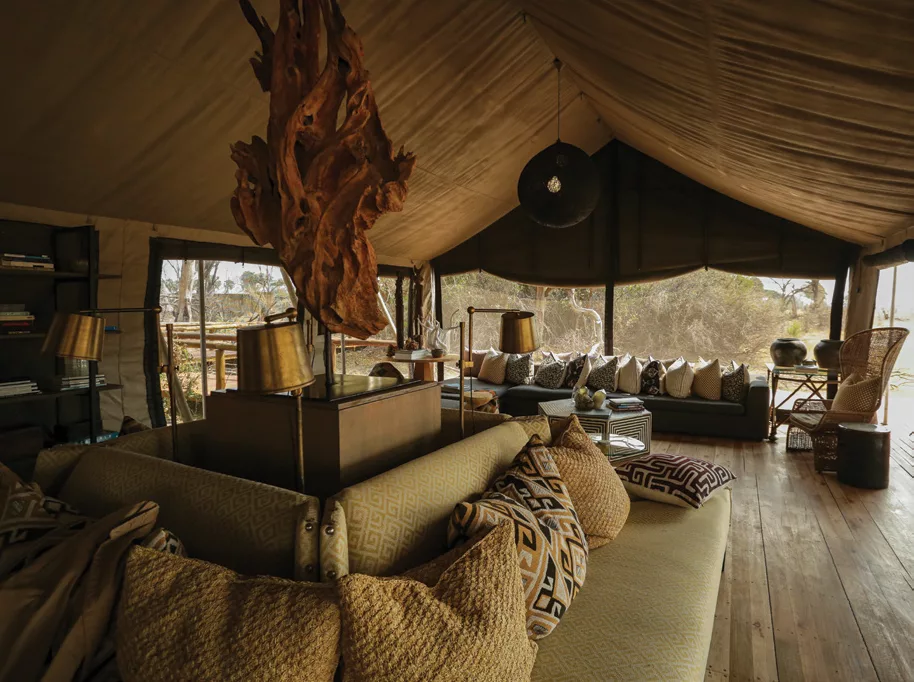
Following a new addition to the lodge in January 2024 – a larger dining area that includes an interactive kitchen and more seating for guests – you can now watch the team of chefs prepare your food. Head chef Lapologang hails from Gaborone and has clearly found his calling when it comes to making delicious meals. He is hands-on, presenting the menus to guests himself and will go the extra mile to ensure that their food journey is a memorable one. If you would like something that is not on the menu, he will make that too, if he has it in stock.

With options including a perfect cut of Botswana rib-eye, foodie heaven awaits for guests who enjoy the finer things in life.

The private concession on which Gomoti Plains is situated is renowned for its spectacular views over the floodplains in the centre of the Okavango Delta and the adjacent Gomoti river system.

Getting to camp requires a short, scenic flight. Spotting wildlife from the air is not uncommon, especially herds of elephants having an aquatic moment in one of the Delta’s tributaries. Arriving at the Qorokwe airstrip in a Cessna Caravan, the journey to camp can take 45 minutes or more, depending on what you see along the way.

High drama

Oracle is ready to depart on our first game drive to showcase the beauty of the surrounding wilderness and the wildlife that inhabit the 100,000ha area.

Up first, a brown snake eagle is sitting on the ground, apparently picking at something. Through his binoculars, Oracle confirms that he has an object in his beak – yes, it is a snake!

There is a lot of chatter on the two-way radio, and Oracle discloses that one of the other guides has found the pride of lions that hasn’t been seen for a few days. We locate them in the late afternoon and, as luck would have it, they are all there – two lionesses and eight cubs.

The cubs are playful but restless, as they are hungry, and the lionesses are not allowing them to have milk. The one lioness, assumed to be the cubs’ mother, gets so agitated that she snarls at them, bearing her teeth. It’s a sad sight – you can count the cubs’ ribs, and it’s clear that the moms have had a meal from the bloodstains on their faces and their full bellies.

The process goes around in circles – the youngsters plead for milk while making their cute cub sounds, grooming mom for a while, and then get rejected with an exasperated, growling face.

An unusual occurrence on the morning game drive is seeing a few giraffes inspecting a fresh buffalo carcass. Giraffes feed on animal bones to provide them with calcium and phosphorus they need to maintain their own skeletal structure. In the background, a black-backed jackal hopes that they will vacate the area, so that he can scavenge on the remains.

Another amazing sighting is two African fish eagles in an air-to-air battle for territory. They are dive-bombing one another. The one is fully grown, while the other is a juvenile with a mottled black-and-white chest. Unable to see who the winner is, we hope they are able to resolve their dispute in an amicable way.

The last morning is filled to the brim with once-in-a-lifetime experiences. Oracle starts off in a westerly direction and then veers to the eastern side of the concession. We find a beautiful young male leopard sitting camouflaged in the tall grass. He has a warthog kill, which he abandons in his quest to leave the area.

“We call him Nijel Amos,” Oracle says with a smile. “This leopard can move on par with Botswana’s Olympic runner.”

A lion pride has made a kill, and once they have had their fill, the vultures swoop in to feast on the remnants of another warthog. Showcasing his best John Wayne walk, a hooded vulture is trying to chase a juvenile one away from his precious ribcage meal.

The lions are called the Survivor Pride, consisting of two females, one ‘uncle,’ and four cubs. What happens next is almost surreal – the lions decide to cross the channel to get to the opposite bank. We all know cats and water aren’t friends and, when they reach the other side, they turn and look our way as if to say, “Hey guys, we can swim!”

Text and Photography | Heléne Ramackers

For more information, go to machabasafaris.com. Heléne’s flights between Cape Town and Maun on Airlink were sponsored by Journeys By Design. For more information, go to journeysbydesign.com.


Read more

Collecting cats

Leopards lurk everywhere in and around wonderfully luxurious private lodge

It isn’t every day that one is on foot with a handsome young game ranger while a large male leopard is padding along close by.

“Look!” Daniel Anthony whispers. “There he goes!”

This is well within the safari lodge’s camp perimeter and, while en route to the boma for dinner, with room key still in hand, we watch the big cat purposefully strolling along before disappearing into the darkness of the African night.

“It’s been a while since we had a leopard in camp,” Anthony whispers as we resume the short walk to the boma for dinner. “But it does happen.”

It is an incredible start to a four-day stay at Chitwa Chitwa, a spectacular safari lodge located on the banks of one of the largest perennial bodies of water in the 65,000ha Sabi Sand Private Game Reserve. The Sabi Sand is, of course, famous for its phenomenal leopard sightings and, as it turns out, this lodge is no exception.

Comprising six individually designed suites, each with its own dramatic flair and eclectic decor, Chitwa Chitwa derives its name from an ageing giraffe bull with creaking joints that frequented the lake back in the day when the lodge was still a private retreat. The emblem of the lodge is a fitting tribute to the memory of this special creature.

Each of the spacious suites ensures maximum privacy and offers superb views of the lake and both its resident wildlife and those stopping by for a drink. In just a short few hours, visitors include crocodiles, hippos, elephants, kudu, impala, buffalo, nyala, and waterbuck – all seen while seated on the sun lounger on the private deck.

Mothers and children

Earlier that afternoon, during the first game drive, Anthony and tracker Bethuel Sithole had found the outing’s first leopard, an extraordinarily beautiful sighting of a female, known as Wakita, as she lay resting against a sandy termite mound lit by the golden rays of the setting sun.

The best thing was being the only vehicle there, which meant that we were able to spend some quality time with her and observe her as she started to move around. Focusing intently on a nearby clump of high grass, she suddenly pounced and rooted around a little before emerging again without, unfortunately for her, whatever she had spotted.

The blazing fire in the boma, along with a generous amount of cooked food, provided the perfect preparation for a deep night’s rest. Being woken by the bellowing of the lake’s resident hippos, there was an early morning start for another safari adventure.

“Get your cameras ready!” Anthony calls out as he manoeuvres the vehicle along a bend in the road. “It is going to be another great sighting!”

Nobody was expecting another leopard quite so soon but, as it turns out, there are two – a female named Xidulu with Nhenhe, her almost fully grown male son. While mum walks along the road, Nhenhe is showing the tell-tale signs of his young age. Ducking behind several bushes, he playfully pounces and mock-attacks his indulgent mum, swatting her softly on the side of her head.

His efforts pay off and, eliciting her high-spirited nature, the two leopards gambol off into the bush together.

After breakfast, and a wonderful outdoor shower, it is time to charge camera and phone batteries and relax. With the sun now high overhead, it is the perfect setting as one herd of elephants after another appears from the bush to drink from the lake – mothers, aunts, juveniles, and babies, along with several young bulls.

One of the bulls is trumpeting excitedly as he hurries in ungainly fashion to reach the water’s edge. A tiny calf half-trots beneath his mum’s belly and legs, swinging his little trunk from side to side in an effort to keep up. It is a truly lovely sight.

Sipping at sundown

A surprise is in store for all the guests later that day, after another exciting game drive. The sun is slowly setting and, heading back in the direction of the lodge, Anthony manoeuvres the vehicle across a beautiful open area dotted by marula and jackalberry trees before coming to a stop amid a scattering of twinkling lights.

It is time for sundowners, but not such as any have ever experienced before!

Busi Chiloane, the wonderful lodge manager, welcomes everyone and invites them to rinse their hands with warm water poured from a jug over a copper bowl. Passing out hand towels, she gestures to a specially kitted-out game drive vehicle draped with fairy lights that serves as both bar and buffet.

Lit candelabras provide a touch of elegance and, as other lodge vehicles pull into the clearing, more guests join the party and help themselves to paper cones brimming with crisps, platters of fresh fruit, and other bar snacks. Wine corks are popping and, at the far end of the vehicle, a small pizza oven is ablaze! A short time later, Chiloane is serving hot slices of pizza and offering a range of toppings on the side!

That same night, seated by the warm glow of the open fireplace in the suite and hearing an orchestra of cicadas outside, there is an opportunity to revel in this – an unsurpassed safari experience.

Text and photography | Fransje Van Riel

For more information or to book a stay, go to chitwa.co.za.

Read more

Memories made magnificent

Traditional hospitality is augmented by modern luxury in Lowveld lodge

Upon arrival at Nyala Safari Lodge, the name of which comes from the Zulu word inxala meaning ‘onion,’ in reference to the distinctive white lines on the sides of nyala antelope, it’s as though you step back through a tunnel of time. I felt as though I had been transported back to 1966 and my first visit to the Kruger National Park.

There are five rondavels set out in lush green surroundings that are in a stark juxtaposition to the bushveld just outside the encompassing game fence. The purpose of that boundary is to keep out the larger species like elephants yet allow the smaller game to wander through.

The actual footprint of the lodge is compact, but it is laid out in such a way that it makes it seem larger than it is. And although it’s intimate, there is enough space between the rondavels to allow guests to feel relaxed and secluded.

Emotional nostalgia aside, it is essential to acknowledge that the only tangible similarity between the Kruger National Park camp layout of 1966 and the modern splendour of the current Nyala Safari Lodge is in the shape of the rondavels.

As the door to the accommodation swings open, the initial illusion of a bygone era is promptly replaced by the reality of exquisite fixtures and finishes. The accommodation is far more spacious than the exterior leads you to believe – it’s always amazing how deceptive circular buildings can be. Crisp linen, a soothing neutral colour palette, and a regulation mosquito net combine to create a comfortable and relaxing environment. The space also features a desk, a pair of inviting chairs, and a built-in cupboard offering both hanging and shelving for luggage and clothes.

Enjoyment in the details

A set of double doors gives access to an intimate verandah that provides a vantage point to contemplate the manicured lawns and lush vegetation that stretch out in front of the chalet.

In contrast to the pre-refurbishment era, when rondavels were compact with all ablutions included in the living space, the current design features a spacious bathroom with a sculptured oval bath, an indoor shower, and a vanity boasting double basins and mirrors. Naturally, there is an outdoor shower that guests are encouraged to try at least once during their stay. Using this feature during a lightning storm is a captivating experience of simultaneous showering and being rained on while flashes of lightning illuminate the tree in front of the accommodation. It’s not a recommended practice, but it’s undeniably exhilarating.

The whimsical touch of ‘towel animals’ on the bed greets guests. Converting the guest towels into elephant-shaped configurations with eyes and a leaf on the tip of the trunk provides a playful yet memorable detail.

The game viewers, an integral part of the safari experience, differ from the usual 10-seater vehicles found in most of the lodges. This one has a capacity for six guests and offers luxurious seating and convenient access via a side door. Being unaccustomed to this configuration, my initial attempts at ingress and egress involved climbing over the side rather than utilising the door, a comical error rectified with laughter and a newfound appreciation for checking the number of doors.

Exploring the lodge’s surroundings, there is a persistent feeling of being observed, a sensation validated on discovering a watchful squirrel overseeing my wanderings. The lodge’s gardens, meticulously tended by managers David and Nicki, are a spectacular oasis of green. Their commitment extends even to repurposing old agricultural implements, adding a unique touch to the landscape.

Take it slow

The inviting pool tempts guests, but you can also sit on the deck, anticipating the arrival of various species drawn to the pools formed in the hollows of the dry riverbed. Here, guests gather for post-game drive breakfasts. Amid shared tales of morning sightings, which included a leopard cub, everyone expresses their hopes for upcoming excursions.

The expansive verandah, enveloping the main building, features an indoor lounge facing an open-plan kitchen, providing a comfortable setting for guests to enjoy meals or simply relax while overlooking the seasonal Mohlabetsi River.

The passage of time is unhurried, a defining characteristic that enhances the overall experience. Guests are not subjected to pressure. Rather, they are encouraged to savour all the amenities the camp offers at their own pace.

The food is excellent, especially the lemon meringue pie, prepared in the open-plan kitchen, in full view of the guests. This gives a sense of intimacy to the visit, part of the immersive nature of a stay there.

On one of the drives, a tortoise is making its way across the road. Its leisurely meanderings are a metaphor for the pace at which time passed at the lodge. That being said, the tortoise eventually vanished into the grass at the roadside and there would soon need to be a return to urban life.

Text and Photography | David Batzofin

For more information or to book a stay, go to nyalasafarilodge.co.za.

Read more

Straight outta Kempton

Schalk Bezuidenhout explains why he believes in the wizards of Oz, Borat being a role model and more

What was it like growing up in Kempton Park?

Schalk Bezuidenhout: I loved it and, looking back now, I love it even more! Kempton Park is a big city and small dorpie at the same time. You kind of know everyone, but it’s not a one-horse town (by the way, the rumours about Oom Sampie and Tannie Angelique are not true). There is something very special about East Rand people. It can’t be described. It’s just a vibe.

Do you still use English in self-defence?

Ever since I started performing more overseas, I think my English has actually become pretty good! But I can’t seem to shake the accent. Not that I want to! An accent immediately tells people where you’re from. It’s unique to you. I embrace my Afrikaans accent, even though sometimes when people hear it, they’ll talk a much slower English to make sure you understand.

When did you discover that you are funny?

In school. I made some kids in class laugh and, in high school, I would always get nominated to advertise things like the Valentine’s ball in a funny way during assembly. My go-to character was always Borat. But that doesn’t mean anything. Some of the most naturally funny people I know wouldn’t be good at stand-up. And some of them have tried and failed! Equally, some of the best comedians I know aren’t funny at all offstage. Making people laugh at a braai is one thing. We all know that guy. You, reading this, might even be that guy! But making people laugh on stage you can only discover, well, on stage. And the first time I was on a stage with a mic in my hand, people laughed. And I thought: I am good at this. The second time, people didn’t laugh at all. And I thought: well, it was fun while it lasted. The third time, people laughed again. And I thought: I am good at this, but there will be some bad ones along the way. And to this day, I still have some gigs that go terribly. But those are good too.

Do you have a serious side?

Yes, when I am busy filing my taxes to SARS, I am very serious.

What is the inspiration for writing your comedy?

Life. Or should I say my life. It sounds silly, but literally every piece of material I have is about things that have happened to me in my life. Including the time I got circumcised at the age of 13. That’s why, when I need material, I have to go do things. I have to leave the house. I have to go live! Nothing funny or interesting is going to happen to me while sitting on the couch at home.

Are there any taboo subjects?

Yes and no. A joke about running over a dog with your car would be unacceptable to someone whose dog has recently been run over by a car. But someone who has never been directly affected by that would probably think it’s fine. Every comedian will ultimately decide what is taboo to them, and their own audience will either get on board or walk out. Ricky Gervais is a comedian whose sense of humour is certainly darker than someone like Jerry Seinfeld. If you put Gervais in front of Seinfeld’s audience, they probably wouldn’t be able to stomach most of it. To some, almost everything is off limits. To others, nothing is off limits. I am probably somewhere in the middle. And for the record, no dogs were harmed in the answering of this question.

How prudish are you?

I perform at comedy festivals all over the world, which would be pretty hard to do if I was a conservative bigot. I always explain to the audience that there is a difference between conservative and prudish. Conservative normally means that pronouns piss you off. Prudish is when you blush when someone makes a dirty joke.

How do you stay relevant?

I watch a lot of shows at comedy festivals I perform at. The best way to stay relevant is to see what your peers are doing.

Besides your comedic prowess, you are also an actor. What are the main differences or similarities between stand-up comedy and acting?

Both are performance and both serve to entertain, but I see them as separate things. In stand-up, I am trying to tell people who I am. In acting, I am trying to tell them who someone else is. In acting, I want them to forget about Schalk. In stand-up, I want them to see Schalk and remember Schalk. I don’t know how I started talking about myself in the third person. But it’s quite fun – you should try it sometime!

You have taken your shows overseas. Which places have left a lasting impression and why?

I love touring in Australia. It’s similar to South Africa; it’s easy to adapt. I find the Aussie comedians inspiring. They are not confined to any rule or genre of comedy. Which is ironic because Australia has a lot of rules that you have to abide by! People who have seen my show Crowd Pleaser will have seen that I bring in some other elements as well, and that is largely due to being so inspired by the Aussies! On the rugby field, we dominate, but I wouldn’t easily take them on in a comedy competition.

You play bowls?

I am the youngest member of the bowls club at the Allan Park Retirement Village. The people there of 70 years and upwards are really good! I started playing bowls at 30. Imagine how good I will be when I get to 70! Commonwealth Games, here I come!

Text | Heléne Ramackers 

Photography | Marguerite van Eeden

For more information, visit www.schalkbezuidenhout.com.

Read more
3,463m: The length of the longest scarf ever knitted. 4: Decades of commitment to excellence. Auto&General. Never Not There. 4.6 billion years: The age of the oldest meteorite found on Earth.

Take it to heart

The risk of hypertension and its effects is too great to ignore

According to the Heart and Stroke Foundation South Africa (HSFSA), 215 people die every day from heart disease or strokes in our country. Hypertension, a major risk factor for heart disease, affects more than 45% of adults in the country and its prevalence continues to rise.

There is an urgent need to shift from treatment to prevention. The recently released guidelines from the European Society of Hypertension (ESH) offer a blueprint for creating a healthier future, one that starts with us and extends to those who will follow in our footsteps.

A heart-healthy diet is paramount. Eat more vegetables, fresh fruits, fish, nuts and low-fat dairy products, and less red meat. Reducing salt intake is crucial, as excessive sodium consumption is closely linked to hypertension. It’s recommended to have less than one teaspoon of salt per day. And limit your sugar intake by eating fewer refined and processed foods.

Eat more foods rich in the mineral potassium, such as lentils, squash, prunes, raisins, potato in the skin, kidney beans and soya beans. Potassium is a core element of the Dietary Approaches to Stop Hypertension (DASH) diet, along with calcium, magnesium and fibre.

Follow a plan

Around 150 minutes of moderate-intensity exercise per week, such as brisk walking, swimming or cycling, can lower your risk of heart disease. People with high blood pressure are also encouraged to do some sort of weight and resistance training.

As your body mass index, waist circumference and waist-to-height ratio increase, so does your risk of developing hypertension. If you need to lose weight, a modest weight loss that can be maintained is advisable.

Both alcohol and tobacco are major contributors to heart disease. Limiting alcohol intake and quitting smoking are essential steps in protecting heart health.

Chronic stress is another known risk factor for hypertension. Incorporating stress-reducing practices like mindfulness, meditation or yoga can significantly benefit heart health. Ensure that you’re getting enough sleep; seven to nine hours a night is recommended.

Noise and air pollution are considered environmental stressors and, while admittedly difficult to control if you live in the city, those with high blood pressure can try changing the location, timing and type of outdoor activities to reduce their exposure.

All adults should visit their GPs for an annual check-up and make lifestyle changes if necessary. Whether through adopting a healthier diet, increasing physical activity or managing stress, every step counts in the journey to a healthier heart.

Heart health is more than just a medical concern, it’s a legacy passed on to future generations. By modelling healthy behaviours today, we can help shape the health of our children and the generations that follow.

Text | Ryan Snodgrass 

Photography | Prostock-studio

Ryan Snodgrass is CVD Product Manager for Pharma Dynamics. For potassium-rich recipes, go to heartyfood.co.za.

Read more

Success follows self-mastery

Habits are unparalleled predictors of long-term outcomes. They affect performance more than talent, intelligence, luck or decision-making. Most know this, yet we struggle to take control of our habits to get the outcomes we want. If knowing is half the battle, the other half is doing. Success is predicated on self-mastery; high performance is a matter of habit.

If you feel bombarded at the beginning of the year with all the ideas on New Year’s resolutions, lists of how to do better this year, a multitude of tips for success, and so on, the good news is that you can ignore all those lists and supposed quick fixes. Or, if you are depressed in February because you’ve already failed your goals for the year, we have good news. There are real ways to effect change in your behaviour. Building a new habit is not always easy, but it’s worth it.

Tools for total performance

Based on the best-seller by Charles Duhigg and the latest science in habit formation, The Power of Habit teaches how habits work and how to develop effective habits using skill instead of willpower. The programme teaches a skill set for mastering any habit. You might call this skill set the habit of all habits—the one to rule them all. Whether participants take the programme on demand, virtually, or in person, they learn the skills through instruction, reflection, practice, and coaching. The result: greater performance and continuous improvement.

Understanding how habits work makes them easier to control. Once you break a habit into its components, you can fiddle with the gears. The components can briefly be summarised as follows:

01 SPOT THE LAG

  • Identify where you’re frustrated, stuck, or otherwise not getting the results you want or need.

02 SPOT THE LOOP

  • Learn the Habit Loop – cue, routine, reward.
  • Identify the habits holding you back, including the hidden cues and rewards.
  • Identify the habit(s) you need to develop to get the future results you want.

03 SHRINK THE ROUTINE

  • Simplify the routine so it’s easier to do.

04 CUE THE ROUTINE

  • Create a prompt or trigger to set your routine into motion.

05 REDUCE THE NOISE

  • Get rid of or avoid the cues that trigger bad routines.

06 WRITE A REWARD STORY

  • Identify the psychological drives behind your habits – both good and bad.
  • Clarify your ‘why.’ Connect the dots between the outcomes you want and your psychological drives and needs.

07 TURN BAD DAYS INTO GOOD DATA

  • Become both the scientist and the subject to learn from setbacks.

08 REPEAT. REPEAT. REPEAT.

  • Use visualisation to increase your reps.

The core competencies built throughout this training will not only serve the individual personally but align habit skills learned with your business needs. These core competencies include:

Change management

  • Take control of habits to get to desired outcomes.
  • Learn the Habit Loop – Cue, Routine, and Reward.
  • Develop effective habits through skill instead of willpower.

Self-direction and professionalism

  • Identify where you’re not getting the results you want.
  • Get rid of or avoid cues that trigger bad routines.
  • Identify the psychological drives behind your habits.

“To achieve greatness, start where you are, use what you have, do what you can.”

The power of habit equals high returns

The Power of Habit skills help organisations meet challenges related to efficiency, agility, compliance, safety, development, and more.

AGILITY AND ADAPTABILITY

Employees can better adapt to changing circumstances with skills to control their habits. The case study of Travis Leach, who made a dramatic change after learning a few skills at Starbucks, demonstrates how simple shifts in habits can drastically alter workplace performance and life outcomes.

EFFICIENCY

Habits are automatic routines that occur with very little thought or effort. Leaders and employees can leverage programme skills to automate behaviours for increased efficiency. For example, workers at the Alcoa Corporation automated a behavioural safety routine that dramatically improved efficiency, productivity, and revenue.

ENGAGEMENT

The skills for habit control are empowering by their very nature. As people increase their ability to build good habits, they become more engaged in work and life and take greater responsibility for outcomes.

QUALITY AND SAFETY

Organisations don’t instil workplace behaviours simply because leaders order it. Only by implementing measures and training that foster habit formation can they successfully help employees meet quality, safety, regulatory, or cultural standards.

SKILL DEVELOPMENT

A recent survey reveals that newly promoted leaders take more than six months on average to develop the skills they need to succeed in the new role. Conversely, when employees know how to leverage The Power of Habit, they can more quickly adopt new skills and turn them into habits.

If you believe you can change—if you make it a habit—the change becomes real. This is the real power of habit: your habits are what you choose them to be. Once that choice occurs and becomes automatic, it’s not only real, it starts to seem inevitable. Interested in learning more about The Power of Habit? Reach out to us at hello@humanedge.co.za or join one of our training sessions to see The Power of Habit methodology in action.

Text and Photography | Supplied

For more details, contact The Human Edge at hello@humanedge.co.za or call 012 345 6281.

Read more

A journey of good taste

Chef Jenny Morris’s love for conjuring up delicious meals began in the kitchen of her parents.

You were born in KwaZulu-Natal. What are your fondest childhood memories?

Jenny Morris: I have a couple of fond memories. My grandpa Bob Cannon used to call me for tea every afternoon at 3 pm. And he would say, “Soekie (his nickname for me), put your shoes on.” We would go into his kitchen and, on the solid plate, he would make these glorious crumpets and then top them with lots of salted butter and honey – the honey that tasted like honey.

I would lick everything off the top and leave the crumpet, which used to drive him insane. My sister Beverly and I would climb up our mango tree in the back garden, and each of us would have our own salt cellar. We would eat the mangoes grass green. We would eat them half ripe, and then we’d bring some down to the kitchen and eat them with curry powder and salt.

What smell or taste immediately takes you back to your childhood?

There were wonderful aromas coming from my mother’s kitchen growing up as a child. We ate a lot of mutton, so she would start roasting a leg of mutton at 5 am in the morning to be able to have lunch at 1 pm. It was gloriously delicious.

Our home would be filled with the smells of rosemary and garlic. She would have pumpkin on the stove, slow-cooking with a stick of cinnamon. The smells of cinnamon, garlic, and rosemary always remind me of growing up.

What was your favourite dish as a child?

Besides my father’s brinjal curry? Amasi (a thick curdled sour fermented milk product) with brown bread and madumbis (a starchy root vegetable) – I still eat that today.

When did your food journey start?

That’s a difficult one – I believe I already started that journey as a foetus! I’ve always loved food. I’ve always been passionate about food and fresh ingredients. It’s about combinations, textures, and flavours.

My father grew 99.9% of everything that we would eat, except mushrooms. He said if he could get his hands on the spores, he would have done that as well. My mother seldom had to buy anything, and one of my fondest memories would be her sending me into the garden saying, “Pick me a couple of green beans… pick me some carrots.”

We had these little sugarloaf cabbages, and we’d pick them while they were still young, so we would eat four or five veggies at a sitting. Every night we would have the most delicious vegetables with our meal. I think my journey began there.

I spent a lot of time in the kitchen with my dad. He was the adventurous cook, while my mom had a more holistic approach. She was the nurturing cook and the mommy. She couldn’t put an extra ingredient in her braised beef because we’d all have something to say. We didn’t ever want that flavour to change.

My father used to get into the kitchen and mess it up, and he knew his way around a pot. All three of us, including my brother Billy, spent a lot of time in the kitchen with our parents. That hunger to be in the kitchen with all the pots bubbling with the wonderful aromas surrounding you was so great, and I learnt, with practice, of course.

Today, I cook for presidents and kings, royals, and, of course, my family.

How did your nickname ‘The Giggling Gourmet’ come about?

I used to call myself the ‘galloping gourmet,’ and when I went to register the name, there was a reserve on it. Because I’m so happy and I laugh and I have a wonderful sense of humour, I decided I should rather become the Giggling Gourmet!

Do you have a favourite dish to make at home?

I have so many favourites. I’m a greedy girl. It’s like asking who my favourite child is – I have three beautiful sons. But I do love comfort food…

If you dine out, what is your go-to dish to order?

It would be something Asian – I love Chinese and Thai food.

What type of patron are you when dining out?

I’m pretty easygoing. I love to experience other chefs’ food because that’s their art and craft, and I appreciate all the work that goes into what they serve. But when I order an egg, it needs to be soft and trembling, and if it’s not presented that way, I’ll send it back. If I order a steak medium rare and it’s not the right temperature, it’s also going back to the kitchen.

How has the culinary scene evolved since you started your journey as a chef?

I started my journey a long time ago, and what the chefs are putting out today, with the foods we are experiencing, it’s become global. You can get any ingredient you want; you can create any dish you want.

If I want to cook Thai food, I can go into any supermarket – it doesn’t have to be an Asian one – and find incredible ingredients. South African palates have been exposed to the most beautiful cuisines. And that’s not discounting our own!

Exciting projects on the horizon?

One of the most exciting is called The Diaries of The Giggling Gourmet, a new television series. I’m busy with a new cookbook. I love to travel and want to take a group of foodies to Morocco. I have filmed there, and I know the country well enough. I love it; it’s simple, and the food is honest. It’s a beautiful place to be.

Text | Heléne Ramackers 

Photography | Jasmine Heuvel Photography

Follow Jenny Morris on Instagram: @jennymorrischef.

Read more

Get your papers in order

Preparing in advance is essential when organising a visa ahead of a trip.

When navigating the visa application process, be aware that requirements can change quickly, and exchange rates can fluctuate. But there are steps that remain valid.

Many countries require passports that are valid for at least three to six months beyond your planned departure date from your destination country. Your passport must have a minimum number of blank pages, usually at least two, for entry and exit stamps.

Calculate the cost of flights, accommodation, meals, transport, travel insurance, and sightseeing. It’s wise to have an emergency fund, too. Ensure that you fill in your full name, passport number, and date of birth exactly as they appear in your passport. If your name appears in reverse order in official documents, copy this format on forms.

Some countries require confirmed flight bookings, while others accept tentative plans. Compile an itinerary showing round-trip reservations. Include dates and flight numbers for your entry and exit. If friends or relatives are hosting you, provide a detailed invitation letter according to regulations. If you are on a prepaid tour, provide the itinerary and proof of payment to the tour operator.

Select refundable or flexible bookings. This limits your financial risk if your visa application is rejected. Obtain a work letter stating your continued employment and monthly salary. If you’re self-employed, provide the required business documents. Visa applications generally require at least three months’ worth of bank statements. Ensure that your account is active and reflects regular income. Also, ensure that your bank statements are signed and stamped by a bank official.

Prove that you have sufficient funds. You can use a combination of accounts. It’s advisable to obtain a letter from your financial adviser confirming this. Visa authorities might flag sudden, large cash deposits into your account. If you have received a gift or loan from family or friends, provide a letter or documentation explaining the deposit.

Ensure that your photos meet requirements. Get insurance: check what’s covered by your medical aid and personal insurance policies. Free cover is available when you pay for your flight by credit card, but this is generally limited and excesses can be high.

Phase two

Once you’ve collected your passport with the visa, start the second phase.

Inform your bank of your travel dates and destinations and activate your debit and credit cards for international use. Banks often charge additional fees for international card usage, including foreign ATMs. Some banks offer prepaid travel cards with reduced fees – load these with foreign currency and use them like a debit card.

Take at least two forms of payment, such as a debit and credit card, in case one gets lost or stolen, or doesn’t work overseas. Note helpline numbers, should your cards be lost or stolen, or if you need to access healthcare or make an insurance claim. And install apps needed to access these services.

Scan and store your passport and financial documents for easy access in case of follow-ups or emergencies.

Text | Sarah Nicholson 

Photography | AnnaStills

Sarah Nicholson is operations manager of JustMoney.co.za.

Read more
9kg: The weight of a sperm whale’s brain. 20: The approximate number of active volcanoes erupting daily. 1796: The year in which the first administratively recorded divorce took place (in the Netherlands)

No business liability too small for insurance

While most small- and medium-sized businesses will have insurance in place to cover tangible assets such as buildings, vehicles, office and other equipment, and even business interruption insurance, which has garnered renewed attention in recent years, liability insurance is typically not top of mind.

Storm Mhlambi, senior manager responsible for Specialist Liability at Auto & General, explains that liability insurance provides protection against claims resulting from injury to other people or damage to their property. It is specifically designed to protect businesses from the liabilities associated with their operations, actions, and the products and services offered to customers.

“What many smaller businesses don’t realise is that even one liability claim can put their entire business at risk, particularly if they are sued for an amount that is higher than the value of the business,” she says. “In a tough economy, businesses are being held accountable more than ever before, with litigation becoming much more prevalent, even for seemingly minor issues. Our Specialist Liability insurance products provide up to R100 million in cover to pay for the legal defence costs or damages awarded against the insured business.”

Auto & General’s Specialist Liability cover includes Broadform Liability insurance to protect businesses against claims by third parties for bodily injury or property damage they suffer as a result of your day-to-day business activities; Professional Indemnity, which covers professionals for errors or omissions in their professional services, which causes third parties a financial loss; Directors’ and Officers’ Liability, which provides financial protection for the directors and officers of a business in the event that they are sued for breaching their fiduciary duty; and, more recently, Events Liability insurance, a tailored offering aimed at addressing the risks and liabilities that come with organising and hosting events.

She explains that while small businesses are often put off by high annual fees and complicated industry jargon in insurance products, Auto & General’s specialist liability insurance products have been designed and structured with small businesses in mind. Clients are provided with the option of paying either an annual or monthly premium, depending on their preference and needs, while each product’s terms and conditions have been written in clear and easily understood language. Provision has also been made to include more than one product on the same policy, rather than a number of standalone policies.

“Auto & General has been serving small businesses since 1985, and we will continue with our commitment to providing innovative solutions for their ever-evolving needs.”

Text and Photography | Supplied

To find out how Auto & General Business Liability Insurance can help your business today, contact us on 0861 00 02 09 or at liabs@autogen.co.za.

Read more

Wildlife after the war

A passion for animals inspires an author to venture into a high-risk situation

Crossing the line

Every step I took felt like an eternity. From the corner of my eye, I could see soldiers with assault rifles aimed at me. I have faced many life-threatening moments with gorillas, lions and charging elephant bulls, but I had less control over this situation.

Suddenly I remembered the final warning of the security police, who said: “Once you cross that line, we have no jurisdiction over you. You are on your own. Are you certain you want to cross the line?”

The previous year, I had paid a visit to my colleague, Dr. Klös, director of the Berlin Zoo in the beautiful, modern city of West Berlin. Like most tourists, I paid a visit to Checkpoint Charlie (the United States customs control point between West and East Berlin) and found a modest double-storey museum close to the infamous Berlin Wall. The museum was officially opened on 14 June 1963 and displays numerous photographs of the often unsuccessful, fateful attempts by East Berliners trying to escape the horrendous life under communist control. The second storey is mostly a lookout point where the visitor can get a glimpse of what happened on the other side of the wall. All one could really see at that time were numerous cranes, leaving the impression of vast construction development.

How did this all come about? After the end of World War II and following the Potsdam Conference, it was decided to divide Germany into four occupied zones under the jurisdiction of the four allies – the United States of America, Great Britain, France and Russia. Berlin, situated in the Russian-occupied zone, had lost its status as the capital of Germany, which was temporarily replaced by Bonn in the western zones. Berlin itself was also divided into the four occupied zones. The reason for this subdivision was based on Germany being held accountable for starting both World War I as well as World War II. Allied forces occupied the four sectors, thereby hopefully preventing the possibility of another World War.

After the division of the city of Berlin into the four sectors, a mass migration of more than 3.5 million East Germans defected to the Western Sector. This had an immediate effect on the remaining population, as both skilled and unskilled Germans moved to the West. This not only resulted in a serious loss of manpower but also a considerable brain-drain. In order to curb this movement, the East Bloc sector decided to construct the Berlin Wall. The wall was promptly constructed in 1961 and consisted of a guarded concrete barrier encircling West Berlin, basically creating an isolated island of the four small zones in the middle of the Russian-occupied socialist eastern half of the former German state.

During the time the wall existed, more than 10,000 people tried to escape into West Berlin, of which an estimated 5,000 succeeded. More than 200 were shot or committed suicide. The East Bloc justified the construction of the wall as a protection of its population from fascist elements and officially referred to the wall as the ‘Anti-Fascists Protection Rampart’. In contrast, the West Berlin government referred to the wall as ‘The Wall of Shame’, an extension of the symbolisation of the ‘Iron Curtain’ and the start of the Cold War.

The Berlin Wall consisted of two walls. The area between the two was approximately 100m wide. This area was commonly referred to as ‘The Death Strip’. The strip contained hundreds of guarded watchtowers, miles and miles of anti-vehicle trenches, guard dog runs, flood lights, and trip wire machine guns. Anybody found in the Death Strip could be and generally was shot. After almost 30 years, the wall was demolished on 9 November 1989.

The Berlin Wall, like so many other atrocities since the beginning of time, should surely be regarded as a crime against humanity. People were killed or mutilated; families, friends and loved ones were separated; and individuals were encouraged by State Security in East Germany to spy on and denunciate each other. The effect it had on human beings is indescribable.

Why is it necessary to declare war? It is often motivated by would-be rulers who wish to demonstrate their capacity to control other human beings. The tragedy is that, in the battle for supremacy, innocent people lose their lives.

One of the monumental occasions in the history of warfare must certainly be the Christmas Truce between British and German soldiers on 24 December 1914, when soldiers from both sides left their bunkers and joined together in no-man’s-land to celebrate the coming of Christmas, singing Silent Night and other Christmas carols. Peace and goodwill to all. But alas, after they returned to their respective trenches, they were once again ready to kill one another the following day. This truce was so incredible that many believe it to be a myth that never happened.

Text | Willie Labuschagne

Photography | bodrumsurf and supplied 

Of Man and Beast by Willie Labuschagne, published by Tracey McDonald Publishers, is available now. This excerpt is published by permission.

Read more

Nature’s weirdest creatures: furry hedgehog

Strange, wonderful animals fill a number of unique roles in their ecosystems

Think all hedgehogs are spiky? Think again.

The aptly named furry hedgehog sports a fine pelt of floof with ne’er a prickle in sight. Furry hedgehogs, also known as gymnures, are found in the subtropical evergreen forests of Southeast Asia, including Vietnam, Sumatra, China and the Malay Peninsula.

Their pointy snouts are hedgehog-like and their naked tails are rat-like, but there’s also something of the shrew about them. They’re not, however, closely related to rats and instead nestle happily within the family of Erinaceidae, which incorporates both furry and spiky hedgehogs alike.

Where regular hedgehogs have spines made from stiff, hollow, keratin-dense hairs, furry hedgehogs, which are thought to have evolved before their spiky relatives, are covered in dense fur. Depending on the species, the fur can be soft or bristly, and the size can vary considerably. In Indonesia, for example, the dwarf gymnure grows to about the same size as a house mouse, while a different variety, known as the white-faced moonrat, grows as big as a domestic cat.

The body plan of furry hedgehogs is thought to resemble that of the earliest mammals, with a long, pointy head, a naked tail for regulating body heat and a plantigrade stance, which sees the base of all four feet firmly in touch with the ground.

Like the regular hedgehogs you might find in your garden, they’re omnivores. Foraging in darkness or the twilight hours, furry hedgehogs use their bristly whiskers to help them find worms, insects, scorpions, spiders, frogs, fish, fruit and other delicacies. The solitary beasts also have a strong scent, likened to rancid garlic, which they produce from scent glands and use to mark their territory.

Until recently, there were thought to be two known species of soft-furred hedgehogs (genus Hylomys), but a 2023 study revealed an additional five. Researchers studied 232 physical specimens and 85 tissue samples, which came from fieldwork and decades-old museum collections. Genetic analyses revealed two species that were new to science and three that were elevated from subspecies level (the taxonomic rank below species) to species level.

  1. macarong has dark brown fur and is around 15cm long. It’s found in Dalat, Vietnam, and is named after a Vietnamese word for vampire (ma cà rong) because males of the species have long, fang-like incisors.
  2. vorax, meanwhile, is a little smaller, with dark brown fur, a black tail and a delicate, narrow snout. It’s found only on the slopes of Mount Leuser in Northern Sumatra and is named for its supposedly voracious appetite. After the respected mammalogist Frederick Ulmer captured some during a 1939 field trip, he wrote, “They were voracious beasts often devouring the whole bait before springing the trap. Ham rind, coconut, meat and walnuts were eaten. One partially devoured the chicken head bait of a steel trap before getting caught in a nearby Schuyler trap baited with ham rind.” Not fussy eaters then!

This article appears in Very Interesting #80. Please click here to receive the current VI issue digitally for FREE!

Read more

SWEET truth

Too much sugar can affect your mental health

Excess sugar consumption is a global problem. While the recommended daily average for added sugars – table sugar, honey or syrup – should be 30g, South Africans are consuming up to 100g a day. Beyond the threat to physical health, sugar has a lasting impact on mental health as well.

Consuming foods high in added sugars, like sugary snacks and soda drinks, causes a rapid spike in blood sugar followed by a crash. This fluctuation can lead to mood swings, irritability and fatigue. Unlike naturally occurring sugars in fruits and dairy, which are digested slowly, added sugars cause quick blood sugar spikes and crashes, which can affect brain function and cause chronic irritability and emotional instability. Prolonged consumption can impact cognitive function, memory and decision-making.

High added sugar intake is linked to increased anxiety, stress and depression. It disrupts neurotransmitters like serotonin and dopamine that regulate mood and raise cortisol levels, exacerbating stress and anxiety.

Go natural

Choose fun drinks that are low in added sugar. Try homemade iced teas or warm teas. Add slices of lemon, fresh mint or berries. These additions provide a fun twist without the extra sugar.

Many packaged foods and drinks contain hidden added sugars, even those that don’t taste particularly sweet. Check labels carefully for common names like high fructose corn syrup, sucrose, dextrose and maltose. Choose products labelled ‘unsweetened’ or with minimal added sugar. Low-added sugar is typically 5g or less per 100g or 100ml of a food item. Moderate is 5-15g of added sugar per 100g/100ml, while high is more than 15g per 100g/100ml added sugar.

Remember, there is a difference between a ‘snack’ and a ‘treat’. A snack is a small, nutrient-dense meal eaten between meals. Try to choose low-added-sugar snack options like raw nuts, seeds, fresh fruit or plain yoghurt with a handful of berries. These provide natural energy and won’t cause the dramatic blood sugar spikes that sugary snacks do. Pairing fruit with protein or healthy fats like yoghurt or nuts helps balance your energy levels throughout the day.

One of the easiest ways to cut down on added sugars is to prepare more meals and treats at home. By cooking or baking your food, you have full control over the ingredients. Try to reduce the amount of sugar in your favourite recipes or substitute it with more natural sweeteners like dates or pure honey.

If you add sugar to your coffee, tea or cereal, try to gradually cut back. Start by reducing the amount little by little over time to give your taste buds a chance to adjust. You’ll find that you eventually need less sugar to enjoy your drinks or meals.

Text | Mbali Mapholi

Photography | Cast Of Thousands

Mbali Mapholi is a Tetley partner dietitian. For more information, go to joekels.co.za.


Read more
24: The number of Uranus’s moons named after characters from Shakespeare’s plays. 150: The number of different bacteria we have on our hands at any given time. 19m: The height of the biggest wave ever recorded.

Know, don't guess

When caring for a child, ‘responding’ is different to ‘reacting’

Parenting is a journey filled with countless moments that shape a child’s development and the dynamics within a family. In South Africa, where diverse cultures and traditions influence how children are raised, understanding the difference between responsive and reactive parenting can be particularly valuable.

Responsive parenting is about tuning into your child’s needs and responding thoughtfully and empathetically. It involves actively listening to both verbal and nonverbal cues, understanding and validating their feelings and creating a stable environment where they feel secure. When parents respond with empathy and encouragement, they not only support their child’s exploration and learning but also provide the guidance and reassurance necessary for healthy development. Being responsive to your child’s needs, especially in communal settings like family gatherings, helps them feel integrated and valued, laying a strong foundation for their emotional development, self-esteem and social skills.

On the other hand, reactive parenting occurs when responses to situations are driven more by immediate emotions rather than thoughtful consideration. This often results in quick reactions to a child’s behaviour without fully understanding their needs or the context of the situation. Emotional reactions, rather than considered responses, can lead to inconsistency in discipline and create confusion for children about what is expected of them. In busy households, where parents juggle multiple responsibilities, reacting impulsively can strain relationships and create a tense home environment.

Make an effort

Finding the right balance between responsive and reactive parenting is key to nurturing a healthy family dynamic. One effective strategy is to take a moment to pause and breathe before reacting to challenging behaviour. This pause allows parents to respond more thoughtfully and constructively rather than impulsively. Understanding a child’s unique temperament and needs can also help tailor responses more effectively. For example, if a child feels overwhelmed in a busy setting, offering a calm and reassuring response can help them feel more comfortable.

Parenting is not about being perfect; it’s about being present and intentional. Parents can gain valuable insights and encouragement by seeking support from family, friends or parenting groups. Regularly reflecting on your parenting approach and adjusting as needed can also help strike a better balance between responsiveness and reactivity.

Parenting is a continuous learning experience. Parents can create a nurturing environment that supports their child’s growth and development by striving to be more responsive and less reactive. In South Africa, responsive parenting benefits children and strengthens the bonds within families and communities. Embracing the journey with patience and reflection fosters a loving environment where children can truly thrive.

Text | Ursula Assis

Photography | CandyRetriever

Ursula Assis, Country Director of Dibber International Preschools.

For more information, go to dibber.co.za.

Read more

Caught in time

When caring for a child, ‘responding’ is different to ‘reacting’

Parenting is a journey filled with countless moments that shape a child’s development and the dynamics within a family. In South Africa, where diverse cultures and traditions influence how children are raised, understanding the difference between responsive and reactive parenting can be particularly valuable.

Responsive parenting is about tuning into your child’s needs and responding thoughtfully and empathetically. It involves actively listening to both verbal and nonverbal cues, understanding and validating their feelings and creating a stable environment where they feel secure. When parents respond with empathy and encouragement, they not only support their child’s exploration and learning but also provide the guidance and reassurance necessary for healthy development. Being responsive to your child’s needs, especially in communal settings like family gatherings, helps them feel integrated and valued, laying a strong foundation for their emotional development, self-esteem and social skills.

On the other hand, reactive parenting occurs when responses to situations are driven more by immediate emotions rather than thoughtful consideration. This often results in quick reactions to a child’s behaviour without fully understanding their needs or the context of the situation. Emotional reactions, rather than considered responses, can lead to inconsistency in discipline and create confusion for children about what is expected of them. In busy households, where parents juggle multiple responsibilities, reacting impulsively can strain relationships and create a tense home environment.

Make an effort

Finding the right balance between responsive and reactive parenting is key to nurturing a healthy family dynamic. One effective strategy is to take a moment to pause and breathe before reacting to challenging behaviour. This pause allows parents to respond more thoughtfully and constructively rather than impulsively. Understanding a child’s unique temperament and needs can also help tailor responses more effectively. For example, if a child feels overwhelmed in a busy setting, offering a calm and reassuring response can help them feel more comfortable.

Parenting is not about being perfect; it’s about being present and intentional. Parents can gain valuable insights and encouragement by seeking support from family, friends or parenting groups. Regularly reflecting on your parenting approach and adjusting as needed can also help strike a better balance between responsiveness and reactivity.

Parenting is a continuous learning experience. Parents can create a nurturing environment that supports their child’s growth and development by striving to be more responsive and less reactive. In South Africa, responsive parenting benefits children and strengthens the bonds within families and communities. Embracing the journey with patience and reflection fosters a loving environment where children can truly thrive.

Text | Ursula Assis

Photography | CandyRetriever

Ursula Assis, Country Director of Dibber International Preschools.

For more information, go to dibber.co.za.

Read more

Surface tension

Men need to be careful about their skincare to avoid a number of potential negative effects

A health factor many men overlook is skincare and personal care. Many common products contain toxic ingredients that may increase health risks, including cancer, skin irritation and hormone disruption.

When you reach for a face wash, shaving foam or moisturiser, you probably don’t think about potential toxins lurking within. Yet, many conventional products contain harmful ingredients linked to serious health concerns.

Parabens are synthetic preservatives, often found in moisturisers and shaving gels, that can act as hormone disruptors. Studies have linked them to reproductive issues and even certain types of cancer. Phthalates, common in fragranced products, are linked to hormonal imbalances and fertility issues. They’re also potentially carcinogenic, making them a no-go for any personal care product.

Formaldehyde is used as a preservative but has been classified as a known human carcinogen by health organisations worldwide.

Triclosan, an antibacterial agent often found in soaps and shaving creams, is linked to hormone disruption and may contribute to antibiotic resistance. Synthetic fragrances can be a problem. ‘Fragrance’ on an ingredient list often refers to a cocktail of chemicals, some of which can cause allergic reactions, respiratory issues and even hormone disruption. Sulfates are harsh detergents that are responsible for a foamy lather but which can strip your skin of natural oils, causing dryness and irritation.

Assistance, naturally

Switching to clean skincare doesn’t just help you avoid toxins – it also allows you to harness the benefits of nourishing ingredients. These powerful, plant-based compounds can actually support your health while giving your skin what it needs to look and feel great.

Superfoods made with ingredients like baobab, marula and chia are packed with antioxidants, vitamins and essential fatty acids that help repair, hydrate and protect your skin. Aloe vera is a soothing plant extract that is perfect for calming and hydrating, making it ideal for shaving-related irritation.

Jojoba oil, known for its anti-inflammatory and deeply moisturising properties, can mimic your skin’s natural oils, helping to balance and protect it. And green tea extract is loaded with antioxidants, helping to defend against environmental stressors and ageing.

Non-toxic products provide a simple way to make a positive impact on your health. By avoiding harsh, toxic ingredients, you’re not only protecting your skin but also reducing the chemical load your body has to process. Switching to clean skincare is a powerful step in supporting long-term wellness. Protection from hidden toxins should be part of your men’s health journey.

Text | Nicole Sherwin

Photography | DimaBerlin

Nicole Sherwin is founder of Eco Diva Natural Superfood Skincare.

For more information, go to ecodiva.co.za.

Read more
4.2 million: Number of Americans with access to state secrets via their jobs. 20%: Percentage of the world’s population living in areas where marriage between relatives is desired. 1988: The year in which Stephen Hawking published his groundbreaking A Brief History Of Time.

Outside and in

Allergies can be troubling to man’s best friends, but it’s possible to minimise the possibility of them happening

As global warming may lead to longer and more intense pollen seasons, many people will suffer from stuffy noses, itchy eyes and sneezing. But did you know that pets experience similar allergic reactions that cause itchy skin, watering eyes and other signs? Over 50% of dog allergies stem from environmental factors.

Skin issues in pets are widespread, with 40% of dogs visiting the vet for itchy, irritated skin. Environmental allergens – like mould, pollen and house mite dust – are often invisible, yet persistent triggers for many dogs. What might be surprising to many pet owners is that only 10% of allergy-suffering dogs have true food allergies, but dogs with food allergies have a 20-30% higher risk of developing an environmental allergy as well.

Pet owners should watch for these signs of skin disorders in their dogs:

  • Itching, scratching, licking and rubbing
  • Infected ears (smelly and moist)
  • Paw licking
  • Flaky or scaly patches
  • Red patches, spots or pimples
  • Scabs, crusts or thickened skin
  • Upset stomach
  • Hair loss
  • Bad skin odour

A multi-modal treatment approach is often the most effective. Sometimes, diet is overlooked as a key factor in managing allergies, but the right food can help soothe skin from the inside out. It should be emphasised that nutrition ranks as the fifth most vital health assessment factor, after temperature, pulse, pain and respiration.

Eat for health

Clinically proven nutrition for both food and environmental allergies, supporting skin health through specially selected ingredients, is always a good idea. Research has shown that allergies in puppies probably occur more commonly than originally thought and specifically formulated food is needed to address allergy management in puppies of all breed sizes, while meeting growth and developmental needs. This food should contain essential DHA for brain and eye development and essential vitamins and calcium for optimal bone and immunity development.

Speaking to your vet about additional treatments should be encouraged. Your vet may suggest a multimodal management plan that could include topical treatments, regular itch-calming baths, non-irritating shampoos and possibly antibiotics, together with the correct nutrition. Washing your dog’s bedding in hot water every two weeks can also help minimise allergens.

A pet’s skin health is vital to their overall health and happiness. By talking to your vet about a treatment plan and making small changes, you could eliminate or significantly reduce allergy-related irritations for your animal companions.

Text | Guy Fyvie

Photography | Krasula

Dr Guy Fyvie is Senior Veterinary Affairs Manager at Hill’s Pet Nutrition.

Read more

Turn down the flame

Kids struggling with tough emotions can be better managed with a little more understanding

Managing intense emotions in young children, especially when they manifest as anger or frustration, can be challenging for any parent. Parents and educators need practical strategies for handling these situations effectively, supporting emotional growth and fostering positive behaviours.

Emotional regulation is a skill children can learn from an early age. By teaching children ways to understand and manage their feelings, they become equipped with tools for life, allowing them to navigate their emotions with resilience and empathy.

One of the key principles behind managing intense emotions in children is validation. When a child has a meltdown or displays aggressive behaviour, the initial step is acknowledging their feelings rather than jumping straight into discipline. Simple affirmations like ‘I can see you’re upset’ help children feel understood and can reduce the intensity of their emotions.

Grounding techniques are also highly effective. For instance, the ‘Five Senses Activity’ encourages children to identify something they can see, hear, touch, smell and taste. This practice helps shift their focus from overwhelming emotions to the present moment, providing an immediate calming effect.

Calm communication

Observing patterns and identifying triggers that lead to emotional outbursts is another valuable approach. If a child becomes irritable when hungry, it’s best to avoid challenging conversations or activities during that time, for instance. This approach not only helps parents manage child aggression but also teaches children the importance of self-awareness.

Parents are encouraged to discuss emotions with their children during calm moments, helping them recognise the physical and mental signs of intense emotions. By teaching children to notice when their body feels tense or when specific thoughts accompany frustration, parents empower them to use self-regulation techniques. Deep breathing, counting or taking a momentary break are all strategies that can prevent emotions from escalating.

Children learn so much by watching their parents. When parents model healthy emotional regulation, they demonstrate that it’s okay to feel strong emotions and that there are positive ways to handle them. These shared practices turn self-regulation into a bonding experience and a valuable learning opportunity.

Through using these strategies, parents and educators can manage child aggression more effectively. These early lessons in emotional regulation lay the foundation for resilient, well-rounded individuals.

Text | Ursula Assis

Photography | mr. teerapon tiuekhom

Ursula Assis is Country Director of Dibber International Preschools.

For more information, go to dibber.co.za.

Read more

Say nothing – and everything

Brilliant magazine writer pursued his curiosity to create a celebrated examination of the Troubles

February 2025 marks exactly 100 years since the first edition of The New Yorker was published. To celebrate this milestone, it’s worth exploring the work of Patrick Radden Keefe – one of its accomplished writers – and his book Say Nothing.

The inspiration for Say Nothing struck Keefe in 2013 when he read an obituary for Dolours Price, a former member of the Provisional Irish Republican Army. He was intrigued by the story of a revolutionary who had lived into old age, rather than dying young as a martyr as so many of her compatriots had. The obituary also mentioned the 1972 disappearance of Jean McConville, a mother of 10 from Belfast, and suggested Price’s involvement in her murder.

This connection between two very different women – one a perpetrator, the other a victim – linked by a single act decades before fascinated Keefe. It raised questions about what happens when the passionate idealism and fierce ambition of youth collides with the realities of a long life and changed circumstances. These themes, along with the real-life mystery of McConville’s disappearance, would become the core of Say Nothing.

Keefe’s interest in the Troubles actually predated his work on Say Nothing by many years. As a student, he had found the history of the Northern Ireland conflict confusing, with its dizzying array of factions, acronyms and interwoven events. The books available on the subject tended to assume a high level of background knowledge, making it difficult for a general reader to find a way into the story. Keefe wished for an accessible, narrative account of this important history that could engage readers who were not already experts. With Say Nothing, he set out to write the book he had wanted to read, one that would invite a broad audience into the story while still ringing true to those who had lived through the events.

State the truth

To write the book, Keefe made seven research trips to Northern Ireland over the course of four years. Though his Irish-American background initially seemed like it would be an advantage in talking to people there, he soon realised that being perceived as an outsider was actually a benefit. Interview subjects couldn’t easily categorise him as belonging to one side or the other based on his accent, appearance or background. As a result, they were more inclined to explain things thoroughly rather than assuming prior knowledge.

Some of the key figures in the story, like Dolours Price, had already died by the time Keefe began his research, so he had to seek out the people around them to piece together a picture of who they had been.

He sometimes found himself talking with people who had ended up friendly despite being on opposite sides of lethal violence in the past.

Keefe’s approach to writing about his subjects, many of whom are still living, is to not let concerns over their potential reactions sway his commitment to the truth. He feels he owes his readers an honest account of what his reporting revealed, not a story carefully manicured to avoid ruffling any feathers. With a divisive figure like Gerry Adams, who comes across negatively at times in the book, Keefe simply wrote what his research showed and let the chips fall where they may. He applies this same philosophy to his portrayal of victims’ families.

While Keefe felt great empathy for the McConville children and understood their desire for definitive answers about their mother’s fate, he couldn’t state conclusively that she had not been an informer to the British authorities, since his own investigation of that question was ultimately inconclusive. Though emotionally difficult, Keefe saw directly addressing what he did and didn’t know as essential to maintaining his credibility.

Access and accolades

Keefe contrasted the research process for Say Nothing with some of his other high-profile projects. Joaquín ‘El Chapo’ Guzmán, the notorious Mexican drug kingpin, never agreed to speak with Keefe for the article he wrote about him and the Sinaloa Cartel. After it was published though, Keefe received the surprising request to ghostwrite El Chapo’s memoirs, which he promptly refused, only revealing the request later once Sean Penn’s interview with Guzmán became public. On the other hand, the prominent art dealer Larry Gagosian granted Keefe extensive access for a profile, sitting for lengthy interviews and encouraging his inner circle to participate as well. Keefe says he felt a bit of vertigo at receiving such co-operation from a subject he was used to being more elusive. Still, he strove to write an honest, unvarnished account, aiming not to be swayed from his mission of capturing the truth even by extensive access.

Upon its release in 2019, Say Nothing garnered widespread acclaim from critics and readers alike. Glowing reviews appeared in esteemed publications like The New York Times, NPR and The Washington Post, celebrating Keefe’s gripping writing and extensive research. It was named one of the top 10 books of the year by the Times and the Post. The book achieved commercial success as well, debuting at number five on the New York Times’ Combined Print & E-Book Nonfiction Bestseller List and remaining there for six weeks. In recognition of his achievement, Keefe was awarded the National Book Critics Circle Award for Nonfiction in 2019.

Text | Eugene Yiga

Photography | Supplied

Read more of Patrick Radden Keefe’s work at Longform.org and watch his talk on Fragile Truths from the CCCB on YouTube.

Read more

Concern and compassion

Paying only lip service to caring for staff will soon yield negative results

There was recently a meme on social media that said: “The only thing worse than an organisation that doesn’t care is one that pretends to care.” Organisations that fit this description have bold values displayed prominently, even while their employees privately share how overwhelmed and unsupported they feel.

These are organisations that frequently use buzzwords like ‘burnout’, ‘mental health’, ‘culture’ and ‘change’, yet remain riddled with disengagement, blame and shame. They might point to one-off initiatives to prove their commitment, but still wonder why people are unhappy.

Do leaders truly understand what their teams are experiencing and needing? Are their responses genuinely caring, or are we setting people up for failure with surface-level gestures, token gifts and celebration days that lack real impact?

There are many stories about employees feeling invisible, unheard and disconnected from their workplaces. People express frustrations and remark: “What’s the point of speaking up? No one listens anyway.”

Leaders, too, face their struggles. Many are burnt out, micromanaging and overwhelmed by tasks, admitting they don’t have the time to ‘manage people’ beyond ensuring that the job is done. A common scenario is leaders blaming higher management for urgent, last-minute demands that require their teams to work late.

These leaders seem afraid to have tough conversations with either their bosses or their teams, preferring to push blame rather than tackle the issue and find constructive solutions.

A big part of leadership and demonstrating care involves having difficult but necessary conversations. Leaders have a duty to protect their teams. If a deadline shifts unexpectedly, how can a leader communicate transparently, negotiate and work collaboratively with the team to meet the challenge? Authenticity and regular, honest communication are crucial.

Take point

As a leader, remember that your team observes your behaviour every day. Even when you’re not speaking, your non-verbal cues – whether you’re frustrated, tired, irritable or inspired – are loud and clear. Model the behaviours you would like to see in your team. This is one of the most impactful things that leaders can do.

Engage and listen to your team. Find out about the burning issues affecting them, what is working well and what can be improved. Connect with them as human beings first with lives, joys and challenges like you. When you are not okay, seek support from your team – it’ll make it okay for others to do the same.

Create authentic spaces for engagement with your team such as social gatherings, a break station or a weekly check-in. What you will find is that this is likely to transform into a vehicle to tackle many other important work issues.

Demonstrating true care takes consistent effort, time and a commitment to people, and it means that leaders must be intentional about putting aside time to invest in their teams. Leaders who do this often see incredible results. When people feel safe, valued and have a true sense of true belonging, they’re more willing to give their best.

Text | Taegan Devar

Photography | Pormezz

Taegan Devar is an Industrial Psychologist and the Managing Director of PeopleSmart. For more information, go to peoplesmart.global.

Read more
116-164: The average range of words we use in a conversation. 1153: The year in which the oldest restaurant in the world opened in China 44: The number of seats on the Boom XB-1, a passenger aircraft that is expected to have a top speed of Mach 2.2.

Expedient extravagance

Luxury looks different if you’re travelling for work rather than pleasure

When was the last time you got excited about a hotel’s proximity to the financial district? If you’re a business traveller, probably more recently than you’d like to admit. While your Instagram feed fills up with friends posting sunset cocktail shots from their holiday stays, you’re quietly celebrating the fact that your hotel room comes with multiple power outlets and actually fast WiFi.

Welcome to the great luxury divide between business and leisure travel. Because, when you’re travelling for work, luxury takes on a whole new meaning – and it’s something that travel managers should take note of.

Quality business travel pays off. It’s not about splashing cash on unnecessary luxuries. It’s about recognising that a well-rested, unstressed traveller is more likely to nail that presentation.

Finding a meeting venue right next door to the hotel might not sound like the height of luxury. But for business travellers, skipping the cross-city commute beats any five-star spa treatment. While holidaymakers hunt for rooms with mountain views and private balconies, the simple pleasure of rolling from breakfast meeting to client presentation without checking traffic apps or weather reports is incredible.

Midnight room service that arrives hot and exactly as ordered – now that’s luxury for business travellers. Forget elaborate tasting menus and chef’s tables. The real win is a club lounge serving fresh, healthy options around the clock. Business dining is getting a much-needed upgrade. Many executive lounges now double as informal meeting spaces, with menus designed around productive days rather than Instagram shots of rainbow chia bowls.

Room rewards

While leisure guests fiddle with mood lighting settings, business travellers get a thrill from crystal-clear video conferencing that connects without a glitch. It’s about having the tech essentials that actually matter: reliable WiFi, abundant power outlets (bonus points for those with international variants) and presentation capabilities that mirror an office set-up.

The business-grade connectivity revolution is coming. Properties are installing dedicated bandwidth for virtual meetings and wireless systems that connect instantly.

Skip the welcome ceremonies and butler service – real luxury is having a dedicated team who understands business priorities. When you need that presentation printed and bound at midnight, you need it now, not after the morning shift change. Executive floors are evolving into complete business support hubs. Private check-in merges with business centre services, while concierge teams are trained to handle corporate crises as efficiently as dinner reservations.

Sunrise yoga sounds lovely – if you don’t have an 8am presentation. Business luxury means maintaining your fitness routine despite a packed schedule, about accessing a proper gym when you need it and finding healthy fuel beyond the minibar.

Hotels are finally creating wellness solutions that work with business reality. Modern properties increasingly offer 24/7 access to fully equipped gyms, in-room workout options that make sense in limited space and recovery treatments designed for the business schedule.

Companies often think incorporating these business-focused luxuries means blowing the travel budget. But it’s about strategic spending, not splurging.

Text | Mummy Mafojane

Photography | Opat Suvi

Mummy Mafojane is Productive Operations Manager at FCM. For more information, go to fcmtravel.co.za.

Read more

Interwoven outcomes

Changes to SARS rules mean potentially significant changes to the prices of imported clothing

The clothing and textile industry has faced widescale criticism for controversial environmental, social and governance (ESG) practices. Recent changes to the imposition of customs duties on online retail orders shine a light on some of these issues.

South Africa’s textile industry, which includes the production of fabrics, apparel and home textiles, has a rich history and has undergone significant transformations. Today, it is a diverse and multifaceted sector, encompassing various segments such as spinning, weaving, knitting, dyeing, finishing and garment manufacturing. The industry primarily serves the domestic market but also exports to regional and international markets.

South African consumers still purchase significantly more imported products as compared to locally produced clothing. According to the South African Revenue Services’ (SARS) trade statistics for June 2024, China remains the primary source of textile imports for South Africans, with an average monthly import value of approximately R4.2 million. Imported goods are subject to customs duties and a 15% VAT rate based on their value, which must be paid to SARS. The rate of customs duties differs depending on the type of goods imported and the country of origin. Goods that can be sourced locally through the local manufacturing industry would typically be taxed at higher customs rates. This ensures that South African manufacturers and suppliers are not disadvantaged. This is often why an item from a foreign e-commerce website may appear to be affordable, but once shipping costs are calculated (which often include customs duties), the final price at checkout makes one abandon their entire shopping cart.

Many online retailers, such as Shein and Temu, have been able to use the de minimis rule, which means that imports of R500 or less have been subject to a standard customs duty of 20% on the value of the goods without VAT. This was in contrast to local retailers who pay up to 45% customs duty on imports and 15% import VAT.

In a significant move aimed at bolstering local businesses and streamlining the customs process, SARS has increased customs duties on imports from popular online retailers. This is expected to impact many South African consumers who frequently shop in these international online stores.

Changing landscape

The new regulations, which came into effect on 1 September 2024, modify the way customs duties and import VAT are calculated. The changes are grounded on the Customs and Excise Act, No 91 of 1964, the Value-Added Tax Act, No 89 of 1991 and the World Customs Organization (WCO) framework. Effective 1 September 2024, VAT is added to the current 20% flat rate customs duty as a temporary measure. After 1 November 2024, the 20% flat rate was restructured to align with the WCO categories.

Customs duties are calculated based on the declared value of the goods, including any applicable shipping costs and insurance. SARS has adjusted the duty rates to make importing small, low-value items less economically attractive. This adjustment is intended to discourage the frequent, low-value imports that contribute to inefficiencies and unfairness in the local market.

Import VAT is levied on the total value of the goods, customs duties and a 10% upliftment on the customs duty value. This 10% upliftment represents an amount in lieu of shipping and insurance costs. According to the VAT Act, the standard rate of VAT is 15%, but the recent changes may result in this rate effectively increasing for certain categories of imported goods due to higher customs duty rates.

In and out

The South African textile and clothing market is a mix of established local brands and retailers, with a growing interest in affordable, fast-fashion imports and luxury, local products for niche markets. Consumer preferences have shifted towards more affordable and fashionable products, resulting in increased competition from imports, particularly from China.

South Africa exports textiles and clothing to various markets, including the United States, Europe and other African countries. The African Growth and Opportunity Act (AGOA) has been a significant factor in boosting exports to the US, allowing duty-free access to certain products. However, the industry faces challenges in maintaining competitiveness due to rising production costs and competition from low-cost producers.

The textile industry provides jobs for thousands of workers. However, employment has declined over time due to automation, globalisation and competition from cheaper imports.

The South African clothing and textile industry is an important industry to watch due to local policies and regulations, as well as regional opportunities such as the African Continental Free Trade Agreement (the AfCFTA). The AfCFTA in particular presents a real opportunity to create a ‘Made in Africa’ sustainable textile industry, which relies on the various strengths and resources of the members of the AfCFTA.


Text | Chetan Vanmali, Yael Shafrir, Emily Gammon, Raeesah Shaik, Sidrah Suliman, Lauren Jimmy and Danica Jonker

Photography | MS Sell Pic

Chetan Vanmali is Partner; Yael Shafrir is Associate Director; Emily Gammon is an Associate; Raeesah Shaik is an Associate; Sidrah Suliman is an Associate; Lauren Jimmy is a Candidate Attorney and Danica Jonker is a Candidate Attorney from Webber Wentzel. For more information, go to webberwentzel.com.

Read more

Keep it short

If disciplinary procedures can be kept short, it benefits everyone

The Labour Relations Act (LRA) in South Africa goes to great lengths to provide employees and employers with a structure they can use to address matters around conduct and discipline.

However, since the LRA and Commission for Conciliation, Mediation and Arbitration (CCMA) came into existence, a perception exists that disciplinary matters are events of almost last resort because of their cost in time and money.

While many employees and employers might believe disciplinary hearings are slow, there’s legal backing for faster resolutions. The Constitutional Court has confirmed that disciplinary hearings should be prompt and concluded in the shortest possible time. The reason is that shorter disciplinary hearings would save employers and employees time and money.

Begin by acknowledging that a fair and disciplinary process doesn’t require elaborate formalities or resemble a criminal trial, as highlighted in Item 4(1) of the Code of Good Practice: Dismissal. This view was confirmed in 2006 by the Avril Elizabeth Home for the Mentally Handicapped v CCMA & others court case, where the court found that “true justice” for workers “lies in a right to an expeditious and independent review of the employer’s decision to dismiss”. The Avril Elizabeth case emphasises that a chance to be heard is central to a fair dismissal process, not rigid adherence to formalities.

Stay on track

Departure from procedure does not mean that the procedure is unfair. What muddies the waters is if an organisation is committed to a formal approach in its own disciplinary code or practices. Typically, an employer is bound to apply a formal procedure to disciplinary enquiries if that procedure is agreed in practice, contract or agreement.

The risks for employers are disciplinary procedures incorporated into an employee’s employment contract. Departure from a procedure, in this instance, can be a breach of such an agreement. There are several ways employers and employees can shorten disciplinary proceedings, with each example found in South African law:

  • Shorter proceedings can be discussed with the employee first
  • Conducting an enquiry through written representations
  • Mass hearings for group misconduct
  • Collective representations through trade unions in cases of group misconduct
  • Precautionary suspension without pay to curb unnecessary delays
  • Pre-hearing minutes can be used to shorten disciplinary hearings with certain facts agreed upfront

Section 188 of the LRA states that a dismissal is fair if it occurs for a fair reason and by fair procedure. To this end, an employer can investigate to understand if there are grounds for dismissal, which does not need to be a formal inquiry. The employee in question should be told about the allegations against them in a language that is easily understood and allowed the chance to respond to the allegations in a reasonable time. A trade union representative can also assist the charged employee. After the inquiry is complete and the employee’s response is in hand, the employer should communicate the decision taken and ideally inform the employee with written notification of the decision.

Text | Dumisani Ndiweni

Photography | Andrey_Popov

Dumisani Ndiweni is a Partner at Webber Wentzel.

For more information, go to webberwentzel.com.

Read more

Deep and digital

As technology changes, so the need for an appropriately trained workforce increases

South Africa’s mining sector is regaining momentum, with production increasing by 4.7% year-on-year. While this growth signals recovery following a period of protracted stagnation, its sustainability is at risk unless the industry addresses a critical challenge: the shortage of skills necessary for implementing next-generation technologies.

This issue has implications for the prosperity and global competitiveness of South Africa’s mining industry. The country is losing valuable mining investments to more technologically advanced nations, currently ranking 62 out of 86 jurisdictions in investment attractiveness. The skills gap and its impact on the deployment of emerging technologies not only prevent the industry from achieving greater productivity but also exacerbate critical challenges, including workplace safety risks, high operational costs, inefficiencies, poor profitability, and sustainability issues.

Digital transformation in the mining industry is critical for creating employment opportunities for individuals equipped with digital as well as science, technology, engineering and mathematics (STEM) skills.

Yet, there is a notable gap between the demand for these skills and the current supply, largely due to insufficient technical foundations at basic and higher education levels. If these foundational knowledge gaps are not addressed, South Africa’s mining industry will continue to face a shortage of skilled professionals, further compounded by the emigration of talent.

Taught to succeed

Technology plays a critical role in education and training to provide pathways for progress, feedback and remediation. By using data-driven learning models inspired by the world’s most advanced mines and emphasising an outcome-based approach, we can cultivate a future-ready talent pool to support the sector.

For mines to bridge the digital skills gap and acquire the 21st-Century competencies essential for competitiveness, collaborating with educational institutions to develop customised training programmes is vital. Key areas of focus should include data analytics, automation, Internet of Things (IoT) and sensor technology. Equally important is addressing environmental sustainability, project management and soft skills to ensure the workforce can meet the mining industry’s evolving demands.

Comprehensive in-house training also enables current employees to gain hands-on experience with emerging technologies while refining their existing skills. Focused training initiatives can close specific skill gaps in as little as six to 12 months, while a culture of ongoing learning can mitigate skill shortages over one to three years. Long-term, consistent training can build a digitally mature workforce and reduce the frequency of skill shortages – creating a sustainable pipeline of talent for the future.

Text | Corrin Varady and Kerry Marques

Photography | Magnifical Productions

Dr Corrin Varady is an education analyst and CEO of IDEA, and Kerry Marques is General Manager of the Engineering Institute of Technology.

For more information, go to ideaonline.com and eit.edu.au.

Read more
136: The number of dance moves used by male flamingoes to woo females. 800km: The distance a pigeon can fly in a day. R100 million: in Specialist Liability cover offered to SMMEs by Auto&General.

Break and remake

Making mistakes is an important part of learning how to move forward

One of the things many of our parents teach us when growing up is that making mistakes are part of life and that we need to persevere and not give up. We are also taught to ‘try again’ and to ‘learn from our mistakes.’

This is all good and well but, as we can all concede, making a mistake is never easy. Our confidence takes a knock, so mistakes often help us build a healthy resistance to making more of them in the future. Whether it’s in our private or business lives, our dedication to avoiding mistakes can become one of our greatest downfalls. In our drive for perfect, ‘mistake-less’ work, we often miss the opportunities to innovate and create something truly unique.

Sometimes, an attempt at great work can start off looking and feeling like a mishap or a step in the wrong direction, but it’s how you reroute and get back on track that allows for the real magic to come to life. Acknowledging that you’ve made a mistake or failed at something is incredibly powerful, because it shows that you’re not only empathetic but that you are willing to own your problem, analyse why it happened and find a way to fix it.

But this kind of growth takes a mindset shift. It’s all about looking at the issue with a clear mind, identifying the areas where you can make a change or a difference, figuring out a possible solution and taking action.

What’s great about taking ownership in your own business is that it’s contagious. The more you own up and work at solving your problems, the more the people around you will strive to do the same. There’s great power in humility and acceptance, particularly when your goal is to set a good example for those around you.

Safe zone

Once you, as a leader, have shown a willingness to admit your faults and be honest about your mistakes, you almost instantly create an environment where your team feels safe to make mistakes and that learning from them is of greater importance than trying to hide them or fostering an obsession of avoiding them completely.

In businesses where mistakes are embraced rather than punished, it has been proved that fewer significant mistakes happen. And this, in turn, not only boosts productivity but efficiency and happiness in teams too. This is especially true in a business where creativity and independent thinking are a core part of the job.


The process of learning from mistakes is ongoing. But it’s not that you become better at making mistakes – you just become better at turning your mistakes into opportunities, extracting more lessons from your downfalls and embracing continuous development.

People with growth mindsets are those you want in your corner. They’re the team members who are the champions of motivation – always pushing for more, striving to do better and never settling. They’re also the people who are better at giving and receiving criticism, which is invaluable.

Text | Rogan Jansen

Photography | Gorgev

Rogan Jansen is creative director at DashDigital. For more information, go to dashdigital.studio.

Read more
A lithium mine in Argentina.

Stored sustainability

Batteries are a growing part of the energy landscape, and the minerals involved in their manufacture are ever more valuable

The world is going electric, from vehicles and smartphones to portable electronics and renewable energy storage systems. This battery-powered world is fuelled by crucial minerals like lithium, cobalt, nickel, manganese and graphite.

By 2030, renewable energy is likely to account for 20% of South Africa’s power mix – a far cry from its initial target of 41% by the end of the decade – with the country’s updated energy blueprint committing to more than 100 gigawatts of new generation capacity to be built by 2050. For this goal to materialise and for us to end South Africa’s ongoing energy crisis, however, battery storage will be key.

As consumers, industries and economies grow more reliant on renewable energy and electric mobility, the demand for battery minerals has surged exponentially. The global shift towards electrification and renewable energy has created an insatiable appetite for these minerals. With an increased focus on environmental sustainability and the need to safeguard the Earth for future generations, the importance of battery minerals cannot be overstated.

Consumers should care about what is happening in the battery mineral mining industry as it directly impacts technological innovation, environmental sustainability, electric vehicles and the future of renewable energy – and with that, an alleviation to the energy crisis.

The availability and cost of battery minerals directly impact the adoption and affordability of renewable energy technologies and electric vehicles. Consumers who support the transition to cleaner energy sources, and the efficient storage of renewable energy generated from solar and wind, should be aware of the challenges and opportunities within the battery mineral mining industry; these minerals lie at the heart of a just transition.

Resources for growth

Over the past few years, the need for minerals like manganese dioxide and vanadium, cobalt, copper, lithium, nickel and graphite has evolved significantly. This is driven by rapid technological advancements and the rapid growth of industries reliant on energy storage, electrification and sustainable technologies.

Most people are familiar with the uses for lithium in psychiatric medications that help manage mood disorders, but now it plays a crucial role in powering renewable energy.

As these trends continue to unfold, the importance of these minerals in shaping the future of technology and sustainability will keep expanding. The exponential growth in the electric vehicle and renewable energy markets has propelled the demand for these minerals, which are the building blocks for lithium-ion batteries.

Copper is a fundamental component in electrical wiring and electronics and the rapid expansion of renewable energy infrastructure and the electrification of transportation has led to increased copper demand. The question now is how best to meet these needs in a sustainable way. Securing sufficient supplies is one of the greatest challenges we face in enabling this transition.

Responsible resource development goes hand in hand with environmental stewardship and social responsibility. Firms involved must prioritise sustainable practices, adhere to environmental regulations and strive to foster positive relationships with the communities they operate in.

Text | Oscar van Antwerpen

Photography | Freedom_wanted

Oscar van Antwerpen is director and founder of Minrom. For more information, go to minrom.com.

Read more

Adding a purpose to paychecks

Remuneration is less and less about the money alone

The landscape of pay in South Africa is evolving, demanding a balance between competitive strategies and ethical practices. Remuneration discussions with clients are increasingly focused on variable pay, equitable wage structures, and new regulatory mandates that are shaping the narrative.

Pay trends are aligning closely with sustainable business practices, fairness, purpose-driven retention and adaptability in an increasingly global job market. There is a clear shift towards purpose-driven incentives. It’s evident that variable pay, including short- and long-term incentives, remains vital for motivating performance. Importantly, there is a greater focus on linking these rewards to environmental, social and governance (ESG) goals. This approach not only bolsters accountability but also integrates corporate and societal objectives, reinforcing the company’s broader purpose of aligning profit with meaningful, positive impact.

The regulatory emphasis, marked by Section 30A of the Companies Amendment Bill, mandates transparent disclosure of wage gaps, highlighting the ratio between top earners and the broader workforce. Aligning with King IV’s principles, organisations are treating wage gap analysis not just as a compliance check but as a moral and purpose-driven commitment to equity. High-profile cases have underscored the importance of bridging these gaps to maintain workforce trust and public credibility.

Fit for purpose

Organisations are experiencing challenges when trying to meet diverse employee needs through personalised reward offerings. There is a shift from static reward structures to more adaptable benefits that resonate with different life stages and career aspirations. This emphasis on tailored solutions is rooted in the purpose of creating a work environment where all employees feel valued and supported.

The initial enthusiasm for hybrid work models has tapered off. While flexibility remains a highly valued part of an employee value proposition (EVP), implementing it effectively has proven complex. Organisations are now grappling with tailoring flexibility to balance productivity, team cohesion, shared learning and fairness, with a purposeful approach to meet employee needs while sustaining the company’s values and performance expectations.

Advanced HR analytics have become essential for modern reward systems. With real-time performance tracking and robust people analytics, HR teams can better interpret data, predict trends and refine strategies that align with both performance and purpose. This analytical capability enhances HR’s strategic role, allowing it to actively support a purpose-aligned workforce that thrives on transparency and trust.

South African organisations must continuously adapt their pay strategies to be competitive, fair and purpose-driven. Embracing flexible, transparent, and performance-focused remuneration practices underpinned by a clear sense of purpose will not only secure employee loyalty but also strengthen companies as ethically driven and strategically agile market leaders.

Text | Craig Raath

Photography | Andrey_Popov

For more information, go to 21century.co.za.

Read more

Shared responsibilities

By managing its risks, mining is helping build Africa’s future

The risk profile of mining has been raised by climate change, technological advances, a global pandemic and geopolitical instability – but it is still delivering value to countries and communities around Africa.

Mining remains a powerful pioneer sector that can kick-start much-needed economic diversification. As Africa looks to foster development in the face of tomorrow’s unexpected challenges, building local resilience is a task to which mining is contributing significantly.

Much of this contribution is being made through the mining sector’s relatively agile responses to its own operational requirements – in relation to energy, for instance. In contrast to large-scale national infrastructure projects, which can take time to coordinate and implement, private companies can dedicate resources quickly, and in ways that multiply the impact.

This has already occurred in the renewable energy space in many African countries, including South Africa. Where there is sufficient common interest, each of these contributions can add up to an important groundswell.

Renewable gains

The mining sector in South Africa has about 7.5GW of renewable energy projects in various stages of development. This country provides a good example of what can be done with the right government facilitation, as this surge in capacity was almost impossible until recent legal changes.

In addition to serving its own need for energy and its strategic drive to reduce carbon emissions, the sector is opening doors for renewable technology to enter and transform communities around Africa. In remote local economies, where basic services are minimal, the adoption of solar energy by a mine can foster a valuable supply chain in related skills and products.

Renewable energy technology has been rapidly embraced by communities to enhance business, education and other facets of life; an advantage of modern generation and storage systems is that they do not necessarily need the investment and infrastructure of traditional national grids.

What was primarily a national government responsibility just a few decades ago is now shared by private enterprise and community members. Access to water is another item high on Africa’s list of developmental priorities, and the mining sector has made considerable progress on this issue. Driven by the principles of water stewardship, global mining players today are starting to consider the whole catchment in which a mine is located – planning collaboratively with all stakeholders in that catchment.

This paves the way for involving communities, other mines and businesses, as well as government agencies, in the quest to protect water resources and make them available to all who need them.

Text | Andrew van Zyl

Photography | Shutterstock AI Generator

Andrew van Zyl is managing director of SRK Consulting (South Africa). For more information, go to srk.com.

Read more
36.27 seconds: The time taken for Naasi Vanhala from Finland solved the Rubik’s Cube with his feet. 500,000: The number of people living in Cordoba, Spain, in the year AD 1000.

Time to talk

Workplace awareness of and support for mental health challenges helps on many levels

Conversations about stress, anxiety and self-care occur regularly on social media and probably around many kitchen tables too. Yet, work-related mental illnesses are still on the rise. According to Corporate Wellness magazine, 31% of workers experienced a decline in their mental health in the past year – up from 24% at the end of 2020.

The same survey found that 84% of workers experienced at least one mental health challenge during that same time period, from issues such as stress and burnout to diagnosable conditions including depression and anxiety. There is plenty that employers can and should be doing to help their staff and make a meaningful difference. And setting out a structured, open and respectful conversation about mental health can have manifold positive effects, down to the bottom line.

Perhaps the simplest of all the steps is to just listen to your employees. To have regular catchups and informal updates on projects, and by asking that direct question – “How are you?” Offering a clear path to conversations about feelings and workload (often the root cause of stress) helps to build a culture of care and it puts the subject of mental health in plain sight, where it needs to be. The Harvard Business Review suggests asking these three questions: “What would be most helpful to you right now?”; “What can I take off your plate?” and “How can I support you without overstepping?”

This type of conversation is just as important to have with workers who spend a lot of time away from the company headquarters. Psychotherapist Owen O’Kane, a former NHS clinical lead, suggests you adopt a down-to-earth conversational approach. A starting point could be, “Shall we grab a coffee over Zoom? It would be great to catch up with you.” If the situation would benefit from a face-to-face conversation, managers can use days at the office or a local flexspace to catch up.

Do as you say

Of course, listening then has to be followed with action. If someone tells you that they are being buried under a growing pile of work, then you need to be willing to remove some of that burden. If they are finding the juggle of work and family life too intense, then you need to find a way to make it manageable. It’s about bringing basic human kindness into a world of deadlines, targets and finance – it’s not easy, but it is achievable.

Increased flexibility brought about by hybrid working can help to ease stress by directly addressing so many of its primary causes. iHire’s 2022 Talent Retention Report, which surveyed 2,665 workers, found that poor work-life balance was the third most common reason why people left jobs in the past 12 months. There has also been an anecdotal rise in employee disengagement, or ‘quiet quitting’, a TikTok-era take on not going above and beyond at work.

A study from IWG found that 95% of HR leaders believe hybrid work is an effective recruitment tool, with 60% saying that it increases employee retention and 80% agreeing that it boosts employee satisfaction.

Text | Supplied

Photography | fizkes

For more information, go to iwgplc.com.

Read more

Don’t get beaten to the punch

Dealing with assault in the workplace requires an understanding of context

According to the Code of Good Practice: Dismissal, a dismissal for a first offence is not appropriate unless it is so serious that it makes a continued employment relationship intolerable. Included among offences that might merit dismissal for a first offence are wilful endangering of the safety of others and physical assault.

This provision applies regardless of whether or not the victim is a colleague of the culprit or a non-employee. Assault at the workplace is normally seen as serious misconduct because of the harm or potential harm to the victim of the assault; the potential disruption of workplace harmony; the potential for the employer to be sued for vicarious liability by the assault victim; the loss in working time due to the need for an assaulted employee to take sick leave; and the loss of business if the victim of the assault is a client.

Despite this, employers sometimes bungle disciplinary action against alleged assault culprits, often because of the emotion attached. This can be disastrous, because section 188(1)(a) of the Labour Relations Act (LRA) makes it clear that the employer cannot fire an employee without good cause.

Should the employee dispute a dismissal via the CCMA or a bargaining council, the employer will have the legal duty to prove that the dismissed employee was guilty of the assault and that, under the circumstances, dismissal was the most appropriate corrective measure. If the employer fails to prove this, the arbitrator could award reinstatement with back pay or order the employer to pay up to 12 months’ remuneration in compensation.

Principle first

In the case of Mafete vs SARS (Lex Info, 11 November 2024; Labour Court case number JR1479/21), Mafete, a customs section manager, pleaded guilty to assaulting a tourist and was dismissed. The tourist had refused to pay the customs duty on items she had declared at customs. Mafete and a colleague had made several attempts to persuade her that she was required to pay the levied amount, but the tourist fled with the bag.

When Mafete caught up with her, the bag fell to the floor. The video footage showed that, while Mafete was in the process of attempting to pick the bag up, the tourist ran forward to grab the bag, but Mafete fended her off with his arm. As the CCMA upheld the fairness of the dismissal, Mafete took the matter on review to the Labour Court.

The Court noted that, while Mafete had admitted to committing assault, he had done so in the context of his duty. The Customs and Excise Act entitled officials to commit assault where it was necessary to uphold the law. The Court noted that Mafete had been duty-bound to use force. The Court therefore found that the dismissal had been unfair and ordered SARS to reinstate Mafete with three years’ and five months’ backpay.

In labour law, the outcome of cases is based not on technical guilt but on the principle of fairness as applied to the unique circumstances.

Text | Ivan Israelstam

Photography | PeopleImages.com – Yuri A

Ivan Israelstam is Chief Executive of Labour Law Management Consulting. Contact him on 011 888 7944 or 082 852 2973, or at ivan@labourlawadvice.co.za.

For more information, go to labourlawadvice.co.za.

Read more

Shifting the focus

Current schooling systems don’t necessarily equip learners for employability

How do we help the estimated 60% of learners who drop out of the education system before matric? These dropout rates are highest in the higher grades: 24% of learners drop out in Grade 11 and over 14% drop out in Grade 10.

The current, highly academic education system is failing the majority of hard-working South African parents and jeopardising their children’s future. It offers these learners little hope for the future, leading many to sit on street corners and resort to crime.

Various factors have been cited as reasons for the high dropout rate, such as poverty, child-headed households, teenage pregnancies, lack of interest and failing a grade. But could it be that the system that most learners have to endure is the real issue?

In reality, only 12% of the total learner cohort who finish matric begin university studies. This is a failure of a system, not a failure of the learners.

This situation contributes to a range of socio-economic issues, such as high rates of youth unemployment, substance abuse, teenage pregnancies, poverty and skills shortages.

Getting ready

In countries like the UK and USA, skills-based programmes have met the demand for work readiness as well as university readiness (for a small percentage). In the USA, Career and Technical Education (CTE) is growing rapidly and in the UK, BTEC programs are offered to thousands of students in high school.

These programmes are skills-based, practically oriented, career-focused and work-ready. While these programmes are built on a solid theoretical framework, traditional subjects are not offered. Instead, they focus on relevant sectors such as business, IT, sport, art and design, hospitality, creative media, performing arts, travel and tourism, among others.

In addition, these programmes move away from final examinations to continuously assessed assignments to evaluate whether learning has taken place. The objective is that no learner be left behind and that every learner leaves school with a relevant qualification to become an asset to society.

South African employers are looking for school leavers who are job-ready. This is exactly what CTE and BTEC programmes aim to achieve. They integrate transferable 21st Century employability skills, including cognitive, intrapersonal and interpersonal skills. Since these qualifications are available in different sizes, learners may choose to stop at any time (from a certificate equivalent to half an A-level) or proceed to a full extended diploma (equivalent to three A-levels) for those wishing to pursue a university education.

In South Africa, a few schools have already recognised the value of CTE (Grade 10) and BTEC (Grades 11 and 12) programmes to engage those learners who lose interest in a purely academic education.

This alternative stream of qualifications has the potential to transform the South African educational landscape and rescue learners, positioning them for success in the world of work or in higher education.

Text | Daniel Govender

Photography | photobyphotoboy

Daniel Govender is Director at SwitchedOn Education.

For more information, check out switchedoneducation.co.za.

Read more

Pillow talk

Good sleep and natural sunlight are just two of the aspects of a trip that can make a business traveller feel more valued

Remember when business travel wellness meant a gym with a treadmill and a fruit basket in your room? Fast forward to today: South African business travellers are upping the ante with demands for light-filled rooms and the holy grail of sleep aids – a memory foam pillow.

Such requests go beyond comfort – this is about overall wellbeing. Travellers want to perform at their best and that starts with feeling good, physically and mentally. Science backs this up. Natural daylight isn’t just eye candy – it positively impacts mood, productivity, and even sleep patterns. For businesspeople bouncing between airport lounges and hotel conference rooms, natural light is becoming as crucial as WiFi. People are naturally drawn to daylight because it keeps them physically and mentally healthy. If you’re spending hours in transit or meetings, getting that exposure to natural light can instantly lift your mood. It’s not just about aesthetics – this simple tweak in hotel choice can drastically improve how a traveller feels.

Sweet dreams

And let’s not forget about getting some decent sleep. On long business trips, the right pillow can mean the difference between a productive meeting and a sluggish, jet-lagged blur. Poor-quality sleep doesn’t just drain energy – it makes it harder to cope with the inevitable frustrations of business travel, like flight delays and long layovers.

When you’re struggling to sleep properly, dealing with even the smallest inconveniences is harder. A memory foam pillow might seem minor, but it can really help give travellers the rest they need. It’s all part of realising how physical health fuels mental stamina. However, wellness isn’t just about the comforts experienced during the trip – it’s also about avoiding burnout during frequent work travel.

While travel agencies don’t directly manage their clients’ health records, travel management companies (TMC) have developed systems to monitor how often their travellers are flying and how many days they’ve been away from home. It’s noticed, for example, if someone has travelled 60 days out of the past 90. That’s something that gets flagged, with the TMC then taking action.

That might include asking the hotel for an upgraded room or arranging for something special like a bottle of champagne waiting for them when they check in. These little thoughtful touches can change how they feel about the trip. It’s the kind of proactivity that shows clients that their well-being is being taken seriously, even on the road.

Food for thought

This growing emphasis on wellness also extends to the dining experience. Clients are starting to ask whether hotels offer à la carte dining instead of buffets, as travellers are thinking about their health after hours of negotiations or presentations. They want food that works with their wellness routines rather than against it – a consideration that was scarcely discussed a decade ago.

Interestingly, the growing demand for better wellness options isn’t just coming from the travellers themselves. Companies are realising that investing in their employees’ health during trips doesn’t just make for happier employees – it makes for a more loyal workforce.

Some employers have made it company policy that any air trip over five hours has to be business class. It doesn’t matter who the employee is. Companies also often choose to work with airlines that offer luxurious shuttle transfers to and from the airport. It all adds up to creating a travel experience that says, ‘You are valued here.’ That’s crucial for employee retention.

It’s not just about the pampering perks. These choices have long-term effects on employee happiness and productivity. Corporate loyalty often hinges on these wellness measures, with travellers willing to stay in their jobs longer if they feel their company genuinely takes care of them while they’re on the road. Companies aren’t afraid to spend money, but they have to see the return. They want the traveller to return in a good headspace, not completely run down.

Text | Rategang Moroke

Photography | Dragon Images

Rategang Moroke is Operations Manager at Corporate Traveller.

For more information, go to corporatetraveller.co.za.

Read more

Career quarry

Historic South African industry offers a wide range of job opportunities

With a multitude of vocational choices available for matriculants and school leavers, the mining industry offers a variety of rewarding career paths. From geologists and environmental scientists to logistics managers and heavy machinery operators, there are many opportunities for school leavers to find a career in mining that suits their interests and abilities.

Playing a vital role in the global economy and society, the mining industry is a great place for school leavers to learn new skills and gain valuable work experience. As mining companies offer a variety of training and development assistance programmes to those in their employ, school leavers can start their careers with a solid foundation and build on their skills over time.

Contrary to popular belief, the mining industry is not solely limited to engineering roles and manual labour. It offers a diverse array of career paths that cater to various interests and skill sets. For example, geologists and geoscientists play a critical role in identifying and exploring mineral resources. They use their expertise to assess the viability of mining projects and ensure sustainable practices.

Environmental scientists are responsible for protecting the environment and mitigating the impact of mining operations, working to ensure compliance with environmental regulations and developing sustainable mining practices. Mining engineers oversee the design, planning and implementation of mining operations, ensuring the safety, efficiency and profitability. Other engineering disciplines involved in mining include mechanical, electrical and civil engineering.

The mining industry also requires skilled professionals in finance and accounting to manage budgets, financial reporting and risk assessment, while HR professionals play a vital role in recruiting, training and managing employees in the mining industry. They ensure compliance with labour laws and promote a positive work environment. The mining industry is also increasingly embracing technology, creating opportunities for skilled professionals in fields such as data analytics, automation and robotics.

Layers of growth

The mining industry plays a significant role in the global economy. It provides numerous employment opportunities and contributes substantially to our country’s GDP. For school leavers, a career in mining provides ample opportunities for financial stability and professional growth. With the industry’s continuous evolution and the increasing demand for minerals and metals, there is a growing need for skilled professionals.

Within the mining industry, there are programmes that have been designed specifically for students who may not have the opportunity to attend university directly after high school, aiming to provide a pathway into the mining industry for individuals seeking a career without having to take the traditional university route. These training programmes have been developed to facilitate a comprehensive career path within the mining industry, covering both surface and underground operations, outlining the various roles and qualifications available and helping individuals understand their starting points and potential career progression.

The career path begins with entry-level roles such as machine operators. As individuals gain experience and skills, they can progress to more specialised positions like excavator operators and drilling assistants. Further advancement includes becoming a blasting attendant, blasting assistant and eventually a blaster. With continued development, individuals can reach supervisory roles like blasting foreman or drill bit foreman. The highest qualification, the Further Education and Training Certificate in Mining Operations, prepares individuals for foreman or supervisory positions.

Good experience

Such a structured career path allows individuals to gain practical experience and knowledge and an appreciation of what is expected of them before pursuing further education. Many learners who complete such programmes use their qualifications as a foundation to study mining engineering at university, either via distance learning or part-time, with financial assistance from their employer. This approach is particularly beneficial for those who may not be ready for university immediately after high school, allowing them to gain valuable work experience and develop their skills before pursuing higher education.

To make mining careers more appealing to school leavers, the diverse range of roles beyond physical labour must be showcased, highlighting the industry’s contributions and its commitment to sustainability. By addressing common misconceptions, emphasising technological advancements and the availability of mentorship and skills development opportunities, a new generation of talent can be attracted to the mining industry. Showcasing the potential for personal and professional growth, including global experiences and ongoing training, will further enhance the industry’s appeal.

Text | Jacques Farmer

Photography | Kittirat Roekburi

Jacques Farmer is Managing Director at PRISMA Training.

For more information, go to prisma.co.za.

Read more

Phone for back-up

Mobile cyber crime is a large and growing threat for consumers

The cyber-security industry has undergone significant changes. The threat landscape has evolved to the extent that cyber criminals are adopting sophisticated business models, just like legitimate businesses, to earn substantial returns on their criminal activities.

These activities range from trading stolen data to hacking into corporate networks, giving rise to ‘Malware-as-a-Service (MaaS)’, demonstrating the increasing sophistication, creativity, and maturity within this illicit market.

The business model of blanket spreading malware or ransomware attacks is a profitable form of distribution, making every business a target. And right now, the easiest way in is through cell phones.

Some statistics:

  • Eighty-three percent of breaches involve external actors.
  • Statistics predict that cyber crime will cost the global economy more than US$20 trillion by 2026.
  • Nearly a quarter of all emails can be classified as malicious or ‘do not engage’.
  • Cyber crime occurs with an average of 97 cyber-crime victims per hour, which means there is a victim of cyber crime every 37 seconds.
  • Hackers attack computers with internet access every 39 seconds, on average.

Mobile devices serve as a convenient entry point for cyber criminals to obtain passwords, subsequently infiltrating company networks. A significant number of employees use mobile devices to connect to their organisation’s networks, inadvertently providing cyber criminals with the opportunity to access sensitive company information.

Angles of attack

A number of different types of mobile cyber crime exist. Mobile malware and malicious websites can perform various harmful activities on mobile phones, similar to traditional computers. Mobile ransomware is malware that encrypts files and demands a ransom for their decryption.

Cyber attacks commonly begin with phishing emails, but on mobile devices, phishing attacks can occur through various means, including email, SMS messaging, and social media platforms. Man-in-the-middle (MitM) attacks involve intercepting network communications to eavesdrop on or modify transmitted data. Mobile devices are particularly vulnerable to these attacks.

Advanced jailbreaking and rooting techniques exploit vulnerabilities in mobile operating systems to gain administrator access, allowing attackers to access more data and cause greater damage. And with mobile devices – like computers – vulnerabilities in the mobile OS or the device itself can be exploited, as they often exist below and outside the visibility of the device’s security.

Mobile devices such as smartphones and tablets carry a plethora of inherent cyber risks. Background apps may scan devices, URLs, and WiFi connections, which can lead to exposure to dangerous links across various platforms, including social media and games.

To safeguard devices and secure sensitive business information from potential threats, it’s crucial to invest in security measures. Look for options that provide comprehensive protection by shielding you against seemingly innocent yet malicious apps, scanning WiFi connections, and blocking access to malicious URLs that are sent in communications like email, SMS, and WhatsApp.

Text | Zamani Ngidi and Macleod Burrill

Photography | PeopleImages.com – Yuri A

Zamani Ngidi is Business Unit Manager for M&A and Cyber Solutions at Aon South Africa. Macleod Burrill is CEO of Cybersafe.

For more information, go to aon.co.za.

Read more

Voting for data access

Allowing everyone to work with workplace-specific information doesn’t necessarily problematically affect power dynamics

In January 2024, a Time Magazine article called last year a make-or-break year for democracy, with more than half of the planet’s population heading to the polls. South Africans saw peaceful democracy at play when the ruling party lost its majority for the first time since 1994. Dozens of other countries had elections with varying degrees of peaceful acceptance of the results. And the ‘year of democracy’s’ climax was no doubt the US general election.

While politics around the world can be described as messy, the goal of democracy, the end – as it were – is equal rights for all. It is the democratisation of choice, voice, opportunity, and more. That, despite challenges, is a beautiful ideal that many dedicate their lives towards either achieving or protecting.

This ideal has the power to reshape how we approach data in the business world. Why? Because data is fuelling our digital age. However, many organisations today, while familiar with the term ‘data democratisation’, are still stuck in the opposite of a democracy, a data autocracy, where control and access are limited to a select few.

While many may talk about data democracy and enablement, in practice they only enable a part of it. To be liberal and agile with data requires the confidence to enable knowledge workers at all levels of an organisation. While tools and processes play an important role here, cultural change is one of the biggest drivers of true data democratisation.

A major barrier to the cultural change required is fear. This is not just a top-down fear of relinquishing control; it’s also a fear driven from the bottom up with concerns around job security. In other words, like in the world of politics, much of the resistance comes from fear about the prospect of transformative change.

Yet the truth is that true data democratisation is not about taking power away from anyone. Rather, it is about empowering everyone in an organisation. It’s about fostering a culture where data is seen as a tool for collective problem-solving and innovation. It is for the benefit of the organisation as a whole.

At the heart of data democratisation lies the concept of ‘augmented intelligence’, a new AI. This AI refers to how human creativity and critical problem-solving are amplified through technology such as artificial intelligence.

Re-imagining AI as augmented intelligence can transform how we approach problem-solving and decision-making within our organisations. Rather than artificial intelligence being a threat to human jobs, its ability to excel at tasks such as data analysis and pattern recognition makes it useful because it frees up humans to bring real value to an organisation.

Streamlined systems

Imagine the example of a leader in an organisation facing a challenge with the manual processing of invoices. The admin team, despite their best efforts, is taking an inordinately long time to capture data, which is having an impact on payment cycles.

The leader recognises that the delay is a business problem, affecting efficiency and productivity. An AI-powered tool that leverages optical character recognition (OCR) can automatically extract key information from the invoices, such as the VAT number, customer details, and product codes. This simple, automated step eliminates the need for hours and hours of manual data entry. By automating this repetitive task, the business is able to free up valuable resources and improve the overall financial management of the organisation.

By committing to the democratisation of data, businesses can unlock value at every stage of the data value chain, from data acquisition to decision-making – not just in the realm of advanced analytics. This is the definition of augmented intelligence because humans, up and down the data value chain and at various levels in the organisation, are empowered to think critically.

The future belongs to those organisations that see data not as a weapon of control or a resource to hold closely within a few hands but rather as a catalyst for democratisation and collective progress. Organisations need to focus on a cultural evolution rather than a technological revolution.

Text | Upuli de Abrew

Photography | SFIO CRACHO

Upuli de Abrew is co-founder and director at Insight Consulting.

For more information, go to insightconsulting.co.za.

Read more

Wrap it up

Smart strategies can help grow wealth in safe, stable ways

In an increasingly interconnected world, South African investors have access to a broader range of investment opportunities than ever before. One of the key strategies for maximising these opportunities is investing in global assets through a wrapper.

An investment wrapper is a financial product or account that ‘wraps’ around investments to provide certain tax advantages or other benefits. It typically allows investors to hold a variety of assets like stocks, bonds, and funds within a single structure while benefitting from specific regulations or protections. One example of this would be an endowment.


This approach not only diversifies an investment portfolio but also provides several financial and regulatory advantages that can safeguard and enhance wealth.

One of the primary reasons for investing in global assets is to achieve diversification. By spreading investments across different geographic regions, industries, and asset classes, investors can reduce their exposure to risks specific to South Africa, such as currency fluctuations, political instability, or economic downturns. The Johannesburg Stock Exchange (JSE), while one of the top 20 stock exchanges in the world, accounts for only about 0.3–0.4% of the roughly US$109 trillion in global stock markets.


Global markets often move independently of each other. When one region’s economy is underperforming, another might be thriving. This diversification can help stabilise your overall portfolio performance, providing a buffer against market volatility.

Investing globally gives South African citizens the opportunity to participate in high-growth markets and industries that may not be well represented in the local economy. For example, the technology sector, particularly in the United States and Asia, offers investment opportunities that are not as prevalent in South Africa. By investing in global assets, it’s possible to take advantage of these growth sectors, potentially increasing returns.

Aiming for stability

The South African rand is known for its volatility, which can significantly impact the value of investments. By holding assets in stronger or more stable currencies like the US dollar (USD), the euro (EUR), or the pound (GBP), you can hedge against the depreciation of the rand. This strategy is particularly important for investors who plan to spend time or retire in countries with stronger currencies, ensuring that their investments retain value when converted.

One can also use the volatility of the rand to determine valuable entry and exit points into global markets. The rand tends to, over time, depreciate against the major currencies, so during times of rand strength, it may be an opportune moment to increase one’s global exposure and subsequently benefit from the global asset growth as well as the currency movement.

Investing in global assets through a wrapper can offer significant tax advantages. Wrappers can help defer taxes on investment gains, allowing investments to grow without the immediate impact of taxes on dividends, interest, or capital gains, especially when utilising roll-up funds.

In some cases, wrappers can also provide a more favourable tax treatment when the funds are eventually repatriated to South Africa. For instance, when investing in global assets directly, capital gain is levied only on the actual capital gain of the asset, not on the exchange rate, as it would be if one invests in a rand-denominated global feeder fund.

Moreover, investing through a wrapper can simplify compliance with the South African Reserve Bank (SARB) regulations on foreign investments. South Africans are subject to exchange control regulations, which limit the amount of money they can invest abroad. Wrappers often provide a legal and structured way to maximise these allowances while remaining compliant with local laws.

Looking forward

A well-structured global investment portfolio can be a powerful tool for estate planning and wealth preservation. By holding global assets in a wrapper, it’s possible to protect wealth from potential local economic crises and ensure that assets are efficiently passed on to heirs. Many wrappers offer estate planning benefits, such as bypassing local probate and situs processes, which can be time-consuming and costly.

Cash in a foreign bank account could be subject to either or even both of these processes, which could severely delay and substantially increase the cost of winding up an estate. It may cause grey hairs for heirs, a situation that can easily be avoided through the prudent use of an appropriate wrapper.

Probate is the legal process through which a deceased person’s will is validated and their estate is administered. It involves proving the authenticity of the will, paying any debts or taxes owed by the estate, and distributing the remaining assets according to the terms of the will or, if there’s no will, according to state law.

Situs tax refers to the principle that a tax is levied based on the location of the property or asset being taxed. In other words, it pertains to the tax obligations that arise from where an asset is physically situated or where a transaction takes place.

South Africa has faced political and economic challenges in recent years, from fluctuating economic policies to concerns about political stability. While the country has many strengths, these factors can introduce risks that affect local investments.

By diversifying globally, it’s possible to create a safety net that insulates your wealth from local uncertainties, providing peace of mind and financial security.

Text | Ettienne Bezuidenhout

Photography | nampix

Ettienne Bezuidenhout is a Wealth Manager at Alexforbes.

For more information, go to alexforbes.com.

Read more

Careful communication

Employees need to clearly understand what they can and can’t share on mainstream messaging apps

It is vital for employees to understand how to conduct themselves during interactions with regulators. Failure to do so may result in significant consequences for the employer.

The European Commission recently fined a European company after a senior employee deleted private WhatsApp messages during a raid pertaining to a competition law violation. The WhatsApp chat in question was with a competitor and contained business-related information.

This fine illustrates the growing scrutiny on digital communication channels as employees increasingly rely on platforms like WhatsApp for personal and professional interactions. Regulators are recognising the need to adapt their enforcement strategies.

The use of messaging platforms such as WhatsApp and Snapchat, which offer ephemeral or disappearing message features, likely provides a false sense of privacy to employees and managers. Employees may feel more comfortable sharing information or discussing sensitive topics that they might not want to address in a more permanent format, like email.

Similarly, when the regulator is at the door, employees who are hesitant to switch on the shredder can quickly reach into their pocket and hit delete on communications they don’t think their employer will want the regulator to see. As the European Commission’s fine illustrates, the consequences can still be borne by the company.

Financial institutions globally have faced regulatory scrutiny over the use of messaging apps by employees to discuss sensitive matters. There has been a move away from the use of third-party messaging apps on the work mobile phones of employees, a trend not yet seen locally.

In South Africa, a number of regulators and public bodies are empowered to conduct raids, including the South African Police Service, the South African Revenue Services, the Competition Commission and the Information Regulator.

While each authority is subject to different laws governing the powers granted to them, as a general principle, they may enter a firm’s premises, seize and/or make copies of documents and collect electronic data that forms part of the investigation. A significant focus of raids is accessing electronic documents, such as those on servers and devices.

If a company fails to comply with its legal obligations during a raid, significant fines and/or criminal penalties may be imposed. As such raids have proven to be effective investigatory tools, it is anticipated that regulators and law enforcement will continue to conduct raids in South Africa (and that their frequency will likely increase).

Be prepared

The best defence is having an effective document management and communication policy that is well known and understood.

The hallmarks of a raid-ready company are the following:

  • Employees have clear reporting guidelines, indicating who they must contact in the event of a raid.
  • Employees are aware that they cannot delete, destroy, hide or falsify any documents or information during the raid, as this may result in criminal liability not only against the employer but also against the employee. This includes information stored on mobile phones or computers that relate to the business of the employer.
  • Employees are provided with training on their rights and obligations during a raid, as well as the manner in which they must act to protect the confidential and legally privileged information of their employer within the confines of the law.
  • Employees are aware that any raid must be conducted with due regard to their dignity, as well as their right not to answer questions that may be incriminating, particularly without the assistance of a legal representative. This being said, employees must cooperate with the investigators and answer questions truthfully and to the best of their ability.
  • Employers should implement procedures for the disclosure of confidential information. This may include a process that requires employees to disclose to the employer any information that they have been required to disclose by law to enable the employer to take steps to mitigate any harm to its business and/or its clients.
  • Employees are aware that they cannot discuss the raid with other employees or third parties unless they have been authorised by their employer to do so.

Employers must take measures to protect the confidentiality, availability and integrity of communications pertaining to their business and may face difficulties if employees routinely utilise messaging apps to conduct business.

Some applications make provision for encrypted messaging, and communication data is typically kept ‘in the cloud,’ to which employers do not have access. Companies should understand the extent to which employees are using third-party applications in conducting business and appropriately adjust their policies and procedures.

Text | Clare-Alice Vertue, Karl Blom, Siya Ngcamu and Sidrah Suliman

Photography | Diego Cervo

Clare-Alice Vertue is Partner, Karl Blom is Partner, Siya Ngcamu is Senior Associate, and Sidrah Suliman is Associate, all from Webber Wentzel.

For more information, go to webberwentzel.com.

Read more

Getting plenty of Zs

A new generation of workers has plenty to give, provided their needs are met

Gen Z has never been without the internet. They’ve shared their life milestones on Instagram and are now following TikTok trends. Their appetite for digital is unprecedented. Globalisation and economic uncertainty have been a constant thread. Still, thanks to a lifetime of search engines, they are armed with information and expect their questions to be answered.

Now that their entry into the work market is in full swing, they look set to transform it radically. Business leaders want to attract this generation’s unique perspectives and talents, so understanding what they want from their work environment is key.

The new whitepaper from Regus, titled A World-Changing Generation, sets out what Gen Z expects from the workplace. It’s a future of flexibility – in terms of where we work, how we work and how we collaborate with others.

Arguably, the most marked change from Gen X and millennials is that Gen Z doesn’t feel the need to move to the capital cities to find the best jobs. No more sofa-surfing, less renting tiny box rooms that cost the earth – this generation can work from anywhere, whether that’s a tropical beach or a suburb.

What’s clear is that Gen Z definitely doesn’t want to be held pointlessly to a nine-to-five in a traditional office. They’re focused on productivity rather than presenteeism. If they’re asked to go to an office, they expect to be given a good reason for doing so. What are the benefits for them? How will it help them to be more productive and to advance their careers?

This is a generation that wants to do things their own way.

According to the survey, 85% of Gen Z want to work in an office close to home – and that’s likely to be in the suburbs because that’s where most of them can afford to live. There is a rise in demand for shared working spaces in suburban and rural areas.

Living online

Gen Z-ers are digital natives. They’ve made friends online, found partners online, and had parties online – and many of them have also probably started their working lives online. They are comfortable making human connections through technology, so they are naturally drawn to companies that enable and drive their tech forward.

A Gen Z survey by Dell found that 80% of respondents want to work with “cutting edge” technology in the office, while 91% said the technology offered by an employer would be a factor in choosing between job offers.

Bad or unreliable technology can also have a more significant adverse effect on Gen Z than on older generations. For them, the idea that things don’t work, or they’ve got to try and make them work, is the fastest way for them to become frustrated and disengaged.

Seas of grey desks and cubicle farms stretched out across entire floors feel quite strange for most of us now, but it’s a particularly foreign concept for Gen Z. They want flexible work environments that fit their immediate needs, whether that’s big group work, a private meeting for learning and mentorship, or a relaxed space free of tech, noise, and bright lights.

Offices should be agile by design, inspire conversations, and build a strong sense of company culture for the days employees collaborate in person. This generation needs large, open meeting rooms where team members can brainstorm, long bench tables that encourage group working, and lounge spaces where colleagues can sit and chat over a coffee.

Modern flex spaces offer these opportunities and the chance to meet people from other companies, helping Gen Z-ers grow their professional networks. Depending on travel plans or where they happen to be that week, they can also move between offices.

Sense of control

Another thing that sets Gen Z apart from their immediate predecessors is their personal sense of environmental and social responsibility. They have grown up in turbulent times, which has left them with a strong sense of ethics.

They have experienced more change in their brief years than most generations experience in a lifetime. And not only have they experienced all these turbulent events, but they’ve had to digest them more completely because of their digital technology access.

In a world where they have felt little control, the one thing they can do is choose to work for a company that fits with their social conscience.

According to the Regus study, almost half (48%) of survey respondents said they would refuse to join a business that doesn’t have clear environmental and social goals.

In addition to sustainability policies, they may also ask if the management hires diverse people and whether these people are enabled to work in a way that works for them.

Flex spaces allow for an individualised approach, giving people room to build their own working lives. They also work from an environmental perspective by cutting out unnecessary commuting and ensuring that space is fully and properly used.

What is abundantly clear is that while Gen Z-ers are fledglings in many respects, they also have much to offer in terms of skills and ideas right from the outset, and that deserves to be utilised. They are digital natives and hybrid natives, and a flexible and personal approach will enable them to work at their best, helping businesses harness their talent and insight.

Text | Mark Dixon and Marcie Merriman

Photography | Ground Picture

Mark Dixon is CEO of IWG. Marcie Merriman is Cultural Insights and Customer Strategy Leader at EY.

For more information, go to iwgplc.com or ey.com.

Read more

Change the blueprint

The way risk is determined and planned for in an industry where disasters exact an especially high toll needs to be revisited

The construction industry is a powerhouse, reshaping skylines and revitalising communities. But beneath the scaffolding, a growing threat is emerging.

In recent years, tragedies like the George building collapse in South Africa, the L’Aquila earthquake in Italy, the devastating earthquakes in Haiti and Christchurch, New Zealand, and the horrific Grenfell Tower fire in the UK have exacted a staggering toll: over 200,000 lives lost and nearly R1.2 trillion in damages. These disasters were more than accidents – they were the result of overlooked risks, a failure to prepare for the worst.

The construction industry isn’t alone in its vulnerability. The oil, gas, and extractives sectors have long understood that loss of life impacts share value. It’s only a matter of time before South Africa’s construction companies are held to the same standard – some are already, due to reputational impacts.

Insurers, who play an integral part in the construction ecosystem, are growing wary of unchecked threats and are pushing for better risk management and targeted regulation enforcement. And they’re not alone.

As 50- and 100-year weather events become the new norm, the entire sector must adapt with novel approaches to the construction of assets to withstand these types of severe weather conditions and environments.

Risk is a part of life, something we all intuitively assess every day. From the moment we roll out of bed and decide if we’re well enough to face the day, we constantly weigh threats and vulnerabilities. Yet in construction, where the stakes are highest, this intuition is often abandoned. The way many in construction approach risk is broken, and the cost of inaction could be catastrophic.

Put a framework in place

A threat is anything with the potential to cause harm. Vulnerability is our susceptibility to that harm. Risk is the intersection and outcome of the two – the resulting damage and picking up the pieces afterward.

Risk is often used as a catch-all phrase. But in construction, a game lodge and an office building face different types of threats while both ultimately being the same underlying asset – property. Marauding elephants may be a risk for the former but not the latter. Nuance matters.

Real estate investors and speculators understand this. They conduct rigorous risk assessments for every deal, knowing that without them, they won’t survive. But this mindset often doesn’t extend to the actual building process. Many in the construction industry consider risk assessments a burden, a grudge purchase.

Worse, they leave our biggest assets in the hands of the lowest-paid workers with the least training. This must change.

A good idea is to use models and international standards for risk management. It’s an accessible, affordable, and comprehensive framework designed into deployable commercial frameworks that increase the likelihood of organisations achieving objectives, identifying opportunities and threats, and effectively allocating resources to deter catastrophes or manage them better. It’s a model that can be used by any organisation, regardless of size or sector.

Successful organisations and entities operating in challenging environments all deploy risk engineering. It’s about using the least cost to achieve the greatest benefit. No one wants to spend R50 to save R1, but it’s worth spending R100 to save R1 million. This principle is at the heart of smart risk management.

Be prepared

Exposure analysis takes risk assessment a step further, using environmental and historical data to anticipate potential disasters. In an age of big data, there’s never been more information available to learn from past mistakes and make informed decisions.

Preparedness is about proactive measures to prevent hazards and prepare for the worst. For example, just as you would expect from a completed building, a construction site should be prepared by having space for evacuation and responders.

On the other hand, it’s not about having an emergency response plan gathering dust. If you don’t know who your crisis team is and can’t gather them in 10 minutes, you’re not prepared. If your plan isn’t integrated with your insurance, you’re leaving yourself exposed and potentially ignoring a variety of tools to support you either via expertise or service provision.

Response plans must be swift, coherent, and considerate. It’s about communication, both with those impacted and with partners like insurers and vendors. Noncompliance is a ticking time bomb.

The trajectory of construction’s approach to risk is unsustainable. If things don’t change, insurance costs will skyrocket, making development prohibitively expensive. This will stall projects and prevent much-needed construction. The community will suffer, as will the industry itself.

The status quo isn’t an option anymore. The time for the entire construction industry to get serious about risk is now.

So, what more can we do to ensure safer construction? Insisting on well-trained workers and artisans reduces construction risk. Embracing new, safer technologies, materials, and equipment, where training and education are part and parcel of their use, can also make sites safer.

Then, building management systems in the design and construction of buildings, particularly for air quality control, heating, ventilation, and air conditioning (HVAC), and fire, should be a prerequisite and certified. HVAC and its ongoing importance in ensuring building integrity, occupant health, and safety cannot be overstated.

Text | Jason Griessel

Photography | SaiArLawKa2

Jason Griessel is Head of Cushman & Wakefield | BROLL Strategic Risk Services. For more information, go to cwbroll.com.

Read more

Team green

Anyone looking for vegetarian options can try these delicious, satisfying dishes to enjoy at home

Chickpea curry with coconut rice

Serves four

Ingredients:

  • 1 onion, peeled and quartered
  • 1 garlic clove
  • 2cm fresh ginger, peeled
  • 1–2 red chillies, deseeded
  • 10 fresh coriander stems
  • 30ml peanut or sunflower oil
  • 2.5ml freshly ground black pepper
  • 2.5ml turmeric
  • 12ml ground cumin
  • 5ml ground coriander
  • 1 tin coconut milk
  • 2 medium potatoes, peeled and chopped
  • 2 tins chickpeas, drained and rinsed
  • 2 tomatoes, sliced into thin wedges
  • 1 punnet mangetout
  • 30ml light soy sauce

Tamarind paste:

  • 40ml fresh coriander, chopped
  • Coconut shavings, to serve
  • Jasmine rice, cooked, to serve

Method:

  1. Place the onion, garlic, ginger, chilli, and coriander stems into a food processor and blend until it forms a smooth paste.
  2. Heat the oil over medium heat and fry the paste for three minutes or until it starts to turn golden. Add the spices and fry until fragrant.
  3. Add the coconut milk a little at a time.
  4. Add the potatoes, chickpeas, and tomatoes and simmer for 15 minutes or until the potatoes are cooked. Stir every few minutes to prevent the food from burning. Add the mangetout, soy sauce, and tamarind paste to taste. Simmer for three minutes, then stir the coriander through.
  5. Mix the fresh coconut shavings into the hot jasmine rice and serve with the curry.

Chilli cheese cornbread

Serves six to eight

Ingredients:

  • 1 cup maize meal (yellow or white)
  • 1 cup mature cheddar cheese
  • 1 cup milk
  • 1 tin sweetcorn
  • 2 eggs
  • 2 tsp baking powder
  • 2 tbsp oil
  • 3–4 chopped chillies
  • Seasoning to taste

Method:

  1. Heat the oven to 180°C.
  2. Combine all the ingredients and pour into a baking dish approximately 26cm x 16cm in size and 5cm deep.
  3. Bake for 55 minutes to an hour.

Stuffed roast tomatoes

Serves four

Ingredients:

  • 1 x 400g tub feta
  • 1 tbsp curry powder
  • 1 tbsp paprika
  • 1 tsp garam masala
  • 5g coriander (a few large sprigs)
  • 4 tbsp canola oil, plus extra for drizzling
  • 6 large tomatoes
  • 500g Spanish-style rice, for serving

Method:

  1. Preheat the oven to 200°C. Place the feta, spices, herbs, and oil into a blender and process to form a chunky purée.
  2. Hollow out the tomatoes, place them in an ovenproof dish, and stuff them with the feta mixture. Place the tops of the tomatoes back on top.
  3. Drizzle over the remaining oil and bake for 25 minutes, or until the tomatoes have softened and started to caramelise. Serve warm with the rice or a salad.

Text | Sean Granger

Photography | Supplied

Sean Granger is the General Manager of Granny Mouse Country House & Spa. For more information, go to grannymouse.co.za.


Read more

No horseplay, please

Reaping the rewards of reading the room is not species-specific

Clever Hans was never on Twitter (or X). He didn’t have Instagram or Facebook accounts and amassed no followers on TikTok. The likely reason is that Hans lived in the early 1900s, which meant that he was unable to leverage the opportunities presented by social media. He was also a horse. But given the range of four-legged account holders on these platforms, that would have been unlikely to have been a limitation.

Clever Hans was German. As indicated by his name, as far as horses went, Hans was no fool. In fact, anyone who met him was apparently amazed by him, in particular his ability to perform complex maths, answer questions, and even spell words by tapping his hoof.

His owner, Wilhelm von Osten, was convinced – or claimed to be convinced – that Hans could understand and solve problems, communicate, and perform logical tasks just like a human.

He was also a bit of an influencer back then. Crowds would gather to watch Clever Hans answer questions by tapping out the correct number of hoof beats, seemingly confirming his intelligence. People believed they were witnessing an extraordinary phenomenon: a highly intelligent animal.

In order to make sense of Clever Hans, psychologist Oskar Pfungst conducted a series of controlled experiments to understand Hans’s abilities. The result was disappointing. Hans, it turned out, wasn’t as smart as he was crafty. Pfungst found that Hans was in fact not responding to the questions themselves, but to the subtle, unconscious cues given by his human questioners.

Hans could read the room. And so, when his audience held their breath, looked up, or moved a certain way when he reached the correct answer, Hans would stop tapping. It wasn’t the ‘facts’ that he understood. Just people.

This discovery shocked his early-1900s followers. What they believed was proof of a horse’s intellect turned out to be a simple reaction to human signals. More than that, Pfungst revealed how easily observers could be misled by their expectations and assumptions, a phenomenon that is now known as the ‘Clever Hans Effect.’

We can only speculate that if Hans were alive today, he would probably be employed by the United Nations (UN) or similar. As a minority – horses are terribly under-represented – he would have been a shoo-in.

Hans would no doubt have discovered the power of social media – @CleverHans – and would acquire millions of followers who would hang onto each proclamation as the source of truth.

He would appear weekly on CNN and become a columnist for News24.

The story of Clever Hans is an interesting one. Interesting, because it was no different in 1907, when people chose to see what they wanted to see rather than what was truly happening.

I don’t know what happened to Hans after the facts became known. But I do know that in every generation, there are those who stamp their hooves pretending to be smart when all they are is beautifully adorned horses.

Text | Howard Feldman 

Photography | Photo_Olivia

Follow Howard Feldman on X: @HowardFeldman.

Read more
Scroll to Top

Skyways delivers bespoke advertising campaigns for brands to real people. We connect the brand to the passenger at a unique moment in the sky where they have 50% higher recall. These campaigns sit across our award-winning magazines, digital, video and targeted digital solutions.

For all advertising Inquiries, contact Gill Johnston
at +27 83 455 2397 or gill@panorama.co.za