
insight for executives on the move
june 2026
Zanzibar offers beauty, luxury, history and culture
Spice up your life
Zanzibar was once known as ‘The Spice Island’, having, in the first half of the 19th Century, a near monopoly on the world’s supply of cloves and situated, handily, right on a busy maritime trade route.
Whether folks started making fewer curries or Old Fashioneds or tourism focal points simply shifted, no contemporary nickname has stuck in the same way, with ‘Honeymoon Haven’, one that travel agents don’t mind shopping around, suggesting a different sort of spice. The Gen Z slang word ‘spicy’ goes perhaps one step further, with words like ‘dramatic’ or ‘provocative’ being more or less accurate as definitions.
Today, all three reputations apply. Almost luminous turquoise waters fringed by long, sandy beaches are attractive to visitors of any generation, and gorgeous hotels plus a mixture of history, culture, wildlife and other exotic charms mean the island offers dozens of reasons for travellers to book a trip there.
And Airlink flies there from Johannesburg, as of 3 June. Do the maths.
Safe travels!
Bruce Dennill
Editor

PUBLISHER: Urs Honegger
EDITOR: Bruce Dennill
SENIOR SUB-EDITOR: Claire Rencken
SUB-EDITOR: Gina Hartoog
OPERATIONS AND PRODUCTION MANAGER: Paul Kotze
SENIOR DESIGNER: Annie Fraser
DESIGNER: Perpetua Chigumira
ADVERTISING: sales@panorama.co.za, +27 11 468 2090
NATIONAL SALES MANAGER: Gillian Johnston, +27 83 455 2397, gill@panorama.co.za
SUBSCRIPTIONS: subscriptions@panorama.co.za, Tel: 011 468 2090, Fax: 011 468 2091
Digital ezine available from skywaysmagazine.co.za
COMMENTS AND SUGGESTIONS: skyways@panorama.co.za
We value reader feedback. Please get in touch.
FINANCE: accounts@panorama.co.za
ISSN 1025-2657
Skyways magazine is published monthly and distributed via Airlink. All rights reserved. Reproduction of this magazine in whole or in part is prohibited without prior written permission of Panorama Media Corp (Pty) Ltd. Copyright © 1994-2024 Panorama Media Corp (Pty) Ltd. The views expressed in Skyways magazine are not necessarily those of Panorama Media Corp or Airlink, and the acceptance and publication of editorial and advertising material in Skyways magazine does not imply any endorsement or warranty in respect of goods or services therein described, whether by Skyways magazine or the publishers. Skyways magazine will not be held responsible for the safe return of unsolicited editorial contributions. The Editor reserves the right to edit material submitted and in appropriate cases to translate into another language. Skyways magazine reserves the right to reject any advertising or editorial material, which may not suit the standard of the publication, without reason given. Editorial material accepted for publication in Skyways becomes the property of Panorama Media Corp. Executive Briefs, Corporate Briefs, and Knowledge Profiles™ are solicited and paid for advertorial features in this magazine. Skyways magazine is published by Panorama Media Corp on behalf of Airlink.
Do More Foundation and Airlink partner to enable national impact in early childhood development
The Do More Foundation, established in 2017 by RCL Foods, works to strengthen South Africa’s early childhood development (ECD) system so that every young child from conception to age five has the opportunity to thrive. With two-thirds of young children living below the food poverty line and many communities lacking access to essential developmental services, the foundation focuses on long-term systems-level solutions.
Delivering this work at scale requires more than well-designed programmes, it requires national reach, strong partnerships and the ability for teams to be present where change happens in communities with practitioners, partners and government. This is where the foundation’s partnership with Airlink plays a catalytic role.
Through Airlink’s support, the Do More Foundation can operate as a truly national organisation. With team members based across the country, the partnership enables regular connection with ECD centres, community organisations, provincial and district government partners and private sector collaborators. This physical presence is critical to building trust, strengthening implementation, learning from practice and supporting the scale of effective models across diverse contexts in South Africa.
At the centre of the foundation’s approach is the Everyone Gets to Play model, a collaborative framework that brings together business, government, civil society and communities around a shared agenda for young children. The model is designed to move beyond isolated interventions towards aligned and sustainable systems that support children’s families and caregivers over time. Flagship initiatives within this model include the provision of Do More Porridge to address child hunger, the distribution of quality early learning resources and practitioner training in play-based learning, as well as the Eat Love Play Talk programme, which equips parents and caregivers with practical tools to support early development.
Easy access
These programmes are currently active in 30 under-resourced communities across South Africa, forming part of an integrated basket of services aligned with national policy priorities.
The foundation’s credibility and systems approach have been further reinforced through a formal partnership with the National Department of Basic Education. Through this collaboration, the Everyone Gets to Play model is filling a gap in the national ECD framework, aligned with the District Development Model.
The partnership with Airlink directly strengthens the foundation’s ambition. By enabling the foundation’s team to travel efficiently across provinces, Airlink supports programme quality, relationship building and learning, while also amplifying awareness of early childhood development among business leaders and travellers. This visibility contributes to advocacy, resource mobilisation and the continued growth of partnerships needed to reach more children and communities.
The Do More Foundation extends its sincere appreciation to Airlink and its stakeholders for recognising that sustainable change in early childhood requires collective responsibility and practical support. Together, we are enabling connections that matter, supporting communities on the ground and building a national system where young children are not left behind. Through partnerships like this, the foundation continues to show that when business, communities and government work together, meaningful and lasting impact for South Africa’s children is both possible and scalable.
Text and photography | Do More Foundation
For more information, go to domore.org.za.
HEALTH
Every day, approximately 17 infants are born with permanent hearing loss, that is around 6,000 each year in South Africa. Yet, fewer than 10% of newborns receive hearing screening and many hearing-impaired children are only identified much later, often at 20-30 months old, long after the window when early detection is essential for healthy child development and overall public health. This is also much later than the World Health Organization guideline, which advocates for hearing screening within the first month of life.
The recently adopted National Strategy to Accelerate Action for Children (NSAAC) recognises this. It lists newborn hearing screening as one of catalytic interventions that can accelerate progress for children. Universal hearing screening is a practical ‘first 1,000 days win’ that can be built into routine maternal and child health services.
“Every child deserves the chance to understand their name, sing a song or laugh with their friends,” says Dr Noxolo Gqada, Strategy Lead for the Hold My Hand Accelerator for Children and Teens.
Source: holdmyhand.org.za
ENVIRONMENT
South Africa’s paper recycling rate reached 63.3% in 2025, up from 60% in 2024. Through paper mills and a nationwide network of collectors – including small recycling businesses and informal waste pickers – around 1.2 million tonnes of paper and paper packaging are diverted from landfill each year and returned to the recycling loop, where they are used again to produce new paper products such as packaging and tissue.
“Unfortunately, a substantial volume is still ending up in landfill or the environment due to poor waste separation and recycling habits,” says Samantha Choles, communications manager for the Paper Manufacturers Association of South Africa (PAMSA). “We really want to encourage people to put cardboard boxes and paper bags out for collection by informal collectors,” says Choles. “If these materials are placed in wheelie bins, they often become dirty and wet, making them far more difficult to recover and recycle.”
Every tonne of recycled paper saves around 3m3 of landfill space. If baled, the recovered material would cover the equivalent of 218 football fields or 154 rugby fields, fill 1,438 Olympic-sized swimming pools or stretch 1,797km if laid end to end – roughly the distance from Cape Town to Kruger National Park.
Source: thepaperstory.co.za
CULTURE
Recently, UNESCO Director-General Audrey Azoulay announced a strengthened partnership between UNESCO and the Zanzibar Archipelago for the protection of heritage and the environment, and the creation of sustainable economic activities in both fields.
Last year, the Stone Town of Zanzibar celebrated the 25th anniversary of its inscription on UNESCO’s World Heritage List. While much has been done to protect it over the past two and a half decades, major conservation challenges remain, requiring the support of the international community.
UNESCO-supported restoration projects include the House of Wonders, the former ceremonial residence of Sultan Barghash, and the Majestic, Zanzibar’s last cinema, which is to become a cultural and community reference centre for the promotion of Swahili culture.
UNESCO will also provide training for guides and other tourism professionals, heritage site managers and local associations.
Source: unesco.org
TRAVEL
When arrival airports learn about flight delays too late, the cost is felt far beyond the schedule. As traffic volumes rise and recovery margins shrink, SITA has launched Advance Flight Delay Notification API (application processing interface) to give airlines and airports earlier visibility of potential delays, allowing teams to act sooner and limit disruption before it escalates.
This solution uses the most up-to-date departure information, combined with business logic based on expected flight duration, to anticipate potential delays and automatically inform destination airports. It delivers automated early warnings and real-time updates on delayed or potentially disrupted flights directly to destination airports. This can give airline and airport arrival teams the time they need to adapt operational plans earlier, reducing knock-on effects across aircraft turnarounds, crew planning, gate allocation and passenger connections.
Advance Flight Delay Notification API is offered as a subscription service.
Source: sita.aero
TRAVEL
Cape Town International Airport (CTIA) is working through highly anticipated phased infrastructure developments forming part of Airports Company South Africa’s (ACSA) broader R21.7 billion infrastructure investment programme across its network of airports.
A flagship component of the CTIA upgrade programme is the new, realigned main runway, currently estimated at approximately R6.39 billion, with contractor appointment planned for December 2026. This major infrastructure project is designed to increase runway capacity, optimise aircraft movement patterns and strengthen operational resilience.
The project includes rapid exit taxiways and a partial parallel taxiway, which will reduce runway occupancy time and improve aircraft turnaround efficiency. The runway will be fully Code F compliant, enabling the accommodation of next-generation aircraft and reinforcing Cape Town International Airport’s position within the global aviation network.
Complementing the runway project is the expansion of the Domestic Terminal Building, which is anticipated to commence in April 2027. The expansion will significantly enhance passenger processing capacity, improve circulation and modernise the overall terminal environment in line with projected demand growth.
Source: airports.co.za
ENVIRONMENT
To highlight the drastic decline of African vulture populations over the past 30 years, the South African Post Office has issued a unique collection of B5 rate stamps, accompanied by a commemorative display card (CDC). The striking images featured on both the stamps and the CDC were captured by André Botha, co-chair of the IUCN SSC Vulture Specialist Group.
Resident vulture species featured on the stamp set:
These stamps and the CDCs are available at selected post office branches and from Philatelic Services at sa.stamps@postoffice.co.za.
Source: postoffice.co.za
Picture perfect
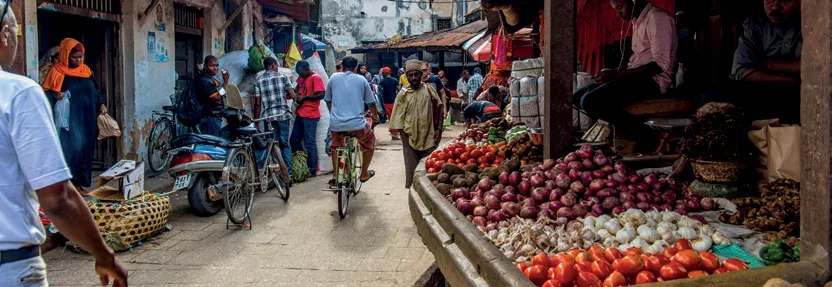
From beautiful beaches, haunting history and delicious delicacies to decorated doors, Zanzibar is a multi-faceted, idyllic destination.
Starting this month, Airlink begins flights to Zanzibar. Preface your visit with a visual walk through the island’s many attractions…
Okavango Delta lodge connects guests to a wild range of animals
Approaching the grey bird on foot is giddily exciting. This is no ordinary species – it’s sleek, polished and can take off at a moment’s notice. It is able to land anywhere and on a variety of terrains. Noisy when in flight, the solution to drowning out the cacophony is to cover your ears. Standing next to the six-cylinder, fuel-injected Robinson R44, commercial pilot Zakai gives a safety briefing, cautioning to exit to the front of the helicopter on landing.
It never gets old to experience the beauty of the Okavango Delta from a bird’s eye view, secretly hoping none of them will be soaring at our level of 500 feet. What a privilege to see the magnificent Monachira Camp from the air before Zakai safely lands the helicopter following the 25-minute flight in a northerly direction from Maun.
Opened in May 2025, the property’s newness is felt in the enthusiasm of the staff. Guide Harold drives the three minutes between the chopper and the arrival area of the camp and members of the team break into song and dance for a warm welcome. At the end of a sandy pathway, tented suite number 10 is home for the next three nights. Beautifully decorated in shades of white, black, grey and brown, with some striking accents in the form of mustard-coloured cushions, the suite commands the most exquisite views over the floodplains.
In close contact
Upon opening the zip to the outside section of the tent, there is a colourful bird doing his best to appear inconspicuous. He’s flapping his bright orange wings and momentarily lands on the branch of the imposing sausage tree that is casting shade on the deck. Then he vanishes, before posing properly for a picture.
At the main dining area where meals are served, a few small critters are making their way up the base of a tree and leaping from a dizzy height to run along the deck. Tree squirrels always seem to be around, much to the chagrin of the staff. Apparently, they run off with doilies! During brunch, bright green little bee-eaters flutter from branch to veld, searching for their own meals. Surveying their surroundings after swaying on thin blades of grass, the tiny birds abruptly dart off to find insects in the sandy soil.
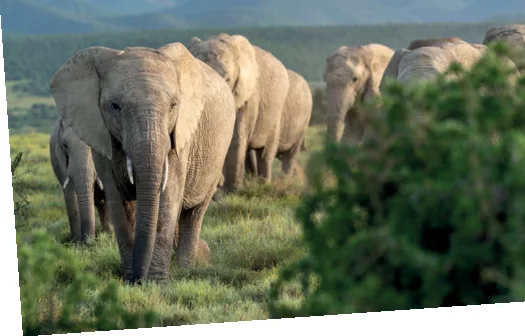
Commencing the afternoon game drive, Harold is keen to show off the wildlife that inhabit Moremi Game Reserve. A small breeding herd of elephants is feeding on the overwhelmingly generous greenery, while a lone male is overindulging on the fruit and leaves of a marula tree. His eyes are closed and Harold explains that the elephant is eating while sleeping. He is clearly loving the nutrient-rich tree and pods, stopping short of completely demolishing it. A lilac-breasted roller is perched atop a small rain tree. Looking in the sand for insects to catch, he takes flight, displaying the iridescent plumage that makes these birds such popular subjects for photographers.

In the shade of a sausage tree, there are two shapes lying flat in the grass. On closer inspection, it’s a coalition of male lions having a nap. Oblivious to our presence, they continue their slumber until an unusual sound makes the one wake up and take notice. His mane is so dishevelled that it looks as though he has had the best sleep of his life.
The instantly recognisable call of a woodland kingfisher is heard. Scanning the trees to see where the sound is coming from seems uncomplicated, but take into account that these birds are only around 23cm long. Suddenly, one flits past and lands on a branch to the left. Harold points out that it’s a juvenile, as it lacks the red of its bill reaching right to the end.
Immovable object
We are stuck. Properly stuck. In the mud. Harold removes his shoes, alights from the vehicle and disappears into the bush barefoot and unarmed. Fearing for his safety, as there might be something lurking in the tall grass, it’s a relief when he appears brandishing three large tree stumps. He has a plan to solve the dilemma. Looking at the rear of the vehicle, he announces: “It’s the diff.” Wedging the branch underneath the back axle, he uses the jack to hoist the right side up. Splashing is audible as he wades ankle-deep through the muddy water. The rescue team has been notified but, until they arrive, Harold is trying his utmost to leverage the logs with the mud. Or is it the other way around? He hotfoots it into the bush again, this time dragging two pieces of an African mangosteen tree behind him. After a considerable amount of effort, we are free!
On the morning game drive, the male lions appear again. And they are not alone. A female has joined them, and one of the males is rather besotted with her. The saying “two’s company and three’s a crowd” has never rung truer. The honeymooners want their privacy, but the third wheel keeps on following them. Sniffing the grass where the female has previously laid down, he proceeds to do a Flehmen grimace. His brother walks away with his new flame. However, they are two incredibly handsome male lions. How will the lioness choose between them if she has to, down the line? Only time will tell.
Text and photography | Heléne Ramackers
For more information or to book, go to machabasafaris.com.
Stellenbosch is hugely attractive, whether you’re exploring the city or the landscape around it
A clear morning anywhere in the Cape Winelands is mesmerisingly beautiful and, when you’ve arrived at your accommodation in the dark and your first sense of a place is revealed in perfect golden light, it’s like the place is unashamedly showing off. Such is the case when opening the blinds of Avemore Rare Gem, a converted cellar in a large manor house on an estate called Le Verger in the beautiful Devon Valley.
The self-catering apartment has the thick walls of a former wine storage area, which regulates the temperature and sound wonderfully. Arguably, it’s the holes in those walls – the windows in the bedroom and the kitchen – that are the best feature, allowing views first over a shared pool and then the slopes on the opposite side of the valley, with the Hottentots-Holland Mountains looming dramatically in the background.
Breakfasting around the pool facing that view is pretty much mandatory, but if you can tear yourself away from the visuals for a walk, Le Verger offers a range of sights and sounds in a compact space. Green lawns are patrolled by egrets and hadedas at opposite ends of the scale in both colour and personality (when was the last time you yelled at an egret to “keep it down!”?).
Alongside the foliage-fringed driveway is a lake, home to a number of other birds and, judging by the sounds, a large frog contingent. Grey squirrels meander in and out of every wooded border, glancing at you to establish your intent and then attending to their food intake needs with hyperactive intensity. An olive plantation transports you briefly to the Mediterranean before a massive banyan fig tree evokes the tropics. All the while, other accommodation options, for couples, families and groups, appear and blend into the landscaping, providing a feeling of a safe, peaceful little country community.
It’s a cosmopolitan crowd too. Around the pool, there are couples from different countries lying on sun loungers and a gentleman – from another country – on the verandah above raising his coffee cup in greeting. It’s a very different tone to a hotel stay, with everyone self-sufficient and on their own timetable, as happy to swap recommendations as they are to hide in their private retreats.
Streets with stories
The Devon Valley, whichever direction you’re heading, is a scenic drive. The tasting room and restaurant at JC Le Roux occupy one end, with the historic town of Stellenbosch at the other extreme. Midweek, the latter is unexpectedly (for a visitor) busy, its energetic buzz reflected in the agreeable challenge of finding parking on the central streets. All of that area is easily walkable and navigable – if you get lost, simply look up the slope occasionally and orientate yourself using the spire of the imposing Moederkerk.
Make sure you’re hungry when visiting. There is a literally mouthwatering array of eateries, from coffee shops serving light meals to magnificent fine-dining institutions and all points in between. It’s bewildering to try to work out how so many options survive, as it’s possible to discover a spot with incredible appeal between seeing the sign for and reaching the door of a different venue. And given how Stellenbosch’s architecture reflects its history, there are often more common chain outlets given vintage, storied ambience by their surroundings.
Comfortable, modern Avemore Mareba Court No 9, between celebrated Dorp Street and the clear-flowing Eerste River, which marks the boundary between the centre of town and the suburbs, is within easy walking distance of most of the more popular attractions.
Just 500m away is Oom Samie Se Winkel, a trading store that has occupied the same building and served more or less the same purpose for over 120 years. Today, there are more contemporary stock items, but the shop still has an outlandish array of supplies, including bokkoms (salted, dried mullet; bit of a whiff), antiques, taxidermy as decor, amusing signs and the odd chandelier, all in a cramped space. There are also idiosyncratic food choices, like foot-long koeksusters, which have stood the test of time. It’s impossible to ignore the thought that stock-take here must be a nightmare, but it’s an immersive browsing experience and an opportunity to buy something that will represent your memories here once you get home.
Partnerships to enrich the future
Further afield, over the hill at the far end of the Devon Valley and along the Bottelary Road (which overlaps the original wagon trail from Cape Town to Stellenbosch), conservation becomes a central theme. Developers and their projects are a constant threat to indigenous vegetation here, but the Bottelary Hills Renosterveld Conservancy is making a notable difference in ensuring that the area retains many of its original ecosystems and habitats.

Perhaps the most impressive thing about the conservancy is the network of partnerships it’s engendered. Running a farm is a brutally difficult business and yet 55 private landowners in and around the Bottelary Hills have committed to conserving endangered Renosterveld on part of their land – including the hard work of clearing alien vegetation, maintaining hiking and mountain biking trails and more – showing unusual foresight and altruism for businesspeople (even if many did grow up in the area). Some have even had their protected areas declared as official nature reserves, meaning protection in perpetuity, regardless of what happens after they’re gone.
The properties involved in the scheme differ wildly. Hazendal is a sprawling, mostly modern campus with a par-three 18-hole golf course, an epic putt-putt area and a driving range, a boutique hotel, a space-age children’s play and learning area, multiple restaurants and an impossibly elegant tasting space, all integrated into one of the oldest estates in the region.
The owner’s car collection, displayed with plaques explaining the vehicles’ providence, includes a line of vintage Rolls Royces and a Bentley, a measure of the budget behind the estate and the many programmes it has in place to support the local community.
A couple of minutes away, Mooiplaas is the antithesis of all that modernism – old, cultured and traditional. It still looks like a working farm of its kind would have a century or more ago, with a quiet mood and reserved pace that makes it feel serene. Tielman Roos, the chairman of the conservancy, grew up in the stately Mooiplaas manor house. He notes that the bulk of the wood inside is yellowwood because it was cheap to bring in from Knysna at the time, unlike that swanky Oregon pine. He also shows off a magnificent carved frieze, showing off the history of the Dutch settlers in what looks like teak. It’s incredible work, the kind of thing that might be a museum centrepiece one day.
As he hosts a tasting of his delicious wines, Roos notes, “The sun shines on everyone. We all get to benefit and we all get to give something back.” It’s an attitude that will keep the conservancy spectacular, friendly and undeniably worth visiting.
Text and photography | Bruce Dennill
For more information or to book a stay, go to avemore.co.za and bottelaryconservancy.co.za.
Gorgeous island is a spectacular retreat from the concerns of the world
The boundary of Lake Malawi National Park starts to become apparent when the lush roadside greenery begins to feature larger, more intact trees, as the locals don’t go into the conservation area for their firewood or timber.
The village of Cape Maclear, a little further on, reintroduces human influence, an urban enclave that is both a traditional fishing village and a tourism hotspot featuring lodges, restaurants and bars. Refuel on tasty, unpretentious food – some combination of rice or nsima (maize porridge) and cassava leaves and fresh fish or chicken – at an eatery there before heading out on the water to experience something more distinctive: an island that’s uninhabited other than the staff at Mumbo Island Camp and its guests.

The departure point for that short transfer – Mumbo Island is 10km from the reception at Kayak Africa in the village – offers a first experience of Lake Malawi and just a hint of its immense size. Forty-five minutes on a comfortable catamaran reinforces the feeling of intense wildness as a couple of other islands featuring nothing more than foliage and birds pass by, and blue-green water extends all the way to the horizon. The approach to Mumbo builds expectations. First, a chalet or two poke through the vegetation at the top of a cliff before, rounding the headland into a narrow bay, the boat hones in on a beach with a snorkelling and kayaking centre on one end and a boardwalk above the water on the other.
If there’s still sunlight, you can drop your luggage, grab a snorkel and fins, literally fall face-down into the water and immediately see a couple of species of cichlids, the fish for which the lake is most zoologically famous.
Returning from the swim – and only then considering that lakes in Africa are generally home to large numbers of hippos and crocodiles and panicking slightly before being told that they don’t tend to venture this far from the shore – the next item of business is a sunset cruise around the back of the island. A pair of fish eagles hunts overhead as the mountains guarding the western edge of the lake are briefly and dramatically silhouetted as the sun clocks out for the day.
Quietly powerful

The bathroom adjacent to the reed-walled clifftop chalet (the latter weirdly warm and sheltered inside, even when a cool breeze is blowing) is walled largely by huge boulders, with a bucket shower topped up with hot water at a pre-arranged time. For all of the low-fi technology, it’s a brilliant system – you have a spectacular view while showering and will almost definitely run out of things to wash before the water runs out.
The general lack of electricity takes a bit of getting used to, with a central station for charging phones and small solar-powered batteries for a bedside lamp being the bulk of the power on offer. Being out of touch is not necessarily a bad thing, though it might be easier for you to deal with while cavorting in the waves or breathing in pure forest air than for your loved ones trying to get hold of you from (alleged) civilisation. With your phone now only useful as a camera, you are in many ways freed up to make the most of what you have here: complete privacy and safety and exceptional natural beauty.
One of the benefits of not having lights and screens everywhere is that, post-dinner (the cheesecake is extraordinary), the clear night sky is a spectacle that is almost impossible to achieve closer to a city. The whole of the Milky Way presents itself for examination, and the only thing marking the passing of time is the metronomic thud of waves on the beach below. Below the chalets, far away on the surface of the lake, the lights of fishing boats in which locals are trying to catch tomorrow’s meals twinkle gently, complementing the stars and making visitors question how the fishermen navigate in such inky blackness.
Stop and go
Beyond all the beach-related activities and the conscious appreciation of the tranquillity and soul-stillness of the place, something worth doing on a daily basis on Mumbo is exploring the island’s network of walking trails. None of the distances are particularly great – it’s a small piece of land – but it does get steep in places, and, what with wanting to stop regularly to appreciate the scenery and take photos, it’s certain that getting anywhere quickly should not be a priority.
All around the island are spectacular vistas and viewpoints, and places to stop and take in the splendour all around. Two of the best take visitors high (Fig Tree Rock) and low (Impipi Bay). The first will make you feel like the captain of a ship, standing on the prow of his vessel, with everything before you and every direction the route to somewhere magical. The second is a secluded strip of rocks and pebbles with a shaded sandy area above it in which to dry off after a dip. These and other spots are purpose-built to lie in the sun or under a tree with a book and rediscover how to turn off or, at least, how to lower the volume all the way down.
Between those pauses, exercise – on the short hikes (with some added adrenaline after a brief snake sighting), on a kayaking excursion or in the water (with or without a snorkel) – will help build an appetite for the fine food and the warmth and care that comes with its preparation. It’s a fine cycle – repeat it often before heading back to the mainland.
Text and photography | Bruce Dennill
For more information or to book a stay, go to mumboisland.com and malawitourism.com.
Brand flagship is a joy to drive – provided it doesn’t talk too much
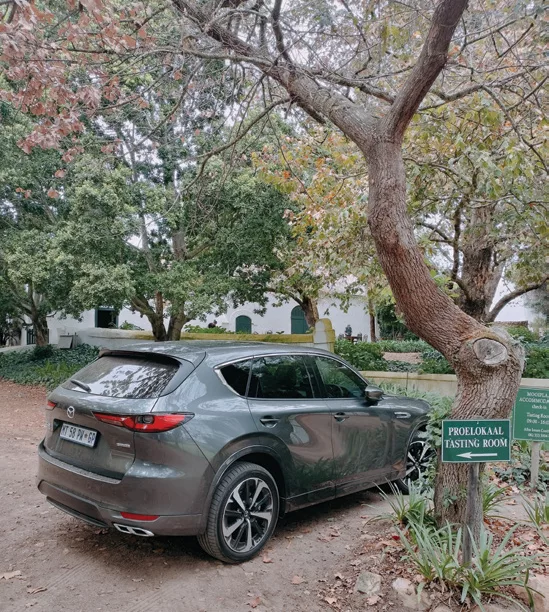
First impressions arguably hit harder when you’re picking up a car in a bland concrete parkade, but the external styling of the Mazda CX-60 immediately brings to mind the looks of similar SUVs from grand marques rather than the more utilitarian, workhorse feel of some of its direct competitors. And there’s more inside, with an elegantly unaffected dashboard and control design and a cockpit position so comfortable and easy to occupy, it’s almost like the engineers want you to enjoy being there.
It is a happy place to sit when out on good roads, with a wonderfully smooth ride at speed and powerful acceleration off the mark, whether that’s getting going at an intersection or deciding to take a gap on the highway when overtaking is the next move. The steering and handling are reliable and solid going forward, and, for a big car – it weighs in at nearly two tonnes – it has a surprisingly tight turning circle.
In a spin
Some of the initial goodwill generated by the luxury and basic driving experience is undone once you no longer know how to get to the next destination. While it’s clearly not ideal to be inputting details for where you need to get to while on the go, a touchscreen media centre and navigation centre – as is available on a number of other cars in this sector of the market – is at least a quick and intuitive method to set or update routes. The system in the CX-60 encourages the driver to do all of the preparation before setting off – sensible – using the ‘centre console commander knob’ on the console between the driver’s and passenger’s seats. That’s all well and good, except that entering words involves spinning the wheel to choose each letter from an alphabet displayed in a circle, which takes forever – much less straightforward than typing on a screen keyboard.
Many of the rest of the controls accessed by using the same knob or the auxiliary buttons on the steering wheel are counterintuitive or simply clunky, which is not at all in keeping with how friendly the rest of the car feels from a user’s point of view.
Mission accomplished!
How enjoyable the Mazda is to drive proves noteworthy when it becomes the means of carrying out an unexpected rescue mission. A product needed for an important event hasn’t arrived, and the couriers, when confronted, don’t think they can make a plan to have it on site before the event begins.
The CX-60 has loads of space – a large boot with an extensive extra packing area if you put the back seats down – so that important aspect is sorted. It also has air conditioning to bring down the heat caused by the delivery frustration, a classics/jazz station as a preset, a glorious 12-speaker Bose sound system and widescreen winelands scenery outside the windows.
So effective is this package that, on returning with the goods from the faraway warehouse, the star attraction of the event is surprised, blurting out, “Are you back already? I didn’t have time to finish my prep!” Chalk that up as a tick in the CX-60’s KPIs.
The vehicle is rewarded with a spin along the winding coastal road between Strand and Pringle Bay, where it manages the slopes and curves with ease while providing sumptuous comfort from which to view the ever-extending magnificence of the ocean panoramas.
Side-eye…
One thing about enjoying such natural beauty while driving, though… The CX-60 has a Driver Monitoring system that wants your eyes nowhere but straight ahead. There is a near-infrared camera on the dashboard that supposedly measures eye movement deviation and other markers of tiredness or a lack of attention. This could be, in certain situations, a lifesaver. Likewise, another feature that notes and highlights meandering in a lane could help tired drivers decide that it’s time to pull over and take a rest.
But these features are not – and it’s unlikely they could be – calibrated to allow for completely normal driver behaviour. Looking very briefly out of the side window – to see where a fellow road user is, to check a street sign or to appreciate the majesty of a sunset – is part of good, safe driving. And where there are potholes or other obstacles (a stone, perhaps) ahead of you, continuing in a straight line is almost certainly going to result in damage to the vehicle, so taking appropriate evasive action should be acceptable.
Mazda’s features are designed to help people to avoid getting sidetracked while behind the wheel, but when an insistent “Distracted driver!” message flashes up on the screen in front of you, accompanied by an annoying electronic sound, all it achieves is to draw the eye to the message and off the road, which is undeniably more distracting than a quick sideways glance to note where you are or what traffic is doing.
Beyond such nanny state nonsense, however, the CX-60 is an excellent option for cruising and carrying. It’s not as specced out as the top-of-the-range alternatives from other manufacturers, but with its cheaper price point, it’s not trying to be direct competition. As a luxury urban 4×4, it does everything most buyers will need, and, once you establish an understanding with the media centre and its controls over time, any vexation in that area should cease.
Text and photography | Bruce Dennill
For more information, go to mazda.co.za
Coffee table book reveals extraordinary angles on well-known wildlife subjects
Wilderness guide and wildlife photographer Armand Grobler’s new book Eden: Soul of Africa communicates his love of Africa’s animals and the incredible places in which they live.

The world’s ecosystems are filled with fabulous, fantastic life forms
Picture the scene. Camden’s Electric Ballroom, circa 1976. Sex Pistols are on stage, belting out Anarchy in the UK to a pogoing mosh pit full of spiky-haired punks. The floor is sticky with lager… the air weighs heavy with attitude. And in the midst of it all, blending in perfectly, is the Lowland streaked tenrec…
Go with me on this one. If ever there was an animal that would fit right in at a Sex Pistols gig, this would be it. The lowland streaked tenrec has both the look and the swagger. This small mammal, from the rainforests of Madagascar, sports a John Lydon-esque crown of punky yellow quills. Matching stripes run the length of its otherwise black body, which is peppered with yet more quills. When the animal feels agitated, the detachable spines become erect and can be used as a weapon. Non-receptive females, for example, will repel the advances of an amorous male by sticking the sharp, hard spines into his genitals. Predators, such as snakes and fossas (cat-like mammals found only in Madagascar), can also get ‘spiked’ and so are wary of these feisty hellraisers.
The lowland streaked tenrec is also a musician of sorts. Look closely at the lower part of its back, and you’ll notice a dense patch of 15 or 16 light brown quills. They sit on a thumbnail-sized pad of muscle, and when the muscle contracts, it makes the quills vibrate. This generates an extremely high-pitched sound, inaudible to humans, but obvious to fellow tenrecs, who use it to communicate.
When animals rub body parts together to make sound, it’s known as stridulation. Crickets do it. Some snakes and spiders do it, but the streaked tenrec is the only mammal known to generate sound in this way.
The lowland streaked tenrec is one of 36 tenrec species, which all belong to the family Tenrecidae. The family is diverse. They range from species the size of a cocktail sausage to species the size of a sausage dog. The lowland streaked tenrec is about the size of a breakfast sausage. Some tenrecs look like hedgehogs, others more like shrews or moles, but they’re all more closely related to animals such as elephants and sea cows than they are to their familiar lookalikes.
This is because of their evolutionary history. Madagascar broke off from mainland Africa around 170 million years ago. Sometime after that, it’s thought the ancestor of tenrecs hitched a ride from Africa to Madagascar on board some floating detritus. As a result, all tenrecs are of African heritage. They belong to the order Afrotheria, which includes other mammals of African origin, such as aardvarks, elephants and sea cows. Once ensconced in Madagascar, the tenrec’s ancestor then diversified into the many forms that exist today.
Lowland streaked tenrecs are social animals that live in big family groups. They use their long, bendy snouts to rootle around for earthworms and other invertebrates and have been spotted stomping on the ground with their front paws. This is thought to make the earthworms more active, so they can be detected and eaten more easily.
Text | Helen Scales and Helen Pilcher
This article appears in Very Interesting #85.
Picking a favourite pastry is becoming an ever more interesting pastime
The pastry world is entering a renaissance defined by creativity, comfort and curiosity, and nowhere is this more evident than in the rise of hybrid baking trends that continue to evolve. What began as croissant-inspired experimentation has now moved far from the cronut era and into a global appetite for mashups that merge technique, tradition and pure indulgence. From Paris to Toronto, bakers are doubling down on unexpected creations that have transcended gimmick status to become mainstream staples.
One of the most headline-grabbing examples appeared on National Donut Day, when Philadelphia Cream Cheese unveiled the bonut – an uncut, doughnut-shaped bagel slathered with the brand’s newest sweet flavours, blueberry and pineapple, developed in collaboration with College Street Bagels and Fairmount Bagel. With Nielsen IQ data showing that 89% of cream cheese sales sit firmly in the savoury category, despite nearly half of consumers preferring sweet, the bonut reveals a clear opportunity in the market. It also reflects a broader consumer mindset: while people still long for the familiarity of comfort foods, there is an equally powerful hunger for adventure and novelty.
According to Taste Tomorrow’s global insights, 63% of Gen Z-ers and millennials say they are drawn to bakery items that offer something unexpected, a sentiment fuelling the popularity of cruffins, croffles, bonuts, duffins, crookies and other playful hybrids. Among these emerging icons, the crookie, a croissant-cookie mashup rumoured to have originated in Paris, has quickly gone international, blending buttery lamination with a soft, cookie-like centre to create a treat that feels both nostalgic and entirely new. The trend extends to filled pastries, too, as bakers increasingly abandon plain croissants in favour of versions piped with pistachio, hazelnut or chocolate custards that peek temptingly from the edges. Equally eye-catching are cube-shaped croissants, which require specialised moulds and meticulous technique, often finished with colourful icing drips or elaborate toppings that highlight the baker’s artistry. Laminated brioche has also risen in prominence, using brioche dough layered with butter to achieve visually striking loaves with distinct layers and rich texture.
Playing the long game
Alongside these indulgent innovations comes a growing commitment to sustainability, as bakeries adopt low- or no-waste practices that acknowledge both environmental responsibility and rising consumer expectations. Bakers are reimagining by-products, turning stale bread into bread pudding, for example, and reducing packaging by opting for durable, reusable flour bags. The movement also extends to maximising whole ingredients, lowering energy consumption by using motion-activated lighting or renewable energy for ovens, recycling water and optimising overall utility usage.

The pursuit of sustainability dovetails naturally with another major trend: the revival of heritage grains. Celebrated for their deep flavours and nutritional density, these grains benefit from long fermentation, allowing complex enzymes to develop and giving breads hearty, nutty or earthy profiles. Their high levels of vitamins, minerals and fibre appeal to health-conscious consumers, while their connection to tradition aligns beautifully with the artisanal baking movement. Bakers who use heritage grains are not just producing food; they are telling stories about origin, craftsmanship, authenticity and the rediscovery of ancient ingredients that lend character and meaning to modern loaves. At the same time, artisanal baking continues to thrive, powered by a renewed focus on long fermentation, visual artistry, ingredient quality and the storytelling that elevates a simple pastry into a crafted experience. Craft bakeries are multiplying despite operational challenges; driven by a consumer desire to know not only what they’re eating but who made it and why.
Size does matter

Balancing these rich, layered trends is the rise of miniature and bite-sized desserts, offering indulgence without the guilt. Items like mini croissants, madeleines, petit fours and two-bite brownies have become staples for customers seeking portion control or variety without waste. Such tiny treats fit into more mindful eating habits while also serving the grab-and-go culture of cafés and retail bakeries, where they are priced for impulsive enjoyment.
The hybrid landscape continues to expand as brands and bakeries test new ideas. Starbucks has explored muffin crossovers such as the seasonal pumpkin cheesecake muffin, while in the frozen aisle, brands like Nestlé Toll House and Pillsbury have seen success with cookie-stuffed brownie bites and doughnut-glazed cake bars. The croffle, made by pressing croissant dough in a waffle iron, has become another standout, joining a growing cast of inventive creations such as the suprême, a spiral of croissant dough filled with Italian bomboloni cream; the biski, a biscuit-cookie-cake trifecta developed by London’s Cutter & Squidge; the pretzel-croissant hybrid known as the cretzel; and the baissant, which merges the chew of a bagel with the flakiness of croissant layers.
Text and photography | Supplied
For more information, go to capsicumcooking.com
Allowing kids to fail and learn for themselves helps equip them for the future
In a world of packed schedules, rising anxieties and digital distractions, the way we parent has never been more complex or more important. Children don’t need perfect childhoods – they need real ones. Ones filled with play, protection and participation to grow.
Today’s parenting styles often come from a place of deep love, but when we hover too closely or clear every obstacle before our children reach it, we can unintentionally rob them of the small struggles that help them thrive.
Modern terms like ‘helicopter parenting’ and ‘lawnmower parenting’ describe well-intentioned behaviours – ‘hovering’ to protect and help, or smoothing every path to prevent discomfort. These approaches often overlook what child development experts call the ‘just-right challenge’. A balanced philosophy can give children the support they need while encouraging and maintaining independence.
Children build confidence by trying, failing and trying again. That’s where resilience begins. When warmth is paired with boundaries and love with opportunity, there is incredible growth – not just academically but socially and emotionally.
Free play remains one of the most powerful developmental tools in early childhood.
Whether it’s climbing, balancing or imaginative play, these experiences help children build executive function, manage emotions and understand social dynamics. With adult support close by – but not overbearing – these activities become safe and enriching opportunities to learn.
It should take a village
In South Africa, parents often have a unique advantage: community. Grandparents, neighbours and extended families often play a vital role in raising children. That village of support is a strength. Families should be encouraged to use it to plan outdoor playdates and to invite cousins to join or share learning spaces. There’s no app that can replace the value of human connection.
The focus should be on nurturing not just cognitive skills but the whole child. Teachers should act as gentle guides, helping children navigate early life’s hurdles with empathy, patience and clear structure. The result will be children who feel seen, heard and confident enough to explore the world.
Resilience doesn’t come from a perfectly smooth path. It comes from knowing that when life gets bumpy, someone is there to support you while you take the wheel. It’s not about raising perfectionists, but rather about supporting capable, compassionate human beings. For parents wondering whether they’re doing it ‘right’, there is no single perfect parenting style. What matters most is balance. Guide, protect, listen and, most importantly, let children play, explore and grow into who they want to be.
Text | Ursula Assis
Photography | Ekaterina Pokrovsky
Ursula Assis is Country Director for Dibber International Preschools in South Africa. For more information, go to dibber.co.za
Body acne can be a problem for people of all ages
Globally, adult acne is gaining momentum. Regular breakouts are becoming more and more common among men and women in their twenties, thirties, forties and even beyond. And it’s not just facial skin that’s at risk of breakouts. Body acne most commonly occurs on the back, chest or buttocks and may be caused by several factors, such as genetics, hormones or lifestyle habits.
Body acne can be classified into several categories. Acne mechanica is caused by repeated friction or pressure on the skin. Think sweat-soaked clothing during a workout, exercise gear or workout equipment. It’s common among athletes and among men and women who lead active lifestyles. When sweat sits on the skin for a prolonged period, it may clog pores, leading to breakouts.
Acne cosmetica refers to acne on the body caused by cosmetic products. Some products contain pore-clogging ingredients like silicones and oils. Hormonal body acne occurs when hormonal changes increase sebum production, leading to breakouts. This is particularly common among women going through puberty, pregnancy or menopause.
Fungal body acne, also known as Malassezia folliculitis, is caused by a fungal infection of the hair follicles. This may lead to clusters of small, red, itchy bumps that sometimes grow bigger and turn into whiteheads.
Acne may also be influenced by poor diet, stress, poor hygiene and genetics.
Plot your own path
Because there are so many causes of body acne, it’s essential to determine the cause of yours before embarking on a treatment. Speak to your medical practitioner to determine the best course of action. There are also a few simple lifestyle changes that can help.
One key is to remove sweat from your skin as soon as possible. Take a shower right after a workout and change into a fresh set of clothing.
Salicylic acid is a great ingredient to treat breakout-prone skin. It gently exfoliates, prevents the build-up of dead skin cells, unclogs pores and reduces the redness and swelling that sometimes accompany breakouts.
Sweat, dead skin cells and cosmetic products get absorbed into fabric, such as clothes and bedding. Wash sheets and pillowcases regularly and don’t wear yesterday’s workout gear again before washing it. For heavily soiled clothing, consider adding bicarb to your wash and avoid heavily perfumed washing powders.
Avoid body care products that contain oils, silicones, waxes and fragrances that may clog pores and cause skin irritation. Hypochlorous acid is one of the most versatile and beneficial ingredients you can apply to your skin. A powerful, natural antimicrobial agent, it serves as an effective disinfectant that kills bacteria, viruses and fungi while speeding up wound healing and reducing inflammation.
Text | Judey Pretorius
Photography | Voyagerix
Dr Judey Pretorius is the MD of Biomedical Emporium.
For more information, go to biomedicalemporium.com
Optimism trumps mindfulness when things get tough, says the science
In the last decade or so, mindfulness has been one of the revelations in the science of wellness. Researchers have shown that meditative practice can lower stress, reduce blood pressure, improve sleep and promote a good mood.
But there’s a ‘but’, because in science, there’s almost always a ‘but’. Mindfulness doesn’t work for everyone, and for some people, it can lead to adverse effects, such as increased anxiety or depression. Which makes sense. Being present in the moment feels good when the moment in question is generally positive, or neutral. But if you happen to be going through a bad time, mindfulness can serve to increase awareness of your own emotions and exacerbate the psychological problems that come with them.
“I’m drowning here… And you’re describing the water!” yells Jack Nicholson in the 1997 film As Good As It Gets. He was talking about his love life, but the sentiment holds for mindfulness, too.
So, when mindfulness means a mind full of negative emotions, what mental tools should we reach for instead?
Last year, an interesting study compared mindfulness with a different kind of positive mindset: hopefulness. Researchers at Clemson University and North Carolina State University wanted to know how these different mental states affected people during an unquestionably difficult period.
They spoke to workers in the music industry about their experience of the COVID-19 pandemic. “We deliberately reached out to a group that had been really impacted by the pandemic,” says study author Dr Kristin Scott. “Their work was obliterated for a long time.
“We approached this from the mindset of, ‘What helped these individuals stay the course, stay focused, not totally give up, not fall into depression?’”
Scott and her colleagues found that hope improved the music workers’ resilience and professional engagement. Mindfulness, in contrast, increased job tensions and stress. It was a stark result that begs another question: what exactly is hope?
It might sound like something passive – a blind faith that things are somehow going to be okay. Scott says that’s not quite right. To be beneficial, hope has to be something active and proactive, strategic and forward-looking.
“It’s quite a goal-oriented mindset,” Scott says. “It’s saying, ‘I don’t know how things are going to go, but I feel that if I do these things and if I stay focused, I think that I can get positive outcomes.’”
“You don’t get so caught up in the noise and distractions of the negative. You put that information more in the back of your mind.”
The finding chimes with evidence on the power of optimism. Multiple long-term studies find that optimists live longer, happier lives and are more likely than pessimists to adopt healthy behaviours.
Scott is keen to stress that although hope led to more positive outcomes in her study, that’s not to say there isn’t a time and a place for mindfulness.
“Mindfulness isn’t bad at all,” she says. “It’s a calming mechanism. And purists would say there’s also mindful acceptance, which is about acknowledging when things are bad but not letting that get to you. ‘I’ve seen negative stuff, and I’m not giving in to that.’”
“I think hope just takes it a step further by saying ‘I’m actively going to work around these different barriers.’”
Scott can relate – she needed hope and resilience to get the research published. “This is humbling to disclose, but this paper was initially rejected, even at conferences. People were defensive or confused about what we were saying about mindfulness. Honestly, for a while we joked that it was the hopeless paper.”
She had another colleague who questioned the idea of false hope and whether telling people to get their hopes up could be problematic.
“I’ve been thinking more about that too, but in its pure sense, hope is about asking what you can do instead of falling into pure dejection and helplessness. To me, hope is about staying hopeful, no matter what happens.”
Text | Ian Taylor
Illustration | Jesus Escudero
Ian Taylor is a freelance science writer and the former deputy editor of BBC Science Focus.
Eastern Cape safari offering distinguishes it from other South African holiday areas
During holidays, migrations happen in and around South Africa. Johannesburg empties out, the N2 fills up and South Africa’s coastal towns brace for an influx. Families pack roof racks, book beach houses and head towards the promise of warm water and slower days.
Sometimes, there are other migrations worth watching. Southern right whales calve in Algoa Bay, their massive forms breaching just offshore. Great white sharks patrol the deeper waters, drawn by the rich marine ecosystem that makes the Eastern Cape coastline one of the most biodiverse stretches in Africa. Bottlenose dolphins hunt in super pods. African penguins waddle across beaches that double as breeding colonies.
Welcome to Big Seven territory. Most safari-goers know about the Big Five – the terrestrial celebrities of African wildlife tourism. The Eastern Cape offers something rarer: those five plus two marine mega-species that turn the province into a year-round wildlife destination. Addo Elephant National Park hosts lion, leopard, elephant, buffalo and rhino across 180,000ha. Drive an hour to the coast, though, and you’re scanning the waves for whales and sharks. It’s a geographic advantage that’s reshaping how tourists think about South African travel.
Taking the gap
Eco-tourism in the province is no longer just about game drives and lodge stays. Marine safaris have become as sought-after as traditional bush experiences, with operators offering cage diving, whale watching and dolphin encounters that rival anything found on terrestrial safaris. The thrill of a great white shark rising through the water column or a southern right whale rolling beside a boat carries the same weight as spotting a leopard in a marula tree.
This diversification is happening at exactly the right moment. Global tourism trends show travellers increasingly seeking sustainable, multi-experience destinations where conservation and adventure intersect. The Eastern Cape delivers this naturally. SANParks has partnered with Red Sea Global on an SMME Incubation Programme that’s nurturing 20 local enterprises over 18 months, creating pathways for entrepreneurs to build tourism businesses rooted in their communities. These aren’t token initiatives. The programme includes connections with international agencies, sustainability networks and eco-tourism marketers, giving Eastern Cape operators access to global distribution channels and best practices.
The result is an ecosystem where wildlife experiences, community-based tourism and international partnerships are creating something bigger than the sum of their parts. A tourist can spend the morning tracking elephants in Addo, the afternoon watching great whites breach off Seal Island and the evening eating at a restaurant owned by a programme graduate, all while staying in accommodation that understands what modern travellers want.
Reasons to stay
Eco-tourism can’t scale without infrastructure that meets expectations. Travellers committed to sustainable experiences still want comfort, connectivity and contemporary design. The Eastern Cape tourism landscape is evolving in real time. The wildlife experiences have always been world-class. What’s changing is the infrastructure around them and the collaborative approach between conservation bodies, local entrepreneurs and hospitality providers. When tourists have a comfortable, well-located base, they explore more, stay longer and engage more deeply with the region.
The timing aligns with broader shifts in South African tourism. Domestic travel surged post-pandemic, and international arrivals (even factoring in challenges caused by major conflicts) see European and American markets showing strong interest in destinations that offer both classic safari experiences and something beyond the standard circuit. The Eastern Cape’s Big Seven narrative, combined with its emerging reputation for sustainable, community-linked tourism, positions it as an alternative to the more saturated safari regions.
Holiday migrations will still happen. Roof racks will still groan under the weight of beach gear and optimism. The difference is what travellers will find when they arrive: an Eastern Cape that’s figured out how to turn its natural advantages into a genuinely differentiated tourism offering, where the Big Seven aren’t just marketing copy but the foundation of an ecosystem that works for wildlife, communities and the visitors who come to experience it all.
Text | Garnet Basson
Photography | Ahturner and South Africa Wildlife
Garnet Basson is COO of The Capital Hotels, Apartments & Resorts.
For more information, go to thecapital.co.za.
Some established business practices will make no sense in particular contexts – so ditch them!
Businesses need to stop doing the things that drain resources without delivering results. Think through strategies to remove the fat.
Stop adding ‘AI-powered’ to your pitch deck if it doesn’t actually solve a pedagogical problem. If a simple logic tree or a human mentor works better for the learner, use that instead. There is certainly value in AI in certain instances, but it’s important that the tech is not allowed to dictate the solution.
Leave behind the assumption of perfect connectivity and high-end devices. If a product doesn’t account for data costs, loadshedding or low-spec hardware, it is being designed for a minority and not the reality of the context.
Don’t treat evidence as an afterthought. It needs to be integrated into daily operations, so that it doesn’t become about guessing what works. It’s not just something quickly found to satisfy a grant requirement at the end of the year. Also, ditch the ‘lone wolf’ founder mentality. The ecosystem is too complex to navigate alone. Other founders are competitors, but more importantly, they can also be potential partners for distribution, data sharing or advocacy.
Never prioritise downloads over engagement. A million downloads mean nothing if only 1% of users return after day three. Stop chasing vanity metrics that look good in press releases but don’t translate into actual outcomes.
Allow for nuance
Never neglect the human in the loop. Time and again, technology ignores the person working with it and the challenges they face. Take time to focus on how tools can make difficult jobs just a little bit easier.
Don’t put scaling before solving. Don’t rush to five new markets if a product-market fit is still shaky in the first one. Scaling a broken or inefficient model only helps the business to fail faster and at a higher cost. Also, don’t ignore ‘small’ data. While big data is great for trends, small data – the direct feedback from 10 frustrated customers – is often where the real breakthroughs happen. Pay attention to the qualitative stories in favour of the dashboard numbers.
Avoid a ‘one-size-fits-all’ user interface. Africa is not a monolith. Western-centric design templates don’t always resonate with local languages, cultural contexts or visual literacies. Localise interfaces, not just text.
And beware the “I’ll rest when I’m funded” lie. Founder burnout is a quiet epidemic in every industry. Mental health should not be a secondary priority. A burnt-out leader cannot build a sustainable business or inspire a team.
Text | Supplied
Photography | Ralf Geithe
For more information, go to injini.africa
How to minimise the costly impact of business interruptions
For many South African businesses, risk planning tends to focus on visible threats such as fire, theft or natural disasters, and how to avoid them. What often goes overlooked is how downtime impacts business operations when the unexpected occurs.
When operations stop, the financial impact extends beyond immediate physical damage and overflows into lost revenue, ongoing expenses, reputational harm and customer churn. These factors can compound, potentially becoming a storm greater than the initial loss event. It can threaten a company’s short-term operations and long-term survival. Because when business is interrupted, what matters most is not just the event itself, but how quickly you can recover from it. This is where business interruption insurance cover becomes critical.
Know your cover
The purpose of business interruption insurance is to help put a company back into the financial position it would have been in had the disruption not occurred.
In other words, it’s not just about cover; it’s about restoration.
Many businesses find themselves exposed when they assume that their general cover will protect them against the longer-term effects of a loss event – but it doesn’t.
Specific policies also include cover for fixed operating costs like salaries, rent and utilities, costs that continue, even while business activity is halted. Some policies also allow for ‘increased cost of working’, enabling businesses to fund temporary solutions like alternative premises or rental equipment to reduce downtime and get back on track sooner.
Because when the unexpected happens, staying operational, or getting back to it quickly, makes all the difference.
Cover from an insurance ecosystem
It’s equally important to understand what business interruption cover does not include, as it’s not a catch-all solution for every operational setback. It generally only covers businesses for events involving physical damage that are specifically insured under the policy.
Disruptions caused by events like prevention of access or supplier failure may require additional extensions to a policy. These optional add-ons may look like additional cost at face value, but they play an important role in strengthening your business against a wider set of risks.
Because risk doesn’t always come in one form – and when it does come knocking, having the right solutions and partner like Auto&General in place can help you respond with confidence.
Know your worth
Underinsurance remains one of the greatest risks a business can face, for both standard and business interruption-specific policies. Businesses often miscalculate their gross profit or fail to account for growth, leaving them inadequately covered if policies aren’t reviewed regularly.
Ultimately, business interruption insurance is not just about having cover; it’s about having the right cover in place when you need it most.
Regular reviews with your insurer or broker, accurate financial declarations and a clear understanding of policy terms are essential. Because in an unpredictable environment, the real risk isn’t just the disruption, it’s not being prepared for the cost of recovery.
When the unexpected happens
Business interruption insurance is about more than protection. It’s about getting your business back on its feet. At Auto&General, we’re committed to being there when it matters most, with solutions that help restore your business, minimise disruption and keep you moving forward. Because when your business needs to recover, you need more than cover. You need someone who’s there for you.
Text | Supplied
Photography | Getty Images
Get an Auto&General business insurance quote
Get protection for your business with Auto&General insurance. For more information or a quote, visit autogen.co.za or contact us on 0861 333 877 to speak to a dedicated team of experts.
Auto&General is a licensed non-life insurer and financial services provider. Terms and conditions apply.
New legislation is tougher on bribery than ever before
South Africa continues its strong stance against corruption with the recent amendments to the Prevention and Combating of Corrupt Activities Act (PRECCA). These changes extend the country’s efforts to fight bribery and promote ethical business practices, especially in the private sector. Small- and medium-sized enterprises (SMEs) need to be aware of these updates and how they affect day-to-day operations.
The amendment significantly broadens the scope of bribery offences, moving beyond public officials to include bribery within private business transactions. This means offering, giving, receiving or soliciting any form of improper advantage – whether monetary or otherwise – in private sector dealings is expressly prohibited under the law. Previously, anti-bribery enforcement focused largely on government officials, but the amendment clearly criminalises corruption between businesses and individuals in the private sphere as well.
A critical feature of the amended act is the introduction of strict liability for companies. This legal principle holds businesses accountable for corrupt activities carried out by their employees, agents or representatives, even if senior management had no knowledge or involvement. The company’s defence lies in proving it had implemented ‘adequate procedures’ to prevent such acts.
This change compels SMEs to take proactive steps to prevent bribery, as failure to do so could result in serious legal and financial consequences.
Boundaries in place
To comply, SMEs must establish and maintain effective anti-bribery compliance programmes. These include implementing clear anti-corruption policies, conducting staff training and creating safe channels for whistleblowing. Additionally, transparent financial record-keeping and regular audits help detect and prevent illicit payments or gifts. Maintaining detailed records of hospitality, gifts and facilitation payments is particularly important to avoid misunderstandings and demonstrate compliance during inspections or investigations.
Penalties for non-compliance under the amended PRECCA are substantial. Fines can be hefty, and individuals involved may face criminal prosecution, including imprisonment. Beyond legal sanctions, the reputational damage resulting from bribery scandals can severely impact an SME’s ability to secure contracts, attract investors and grow.
For SMEs, the implications are clear: adopting strong anti-bribery controls is no longer optional but a necessity. Early compliance not only protects against legal risks but can also serve as a competitive advantage. Ethical business practices build trust among clients, suppliers and partners, which is vital for sustainable growth.
The amendments to the Prevention and Combating of Corrupt Activities Act represent a zero-tolerance approach to corruption in South Africa’s private sector. SMEs that embrace transparency and accountability will not only avoid costly penalties but also position themselves as reputable, reliable players in the business community.
Text | Molisa Cheda
Photography | David Gyung
Molisa Cheda is Founder and Managing Director of Vanguard Legal.
For more information, go to vanguardlegal.co.za
Trying to save money when enjoying or working with alcohol can have terrible consequences
South Africa has one of the highest levels of alcohol consumption per capita in the world and the government has long used sin tax as a way to tackle the problem. By steadily raising the price of alcohol, the aim is twofold: discourage excessive drinking and generate revenue for public health. But while the intention is clear, the reality is more complicated.
As prices climb, demand for cheaper alternatives has surged. This has created fertile ground for the illicit alcohol trade, a shadow market that brings its own dangers, not just for public health but also for workplace safety in high-risk industries such as mining, construction and transport.
Raising alcohol taxes is not a new idea. However, history shows that restricting access to alcohol rarely eliminates demand – it simply pushes it elsewhere. As mainstream alcohol brands become more expensive, counterfeiters and homebrewers move in to fill the gap.
Illicit alcohol takes several forms. Some products are smuggled into the country without paying import duties, while others are counterfeit versions of well-known brands. The most dangerous are backyard brews with no oversight or quality control. What they all have in common is a much lower price tag, making them more accessible to workers earning modest wages.
The problem with the trade of unregulated alcohol is not just the loss of tax revenue, it is the complete lack of safety standards. Legitimate producers are required to follow strict processes to ensure that alcohol is safe for consumption. Bootleg producers are not safe.
Beware of the danger
This is where the danger of methanol comes in. When alcohol is improperly distilled, methanol can be produced instead of ethanol. Both can intoxicate, but methanol is highly toxic, damaging the liver, impairing the memory and even causing blindness. For workers consuming these products, the risks extend far beyond a hangover. They face long-term health consequences that can undermine both their wellbeing and their ability to work.
Large, shift-based workforces with lower pay and limited healthcare access are more likely to turn to cheaper alcohol. Unfortunately, these are also the industries where safety risks are greatest. A miner or construction worker under the influence endangers colleagues, while an impaired truck driver threatens other road users. Because illicit alcohol is stronger and cheaper, workers may drink more often and in higher volumes than they would with regulated products.
Workplace breathalysers are a crucial safeguard. Whether the alcohol is legal or illicit, the technology detects intoxication before a worker enters a hazardous environment. Since both ethanol and methanol register in breath analysis, no form of consumption escapes detection.
Consistent, daily testing does more than just catch workers who arrive intoxicated. It changes behaviour. Employees who know they will be tested every morning are less likely to drink heavily the night before. Over time, this can reduce overall alcohol consumption, cut down absenteeism and even free up household income that would otherwise be spent on alcohol.
Text | Rhys Evans
Photography | W. Scott McGill
Rhys Evans is Managing Director of ALCO-Safe.
For more information, go to alcosafe.co.za
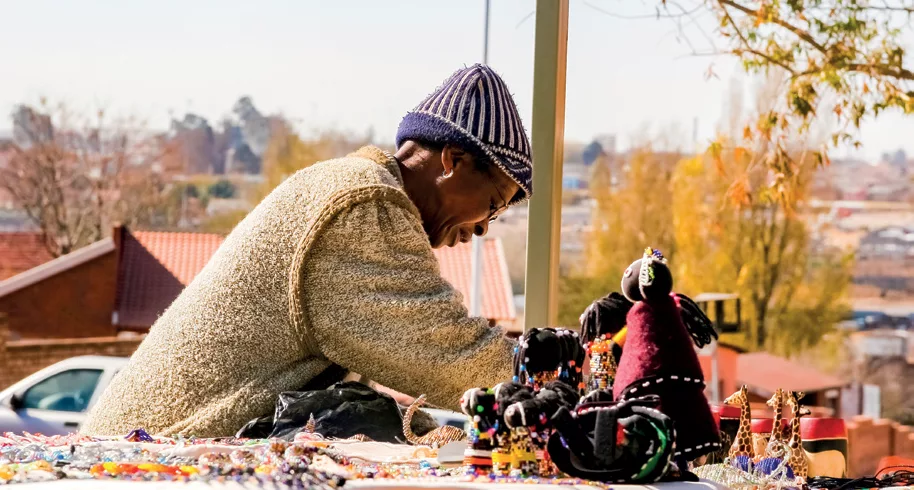
Residents welcome visitors into their worlds in powerful new tourism model
Across South Africa, community-driven tourism is emerging as a powerful alternative to traditional tourism models, creating meaningful economic opportunities while preserving local culture. Many organisations, including the Maboneng Township Arts Experience, are championing this shift, demonstrating how tourism can become a tool for shared value rather than a top-down industry controlled by a few large stakeholders.
At its core, community-driven tourism places residents at the centre of economic activity. Rather than positioning communities as passive recipients of tourism, this model encourages them to become creators, hosts and entrepreneurs. In some cases, this might mean that homes are transformed into galleries, artists become cultural ambassadors and families host visitors in ways that honour their lived realities. This approach not only generates income directly for households but also supports local creative professionals who often face barriers to mainstream markets.
For travellers, community-driven tourism offers a deeper connection to places and people. It allows visitors to engage with authentic cultural expressions, gain insight into township histories and invest directly in neighbourhood economies. As travel trends shift globally towards ethical, socially conscious experiences, such models are increasingly attractive to both domestic and international visitors seeking meaning beyond sightseeing.
In-house benefits
Economically, the impact of community tourism can be significant. When revenue circulates within a neighbourhood rather than leaving it, the multiplier effect strengthens informal businesses such as local eateries, transport providers, youth performers and crafters. It also nurtures an entrepreneurial ecosystem where creativity is valued and supported. For many young people, these environments become incubators for skills development and small business creation.
Community-driven tourism also encourages collaborative partnerships between residents, artists, local government and private-sector organisations. These partnerships expand resources, increase visibility and contribute to long-term sustainability. They also create a more inclusive tourism narrative that recognises communities not as ‘tourism products’ but as active contributors shaping their own economic futures.
As South Africa continues to work towards inclusive growth, models like this demonstrate what is possible when economic participation is expanded at the grassroots level. Community-driven tourism not only diversifies the tourism sector but also deepens its social impact. Through creativity, collaboration and community leadership, it provides a scalable framework for building resilient local economies while celebrating the country’s cultural richness.
Text | Supplied
Photography | Sunshine Seeds
For more information, go to maboneng.com
Disasters – physical or digital – are a fact of life, so preparing well for them should be on the priority list
The one thing companies can’t afford is to lose revenue, and yet, disaster recovery is still not a priority for many.
One hundred percent. That’s how many companies have reported revenue loss from downtime in the last year. And enterprises are now experiencing around 86 hours of IT outages a year. In South Africa, the cost of breaches is as high as R350 million in direct losses over three years, says PwC, with threats gaining momentum alongside digital and cloud adoption. On the flip side, companies that invest in disaster recovery (DR) solutions and have clearly defined DR metrics experience a reduction in fraud and cyber-related losses and minimise revenue loss. They also have better relationships with customers and stakeholders.
Then, there’s the R40 trillion cost of disaster. The United Nations Office for Disaster Risk Reduction estimates that this is now the annual bill that comes due for DR, and points out that intelligent planning and investment play a significant role in offsetting the risk. Whether the disaster is digital or physical, planning has become everything.
However, implementing DR strategies and policies can be challenging. Compliance, for example, is complex and can have a negative impact on the business. According to PwC, 77% of respondents felt that compliance was too complicated, underscoring the need for the move towards solutions that made it simpler and faster. It’s needed – only 7% of those surveyed felt they were leading with compliance. When a company can co-ordinate its compliance and DR activities, its confidence levels increase, as does its operational resilience.
Hoping for the best
Another challenge is far more human – companies don’t have a great attitude towards DR. Many still believe it is either a luxury or an unnecessary expense, one that only becomes relevant after an incident. When it comes to DR, companies tend to fall into three groups: those who don’t know what it is; those who think a disaster won’t happen to them; and those who view it as an avoidable cost.
Unfortunately, this mindset is one of the biggest contributors to prolonged outages. Companies underestimate the frequency of failure and the financial impact of downtime, not really recognising how DR is actually less of a cost centre and more of a resilience mechanism. They also often don’t realise that there’s a chasm-wide difference between backups and DR.
Backups can only take a business to a point. They can help the company recover data, but not operations. They don’t have the systems and capabilities to recreate a functioning environment, spin up infrastructure or restore customer-facing services. Critically, they don’t meet the recovery time objectives required in regulated or high-availability sectors.
Companies can’t afford to be comfortable with backups. It doesn’t matter how well the business understands its systems or how expert the IT team is, a day lost to downtime while the backup is being restored is a day of lost transactions, productivity and reputation.
Quick renewal
Disaster recovery, on the other hand, is designed to lift the company straight back into business. It involves replicated environments, automated orchestration, defined failover plans and continuous synchronisation. The technology and the strategy behind DR restore the entirety of the business extremely quickly, not just the data. And this neatly brings the conversation back to compliance – often, it is exactly this requirement that brings companies to the DR doorway, knocking to find out how they can remain compliant and competitive in a highly regulated market.
Companies, especially those in the financial services sector, increasingly require regulator-aligned DR architecture. And many have had unexpectedly unpleasant experiences when their DR systems have failed or haven’t met regulatory requirements and they’ve been expected to rebuild from scratch. In sectors like financial services, there’s almost zero tolerance for downtime and weakly designed systems.
Fortunately, technology has caught up, as have metrics that allow companies to better define their DR practices against global standards. Companies need visibility into their Recovery Time Objective (RTO), so that they know how long they can afford to be down, then into their Recovery Point Objective (RPO), which determines how much data they can afford to lose. These metrics then need to feed data from testing under pressure, so that companies know how their systems will react and how long it takes for them to achieve full operational recovery.
And that full recovery today? Try seven minutes. There are DR tests that have spun up entire production environments, including firewalls, virtual machines, databases and networking, in under 10 minutes. Not hours. Compared to a traditional backup restore, which can take hours under ideal conditions, DR as a service is lightning fast.
It also protects revenue, underpins compliance and directly influences customer and stakeholder trust.
Text | Mandi Matthews
Photography | Sutthiphong Chandaeng
Mandi Matthews is a Solutions Architect: Azure at Braintree.
For more information, go to braintree.co.za
Changing strategies may help make South Africa a friendlier place for investors
After last year’s G20 Summit, there were three signals that matter for anyone who saves, invests or trades. The first was about debt and the cost of capital. In the G20 South Africa Leaders’ Declaration, heads of state endorsed a new Ministerial Declaration on Debt Sustainability, committing to supporting low- and middle-income countries in addressing rising debt vulnerabilities.
This feeds into how investors price risk, how rating agencies think about countries like South Africa and how much governments and businesses pay to borrow. For traders, this shapes the backdrop for bond yields, bank earnings and currencies over the next few years.
The second signal was the push for reform of the international financial architecture, with a strong African voice. The current system makes capital too expensive for many developing countries. If those reforms move to implementation, the long-term effect could be a more predictable environment for infrastructure, energy and digital investment across the continent.
The third signal was the link between climate, critical minerals and capital. Leaders again recognised the need for ‘deep, rapid and sustained’ emissions cuts and the need to scale up climate finance. They also endorsed a G20 Critical Minerals Framework as a co-operative approach to ensure that mineral resources support sustainable development rather than deepen inequality.
Practical implications
Macro-economics is now a long game. Interest rates may be close to a peak globally, but the G20 debt and architecture discussions suggest that funding conditions for emerging markets will remain in focus.
Climate and transition themes are becoming part of the cash flow discussion. The commitments on climate finance and critical minerals are part of a broader shift in how capital is allocated. In practice, that means watching for opportunities and risks in utilities, miners, industrials and financials that are either funding or enabling transition projects. For traders, it is no longer enough to know that climate matters. You need to see how policy, funding and company strategy intersect in specific names and sectors.
Inclusion and digital infrastructure will shape who gets to participate. Alongside debt and climate, the talks again highlighted the importance of financial inclusion, digital public infrastructure and better access to payments and finance for underserved communities. More South Africans can move from being passive observers to active participants in the financial system.
Text | Zihaad Israfil
Photography | Master1305
Zihaad Israfil is CEO of CFI Financial Group South Africa.
For more information, go to cfi.trade

New book helps readers to manage their income in sensible ways
The wealth creation formula
How can we create wealth? That is the burning question. So naturally I asked AI: ‘If you could write a formula to create wealth for a South African, what would it be? (Give me something that can be applied by most people).’
Here’s the response I got: wealth = (income – lifestyle costs) × investments × time.
That makes sense: wealth creation is the strategic process of accumulating assets and growing financial resources over time to achieve long-term financial security and ensuring a comfortable future. To increase wealth, you can either increase income, decrease expenses or both. This excess money (your disposable income) can then be grown by putting it into savings and investments. That’s why you have to be intentional about how you create your wealth.
Here’s the formula in more practical terms: Wealth = (control lifestyle costs + grow income streams + invest boldly) × stay consistent over 10-30 years. In other words, to be wealthy, you need to earn more than you spend, invest the difference wisely and stay consistent long enough for the wealth creation formula compounding interest to do the heavy lifting. Let’s unpack these elements further.
Wealth
What is wealth? (Yes, really – and it’s a good question.) Wealth is the money you have but don’t spend. It is not represented by fancy clothing, cars or gadgets – instead, it’s the net assets you have after paying off any debt or expenses. This can be quite intimate information that not many people will know about you.
Control lifestyle costs
This means having a clear understanding of your expenses and their escalations. This includes keeping track of your day-to-day spending, understanding your debit orders and subscriptions and reducing ‘money leaks’ (money spent that wasn’t budgeted for). It also means being intentional about any lifestyle upgrades – being careful about getting better cars, better housing or better gadgets with every increase in salary, which means you are not redirecting such increases towards saving and investing.
Grow income streams
Your income could be in the form of a salary that continues to grow, new income streams (like a side hustle or income from property rentals) or a combination of both. Successfully increasing your income stream allows you to build wealth faster. Your first target should be to reach your savings goals as protection in emergencies (for example, having an emergency fund) and then to make smart investments with the rest.
Hopefully, you can also afford some of life’s luxuries along the way!
Invest boldly
This means confidently prioritising ways to grow your money for the future, including taking calculated risks such as investing in stocks, shares, equities or property and planning for your retirement. Understand that the younger you are, the higher risk you’re able to take on, as you have more time to recover from losses. It’s also important to have safeguards and checks in place to avoid being scammed or chasing unregulated get-rich-quick schemes.
Text | Nokuhle Kumalo
Photography | Supplied and Daffa Sinai
Boss Your Money by Nokuhle Kumalo, published by Pan Macmillan, is available now.
For more information, go to panmacmillan.co.za

Office and employee behaviour preferences are shaping what future remuneration strategies need to look like
A number of contemporary workplace trends are expected to impact how organisations reward their employees.
Growing adoption of AI in organisations alone promises greater demand for specialised products, services and training to maximise the value of their investment. This will accelerate entrepreneurship as new players enter the market.
Following in the footsteps of entrepreneurs like Elon Musk, more CEOs will take on nearly impossible targets. If achieved within their 5-10-year windows, these high-risk commitments promise billions in payouts and share ownership. But of course, such deals have remuneration experts concerned.
Mostly propelled by AI, more data is being generated more than at any other time in history. Workers who can cut through the noise and mine valuable insights from not only more but also unique types of data will be in great demand, with lucrative reward packages designed to attract them.
Beyond the superficial
Expect organisations to demand their employees spend even more time interacting with technology during working hours. However, in their free time, staff will go to greater pains to reduce screen time or avoid using their devices altogether. This will be the fastest-growing total rewards trend employers need to respect.
In corporate situations, leaders and decision makers often see only the tip of the iceberg and are unaware of deeper issues and problems. This can result in poor and ineffective decision-making that impacts their entire organisation. Leaders now have at their disposal better tools to see what lies beneath and greater opportunities for positive change, especially in rewards.
Toxic leaders are unsupportive, uncollaborative, coercive and threatening – and are avoided by the top 300 companies in the world. The trend of removing toxic leaders from power looks like it will continue to seep down to smaller companies as they realise the benefits of hiring those who persuade and motivate rather than those who only crack the whip.
Corporate layoffs to release funding for AI initiatives are rife. In China, unemployment has led Gen Z workers to pay for the appearance of working in an office. Unfortunately, rising populations, geopolitical trends and market forces mean global unemployment will have a devastating effect on some workforces going forward.
Look to the future
Gen Z and, to a lesser extent, millennial employees are reluctant to take on leadership and management roles, mainly because of high stress versus comparatively low reward. Instead, they are opting for career paths that promise personal growth and self-improvement. They also prefer leading themselves. Employers will need to plan carefully to accommodate this mindset while preserving succession.
As technologies like AI demand a shift not only in corporate culture and rewards design but also societal norms, there are likely to be new developments in education and parenting. These changes will dictate how children are raised and taught – something employers already need to consider now, as many students in their teenage years may become employed within a decade.
Growing use of AI, analytics and automation can have a positive influence on corporate and public leadership. It can help tear down silos that have long hampered divisional and departmental cooperation and allow executives to work together in tight coordination.
It’s not enough to be proficient in just one of the popular AI models – ChatGPT, Microsoft Copilot or Google Gemini. Workers need to know all of them if they want to remain employable by organisations that use these platforms and the systems they integrate with in their day-to-day operations, for example, Copilot for Microsoft’s office products and Gemini for Google Workspace.
The day the planet’s first trillionaire is declared is fast approaching. What this means for executive remuneration remains to be seen, but it’s sure to raise questions – moral, ethical and legislative.
To prioritise great performance in an organisation, focus on total rewards. Humans are consciously and unconsciously driven by incentives, and if you can leverage that dynamic, you can have much better outcomes. No matter the trends, a solid total rewards strategy can incentivise people to remain productive.
Text | Mark Bussin
Photography | Fizkes
Dr Mark Bussin is an Exco Member of The South African Reward Association (SARA).
For more information, go to sara.co.za
Workers’ representatives need to be consulted before retrenchments
Due to the facts that retrenchments are no-fault terminations and that South Africa has a sky-high unemployment rate, the law provides strict rules for retrenching employers. When an employer contemplates retrenching employees, it is required by the Labour Relations Act (LRA) to first consult about this prospect before making any decision to retrench.
Section 189 of the LRA unequivocally requires employers to consult with the trade unions to which the affected employees belong.
An exception to this rule may be made where the employer has truly exhausted every effort to locate and contact the union without success. In the case of NUMSA vs Ascoreg (CLL Vol 12; July 2008), the Labour Court found that the employer could consult directly with the employees where the union refused to consult.
However, the employer would need solid proof of such a trade union refusal, as consultation with employees instead of their union is forbidden under normal circumstances. However, the law clearly gives the employer the onus of ensuring, as far as it possibly can, that proper consultations with the union take place. Therefore, despite difficulties in getting the union to co-operate, the employer must do everything in its power to gain the union’s co-operation. It is only where the employer has proved that the union has been unreasonably uncooperative despite the employer’s best efforts that the courts may excuse the employer for retrenching without union consultations.
Have the talk
The employer’s duty to consult before retrenching lies at the heart of the employer’s duty to ensure procedural fairness. Despite the numerous and varied obstacles to the achievement of proper consultations, the employer is likely to find that failure to consult (or to consult properly) extremely costly from a legal point of view. On the other hand, where the retrenchments are delayed due to holdups in consultations, this could be equally as costly from a salary bill point of view.
However, where the employer has made no effort to consult the union, the retrenchment will be considered procedurally unfair.
In the case of Tsogo Sun Casinos vs SACCAWU, the employer failed to consult the employee’s trade union before retrenching her. The Labour Appeal Court found that there was no acceptable reason for this failure and ordered the employer to pay the employee three months’ compensation for the procedurally unfair retrenchment.
Employers are therefore advised to ensure that they train their executives in charge of retrenchment decisions on the requirements of the law regarding retrenchment consultations.
Text | Ivan Israelstam
Photography | Fizkes
Ivan Israelstam is Chief Executive of Labour Law Management Consulting.
Contact him on 011 888 7944 or 082 852 2973, or at ivan@labourlawadvice.co.za.
For more information, go to labourlawadvice.co.za

Combining technology and new curricula with tried and tested methods is becoming normal in learning institutions
What if the future of tertiary education is no longer defined by campuses, lectures and traditional qualifications, but by how quickly institutions can reinvent learning itself? With global education spending expected to exceed R170 trillion in the next decade, the real question is not how much is invested, but how boldly learning is redesigned to meet a world in rapid transition.
Hybrid learning – once a stopgap solution – has become the backbone of modern education systems. AI-enabled platforms, adaptive assessments and data-driven teaching models are moving tertiary institutions into a new era where structure, flexibility and personalisation are no longer competing priorities but essential building blocks of a future-fit learning ecosystem.
There is a deliberate move towards guided sessions, interactive content and faculty-supported collaboration – a model that blends the best of digital convenience with the irreplaceable power of human connection. Learning is no longer a solitary pursuit. Students thrive in active, community-driven environments where academic, emotional and social support intersect. Building these communities is now a hallmark of institutional excellence.
But the transformation isn’t only about how learning happens – it’s fundamentally about what is being learnt. The next generation of graduates will need far more than academic knowledge. Critical thinking, adaptability and empathy are becoming core competencies. Soft skills like communication, creativity and collaboration are no longer optional; they’re the currency of an unpredictable world.
This has pushed leading institutions to redesign curricula around real-world cases, lived experiences and industry scenarios that connect theory directly to practice. At the same time, the digital economy has rewritten what it means to be ‘career-ready’.
New model
Employers are seeking professionals who can merge core business principles with digital fluency – people who can analyse data, solve complex problems, leverage technology and innovate at speed. As a result, digital business skills are not just shaping new career paths; they are creating entirely new industries and opportunities.
This convergence of business and technology presents an exciting challenge. Institutions must build graduates who not only understand digital tools, analytics and innovation, but who can apply them confidently and creatively. That is where true competitive advantage lies.
The future of tertiary education must be globally competitive and locally responsive. Graduates need the capacity to contribute meaningfully to national development priorities while operating on an international stage. Institutions that master this dual mandate – local relevance, global readiness – will define the next decade of South African education.
Education is no longer just about content. It’s about connection, adaptability and inspiration. The question is not whether institutions can keep up with change, but whether they can shape it.
Text | Andrew Horsfall
Photography | Andrey Popov
Andrew Horsfall is CEO of Milpark Education.
For more information, go to milpark.ac.za
Renewable energy is requiring changes in the employment landscape as it grows
The renewable energy sector stepped up when legacy infrastructure was struggling to keep up. Now, this sector is changing the nature of the industry in South Africa on multiple levels. From employment to innovation to global best practice, the renewable energy economy is transforming the industry. And yet, when it comes to employment and skills development, the sector continues to grapple with serious gaps.
The first is permanence. The industry hasn’t fundamentally transformed net job creation with only 6,000 permanent jobs created. The rest are temporary. Many people are working on the initial construction phases of a project, but their skills aren’t translating into long-term roles.
This dynamic has created a uniquely South African version of the clean energy transition. The industry continues to modernise, but it does so in a way that supports employment and economic participation. In practice, this has widened the definition of what the renewable energy workforce looks like, bringing a different emphasis to roles and attributes that weren’t essential a decade ago.
Specialists required
The move towards large-scale renewable energy deployments has increased the demand for specialised skills, but many of these aren’t entirely new roles. They are extensions of existing roles that have been reimagined by the complexity of modern projects. As more solar and battery plants move from development to operation, there’s a growing need for asset managers, performance analysts, operations and maintenance specialists and grid engineers – roles that ensure that energy plants can operate optimally throughout their lifecycle.
Then, of course, cyber security is an important issue. Modern energy plants rely heavily on control and networking technologies that enable remote monitoring and data collection through digital interfaces and that means protecting these systems is critical. Downtime or disruption can have serious financial and operational consequences. Cyber-security training and expertise are increasingly associated with renewable energy.
The volume of data created by these intelligent systems has increased demand for people who can do analytics or data management and who can support day-to-day decision making. Their insights can fundamentally change how leadership perceives plant performance and operational risks, as well as guide preventative and corrective maintenance.
Evolving market
Looking into the future, the introduction of the South African Wholesale Electricity Market (SAWEM) is going to change the demand for talent even more. Energy trading, day-ahead forecasting and financial modelling are already well-established careers in the UK and Europe, but are relatively new locally. South Africa’s move towards a more open electricity market will make these skills increasingly important, presenting an opportunity for skills transfer between the financial services and energy sectors.
The sector is also attracting experienced professionals from mining, oil and other heavy industries who are looking for work that carries more meaning. Many want to contribute to long-term energy security and climate resilience, and renewable energy offers a way to do that. Internal engagement data consistently shows that people working in the sector feel connected to the mission of building a cleaner, more stable future, although this is not their only motivation. The rapid change of pace in the sector is alluring for people who enjoy problem solving and rapid innovation.
Text | Alicia Dean
Photography | Koldo Studio
Alicia Dean is Head of People and Group Services at SOLA Group.
For more information, go to solagroup.co.za

Different generations of employees have varying expectations of what makes a good business trip
Here’s the thing about business travel: everyone’s doing it, but nobody’s doing it quite the same way. The twenty-something on their first international assignment has a completely different idea of what makes a trip ‘good’ than the executive who’s been flying for work since the early eighties.
One wants flexibility and adventure. The other wants direct flights and zero surprises. Both are essential to your business. And both need to show up ready to perform. So how do you design a travel programme that works across the generations?
The answer isn’t about choosing sides; it’s about understanding what drives each generation, finding the common ground, embracing change and building policies flexible enough to work for everyone.
The good news? Younger travellers genuinely want to be on the road – and they’re right to. Recent research from US-based travel management company (TMC), Perk, found that 35% of 18-24-year-olds believe business travel has directly helped them gain promotions.
Business travel is unbelievably beneficial when you’re just starting out. Not only in terms of opening doors, building relationships, learning opportunities, a confidence boost and career progression, but also as an opportunity to see parts of the world still out of reach for those who can’t afford leisure travel. In fact, over half of Gen Z and millennials would love to travel more.
But they want trips that feel meaningful. They need to see how the travel connects to learning, networking or career development. They want seamless tech, reliable connectivity, a say in their itinerary (something that would have been unthinkable even a decade ago) and accommodation that’s safe and interesting – not just functional. And they absolutely expect the option to arrive early or stay an extra day to explore.
For this group, a work trip is an investment in their future. If it feels like just another obligation, they’ll disengage.
Diverse priorities
For more experienced travellers, the novelty has worn off. They’ve done enough trips to know what actually matters: direct flights where possible, lounge access, realistic schedules that don’t wreck their week, safe, comfortable hotels (ideally with early check-in) and 24/7 travel support when things go wrong.
They’re also managing more complex lives. Millennials and Gen X have families. The disruption to home life has to be worth it. They want clear itineraries, straightforward policies, limited expenses admin on their return and proof that companies respect their time and energy. Travel used to be a status symbol. You were the one trusted to go, so you just got on with it. But that’s not the world we’re in anymore. The way a company structures its travel now reflects how it treats its people.
Strip away the generational preferences, and you find something universal: everyone just wants to arrive intact and return without burning out. Business travel can be a double-edged sword, a demand that drives exhaustion and work-life conflict and a resource that boosts learning, visibility and career satisfaction at the same time.
Business travel stress often occurs in three distinct waves. The first hits before anyone even leaves home – the scramble to arrange coverage at work, sort out family logistics and prepare the household for an absence. The second wave arrives during the trip itself – think long-haul flights alongside unexpected delays or disruption. The third wave? That’s when you get back. The mountain of emails, the pressure to reintegrate into work and home routines and the family tensions that surface after time away. It’s a lot. And a common thread for travellers, young and old.
Burnout is real. But those who feel supported and able to balance work with life – through practical help and human-centred policies – are more engaged, resilient and loyal. Business travel done well is a great retention strategy.
Upgrade strategy
Interestingly, research shows that travellers from younger generations are more likely to comply with business travel policies than their older counterparts. In other words, Gen Z are more likely to toe the line (which makes sense, as they’re still finding their place in the workforce), while older employees are more likely to push back against (or ignore) policies that don’t meet their needs.
The good news? You don’t need a massive budget to fix this. You need a policy that acknowledges reality, moves with the times and demonstrates a willingness to treat travellers like adults. SMEs actually have an edge here. They may not have the scale of a multinational, but they’re far more agile when it comes to changing the rules.
There are a number of ideas that work. Build flexibility into your policy – let people choose their preferred flight times, airlines and accommodation (within reason). Allow for early arrivals or weekend extensions where it makes sense. Give travellers a say in their schedule.
Plan for recovery. Don’t schedule critical meetings the morning someone lands from an international flight. Build in buffer days. Respect time zones. Support health and safety properly. This means clear protocols, 24/7 access to help and a TMC that can handle disruptions without drama.
Prioritise sustainability. Incorporate eco-friendly options into your travel policy, like promoting green transportation and supporting sustainable accommodations. Show Gen Z your commitment to environmental responsibility. Make the purpose clear. Before anyone books a ticket, they should understand why they’re going and what success looks like. Younger travellers especially need this.
Then, count the real costs. Not just airfares and hotel rates, but energy, stress and time. Companies with fair, flexible travel policies see higher engagement and better performance. Those focused solely on cost control see more policy non-compliance, higher turnover and avoidable productivity loss.
Text | Herman Heunes
Photography | Jacob Lund
Herman Heunes is GM of Corporate Traveller South Africa.
For more information, go to corporatetraveller.co.za

Growing numbers of internet users know the value of protecting their digital assets
More people are taking control of their digital security. A recent Kaspersky study has shown that cyber-security solutions have become increasingly popular, with the number of users globally exceeding 90% among surveyed participants in 2025.
This increasing focus on cyber-threat protection needs no explanation. Last year alone, Kaspersky’s detection systems discovered an average of 500,000 malicious files per day, marking a 7% increase compared to the previous year. According to the data, the share of people using at least one type of solution for digital life protection reached a remarkable 93% globally.
These findings were the result of a global survey spanning more than 20 countries in the Asia-Pacific, European, LATAM, Central American and Middle Eastern regions.
The top cited reason for using digital life protection tools was blocking viruses, malware and cyber attacks, with more than 60% of users naming it as a key factor. Protection of sensitive data (53%) and feeling safer online (53%) followed closely to complete the top three.
To achieve these goals, consumers rely on a variety of tools: they use antivirus software, phone number blockers and parental control tools, just to name a few. Among participants of the study, antiviruses, VPN products and password managers became the most popular ones in terms of usage.
It is worth noting that another global survey conducted in 2023 showed that back then, the number of users relying on security tools stood at 79% worldwide, confirming today’s movement towards a more conscious digital life. This shift is not just a reaction to threats; it’s a digital culture change. People are beginning to see online safety and digital literacy not as a technical niche, but as a vital life skill inseparable from today’s digitalised life.
Put steps in place
To stay safe, use reliable security solutions. Protect your devices against malware and other cyber threats by installing a comprehensive security solution. Make timely updates. It’s a safe practice to update operating systems and important apps as updates become available. Many safety issues can be solved by installing the latest versions of software.
Beware of identity leakage. Try to avoid posting other information that may give away too much, such as your home address, personal phone number, email address and so on. Before sharing anything, consider the unintended consequences and do not overshare anything that might compromise your or someone else’s privacy.
Use a strong and different password for each service: that way, even if one of your accounts gets stolen, the rest won’t go with it. Though it’s nearly impossible to memorise long and unique passwords for all the services you use, with a password manager, you can memorise just one master password.
Uplift your digital literacy. From deepfake videos to AI-generated phishing emails, deception is becoming harder to spot. That’s why structured education matters. Learn basic digital literacy: master how to recognise phone fraud, phishing and other cyber threats. Understand how to protect personal data from intruders, safely use email, social networks and other applications and make purchases in secure online stores.
Text | Supplied
Photography | Billion Photos
For more information, go to kaspersky.co.za

Moving around the world means needing to know how pensions and other savings will be affected
South Africans are a mobile nation. Many people build their careers abroad or decide to relocate permanently for family or lifestyle reasons. But what happens to your South African retirement savings when you emigrate? The rules can be confusing, especially since the introduction of the new two-pot retirement system.

In South Africa, retirement savings are grouped into three main categories: occupational funds (pension and provident funds, through your employer), preservation funds (pension and provident preservation) and retirement annuity funds (funds that you contribute to privately).
These funds exist to help South Africans save enough to live comfortably when they stop working and to reduce their reliance on the state in retirement. That’s why the system is supported by generous tax incentives. In exchange, there are restrictions on when and how you can access your money.
Under the new two-pot retirement system, which came into effect recently, your retirement savings are divided into three parts. The retirement component is locked in until you retire and must be used to provide an income in retirement. You can access your savings component while you’re still working but only once a year and within limits. The vested component refers to savings accumulated before the new system started and may have different withdrawal rules depending on the fund.
This structure is designed to give members limited flexibility while ensuring that they don’t deplete their retirement capital too soon. However, things work differently when you emigrate permanently and are no longer part of the South African tax base.
Outside the loop
Once you officially cease to be a South African tax resident, you are effectively no longer part of the country’s retirement system. The law therefore allows emigrants to access their retirement savings earlier than those who remain in South Africa, but there are waiting periods and conditions depending on your situation.
Temporary residents: If you worked in South Africa on a temporary work visa and your visa has since expired, you can withdraw your full retirement benefit immediately after leaving the country. There’s no waiting period, regardless of the fund type.
Individuals who emigrated more than three years ago: If you emigrated and ceased to be a South African tax resident more than three years ago, you can withdraw all your retirement savings, including the retirement and vested components without any waiting time.
Individuals who emigrated within the last three years: Other members who ceased to be South African tax residents less than three years ago will have some waiting periods. They will not be able to withdraw their retirement component until they have been non-residents for an uninterrupted period of three years.
There are some differences between the different types of funds. In a retirement annuity fund, the vested component will also be subject to the uninterrupted three-year period.
In a preservation fund, the latest legislative proposals will allow immediate access to the vested component if it is the first withdrawal. If the member had a previous withdrawal or has previously transferred a retirement benefit after retiring from employment, the member will also have to wait for the three-year period.
The savings component, however, is always available for immediate withdrawal.
Highly rated
Withdrawals from your retirement fund on emigration are subject to tax, but the rate and method depend on which component you’re accessing. The savings component is taxed at your normal income-tax rate. The retirement and vested components are taxed according to the lump-sum withdrawal tables, where higher amounts attract higher rates of tax.
Another key consideration is whether your new country of residence has a Double Taxation Agreement (DTA) with South Africa. These agreements determine where the income is taxed, in South Africa or in your new country, and help prevent being taxed twice on the same withdrawal.
The rules around accessing retirement funds after emigration can seem complex, especially with the new two-pot structure now in place. Timing is crucial: the three-year waiting rule can make a big difference to when you’ll have access to your full savings and how much tax you’ll pay.
Before making any decisions, it’s important to speak to a qualified financial planner or tax specialist. They can help clarify how the rules apply to your specific situation, assist with the paperwork required by your fund and the South African Revenue Service (SARS) and ensure that your withdrawal is processed in the most tax-efficient way possible.
South Africa’s retirement fund system is designed to protect long-term savings, ensuring that members have a secure income later in life. Yet, for those who choose to build their future abroad, the law also provides a fair and practical route to access these funds.
Understanding how the different fund components work, the timing requirements and the tax implications can help emigrants make informed decisions and avoid unpleasant surprises down the line. With careful planning and professional advice, you can ensure that your hard-earned retirement savings continue to support your goals, wherever in the world you may be.
Text | Jenny Gordon
Photography | People Images
Jenny Gordon is Head: Technical Advice at Alexforbes.
For more information, go to alexforbes.com
By using modern digital tools sensibly, students can overhaul their study methods
For South African students and matriculants, exam preparation is part of the foundation of academic and future success. Encompassing far more than short-term memorisation, effective exam preparation is about cultivating the ability to analyse and engage critically with knowledge. And nowadays, it is a radically different process to what it was even two years ago.
AI-driven platforms such as ChatGPT, POE AI, Perplexity AI and Microsoft Copilot offer interactive, personalised pathways that traditional textbooks could never deliver – and have the potential to transform how students prepare for their exams.
These tools are not shortcuts, though. AI tools have the potential to be an effective study partner – they can sharpen thinking and boost confidence – but do not replace the discipline of learning.
This balance between rigour and technological innovation is important. Education can no longer be confined to outdated models that produce students who are ill-equipped for the demands of a digital economy. Matriculants must not only be equipped for exam success, but also for a future in which digital literacy will determine employability.
Useful collaboration
Practical strategies may help students to use AI in their preparations. AI can distil lengthy chapters into clear, structured summaries.
For content-heavy subjects such as history or life sciences, this shifts the focus from memorising dates and definitions to grasping the bigger picture – an essential skill in higher-order thinking.
When material feels overwhelming, AI can reframe it in accessible language, complete with analogies and step-by-step reasoning. This strengthens comprehension and empowers students to articulate ideas in their own words, which is a reliable indicator of mastery.
Mock quizzes and exam-style problems generated by AI allow students to test themselves in low-pressure environments. The instant feedback highlights gaps and directs revision energy to where it matters most.
Whether a student absorbs best through visual or audio cues, repetition or applied examples, AI can tailor the most effective study aids. This flexibility ensures that students prepare in a way that plays to their strengths.
AI scheduling tools help students distribute effort across subjects, manage time effectively and integrate breaks to avoid burnout. Structured planning not only reduces stress but also mirrors the self-management skills required in higher education and the workplace.
The responsible use of AI should become a thread running through every school’s approach to teaching and learning. Exams are a milestone, but they are not the end goal. The real measure of success is equipping students with the critical thinking, digital fluency and resilience to thrive in an uncertain future. AI, used wisely and ethically, can be a powerful ally in achieving that vision.
Text | Amoré Pretorius
Photography | Face Stock
Amoré Pretorius is Director of Academics at Centennial Schools.
For more information, go to centennialschools.co.za
The shift towards net zero is no longer a distant aspiration; it’s an urgent reality
As rising global temperatures exacerbate extreme weather events, hastening the pace of the transition is critical. For South Africa, as the world’s 11th highest emitter of greenhouse gases, the transition to net zero is complex.
The country remains heavily dependent on coal, with nearly 80% of electricity still generated from carbon-intensive assets, while energy insecurity, socio-economic inequality and unemployment increase. Beyond the country’s borders, the landmark consensus and associated instruments achieved by the Paris Agreement are being eroded. Yet, the imperative remains for the South African business community to hold firm. Opportunities abound to capitalise on the positive readiness trends associated with the climate transition. Product innovation, a young-leaning population and new opportunities for dialogue and collaboration in a changing world provide South African businesses with a unique chance to lead through reinvention, resilience and growth.
The urgency is real. Climate change and its associated risks are a daily reality for South Africans, with severe droughts, floods and biodiversity loss affecting food security and other vital ecosystem services, and extreme weather events disrupting supply chains, damaging infrastructure and exacerbating public health and sanitation risks. The agricultural sector has experienced significant losses in recent years and faces ever more uncertain yields; mining sector assets are being hit by water scarcity and uncertain financing; and insurers have experienced heightened sensitivity with both assets and liabilities exposed to climate risk. These risks emphasise that sustainability must be proactively integrated into company strategy to enable organisations to deliver value while navigating the prevailing forces.
Renewed hope
Despite the optics of global capital markets faltering in their visible commitment to sustainable investments, climate change and nature loss will inevitably transform every industry and every business. South African firms seeking to remain competitive internationally cannot afford to lag behind the progress made in other regions. Export-driven industries like mining, automotive manufacturing and agriculture are particularly exposed, as trading partners in Europe and elsewhere begin implementing carbon border adjustment mechanisms. Without clear transition strategies, local firms risk losing market access and investor confidence.
Renewable energy lies at the heart of South Africa’s path to net zero. The country has some of the world’s best solar and wind resources and the private sector is already stepping in to supplement the state-owned power utility’s constrained grid. Mining companies have begun investing heavily in their own renewable plants to ensure reliable power, reduce emissions and reinvent their business model for future relevance. Similarly, retailers and property developers are increasingly turning to rooftop solar and energy efficiency measures to both cut costs and align with sustainability targets. These moves are not only environmentally sound but also make strong business sense in a context of frequent loadshedding and rising electricity tariffs.
The financial sector also plays a pivotal role. South Africa’s banks have already started aligning lending portfolios with climate goals, with several committing to phase out direct financing of coal projects while expanding investment in renewable infrastructure and nature-based adaptation to climate change. Development finance institutions, too, are mobilising capital towards projects that support just transition goals and participation in the digital economy, ensuring that vulnerable communities are not left behind as industries evolve.
Profitable partnerships
Skills development is essential. The transition to net zero will create demand for new expertise in renewable energy, circular product and system design, advanced manufacturing and the digital economy. South Africa’s education and training systems need to align quickly with this shift. Encouragingly, partnerships are emerging between universities, multinational corporates, small and medium enterprises and government to establish specialised programmes in future-facing green and digital skills. But scale remains a challenge.
Without co-ordinated investment, the skills gap could undermine the country’s ability to take full advantage of new industries. Credible and actionable transition plans are essential, alongside an understanding of the most impactful levers for decarbonisation.
Government policy should be the glue that holds these efforts together; while South Africa has some of the frameworks in place, including the Just Energy Transition Investment Plan and international climate finance arrangements, the country’s regulatory system remains behind. But businesses cannot afford to wait for government alone to lead. Companies that move ahead of policy – by recognising the urgency of pivoting their products and services, investing in innovation and developing the capabilities needed to adapt to and mitigate physical risk, transition risk and reputational risk – will help shape a positive policy environment.
Opportunity to lead
Technology and innovation will underpin much of this progress. Advances in new energy markets are gaining global traction and South Africa has an opportunity to position itself as a leader, given its natural resource base. The country will also need to exhibit a timely and well-governed response to the growing digital and artificial intelligence economy. Critically, the role of human ingenuity and local nuance continues to be essential to any attempt to reduce emissions, restore nature and unlock growth at scale. Sectors such as healthcare, agriculture, transport, mining, real estate and tourism must be supported by investment in the green and blue infrastructure that underpins economic, human and planetary health.
South African businesses must be resolute in leaning into the net zero transition. The transition involves significant upfront costs and, in a country already grappling with fiscal pressure and social inequality, businesses may be tempted to delay. But the cost of inaction in the face of systemic risk is far greater. The World Bank has estimated that climate change could reduce South Africa’s GDP by as much as 3% by 2050 if adaptation and mitigation measures are not accelerated. For businesses, this translates into disrupted operations, reduced productivity and heightened exposure to global regulatory shifts.
Text | Claire Bradbury
Photography | Sansoen Saengsakaorat
Claire Bradbury is Sustainability Lead for Accenture, Africa.
For more information, go to accenture.com
Paying taxes can be an overcomplicated challenge, so good assistance can make a big difference
If South African tax were a fable, it would feature three enduring characters: the weary taxpayer, the watchful SARS and the elusive concept known as certainty. All three appear in local legislation, but only one consistently shows up in practice – SARS.
The taxpayer, meanwhile, wanders through labyrinths of interpretation notes, explanatory memoranda, cases and rulings, searching for the promised land of compliance. Somewhere between section 11(a) and paragraph 80 of the Eighth Schedule, they pause to ask, “Is this deductible, or am I simply hopeful?”
And certainty – that most noble of tax ideals – remains the unicorn in the fiscal landscape. It is invoked in policy speeches and discussion papers, usually alongside phrases such as ‘taxpayer confidence’ and ‘ease of doing business’. Yet as with all mythical creatures, it tends to vanish when needed most – for example, at 11pm on the eve of a deadline, when an invoice is vaguely described as ‘services rendered’.
To its credit, South African Revenue Service (SARS) has become something of an oracle – though, as with those of ancient myth, its answers are often cryptic. A taxpayer asks, “Is this supply zero-rated?” and the oracle responds, “It depends.” In tax language, that is the gentle equivalent of, “You will discover the answer after the audit.”
Technology was meant to simplify the journey. Yet eFiling sometimes behaves less as a portal and more as a gatekeeper with discretionary powers. On a good day, it opens smoothly. On a bad day, it informs the taxpayer that they are “not authorised for this function”, as though invoking section 95 of the Tax Administration Act.
There is a certain rhythm in this dance between taxpayer and authority – a choreography of mutual suspicion and reluctant co-operation, both sides convinced of their reasonableness and each occasionally frustrated by the other’s interpretation of “within a reasonable time”.
Twists and turns
The Tax Administration Act (TAA) deserves recognition as one of South Africa’s great works of modern literature. It contains drama (chapter 5), suspense (section 99) and the occasional twist worthy of a courtroom thriller.
Few experiences rival the tension of receiving a section 46 request for information. The taxpayer reads the letter, heart pounding, scrolling to find the deadline. Relief follows when they see “within 21 days” – until they recall that SARS counts days as calendar days, not business days. If William Shakespeare had known the TAA, he might have written, “To disclose, or not to disclose – that is the question.”
Income tax law is, at its heart, a philosophical pursuit. Section 11(a) is not simply a rule of deduction; it is a meditation on purpose. What does it mean to incur an expense “in the production of income”? Must the income exist first, or is a genuine expectation enough?
Every transaction becomes an exercise in judgement: to claim or not to claim; to capitalise or expense. The law demands both honesty and imagination.
Too little imagination and the taxpayer pays too much. Too much and one may find oneself explaining “substance over form” to an auditor who does not share one’s appreciation for interpretive nuance.
Then there is VAT – the philosopher’s stone of tax. It transforms ordinary transactions into puzzles of time, place and value. When is a supply made? Where is it made? And what, exactly, constitutes “consideration”? The VAT Act provides answers, though seldom in the same paragraph.
There was a time when paying tax was seen as a civic virtue. Yet in a cruel irony worthy of our fiscal fable, the shrinking tax base has transformed compliance into a form of punishment. The more diligent the taxpayer, the more likely they are to find themselves under SARS’s microscope – as though virtue itself has become suspicious. Meanwhile, billions leak from the fiscus through wastage and corruption.
Still, there remains a certain dignity in compliance – not out of fear, but out of respect for the rule of law. Each return submitted, each objection lodged, each dispute resolved – these are small affirmations that, despite bureaucracy and fatigue, each of us carries the fiscal weight where too many in our society cannot and do not. The arithmetic is stark: 978,140 individuals, or 1.5% of the SA population, pay more than 60% of personal income tax, of which under 240,000 contribute a third of the total.
Small victories
In this fable, the tax professional is the quiet hero. Equipped with the TAA and a calm disposition, they guide clients through the maze with patience and precision. They translate SARS correspondence into human language and remind anxious taxpayers that a ‘penalty’ is not always fatal – even when it concerns understatement.
The adviser’s greatest strength is technical expertise and persistence. Amid excruciating delays, shifting laws, automated assessments and the occasional eFiling rebellion, persistence has become the currency of survival.
When the day ends – after the objection is filed, the client reassured and the Act closed – the adviser returns home knowing that even small victories matter. In tax, they always have.
The South African tax system, as with all enduring fables, reflects the human condition: intricate, rule-bound, occasionally absurd, but ultimately striving for balance. The mythical creatures of tax – certainty, simplicity and trust – may remain elusive, but the pursuit of them sustains the system.
Perhaps one day SARS will publish a guide that says, simply, “Yes. This is deductible.” Until then, taxpayers, advisers and the fiscus will continue their delicate dance – bound together by law, logic and the shared hope that justice, in the end, will prevail.
Text | Joon Chong
Photography | Maya Lab
Joon Chong is a Partner at Webber Wentzel.
For more information, go to webberwentzel.com
Retailers can expect digital attacks and must have strong responses in place
South African retailers are facing an unprecedented wave of cyber crime and fraud as businesses battle a sophisticated and ever-evolving threat landscape. From organised cyber attacks and e-commerce vulnerabilities to internal fraud, retailers face pressure to bolster their defences, protect their bottom line and maintain their customers’ trust.
The repercussions of cyber crime and fraud are significant. The average cost of a data breach for a South African company is a staggering R40 million. Beyond financial losses, the legal and reputational consequences are severe, with 79% of consumers regarding the protection of their personal data as very important when choosing with whom to transact. Furthermore, cyber, financial and data security failures can result in regulatory fines, litigation and criminal charges.
The battlefront against fraud is multi-faceted, spanning online platforms, physical stores and internal operations. The continued growth of online shopping has brought a surge in e-commerce fraud. Retailers face fake e-commerce sites mimicking their brands to steal payments, widespread payment fraud using stolen credit card details and account takeovers that exploit customers’ stored information.
While online channels are a key battleground, traditional in-store fraud remains a persistent problem. This includes card skimming at point-of-sale devices and return fraud. Employee fraud is also a sensitive but critical issue. Common schemes range from direct theft of cash and inventory to more complex activities such as generating fraudulent invoices or colluding with external parties to defraud the organisation.
The rise of artificial intelligence (AI) is further complicating issues. AI-powered bots can be used to execute sophisticated credential stuffing and phishing attacks on a massive scale, tricking customers and employees alike into revealing sensitive information.
Look at the legislation
Over and above grappling with an evolving threat landscape, retailers must be aware of and comply with several key pieces of legislation. These laws create a framework for data protection, electronic transactions and the prosecution of cyber offences, imposing significant compliance burdens on businesses that handle customer information.
The Protection of Personal Information Act (POPIA) is the most significant piece of data protection legislation in South Africa and governs how retailers process personal information. In terms of POPIA, retailers are legally obligated to secure the integrity and confidentiality of personal information in their possession.
The Cybercrimes Act consolidates South Africa’s laws related to cyber offences. It creates a wide range of new crimes and imposes legal obligations on businesses to assist law enforcement officials in investigations. Since consumers and employees expect retailers to take proactive steps to protect them from falling victim to cyber crimes, retailers must be familiar with the activities the Act criminalises, such as hacking, digital misrepresentation with the intention to defraud, ransomware attacks and cyber fraud.
The Electronic Communications and Transactions Act (ECTA) provides specific protections for online shoppers. Retailers must provide detailed information about their business, the goods or services being sold, payment terms and return policies.
Financial Intelligence Centre Act (FICA) is South Africa’s primary anti-money laundering and counter-terrorist financing legislation. Its purpose is to help identify the proceeds of crime and combat illicit financial activities. While not every retailer must comply with FICA, it becomes a critical obligation for those dealing in certain high-value goods or offering specific financial services. FICA compliance forces retailers to be a frontline defence against financial fraud, requiring them to actively vet their customers and scrutinise transactions.
Non-compliance with the above statutory obligations can result in severe penalties, and the reputational damage and civil claims from affected customers can lead to significant financial losses.
Plan for risk
For South African retailers, navigating the demands of legislation while defending against an ever-evolving array of sophisticated fraud schemes is a monumental task. Rather than striving for perfect security, shifting focus to building resilience and adopting smart, targeted risk mitigation strategies is much more effective.
The lynchpin of an effective risk strategy isn’t in a server room but on the shop floor and in the regional offices. One of the most strategic investments a retailer can make is in empowering middle management, the individuals who oversee daily operations and lead the frontline teams. These managers are perfectly positioned to act as a human firewall, capable of spotting anomalies and responding with an agility that centralised security teams cannot match.
Treat cyber security not as a burdensome cost centre, but as a competitive advantage. This begins with a proactive risk assessment. This analysis must then be benchmarked against industry norms.
Managers must be equipped with practical skills to spot threats. Fostering a security-conscious culture starts with regular cyber-security awareness sessions and simulations tailored to the specific risks of a retail environment. They must also understand compliance obligations and the penalties for failing to comply so that compliance becomes a critical part of operational decision making.
Employees should feel empowered to question unusual requests and report potential threats on an ongoing basis. The effectiveness of these measures should be validated through regular audits. Empowering middle managers to act decisively transforms them from passive observers into a rapid response force. This empowerment is not about encouraging reckless action but about providing a clear framework for immediate and effective intervention. A manager who spots a potential breach must be guided by an incident response plan that defines response procedures, outlines exact roles and responsibilities during a crisis and provides robust stakeholder communication protocols. This plan must be reviewed quarterly, tested annually and updated after every major security event.
Practical strategies retailers can implement include conducting a comprehensive compliance gap analysis to map processes involving personal or financial information and compare them against legislative and regulatory requirements.
Text | Chandni Gopal, Aaqilah Nagdee and Precious Maphupha
Photography | Parin Pix
Chandni Gopal is a Partner, Aaqilah Nagdee is a Senior Associate and Precious Maphupha is a Candidate Attorney at Webber Wentzel.
For more information, go to webberwentzel.com
Build a rich combination of tastes with layered ingredients
Serves 4-6. Preparation time: 20 minutes.
Cooking time: 2.5 hours.
Ingredients
To add later:
To finish:
Method
Text and photography | Supplied
For more information, go to banhoekchillioil.com

The Rift: Scar Of Africa
by Shem Compion
Africa’s Rift Valley is a massive natural phenomenon, so it’s fitting that a book representing it visually is appropriately substantial. Photographer Shem Compion honours that scope in all aspects of the publication, looking at everything from the geographical prehistory of the region to small cultural details of the people who live around it now via the incredible natural features and biodiversity of the creatures who live there.
Different experts – geophysicists, archaeologists, anthropologists and more – contribute sections of text to go with Compion’s photographs, making the book far more than a simple portfolio of excellent visuals. It is the latter, though, that make the strongest impression.
The details of the close-ups, from fishing nets to necklaces on striking tribesmen and from animal portraits to details of rock surfaces, help communicate the daily rhythms of the communities (human and wildlife) in and around the valley, introducing readers to customs and behaviours in far more detail than many similar publications do and with, in many examples, a greater sense of intimacy.
Unsurprisingly, perhaps, given that the book is published in such a large format (when open, it’s the better part of a metre from edge to edge), the double-page landscape spreads are astounding, giving a sense of scale – both the gobsmacking magnitude of the African continent and the relative frailty of those trying to survive tough conditions.
The sheer number of photographs means there will probably be dozens of favourites for every individual reader. One that is especially memorable is a brooding shot of Ol Doinyo Lengai volcano in Tanzania, with a quartet of reed-and-grass huts in the foreground. It is an undeniable statement of the eternal power and presence of the Rift Valley, beautifully supported by everything that is to follow.
Humankind by Rutger Bregman

Almost every kind of contemporary news media is geared towards hits or clicks as a metric for success, with the chief mindset being that bad news – or more accurately, the actions of bad people – sells. Historian and writer Rutger Bregman understands that not only is such a system profoundly flawed, but it’s also not even vaguely accurate in the way it presents the world. Unafraid of deep research, Bregman dives into a number of contexts – famous studies, landmark events, ancient history – to reveal (and remind readers of) the fact that bad, negative or greedy is not necessarily the default. It’s a refreshing read on a number of levels.
Michael (PG)

A first note on this Michael Jackson biopic: Janet Jackson isn’t depicted in it at all; she’s not even mentioned. And that’s because she didn’t want to be. Whatever the reasons for that (some of the Jackson family’s problems make it to the screen), it immediately undermines the legitimacy of this hagiographic project, which looks at the first 30 or so years of the singer-songwriter’s life. The controversies that plagued Jackson’s career are largely avoided, and the presence of his son and most of his siblings as executive producers suggests that the other filmmakers may not have had much say in the film’s tone. The music remains incredible, and Jackson’s nephew Jaafar Jackson, in the title role, provides a meaningful link to one of popular music’s most prominent personalities.
Scrubs (PG13)

Scrubs arrived in 2001 as a charmingly goofy then-weekly examination of friendship, daft daydreams and jokes related to the series’ hospital setting. It made stars of Zach Braff and Donald Faison, whose BFF relationship hilariously showcased the opposite of toxic masculinity. This revival on Disney+ brings back many of the original cast members, definitely older and possibly wiser, as well as the same kindness in tone. There are concessions to issues outside the set, like the real-life challenges of healthcare in the US, but in other ways, what wasn’t broken has not been fixed, meaning that this is a very welcome return for fans of gentle but genuinely funny comedy.
Billy Joel: And So It Goes (PG13)

Billy Joel fans will need no convincing that he is one of the most important and influential popular music artists of the last half-century, but for whatever reason – possibly because he’s never pandered to anyone’s opinion – he’s experienced significant dips in critical support that have rather undermined his place in the pantheon of greats. And So It Goes, a two-part HBO documentary on Showmax, does a lot to place him back where he belongs. It doesn’t dig too deep into the messiest parts of the pianist and singer’s brash personality, but neither does it shy away from saying they exist. And the rest is a fascinating walk through a different musical time and an immense talent’s navigation of it. Interesting and entertaining.
Trying not to platform-hop between trains of thought is not as easy as it used to be
At some point, we lost the ability to watch a movie without needing to do something with our hands. Popcorn, before it started costing the equivalent of a new alternator for your car, was a useful prop in this regard.
You could buy an enormous bucket of the stuff – utterly pointless from a nutritional perspective – smother it in your choice of 14 different flavoured salts to give it some semblance of a taste, and then nibble your way through it for the first half of the film before spending the second half trying to get the remaining gum-lacerating fragments out from between your teeth.
At home, we had television series with advertisements that made 17 minutes of actual episode content last for an hour, allowing you to make a cup of tea, go to the loo, read a couple of pages of your book, help a child (your own or a random one that just wandered in) with homework and possibly wrap some gifts if someone had a birthday coming up – all without missing a moment of the story.
Nowadays, when film and television fans watch their favourites on streaming services and have more devices than they have hands (so they can’t hold any popcorn), there are no breaks and people who get their investigative journalism from TikTok do not have the attention spans needed to deal with half-hour sitcoms, much less 200-minute epics that have taken visionary directors nine years to construct.
So the obvious compromise is to temper the angst and stress of a Viking invasion or an asteroid shower denting the walls of a spacecraft or, indeed, worrying about the fate of the springbok as David Attenborough describes the speed and power of the cheetah in the background with 20 or 25 levels of some game that requires you to put three or more of the same coloured blocks in a line. Or to spend most of a chase scene, which took two weeks to film, looking down at your phone and deleting memes so that Instagram will know that you’re not interested in a series of posts about what exact colour toast should be or what someone who must be a doctor because she says so at the beginning of her video thinks about fungal toe infections.
This is not a good system, people. But it is also widely entrenched, for anyone who can afford the technology involved, as a habit, rather than a mere distraction. If you have read this whole article while the aircraft taxis into position, it’s probably scientific proof (not peer-reviewed, but hey, baby steps) that you can focus on one thing for a minute or three. Next goal: a detailed conversation with a loved one after you land. Without turning the TV on.
Text | Bruce Dennill
Photography | DC Studio
Skyways delivers bespoke advertising campaigns for brands to real people. We connect the brand to the passenger at a unique moment in the sky where they have 50% higher recall. These campaigns sit across our award-winning magazines, digital, video and targeted digital solutions.
For all advertising Inquiries, contact Gill Johnston
at +27 83 455 2397 or gill@panorama.co.za