

insight for executives on the move

november 2025

Airlink increases range and capacity with new Embraer E2 aircraft

Beige hotels • Countering cyberbullying • Greener mining • Lemurs in Nosy Be • Micro-vacations • Wildlife drama in Zambia •

Table of Contents


Work and play

As leaders from all over the world gather in Johannesburg for the G20 Summit this month, the links between travel and business are as clear as ever, with all aspects of the tourism industry involved in getting delegates here and then accommodating and making them feel welcome.

There are unmistakably clear lines between air routes and the sustainability of various businesses, and no doubt the serious aspects of that relationship, including sustainable development, climate change and global health, will be on the agenda for the politicians and bankers. Much more fun, though – and it might involve wildlife or beaches rather than the inside of a conference centre – is considering how your enjoyment and convenience might benefit such businesses.

Heading to Nosy Be to watch lemurs or take a Zen motorcycle journey supports local enterprises there and creates unforgettable memories for you. Sharing an intimate South African nature reserve with a striking endangered species or heading abroad to have a wilderness adventure in Zambia involves adding to the resources being used for conservation, an achievement that can be toasted with a gin and tonic while watching the sun go down. Win-win!

Travel safely and responsibly – and enjoy it!

Bruce Dennill

Editor

Read more

PUBLISHER: Urs Honegger
EDITOR: Bruce Dennill
SENIOR SUB-EDITOR: Claire Rencken
SUB-EDITOR: Gina Hartoog
OPERATIONS AND PRODUCTION MANAGER: Paul Kotze
SENIOR DESIGNER: Annie Fraser
DESIGNER: Perpetua Chigumira
ADVERTISING: sales@panorama.co.za, +27 11 468 2090
NATIONAL SALES MANAGER: Gillian Johnston, +27 83 455 2397, gill@panorama.co.za
SUBSCRIPTIONS: subscriptions@panorama.co.za, Tel: 011 468 2090, Fax: 011 468 2091
Digital ezine available from skywaysmagazine.co.za
COMMENTS AND SUGGESTIONS: skyways@panorama.co.za
We value reader feedback. Please get in touch.
FINANCE: accounts@panorama.co.za
ISSN 1025-2657

Skyways magazine is published monthly and distributed via Airlink. All rights reserved. Reproduction of this magazine in whole or in part is prohibited without prior written permission of Panorama Media Corp (Pty) Ltd. Copyright © 1994-2024 Panorama Media Corp (Pty) Ltd. The views expressed in Skyways magazine are not necessarily those of Panorama Media Corp or Airlink, and the acceptance and publication of editorial and advertising material in Skyways magazine does not imply any endorsement or warranty in respect of goods or services therein described, whether by Skyways magazine or the publishers. Skyways magazine will not be held responsible for the safe return of unsolicited editorial contributions. The Editor reserves the right to edit material submitted and in appropriate cases to translate into another language. Skyways magazine reserves the right to reject any advertising or editorial material, which may not suit the standard of the publication, without reason given. Editorial material accepted for publication in Skyways becomes the property of Panorama Media Corp. Executive Briefs, Corporate Briefs, and Knowledge Profiles™ are solicited and paid for advertorial features in this magazine. Skyways magazine is published by Panorama Media Corp on behalf of Airlink.

74km The distance the universe expands every five seconds. 1:3 The ratio of sheep to people in Australia.

Airlink connects Africa’s skies and its future

The next generation – and their ideas – receive support and a platform at global summit

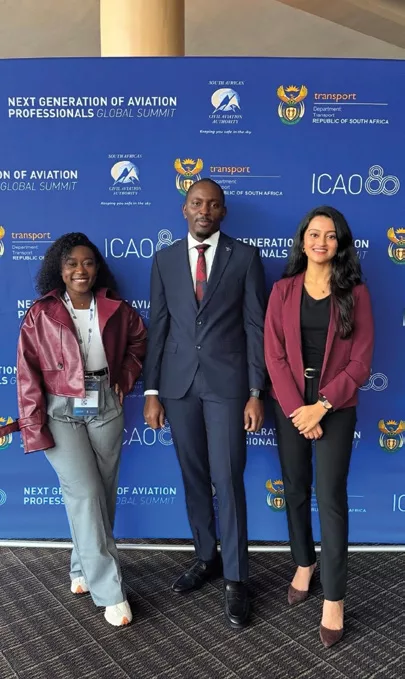
In the world of aviation, connectivity is often measured in routes and networks. But for Airlink, one of southern Africa’s leading regional airlines, connectivity goes far beyond the skies. It reaches into communities and the dreams of young professionals in the aviation world. At the ICAO NGAP Global Summit in Durban, Airlink’s commitment to supporting and empowering youth was shown through sponsorships. The airline enabled three rising aviation professionals in Africa to attend and participate in the event: Ousman Ceesay, a Flight Operations Officer from The Gambia, undergoing his commercial pilot licence training in Kenya and an AviaDev Ambassador; Ellah Wafula, a Kenyan aviation maintenance specialist and founder and director of the Association of Women in Aviation Maintenance (AWAM) Kenya Chapter; and Mahek Shah, a 21-year-old private pilot and drone pilot from Mombasa, Kenya, and founder of Wings for Women.

Ceesay used his platform to advocate for structured internships, harmonised licensing across African regions and youth-focused training programmes. 

His presence at ICAO was a testament to what happens when airlines like Airlink recognise the value of youth engagement, not just as future leaders but as current contributors in the aviation world.

Opportunities for new communities

Wafula’s organisation works with high school girls in under-represented communities, combining mentorship, workshops and practical projects to spark interest in aviation careers. “Flying with Airlink was more than just a journey; it was a reminder of the critical role regional connectivity plays in strengthening Africa’s aviation,” Wafula shared. At ICAO, she spoke about funding, inclusion and access, emphasising how scholarships and support can transform lives. Her presence at the summit increased voices from communities often left out of global aviation conversations.

Shah, as the first in her family to pursue aviation, founded Wings for Women (WFW) at the age of 14 to address the lack of mentorship and representation for young women in the aviation world. Her leadership is hands-on, designing programmes, getting partnerships and ensuring she engages with communities so that the future aviators have the support she never had.

Airlink’s support to attend the ICAO meant more than just a ticket: it meant visibility, validation and voice. “Their sponsorship made it possible for me to attend the ICAO summit in Durban, and that meant everything,” said Shah.

Airlink’s support of these young leaders is a powerful reminder that airlines have a role to play beyond operations. As Africa’s aviation sector continues to grow, the question isn’t just how cities can be connected but also how generations are connected. Thanks to Airlink, the answer is becoming clearer: do it by investing in people.

Text | Keamogetswe Masango

Photography | Supplied

For more information, go to flyairlink.co.za and icao.int

Read more

Mark your calendars!

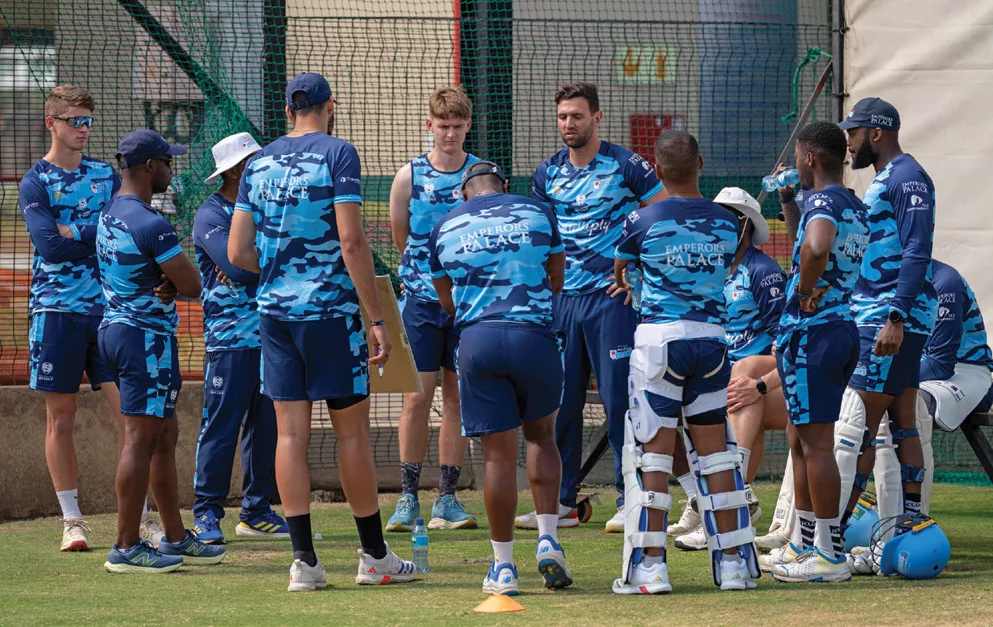
This month’s Momentum Multiply Titans fixtures at SuperSport Park

The Momentum Multiply Titans are set to kick off their T20 Challenge this November at SuperSport Park. After beginning their season with the 4-Day Series, the team will be looking to launch an energetic and fast-paced T20 campaign. As a leading cricket union based in Centurion, the Titans have secured 21 trophies over the past 21 years and are well known for producing Proteas players such as Aiden Markram, Corbin Bosch, Dewald Brevis and Heinrich Klaasen.

Get your tickets at Ticketpro.co.za, gather your friends and family this summer at SuperSport Park for an unforgettable cricket experience and vibrant atmosphere.

Text and Photography | Supplied

Read more

Dear Valued Airlink Customers,

It is that time where many of you start planning to wrap up your year, to reflect on what you did while the days, weeks and months flew by faster than an Airlink jet, and to contemplate what 2026 holds.

This year, 2025, has been anything but clear skies and plain sailing. It has been a challenging and unsettling year. The upending of traditional global trade and diplomacy, intensified conflicts, geopolitical tensions and the rapid advances and adoption of Artificial Intelligence have caused economic uncertainties and compelled many businesses to rapidly adapt their models and tactics. Closer to home, South Africa’s Air Traffic Navigation Services (ATNS) failed in their obligations to manage our air and airport traffic, causing inconvenience and frustration for our customers and immeasurable financial harm to airlines. Indications are that matters may only improve 12 months from now – more evidence of how important it is to take care of our infrastructure.

At the same time, whether you are flying with us for business or leisure, we strive to provide you with the best value combination of convenient and reliable connections together with our renowned service and comfort.

This year, we launched our Cape Town–Gaborone service and we also increased our flights between Johannesburg and Nairobi, Lusaka and Walvis Bay. Next month, we will reintroduce our summer season Cape Town–St Helena flights, which augment the weekly service between Johannesburg and the mid-Atlantic island.

At the same time, we have also strengthened our commercial relationships with our wide array of partner airlines. They include most of the major intercontinental carriers that operate long-haul flights to South Africa. It means more of our customers can travel to or from an Airlink destination and almost any point on the globe on a single ticket, offering convenience and peace of mind for those long journeys. Airlink now has a fleet of 71 aircraft and currently operates on 65 routes to 46 destinations in 15 African countries, including Madagascar and St Helena Island.

Earning and burning your Skybucks with Airlink has never been easier as we have aligned our Skybucks programme with Qatar Airways’ Privilege Club and Avios. This has enabled our most loyal customers to seamlessly enjoy even greater baggage allowances, earn more Skybucks per spend, and soon the ability to book redemption flights on Qatar Airways’ route network. This will enrich our programme and give our customers a superior proposition with more enhancements to the programme yet to come.

As we head towards the mid-summer holidays, Airlink will be introducing the first of ten brand-new Embraer E195-E2 aircraft. These are the latest models of the popular E-Jet series and comfortably seat up to 136 passengers in a two-by-two cabin configuration. Their additional capacity will let Airlink accommodate more customers on our most popular routes, while their extra range will allow us to satisfy customers who want direct flights to new destinations and markets that have been beyond our reach. We will have more exciting news shortly.

From all of us at Airlink, please be safe during the holiday season. Enjoy the time with your family and friends, rest, play and recharge for 2026. It will be another bumper year, full of surprises and excitement.

Thank you for choosing and trusting Airlink. We look forward to welcoming you onboard again soon.

Best wishes

de Villiers Engelbrecht

Chief Executive Officer

Read more
24 The number of time zones around the world. 1,000 years The amount of time it would take to watch all the videos on YouTube (though that’ll increase while you’re watching)

Beyond the grave

CULTURE

A new exhibition at the Apartheid Museum titled “Grave Injustice: The Unfinished Business of the TRC” opened to the public on 24 September, highlighting the ongoing struggle for justice and reparations since the conclusion of the Truth and Reconciliation Commission (TRC) in 2003. Curated by the Apartheid Museum in partnership with the Foundation for Human Rights, the exhibition sheds light on the enduring legacy of impunity and the urgent need for truth by sharing the powerful stories of the families and survivors who have led this decades-long fight for accountability.

In January 2025, 25 families of apartheid-era victims filed a lawsuit against the South African government, seeking R167 million in constitutional damages for its failure to pursue justice after the TRC ended in 2003. They also urged President Cyril Ramaphosa to establish a commission of inquiry into longstanding allegations of political interference in these cases.

The lawsuit and call for a commission follow over two decades of struggle by families and survivors seeking accountability and closure for the loss of their loved ones in the fight for democracy.

The Commission of Inquiry into Criminality, Political Interference and Corruption in the Criminal Justice System is to complete its work in six months. Survivors, families and civil society organisations have welcomed the establishment of the commission, expressing hope that it will finally uncover who was responsible – and why – for obstructing investigations and prosecutions related to TRC cases.

Source: apartheidmuseum.org

Read more

Picture profits

CULTURE

High-end art has always made for a compelling alternative investment, combining cultural significance with impressive financial performance. The numbers tell a remarkable story: since 2000, the Artprice100 index, which tracks the world’s top 100 artists, has delivered annualised returns of 8.6%, marginally outperforming the S&P 500’s 8.4% – including dividends – over the same period. Excluding dividends, blue-chip art has outperformed developed equities by 4% a year since 2000.

But what makes art especially attractive isn’t just its returns. It’s the low correlation with traditional asset classes that makes it a powerful portfolio diversifier.

For South African investors seeking alternatives to volatile equity markets and uncertain economic conditions, art represents something unique: a tangible asset that can provide both aesthetic pleasure and financial growth while offering protection against currency fluctuations and market downturns.

Source: currencynews.co.za

Read more

Extra flights to Nosy Be

CULTURE

The warm waters surrounding Nosy Be reveal a playground for explorers, alive with colour and movement. Beneath the surface lie coral gardens, bright shoals of fish and the chance to encounter gentle whale sharks in their seasonal migration. Days can be filled with diving across more than 20 sites, paddling across coves at sundown, exploring mangroves by kayak or setting out on a catamaran for a day of island-hopping.

Include a day visit to Nosy Tanikely, a marine reserve with vibrant coral reefs and excellent snorkelling conditions, or Nosy Iranja, famous for its beautiful sandbanks and crystal-clear water, often described as a paradise. Evenings bring sunsets best enjoyed from a paddleboard or the deck of a boat, with the horizon turning gold and crimson.

From 17 December 2025 to 7 January 2026, Airlink will operate an additional Wednesday return service due to peak season demand. From mid-January to 21 March 2026, the Nosy Be service will take a seasonal break and resume on 22 March with weekly Sunday flights until 30 April. From 5 May 2026, Airlink’s Nosy Be flights will operate on Tuesdays instead of Sundays.

Source: flyairlink.com

Read more
92 The number of countries that competed in the 2018 Winter Olympics – the most ever. 150 million The estimated number of males named Muhammad worldwide.

Airlink welcomes the future

First Embraer E195-E2 joins the fleet

Airlink has officially welcomed its first brand-new Embraer E195-E2 aircraft, marking a bold new chapter in the airline’s growth story. The first sleek jet, registered ZS-ARF, touched down at Cape Town International Airport at 09h58 South African time on Tuesday, 22 September, following a non-stop ferry flight from Embraer’s factory in São José dos Campos, Brazil.

Piloted by Airlink’s Chief Pilot: Line and Standards, Jaco Henning, and Fleet and Line Check Captain, Dean Nicholas, the aircraft covered the 3,400 nautical miles (6,317km) in just over seven hours. After a brief technical stop in Cape Town, it continued to Johannesburg, where it will undergo final preparations ahead of its first revenue flight in December this year.

This delivery is the first of ten E195-E2s scheduled to join Airlink’s fleet by 2027, under a leasing agreement announced in August with Azorra, the Fort Lauderdale-based lease, finance and asset management firm.

The first three aircraft are configured in a single-class layout with 136 seats in a 2-2 abreast layout. The advanced Pratt & Whitney engines and aerodynamic design make it the most fuel-efficient single-aisle jet in its category – a key advantage in today’s competitive aviation landscape, offering greater capacity and improved fuel efficiency compared to their predecessors.

“This is a very exciting time for Airlink,” said CEO, de Villiers Engelbrecht. “The E2’s enhanced range and capacity will allow Airlink to respond to growing demand on popular routes and expand its network to new destinations across Southern Africa and beyond. This is a strategic move that positions the airline for sustainable growth while maintaining its reputation for reliability and comfort.


“Additionally, they will bolster our business, helping us to be even more competitive on key routes and continue providing the great service our customers are accustomed to.”

The aircraft’s arrival also marks a milestone for South African aviation, with the South African Civil Aviation Authority (SACAA) granting type acceptance for both the E195-E2 and its Pratt & Whitney engines in September this year – a milestone that underscores Airlink’s commitment to innovation and operational excellence.

As the countdown begins to the E2s’ first commercial flights, keep an eye on Airlink’s social media platforms for behind-the-scenes updates, crew insights and fascinating facts about this next-generation aircraft.

Text and photography | Supplied

For more information, go to flyairlink.com.

Read more

About Embraer

Embraer is a global aerospace company headquartered in Brazil. It manufactures aircraft for commercial and executive aviation, defence and security, and agricultural customers. The company also provides after-sales services and support through a worldwide network of wholly owned entities and authorised agents. Embraer is the leading manufacturer of commercial jets with up to 150 seats and is the leading exporter of high-value-added goods in Brazil. The company maintains industrial units, offices and service and parts distribution centres across the Americas, Africa, Asia and Europe.

9,000 The number of aircraft delivered by Embraer since 1969. 10 seconds The gap between Embraer aircraft taking off somewhere in the world.

War and peace

Wildlife drama is balanced by lodge pampering at South Luangwa lodge

Sunning themselves on the riverbank, four hippos are fast asleep. The overcast day has allowed them to linger a while longer, until one lifts its head. It’s face to face with a puku, which doesn’t look like too much of a threat. The puku, on the other hand, seems intrigued by this grey and pink blob that appears, for now, to be immobile.

Continuing to graze, the puku glances over to the four rock-like shapes that now appear even more comfortable than they previously did, with some lying on their sides, taking full advantage of the balmy temperature outside the water.

Suddenly, pandemonium erupts with Egyptian geese alarming, helmeted guinea fowl screeching and pukus whistling – all indications of something that should not be there. Having just finished a peaceful lunch at Time + Tide Chinzombo in Zambia’s South Luangwa National Park, the hysterical wildlife frenzy attracts our attention. Assistant camp manager Malama rushes over, pointing in the direction of a fallen tree stump. “Look, there’s a leopard!” he excitedly exclaims. “Wait, there’s another one.” Lucy the leopard’s two cubs are walking along the riverbank, splitting off in different directions. Nobody appears to appreciate their presence, especially the vervet monkeys that are vocalising with increased vigour.

Seeking the sound

Malama tracks down George, Chinzombo’s safari guide, who whisks us across the perennial Luangwa River in an aluminium boat, whereafter we clamber into the game drive vehicle to investigate why there is so much fussing and fury. Following the sound, one cub is spotted hotfooting it into an impenetrable area. To find the other cub, George only has to point the vehicle towards the mayhem involving the vervet monkeys and guinea fowl to find where the rosetted cat is hiding in the foliage of a tree. He is holding something in his mouth and is incredibly nervous, glancing up into the large tree every so often with big yellow eyes. This is all too much for him. The noise from the vervet monkeys is overwhelming and it becomes clear why they are shouting at him – he has caught one of their troop and has started feeding on what is possibly a family member. Indicating that he has had enough of this primate furore, the cat takes his meal to enjoy it in peace somewhere quiet.

Spotter Manuel joins the afternoon game drive and the cub is found again, still feeding on whatever is left of his prized possession. He has positioned himself in the shade of a sausage tree with mom Lucy close by, camouflaged in the dropseed grass. After every few bites, he emits a number of deep growls, which George calls ‘mocking behaviour’, indirectly letting his mom know that he is not sharing his food. At sunset, the cub is in a different spot, enjoying the last rays of warmth on his gorgeous coat. He sits up and starts vocalising, calling for his mother with two short calls. She doesn’t respond, as he is of the age where he is close to becoming independent and will soon need to fend for himself, which he has proved he can do today, given the shape of his round white belly.

Privacy and pampering

With only six safari tents and a luxury family tent set along a bend in the Luangwa River, it’s hard to beat the feeling of being so close to nature while luxuriating in a private haven of tranquillity. This is no ordinary tent – it’s large, with a bedroom, coffee station, mini-bar, writing desk, wardrobe, freestanding bath, shower, double vanities and flush loo. The large outside deck has different seating options from which to watch the parade of wildlife strolling by – or that can be done from a private pool. Meals are served in the main dining area, with Head Chef Webby ensuring that guests are well fed and all dietary foibles are catered for. 

A complimentary treat for guests is a 20-minute in-room (on-deck) spa treatment. Therapist Vastina goes to work on de-knotting my shoulders with her healing hands, using a fragrant stress relief oil. Feeling relaxed, the time has come for the afternoon game drive. Spanning 9,050km², South Luangwa National Park is a popular destination for both tourists and locals. Anticipation is palpable when news gets shared that a big cat has been spotted. Zambia’s endemic Thornicroft’s giraffe, statuesquely making its way across the open plains, causes more excitement. The wildlife never disappoints here.

Finding the Chichele pride of lions as the sun is starting to set gives new meaning to being in the right place at the right time. The lions are having a wonderful catnap and, one by one, they become aware of an unusual smell, sitting upright to sniff the air. An elephant has just crossed a shallow part of the Luangwa River and, as he ascends onto the sandbank, he looks like he’s wearing long socks. Catching wind of the lions, he trumpets loudly and charges away with his ears flapping and his tail in the air. Turning towards us, George gives a wry smile and says, “At least the elephant woke up the lions – this is nature in its purest form!”

Text and photography | Heléne Ramackers

For more information or to book, visit timeandtideafrica.com. Heléne Ramackers’s flights between Cape Town and Lusaka on Airlink were sponsored by cazenove+loyd.

For more information, go to cazloyd.com.

Read more
48.5m The length of the tentacles of the longest jellyfish on record. 25% The approximate percentage of the land area of Los Angeles taken up by cars.

Rock stars

Magnificent mountains are the calling card in beautiful conservation area

Heading west out of Hoedspruit, the cliffs of the northern Drakensberg quickly become the landmark feature of the area to the extent that, when passing through plantations of green trees, it’s easy to imagine yourself in Franschhoek. The Cape Vulture Nature Reserve extends from the road up the slope, where two old farms were combined to create a conservation area.

There are no predators bar the occasional itinerant leopard – they don’t respect boundaries but keep to themselves – so it’s safe, on this property, to walk and cycle or to take a short safari vehicle drive up to a viewpoint where the reserve’s magnificent namesake birds can be clearly seen, their nests marked by ragged trails of guano.

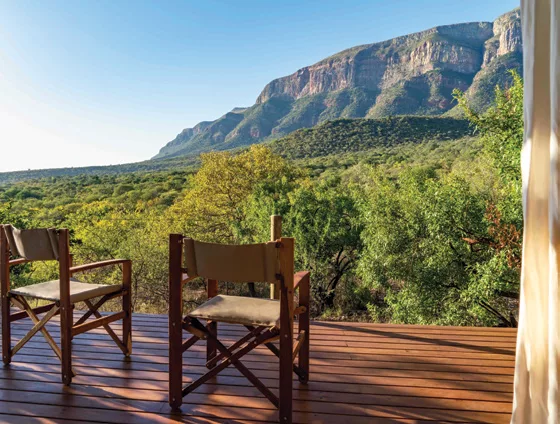
The cliffs and the vultures are the undeniable stars here, and the accommodation reflects that, with spacious, comfortable safari tents spread out in a fan in front of the main lodge, which is large, all clean lines and a richly shaded wooden deck. All these structures face towards the mountain, maximising a view it’s impossible to get tired of.

Interaction with nature is a staple of safari holidays, but the vision here is to do things differently – physically and intellectually – to get out and go somewhere under your own steam or to go and join the team in the permaculture centre near the gate, where beautiful gardens, vegetable patches and excellent facilities display the fruits of research and work geared towards making agricultural practices sustainable and more efficient.

Winging it

On the way to the viewpoint below the cliffs, a stop at the reserve’s ‘vulture restaurant’ reveals where the birds take their partners for a tasty giraffe femur on special occasions. The hide alongside the dining area is superbly camouflaged, with layers of thorn tree branches screening a viewpoint from which the action – Cape vultures feasting on whatever carcass is available, as well as the ungainly landing of birds descending from soaring altitude – can be seen. At 14kg and with wingspans often exceeding 2.5m, it takes a while to stop on the ground, involving a stumbling run. And the spectacle is given further texture through the strange sounds the vultures make – scream-like calls, at once shrill and oddly quiet – in their excitement.

The viewpoint higher up requires a 4×4 to get to, positioning visitors right under the towering escarpment, daubed rich red by the low sun. Binoculars and a small telescope are provided, allowing for sharply focused, close-up viewing of the dozens of vultures circling high above the staggered peaks before landing on ledges that look impossibly thin to support the nests of such bulky birds. The scale of the colony is astounding, especially given that many of the gorges and folds in the rockface aren’t visible from this perspective.

On the opposite horizon, the sunset is spectacular, seeming to last longer because of the elevation of the vantage point. 

Guests are advised to shower before dinner, as waiting gives the solar-heated water time to cool down. It’s a strategy that is immediately proved sound as a luxuriously hot stream washes away the dust of the drive. A bonfire in the sunken boma, with logs burning in a globe-shaped brazier, is inviting both before and after a delicious three-course dinner, with both the dining room and the bonfire area excellent spaces to get to know fellow travellers over a drink or two.

A sharp breeze comes up around bedtime, causing the tent’s canvas roof to creak, giving the feel of camping without the cramped space or exposure to the elements.

Walk and wonder

In the morning, the huge plain below the lodge lights up slowly thanks to an expansive, no-obstacles sunrise. It’s a spectacle that makes you want to get up and get out. A nature walk in a game reserve is a different proposition when the chance of encountering something aggressive is low, as it is here. There is time to dawdle and take in the atmosphere as well as the details of the landscape around you. The slopes of most of the trails are steep, unsurprisingly, but there is no rush, so you can stoop to examine the spoor of baboons, leopards, various antelope, zebras and the occasional giraffe.

The trailhead of the Baobab Trail is some distance from the lodge, giving walkers a fair workout by the time they begin the hike. The trail is easy to walk on but subtle, hardly bothering the soil or surrounding vegetation. The first section heads upwards to Big Rock, an imaginatively named boulder that separated from the cliffs above millennia before and that now provides a striking viewpoint for guests agile enough to clamber to the top. From there, you can peer across the now brightly lit plains as you catch your breath.

Nearby, the baobab that gives the walk its name is mercifully unmarked by vandals and their pocket knives. Beyond that, a column of giant ants crosses the path on their way down the hill. They command the respect of all the guests – get too close and you might become the object of their investigation.

Meals, then wheels

After a revitalising breakfast, there is an offer for either lunch or high tea. This is a pleasing option for regular safari travellers used to getting both and then needing to somehow roll into the vehicle for an afternoon drive. 

A further escape from the threat of holiday bloating is offered through cycling through the reserve. Beginning at the permaculture centre, the ride begins on flattish terrain, providing a psychological boost for part-timers who have noted the general slope of the property. It’s also possible to hire an e-bike, on which the battery-powered engine can help keep the outing fun and easy and maximise enjoyment of the spectacular surroundings. Not being reduced to wheezing like an ancient Bulldog means you can also get close to impala and other wildlife, fostering a connection to nature that should make this activity a no-brainer addition to your itinerary.

Text | Bruce Dennill

Photography | Supplied

For more information or to book a stay, go to capevulturelodge.co.za.

Read more
50 The number of flavours of Kit Kat in Japan. R9.7 million The speeding fine imposed on a driver in Switzerland, where there is no limitation on the size of a fine.

Cameo appearance

Striking lemur species thrills visitors to Nosy Be reserve

There are moments on any great trip when reality and imagination blur so perfectly that you might expect movie credits to roll and a cartoon penguin to wave at you. That’s exactly what happened during a visit to Nosy Be’s Lemuria Land, close to the capital city of Andoany, still largely known by its former name, Hell-Ville.

We had been exploring the lush reserve, a green pocket in the south of Nosy Be that still hums with life the way untouched forests should. Our guide was leading us along a narrow path framed by towering trees and enthusiastically identifying birdsong when there was movement up ahead.

Despite what much of the literature about the island states, a ring-tailed lemur, bold as brass, tail arched like a question mark, was sauntering down the middle of the road. For one brief, goose-bump-fuelled moment, I was Sir David Attenborough, narrating the discovery of this misplaced creature. These charismatic primates are typically found in Central and Southern Madagascar. So what was it doing here? Was this a wayward northern population? Was I about to have a new subspecies named in my honour?

I whispered to our guide with the seriousness of a man who has just stumbled upon a living fossil. He listened patiently, then grinned.

“Oh, yes,” he said, trying not to laugh. “Those are part of a small colony being rehabilitated here. They’re not tame, but they are habituated to humans. Especially those with food.”

So much for Lemur batzofina. My bubble burst with an almost comedic pop, and the animal – blissfully unaware of my emotional roller coaster – paused, scratched its ear, then trotted off with the swagger of a rock star leaving the stage.

In art as in life

All I could think of was the Madagascar movie franchise, with the singing lemur king and the scheming penguins. This mammal had the same look in its eyes: vaguely amused, slightly distracted and completely in charge. All that I was waiting for was the famous song I Like to Move It, Move It!

No penguins were spotted that day, animated or otherwise, but more members of the colony revealed themselves, lounging in the trees and occasionally posing like influencers in a lifestyle shoot. It was difficult to not anthropomorphise them, as they had that same expression many humans get after a cup of coffee: serene, smug and mildly judgemental.

So, despite the flirtation with scientific stardom, the experience was more memorable than could have been imagined. These were not a newly discovered branch of the animal kingdom, but a reminder of how fragile and precious Madagascar’s ecosystems are.

That this reserve, Lemuria Land, is playing a role in their rehabilitation deepened my admiration for the people protecting it. 

It’s a place where, during a walk in the forest, you can feel like an explorer. And that is a priceless reward.

Text and photography | David Batzofin

For more information, go to lemurialand.com.

Read more

Cruising through culture

Madagascan motorcycle journey brings rider into close contact with local residents

The little hotel is silent as I leave. I push the starter button at 6:30am, and my Kawasaki starts on the fourth push – it’s moody. Young children nearby, deposited by their parents at a nursery school, wave me on my way.

I am fond of my bike in a way that I could not be of a car: the immediacy of it. A twist of the throttle, a touch on a brake – and the bike responds immediately. There is a feeling of contact, a connection with a motorbike that creates a bond. I hug the tank between my knees to help steer: a kind of intimacy.

I feel happy as I cross the metal suspension bridge outside of Ambanja and face the day. I’ll be traversing a high plateau, the highest point on this 1,000km ride across Madagascar. I like high plateaux. Soon afterwards, another bridge, another river and children going to what is obviously a school on the banks of the river underneath the road. I pass, and then it hits me: “Was that a white man standing by the side of the road?” I do a U-turn to investigate this surprising development.

There are quite a few white, retired expats living in Madagascar, of whom the majority are French. They tend to live in the large towns where there is more regular electricity for fans or air conditioning to keep cool.

Jacques is French, seventy-ish, ex-military and served his country in Madagascar when it was a French colony. He has lived in this village on the banks of the river for 12 years and has been married for 11 years to the principal of the school behind him. The couple live in the school grounds, near the water, well below the level of the road. Jacques tells the story of how he almost drowned during a recent cyclone when a huge wave flooded the school grounds, showing me the point on his chest where the water rose to. Unable to swim, he was saved by others.

Does he speak some Malagasy? No, he says, suggesting that he feels people around like to hear him speak French! I don’t ask him how he spends his time or why he is standing straight-backed on the side of the road. He asks me if he should put on his hat for the photo, and I reply, “Oui, oui.”

A spark of spontaneity

Sitting in a local market and having a not-so-cold cold drink, I note that there is no electricity here – only about 30% of Malagasies have access to electricity. I am content to watch from a secluded corner: a man with an oxen cart is delivering charcoal to a thatched restaurant; a woman is carrying burning coals to light her neighbour’s fire; a lady with a pail of water on her head sways elegantly by; and an old man tries to interest me in a bottle of honey.

It’s impossible for me to stay completely unnoticed, and a young girl, seven-ish, comes to where I am, looks at me intently and says, “I’m going to dance, vazaha.” A term for foreigners. Then, “Watch me.” She doesn’t ask for anything. Giggling, she runs away, hand in hand with a friend.

There are few questions about the existential meaning of life here, or questions about whether one is happy or not. There is a constant struggle for survival, but there can be grace and dignity in the struggle. A pinch of good humour and laughter, a smidgen of bantering, a dose of stoicism, and there is, sometimes, an envious mix. It’s a pleasure to watch unknown people going about their daily lives. It is one of the reasons for travelling to these places – a gentle going back to a less complicated time.

The afterlife, now

Before the road begins to rise, I stop to take a photo, as unobtrusively as possible, of a small roadside cemetery. It might, indeed, be a single-family cemetery. Different graves are getting attention. There are 18 different ethnic groups in Madagascar, many with different customs and with some extraordinary taboos – fady they are called in Malagasy.

I know little of this bewildering subject, but I know enough to know the graves do not belong to either of the two most important ethnic groups. Those groups, in most cases, build walk-in tombs that facilitate a very important custom both have, which is famadihana: the turning of the bones. After seven years, they remove the bones of a deceased beloved for a day. Family and friends wash the bones and wrap them in a new shroud (often silk). They gather around him or her, bring the deceased up to date on all the local and family news for the seven years they have been away, eat, drink, play music and dance – with the bones. Then, as night falls, they restore the ancestor back to eternal quietness and the company of the other revered ancestors.

The road, in good condition, begins to climb and stretches into the distance. On a high plateau, I stop to watch predator birds, maybe kestrels, wheeling in the sky. There are many of them. They alight on the road in numbers in front of me; traffic is non-existent. They lift lazily as I approach.

There are no houses up here. I can see Madagascar’s highest mountain far away to the east. Suddenly, in the distance, there is a man walking towards me. There is no other living being to be seen. He seems to be barefoot – on a scorching hot road! He’s wearing ragged clothes. A wanderer? A traveller? A tramp? A free spirit? A guru? A shaman? I stop my motorbike and watch him approach. Here, in one person, is an entire new story.

Text | Donal Conlon

Photography | Greens and Blues, Pierre-Yves Babelon, Power Studio and Wirestock Creators

For more information, go to facebook.com/donal.conlon1.

Read more
R112 million The price paid for the world’s most expensive coin, a 1933 Double Eagle – US gold currency that never went into circulation. 1,500 The approximate number of languages spoken in Africa.

From Johannesburg to the world, a new economic vision takes flight

For the first time, the B20, the official business engagement group of the G20, is being hosted on African soil

As delegates from G20 countries prepare to convene for the G20 and B20 Summit this month, we stand at a defining moment for Africa’s role in global economic governance.

The B20 South Africa 2025 Summit is more than a gathering of global business leaders. It is a call to reimagine the role of business in shaping a future defined by solidarity, equality and sustainability. Business travellers can engage with the summit, not as spectators, but as co-architects of a new global economy.

Throughout the year, B20 South Africa has taken Africa’s message to the world. From the World Bank and IMF Spring Meetings in Washington to the Africa CEO Forum in Côte d’Ivoire, from FFD4 in Spain to WEF in China, BRICS in Rio, TICAD in Yokohama and the CII Africa Business Conclave in India, we have consistently advocated for Africa’s growth agenda.

At the United Nations General Assembly in New York, and through sustained engagement with journalists around the world, we have amplified the call for inclusive and sustainable global business.

The B20 is a unique platform, bringing together over 1,000 business leaders from across the globe to shape recommendations for G20 leaders. Under South Africa’s G20 Presidency, we convened eight Task Forces spanning critical areas: Trade and Investment, Energy and Climate, Digital Transformation, Employment and Education, Finance and Infrastructure, Integrity and Compliance, Food Security and Agriculture, and Industrial Transformation and Innovation.

Potential for growth

Together, these Task Forces produced 30 actionable recommendations, which we formally handed over to the G20 Presidency in September 2025. These proposals reflect the voice of global business – and they are grounded in the realities of our time: economic uncertainty, technological disruption and the urgent need for inclusive growth.

They are not just policy proposals; they reflect the grit, ingenuity and ambition of Africa’s private sector. They speak to our shared belief that inclusive growth is not a slogan but a strategy. And they affirm that Africa’s moment is not on the horizon – it is here.

We must ensure these recommendations do not sit on shelves but shape boardrooms, budget tables and bilateral agreements. Africa’s private sector stands ready. We are not asking for charity – we are inviting partnership. We are not waiting for permission – we are offering leadership.

As we stand alongside the G20 Summit, we call on leaders to transform these shared priorities into concrete commitments. By acting in solidarity, we can build an economy defined by greater equality and sustainability, ensuring that global growth leaves no one behind.

South Africa will hand over the G20 and B20 Presidencies to the United States in December 2025. That transition offers a unique opportunity to carry forward these priorities with continuity, ambition and shared purpose.

The B20 South Africa Summit in November is not the end – it is the beginning. We need to continue the work to build coalitions, mobilise support and ensure that these proposals are translated into real-world impact. We need champions in every region, every sector and every government.

Text | Cas Coovadia

Photography | Svet foto

Cas Coovadia is a B20 South Africa Sherpa. To learn more and engage with the B20 South Africa Summit, go to summit.b20southafrica.org.

Read more
2 million The number of advertisements the average 65-year-old in a developed country will have seen on TV. 221,800 The number of islands that are part of the nation of Sweden.

Exploring the aria

Opera resurgence as a better understanding of the art form emerges

There’s a reason opera has lasted over 400 years. It speaks to something universal in us – a need to feel, to connect, to reckon with beauty and pain in a single breath. And far from being the relic some imagine it to be, opera today is not only surviving – it’s quietly staging one of the most remarkable cultural comebacks of our time.

Younger audiences across the globe are rediscovering opera – not because it’s trendy, but because it’s timeless. It has something the world is desperately short on: emotional honesty.

Though we often associate opera with chandeliers, gowns and imported European elitism, its roots are deeply populist. The earliest operas, especially those of Verdi and Puccini, were the Netflix and telenovelas of their time – wildly emotional, thrilling and unapologetically dramatic. They were made for working people, sung in the street and staged in makeshift theatres, telling stories of injustice, love, war, betrayal and redemption.

Opera was never designed to be a luxury. It was always meant to be an experience – total immersion in voice, music and human feeling. That remains true today.

A happy balance

No algorithm can replicate the feeling of sitting in a room with a living, breathing voice trained to move your soul without a microphone. In a world of scrolling and skipping, opera forces audiences to pause, witness and feel – deeply and without distraction.

Yes, opera is often in a foreign language. But heartbreak is universal. So is desire. So is the sound of someone putting everything they have into a single note.

Opera has often been accused of gatekeeping, and not without reason. For too long, the art form has suffered under the weight of its own perceived exclusivity. But that’s changing – not just globally, but also in South Africa. Institutions like Opera UCT are dismantling that myth by making opera accessible, relevant and rooted in the African experience. They are training the next generation of voices, many from underserved communities, to take their rightful place on the world stage.

And many performances show that opera doesn’t need fancy costumes or sets to be powerful. When the music is honest, the setting becomes secondary. To say that opera is ‘coming back’ suggests it went somewhere. But it’s always been here – quietly waiting for people to listen again.

In an age of curated perfection and attention fatigue, opera reminds us what it means to feel – raw, unfiltered and unashamed. It asks us to sit still and be moved. What could be more revolutionary than that?

Text | Supplied

Photography | Igor Bulgarin

For more information, go to humanities.uct.ac.za.

Read more

Danger - for real

Cyber bullying is an insidious threat in both life and art

The Netflix series Adolescence sparked a wave of conversations about teenage mental health and digital safety. The chilling four-part narrative follows a 13-year-old boy who, after months of cyber bullying and immersion in toxic online communities, comes under investigation for allegedly murdering a schoolmate. The narrative delves into themes such as youth violence, bullying and the influence of social media on young people.

According to research by Kaspersky, half of children in South Africa receive their first personal device – a smartphone or tablet – quite early, at the age of 3–7 years. This early exposure is not inherently negative: digital tools can support learning, creativity and social connection. However, what’s often missing is a structured introduction to the online world – one that matches a child’s emotional and cognitive development, because knowing how to use a device isn’t the same as knowing how to use it safely. Children are exposed to a vast, largely unfiltered digital ecosystem long before they are able to critically assess content, set boundaries or understand the long-term implications of their online behaviour. As a result, their first experiences online may include encounters with inappropriate content, aggressive behaviour from peers or the pressures of social comparison.

Exposure to harmful or inappropriate content is one of the most common online risks for children – and one of the easiest to underestimate. However, a quarter of respondents in South Africa have not discussed internet safety rules with their children, leaving dangerous gaps. A child watching innocent videos can, within a few clicks, be shown violent content or explicit materials. Without content filtering or visibility into what children are watching, parents may not realise how quickly the digital environment can shape thinking and behaviour.

Keep communicating

Cyber bullying is one of the most visible digital threats faced by children and teenagers and one of the hardest for parents to detect. Unlike traditional bullying, it doesn’t rely on physical presence. It takes place through devices and platforms that teens use every day, potentially making the abuse constant and inescapable. From impersonation via fake accounts to the distribution of humiliating screenshots, memes or videos, cyber bullying can be co-ordinated, persistent and often go unnoticed by adults – particularly when it happens in private chats, closed groups or disappearing content formats.

When such harassment goes unresolved, it often drives teens further into digital isolation – not just from their peers but also from their families. Searching for support or a sense of belonging, some turn to anonymous or niche online communities, where harmful ideas are normalised and vulnerability is easily exploited. Digital isolation and loneliness push the main character to become deeply involved in toxic online subcultures in niche forums. These environments can be difficult for adults to monitor, especially when teens actively hide their digital activity to avoid scrutiny.

To shift from digital isolation to digital dialogue, parents need to pay special attention to building a relationship where teens feel comfortable speaking up when something goes wrong online. From phishing links to suspicious messages, or from unwanted contact to harmful content, early detection depends on whether a teen feels safe enough to say that something happened.

However, dialogue alone isn’t always enough – especially when parents don’t know what to look for. That’s where parental control apps can help. These support parents with real-time insights, alerts about risky behaviour and smart tools to help families stay informed – without crossing the line into digital surveillance.

Subtle dangers

What Adolescence gets painfully right is that danger doesn’t always look like malware or hacking. Sometimes, it’s a slow erosion of trust, where a child feels safer confiding in anonymous forums rather than in their own family. While some online platforms offer support, others exploit that silence, normalising harmful behaviour or encouraging secrecy. That’s why digital safety at home can’t rely on monitoring alone; it has to be built on open dialogue, where teens know they can talk about what they’re experiencing online without fear or judgement.

By staying informed about the latest threats and actively monitoring their children’s online activities, parents can create a safer online environment for their kids. It’s crucial for parents to have open communication with their children about the potential risks they may encounter online and enforce strict guidelines to ensure their safety.

Clear ground rules about what children can and can’t do online must be set, and parents need to explain why those rules are in place. Also, these rules need to be reviewed as children get older.

Text | Andrey Sidenko

Photography | Anna Stills

Andrey Sidenko is a privacy expert at Kaspersky. For more information, go to kaspersky.co.za.

Read more
950 million The number of people speaking Mandarin as their native language 1900 The year in which the word ‘television’ was coined by Russian scientist Constantin Perskyi

Can you really target belly fat for weight loss?

There’s a lot of advice about exactly what you should do to shift that spare tyre around your waist. Does any of it add up?

We’ve all seen the adverts. “This one simple trick will blitz the blubber around your belly.” “Turn your body into a furnace and burn off your spare tyre with this diet hack.” But exactly how sceptical of their claims should we be?

The first thing to say is that not all fat is bad. To maintain good health, it’s critical that our bodies can store excess energy, and they do this using fat. Fat tissue is also structurally important in our bodies – it helps keep us warm through insulation and it cushions the palms of our hands, the soles of our feet and, yes, our bottoms. The fat just under our skin, known as subcutaneous fat and often found on the hips and buttocks, can be healthy. Ultimately, without any fat storage in our bodies, we would be unwell and uncomfortable.

That said, losing excess belly fat is a good idea. A sizeable gut could indicate a person is carrying a large amount of “deep” abdominal fat, known as visceral fat, which can surround our organs and make us more likely to be ill. Visceral fat is more insulin-resistant than other fat tissue – meaning it’s worse at absorbing blood glucose. It’s also more linked to inflammation and is more likely to release fats into the blood in response to stress hormones, increasing a person’s risk of metabolic disease.

There are various ways to see if your levels of visceral fat are high, but the easiest is to check your waist-hip ratio. Using a tape measure, measure the widest part of your hips and the narrowest part of your waist, then divide your waist measurement by your hip measurement. According to the World Health Organization, the healthy ratios for men and women are below 1 and 0.85, respectively (the difference is due to women having broader hips).

Ready, aim…

How hard is it to target this abdominal tissue? That’s not really up to you because where your body stores (and loses) fat depends on factors largely outside of your control. Not only that, but the ability to make fat cells, and where in the body those fat cells are made, varies widely between people.

Biological sex makes a big difference here – the healthy amount of body fat for women is about 10% higher than for men. This has to do with different factors, including hormones, and is linked to reproductive health. Essentially, this fat is required during pregnancy and breastfeeding (both processes that require a lot of energy), and women who have very low body fat can struggle with infertility.

We also know from large-scale genetic studies and from studies of siblings and twins that genes probably play an important part in body fat distribution. So far, there have been over 300 individual genetic differences found associated with the waist-hip ratio, and scientists are still working on what these differences do. This means the variability in different people’s natural body shape isn’t something we can really change – at least in terms of fat.

Weight loss in general can help you to reduce abdominal fat and your waist-hip ratio, because if you lose weight, you lose it from your entire body, including your belly (if that’s where you naturally store fat). Most of the “tips and tricks” advertised as targeting belly fat exploit this: you lose weight everywhere, but you’re primed to notice it on your belly.

How to fight a losing battle

Put simply, weight loss is achieved by burning more calories than you consume. But that isn’t easy for everyone because, just like with body fat, hunger varies a great deal between people and is strongly influenced by a number of factors, including your genes. Hence, some people will find it easier to stick to certain diet or exercise plans than others.

There are a few strategies that may make it easier, however. One of these is intermittent “fasting”, which comes in several forms. For instance, on the 5:2 diet, you eat a “normal” amount for five days a week (according to the NHS, the recommended daily calorie intake is 2,500 for men and 2,000 for women), but on two days you “fast” by reducing your daily calorie intake to around 800. Other time-restricted eating schemes involve only allowing yourself a 10-hour window in which to eat during each 24-hour day.

Which works best? Well, it could be any of them: a meta-analysis published in Obesity in 2023 found that these different intermittent fasting plans all work to lower how much we eat.

You may have seen claims that cutting down on a specific macronutrient is key to losing belly fat – think about the low-carb, or ketogenic, diet recommendations. Unfortunately, there’s simply not enough evidence to say dietary changes can target fat loss in a particular area of the body.

It’s the same story with weight-loss drugs. While there is some evidence that drugs such as pioglitazone could work by indirectly targeting visceral fat, it’s only currently used to treat diabetes.

Work it off

While increasing your energy expenditure through exercise can help with weight loss, some studies show that this can also increase your appetite, but again, this differs between people.

Many people find high-intensity interval training (HIIT) a convenient way to build fitness and burn calories in a short space of time, and a major meta-analysis carried out by French scientists in 2018 found that HIIT does help to reduce fat deposits in men and women. But there’s no evidence that a certain exercise can specifically target belly fat, even when performed at high intensity. Exercise can tone and build muscle in a targeted way, though, and this can influence body shape, but not by changing body fat distribution. In other words, it’s much better to get your entire body moving than to just focus on sit-ups, for example.

Text | Rebecca Dumbell

Dr Rebecca Dumbell (@rebeccyannie) is a neuroendocrinologist and senior lecturer at Nottingham Trent University.

Read more

Success to scale

Fish populations can be better understood and managed thanks to ongoing conservation strategy

With marine life in rapid decline, urgent action is needed to protect ocean creatures and their habitats to ensure a healthy ecosystem and ocean survival. The establishment of marine protected areas (MPAs) is one way that this can be achieved, with research of fish species showing notable improvement.

MPAs provide many benefits for both ocean health and human activities. One benefit is that they enable fish stocks to increase in abundance and biomass, and, over time, these spill over into adjacent fished areas, improving catches and ensuring fisheries sustainability.

The pristine quality of these essential conservation areas also gives a clearer idea of what nature looks like when it is not impacted by humans. This forms a useful ‘control’ which provides a solid foundation for research into the natural world and the conservation techniques needed.

Interesting evidence

For 16 years, the Pondoland MPA in the Eastern Cape has been studied with impressive results. The team tagged and released 1,042 Scotsman seabream, recapturing 255 (24%) – some multiple times. Most (85%) stayed within small home ranges on MPA reefs, proving the no-take zone’s effectiveness in protecting resident fish. The rest (15%) travelled northeast along the KwaZulu-Natal coast, likely to spawn, and were later caught by recreational and commercial ski-boat fishers, highlighting how MPAs can support both conservation and local fisheries.

To track giant kingfish (GTs), a team tagged 36 adult fish with acoustic tags along the coast from southern Mozambique to the Eastern Cape over five years. The findings were remarkable: every kingfish visited a spawning site in the Maputo National Park (an MPA) during full moons between November and January each year – some travelling distances of 632km at speeds of up to 130km a day! After spawning, they returned to individual home ranges, many within MPAs along the KwaZulu-Natal and Eastern Cape coast. GTs thus rely on MPAs for their survival.

A 20-year study in the iSimangaliso MPA tested whether catch-and-release (C&R) helps conserve shore angling species by tagging fish caught by volunteer anglers in zoned areas within the MPA. The findings showed that when best-practice handling was used, C&R angling had minimal impact on most species, but more sensitive species still showed higher post-release mortality, especially with increased angling pressure. The study concluded that while C&R isn’t suitable in strict no-take zones, it offers real conservation value as a buffer around MPAs or in specially zoned areas.

Text | Bruce Mann

Photography | Callum Evans Photography

Dr Bruce Mann is a Research Associate with the Oceanographic Research Institute in Durban. For more information, go to mpaday.org.

Read more

Robert and Rachel

In 1989, a red steenbras nicknamed Uncle Robert was caught and tagged in the Tsitsikamma MPA, measuring 75cm. In 2011, 22 years later, a ski-boat fisherman caught Uncle Robert near Kei Mouth, when the fish measured 112cm. Another red steenbras, Aunt Rachel, also tagged in the Tsitsikamma MPA, was recaptured at Aliwal Shoal MPA, a record 923km away!

14.3km The shortest ocean crossing between Africa and Europe 7 The number of countries that include the word ‘The’ in their official names: The Gambia and The Bahamas.

Stay well, man

Men need to take more responsibility for looking after their own physical wellbeing

South African men are significantly less likely than women to seek medical advice or attend regular health screenings. Despite increased access to health information in today’s digital age, many men remain under-engaged in managing their own health.

Using hypertension as an example, studies show men lag behind in hypertension awareness and treatment – often due to sociocultural norms, economic pressures and limited healthcare access during working hours. Health experts and industry leaders are now calling for a shift in approach to better support men in managing their long-term health, starting with how to use digital resources effectively.

While men are active internet users, they tend to search for health-related information online far less frequently than women do. A large-scale German study involving over 950 patients found that women are not only more inclined to search for health information online but also do so with stronger emotional and social motivations.

The study also revealed that men and women differ in how they interact with healthcare professionals online. Men, for instance, showed more interest in developing virtual relationships with their general practitioners, such as through online consultations, booking appointments digitally and receiving test results via email. These findings suggest that digital health tools should be tailored differently for men and women – with women responding more to socially driven, engaging content and men potentially benefiting more from structured virtual health services offered by GPs and clinics.

Similar patterns of gender differences in online health-seeking behaviour have been observed in studies from various countries, indicating that this trend is consistent across different cultures and regions worldwide.

Digital help

Artificial intelligence (AI) is revolutionising healthcare by providing personalised health information and recommendations. AI-powered chatbots and virtual assistants can offer immediate responses to health queries, helping men make informed decisions about their health. These tools can guide users on when to seek professional medical advice, interpret symptoms and even schedule appointments.

Men often delay seeking medical advice due to various reasons, including societal expectations and time constraints. Embracing digital health tools can bridge this gap, offering accessible and immediate health information that encourages proactive health management.

Regular health screenings are vital for early detection and prevention of diseases. Men between 45 and 50 should undergo physical exams and screenings for conditions such as high blood pressure, cholesterol, diabetes and prostate cancer annually. Early detection significantly increases the chances of successful treatment and can prevent complications. A lack of action can result in late diagnoses of conditions that might have been more easily managed or treated if detected earlier.

Sensible channels

Practical tips can help men make better use of online health resources. 

Rely on reputable websites, such as the National Department of Health and the World Health Organization. Utilise AI-powered health apps and chatbots for preliminary assessments and to understand symptoms. Do keep in mind, however, that AI can make mistakes and it should not be used to replace the advice or diagnosis of a qualified healthcare professional.

Use online platforms to book appointments for routine health check-ups and screenings. Subscribe to health newsletters and follow trusted health organisations on social media to stay updated on health tips and news. Participate in online forums and support groups to share experiences and gain insights into managing health conditions.

Former Springbok rugby player Rob Louw’s life took an unexpected turn in 2009 when, during a routine gallbladder operation, doctors discovered that he had aggressive metastatic melanoma. The early detection allowed for prompt treatment, which ultimately saved his life. Since then, Louw has become a vocal advocate for cancer awareness, urging men to prioritise regular health check-ups and screenings. His journey serves as a powerful reminder that early diagnosis can make a significant difference in treatment outcomes.

Text | Nicole Jennings

Photography | Ground Picture

Nicole Jennings is a spokesperson for Pharma Dynamics. For more information, go to mydynamics.co.za.

Read more

Keep talking!

Learning multiple languages can give children skills and options beyond what they’d imagined

In an increasingly connected world, multilingualism is emerging as one of the most valuable skills a child can develop. Language learning is seen not only as a tool for communication but as a vital pathway to cognitive, social and cultural development – beginning in the early years of life.

Children have a natural ability to absorb language from a very young age. When families and educators support this journey together, children not only learn to speak more than one language, but also gain confidence, empathy and cognitive flexibility that stays with them throughout their lives.

Research consistently shows that children who are exposed to multiple languages benefit from improved memory, problem-solving skills and mental agility. Switching between languages encourages cognitive flexibility and enhances the brain’s executive function – an ability linked to academic success.

Language is deeply tied to culture and learning more than one language offers children a window into other ways of life. Bilingual children often display a heightened sense of empathy and understanding. By encouraging language learning, we also nurture children’s appreciation for diversity. This is especially important in South Africa, where embracing cultural richness is part of the national identity.

Complex advantages

Multilingualism has been linked to better literacy, stronger academic performance and improved writing and reading comprehension. In the long term, bilingual individuals are more competitive in the global workforce. Whether children become doctors, designers or diplomats, knowing more than one language gives them a powerful advantage.

Parents play an essential role in fostering language development. Reading bilingual books, singing songs and conversing in both languages are simple yet effective ways to reinforce language learning. Consistency, encouragement and playfulness are key. Children learn best in environments where language is part of daily routines and joyful moments.

Language learning works well when embedded in a play-based, holistic approach. Through songs, storytelling and culturally inclusive practices, children can be supported in their language acquisition journey while developing emotionally, socially and intellectually.

Text | Ursula Assis

Photography | Morrowind

Ursula Assis is Country Director of Dibber International Preschools. For more information, go to dibber.co.za.

Read more
4 The number of cars in the US in 1895. 350 million The number of viewers BBC television show Top Gear enjoyed weekly at its peak.

Parts of the picture

Social media can be both harmful and helpful for parents

It used to be that new parents turned to their own moms, a baby book or the clinic sister for advice. Today? It’s more likely they’re scrolling Instagram or TikTok for tips on breastfeeding, sleep training or the perfect nappy caddy.

While social media has opened up a world of support and information for new moms and dads, it’s also changing the parenting landscape – sometimes for better and sometimes for worse.

There is a shift in how South African parents approach raising their babies. Social media gives parents access to a global village of advice, hacks and product recommendations – but it can also lead to comparison, pressure and even confusion about what’s best for their baby.

Platforms like Instagram and TikTok are full of aesthetic nursery tours, toddler lunchbox ideas and clever parenting hacks. Hashtags like #newmomlife, #gentleparenting or #mumtok generate millions of views. While many of these videos are made by well-meaning parents sharing what works for them, they can unintentionally set unrealistic expectations.

There’s nothing wrong with watching other moms for inspiration. But every child – and every parent – is different. Social media doesn’t always show the tough moments: the sleepless nights, the tantrums or the mental load of parenting.

Positive resource

Not all of it is negative. For many new parents, especially in isolated or rural areas, parenting influencers and online groups provide a vital sense of community. From breastfeeding tips to baby-led weaning videos and postpartum mental health discussions, social media has helped normalise many once-taboo parenting topics. It’s also allowed South African parents to learn from others around the world – and realise that challenges like colic, sleep regression or picky eating are universal.

The constant highlight reel of perfectly dressed babies and spotless homes can, however, leave new parents feeling like they’re falling short. It’s easy to forget that behind every adorable baby milestone video, there may be a mountain of laundry, a crying fit or a mom who hasn’t had coffee yet. Social media can also lead to information overload, with conflicting advice on everything from sleep training methods to first foods.

Parents should be encouraged to do what feels right for them. There’s no one-size-fits-all when it comes to raising babies. And it is possible to benefit from social media without letting it overwhelm you.

Follow accounts that uplift you, not ones that make you feel inadequate. Check if advice is backed by health professionals or credible organisations. Step away from the scroll and focus on your baby, your way. And celebrate your real moments – not just the picture-perfect ones.

Text | Sr Londe

Photography | Prostock Studio

Sr Londe is an independent midwife and spokesperson for Vital Baby. For more information, go to vitalbaby.com.

Read more

Africa Golf Club: Connecting the continent through the game of golf

Africa Golf Club: Connecting the continent through the game of golf

Across Africa, golf is becoming more than a sport – it’s a bridge for business, travel and connection At the heart of this growing movement is Africa Golf Club, a pan-African community co-founded by Chad Chawanda, known as The Intra Africa Trader on social media, and Bruce Woest. They’re uniting golfers, entrepreneurs and investors under one shared vision: connecting the continent through golf and growing intra-Africa travel.

Chad Chawanda, the most followed business golfer in Africa with over 140,000 followers across social platforms, has used his digital influence to position golf as a catalyst for African growth. Together with co-founder Bruce Woest, the duo is building a network that celebrates both the sport and the spirit of collaboration across borders.

Since its inception, Africa Golf Club has attracted members from South Africa, Zimbabwe, Zambia, Kenya and beyond. Through its monthly ‘Business Wednesday’ golf events launched at Royal Harare, the club merges business networking with the spirit of the game, fostering genuine relationships that go beyond the scorecard. With partners such as Airlink, Rawson Properties and The Gray Luxury Apartments, Africa Golf Club is redefining what it means to do business on the greens, connecting executives, investors and innovators across the continent.

Looking ahead, the Club is preparing for its most ambitious milestone yet, the South Africa 100 Golf Course Tour – a journey across the country’s top golf courses. The tour will highlight premier golfing destinations and position Africa as an emerging powerhouse for golf tourism.

Africa Golf Club is also nurturing talent through the Africa Golf Academy, training young golfers under certified PGA professionals. Partnerships with hospitality brands such as The Gray Luxury Apartments and Ciela Resort in Zambia extend the experience beyond the course, offering members premium lifestyle and travel benefits through its digital platform, Insights on Africa.

Golfers joining Africa Golf Club can expect a platform that combines travel, learning and lifestyle while spending the last week of each month exploring new markets, touring local businesses, connecting with peers and ending with a round of golf.

For Chad and Bruce, Africa Golf Club is more than a community – it’s a movement. It’s about heritage, connection and commerce. And as it moves toward 10,000 members by 2027, one truth stands out: when Africa plays together, Africa grows together.

Text | Chad T Chawanda

Photography | Supplied

For more information, call or WhatsApp +27 83 488 2600, email join@golfclub.africa or go to www.golfclub.africa

Read more

Tasteful stories

Excited about her first cookbook, Kamini Pather loves things spicy and fresh

Where and when did your love for food and cooking originate?

Kamini Pather: It’s difficult to pinpoint an actual moment because for as long as I can remember, food has been something noteworthy in my life. Since before I could read Sesame Street, I knew that the Cookie Monster was my favourite character. Maybe it was that I grew up with a big family and my grandmothers would always be the ‘ring leaders’ of the home through their Sunday lunches. Perhaps I was just a power-hungry kid!

What was it like growing up in Durban?

When I was a child, it never felt clammy but maybe that’s because we were usually near a body of water. From days spent at the beach to afternoons in the pool or at Hazelmere Dam – I guess growing up in Durban is as much about heat as it is about water.

Were there lots of hot and spicy meals served?

Even if you don’t have Indian heritage in Durban, spicy food is just part of the deal when you live in KwaZulu-Natal. My family isn’t big on really hot food, but the spicing was always on point. My latest cookbook – All Dahl’d Up: Everyday, Indian-ish, Good-Mood Food – conjures up the spice blends from my family roots.

An example of the fact that spices and a considered amount of heat can be eaten all day is the green bean scramble, which made its way into my book. It’s leftover green bean curry that is an egg on toast. It’s the perfect balance of warming aromatics with the natural sweetness of the beans. The main spice in it is my grandmother’s masala, which doesn’t possess great heat but is an elegant picture of various spices.

Is there a specific smell or taste that takes you back to your childhood?

There is nothing that tastes like a litchi from KwaZulu-Natal. The flavour transports me straight back to my grandmother’s porch with sticky fingers – and elbows! – and memories of cousins and that classic KZN ‘glow’.

You are a chef, author and television and radio personality. What do you enjoy about each of these ventures?

Each of these ventures is about telling a story – either my own or the story of the person I am interviewing or through the meal that we are sharing. Being a resident TV chef on Ready Steady Cook meant that I had to remind myself not to take life too seriously. MasterChef was about precision and craft, while Ready Steady Cook is about fun and guest enjoyment. I started to delight in seeing the guests tell their stories and reveal just how much they cannot cook!

Bringing my cookbook to life was a personal journey because this book is a collection of recipes from my Indian heritage through the lens of my global experience. I loved being able to tell my story through the food.

As a chef, what type of patron are you when dining out?

Besides being a TV chef, I was once a waitress, so I am an understanding patron. I know that things can go wrong.

You said, “Adventure for food means adventure for life.” Please explain.

That’s a line from my Netflix-broadcast food-travel show, Girl Eat World. And it means that the same spirit of curiosity that I apply to life, I enjoy on my plate.

You have travelled to many foodie destinations. What do you think of the word ‘foodie’?

It’s an old word, for sure. It came into my world on Twitter, or should I say X. Much like the word ‘influencer’, ‘foodie’ has become a dirty word in certain circles.

Which of the places you’ve visited has left a lasting impression and why?

I travelled to 10 destinations to shoot Girl Eat World, but I have been travelling for many years before and after that. The place that left a lasting impression was Lima, Peru. The wealth of ingredients found there would make your head spin! Industrialisation has decreased the variety of foods grown, seen and eaten, so it was incredible to see carrots, potatoes, tomatoes and so much more in all the colours of the rainbow.

Exciting project on the horizon?

All Dahl’d Up is my first cookbook and I really enjoyed shooting the content last year. It is a compilation of recipes that I cook for myself daily. The recipes are easy to follow, quick to make and designed for small-batch cooking. The dishes are also mindful of modern lifestyles that don’t need double carbs or seed oils, and include sweet treats that won’t make your teeth hurt. There are a few recipes that I learnt from my grandmother but that I have updated to use the healthiest cooking ingredients and techniques while still delivering on the flavours from my Indian heritage.

Text | Heléne Ramackers

Photography | Tegan Smith

For more information, go to likeharmony.co.za.

Read more
26 The number of instruments Beatles guitarist George Harrison could play. 350 million The number of viewers BBC television show Top Gear enjoyed weekly at its peak.

Summer loving

Help your plants manage through the hotter months

Having a seasonal gardening checklist can be extremely helpful. Having a place to keep notes will help you stay on track with your planting, your garden chores and recording temperatures and rainfall.

Summer is a vibrant landscape of colours, evenings of warm breezes and early mornings spent in the garden. The season runs from the end of November to about the end of March, and each area of the country experiences summer in a different way.

In the Western Cape, the Mediterranean climate encourages the blooming of flowers and herbs, while the Highveld experiences hot days with the most magnificent afternoon thunderstorms, providing much-needed relief for the garden. For the Lowveld and KwaZulu-Natal, summer can be particularly intense, which means gardeners need to be ready, balancing watering with leaving the gardens to be nourished by the storms.

Hot or not

The heat at this time of year can be especially taxing on the body and on plants. Try to protect the plants from the scorching sun by strategically placing shade netting and mulching where there might now be gaps.

If it’s possible, set up a spray irrigation system attached to rainwater tanks, though drip irrigation is far better, as it reduces evaporation loss. Regularly check your soil to prevent plants drying out and to prevent overwatering.

Place bamboo or other support structures for beans, tomatoes, zucchini and dahlias. Regularly weed the garden and give flowering plants and vegetables with fruits a watering of plant food every two weeks.

Pull out plants that aren’t doing well. If it is a vegetable that is not healthy or producing, compost it. Deadhead flowers to encourage more blooms.

Start planning for the year ahead and the requirements of the other seasons by making a list of what you want to plant and notes of any seeds to buy. Every garden is unique, so you should adapt the checklist to suit your specific needs and preferences.

Text | Supplied

Photography | Alie04

For more information, go to grannymouse.co.za.

Read more

Screen this threat

Youngsters with their eyes glued to devices suffer the consequences – and adults need to set a good example

Time spent on screens is fuelling a growing mental health crisis among children and adolescents, warns the South African Society of Psychiatrists (SASOP).

The world’s obsession with screens has become so widespread that ‘brain rot’ (a term used to capture concerns about the impact of consuming excessive amounts of low-quality online content, especially on social media) was named the Oxford Word of the Year in 2024. And the impact on our children is alarmingly evident.

Adolescents who spend more than five hours per day on digital devices are 70% more likely to have suicidal thoughts or actions than those who spend less than an hour a day. Even adolescents with moderate screen time of four to six hours per day are more likely to report symptoms of anxiety and depression than those with two hours less screen time per day.

A study across 14 countries reviewing children from pre-primary to high school found that mobile phones consistently distracted students from learning. Simply having a phone nearby, especially with notifications coming through, is enough to break their attention. Another study showed that, once distracted, it can take up to 20 minutes for children to re-focus.

Model behaviour

The average South African adult spends over nine hours and 37 minutes a day on smartphones, with nearly a third of waking hours dedicated to scrolling, swiping and tapping. Social media alone takes up more than 22% of daily usage, led by platforms like Facebook, Instagram and TikTok.

“If we as adults are addicted, how can they not be?” says Prof Renata Schoeman, psychiatrist and member of SASOP. “We cannot expect children to moderate their screen time when they see adults constantly glued to their phones. Children learn by observing. If we don’t model healthy digital behaviour, we are silently endorsing screen addiction.”

Excessive screen time has been linked to numerous mental health concerns among children, such as increased risk of depression, anxiety and low self-esteem; disrupted sleep due to screen exposure, especially before bedtime; declining academic performance due to reduced concentration; lack of motivation to learn and overexposure to unregulated content; social withdrawal, with face-to-face interactions replaced by digital substitutes; and exposure to harmful online content, including cyber bullying, pornography and messages promoting disordered eating.

“The physical consequences are also concerning. Children spending long hours on devices are more prone to obesity, headaches, eye strain and poor posture,” adds Schoeman.

While technology brings obvious benefits, especially in learning environments, it must be used intentionally and in moderation.

“It’s not about banning screens, it’s about balance,” says Prof Schoeman. “There’s a big difference between a family movie night and hours of unmonitored scrolling or gaming. Be mindful, involved and consistent.”

Text | Supplied

Photography | People Images

For more information, go to sasop.co.za.

Read more

Screen guidelines

  • Limit screen time based on age: no screens for children under two years of age; no more than one hour for ages two to five; and a maximum of two hours a day for older children.
  • Encourage offline time, especially outdoors, to support physical and mental wellbeing.
  • Model responsible digital habits, including taking breaks, switching off devices at meals and avoiding screens before bed.
  • Maintain device-free zones and times, such as during family meals and before bedtime.
  • Take overnight custody of children’s and teens’ devices to ensure proper sleep.
27 The number of days it would take to become a millionaire if you started with one cent and doubled your money daily. 50-70% The success rate of African wild dogs when hunting (the highest of any mammal).

Village Oncology: Pioneering compassionate outpatient cancer care in Botswana and beyond

Company overview

Village Oncology stands at the forefront of cancer care, dedicated to serving individuals facing cancer with a blend of compassion, cutting-edge technology and multidisciplinary treatment approaches. Founded on the principle that world-class oncology care should be both accessible and personalised, our practice offers comprehensive services within a supportive environment that prioritises the patient’s dignity and wellbeing.

Our team is committed to walking alongside patients and their families, providing unwavering support, medical excellence and the latest advancements in cancer treatment. At Village Oncology, we believe in fostering hope, trust and healing, ensuring that every patient receives not only effective treatment but also empathic care that addresses their emotional and psychological needs.

Our services

Village Oncology provides a full spectrum of evidence-based treatments supported by advanced technology and compassionate care. Our core services include:

  • Chemotherapy

Administration of cancer-fighting drugs tailored to individual patient needs, effectively targeting cancer cells while minimising side effects.

  • Radiotherapy (VMAT and IGRT)

Utilising advanced techniques such as Volumetric Modulated Arc Therapy (VMAT) and Image-Guided Radiotherapy (IGRT), we deliver highly precise radiation therapy that maximises tumour control while protecting healthy tissue.

  • Image-Guided Brachytherapy

A specialised form of internal radiation where radioactive sources are placed directly within or next to the tumour. Guided by imaging technology, this treatment ensures accuracy and effectiveness in targeting cancers.

  • Counselling services

Cancer care extends beyond the physical. Our trained counsellors provide psychological and emotional support, helping patients and families cope with the challenges of diagnosis, treatment and recovery.

  • Screening services (in partnership with Village Imaging)

Early detection saves lives. Through our partnership with Village Imaging, we offer comprehensive radiological screening services, including:

Mammography: Specialised x-ray imaging for the early detection of breast cancer, often identifying abnormalities long before symptoms appear.

Ultrasound: A non-invasive imaging technique that uses sound waves to justify internal organs and detect potential abnormalities.

CT scan: A detailed imaging technique that uses x-ray technology combined with computer processing to create cross-sectional images of the body. It provides comprehensive views of internal structures, aiding in the detection and assessment of tumours, abnormalities and other conditions with high precision.

These screening tools play a vital role in diagnosing cancer at its earliest and most treatable stages, significantly improving survival outcomes.

A future built on hope

Village Oncology is more than a treatment centre – it is a beacon of hope for patients across Botswana and beyond. With advanced technology, expert care and a compassionate approach, we remain committed to rewriting the story of cancer care in Central and Southern Africa.

Text and Photography | Supplied

Read more

WHERE WE ARE:

Find us at Village Medical Centre, Maratadiba Road, Plot 4921, Gaborone, Botswana.

For inquiries or appointments, contact us at:

Email: reception1@vo.co.bw

Phone: +267 311 0032

Facebook: Village Oncology

Press pause

Short breaks can provide wonderful rest and value when longer holidays are not possible

Between longer school or end-of-year breaks, a proper holiday is seldom on the cards, as most people don’t have the time, budget or energy to plan one. This is why more South Africans are leaning into micro-vacations, which are way more doable. These are two to four nights away somewhere close – no airport queues, heavy packing or epic itinerary planning needed. It’s a quick, easy reset that fits into real life.

These breaks don’t just feel good; they’re good for you too. Research shows that even a quick getaway can boost your health, lower stress levels and elevate your overall wellbeing. And the feel-good effects can last for up to 45 days after your return.

Three destinations are topping the charts for local mini breaks, with booking spikes around school and public holidays. Durban serves up year-round sunshine, laid-back beach days, golden-hour surfs and the kind of curry that lives rent-free in your memory. Hoedspruit delivers safari magic, Big Five sightings and starry skies that rival the Karoo – a wild escape without the long-haul schlep. And then there’s Cape Town: from wine farm lunches and mountain hikes to world-class galleries, the Mother City manages to pack more into three days than most cities do in 10.

Off-season pricing can also be 15% lower than during peak times, making these stays a little easier on the wallet too.

Close quarters

Stick to destinations within a three- to four-hour drive – long enough to feel like you’ve properly escaped, but short enough that you’re not spending half your break in traffic. Tuesday to Thursday bookings often come with serious savings. Plus, you’ll have attractions and restaurants largely to yourself.

Book accommodation for at least two nights. One night feels rushed; two nights allow you to properly decompress and actually enjoy where you are. Some hotels offer staycation deals that include free room upgrades, discounted drinks and complimentary meals. Sign up for hotel newsletters for first dibs on discounts.

Book that spa treatment, order breakfast in bed, try the tasting menu – why not? 

Time is the ultimate luxury and these short, sweet escapes prove that, sometimes, less really is more. You return refreshed, not exhausted from over-scheduling. Your bank account stays largely intact. And most importantly, you actually take the break instead of endlessly planning the ‘perfect’ holiday that never happens. Ditch the two-week fantasy and embrace the two-night reality. Your future self and your stress levels will thank you.

Text | Sandra Kneubuhler

Photography | Anton Herrington

Sandra Kneubuhler is Managing Director for Sub-Saharan Africa at the Radisson Hotel Group. For more information, go to radissonhotels.com.

Read more
1964 The year in which Fidel Castro banned The Beatles in Cuba.

Down to the sea

Early explorer’s account of his travels along the Limpopo River is a wild adventure

The first proper exploration of the Limpopo River was undertaken by Captain Frederic Elton in 1870. This remarkable man was the son of an officer in the Bengal Army. At the age of 17, when the Indian Mutiny broke out in 1857, he himself joined the Bengal Army. He saw active service with the relieving forces at Delhi and Lucknow, which won him the Indian medal with two clasps.

In 1860, Elton volunteered for service in China and was present at the taking of Peking and other engagements, receiving the China medal after the campaign. Soon after gaining his captaincy (98th Regiment), he left the British service and, in 1866, joined the staff of the French Army in Mexico during the reign of the Emperor Maximilian.

On his return to England at the conclusion of the war, he published an account of his adventures, entitled With The French in Mexico.

In 1868, Elton went to Natal and occupied himself in travelling about the colony until 1870, when he undertook a long journey of exploration from the Tati gold district down to the mouth of the Limpopo. His narrative of this journey, accompanied by an excellent map, was published in volume XLII of the Journal of the Royal Geographical Society.

“The idea of making a voyage down the Limpopo first struck me on seeing the river in January 1870. I discussed my plans with Mr Baines FRGS, who was sanguine as to the result of such an exploration, his theory being that the waters of the Usabia [probably the Sabie] and the Limpopo joined and emptied themselves into the sea by a river which could prove to be navigable. Although the theory eventually proved an incorrect one, I must say in justice to Mr Baines that his encouragement and the kindness with which he furnished me with all the information at his disposal, in a great measure, decided me to undertake the journey.”

Elton approached Levert, the managing director of the London and Limpopo Mining Company at Tati in March 1870, proposing that an expedition along the Limpopo “… would lead to the discovery of a shorter route of practicable communication – partly by land, partly by water – between the Tati River and the sea coast and consequently effect an important saving in time and a considerable reduction in the heavy expenses of the carriage of goods by wagons from Natal via Potchefstroom – the circuitous route in general use.”

Levert agreed, and “… a flat-bottomed boat, 13 feet long with masts, sails, oars, etc, was successfully constructed at the Tati; donkeys were ordered from the Transvaal; an interpreter was engaged; saddlebags were made; and a man from Umseila’s tribe, acquainted with the coast country and the lower Limpopo, was enlisted as major-domo.” As permission had first to be sought from Lobengula, Elton and Levert visited the king’s kraal the following month. Approval was given for a road to be constructed from the Shashi to the Limpopo, and Lobengula also promised support on the projected journey from the tribes over which he held power or influence. However, the departure was delayed by a serious setback.

“Through the thoughtlessness of one of the miners, a quantity of blasting powder was exploded, the sparks falling from his pipe into the chest used as a magazine, in which he was searching for a letter. The log-house was instantly enveloped in flames, and it was with difficulty, scorched as we all were by the explosion, that any of us escaped.

Mr Levert was very severely burnt; the author of the misfortune was killed; two miners, the interpreter and myself were more or less injured and the remaining days of May and the month of June found us all under the hands of the doctor. July commenced; no wagons arrived from the Transvaal, no donkeys were to be found and the interpreter engaged for the journey, impatient at the long delay, broke his agreement and left the Tati. Everything appeared to go against the expedition.”

But Elton was made of sterner stuff and, disregarding the threat of tsetse fly, determined to start off with pack-oxen instead of donkeys. He set off on 6 July with his boat and baggage in a wagon. He kept careful notes of the countryside, vegetation and animals: “Lions are numerous and prowl about the riverbanks by night, in search of the game that they know must be forced by thirst into their clutches. Guinea fowls, grey and red partridges, francolin and bush pheasants troop down in the cool of the evening across the sands; the rhinoceros, buffalo, gnu, koodoo, pallah, zebra, giraffe, Harris buck and tsessebe, hidden in the shade of the bush during the day, before daybreak and at sundown, turn their heads towards the water. The elephant travels rapidly from one river to another, the constant war waged against him by the hunters keeping him nervously on the alert, and the ostrich – already rare in the land – chooses an open grass glade where a good view of all approaches can be obtained. The hyena, packs of wild dogs and the tiger with flocks of vultures and the eagle are the scavengers of the land – an immense nursery-ground for big game.”

Text | David Hilton-Barber

Photography | Graeme Stonebank

The Infamous Malaboch War and More Gripping Stories from the Old Transvaal and Beyond by David Hilton-Barber is available now. This excerpt published by permission. For more information, go to footprintpress.co.za.

Read more

A long way to go

The number of short-term loans you burn through may warn banks or other lenders that you’re having trouble managing your finances

Frequent short-term borrowing could be a black mark against you when applying for a home loan. While all debt should be managed responsibly to maintain a good credit score, for many South Africans, short-term loans are becoming an addictive way to make ends meet. Or to fund luxuries they can’t afford but refuse to live without.

It’s tantalisingly easy to get hooked as well – you don’t need to put up collateral to get one, and you don’t have to explain what you’ll use the money for. Also, some like to think that if they fall behind on their repayments, they can simply submit themselves to a debt review. Introduced by the National Credit Act, a debt review is a legal process for someone who is over-indebted to settle with their creditors by paying what they can afford. A registered debt counsellor will review their finances and help them create a repayment plan.

Unfortunately, there’s no such thing as a free lunch. Short-term loans can carry much higher interest rates than other types of debt – up to 5% per month, or around six times the current prime rate. That debt review ‘solution’ you are being offered isn’t necessarily a safe bet either, as it will cut you off from any further credit provision for as long as it takes to remedy your past bad behaviour. Lenders could deny your home loan application simply because you needed debt review in the first place.

Use discretion

Short-term or unsecured loans are not an evil to be avoided entirely. They’re actually good for the economy when used responsibly. However, they’re also a red flag to home loan providers when they feature strongly in your financial history.

Credit providers use various risk models to identify patterns in our spending behaviour – good and bad. They know what financially responsible and irresponsible spending patterns look like. The ability to delay gratification is the underlying attribute that responsible users of credit have, but there is no easy way to quantify whether a particular applicant possesses that trait – the number, frequency and type of unsecured credit transactions is a useful proxy in that regard.

Understand that short-term loans have their place but are seldom necessary. Stop using them and make a plan to pay off the ones you already have. Then get to work on building an emergency fund of cash that can only be touched for true emergencies.

Work on saving for luxuries such as holidays and large capital purchases – in the saving scenario, interest will be working in your favour rather than against you.

If there is no other option, opt for ‘good’ debt as far as possible. Buy your clothes, furniture, appliances, groceries and other items using store credit if you absolutely cannot do without. You don’t have to buy things you don’t need to build a good credit score. Credit providers’ risk algorithms generally look favourably on consumers who start their credit journey with store debt because it fits the pattern of responsible spending, provided you pay your accounts on time.

Text | Renier Kriek

Photography | Andrii Yalanskyi

Renier Kriek is Managing Director at Sentinel Homes. For more information, go to sentinelhomes.co.za.

Read more

Stepping stones

Non-linear career paths, particularly later in life, are a reality best faced with good preparation

In a world where lifelong tenure at a single company is a thing of the past and the workplace is being rapidly reshaped by technological and AI disruption, non-linear career paths have become a practical response to a constantly evolving landscape. And while this path cannot be sugar-coated – it is tough and it will require sacrifice – the good news is that it is possible to make a success of an entirely new career later in life.

A bridging role is a strategic stepping stone – a position that helps you transition into a new industry or function by starting at a foundational level. For example, if you’re moving from manufacturing to retail, or shifting from a technical to a commercial role, it’s wise not to aim for a high-level position right away. Instead, look for entry- or mid-level opportunities such as an operations or supply chain role in retail, or a project co-ordinator position in a commercial team, where you can learn the fundamentals, adapt to the new environment and gradually build your expertise. This approach enables you to gain industry knowledge, establish credibility and develop the skills needed for future advancement.

Whatever your circumstances and career history, you must be able to articulate your value with confidence. Leaving it up to hiring managers to connect the dots between your experience and the role you applied for is a recipe for failure, as you will be competing with professionals who don’t present the same need for mental gymnastics on the part of the employer.

When crafting your motivation, build a clear, logical narrative and arrive ready to sell yourself. Confidence is key.

Phone a friend

Large corporations mostly have rigid hiring criteria and a large selection of applicants who tick every box. Smaller organisations such as startups, mid-sized firms or local businesses can be more flexible, offering a chance to shine.

Smaller environments are more likely to let you wear multiple hats and develop a wider range of skills. So, take time to research local or niche firms in your target industry and apply for roles where your diverse and transferable skills will add immediate value.

Personal and professional networks are a powerful tool to bypass the barriers of a non-linear career. Hiring managers and automated systems often filter out résumés that don’t fit conventional patterns, but a trusted contact can open doors. Reach out to former colleagues, managers or clients who can vouch for your skills, work ethic and adaptability. For instance, if you worked in manufacturing and a past coworker now thrives in financial services, ask them to recommend you or introduce you to key players.

It is also important to build new relationships and not just rely on the old ones. Join professional organisations, attend industry events, join online forums or participate in workshops to meet people in your target field. A personal endorsement carries significant weight, and contacts humanise your story, turning a ‘risky’ non-linear résumé into a compelling case for hiring.

Text | Advaita Naidoo

Photography | Alpha Spirit

Advaita Naidoo is Africa MD at Jack Hammer Global. For more information, go to jhammerglobal.com.

Read more

Firm foundations

Building a successful property portfolio, like launching any successful entrepreneurial business, is a bold and complex undertaking

A property portfolio is not a shortcut to instant wealth, but with the right approach, sound planning and patience, it can be rewarding and ultimately lead one to long-term success.

Two property development strategies tend to yield the most consistent success: new builds and refurbishments. New builds, while offering fresh potential, are intricate by nature. They involve land acquisition, managing construction timelines and costs and navigating regulatory requirements. Refurbishment projects, on the other hand, are becoming increasingly common – not just in inner cities but also across broader metropolitan areas, where offices are being repurposed into residential housing.

Regardless of approach, the first critical key to success in the property sector is doing one’s due diligence. Whether it is new (greenfield) developments or refurbishment (brownfield) projects, property entrepreneurs must have a thorough understanding of the market, client demographics and property specifics.

Understanding your target market is crucial. Who are your tenants? Who lives in the area? Are they retirees, young professionals or families? These questions play a central role in shaping investment strategy. The demographics and lifestyle needs of the surrounding community should directly influence the type of property you develop or refurbish – ensuring it meets real demand and stands a better chance of long-term success.

Cover the bases

Due diligence goes beyond demographics. It includes thorough property inspections, a clear understanding of legal responsibilities, identifying risks or liabilities and assessing both current market demand and future growth potential.

Financing is another pillar of successful development. Property is capital-intensive, and securing the right financial backing is essential. Entrepreneurs must understand the terms of the loan and ensure the financing structure supports their long-term goals. Acting swiftly to close transactions is also important, as delays can result in lost deals or expiring financial terms, all of which are costly and may derail an investment.

Beyond financing and due diligence, success also hinges on the skills of the entrepreneur. A balanced mix of hard and soft skills is vital. The hard skills include financial literacy – the ability to analyse financing structures and assess financial feasibility – along with the business savvy to evaluate property market trends, negotiate favourable contracts and manage operational logistics efficiently.

Equally important are soft skills. Three stand out: patience, meticulous attention to detail and, thirdly, adaptability. Patience allows developers to wait for the right opportunities and make decisions strategically, rather than reactively. A major red flag is rushing into a deal without proper preparation. Attention to detail is non-negotiable. Every aspect – financing structures, inspections, feasibility studies and contractual terms – must be examined carefully. Adaptability is the final key. Entrepreneurs who ask questions, seek clarity and strive to expand their understanding are well positioned to navigate the complexities of the industry.

It’s essential to recognise and prepare for common pitfalls. Acting too quickly, failing to ask the right questions or ignoring red flags (like a seller unwilling to disclose reasons for the sale) can lead to trouble. Poor financial management is a major cause of failed projects, even when all other elements seem sound. Overcapitalising or mismanaging cash flow can quickly derail an otherwise promising development.

Text | Siya Jele

Photography | Stokkete

Siya Jele is Portfolio Manager at TUHF. For more information, go to tuhf.co.za.

Read more

Teams together

Different departments working in partnership make for more potent workplaces.

In today’s volatile and complex business landscape, traditional boundaries between departments are increasingly being replaced by integrated, cross-functional collaboration. Nowhere is this more critical than in the relationship between finance and human resources (HR).

While these two functions have historically operated in parallel, the modern business environment demands that they work together – not just to ensure compliance and manage budgets, but to drive strategic growth through people.

People are a company’s most valuable and costly asset. From talent acquisition and workforce planning to leadership development and organisational culture, HR oversees the drivers of long-term business sustainability. Yet, without a strong partnership with finance, the value of this asset is often under-recognised or poorly leveraged.

Finance holds the key to strategic planning, capital allocation and return on investment – all of which are directly influenced by workforce dynamics. HR, on the other hand, holds insight into employee performance, engagement and future workforce needs. When HR and finance align, the result is a powerful synergy that enables organisations to invest in people strategies that deliver measurable business returns.

Linked objectives

Despite the growing recognition of HR’s importance, the function is still too often viewed as a cost centre rather than a strategic enabler. This perception stems largely from a communication gap: HR professionals tend to speak in terms of engagement, culture and development, while finance is focused on efficiency, cost and value.

This misalignment in language and priorities can result in missed opportunities to justify investment in people initiatives, and HR may struggle to secure buy-in for critical programmes. For HR to shift this perception, it must begin to ‘speak finance’ – articulating its initiatives in terms of measurable outcomes, business value and return on investment.

Analytics serves as the ideal bridge between finance and HR. By applying a data-driven lens to people strategy, HR can translate qualitative outcomes into quantitative insights that resonate with finance leaders.

Change the focus

Key steps in this transformation include:

  • Developing workforce metrics that matter: Linking people data to business outcomes – such as productivity, turnover cost and revenue per employee – allows HR to show how human capital investments impact the bottom line.
  • Forecasting with precision: By partnering with finance on workforce planning models, HR can project the financial implications of recruitment strategies, skills gaps or succession risks.
  • Enabling scenario analysis: Using predictive analytics, HR can demonstrate the long-term financial impact of interventions such as leadership development, diversity and inclusion programmes or employee wellbeing initiatives.
  • Aligning reporting frameworks: Harmonising people dashboards with financial reporting structures helps leadership view talent as a key component of business performance – not an isolated HR concern.

Text | Mandisi Dube and Jaén Beelders

Photography | DC Studio

Mandisi Dube is Reward Administrator (SARA) and Client Executive at 21st Century, and Jaén Beelders is Executive Director of 21st Century Analytics. For more information, go to 21century.co.za.

Read more

Raise the drawbridge

South Africa needs a national strategy for guarding against serious cyber attacks

In an era where borders are no longer physical, South Africa is being drawn into a new kind of conflict, one fought not with tanks and missiles, but with lines of code and silent intrusions. Local municipalities, national ministries and government systems are under relentless attack. The digital battlefield is here and cyber space has become the next frontier of conflict.

Defending the state must start with its digital infrastructure. It’s no longer enough to simply digitise government services – we must protect them with the same strategy, resources and urgency we would devote to any vital organ of the state.

This is a call to action. Cyber security must be elevated to a national priority, placed firmly at the top of the public policy agenda and backed by skilled professionals, enforceable standards and political will. Without this, every investment in digital public services risks collapse under the weight of a single, well-executed breach.

Recent events have highlighted the growing urgency of the issue. Over the past three years, ransomware attacks have disrupted government departments and affected the delivery of some public services. In some cases, hackers stole terabytes of sensitive data. Artificial Intelligence has been used to spread misinformation and undermine state sovereignty. These are not isolated incidents. They are signs of a system under siege.

High risk

The global context only sharpens the concern. South Africa now experiences more cyber attacks than any other country in Africa. According to global cyber-security firms, South Africa ranks among the top three countries in the world for ransomware victimisation.

At the same time, public sector systems remain deeply vulnerable. A 2023 audit by the Auditor-General found that 70% of national and provincial departments had serious cyber-security control weaknesses. Many lacked the basics – strong access controls, regular software patching and encrypted storage. In some cases, the same vulnerabilities flagged by internal audits were later exploited by attackers.

There is a broader danger here. As South Africa’s digital footprint expands from smart cities to e-health to online court systems, the potential attack surface grows. Each new online service, if not properly secured, is another entry point for hostile actors. And these actors are not always anonymous cyber criminals looking for ransom.

South Africa cannot afford to be naïve. It is a member of BRICS, a strategic player on the continent and a country with sophisticated banking, transport and energy infrastructure. Yet, the current approach to cyber resilience remains fragmented. Responsibility is dispersed across multiple departments and agencies. The national cyber-security strategy remains unpublished. And while the Cybercrimes Act of 2020 was a major milestone, its enforcement has been uneven and its reach incomplete.

Come up with a plan

What needs to change is clear. First, South Africa must finalise and implement a comprehensive national cyber-security strategy, one that sets minimum security standards for every government department and entity.

Second, we need to professionalise the state’s cyber capability. That means hiring, training and retaining skilled cyber-security personnel at all levels of government. Third, we must modernise government IT systems, many of which still run on outdated software that is inherently vulnerable. And finally, we need a co-ordinated structure for cyber defence, a central body empowered to set policy, respond to incidents and share threat intelligence in real time.

This is not only a technical project, but also a matter of national resilience. In the same way we think about water security, energy security and fiscal sustainability, we must think about digital sovereignty. Public trust in e-government systems hinges on confidence that their data is protected, their services are uninterrupted and their state is in control.

Companies need to bring global experience in public sector cyber-security transformation, local insights into South Africa’s unique governance landscape and innovative capability in secure digital infrastructure.

New landscape

Governments must assess their cyber maturity, develop strategy, modernise systems and build resilience from the ground up. The work requires designing and implementing national incident response frameworks and embedding zero-trust architecture across government entities. Sustainable internal capability is required.

The answer lies in creating cyber-secure ecosystems, not just point solutions, and doing so with urgency, discipline and foresight. The window for preparation is closing. Cyber threats do not announce themselves with sirens. They enter silently, exploit the smallest crack and often go unnoticed until the damage is done. The question for government is not whether the next major attack will come, but whether South Africa will be ready when it does. We need to choose to fortify the state in this new theatre of conflict. In cyber space, sovereignty is defended in code and the time to defend it is now.

Text | Gugu Nyanda

Photography | Hakinmhan

Gugu Nyanda is Health & Public Service lead for Accenture, Africa. For more information, go to accenture.com.

Read more

Slow the burn

Monitoring stress is an important part of work life

Today, more than 3.5 billion working adults each spend roughly 90,000 hours – or about 45 years – of their lives at work. Now, focus is shifting to the rising tide of workplace burnout in South Africa.

The South African Depression and Anxiety Group (SADAG) estimates that as many as one in three employees in the country are affected by burnout, a condition linked to ongoing, unmanaged stress.

Burnout is more than just feeling overworked – it’s a state of emotional, physical and mental exhaustion brought on by prolonged stress. It can stem from workplace pressure or personal stress, such as a major illness or family problems. Left unchecked, burnout can lead to a host of health issues, including disrupted sleep patterns, cognitive impairments and a higher risk of depression.

Burnout is the result of stress that builds up over time, often ignored until it becomes unmanageable. It’s often disguised as productivity – people push harder, skip breaks, sacrifice sleep – all in the name of performance, until their health begins to unravel.

While burnout can affect workers across the board, those in high-stress environments, such as healthcare and emergency services, are particularly vulnerable. These professions demand long hours, carry heavy emotional loads and often allow little time for recovery.

Earlier this year, a global survey involving over 30,000 employees conducted by the McKinsey Health Institute, in collaboration with the World Economic Forum, revealed that women, members of the LGBTQI+ community, younger people, neurodivergent people and those facing financial challenges reported significantly worse health outcomes at work. These risks are magnified by tough economic conditions, including high unemployment, loadshedding and poor service delivery.

Many people in their twenties and thirties, in particular, entered adulthood during a time of global uncertainty. They’re juggling financial strain, disrupted education or career starts and social isolation due to the difficulty forming social connections in today’s hyper-digital world.

According to a recent report by the American Psychological Association, younger adults are significantly more likely than older generations to feel overwhelmed, isolated and unable to function effectively due to stress. Financial concerns are a major contributor, with nearly 70% of 18-44-year-olds saying they feel consumed by money worries.

Take responsibility

While technology has revolutionised the workplace, it has also blurred the boundaries between work and personal life. The constant connectivity facilitated by smartphones and laptops means many employees find it challenging to disconnect, leading to prolonged exposure to work-related stressors.

Actions can be taken to help avoid burnout. Establish clear work-life boundaries. Avoid checking work emails or messages outside of designated work hours. Allocate specific times during the day to unplug from digital devices. Engage in activities that don’t involve screens, such as reading or outdoor walks.

Open up to friends, family or professionals about feelings of stress or burnout. Sharing experiences can provide relief and guidance. Maintain a balanced diet, regular exercise routine and adequate sleep. These foundational health practices can bolster resilience against stress. And incorporate mindfulness practices, such as meditation or deep-breathing exercises, to manage stress levels effectively.

Employers also play a crucial role in mitigating burnout. By fostering a supportive work environment, promoting regular breaks and recognising employee achievements, organisations can help reduce the risk of burnout among their staff.

Text | Nicole Jennings

Photography | Stokkete

Nicole Jennings is spokesperson for Pharma Dynamics. For more information, go to pharmadynamics.co.za.

Read more

Where there’s a will, there’s a future

Planning how to pass on major assets is a necessary and important task

Nothing is certain except death and taxes, the saying goes. Property owners must plan for both if they want their home and other assets to pass smoothly to those surviving them. Structuring your estate smartly, or at least having a will in place, will spare those grieving your passing further hardship, both emotional and financial.

When planning for death, property owners need to consider two main factors. The first is how to structure their estate so that they don’t directly own anything when they die. This is usually only appropriate for those with large estates and minor dependants, or businesspeople who risk having their assets attached to repay creditors, but may not be the best tax planning advice for most consumers. The second concern is their marital status. Are they single, married in community of property or married out of community of property either with or without accrual? Each marriage model will affect the distribution of an estate differently.

Without a will, intestate rules apply to the deceased estate, as prescribed by the Intestate Succession Act 81 of 1987. These rules determine which surviving relatives will inherit what portion of the estate, from the surviving spouse and descendants down to distant blood relatives. The Act’s complex requirements could result in, for example, a spouse losing their family home to ensure that they and each child receive an equal inheritance.

Who owns what?

Not owning property at death is a desired outcome for some consumers due to tax, risk or other reasons. Avoiding direct property ownership while still enjoying the benefit of owning property can be accomplished through the use of a trust or company. However, the cost of these vehicles makes them best suited to more affluent people who have larger estates and minor dependants, or entrepreneurs.

If property is transferred to or bought through one of these entities, the entity owns the asset. So, dying is of no consequence if one’s dependants are the ultimate beneficial owners of the entity, such as through being beneficiaries of a trust. The property held by a trust or company rather than in a person’s own name will not be subject to estate tax or capital gains tax at death and typically cannot be attached by the deceased’s creditors. Only income that is earned through that property is taxed at a rate prescribed for the specific type of entity in addition to capital gains tax if the entity elects to sell the property concerned.

Unfortunately, structuring cannot save a property that surviving family members are unable to afford, whether it is bond repayments, rates or levies, trust administration fees, corporate accounting fees or other expenses. This could happen if a surviving spouse does not work and cannot raise the required finances to settle existing debt against the family home or other property.

An estate might be able to cover its own costs, for example, where income is derived from rental properties or the entity receives cash bequests from the deceased person. Otherwise, a will, trust or company should be backed by some form of insurance that ensures that funds are available after the owner’s death.

Text | Renier Kriek

Photography | Andrii Yalanskyi

Renier Kriek is Managing Director at Sentinel Homes. For more information, go to sentinelhomes.co.za.

Read more

Driving growth

Getting materials from A to B effectively helps move the economy forward

Transport infrastructure and planning are key enablers of trade and drivers of economic growth. These networks represent invaluable assets, not merely in terms of monetary worth but in the significant socioeconomic benefits they bring.

The ability to move people, goods and services seamlessly lies at the heart of modern life, connecting participants within the economy – businesses and individuals – and fostering progress.

South Africa boasts an extensive network of transportation assets, including vast roadways, comprehensive rail systems, air-, land- and seaports and maritime networks. But a long-term transport infrastructure vision that encapsulates how people will live, work and play beyond 2030 is needed.

Maintenance of existing infrastructure and planning and development of new, future-ready infrastructure is fundamental to economic activity and, therefore, to economic growth. The safe and reliable movement of goods, services and people is essential to prevent stagnation.

The impact of efficient and well-thought-out transport networks extends far beyond functionality, influencing societal transformation and environmental outcomes.

By designing solutions to address specific needs – such as revitalising neighbourhoods, waterfront development, transit-oriented downtown improvements (TOD) or planning for regional growth – thorough planning helps turn transport infrastructure projects into defining landmarks that contribute meaningfully to society. Effective strategies focus on equitable and inclusive designs that reflect the interests of all stakeholders from the outset.

Partnering for progress

Traditional funding models, such as reliance on government budgets or bank loans, often fall short of addressing the growing infrastructure demands faced by communities worldwide. In response, alternative financing approaches have emerged, leveraging both public and private resources to meet these needs.

These innovative financing models provide diverse opportunities to develop sustainable and impactful transport systems that align with contemporary economic realities. They ensure communities are equipped with the foundational infrastructure needed for interconnected growth and development.

Sincere collaboration between the public and private sectors must form the foundation of engagement for this approach to succeed. Once open channels of engagement and trust can be established and cemented – based on mutual understanding of each party’s perspective and needs – immense opportunities for collaboration can be created. This could range from transferring skills to joint strategic planning initiatives and delivery through joint ventures or public-private partnerships (PPPs).

In addition to more effective collaboration, leveraging intelligent transportation systems (ITS) to digitalise transportation networks will further economic growth through efficiency and safety. ITS integrates cutting-edge information and communication technologies into transportation and traffic management to enhance safety, efficiency and sustainability, while reducing congestion and enriching the driving experience.

Real-time data analytics allow for more dynamic decision-making compared to reliance on historical data, and road user behaviour can now be influenced through diverse channels like mobile devices and in-car systems, rather than solely by road signs. To unlock the full potential of ITS, road administrations must adopt comprehensive strategies to unify existing systems, services and operational methodologies over time, ensuring a seamless transition into a more intelligent and interconnected transportation future.

Text | John Rammutla

Photography | Aapsky

John Rammutla is Principal Associate: Highways, Transport and Infrastructure at WSP. For more information, go to wsp.com.

Read more

Soft reboot

Good communication, empathy and transparency are ever more important workplace skills

In the fast-paced, metrics-driven digital landscape, hard skills often dominate the conversation. Proficiency in coding languages, data analytics, AI implementation and cloud architecture are seen as the essential, teachable competencies that tech leaders put a strong focus on when hiring and scaling their teams.

But as the digital world continues to evolve with increasing speed and complexity, a surprising truth is emerging: soft skills are the true differentiators of success.

For digitally led businesses, failing to prioritise soft skills isn’t just an oversight – it’s a competitive disadvantage. In a space where innovation, speed and adaptability are the currency of success, technical brilliance alone isn’t enough. Without the ability to communicate clearly, collaborate across functions, build trust or lead through change and disruption, even the most sophisticated digital solutions can stall or fail outright.

For years, digital talent has often been pigeonholed as technically proficient but socially lacking. This stereotype has shaped hiring practices, performance evaluations and team structures by prioritising the measurable over the meaningful.

Ask any high-performing digital team what makes them thrive. It will be communication, collaboration, adaptability and emotional intelligence. It’s the soft skills that will always stand out.

Emotional agility

Digital work doesn’t happen in a vacuum. It exists within complex, fast-moving ecosystems where success depends on seamless collaboration across disciplines. Developers must work closely with product managers to understand user needs and prioritise features. Data analysts need to translate insights into actionable strategies that align with business and marketing goals. User experience designers collaborate with engineers to ensure that functionality supports and enhances the user experience.

Technical skills alone won’t drive outcomes. The ability to actively listen, navigate differing viewpoints, resolve conflict and build consensus becomes just as critical as writing clean, efficient code. Teams that excel aren’t just technically competent; they’re emotionally intelligent, communicatively agile and highly collaborative.

The digital world is marked by constant flux, a sometimes overwhelming cycle of emerging technologies, shifting user expectations and disruptive innovations that can rewrite the rules overnight. What’s cutting-edge today may be obsolete tomorrow. Adaptability, resilience and open-mindedness are no longer optional – they’re essential traits that determine whether individuals and organisations can pivot, respond creatively to challenges and keep learning.

Be an enabler

Digital leaders are no longer just project owners – they are culture shapers and vision enablers. In an environment where teams are often distributed, cross-functional and operating under constant pressure to deliver, leadership is not just about overseeing tasks; it’s about empowering people and the teams they work in.

The most effective leaders today lead not just through authority, but through emotional intelligence, active listening and trust-building. It’s about creating psychological safety, fostering inclusivity and connecting individual contributions to a shared purpose. While technical expertise may earn respect, it’s empathy, transparency and the ability to communicate with clarity that earn loyalty.

Leaders who can’t connect on a human level often struggle to inspire or retain top digital talent, no matter how strong their technical credentials.

Text | Gontse Mabetoa

Photography | Crizzy Studio

Gontse Mabetoa is Senior Talent Acquisition Specialist at Strider Digital. For more information, go to striderdigital.co.za.

Read more

Learn to project

Critical thinking and teamwork are of more use than being able to simply recall facts

When we talk about what school must teach young people to be, we often fall back on buzzwords: Entrepreneurs. Forward-facing leaders. Innovative thinkers. Team players. But what do these labels actually mean in the context of a classroom – and beyond?

At its core, preparing students for the future means helping them to think critically, work well with others and bounce back from setbacks. These are the human skills that will remain in demand no matter how fast technology evolves. And there is one approach that consistently builds these competencies: project-based, practical learning.

Instead of asking students to memorise information they may never use, we should be giving them opportunities to investigate meaningful questions, collaborate on real-world challenges and reflect on their own learning.

Traditional classrooms reward recall over reasoning. But now that AI can do deep research in the blink of an eye, knowledge alone is no longer power. It is what you do with it that counts. Project-based learning (PBL) flips the script by asking students to analyse, interpret, evaluate and apply what they learn.

Whether they are pitching a business plan or solving a social issue, students should be challenged to question assumptions and make informed decisions. These habits drive critical thinking and they are not developed through worksheets or lectures alone.

Working together

School can be a strangely individualistic experience. But in life, success is rarely a solo act. PBL centres on collaboration. It teaches students life skills like how to listen actively, share responsibility, resolve conflict and build on each other’s ideas. These skills are best learnt through doing – through building something together, solving a shared challenge or presenting a group solution to a real audience.

Collaboration also nurtures empathy and respect. In diverse project teams, students encounter different perspectives, learn to navigate differences and see how their strengths can complement others’. This is powerful preparation for life beyond school.

Most schools still organise knowledge into neat boxes, but the world is not siloed like this. Real challenges, from climate change to financial planning, cut across disciplines and require integrated thinking. Projects naturally connect subjects. A single task might involve mathematical modelling, persuasive writing, ethical decision making and digital design. This not only mirrors real-world problem solving but also helps students see the relevance and application of what they are doing.

When everything in school is geared toward tests and marks, it is easy for students to disconnect from their deeper motivations. Practical, project-based learning reintroduces a sense of purpose. It shows students that their ideas matter, that they can make an impact and that learning is not just about grades – it is about doing something meaningful. It also builds resilience. Projects do not always go according to plan. There are setbacks, iterations and feedback loops. But through this process, students develop grit, adaptability and a growth mindset.

Many students experience school as something done ‘to’ rather than ‘with’ them. But when students have ownership over their work – when they are researching a topic they care about, building something tangible or solving a problem that matters – they engage more deeply.

Text | Shaun Fuchs

Photography | Sophon Nawit

Shaun Fuchs is the founder and CEO of Centennial Schools Sandton. For more information, go to centennialschools.co.za.

Read more

Single-channel strength

Integrating service providers can make operations cheaper and faster

With the threat of a global downturn, costs are under constant scrutiny and mining companies are under pressure to streamline operations without sacrificing output. Despite this, many organisations still depend on a fragmented network of service providers, each with its own contracts, processes and communication protocols to meet their equipment, staffing and maintenance needs.

While working with multiple service providers might seem like a good way to access flexibility and specialist expertise, it often leads to duplicated efforts, increased costs, ineffective communication and frustrating delays. A more practical approach is to use an integrated service provider. This simplifies operations by reducing friction, cutting costs and improving service quality and uptime through one central point of management.

When services are split between different vendors, mining operations face an uphill battle to keep everyone on the same page. Meetings are repeated, data is siloed and communication becomes a constant back-and-forth between various teams. The result is an unnecessarily bloated administrative burden, where every vendor must be managed, vetted for compliance and evaluated for performance.

Response times are slower when emergencies such as critical equipment failure arise, as responsibility is dispersed across multiple parties and projects stall while teams wait for updates, clarification or coordination. Something as simple as repairs could involve several service provider touchpoints and redundant site visits, dragging out timelines and driving up costs.

Better together

An integrated service provider brings together essential functions such as equipment supply, maintenance, safety audits and staffing under one contract with a unified management structure. This streamlined setup delivers immediate benefits, and in high-pressure situations like unexpected equipment failures, the value of having a single, reliable point of contact becomes especially clear. Instead of scrambling to coordinate between multiple service providers, companies can rely on a cohesive team that already understands their infrastructure, protocols and priorities. This can significantly reduce the time to resolution and mitigate operational risks.

An integrated approach also reduces the administrative burden as fewer contracts, invoices and points of contact mean less paperwork and more time for strategic tasks. Such an approach also results in enhanced quality control, as instead of managing multiple suppliers with varying standards, companies can work with one provider to ensure consistency across the board. More importantly, it gives the service provider the visibility to spot opportunities for synergy and efficiency that might be missed when services are split across different vendors. For example, maintenance schedules can be aligned with staffing and equipment supply, minimising downtime and maximising output.

When services are bundled under a single umbrella, cost savings follow naturally. This is because where service volumes are consolidated, mining companies can increase their bargaining power. Instead of negotiating separately with each provider, a mining company can unlock value through economies of scale with reduced rates, rebates or more favourable contractual terms.

With fewer vendors to manage, they can also reduce the number of audits, training sessions, onboarding processes and compliance checks required, which cuts down on both time and expense. The hours once spent coordinating multiple supplier relationships can instead be redirected toward core business tasks. Quality management also becomes more streamlined, with the ability to audit one provider’s systems across multiple services, rather than assessing each supplier individually.

Combined strength

An integrated approach also makes it easier to tailor services to strategic goals. Whether that’s improving safety, increasing equipment uptime or supporting sustainability targets, there is greater alignment and clearer accountability across teams when one provider is responsible for multiple facets of the operation. Regular safety audits and quality assessments can be centralised to ensure consistency and reduce audit fatigue.

The most compelling advantage of service integration lies in lifecycle value. When one provider manages an asset from cradle to grave, covering procurement to maintenance and repair, they’re better positioned to optimise its performance over time. Additionally, there’s no need to re-onboard new vendors at every stage or renegotiate terms with each new requirement, as everything is managed through one trusted partner with a big-picture view of the mine’s operation.

In this way, the total cost of ownership can be reduced, which helps mining companies plan and manage their assets more efficiently, minimising unplanned downtime and extending the useful life of critical infrastructure.

As mining operations evolve, the need for seamless service delivery and tighter cost control will only become more pronounced. Integration provides a scalable solution that helps companies meet today’s operational demands while positioning them to meet future challenges with agility and confidence.

Through the simplification of their service provider portfolio, mining companies can move faster, respond better and produce more, with less friction. Choosing the right partner is key, however, and factors like local availability, strong logistics, technical capabilities and a proven track record must all factor into the decision. The goal is to build a strategic relationship that supports everything from emergency response to long-term efficiency and performance improvements.

Text | Mamiki Matlawa

Photography | Mansong Suttakarn

Mamiki Matlawa is an ACTOM Group Business Development Executive. For more information, go to actom.co.za.

Read more

Work towards work

Graduates must be proactively equipped with skills to create their own opportunities

South Africa’s graduate unemployment rate has surged from 8.7% last year to 11.7% in 2025, which has prompted questions about the value of a university degree in a struggling economy. However, the question should not be about the value of further education but rather the systemic – yet clearly identifiable and addressable – issues that continue to cause barriers to employment post-graduation, an education expert says.

The case for more education, not less, is settled on the numbers. For those with only a matric certificate, the unemployment rate hovers at 34.9%, and it climbs to 39% for those without. The graduate unemployment rate – while up from last year – is a fraction of that at 11.7%.

South Africa’s stagnant economic growth is the primary barrier to graduate employment. The economy needs to grow at least 3% annually to absorb graduates effectively. Without this, even well-educated individuals struggle to find opportunities.

The outdated design of university curricula is a key constraint to workplace readiness. The degrees our parents studied are largely the same as those offered today. To bridge the gap, institutions must align programmes with industry needs, particularly in high-growth sectors like artificial intelligence (AI), information and communications technology (ICT) and cyber security.

Digital fluency must be prioritised, along with soft skills and entrepreneurial competencies, to prepare graduates not just to become employees but also potential employers.

Work while you learn

Collaboration with industry is critical, but there is a lack of incentives for such partnerships with higher education. In the vocational sector, tax incentives drive collaboration, but this is absent in universities. Many companies run bridging programmes to retrain graduates, indicating a skills mismatch that could be addressed earlier through formalised partnerships. Statutory bodies in key sectors, such as mining, ICT and healthcare, should work closely with universities to ensure graduates’ skills are fit for purpose.

Funding shortages further exacerbate the issue, limiting access to cutting-edge equipment. This calls for strategic partnerships to provide the latest technology, ensuring students gain hands-on experience with tools used in industry.

Incorporating work-integrated learning into curricula is non-negotiable. Internships and simulated work environments are game changers. A graduate with just one year of experience sees their employability increase exponentially. Universities must prioritise partnerships with companies for internships, create on-campus labs and develop ecosystems that mimic real-world work settings.

To empower graduates as job creators, entrepreneurship education and micro-credentialing are key. 

Digital entrepreneurial skills and understanding market gaps are crucial. Universities should partner with businesses to provide incubation funding and mentorship, enabling graduates to launch ventures. Social entrepreneurship, in particular, offers opportunities to address societal challenges while building sustainable businesses. 

When employers screen 400 CVs, micro-credentials highlight unique skills and drive. These certifications, combined with an entrepreneurial mindset, equip graduates to identify and solve specific problems, creating businesses that address real-world needs.

We often focus on big businesses, but SMMEs offer significant opportunities. However, access to funding remains a barrier. Many graduates lack the collateral for bank loans, and government processes for micro-loans must be made fairer and more accessible.

Text | Linda Meyer

Photography | Creativa Images

Dr Linda Meyer is MD at IIE Rosebank College. For more information, go to rosebankcollege.co.za.

Read more

All the more reasons

Good support for retrenchments must be in place before actions are taken

Section 213 of the Labour Relations Act (LRA) indicates that the reasons for retrenchment may be based on the economic, technological, structural or similar needs of the employer. It is necessary to look at each of these reasons more closely.

Typically, economic reasons given for the need for retrenchment include the ability to make money or to retain sufficient funds to continue operations. Technological reasons advanced for the need to retrench often include the introduction of new chemical formulas, equipment, computer packages, electronic systems and techniques that might reduce the need for labour. Structural reasons advanced for the need to retrench include the need to flatten the management structure or to switch from a functional corporate structure to a project-based structure.

In Tiger Foods Brands Limited vs L Levy (CLL May 2007, p.102), the employer wished to introduce a system whereby employees would work on public holidays. The employees embarked on a strike in protest against this move. During the industrial action, a large number of strikers behaved violently. As the company was unable to identify the perpetrators, it concluded that it was unable to continue managing the workplace. It therefore decided to consider retrenching several employees.

The Labour Court found that the company’s need to protect its managers and to manage the business fell under the definition of ‘operational requirements’ as they affected the viability of the business. These were grounds “similar to economic, technological or structural needs”. 

Employers are warned not to interpret this finding as a licence to invent their own reasons for retrenchment.

Consider alternatives

In NUMSA vs Chabo and Joubert Air Conditioning (Lex Info, 26 June 2025; Labour Court case number JS432/20), NUMSA referred to the Labour Court an unfair retrenchment dispute on behalf of its members. The Court found in favour of the union primarily because the employer had failed to provide an acceptable reason for the retrenchments.

Specifically, the Court found that the employer’s claim that it had suffered a R3 million loss to be invalid. This was because subsequent financial reports showed the company was trading at a profit. The employer had failed to discuss its reasons with the union, had failed to consider alternatives to retrenchment and had adopted unfair criteria for retrenching NUMSA’s members.

As a result, the Court ordered the employer to pay 12 months’ remuneration to two of the dismissed employees and to reinstate eight others with five years’ backpay each.

In light of the above, before dabbling in the dangerous area of retrenchments, employers should ensure that their management is trained on the requirements of labour law as regards retrenchment.

Text | Ivan Israelstam

Photography | Thong Sam

Ivan Israelstam is Chief Executive of Labour Law Management Consulting. Contact him on 011 888 7944 or 082 852 2973, or at ivan@labourlawadvice.co.za. For more information, go to labourlawadvice.co.za.

Read more

Against the tide

Streaming models are changing, and Africa offers unique challenges when looking for new audiences

As global streaming subscription growth slows, Africa is emerging as a key growth market. With a young, mobile-first population and rising demand for digital content, the continent is fast becoming a strategic focus for streamers.

In South Africa alone, over 8.4 million people now have access to paid or subscription-based on-demand streaming services, according to the latest MAPS dataset (July 2023 to June 2024). Separately, industry projections estimate that the local streaming market could grow at a compound annual growth rate of around 8% by 2028 – underscoring the strong growth potential of the sector.

But platforms that rely on global playbooks risk missing the mark. Africa needs a different approach – one built on access, adaptability and deep local relevance. 

The first and most critical point: Africa is not a single market. Each country comes with its own infrastructure challenges, linguistic diversity, cultural dynamics and economic realities.

In South Africa specifically, users toggle between WiFi and mobile data, prefer short-term subscriptions and expect content in their home languages. 

In many African markets, affordability remains a key barrier. Consumers are practical and value-conscious. They’re weighing every rand. Hybrid models that combine free, ad-supported content with the option to pay for added benefits are striking the right balance.

Free platforms often serve as the first point of entry, especially in lower-income or unbanked segments. But retention hinges on value: users expect content depth, a seamless experience and payment flexibility like daily or weekly subscriptions. This flexibility mirrors how streaming fits into people’s lives. Users dip in and out based on affordability, content preference or life circumstances.

Data costs are another major factor. Even in relatively mature markets like South Africa, data is expensive. This is where telco partnerships matter. Bundled offers, data-inclusive streaming and zero-rated content can make the difference between reaching new users or not.

Get what you ask for

Ad-supported video on demand (AVOD) isn’t a fallback. It’s a smart, scalable model for growth in Africa. It opens the door to new users while creating opportunities for advertisers to connect with a highly engaged, mobile-first audience. And, as advertisers look to connect more meaningfully, innovative ad formats – like interactive or mobile-first placements – are gaining traction, helping brands deliver richer, more engaging experiences in these markets.

What’s often overlooked is how brand-conscious and aspirational these audiences are. While they may not fall into high-income brackets, they’re deliberate in their choices and responsive to messaging that reflects their values. This isn’t a passive viewer base – it’s one that responds to local languages, cultural cues and real relevance.

Advertisers, too, need to shift their thinking. These audiences aren’t a downgrade from higher-income subscribers. They’re the future: young, digitally native, fast-growing and smart in their ability to stretch their budget.

Africa’s streaming audience is ready. Infrastructure is improving, smartphone penetration is high and cultural pride is growing. What’s missing is more investment in African stories – told by African voices, in African languages, across genres that reflect everyday life. With artists like Wizkid (Nigeria), Angélique Kidjo (Benin) and Tyla (South Africa) gaining global recognition, music has shown that Africa’s creative industries can travel. Video is next.

Text | Elouise Kelly

Photography | Pics Five

Elouise Kelly is Country Manager at Viu South Africa. For more information, go to viu.com.

Read more

Before is better

Climate change is underlining the value of early warning systems for businesses impacted by the weather

Among the greatest threats facing infrastructure development today is climate change. To mitigate the associated risks, there is a pressing need to make better use of modern technologies and to establish contractual frameworks that are appropriately structured from the outset.

KwaZulu-Natal’s recent history is informative. Heavy rains and flooding in 2024 caused over 40 deaths and significant infrastructure damage. This followed extreme flooding in the province in 2022, which resulted in over 400 deaths in what has reportedly been described as among the worst floods ever recorded in the province’s history. On both occasions, tens of thousands of people were displaced from their homes, with infrastructure damage caused by the 2022 floods alone estimated at over R15 billion.

As the world adjusts to climate change, two notable trends are becoming increasingly apparent in the infrastructure and energy sectors: the greater use of early warning systems and more robust contractual provisions to address extreme climate events.

A contracting party has a positive duty to take steps to mitigate risks and any resulting damages. This duty is particularly important within the suite of agreements that support major infrastructure and energy projects. In this context, early warning systems, especially to address the devastating effects of climate change, such as flooding, may play a critical role.

These trends are part of wider developments within the regulatory framework, with banks and insurers adjusting to changes in climate-related risks and disclosure obligations to ensure fund stability and workplaces adapting to promote safety and sustainability.

Valuable information

A case study on the impact of early warning systems can be found in Somalia. Between 2023 and 2024, the Somali government partnered with the United Nations Office for Disaster Risk Reduction (UNDRR) and other stakeholders to establish a multi-hazard early warning system.

In 2023, flooding in Somalia reportedly affected 2.4 million people, displaced over 1.2 million and caused more than R3.5 billion in damages. In 2024, although flooding continued, the early warning systems enabled Somalia to significantly reduce the damage and displacement experienced in the previous year. According to the UNDRR, the 2024 floods affected only 160,000 people and displaced 37,000, with financial losses also significantly curtailed.

Closer to home, a study published in early 2025 focused on the Hennops River catchment area in Centurion, near Pretoria. Researchers applied flood hazard monitoring, modelling systems, machine learning and geospatial tools to enhance climate change risk management in the area.

The study found that flood frequency has increased every two years, primarily due to climate change’s impact on rainfall patterns, intensity and frequency. It concluded that areas with “low elevations ranging from less than 1,305–1,430m in the catchment area are at a higher risk of flooding because of their proximity to the Hennops River”.

Insurers may soon require institutional policyholders to implement early warning systems as a condition for coverage. This requirement is likely to extend to the broader infrastructure and energy sectors and should be considered during contract negotiations and risk assessment. Funders and investors may also mandate such systems to safeguard asset value, reduce project delays and limit reliance on indemnity claims, which can give rise to costly and protracted litigation. Viewed through a dispute resolution lens, these developments underscore the importance of incorporating appropriate risk mitigation and monitoring obligations in infrastructure and energy project contracts.

Be on the same page

As stakeholders adapt to the growing risks posed by climate change, the contracting phase has become a critical point for effective risk management. Clients are increasingly focused on two key areas: more precise allocation of liability and clearly defined conditions for triggering force majeure clauses and obligations that follow. The renewed emphasis on force majeure stems from its heightened relevance during the COVID-19 pandemic, when it was widely invoked to defer contractual performance.

Given the high costs, lengthy approval processes and extended construction periods typical of infrastructure and energy projects, these ventures are particularly vulnerable to unforeseen disruptions – even before accounting for the increasing impact of climate change. This raises key questions that parties should consider from the outset, such as what provisions are appropriate, should environmental risks be proactively monitored using technology and what are the consequences if such technology fails?

As climate risk becomes increasingly embedded in project planning, lead times may lengthen as parties devote more time to assessing both the risks of entering into a contract and the consequences of potential climate-related events. These risks are likely to become more prevalent, making their proactive consideration during the contracting process a critical priority for all stakeholders.

Text | Shirleen Ritchie and Kirsten Wolmarans

Photography | Ekapol Sirachainan

Shirleen Ritchie and Kirsten Wolmarans are Partners at Webber Wentzel. For more information, go to webberwentzel.com.

Read more

Countering dictators

If customers know what they want, they should be empowered to access it

Modern consumers are no longer satisfied with being ‘delighted’ by good service. They expect instant results, full transparency and absolute flexibility – all on their terms. And if they don’t get what they want, they switch brands without hesitation. With the rise of this ‘consumer dictatorship’, brands can no longer just look to improve customer experience (CX) but must build new models that embrace customer control.

Empowering these customers should focus on eliminating their dependence on the brand for resolution and giving them the tools to shape their experience on demand. Rather than managing customer journeys, businesses are now able to enable customers to create their own, based on past behaviours. This works best in areas where there is high friction (such as onboarding or billing queries), where there are repeated contacts for the same issue or where there is a drop in engagement or an uptick in churn.

To achieve success, brands must embrace adaptive, real-time technologies that give customers control. From an experience perspective, companies will need to build feedback loops directly into the customer journey to identify where users feel stuck or powerless, while teams must evolve from reactive support to experience facilitators. This will require the empowering of frontline staff to make decisions without hierarchy, training around emotional intelligence and rapid resolution thinking and real-time access to customer data to personalise engagements.

Quick turnaround

Another feature of consumer dictatorship is that modern customers expect access to support, services and products on demand – and they are not willing to wait. To eliminate delays in service, responses and fulfilment, businesses need to decentralise decision making so that frontline staff can act instantly and automate intelligently – not to replace humans, but to reduce friction.

Getting this right requires organisations to make a few key changes. 

Data silos are the enemy of real-time CX, and all departments must access and operate from a single source of truth. Real-time enablement over slow escalations requires that the organisation push decision-making power to the frontline through guidelines, not rules. Data should be used to pre-empt customer needs, for example, triggering support when line degradation is detected.

Businesses can ensure consistency in decentralised environments by establishing a CX playbook that’s principle-based and not rule-based, using real-time dashboards that reflect live customer experience metrics across teams and leveraging internal gamification or scorecards to align behaviour to outcomes.

With more businesses turning to enhanced CX in an effort to differentiate themselves from the competition, brand loyalty is no longer a byproduct of these experiences. It’s a fleeting privilege that is not earned once but must be won each and every day. This will require them to continuously innovate in order to stay ahead of shifting expectations, reward real engagement rather than just transactions and listen, adapt and act in real-time to customer feedback.

Text | Dheeraj Gowrie

Photography | Andrey Popov

Dheeraj Gowrie is Executive: Assurance at Frogfoot Networks. For more information, go to frogfoot.co.za.

Read more

It’s often the quiet ones…

Being aware of introvert bias can help corporates build better teams

Leadership, for the longest time, has been mostly equated with charisma, assertiveness and a commanding presence. The loudest voice in the room or the most gregarious personality tends to dominate, leaving introverts – those quieter, more reserved individuals – overlooked for leadership positions.

However, this bias toward extroversion risks sidelining highly competent, even exceptional candidates, who could excel in senior roles, a leadership expert says. 

Over the past decades, hiring managers have come to understand how unconscious bias, as it relates to immutable characteristics, impacts – often negatively – hiring decisions. As a result, much action has been taken – from putting in place company policies to providing training – to ensure that these biases have as little impact as possible.

However, one bias that remains to be recognised and accounted for is that of introvert bias. Greater consideration must be given to the potential unique strengths that introverts can bring to leadership and to guard against automatically favouring extroverted strengths. Introverts face significant hurdles when advancing to middle and senior management, where visibility, networking and assertive communication are often prioritised. 

The initial perception of leadership tends to favour extroverts, who naturally gravitate toward the spotlight. In interviews, for instance, extroverted candidates often build rapport quickly, creating positive first impressions that can overshadow a more reserved candidate’s qualifications, track record and potential. 

But while extroverts’ outgoing nature makes it easier for them to connect with interviewers, that doesn’t mean, or make it likely, that they’re better suited for a role. Introverts, often perceived as contained, aloof or shy, may be underestimated despite having equal or greater substance.

The quietest person in the room can be just as competent, if not more so, in terms of cognitive and relational abilities. Yet, without awareness of introvert bias, employers risk losing talent by equating extroversion with energy or leadership potential.

Play to their strengths

To tap into the potential of introverted leaders, companies must address biases in hiring and promotion processes. This starts with ensuring interviewers recognise and mitigate unconscious bias toward extroversion. Structured interviews that focus on skills and experience, rather than personality alone, can ensure fairer evaluations. Additionally, organisations should create opportunities for introverts to showcase their abilities in less socially demanding settings, such as through written proposals or online collaboration tools.

Networking opportunities should also be reimagined. Hybrid or virtual events can reduce the pressure on introverts, allowing them to engage authentically. Mentorship programmes can further help introverts build social capital without forcing them into uncomfortable social scenarios.

For ambitious introverts, it is important to understand that you don’t have to change yourself – you just need to learn how to navigate your environment to play to your strengths. Introverts don’t need to become extroverts to succeed. They can manage their challenges by finding strategies that work within their constraints, such as leveraging online platforms for networking or preparing thoroughly for interviews to showcase their expertise.

It’s not about fixing yourself. It’s about working with who you are. Take networking, for instance. Building social capital – essential for upward mobility and cross-functional collaboration – relies heavily on relationships, which extroverts often forge with ease. Introverts, frequently the quietest person in the room, may find in-person networking draining or socially awkward.

Be authentic

A strategy here would be, for instance, to set targets. Instead of dreading events, break them down into actions, such as resolving to stay for an hour and meet three people.

Another issue hampering introverts is self-promotion and visibility. Introverts often shy away from touting their achievements, feeling it’s boastful or inauthentic. Management roles, however, reward those who visibly demonstrate impact. When introvert contributions go unnoticed, chances for promotion are reduced.

The strategy here could be to ensure successes are documented in written format, with concise email updates or portfolios regularly shared without verbal fanfare. Frame self-promotion as advocacy for your team’s work, which can feel more comfortable.

By broadening their definition of leadership to include reserved, substantive individuals, organisations can avoid missing out on leaders who bring depth and resilience to the table. Embracing introverted leaders is not just about fairness – it’s a strategic imperative for companies to build diverse leadership teams that drive innovation and foster trust. Dismantling biases that favour extroversion opens the door to a broader talent pool, ensuring that no exceptional leader is left in the shadows, while companies grant themselves licence to fish in a greater talent pool.

Text | Advaita Naidoo

Photography | ESB Professional

Advaita Naidoo is Africa MD at Jack Hammer. For more information, go to jhammerglobal.com.

Read more

Be better than beige

Variety is preferable to predictability for many people on the road for work

The Luxury Travel Report 2025 has identified a fascinating shift in traveller preferences: the rejection of what it calls ‘beigeification’ – that creeping sameness that has gradually homogenised hotel experiences worldwide.

Step into a typical hotel room today, whether in Bangkok or Birmingham, and you’re likely to encounter the same neutral palette, predictable artwork and standardised amenities. While this uniformity once promised reliability, today’s travellers increasingly crave something more vibrant.

Driven by brand standardisation and Instagram’s obsession with sameness, this trend has left modern hotel rooms looking eerily identical the world over. But luxury travellers have started to push back. Around 70% of premium travellers surveyed say today’s hotels have ‘lost their soul’, while nearly three-quarters say they won’t pay for ‘generic luxury’ anymore.

This evolution isn’t just reshaping leisure travel; it offers valuable insights for corporate travel programmes seeking to energise their approach. Business travel should be a reward – a chance to grow, connect and recharge. Strip away all personality and sense of place from where people stay, and the experience loses meaning.

Research published in the International Journal of Hospitality Management backs this up. A study reveals that hotel aesthetics directly impact guest emotions and satisfaction. The research found that elements like room design accounted for over 10% of what guests valued most.

For road warriors logging multiple trips per month, these environmental qualities make a real difference in how they perform. As the study notes, lifestyle hotels that blend business and leisure by offering high-end lodging with distinctive character cater perfectly to today’s business travellers.

New priorities

Traditional corporate hotel programmes have long prioritised consistency and cost control. Those elements still matter, but companies need to move beyond basic beige boxes. The goal isn’t abandoning practicality but enhancing it with purpose.

Some hotels are already setting the standard. The Detroit Foundation Hotel has transformed a 1929 firehouse into a bold, story-rich space that doubles as a creative hub. The Ace Hotel in New York integrates local artists into its cultural programming, offering a stay that mixes business with immersion. In Bangkok, the Waldorf Astoria weaves traditional Thai elements into its interiors – elegant bronze screens and layered textures that create a distinct sense of place. These properties show what’s possible when spaces reflect context and character. It’s not about extravagance; it’s about experience. Small touches can shift a stay from forgettable to feel-good.

For travel managers, this presents an opportunity to refresh programmes with intention. Expand preferred hotel options to include properties that offer both reliable service and distinctive character. Ask frequent travellers which environments help them feel most productive. Build flexibility into policies that acknowledge personal preferences while maintaining appropriate parameters – all of these are excellent policies.

Companies can also leverage travel management company partnerships to access a broader range of accommodations at negotiated rates. Don’t wait for travellers to demand change. Proactively redesign hotel programmes to balance cost control with quality experiences.

As younger generations enter the workforce with heightened expectations for meaningful experiences, corporate travel needs to evolve.

Text | Herman Heunes

Photography | Kamil Macniak

Herman Heunes is General Manager at FCM. For more information, go to fcmtravel.co.za.

Read more

Allow the enabler

AI can help in running a company, but it’s important to know what outcomes are being sought

The hype surrounding AI being leveraged in businesses has reached fever pitch, to the point where many businesses are panicking about AI implementation. They fear being left behind, worrying that their competitors already have a competitive advantage. Many businesses that ‘want AI’ don’t know what they want it for – as long as they can report to the board that the business has invested in AI.

In many cases, AI becomes a box-ticking exercise. This is unfortunate because when understood as the transformative technology that it is, AI can become a powerful enabler across a business. This means that businesses must first take a step back and, to use a strong human analogy, breathe and ask why.

Too many businesses rush to implement AI without understanding why they are doing it. Unless there is a clear why, the how becomes fairly futile. The fear of being technologically obsolete means everyone should absolutely be having the discussion, but it should never lead to hasty, panicked decisions. Working with an expert partner, strategic implementation of any technology, especially AI, trumps panic-driven adoption.

Artificial intelligence means computers think and act in ways that seem intelligent. This can range from simple calculations to complex problem-solving – at scale. It all starts with data. The better the quality and relevance of the data, the better the AI solution. Machine learning is how computers are taught to learn from data without needing to be explicitly programmed for each single task. The computers are able to find patterns and then make predictions or decisions based on the data. Deep learning is an advanced type of machine learning that uses artificial neural networks with many layers. These networks are able to learn highly complex patterns from vast amounts of data, often used for functions such as image and speech recognition.

Becoming the norm

Another word you’ll hear a lot is ‘algorithm’. An algorithm is best described as step-by-step instructions that a computer follows to solve problems or complete tasks. Training data is the specific set of data used to train an AI model. An AI model is basically the brain of an AI system. It is the result of training an algorithm on data. The model is then used to make predictions or decisions on new, previously unseen data. One will regularly encounter the term ‘inference’, which is the process of using a trained AI model to make predictions or decisions on new data. 

Understood this way, it becomes apparent that AI is a problem-solving, efficiency-enhancing tool – ‘tool’ being the operative word. It is not a magical solution. And so, in the rush to implement AI, businesses must ask: what problems do I need to solve, what efficiencies do I need to gain and how can I deploy this tool to address these?

Think back to the time before Uber. Sure, there were metered taxis for private one-on-one commuting, but their use was nowhere near as prevalent as the modern-day use of e-hailing. Uber, as a platform, opened up an entire mobility ecosystem and created demand that, quite simply, wasn’t there before.

AI should be seen in the same way. As a technology, it is transformative, as it is able to solve multiple problems across an array of different contexts. In addition to this, it is – by virtue of existing – creating new demand for new functions while transforming existing processes.

One step at a time

There is little use in throwing the kitchen sink at a business and hoping something sticks and something else improves. Businesses need to be practical with their AI implementation strategies. Start small, with targeted use cases. Work closely with an expert partner to highlight low-risk entry points. These allow the business to focus on efficiency and a reduction in errors. For example, a focus on daily process improvements will lead not only to better business outcomes, but it’s likely to reveal more use cases. Personalisation is a key strength of AI, and when deployed strategically, it can radically overhaul a business’s effectiveness.

It’s important to see an AI strategy as a continuous evolution and not a one-time implementation. Discard the checklist. One needs to continuously identify areas to improve in the business and then adapt the AI solutions as business needs evolve and change. In many ways, it is about building an organisational culture of constantly building and adapting.

Text | Charlene Smith

Photography | Wee Dezign

Charlene Smith is Sales Director at Insight Consulting. For more information, go to insightconsulting.co.za.

Read more

Expenses through the ages

Making sure you can afford good healthcare requires ongoing planning, however old you are

Healthcare needs change throughout life, but one constant remains: the risk of medical expense shortfalls. As the cost of quality medical care continues to rise and certain medical conditions become more prevalent across all age groups, the likelihood of experiencing shortfalls grows, even if you are on a comprehensive, top-of-the-range medical aid plan.

Gap cover plays a vital role in protecting individuals from unexpected out-of-pocket expenses. Securing gap cover early not only ensures comprehensive protection from the cumulative effect of shortfalls but can also help lock in lower premiums, reducing financial strain later in life.

When you’re young and healthy, it’s easy to dismiss gap cover as unnecessary. However, the reality is that accidents and medical emergencies can happen at any age. Sports injuries are increasingly likely as younger people are realising the importance of staying active, and stress-related conditions that can result in chronic illness or the need for surgical intervention are becoming increasingly common among younger individuals. In addition, many young adults are starting families, making maternity benefits a crucial consideration.

Age-old problems

In your thirties, the likelihood of developing chronic conditions such as high blood pressure, high cholesterol and prediabetes increases. Women may experience reproductive health issues, and the risk of conditions such as breast cancer is rising among younger women. If you have children, visits to casualty due to accidents and illness become a frequent occurrence. Gap cover can help reduce financial stress by covering shortfalls in these unforeseen medical expenses.

By your forties, additional concerns such as joint pain, back pain, hernias, kidney stones and gallstones become more common. Cancer risks continue to rise, and while maternity benefits may no longer be a priority, the need for medical cover for active children remains.

In your fifties and sixties, chronic diseases such as heart disease, diabetes and cancer become more prevalent, alongside musculoskeletal issues that may require costly treatments or surgery. Gap cover helps alleviate the burden of these increasing medical costs.

As you move into your seventies and eighties, the risk of serious health conditions intensifies, including cognitive decline, mobility issues and chronic illnesses. At this stage, access to quality healthcare is essential, and the financial impact of medical expense shortfalls can be significant. Having comprehensive gap cover in place ensures that you are not faced with overwhelming out-of-pocket expenses when you need medical care the most.

Cover all the bases

Medical aid alone is no longer sufficient to cover all healthcare costs. Exposure to non-designated service providers (DSPs), co-payments and sub-limits can result in substantial medical shortfalls. These sums of money all add up and can put a serious dent in your financial stability.

When you consider these are only from a few years, the out-of-pocket expenses over a lifetime could be in the millions, so investing in a gap cover policy early on is a critical investment in your financial wellbeing.

When selecting a gap cover policy, it’s important to consider the coverage limits, exclusions and benefits. One significant advantage of securing gap cover early is that it helps you avoid higher premiums later in life. Once you turn 65, premiums are charged at a senior rate, which is considerably more expensive. Staying on a policy from a younger age allows you to maintain lower premiums and ensure ongoing cover, providing long-term financial benefits while ensuring you’re covered when you need it most.

Adding gap cover to your financial planning from an early age can help safeguard your financial future and eliminate the stress of unexpected medical costs. As healthcare needs evolve, having the right gap cover policy ensures that you and your family remain protected from rising medical expense shortfalls.

Text | Brian Harris

Photography | Valeri Luzina

Brian Harris is General Manager Operations at Turnberry Management Risk Solutions. For more information, go to turnberry.co.za.

Read more

Digging in deep

Green energy and developing a new generation of workers are the new way forward for a huge, established industry

Historically, mining has always had a big impact on the environment. But now, with new technology and a global push for sustainability, the industry is changing significantly. However, this transformation is not just about adopting new technology or changing processes – it hinges on the development of a highly skilled workforce that is well equipped to navigate this landscape as it shifts.

As such, we need to prioritise the training and skills development that will make it possible to implement sustainable practices and attract the next generation of mining professionals.

The Fourth Industrial Revolution has brought a total paradigm shift for mining, with autonomous and remote operations, artificial intelligence (AI) and big data analytics becoming an indispensable part of daily operations. However, these technologies are not self-sufficient. They are only as efficient as the individuals who operate, maintain and optimise them, which means that there is now a demand for workers skilled in these advancements, highlighting a critical need to invest in comprehensive training programmes to shape and equip this workforce.

Historically, the mining industry has grappled with severe environmental challenges, including dust pollution, water contamination and ground degradation. To effectively solve these problems, the industry needs a workforce that is not only competent in traditional mining practices but also adept at implementing and monitoring emerging sustainable technologies. For example, the operation of advanced water treatment and recycling systems demands specialised skills in chemical engineering, environmental science and data analysis. Workers don’t automatically have these skills, so they will need to be developed through targeted, rigorous training.

The ability to interpret data generated by AI and big data analytics and to take action to optimise resource utilisation and minimise environmental impact will demand a new breed of mining professional – one who is both tech-savvy and environmentally conscious.

The integration of renewable energy sources, such as solar and wind power, is a major stride towards greener mining operations, but the installation of these technologies alone cannot guarantee their long-term success. These systems need to be maintained but also optimised according to the unique demands of the mining environment. While government policies encouraging the adoption of renewables have spurred substantial investment, without skilled technicians and engineers, the long-term viability of these projects is compromised.

Learning and growing

Training providers have a critical role to play here in facilitating specialised learnerships in the installation, maintenance and optimisation of solar and wind energy systems for mining operations. These programmes must extend beyond technical skills and must impart an understanding of the environmental implications, as well as the integration of these technologies into existing mining operations.

Additionally, ongoing training is required across the sector to ensure that the workforce can keep up with the rapid advancements in renewable energy technologies, from the development of more efficient solar panels to the integration of smart grid systems.

A career in mining is fast becoming more attractive, thanks to the potential for technological innovation to solve real-world problems and achieve sustainability goals. However, to fully capitalise on this growing interest, there must be an emphasis on the skills and expertise that will be required to succeed in the modern mining industry. It is not enough to showcase the innovative nature of the sector; clear pathways for career development through robust training programmes must also be articulated. 

Offering training in cutting-edge technologies like robotics, gamification and virtual reality will mean being able to attract and retain top talent. Taking it deeper, collaborations with universities and the introduction of mining courses at secondary school level will be essential for cultivating a pipeline of skilled workers who are not only technically proficient but also deeply committed to sustainable practices. This proactive approach will help to dispel outdated perceptions of the industry and position mining as a leader in technological innovation and environmental stewardship.

Future potential

The mining sector’s ability to balance economic growth with environmental responsibility will depend heavily on the development of a skilled and adaptable workforce. As such, mining companies will need to recognise that investing in training is not an expenditure but a strategic necessity that will lay the foundation for the industry’s long-term sustainability. As mines become increasingly autonomous and technology-driven, the roles of workers will evolve significantly. Ensuring that they possess the necessary skills to operate, maintain and optimise these advanced systems is vital for both operational efficiency and environmental safety.

This requires a shift from traditional training models to more dynamic and adaptive approaches that incorporate continuous learning, on-the-job training and mentorship programmes. The future of mining is inextricably linked to the skills of its workforce and by prioritising training and development, the industry will not only achieve its sustainability goals but also cultivate a legacy of responsible resource management and technological innovation. Investing in skills is investing in a cleaner, greener and more prosperous future for mining and for the planet.

Text | Jacques Farmer

Photography | Christian Vinces

Jacques Farmer is Managing Director of PRISMA Training Solutions. For more information, go to prisma.co.za.

Read more

Hoisin mushroom cabbage wraps

Dietary choices can make a difference in terms of the risk of developing breast cancer

No single food protects people against cancer, but some foods contain nutrients that may help reduce the risk as part of a balanced diet.

Mushrooms have nutritional value and a wide range of medicinal properties – including cancer-fighting properties. Multiple antioxidant compounds, including polyphenols, polysaccharides, ergothioneine, glutathione, selenium and vitamin C, are all present.

This recipe serves four.

Ingredients

  • 1 small head red cabbage
  • Sesame oil, for cooking
  • 500g mixed fresh cultivated mushrooms, sliced
  • 2 cloves garlic, grated
  • 1 tbsp ginger, grated
  • 100ml hoisin sauce
  • 1 tbsp soy sauce
  • 3 tbsp rice vinegar
  • 1 red bell pepper, sliced
  • 1 yellow bell pepper, sliced
  • 1 small Mediterranean cucumber, julienned
  • 2 spring onions, thinly sliced
  • Mixed sesame seeds, for garnish
  • Salt and pepper, to taste

Method

  1. Slice out the core of the cabbage and then gently separate the leaves one at a time to end up with about eight nicely sized cabbage cups.
  2. Heat a drizzle of sesame oil in a large frying pan over medium-high heat.
  3. Sauté the mushrooms until tender and golden brown.
  4. Add in the garlic and ginger and cook for a minute.
  5. Pour in the hoisin, soy sauce and two tablespoons of rice vinegar.
  6. Toss to coat well until the mushrooms are sticky and glossy with the sauce, then remove from the heat.
  7. Combine peppers and cucumbers in a bowl with a little pinch of salt and one tablespoon of rice vinegar. Toss to dress.
  8. Place the veg into the cabbage cups and then top with the hoisin mushrooms. Finish with a sprinkle of spring onions and sesame seeds and enjoy.

Text and photography | South African Mushroom Farmers’ Association

For more information, go to mushroominfo.co.za.

Read more
travel | leisure | lifestyle
REVIEWS

Media

This issue: Concerts, crime, golf and greenery

Road Diary – Bruce Springsteen and the E-Street Band (PG)

This film, available to stream on Disney+, is part documentary and part still-developing mythology. It’s very easy to be cynical about the latter angle, as simply supporting the party line about a celebrity with footage that might be recent but is hardly insightful is pretty much the entertainment version of decaffeinated coffee. And yet…

The E-Street Band has been an intriguing construct since the seventies – an undeniable part of the fabric of Springsteen’s career and musical style, and yet not a crucial part of proceedings, as proved by the singer-songwriter’s success as a solo performer or when backed by other musicians. They’re also, beyond their day jobs, hugely important people in Springsteen’s life (the band includes his wife, several friends of many decades’ standing and family members of former colleagues who have since passed on).

As such, the basic premise behind this film – Springsteen reuniting with the E-Street Band after not playing together for six years – holds some weight for at least those music fans who appreciate legacy and influence. And while the behind-the-scenes segments don’t offer any particularly gritty revelations about preparing for a big tour, they do reveal, perhaps more than ever, an aspect of this collective that might surprise music fans expecting ego-drenched narcissism from massive rock stars.

Road Diary shows that Springsteen keeps things going by being an autocrat. And then it shows that this doesn’t need to involve being nasty or unsupportive, and that when a leader continues to work hard and back up his pledges, those he works with are likely to enjoy keeping in line.

Read more

Tree Spotting: Cape – From Coast To Kalahari

by Val Thomas, Rina Grant and Eugene Moll

One of the many attractions of developing an appreciation for trees is that they don’t move. You can go to where they have been and will be for ages and take your time appreciating their beauty, complexity and importance. This regional guide is part of an excellent series from paper company Sappi, offering about as much information as you can possibly use without actually dissecting the tree. Photographs, illustrations and lucid text cover every subtopic from distribution to leaf and bark textures, how to propagate these trees and which species are easy to mistake for others. An excellent resource.

Read more

The Evening And The Morning 

by Ken Follett

Arguably, no other major author is as disciplined as Ken Follett when it comes to developing already ambitious stories into epoch-spanning epics. The Pillars Of The Earth, Follett’s 1989 masterpiece, remains the centrepiece of a glittering career, now extending to three sequels, with The Evening And The Morning a first prequel to that famous story. As ever, Follett’s depth of research means that 10th-Century England and its various hardships feel abrasively real, with over 800 pages of narrative meaning you get to know the characters well enough to feel the sting of tragedy when, inevitably, class systems and their associated cruelty are encountered.

Read more

Happy Gilmore 2 (16LV)

There’s something vaguely comforting about Netflix making and hosting this sequel to the film that made Adam Sandler a household name. People being angry on screen is always funny and that person being a golfer – supposedly a game for gentlemen – adds a layer of inconsequential mirth. The piece’s premise sees art imitating life as a trashy, loud golf league sets itself up in competition with the traditional scene, with the irony being that the latter game’s greatest hope lies in trashy, loud Happy Gilmore. This is a slight film, but it’s packed with charm and has a plot designed to counter cynicism – and there’s plenty to like in that.

Read more

Tulsa King (16LV)

Showmax crime drama Tulsa King sees mobster Dwight Manfredi (Sylvester Stallone), released after a long spell in jail, first relegated to a backwater – in terms of the influence he is able to wield – and then developing his own criminal empire in defiance of those who consider themselves more powerful. It’s a lovely role for Stallone, who fits the character like a glove and seems to be having a blast in both the warmer, funnier scenes and the ruthless, violent ones, where it is confirmed that he is not a man to meddle with. The first two seasons are bingeable, and Stallone has apparently signed on for two more.

Read more

Rabbiting on… and on…

Is borrower’s regret worth finding out if the bunny makes it past the farmer?

In July of 1979, I took out a Beatrix Potter book from the Yeoville Library in Johannesburg. I was 10 years old, had just discovered the joy of anthropomorphic woodland creatures in waistcoats and had every intention of returning the book on time. I didn’t. Or, not to blame my mother, of blessed memory, but she didn’t.

I recently found it in a box, lovingly nestled between a knotted Coke yoyo, a Sprite ‘dingbat’ with no sting or ‘ding’ and a cassette tape labelled “Queen mix tape [don’t fast-forward past We Will Rock You]”.

And that’s when the guilt hit me.

Being a responsible adult now – allegedly – I decided to make amends. Which is when I began to calculate what I might owe the Johannesburg Library (Yeoville) in fines. 

Back in 1979, the going rate for a late book was about 5c per day. Reasonable. But it’s now 16,822 days later. That’s 46 years of literary delinquency, which, even at 5c a day, racks up a bill of R841.10, in 1979 money. But, as anyone who’s ever tried to buy a Coke or a house knows, 1979 rands aren’t the same as 2025 rands. So, adjusting for average inflation over the years – at about 8.5% annually – the modern equivalent is… R36,025.

Yes. Thirty-six thousand rand. For a rabbit in a blue coat who couldn’t stay out of Mr McGregor’s garden. And that’s not all.

According to the terms of the library, which I definitely never read, I was also required to notify them of any address change. Which we failed to do. Restless in body and soul, we have moved a total of 12 times since then. Meaning that technically, to fulfil the obligation, we’d need to update the librarian with each new move. The only problem? She was already about 80 at the time. She was also a chain smoker and had the voice to prove it. Given the circumstances, I have every reason to believe she passed on to the great Dewey Decimal System in the sky sometime around 1983.

Which means exhuming her not once, but 12 times, to share the news of our relocation. It’s not cheap. And frankly, it seems cruel. She deserves her rest, and I suspect she would have understood. After all, it was Beatrix Potter. Not something trashy. And I was 10. And also: inflation.

So, what now?

Do I do an EFT to the city for R36,025, excluding exhumation costs? Do I return the book quietly under cover of darkness – not so difficult considering that Yeoville hasn’t seen a working streetlight in two decades? Or do I start a GoFundMe to crowdsource my literary redemption? I haven’t decided how the story ends. 

But one thing is clear: if you’re reading this and you’ve forgotten to return a book, now might be a good time. Before your fine reaches mortgage levels. And if you’re reading this, dear librarian, wherever you are, I’m sorry. And thank you. For letting me borrow a story that clearly stayed with me for a lifetime.

Text | Howard Feldman

Photography | marhus

Follow Howard Feldman on X: @HowardFeldman

Read more
Scroll to Top

Skyways delivers bespoke advertising campaigns for brands to real people. We connect the brand to the passenger at a unique moment in the sky where they have 50% higher recall. These campaigns sit across our award-winning magazines, digital, video and targeted digital solutions.

For all advertising Inquiries, contact Gill Johnston
at +27 83 455 2397 or gill@panorama.co.za