





insight for executives on the move
october 2025
Diving around Nosy Be reveals magnificent wonders
The ICAO Next Generation of Aviation Professionals (NGAP) Global Summit was recently hosted by the South African Civil Aviation Authority.
Airlink participated in the ICAO Next Generation of Aviation Professionals (NGAP) Global Summit, represented by the Human Resources, Corporate Services and Cargo Department. The summit brought together 1,000 aviation professionals and enthusiastic learners from local schools in Durban. This summit was designed to address the industry’s skills shortage and to expose learners to aviation.
The aviation industry is currently experiencing a shortage of qualified pilots, a challenge expected to intensify as air travel demand continues to grow globally. For Africa, this shortage presents both risk and opportunity.
One of the standout discussions at the Summit was Enabling Talent Mobility, a dynamic session featuring Lungile Langa, Group HR Executive at Airports Company South Africa; Jesset Madunge, Aerospace and Ground Inspector; and Prosper Zo’o Minto’o, Director General at ASECNA.
The panel explored the urgent need for aviation professionals to access opportunities across borders and disciplines. Madunge highlighted a major barrier: the lack of harmonised regulations between African countries, which continues to restrict cross-border mobility and career growth. Langa emphasised that the only way forward is through continental collaboration. Her call to action included the establishment of regional training institution hubs, the design of effective retention incentives and the creation of ethical mobility agreements that support fair and sustainable workforce movement across Africa.
By participating in the summit, Airlink reinforced its commitment to creating pathways for young professionals. Additionally, Airlink’s Human Resource Department team showcased the airline’s Pilot Cadet Programme as a proactive response to the pilot shortage. The programme identifies talented individuals with aptitude and passion for aviation and provides them with training and mentorship.
Text | Keamogetswe Masango
Photography | Supplied
For more information, go to flyairlink.co.za.
Airlink Embraer 135 lands at Rhodesfield
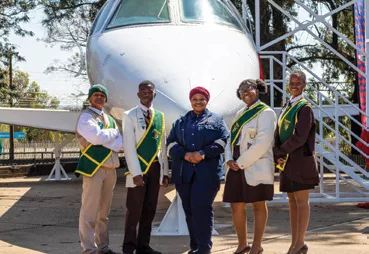
On 19 August 2025, there was a buzz of excitement at the Rhodesfield Engineering School of Specialisation. Learners, teachers, government officials and aviation professionals gathered for the official handover of the Embraer 135 passenger regional jet from Airlink to the school.
Standing alongside Premier Panyaza Lesufi and Education MEC Matome Chiloane, Airlink Executives Dr Namhla Tshetu and Samuel Mampshika emphasised the airline’s commitment to investing in education and building a pipeline of skilled talent for South Africa’s aviation industry.
The Embraer 135 may have retired from passenger service, but its new role is just as important. Instead of carrying passengers, it will now carry knowledge. Airlink has gone the extra mile by also assigning two qualified aircraft technicians to the school. These experts will guide learners through the inner workings of the jet, from hydraulics and avionics to flight control, engine maintenance and landing gear.
When people think of aviation, they often think of pilots. But as Dr Tshetu reminded everyone at the handover, the industry needs far more than just people in the cockpit. South Africa has fewer than 6,000 licensed aircraft maintenance engineers, not nearly enough for a country with ambitions to grow its aviation sector.
Premier Lesufi spoke with pride about how far the school has come.
“When the idea of an aviation school first came about, we asked ourselves how we could possibly have a school right next to one of the busiest airports on the continent, and yet the learners would know nothing about the aviation industry,” he said. “Today, this aircraft ensures that will never be the case.”
Additions to the Airlink fleet are being prepared for service
Airlink recently concluded lease agreements with Azorra, the Fort Lauderdale-based leasing, finance and asset management firm, securing 10 brand-new Embraer E195-E2 aircraft from the Brazilian manufacturer.
This marks a significant step forward, paving the way for delivery of the aircraft to take place.
Meanwhile, at Embraer’s factory in São José dos Campos, near São Paulo in Brazil, production is progressing rapidly. Wings, stabilisers and fuselages have been assembled and the aircraft are currently undergoing interior fittings and exterior painting in preparation for their test and handover flights.
Tight deadlines are being observed and the first three aircraft should be in South Africa by the end of October. Pending South African Civil Aviation Authority (SACAA) approvals, it is anticipated that the first E2 will enter revenue service by mid-December 2025.



Text and photography | Supplied
For more information, go to flyairlink.com.

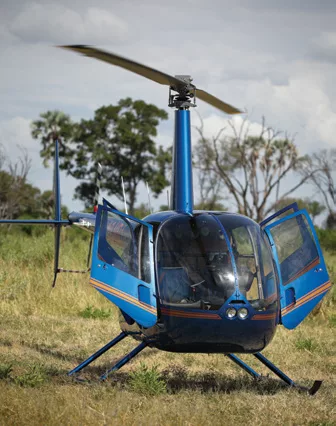
The sound of blades whir overhead as the helicopter starts its descent. The single-engine Robinson R44, piloted by James, is the only way to get to Atzaró Okavango Camp and flying low enough to get a bird’s-eye view of the floodplains, he points to a visibly excited herd of elephants making their way to a watering hole for a muddy roll-around.
Landing at the helipad, James opens the door of the helicopter as someone rushes over to the helicopter. Talk about making an entrance.
“Hi! I’m Bae!” she announces with contagious enthusiasm. “I’ll be your guide!” Being the first qualified female guide at African Bush Camps (ABC), she leads the way in making inroads in what is regarded as a mostly male-dominated environment. When Bae saw an advertisement on social media for the ABC Foundation female guide programme in 2021, it piqued her interest. “As a city girl who’s never left Francistown in the northeastern part of Botswana, I realised this was something I could do,” she recounts. “At that point, I knew nothing about the bush, but I applied in any case.”
Wanting to make an indelible impression, Bae studied as much as she could about ABC and, when the time came for her interview, her knowledge of wildlife was only what she had read in books or viewed on television. The question of why she should be employed came up, and she played her trump card and told them all she could about ABC. Receiving the news the day after that she had been chosen was a life-changing experience. “This is my office,” she gestures to the surrounding bush. “What could be better than being out in nature and doing what I love?”
Dark and dramatic
The Atzaró Okavango Camp, with only eight suites and two villas, offers sublime views over a tributary of the Okavango or a piece of nearby marshland. Teak furniture nods to the safari era of yesteryear with a writing desk, lounge area, bedroom and patio, plus a private plunge pool to round out a stunning suite. High ceilings and the clever use of browns, creams and whites create a luxuriously voluminous space.

Time seems to stand still here and losing track of what day of the week it is adds to the magic of a slow safari. Healthy, tasty meals are enjoyed in the dining area on the main deck. Don’t be surprised when a herd of elephants amble over through the water with a swooshing sound and the distant call of an African fish eagle makes you feel right at home.
Later, an array of snorts cut through the air. Moody dark grey skies emit thunder and lightning and the pitter-patter of soft raindrops starts to fall on the terrain and on the game drive vehicle. A herd of buffalo around 30+ strong are all staring in one direction. Confusion has set in among the herd as the thunder has increased in intensity. A few of them, including a number of young calves, are separated from the rest and loud grunts from the adults are clearly audible.
A male and female leopard have been seen in the area and appear to be hunting in unison. Only the outline of the male leopard is visible as he moves stealthily in the undergrowth of the mopane woodland, flattening himself and briefly lifting his head to see where his potential prey is. More grunts follow as the female buffalo seek to protect their young. Will the leopards be successful? As night falls, we vacate the sighting and decide to see what will transpire under the cover of darkness.
The electric storm has created a blank canvas, but there is no sign of the creatures previously seen, not even a smidgen of a track. It’s as though they were never here. We are hoping to find the leopards, as they were displaying behaviour associated with courtship – the male was inspecting a patch of grass that the female had walked past and ended up with a contorted face known as a ‘flehmen grimace’ as he processed her scent.
Birds and beasts
The range of water sources in the Delta ensure that guests are treated to spectacular avian displays. From the fabulous lilac-breasted rollers to the striking woodland kingfishers, there is a bird type likely to catch everyone’s eye. One striking species is the green-backed heron, which is standing in a water puddle on the game path with a platanna (an African clawed frog) gripped in its beak.
The plains game never disappoints. Zebras and impalas are always around, with zebras being masters at acting silly by nibbling each other’s buttocks. Then there are the cats that are mostly nocturnal – leopards, lions, cheetahs, African wild cats, caracals and servals – but that can also be spotted in broad daylight.
Happening upon a pride of five lions consisting of two males and three females at sunset, it’s clear that one of the females is busy feeding. The rest look rather uncomfortable after having overindulged on their meal. Another female is going to have a drink of water and, as she stands up, the sun’s last rays glisten in her golden eyes.
Text and photography | Heléne Ramackers
For more information or to book a stay, go to africanbushcamps.com.

A hidden gem is the epicentre for a thrilling range of wildlife experiences
One of the many lovely things about Hoedspruit’s Eastgate Airport is that it’s impossible to miss whoever’s meeting you after receiving a welcome message from the lodge the day before arrival – in this case, the striking pair of guide Kelle and tracker Golden. It’s a short, 10-minute drive in a luxury open-top Land Cruiser to the entrance of the Blue Canyon Private Game Reserve, followed by a scenic 20-minute drive to the Leopard’s Bend Bush Lodge. The first game drive starts within 10 minutes of leaving the airport – how does it get any better?
A standout facet of the 9,600ha Big Five reserve is the many large, established trees, allowing for magnificent birdlife, including over 400 species, not to mention the spectacular backdrop of the Drakensberg Mountains and the natural water sources due to the proximity of those mountains.
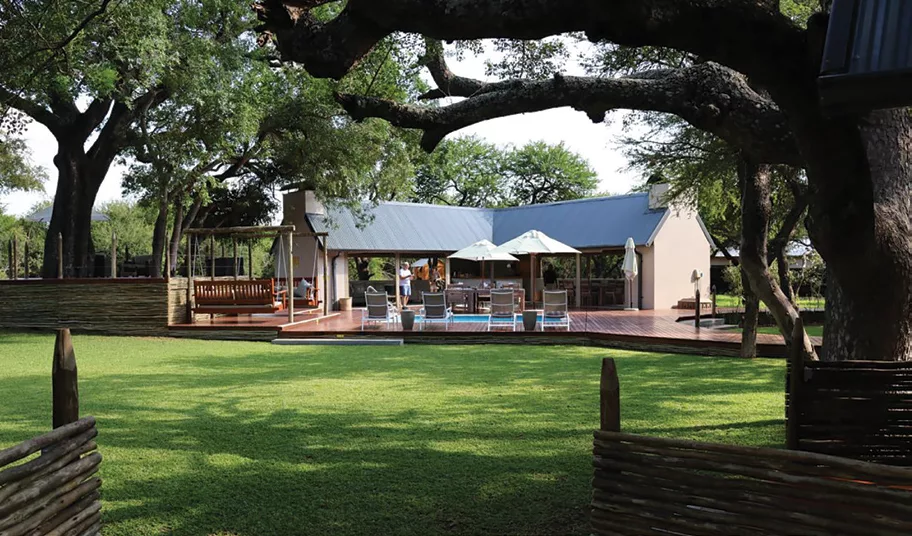
Leopard’s Bend Bush Lodge offers an exclusive and intimate feel, with five Superior rooms in a tight circle of neat, modern buildings surrounding a lush central lawn and swimming pool, with a dining area on a raised deck under the shade of a magnificent jackalberry tree. Peace, tranquillity and the warmth of the hospitality are the first aspects of the lodge’s character noted on arrival, and all are combined in an experience of unpretentious luxury.
A host of highlights
The afternoon game drive begins with a couple of groups (known as ‘journeys’ or ‘towers’ depending on if they are moving or stationary) of giraffe. The first is mellow, many of them acting as passive clotheshorses for numerous red-billed oxpeckers, flitting around in healthy numbers. The next group is two mismatched males, almost lazily indulging in some mutual head-butting. It’s surprisingly languid but also an obviously painful and literally hard-hitting pastime. Other than that, they don’t seem bothered – standing, chewing the cud and peering carefully around before re-engaging.
Close by, a deep, yawning abyss of a den is the backdrop to a trio of hyena cubs from two different litters – two older and one younger. They’re rambunctious, enjoying a playful rough and tumble that involves something like touch rugby ankle-tapping, but with teeth.

Sundowners are enjoyed on a low mound with a 180° vista of wispy candyfloss clouds in increasingly profound pinks. On the opposite end of the horizon hangs an (apparently) rare ‘strawberry moon’, which keeps things pleasingly on theme. Pinkish gins have been only half enjoyed when, in the distance, clear as a bell, a lion starts to roar. Immediately, the romance and ambience of the cocktail-sipping session is abandoned, with two guests supporting their petition to go and seek the big cats immediately by quickly finishing their drinks on the spot.
Finding the lions in question – one adult female and two young but already brutish sub-adult males – involves arriving just after they have gorged themselves on a kill and are ready to flop down in the grass and digest their large meal. The two males walk within close proximity of the vehicle, appreciated by the guests. The sound of grass being cropped close by confirms that there is something else in the vicinity. It’s a majestic white rhino, unperturbed by the drowsy predators. Bonus!
Unexpected excitement

As the sun dips below the horizon, it is time to head back to the lodge to enjoy a three-course dinner that has been thoughtfully prepared by the talented Chef Noks.
There is a slight change of plan (as there always is in the bush), though, when, close to the lodge, a large adult male lion is spotted, his huge head balanced on giant paws, remarkably unbothered by the vehicle. To let all the creatures in the area know that he is the king of the bush, he roars for a minute from his prone position – a sound that resonates right through you and one which you dream of hearing again!
A thrilling evening’s game drive is then supplemented by a spotted eagle owl and a thick-tailed mongoose. But that’s not all: there is a sighting so remarkable that it threatens to eclipse all that has come before – an aardvark snuffles and shuffles his way out of Golden’s spotlight and into a thicket. This truly magical sighting is one which not many guests are fortunate enough to experience.
Back at the lodge, there are warm welcome cloths and dinner, with more culinary magic, is served beside a log fire. Then, with a whiskey in hand, staring into dying embers of the fire becomes a warm and wonderful way to round off the day.
Delight scaled up
After a good night’s sleep, an early start the following morning means it’s cold, but guests are spoilt with ponchos, blankets and hot water bottles to make sure that they are toasty and comfortable.
The cliffs of the Northern Drakensberg dramatically frame the glowing furnace of the winter sunrise. The next stop is next to a small dam for the lodge’s famous Mocha-Choca-Rula, a Leopard’s Bend specialty, served with homemade crunchies while enjoying the sounds of the bush as it comes alive. There are three hippos that keep watchful eyes and show their curiosity by disappearing under the water and popping up again every few minutes. A crocodile appears out of nowhere, enjoying the rising temperature from the sun as guests re-embark on the vehicle with excitement, ready for the next adventure.
A message is received on the radio – a pangolin has been spotted! All other plans are forgotten. When we reach the sighting, we see that the animal is a little off the road. Given how highly endangered these beautiful creatures are, it is an incredible privilege to see a happy individual in such a highly protected area.
The Leopard’s Bend Bush Lodge, together with the Leopard’s Bend Wildlife Foundation (NPC), is driven by the owner and founder, Garth Wolff, to create awareness of the immense commitment conservation requires to ensure the protection of the endangered species on the Blue Canyon Private Game Reserve.
Text and photography | Supplied
For more information or to book a stay, go to leopardsbend.com.

Quiet, friendly island is a peaceful haven and a diving and snorkelling paradise
Nosy Sakatia is a small island, shaped (more or less) like a hand mirror, off the west coast of Nosy Be. On a beach in the corner where the peninsula that forms the ‘handle’ joins the main part of the island, dominated by the bulk of the Ambohibe Sacred Mountain, sits Sakatia Lodge, a family-friendly venue that could hardly be better placed for visitors who want to explore the natural beauty of the area.
On the island, the lodge’s range of bungalow accommodation, including a brand-new glamping option – luxury tents under ravinala leaf roofs, pitched on concrete floors – means simply relaxing, with an occasional trot down to the beach for a swim or to the dining area for a meal or a drink. And hiking around Sakatia’s interior is also an easy and satisfying activity.
Invest offshore
But not surprisingly for a small island, it is in the ocean around Nosy Sakatia that so much of the destination’s most precious treasures lie. It is heaven for divers. Water temperatures range from 26-30°C and undersea topography here includes coral gardens with pinnacles and plateaux, sponge gardens and sandy seabeds ideal for muck diving (searching for small, unusual sealife on the bottom).
Influenced by the tides, you can experience drift dives and big schools of fish or quieter dives in search of different creatures. There are over 20 dive sites, between two and 40 minutes’ travel time from the lodge and all experience levels are catered for.
The lodge’s location gives visitors direct access to an incredibly special attraction. Vast seagrass meadows right in front of the venue host a population of green sea turtles. Some of them are huge and very old. It has been estimated that there is a population of at least 80 individuals (more or less 50% males, 50% females) thanks to photo-identification – around 80% adults and 20% juveniles. It is possible to snorkel with these peaceful, fascinating animals the whole year round. The seagrass area hosting the turtles can be considered a turtle reserve and efforts to create a marine protected area managed by the local community are ongoing.
There are bigger returns too. Between July and November, a whale-watching trip offers a good possibility of seeing humpback whales up close. Often, encounters with these majestic animals occur with females with their calves: the adults migrate to the warm water around Madagascar to raise the youngsters.
Between September and November, snorkelling trips with small groups provide the opportunity to see whale sharks. The gentle giants in this area are normally juveniles or young adults, and following strict rules of engagement makes it possible to swim fairly close to them – an unbelievable experience.
Text and photography | Supplied
For more information or to book a stay, go to sakatialodge.com.
New!
Sakatia Lodge now offers four luxurious glamping tents, a first for the Nosy Be area. They are spacious and have a fantastic view of the bay. Each tent has two ceiling fans, a king-size bed and a single bed to accommodate three guests comfortably.
Sailing safari on Lake Kariba offers a sparkling new perspective on a gorgeous wilderness area
The wind tugged gently at our sails as we glided across the vast, shimmering waters of Lake Kariba. Ahead, the rugged peaks of the Matusadona National Park framed the horizon, a promise of adventure waiting to unfold. This was no ordinary safari. Our family of four was on a unique three-night sail safari, blending the tranquillity of sailing with the untamed beauty of the Zambezi wilderness.
The adventure began at the harbour where we met our skipper, a seasoned Kariba local with an obsessive love of the lake and all its inhabitants. Our yacht – a spacious, beautifully crafted 30-foot Wharram Tikki catamaran – designed specifically for Kariba, offered utility, comfort and a sense of deep connection with the surrounding nature. It also really looked the part. It was clear from the start that this was going to be an intimate experience, allowing us to immerse ourselves fully in the rhythms of the wild.
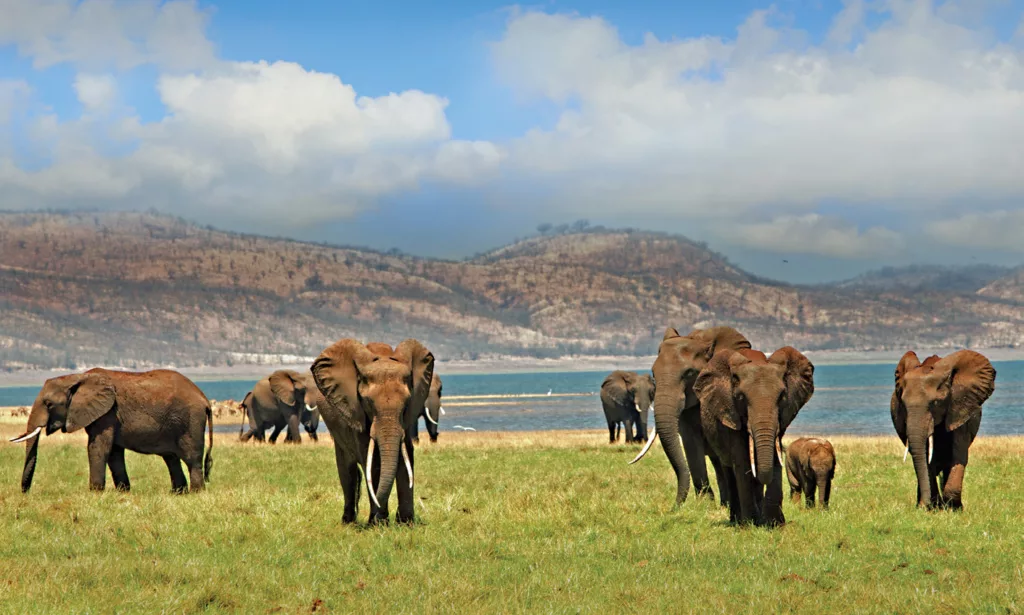
Lake Kariba is the world’s largest man-made lake by volume, straddling the old course of the Zambezi between Zimbabwe and Zambia. It is a watery wonderland teeming with life, from pods of hippos lazing in the shallows to elephants bathing playfully in the water (they love to swim). Fish eagles called above us as the catamaran sliced through the glassy, bath-warm, crystal-clear water, their haunting cries echoing across the sky. The children took to the boat immediately, lounging on the trampolines and sitting in the netting between the two hulls in their swimming costumes to get splashed by passing waves as the boat skimmed its way across the 30km-wide eastern basin to the Matusadona shore.
The Matusadona mountains were mirrored in the water as we glided silently along the national park’s shoreline. Before long, we spotted three young male elephants emerging from the treeline, their enormous frames moving quietly but with unexpected haste as they made their way down to the water’s edge, then straight into the water. That is when the show began. Three young bulls with no responsibilities have all the time in the world to splash about and roughhouse in the warm water of a balmy Kariba evening. No photograph or video could ever do justice to the show they put on as the golden Zambezi sun went down behind this elephantine bathtime.
Walk in wonder
One of the most exhilarating aspects of this sail safari was the opportunity to step off the boat and explore Matusadona National Park on foot. Unlike traditional safaris, where you observe wildlife from the confines of a vehicle, walking safaris bring visitors eye to eye with nature in its purest form. Guided by a ranger direct from the boat, we walked up the grassy plains and into the Matusadona bush, stopping to see a buffalo carcass and numerous impala and zebra.
We returned to the boat as the sun melted into the horizon, painting the sky in fiery hues of orange and pink, and sailed to a nearby sandy island where tables and chairs were set up on the pristine sandy beach for sundowners. Dinner was simple yet sublime: fresh-caught Kariba bream with vegetables and a glass of white wine to the accompaniment of grunting from the hippopotamus night shift shuffling past to graze.
We slept under the stars that night on the deck, the catamaran secured in a secluded bay, gentle waves lapping at the boat hulls. The air was filled with the symphony of nature – distant lion roars, the chatter of night birds and the occasional splash of a hippo returning to the water. We stared into the vastness of the starlit sky. With no city lights to compete, the Milky Way stretched above in dazzling clarity, and somewhere along the way, each one of us faded off to dreamy sleep.
No safari is complete without an element of the unexpected, and the sail safari delivered in ways never anticipated. We never imagined the simple thrill gained from taking the helm under the skipper’s encouragement, feeling the boat ghosting through the water with the wind. Pulling this and that rope to get the sails trimmed just right, then tacking and doing it all again in the other direction or having to adjust as conditions changed. There is surely some deep metaphor for life here, but everyone was too relaxed to work out exactly what it was.
Dreamlike delight

As the final morning dawned, mist curled over the lake, giving the landscape an ethereal quality. There was time for one last game walk, tracing the spoor of a leopard that had walked through the sand during the night. Though the elusive cat was never seen, the knowledge that it was nearby added an extra layer of thrill to the adventure.
Setting sail to return, our hearts were content. We had come seeking adventure and found it in abundance – each moment a brush with the wild, each day a reminder of the magic that exists when we allow ourselves to truly connect with nature.
This three-night sail safari on Lake Kariba was more than just a getaway; it was a journey into the heart of Africa’s wilderness. It was a lesson in patience, respect and the art of slowing down to appreciate the world around us. Most importantly, it was a shared experience – one that brought our family closer as we navigated the waters and trod the soil of one of the last true wildernesses.
Stepping back onto the sand at Hall’s Beach, reality beckoned, but the spirit of the wild remained. Lake Kariba had cast its spell, and we knew we would return someday, drawn once more to its untamed beauty and the life-changing adventures it holds.
Text | Ant Brown
Photography | Ant Brown and Shutterstock
For more information on sailing safaris with Sail With Elephants, go to sailwithelephants.com.
Island destination is not the stuff of brochures, offering instead a gorgeous concoction of beauty, adventure and warmth
There’s a reason Nosy Be isn’t overrun and it’s not the lack of beauty. In a world of meticulously packaged beach holidays and destinations engineered for easy Instagram moments, this Indian Ocean island does things differently. It doesn’t follow the rules of mass tourism – and for the traveller who values character over convenience, that’s its appeal.
Forget glossy travel brochures and over-filtered drone shots. Nosy Be isn’t about curated sunset cruises or perfectly timed beach cocktails. It’s about what happens in between: the scent of ylang-ylang on the breeze, a quick turn down a sandy path where kids are kicking a ball between fishing boats or the unexpected pulse of drums announcing a festival you hadn’t planned on attending. This is a place that reveals itself slowly to those willing to lean in and let go of the checklist.
Nosy Be has plenty of beaches – stretches of soft sand, warm turquoise water and little offshore islands. But it’s what happens away from the shoreline that makes it memorable. Spend a morning winding through the forested interior and you’ll come across ancient sacred trees festooned with strips of cloth, offerings placed at their roots. These are living landmarks, respected by locals who believe the spirits of ancestors gather here.
Elsewhere, aromatic ylang-ylang plantations carpet the hills, their perfume hanging in the air. Unlike other Indian Ocean destinations that have pivoted entirely to tourism, Nosy Be retains its agricultural soul. Coffee, pepper, vanilla and cacao grow in abundance and you’re never far from a market where these are traded alongside seasonal fruits and woven raffia baskets.
Life lived to the full
The island’s culinary culture has quietly evolved in recent years. It’s not unusual to find a modest beach shack dishing up a French-Malagasy fusion menu featuring freshly caught tuna carpaccio with lime and sakay (local chilli paste). One Italian expat runs a gelateria on the beachfront that has earned a loyal following.
Some of what makes Nosy Be engaging isn’t its list of activities but its unpredictability. Plans bend with the weather, tides or perhaps an impromptu public holiday. A dive trip might turn into a dolphin chase. And a village visit could stretch into a full afternoon as you’re invited to share grilled zebu (local beef) and rice with a family you just met.
There’s a sense of playful improvisation here. Rental sedans exist, but most locals and seasoned visitors get around on tuk-tuks, sometimes pausing for chameleons crossing the road. It’s an informal, slightly anarchic way to travel, and it feels suited to the island’s personality.
While well-known spots like Lokobe Reserve and Nosy Komba get all the headlines, it’s the lesser-known corners of Nosy Be that leave a lasting impression. A small, unnamed beach accessible only at low tide might host a spontaneous village wedding. A forest clearing could transform into a tromba ceremony, where ancestral spirits are believed to possess dancers, their movements urgent and hypnotic against the backdrop of pounding drums.
One of the most vivid experiences is witnessing how seamlessly everyday life blends with the island’s natural surroundings. Fishermen paddle dugout pirogues just offshore at dawn, while children play barefoot soccer nearby. Cattle egrets and kingfishers dart between mangroves. The landscape feels inhabited rather than staged.
Indefinable appeal
Perhaps the most valuable thing Nosy Be offers is its refusal to be neatly categorised. It’s not a pure luxury escape, though it has its share of high-end lodges. It’s not an adventure hub, though you can dive with whale sharks, explore crater lakes or quad bike through the bush. It’s not a cultural tour de force, yet it offers rituals, dances and traditions that have barely changed in generations.
It’s all these things in small, generous portions, woven together by the warmth of its people and the steady pace of island life, that make Nosy Be wonderful to visit. It’s a destination that defies the checklist mentality and rewards those who arrive curious and leave sun-kissed and content.
Nosy Be isn’t just another island holiday. It’s an experience stitched together by the small, unrepeatable moments you’ll never find in a brochure.
Text | Harriet Millson
Photography | Shutterstock
For more information or to book a trip to Nosy Be, go to madagascat.co.za.
Exploring and holidaying locally can have numerous advantages
Local tourism is becoming a preferred option for travellers seeking to explore gems in their own backyards. The ever-increasing cost of international travel is a major factor driving more people to explore destinations closer to home. On the flip side, local travel tends to be more affordable by skipping the costs associated with currency exchange fees and visas.
Time constraints are another reason for the surge in local tourism. Not everyone has the luxury of taking extended vacations, especially when juggling work, family and other commitments. Long-haul travel often requires taking significant time off. But with local travel, even a long weekend can be enough to recharge and explore.
From outdoor adventures to cultural festivals, there’s so much to see locally that often goes unnoticed. Whether it’s a lesser-known hiking trail, a charming bed and breakfast or an off-the-beaten-path destination, local treasures create new travel experiences that rival those found abroad.
Travellers who opt for local destinations can help revive these communities by spending their money close to home. The influx of tourists in local areas boosts small businesses and creates jobs for residents. There’s also a growing sense of responsibility to support local economies. Travellers are choosing to spend their vacation money at local hotels, independent restaurants and community-based attractions.
Convenient and climate-friendly
Travelling locally offers unmatched flexibility and convenience. Planning an international trip often requires months of preparation, from securing passports and visas to co-ordinating flights, accommodations and itineraries. With local travel, you can bypass much of this hassle.
Local travel also gives you the flexibility to adapt your plans on the go. Packing light, skipping the airport and avoiding long customs lines makes local tourism not only more appealing but less stressful.
Social media has sparked a rise in local tourism. Travel influencers and bloggers have shifted their focus to showcasing nearby destinations, capturing stunning photos of local landscapes and promoting staycations. Platforms like Instagram and TikTok have made it trendy to explore your own country and hashtags like #staycation and #localgetaway have gone viral.
In addition, the ‘slow travel’ movement, which emphasises immersive and thoughtful travel, has gained traction. This trend encourages people to spend more time in one place, engaging with the local culture and truly appreciating the environment.
As global concern for climate change grows, people are increasingly looking for ways to reduce their impact while still enjoying travel. Sustainable tourism is becoming a growing trend among eco-conscious travellers. Exploring nearby destinations means you can reduce the use of disposable plastics, limit energy consumption and support eco-friendly accommodations.
Text | Samuel Nassimov
Photography | Alexander Narraina
Samuel Nassimov is MD of Premier Hotels. For more information, go to premierhotels.co.za.
New book delves into the mysterious life of Xhosa teenager Nongqawuse and the devastating Cattle Killing of 1856-1857
On that occasion, I’d been mesmerised by the waves and valleys of rocks and red sand while listening to Radiohead’s Bulletproof. On this occasion, all I had to accompany me was the white noise of Pratt & Whitney jet engines and fellow passengers in muted conversation.
With boyish enthusiasm, I pressed my nose against the aircraft window until I left a sweaty oval signature on the glass. Now I could view the verdant Garden Route snaking up the coast in a narrow corridor between the sea and the sharp angular mountains to the north. A thin white line of surf hugged the seashore as the waves of the Indian Ocean fractured on the coast with powerful, metronomic frequency. Every now and again, gaping silvery river estuaries punctured the shoreline, the route of their sweet water meandering back into the interior and a source high in the mountains.
Hopping across the aircraft’s central aisle to the vacant seats on the other side, I gazed at the panoramic view of the Little Karoo, landlocked by mountains and stepped escarpments. There was barely a birdbath of water in sight. It was visibly arid and flat, so static and dry, in marked contrast to the vast rhythmic ocean three aircraft seats to my right.
As we landed at King Phalo Airport, I was disappointed to see that the pristine sun of Cape Town had been replaced by thick, low cloud. After collecting my luggage, I looked out expectantly over the car park for my host, but no one seemed to want me. Soon, all my fellow passengers had dispersed, transported by loved ones and colleagues to homes and executive hotels. The temporary flutter of excitement after a plane’s arrival soon dissipated in the balmy breeze. Now it was just me, a luggage porter and a couple of small birds squabbling over a fence post.
I used my time to reflect on King Phalo, whose name was written large on the utilitarian building. When he, the last chief of the united Xhosa people, had died in 1775, he could never have guessed he’d have an airport in East London named after him. For starters, East London did not exist in the 18th Century. The city had mushroomed in size and importance since its establishment in the 19th Century, a centre mainly intended to offer respite to the British army and new European settlers as they combated the climate, the terrain and the amaXhosa in and around Qonce (King William’s Town) and the Transkei region to the east. I, for one, thought the king deserved the recognition, as the last monarch to rule a united people. After his demise, his jealous sons had permanently split the family into the Rharhabe and Gcaleka clans – and boy, was this to cause them major headaches in the following century. Successive waves of encroaching European administrators, armies and settlers found this division among the amaXhosa people useful and exploited it during the 100-year Frontier Wars and at the negotiating table. Splits and divisions hardly ever strengthen anyone, and this was no exception.
As I concluded my reflections on the genealogy of the amaXhosa and on Phalo’s status, my host – Dr Patrick Hutchison, or Hutch, as he preferred to be called – rushed over and greeted me warmly. It was a frenetic start to our relationship as he apologised for being late while pumping coins into a parking meter. We forfeited the ubiquitous formality of shaking hands or touching elbows, and I was only confident he was my correct host courtesy of a poor image of him on Google Images. I had also gleaned that he was an eminent doctor in the area, focusing on general practice. He was in his late fifties or early sixties, full of youthful enthusiasm and breaking into a beaming grin from time to time.
We had never met before, but we hit it off from the moment the first coin hit the metal bottom of the parking meter. Our mutual interest in Nongqawuse and amaXhosa history in the Eastern Cape was an immediate and invisible bond. He asked me what my priorities were, but it was soon evident that he had organised everything already; an itinerary was drawn up and a vakasha had been prepared. I should say vakashas had been prepared – that is, not one but two – and I did not even know what a vakasha was. Hutch explained gleefully that this was the isiXhosa word for an expedition or adventure into the bush. I’d thought I was on a pilgrimage, not a vakasha, but I’m all for an adventurous pilgrimage. Along with other Border History Society enthusiasts, Hutch had arranged to take me to the important historical sites I had asked to visit – but, as he explained, they would likely as not involve plenty of adventure en route, since the sites might not be easy to find. How true that prediction turned out to be! He’d got everything organised – all I needed to do was pay for the petrol. We had a deal. All being well, we were going to find the graves of Nongqawuse and King Hintsa, the memorial to the Cattle Killing and other historical titbits. I felt like a youth on a blind date.
Text | Treive Nicholas
Photography | Mel Fotografie
In Search of Nongqawuse by Treive Nicholas, published by NB Publishers, is available now. For more information, go to nb.co.za.
This excerpt published by permission.

Intentionality when spending time with children makes an enormous difference
Amid daily schedules filled with school, work and commitments, carving out intentional, meaningful moments with children has become more valuable than ever. While the conversation often revolves around the quantity of time parents spend with their children, it is the quality of those moments that makes a lasting impact.
Children remember how they felt when they were with you – not just how long you were there. A single moment of true connection can shape a child’s emotional confidence and reinforce their sense of belonging.
Quality time is about focused, genuine interaction. It’s found in the bedtime story told with enthusiasm, the walk through a local park filled with questions and laughter or the shared task of preparing a meal together. These small, deliberate acts create memories that build trust, encourage communication and nurture a child’s emotional wellbeing.
Seek purpose
Spending quality time with children fosters a number of positive outcomes. Emotional security comes about when trust and confidence grow as children feel seen and heard. Open communication and meaningful interactions encourage children to express their thoughts and feelings freely.
Self-worth can be built through undivided attention that, even for short periods, helps children feel valued. Life learning through everyday activities such as cooking or gardening provides valuable lessons in patience, kindness and responsibility.
With a bit of creativity, it’s possible for families to integrate purposeful time together into daily routines.
Children thrive in environments where love is shown through shared experiences, not just spoken words. By being fully present in these everyday moments, parents lay the foundation for emotional resilience and a secure sense of identity.
While extended time together is ideal, what truly matters is how time is spent. Even a few meaningful minutes can have a profound effect on a child’s development. The goal isn’t perfection – it’s presence. Nurturing relationships at home complements the structured, play-based learning environment offered at school.
Text | Ursula Assis
Photography | Jacob Lund
Ursula Assis is Country Director of Dibber International Preschools. For more information, go to dibber.co.za.
Never one to shy away from a challenge, Paul Gardiner shines a spotlight on wildlife conservation through running
You grew up in the Eastern Cape, surrounded by wildlife. Take us back to that time.
Paul Gardiner My father was an entrepreneur from the Eastern Cape and, back in the early 1990s, he was on the lookout for a patch of land, a little retreat for the family. He stumbled upon a great little farm between Port Elizabeth and Grahamstown that was about 1,000ha in size and where we would meet for weekends. Being a businessman, he got bored and acquired the next farm and then the next and ended up with 10 farms. In those days, the wildlife had been eradicated from the area but, after doing research, my dad started bringing the big animals back. That was our lives as kids, watching elephants, buffalo, rhino and lion being returned after a long absence. What a pleasure it was as young teenagers growing up in that environment. Seeing lions being reintroduced in the province after an absence of 160 years was simply incredible. It was a rewilding journey second to none and it certainly planted a conservation seed in my siblings and me.
You had an exhilarating experience with guests in the Eastern Cape, where your game drive vehicle got stuck in mud and, suddenly, you were surrounded by a pride of 17 lions. You ensured the guests’ safety by telling them to stay put, locking them in the vehicle and then making a run for it. What happened to the golden rule in the bush – never, ever run?
I was a ranger in my early twenties and this was before we had free-roaming lions in our reserve. We had a 400ha lion enclosure because there simply wasn’t enough food to sustain a pride of 17 lions and we wanted to showcase these beautiful animals to our guests. Those were the days before sophisticated game drive vehicles, rifles, walkie-talkies – basically any type of safeguard. I went into the enclosure with two German guests and we got stuck. No one knew we had gone into the enclosure and I wasn’t going to sit there for eight hours until someone realised we were missing. I couldn’t raise any alarm or set off flares, so I hotfooted it 400m to the gate. I could see all the lions’ heads had popped up above the grass and they followed my every move. I’m grateful to be here to tell the tale all these years later!
Are you older and wiser?
I’d like to think that I am, but you never know what’s around the corner, particularly as we adventure into the wilderness in our Natural Born Runners filming expeditions.
When and why did you start running?
It’s threefold. As a kid, academics wasn’t my forte, so I was kept back a year. When I got to Grade 7, I was disallowed to partake in sports like rugby and cricket because I was bigger than the other kids. The head of sports said I could run in the 1,000m, which was the last sporting event and activity of the whole year. I smashed it and with that came the realisation that I have this running gene in me, inherited from my great, great grandfather. I suffer from chronic insomnia and running is my medicine – it allows me to do lots of thinking about business, opportunities and new ideas.
What was the catalyst for embarking on your mission to shine a spotlight on wildlife by running in different locations across the globe?
I was sitting in a pub one evening with my friend Christian, who is a brilliant aspiring filmmaker. Christian is a creative young man with a natural knack for filmmaking. Over a few whiskeys, we discussed my love for conservation, media and running and he suggested that we combine the three and create a channel with him as the filmmaker, capturing all my stories. Taking the DNA for eco-lodging and eco-tourism around the globe is what I do, so let’s capture it on film and call it Natural Born Runners, which is exclusively on YouTube. It’s a mix of conservation, challenges and laughs, and showcases me running wild in South Africa [‘The rewilding story of the Eastern Cape’], Scotland [‘The Green Desert’], Bahrain [‘The Wild Desert’], Antarctica [‘Ice Ultra’ and ‘Penguins’], Richmond, Virginia, USA [‘Running with a film star in his own race’] and Montana, USA [‘The story of the American buffalo’].
How much training and preparation goes into running in Antarctica?
Training in cold climates definitely helps. My brother Murray and I ran a half-marathon in Antarctica, and it was a pleasant -10°C. You’ve got to layer up and make sure that you’re well equipped. Nothing prepares you when suddenly there’s a wind chill factor and the temperature plummets to -20°C in a matter of minutes.
What was that like?
Antarctica is the most unbelievable place. It is the last true wilderness on the planet. You land on top of a glacier and, during our visit, we hopped into a small aircraft to see a colony of emperor penguins. Having only seen human beings once before, the group of 1,000 penguins were inquisitive and started marching towards us. That experience holds a special place in my heart.
You ran 2,000km in 2024. What are you hoping to achieve this year?
I don’t profess to be an ultramarathon runner. I like to keep my fitness levels consistent, so that when I go on any type of expedition, I’m ready to go, fit enough to handle it and able to do it with ease. As I get older, I try to run the equivalent of an ultramarathon every week and it will be nice to throw in a few challenges along the way.
Text | Heléne Ramackers
Photography | Christian Antoine
Natural Born Runners can be viewed on YouTube. Go to youtube.com/@NatBornRunners.
Easy-to-remember tips can help in recognising signs of a melanoma
According to CANSA (The Cancer Association of South Africa), skin cancer is the fourth most prevalent cancer among male South Africans and the fifth most prevalent among female South Africans.
Exposure to UV radiation (from the sun or tanning beds) is the number one cause of skin cancer. The sun’s UV rays damage skin cells, leading to abnormal cell growth and the development of cancerous tumours.
While it is more common for skin cancer to develop over a long term due to prolonged UV exposure, it’s also possible for it to develop after short periods of intense sun exposure or burning. This is why it’s imperative to drive education on sun safety practices. Prevention is better than cure.
There is a common misconception that only men and women with fair skin tones are at risk of developing skin cancer. While fairer skin tones (Fitzpatrick types I and II) have a higher risk of developing melanoma than people with naturally darker skin tones, dark-skinned men and women are not exempt from sunburn or skin cancer.
Precautions and prevention
Taking precautions when spending time outdoors goes a long way in preventing skin cancer. Apply (and reapply) a broad-spectrum SPF product to all exposed areas of the body when outdoors. Wear sunscreen on your face every day.
Cover up with a hat, sunglasses and loose, comfortable clothing, and avoid spending time in direct sunlight during peak hours (10am-2pm). Never use a sun bed, and don’t expose your skin to the sun in an attempt to tan. A tan is a sign of skin damage, so invest in a good quality self-tan product instead. Visit a dermatologist for a check-up every few years, and if you notice something different on your skin, be it a mole, a sore that doesn’t heal or an unexplained mark, visit your healthcare practitioner. Early detection is key. Learn the simple ABCDEs of skin cancer and monitor your moles.
Look closely at your skin in front of a full-length mirror, as well as with a hand mirror. Examine your body from front to back and remember to raise your arms, look on the inside of your mouth, between your fingers and toes, on the soles of your feet, under your breasts and on the back of your neck. Try to do this once a month, and if you notice anything strange, visit your healthcare provider.
Text | Judey Pretorius
Photography | New Africa
Dr Judey Pretorius is a biomedical scientist. For more information, go to biomedicalemporium.com.
Good habits and exercise are excellent, but a safety net is a good idea for when your health is out of your hands
Staying healthy is about more than taking the occasional jog or eating a salad. For many people, regular exercise, a balanced diet and cutting down on unhealthy habits like smoking or excessive drinking are key parts of maintaining long-term wellbeing. But there’s another side to good health that’s often overlooked: the cost of staying well.
When you’re young and healthy, it’s easy to think of gap cover as something you only need later in life when chronic illness or serious diagnoses start showing up. The reality, though, is that accidents can and do happen to anyone – in fact, some things, like sports-related injuries, are more likely to happen to young, healthy and active people. With medical aid co-payments, sub-limits and medical expense shortfalls on the rise, gap cover is a proactive investment in future health and financial stability.
Maintaining your health for your future self means you need to stay one step ahead of potential health issues rather than waiting for symptoms to become serious. Regular check-ups, blood pressure monitoring, cholesterol and glucose tests and other early screening tools can detect conditions like heart disease and diabetes in their early stages when they’re easier and often less expensive to treat.
Preventative care is a powerful way of taking control of your long-term health. It not only improves outcomes but also reduces the risk of major health complications that can disrupt life and lead to substantial medical costs.
No immunity to accidents
Sometimes, even the healthiest bodies betray us, and when they do, it’s not just your health that takes a knock – your bank account does too. Torn ligaments and broken bones are common sports injuries that can be expensive to treat. No matter how fit and healthy you are, you can still get diabetes, and there are many stories of runners having heart attacks during a race, also requiring expensive treatment.
Being fit doesn’t mean you’re protected from genetics or accidents or that you’re immune to medical expense shortfalls that happen when your medical aid doesn’t cover the full cost of treatment. Musculoskeletal injuries are some of the most common and expensive claims that come through gap cover providers, with heart conditions and cancer high on the list as well – healthcare issues that frequently affect even the most active people.
Gap cover becomes essential when things go wrong – scans, scopes, specialists and surgeries can and do cost well beyond what medical aid covers. Significant medical costs can happen to anyone, no matter how young, fit and healthy you are. And if you’re starting a family or raising young kids, the financial risk multiplies: maternity costs, emergency room visits, unexpected surgeries… Healthy people still get hit with bills they didn’t see coming. Joining gap cover early means you avoid waiting periods and exclusions down the line, and it puts you in a better position to act quickly if something unexpected does crop up. The goal of preventative care is not to treat illness but to stay ahead of it. Sometimes, though, health problems are unavoidable. Gap cover is an essential safety net for when things go wrong.
Text | Brian Harris
Photography | Pranithan Chorruangsak
Brian Harris is General Manager: Operations at Turnberry Management Risk Solutions. For more information, go to turnberry.co.za.
A journalist at heart, Joanne Joseph also enjoys storytelling through the written word
You grew up in Chatsworth, KwaZulu-Natal. What are your fondest childhood memories?
Joanne Joseph I have a number of wonderful childhood memories. We lived in a small house in Chatsworth, but it was one that was bursting at the seams with love, affection and security. My fondest memories involve having my wonderful grandparents around, my brother and my father’s music, my mom’s remarkable leadership as the glue of the family and her amazing cooking as well. It was a happy home, and those are memories I would never trade. I sometimes wish I could return to it in real time to relive, as those were some of the happiest times of my life.
From being the first voice on YFM while a full-time student to Classic FM – did all these slots serve as stepping stones for what you would eventually become, a television news anchor?
It was, thanks to the mentorship of senior journalists along the way, that I was able to actually apply the skills to be able to integrate myself into the world of journalism. Every one of those stepping stones was so important in teaching me what I needed to know and taking me to the next level to be able to eventually become a television news anchor.
Journalism can also be considered storytelling. How did you end up writing your first book, Drug Muled, in 2013?
While I was working at eNCA, a story broke about a young woman who had carried drugs into Thailand in her dreadlocks as a drug mule. We needed to get a sense of what her experience was like on that side. Being arrested, being imprisoned and being tried. We thought someone to give us the most accurate picture of this was a person who had gone through exactly the same process a number of years before. Her name was Vanessa Goosen, a convicted drug mule who had just returned to South Africa from the same prison. What was initially planned as a five-minute interview ended up being a 20-minute interview. The information she gave us was so absorbing, and it was at that point that I had the realisation that her narrative was one that contained so many fascinating elements, it would make for a wonderful book. I discussed it with a publisher, and she agreed that it would make a great book.
Then came Children of Sugarcane, published in 2021, a novel that has garnered high acclaim.
I’m relieved that Children of Sugarcane received such a warm reception from so many communities in South Africa and abroad. It took quite a long time to write – nine years of investment intermittently. I’m glad that, at the end, it was acknowledged as the type of novel that I hope falls into the idea of a collective history, the many histories in our country and the rich histories of so many different communities merging into part of the cornerstones of our identity.
What was the inspiration behind that book?
My great-grandmother was the inspiration for Children of Sugarcane. She arrived here with her younger siblings in the 1880s, and as indentured workers, they were all set to work on the Natal Government Railways. The work would have been gruelling and torturous in many aspects. We know that life was extremely difficult for them, but unfortunately, my great-grandmother’s history was much too scant in the archives for me to flesh that out into a non-fiction narrative. That is how it became a fictional narrative, but one that drew in a number of stories of courageous women who had shared much the same history as my great-grandmother.
How much research goes into your books?
There’s a great deal of research that goes into writing in general. My first book involved a lot of interviews with Vanessa Goosen and various other officials who were reachable at the time and who’d experienced this ordeal along with her. With my second book, I consulted a number of history books and academics who were well versed in the field of indenture. I was fortunate to be able to draw on our wonderful academic tradition, both written and vocally in this area, that brings the story to life in terms of the historical detail.
Do you get writer’s block, and if yes, how do you deal with it?
I don’t think of writer’s block in the way it’s conventionally thought of. When the periods of inspiration come around, I lock in and I write for long periods of time. When I’m in that mindset or the zone, I’m able to write for extended time frames that last several weeks. At the end of that, I feel that I’ve done a useful piece of writing, and I just let that writing rest for a while until the next period when I feel like that again.
And procrastination tactics?
I think I’m a master of procrastination. It can be ‘let me run an hour long on the treadmill’ and then get so exhausted that I can’t write anymore. Or ‘let me go cook something delicious for the family’. These are all excuses that can’t last long, and, at some point, the pressure must build up to the point where I absolutely have to do something. I sometimes feel working under pressure is much better, and I’m less likely to procrastinate, which I’ll sometimes do deliberately.
Text | Heléne Ramackers
Photography | Emil Wessels
Children of Sugarcane by Joanne Joseph, published by Jonathan Ball Publishers, is available now.

Simple habits can increase the sustainability of a business quickly and effectively
In today’s world, sustainability is far more than just another buzzword – it’s becoming a way of life. For businesses, it’s no longer a ‘nice-to-have’ but an absolute imperative. As climate change, environmental consciousness and corporate social responsibility continue to shape public discourse, companies are being called upon to take real, meaningful action.
The great thing about going green is that it’s not just a way to do your part in saving the planet, but can also play a key role in building a better business. Eco-friendly practices can strengthen team culture, enhance your brand reputation and attract purpose-driven talent. In fact, many employees, especially those from younger generations, actively seek out companies that align with their values and environmental responsibility is high on that list.
Introducing sustainable initiatives into the workplace doesn’t have to be complicated or expensive. Small changes can really have a big impact.
If your business doesn’t already have a recycling programme in place, now is the time to start one – whether you work in an office or from home. In the office, a simple but effective first step is to provide clearly labelled recycling bins in shared spaces like kitchens, lounges and restrooms. Make it easy for your team to know what goes where by posting signage that outlines the types of materials accepted, such as paper, plastic and glass.
When it comes to staff who work remotely, it’s important to encourage employees to set up simple recycling stations at home and to share tips on how to dispose of common household and work-related materials responsibly. Regularly communicating your company’s environmental values through internal newsletters or team meetings and highlighting how small individual actions contribute to a larger collective impact can go a long way.
Beyond day-to-day waste, consider reducing your contribution to landfills by rethinking how you manage the office – or home office – equipment and furniture. Instead of discarding outdated fixtures or furnishings, look into ways to repurpose or donate them. Many organisations and recycling programmes will gladly accept used desks and chairs, giving them a second life while keeping waste to a minimum.
Take it online
The move to digital-first workspaces shouldn’t be seen as just a technological shift, but an environmentally conscious one too. Cloud-based tools like Google Workspace, Microsoft 365 and project management platforms such as Trello and Monday.com make collaboration seamless while also reducing paper waste.
Encourage your employees to switch from printing to sharing documents digitally. Move to using digital signature tools for contracts and approvals. All of this can make a meaningful difference in paper usage.
Going paperless not only helps reduce your environmental footprint but also improves organisational efficiency, saves on printing costs and makes document management more secure and accessible, especially for hybrid or remote teams.
Hybrid harmony
Commuting to and from the office is a significant contributor to a company’s carbon footprint. One of the simplest and most effective ways to reduce this is by offering hybrid work options. Allowing employees to work from home helps reduce greenhouse gas emissions from daily travel. Fewer cars on the road means lower carbon output and less time spent stuck in traffic, which has been shown to lead to happier, more productive employees.
Text | Nikki Burgoyne
Photography | Ground Picture
Nikki Burgoyne is Operations Manager at Strider Digital. For more information, go to striderdigital.co.za.
Companies prioritising compliance can increase their chances of profitability
We live in fascinating and fragile times. No one could have predicted how turbulent 2025 would be, with a world superpower disrupting global trade with tariffs. As countries look inward, compliance in South Africa remains misunderstood and underutilised.
For many businesses, especially start-ups and small-to-medium enterprises (SMMEs), compliance is seen as a necessary evil – a tick-box exercise at best and a business-breaking burden at worst. But it doesn’t have to be this way. Compliance can no longer be treated as a back-office task that surfaces when deadlines loom, regulations tighten or investment is on the line. One step is to embed compliance into a business’s DNA from day one, regardless of size or sector.
This starts with a deep, industry-specific understanding of the regulatory landscape in which a business operates. Businesses need robust internal policies and compliance programmes that foster a culture of ethics, actively educating teams on responsible business practices. Improving financial literacy and upskilling are key. Business owners need to understand not just what compliance entails but why it matters and how it can build trust, credibility and long-term growth.
Accountability also means being proactive, understanding sector trends, anticipating legislative changes and aligning operations not just to meet compliance requirements but to exceed them. The businesses that win are the ones that lead with transparency, integrity and foresight.
Online help
One of the most consistent themes is how digital tools can be crucial for resource-strapped SMMEs. Cloud-based accounting, HR, payroll platforms and automated reporting systems not only reduce administration time but also help businesses stay audit-ready and investor-friendly. These tools empower business owners to track compliance milestones, flag issues early and streamline decision-making.
Equally important is access to standardised templates, toolkits and sector-specific guidance that demystify compliance. Whether provided by government departments, banks or industry bodies, these resources fast-track compliance literacy and execution.
Good compliance can and should be rewarded. From tax breaks and grant eligibility to preferential procurement opportunities, a strong compliance track record unlocks business benefits. It builds credibility, opens doors to funding and boosts competitiveness, especially for SMMEs looking to scale or expand. This is critical in the context of the African Continental Free Trade Agreement (AfCFTA), where access to regional and global markets will depend on the robustness of operations and governance frameworks.
South Africa’s relatively informal stokvel sector, valued at over R50 billion, is a great example here. With better compliance frameworks and incentives to formalise, these collective savings schemes could be engines for economic participation and wealth creation.
In South Africa, one of the sectors where compliance challenges are most pronounced is the township economy. While the focus must remain on formalising and supporting all SMMEs, it’s crucial to recognise that our township economy, valued at R900 billion, is one of the country’s most under-leveraged assets. By embedding a culture of compliance grounded in ethics, responsibility and smart systems, South African SMMEs can transform from survival-mode operators to opportunity-seeking market players.
Text | Luncedo Mtwentwe
Photography | MMD Creative
Luncedo Mtwentwe is Managing Director of Vantage Advisory and host of the SAICA Biz Impact Podcast. For more information, go to vantageadvisory.co.za
Expanding on what is already available is more valuable than simply moving the same pieces around
More and more publications are adding the ‘not generated by AI’ disclaimer to their content contributor requests. The Harvard Business Review content submission form includes a standard question on whether generative AI was used, not only in the creation of the content submitted but also in completing the submission questions.
On top of increasing revenue and views, newsrooms have the added pressure of distinguishing between genuine subject matter expertise and content compiled by generative AI. While it is still relatively easy for a trained eye to spot content written – or just ‘compiled’, as some would argue – by generative AI, it is an unnecessary burden on journalists and editors.
Subject matter experts and communication professionals alike need to carefully consider whether their reputations are worth the perceived cost and effort savings of using an AI tool rather than an experienced human writer.
On the other hand, writers and communication professionals need to understand that their clients are searching for solutions that make the effort feel less and the expense worth more than the straight monetary value of it. Subject matter experts need writers and communication professionals to interpret what they’re trying to say, rather than merely regurgitating it.
Expand the playing field
While each party involved in this unpredictable rollercoaster of generative AI may feel like they have right on their side, they’re all indirectly for the same thing: increasing knowledge. Subject matter experts may approach the issue with increased speed and decreased effort in mind, writers and communication professionals may consider quality and differentiation as top priorities and newsrooms may hold the journalistic principles of truth, accuracy, independence and objectivity as the highest standard. In the end, increasing knowledge – not simply reiterating existing information – is the point.
Most generative AI tools use large language models (LLMs) based on existing knowledge to compile responses (answers) to prompts (questions). It is easy for users of these tools to think of the responses provided by the generative AI tools as new, simply because it is new to them, the users. Truly new knowledge, however, springs from critical thinking, a skill not yet mastered by most generative AI tools and not often requested by users.
When using generative AI to produce content that will be submitted to media for publication consideration, AI users need to be honest with themselves when considering whether we are asking AI to help with the pure ‘doing’ or whether thinking is inadvertently being outsourced to AI.
There is no easy solution to navigate these sticky situations. Having AI policies and rules for subject matter experts, writers, communication professionals and media in place is a good start. From there, the impact this phase will have on the future of information and media integrity is up to the moral compass of each individual who gets on board the generative AI rollercoaster.
Note: Not even one smidgen of AI was used during the creation of this piece. Not even for checking spelling or grammar.
Text | Juanita Vorster
Photography | Niko Studio
For more information, go to juanitavorster.com.
Planning for a comfortable life after you stop working needs action now
On the back of the South African budget announcement, the reality is that the cost of living will continue rising, which means income and retirement savings will have to go further. There are several proactive steps people can take to maintain a comfortable lifestyle in their later years.
Financial security is a key component of retirement, as it can inform quality of life, so it’s important to get into the habit of building that retirement fund and cutting unnecessary costs where possible.
Unsecured debt, such as personal loans and credit card debt, can erode financial stability in retirement years. Experts advise that no more than 15% of one’s income should be allocated to debt repayments: retirees – or those planning retirement – should prioritise clearing outstanding balances and avoid high-interest borrowing to secure their retirement fund.
With age comes the increased need for medical care. Comprehensive health insurance can significantly reduce out-of-pocket expenses, while home and vehicle insurance can protect against unexpected financial losses. It’s best to review coverage annually to ensure your policies remain suitable and that you’re benefitting from the most cost-effective option. Compare insurance quotes annually and ask about discounted rates.
Play the long game
While the 2024 introduction of the two-pot retirement system has enabled more financial flexibility now, it also demands responsible long-term planning to prevent retirees from outliving their savings. Early withdrawal means that retirees will lose the annual growth earned on the total amount, while also paying tax on the amount withdrawn.
Some people are looking forward to stopping work, but it’s often quite a tough adjustment for many – not just from a financial standpoint. It’s well worth looking at the possibility of scaling down work so that it’s not such an abrupt shift, while also maintaining an active income stream. Alternatively, monetising hobbies or finding passive income streams to boost those retirement funds can go a long way in meeting those cost-of-living expenses.
Investing in property early is one of the smartest financial moves retirees can make to secure long-term stability and wealth. Property is a tangible asset that not only appreciates over time but also provides a steady income stream through rentals if needed. Unlike volatile stock markets, real estate offers a sense of security, ensuring retirees have a valuable asset that can be leveraged if necessary. Buying property early also means taking advantage of compound growth, reducing the financial burden later in life.
Text | Barto van der Merwe
Photography | oneinchpunch
Barto van der Merwe is Managing Director of Renishaw Property Developments. For more information, go to renishawhills.co.za.
Different generations since the 1960s have had their lives shaped by the dominant technologies of their time
Generational theory offers a practical framework for understanding how collective experiences shape human behaviour across time. Scholars have traditionally delineated Baby Boomers, Generation X and Millennials based on birth year. Yet, as technology accelerates, these broad categories are perhaps oversimplified, much like a one-size-fits-all suit that fits no one perfectly.
The seven generations, each linked to a decade from 1960 to 2030, have been defined by the technological and digital transformations that marked their formative or professional years. Each decade from 1960 to 2030 anchors a generation, inferring its identity from the dominant tech of the period and the impact it has on society.
The 1960s was an era of bold innovation, from moon landings to mainframe computers like the IBM 360. The Mainframe Cohort, born between 1945 and 1960, encountered technology as a monolithic, centralised force. These machines, operated via punch cards and esoteric commands, were the preserve of specialists only. Mannheim (1952) argues that early experiences imprint lasting traits and, for this group, tech was a distant authority to be managed, rather than embraced. Control was paramount and trust in tech was tenuous. Their digital transformation was minimal, reflecting a world where computing remained an organisational endeavour, rather than a personal one.
The 1970s introduced the microchip, shrinking tech from room-sized monsters to desk-friendly devices like the Apple II. The Microchip Pioneers, born between 1955 and 1970, were the first to tinker with personal computing, a shift Tapscott (1998) links to an emergent DIY culture. This cohort adapts and innovates – comfortable with tech as a tool rather than as a tyrant. Research by Bennett et al. (2008) cautions against over-generalising the adoption of tech, yet the Pioneers’ hands-on ethos marks a pivotal transition in digital engagement.
Digital exploration
By the 1980s, technology became more accessible, with the floppy disk and the IBM PC. The Floppy Disk Practitioners, born between 1965 and 1980, navigated a world where tech moved from labs to living rooms. Autry & Berge (2011) calls this cohort the Digital Immigrants, adept at adopting – rather than inheriting – tech fluency. Their era saw the rise of practical computing tools – word processors, spreadsheets and the dot-matrix hum – that bridged analogue and digital realms. Selwyn (2012) underscores how this decade democratised tech, yet for Practitioners, it remained a means to an end, not a lifestyle.
The 1990s unleashed the internet, epitomised by the modem’s dial-up tune, which is permanently engraved in the memories of all who were there at the time. The Dial-Up Innovators, born between 1975 and 1990, surfed the web’s early waves via Netscape and AOL, earning Tapscott’s (1998) title of the Net Generation. This cohort blended their analogue upbringing with digital exploration, mastering email, chatrooms and rudimentary sites. Vial (2021) notes how connectivity redefined work and play and the Innovators thrived in this space – they were essentially digital pioneers who were tethered to a pre-digital past.
The 2000s thrust technology into people’s pockets with the advent of the smartphone. Apple’s iPhone (2007) was a defining artefact. The Smartphone Forerunners, born between 1985 and 2000, embody Autry & Berge’s (2011) Digital Natives, intuitively navigating a world of apps, social media and instant messaging. This cohort integrated tech into identity itself. Facebook and Twitter shifted digital transformation from utility to intimacy. For the forerunners, connectivity was not a choice, but rather a constant – a generational hallmark that some older folk find bewildering.
Everyone connected
The 2010s elevated tech to the ethereal with cloud computing, epitomised by Google Drive and streaming giants. The Cloud Integrators, born between 1995 and 2010, grew up in a seamless digital ecosystem – smartphones, wearables and AI assistants were standard. Vial’s (2021) analysis of digital transformation as boundary-blurring resonates here; physical constraints dissolved as data floated freely. Selwyn (2012) highlights education’s parallel shift, yet for Integrators, tech is less learnt than lived – a fluid, ever-present reality.
The 2020s, our current frontier, is defined by artificial intelligence and interconnected systems – think ChatGPT and the metaverse. The AI Navigators, born between 2005 and 2020, are emerging into a world where tech anticipates our needs, from autonomous vehicles to virtual realms. Vial (2021) describes this decade’s transformation as ecosystem-driven, a notion that these Navigators embody as they partner with AI. Mannheim’s (1952) lens suggests that their identity will fuse with this tech, crafting a generation that is uniquely attuned to artificial agency.
Text | Chris Blair
Photography | Shutterstock
Dr Chris Blair is Group Director at 21st Century. For more information, go to 21century.co.za.
Young people entering the workplace would do well to get their heads around the reality of this stage of life
Graduates entering the workplace for the first time will attest that this next life phase is an exhilarating milestone. However, for many, this transition often comes with unexpected challenges, most notably the need for a significant mindset shift. While academic qualifications open the door, success in the corporate world requires more than just a degree. It demands adaptability and a willingness to start from the bottom.
The leap from academic life to the professional world is not simply a matter of changing environments; it’s a fundamental transformation in mindset, which can be a challenge for starry-eyed graduates who haven’t yet experienced the world of work and its ways. Many graduates are surprised to discover how much orientation, induction and acculturation are required to transition into the corporate world. This is because the environment and expectations, as well as the interpersonal dynamics of the workplace, are vastly different from those of a university.
Employers often invest significant time and resources in onboarding programmes to help graduates adjust, but the success of these efforts depends largely on the individual’s openness to learning and their receptiveness towards feedback. Graduates must embrace these processes as opportunities to grow.
Small steps
Despite the impressive titles on diplomas and degrees, every graduate will likely start at the bottom of the corporate ladder. This reality often clashes with a sense of achievement experienced at the culmination of a university career, upon graduation.
At the entry level, one gains exposure to the organisation’s operations, develops a deeper understanding of the real-world intricacies of a chosen field and starts building a network of colleagues and mentors. These early experiences build a foundation of practical knowledge and skills that no textbook or lecture hall can replicate. Graduates who approach these roles with enthusiasm and curiosity are more likely to advance quickly and meaningfully in their careers.
One of the biggest gifts you can give yourself when stepping into the workplace for the first time is to resolve to become a high-agency employee. Employers value initiative, a solutions-driven mindset and self-direction. Employers seek individuals who can identify gaps, propose solutions and take responsibility for their own development. This is within the means of all graduates and requires only that people seek opportunities to contribute consistently. By demonstrating a willingness to listen, observe and learn, graduates not only gain the respect of their peers but also position themselves as reliable team players and future leaders.
In the workplace, recognition and respect are earned through action, collaboration and contribution. Treating everyone in the workplace with respect – from the cafeteria staff to the CEO – creates an environment of trust and mutual support. Graduates should strive to build relationships, deliver value and learn from every interaction.
Text | Ivor Blumenthal
Photography | Balance Form Creative
Dr Ivor Blumenthal is Head of Career Services at The Independent Institute of Education’s Rosebank College. For more information, go to rosebankcollege.co.za.
Avoid nasty financial surprises by knowing what sort of cover you have for your car
Unforeseen car repairs can be a major financial blow, especially if you’re caught without the right cover. Labour rates at franchised dealerships in South Africa range widely, and parts are often imported, making them more expensive.
It’s essential to understand what protection you’re getting when buying a vehicle and to be clear on the difference between a motor plan and a motor warranty. Although these terms are often used interchangeably, they provide different types of cover.
A motor plan helps you manage the cost of keeping your car in good running condition. It may include a service plan, a maintenance plan or both. A service plan covers the cost of routine servicing according to the manufacturer’s schedule. This includes labour and parts such as oil, brake fluid and spark plugs. Some items are replaced automatically, while others are inspected and only replaced if necessary. A maintenance plan includes everything in a service plan, plus the replacement of parts that wear out over time, like brake pads, the clutch and the battery, as well as mechanical and electrical failure.
A motor warranty, also called a factory or manufacturer warranty, is included automatically with a new car. It usually lasts for a fixed period, such as three to five years, or up to a certain mileage. It covers unexpected mechanical or electrical failures in key components like the engine, gearbox and onboard electronics. If a part fails suddenly due to a manufacturing fault, the warranty pays for repairs or replacement. However, if a part wears out over time, like a clutch or battery, it won’t be covered by a warranty, only by a maintenance plan.
Take the long road
Many new cars come with both a motor plan and a warranty bundled together. When something goes wrong, it’s often the warranty that covers the cost, but drivers mistakenly credit the motor plan. This causes confusion about what each plan really includes.
Normal car insurance is different from both a motor plan and a warranty. This covers accidental damage, theft, fire and third-party claims. While a motor plan pays for scheduled services and a warranty covers mechanical or electrical failures, insurance covers you if your vehicle is involved in an accident or is stolen. Insurance is a legal requirement if you have a financed vehicle, and choosing the right level of cover is crucial for protecting your budget.
Once your motor plan and warranty expire, you have several options to stay protected against high service and repair costs.
Read the fine print when considering your options, and make sure you understand what’s covered and excluded. Whatever you choose must suit both your car and your budget.
Text | Sarah Nicholson
Photography | Thx4Stock team
Sarah Nicholson is the platform and customer experience manager of JustMoney.co.za.
AI can augment the work of human travel professionals, catering to the specific tastes and needs of those going to different destinations
Although AI can’t replace the insights and advice of a dedicated travel manager (the kind of travel smarts that only come with years of personal experience), it is hard at work, working in the background.
In fact, the next time you book a business trip, you can be 100% sure that AI is streamlining site navigation, prompting on-policy travel decisions, anticipating your travel preferences and contributing a few impressively intuitive touches to make sure your journey is smoother than ever before.
Have you checked into a hotel recently and been pleasantly surprised by the choice of room, on-site amenities or mini-bar offerings? It’s not blind luck. Chances are, AI is picking up on your past travel behaviour and preferences and feeding it directly to the people who make a difference.
For frequent flyers, that means enjoying subtle tweaks to lounge benefits, airline seating, meal options and even in-flight entertainment. And an AI-perfected itinerary can also help match traveller and company needs.
Today’s booking tools use AI to curate and shape your travel choices. Platforms built for managers, bookers and travellers automatically green-flag options that comply with your company travel policy while factoring in your preferences and requirements around sustainability and traveller wellness.
AI is also an indispensable tool when it comes to scouring global distribution systems or travel aggregators for the best flights. Convenience and comfort remain top priorities for business travellers. This means a direct flight is often preferable to a cheaper connection. It’s not just about saving money; it’s about reclaiming time. AI puts the best options on the table, improving efficiency, simplifying processes and making business travel an altogether more enjoyable experience.
Automated airports
Biometric screening using facial recognition at check-in and security is already widespread, including at Heathrow, Changi and major US hubs. Technologies like SmartGate, ePassport gates and TSA facial recognition systems streamline security and immigration processes. Singapore’s Changi Airport now offers passport-free clearance, while the US has implemented facial recognition across 80 airports. These AI-enhanced systems ultimately lead to faster check-ins and security processing, reducing airport queues and wait times – still the biggest bugbear for travellers today.
Major airlines are already using machine learning to analyse weather patterns, air traffic data and aircraft turnaround times, predicting disruptions hours – or even days – ahead. Delta led the charge, cutting maintenance cancellations from 5,600 in 2010 to just 55 in 2018 by analysing aircraft sensor data. The airline also employs AI-driven systems to simulate weather disruptions, aiding real-time decision-making for flight schedules and crew management.
JetBlue has also enhanced its weather forecasting capabilities, thereby minimising delays and cancellations. Initially implemented at Boston Logan International Airport, the technology has been expanded across the airline’s busiest airports, saving over R5 million a month across these airports.
Support system
Flight cancelled at midnight? Generative AI chatbots reroute travellers instantly. They’re fast, multilingual and tireless, handling bookings or tracking bags while you sleep.
Travel management companies integrate generative AI chatbots into their platforms to enhance traveller support by handling routine tasks, including flight changes, destination information and everyday queries. In other words, chatbots tackle the basics, freeing human agents to deal with complex crises like unexpected global events or weather phenomena that impact travellers across the world.
Here too, AI is invaluable.
AI-driven risk tools track global events in real time. Machine learning is used in risk assessment, and both travel managers and travellers receive an alert if there is an emerging threat nearby. Travel managers can jump into action, rerouting passengers where possible, rescheduling flights, or, in worst-case scenarios, ensuring safe evacuation. Obviously, AI can’t outsmart a sudden mega-storm. But it’s getting better at smoothing out the rough edges.
AI can help deliver everything travellers are asking for: quick, comfortable and safe journeys. But it’s also enabling personalised travel experiences.
Text | Mummy Mafojane
Photography | inspiring.team
Mummy Mafojane is Productive Operations Leader at FCM.
For more information, go to fcmtravel.co.za.
Reworking reward programmes can make workplaces happier and more productive
In South Africa, many organisations still use performance ratings and hierarchical structures to evaluate performance and allocate mostly financial rewards. This traditional approach often emphasises individual achievement and measurable outputs, which can lead to a focus on visible accomplishments like meeting sales targets or project milestones rather than equally valuable contributions like teamwork, mentorship or fostering a positive organisational culture.
Research shows that employees are increasingly motivated by non-financial factors. They seek meaningful work, independence and opportunities to ‘make a difference’ and earn acknowledgement that resonates with their personal values and aspirations.
By evolving or adapting performance and reward strategies to incorporate intrinsic motivators – such as individual purpose, growth and development opportunities, flexible work arrangements and personalised reward and recognition – organisations can build deeper engagement with their employees, boost productivity and build a more loyal, motivated and innovative workforce.
Financial incentives will always remain an extrinsic motivator. Being paid a market-related salary and short- and long-term incentives or performance bonuses will almost always have a motivating effect on employees, especially in South Africa with our volatile economic situation. Consider the example of a call centre that offers performance-based bonuses that motivate employees to improve service quality, which benefits both employees and the organisation.
In contrast, a strong intrinsic motivator could be enabling employees to work independently and empowering them with decision making and ownership. This could, for example, mean allowing them to provide suggestions on continuous improvements or innovation, boosting their daily motivation.
Aim for trust
Initiatives around employee wellness programmes can serve as both intrinsic and extrinsic motivators. An organisation might implement a reward system that combines financial incentives for meeting objectives with recognition programmes that celebrate community involvement and personal growth. For instance, employees who participate in financial literacy outreach programmes could receive certificates of appreciation as well as opportunities for professional development.
Organisations should critically review and consider innovating their performance and reward systems. They should aim to embed trust and purpose into their culture and use technology to support these innovations.
Create a culture of psychological safety, where employees feel comfortable sharing ideas, giving feedback and admitting mistakes without fear. This is critical for nurturing genuine trust and collaboration, especially in the South African context where historical and socio-economic factors influence workplace dynamics.
Integrate social purpose and community impact into performance and reward systems to significantly boost intrinsic motivation, particularly for younger generations like Gen Z and Millennials who prioritise purpose and social responsibility above financial motivation. Recognising and rewarding contributions that benefit society or align with personal values can deepen engagement, motivation and loyalty.
Open-minded organisations are experimenting with more holistic performance and reward systems, peer recognition programmes and recognition of soft skills that support organisational agility and social impact. Ultimately, performance management should be an ongoing journey rather than something to tick off on the calendar.
Text | Janine O’Riley
Photography | Nednapa
Janine O’Riley is a Chartered Reward Specialist and EXCO member at the South African Reward Association (SARA).
For more information, go to sara.co.za.
New tech is changing an industry, but first principles at the training stage are still hugely important
Advancements in the mining sector have led to machinery becoming more powerful and technologies becoming smarter, resulting in improved safety and efficiency. Now, green hydrogen and automation are both poised to reshape the sector again.
Green hydrogen can help mining operations become safer and more sustainable, while automation improves human safety and allows for mining in environments that have previously been considered inaccessible or too hazardous. However, behind any advanced technology or machine are people. Skilled workers play a pivotal role in shaping the mining industry of the future.
As mining machinery continues to evolve, it becomes increasingly complex throughout its value chain, from design to manufacturing and operation. The skills involved in mining change alongside this and there is a growing need for everything from mechanical engineers and logistics experts to robotic specialists and software developers. As green hydrogen becomes a viable fuel source, machinery will evolve once again. There are also growing levels of digitalisation across the mining sector, with smart sensors, data platforms, AI-driven maintenance tools and remotely controlled equipment becoming increasingly standard.
This shift is not just about technology – it is transforming how the work of mining is done and, subsequently, who does this work. Traditional roles that dominated mining in the past, particularly manual labour-type jobs, are rapidly giving way to hybrid roles that blend engineering, data science and IT.
Getting properly schooled
One of the challenges the mining sector is currently facing is a growing disconnect between what the industry needs and what the education system is producing. Too many graduates enter the workforce with degrees that are poorly aligned with the demands of a digitised mining economy. Enrolment in science, technology, engineering and mathematics (STEM) fields is low, and many engineering students struggle to complete their studies. The solution is not about upskilling people for the mining sector, but about re-skilling. Many current and future workers need an entirely new foundation of knowledge, particularly in digital tools and practical engineering.
This is a challenge, but it is also an opportunity. There is potential to rethink education and training from the ground up, not just at university level but starting at primary school. The gap between theory and practice must also be bridged. Too many people finish their studies without having set foot on a mine or interacted with the tools they are expected to use. Technikons and vocational colleges can help fill this gap, but they are not enough. Industry needs to take ownership of talent development by building from within and forging stronger partnerships with training providers.
To develop the human capital that South Africa needs for the future of mining, government support is crucial, and it must go beyond policy statements. What is needed is bold, co-ordinated leadership and a shared roadmap that aligns industry, education and government in preparing the workforce of the future.
Text | Maureen Phiri
Photography | Scharfsinn
Maureen Phiri is General Manager – Sales at Oxyon People Solutions.
For more information, go to oxyon.co.za.
Legislation to combat money laundering and other criminal acts is ever more strictly enforced
Recently, institutions across banking, legal and financial services have faced steep penalties for non-compliance with the Financial Intelligence Centre Act (FICA).
Capitec, Old Mutual, HSBC and Standard Bank have all been sanctioned with fines ranging from R7.7 million to over R50 million. These are not outliers: they reflect a clear regulatory shift toward stricter enforcement.
While much has been said about FICA’s obligations, less attention is paid to what happens when businesses fall short. The type of punishment depends on the severity of the violation. Regulators apply a structured framework that considers both mandatory and discretionary factors. These include the nature, duration, seriousness and extent of the contravention, as well as whether the conduct was intentional, reckless or negligent. The regulator will also assess whether the entity gained any financial or commercial benefit from the non-compliance and if there was any remedial action taken once the issue was identified.
A business’s compliance history matters too. Institutions with prior contraventions or those seen as repeat offenders can expect harsher sanctions, as can those found to have obstructed investigations or withheld key information.
Sanctions range from a written caution or public reprimand to a remediation directive, restriction or suspension of business activities and administrative fines of up to R10 million for individuals and R50 million for companies. For more serious breaches, criminal charges may be brought, with potential fines of up to R100 million or imprisonment for up to 15 years. Senior managers, directors and employees involved in the breach may be held personally liable.
More oversight
Most FICA penalties stem from recurring failures such as inadequate or generic risk management and compliance programmes (RMCPs), poor customer due diligence, incomplete recordkeeping, failure to submit reports like cash threshold reports and insufficient training. These are not technicalities – they are central to the act and form the basis of most enforcement actions.
The 2025 Budget Speech made it clear – financial crime enforcement is being prioritised. National Treasury has allocated more funding for forensic investigations and compliance monitoring. The FIC and SARS are both sharpening their tools, and accountability is tightening. This comes at a time when South Africa is still navigating FATF greylisting. That context matters – regulatory pressure is mounting, and institutions cannot afford to treat FICA compliance as a box-ticking exercise.
The uptick in enforcement isn’t limited to large financial institutions. Law firms, insurers, financial advisers and crypto platforms have all faced enforcement actions.
Luckily for regulated entities, there are automated compliance platforms available that make it easier to prevent fraud, money laundering and regulatory breaches. These tools reduce manual oversight, simplify regulatory reporting and ensure POPIA-compliant data handling. They also automate Know Your Customer (KYC)/Know Your Business (KYB) verification processes and can generate suspicious transaction and compliance reports as and when they are requested by regulators.
One of the big selling points of automating FICA compliance is ongoing monitoring. Often, a business will do their due diligence at the start of the relationship with a client, only for that client to do something illicit and illegal down the line. Ongoing monitoring helps accountable institutions to assess and manage risks continuously, during the onboarding process and throughout the business relationship.
Text | Sameer Kumandan
Photography | khunkornStudio
Sameer Kumandan is MD of SearchWorks360. For more information, go to searchworks.co.za.
Not far from Nelson Mandela’s Qunu residence, there lies a beautiful building with components placed randomly on a curvilinear path along the contours and developed around a thick, solid brick wall, which forms a spine and runs through the centre.
This is the Nelson Mandela Youth and Heritage Centre, built on a hill in Qunu village, 35km from Mthatha. It is surrounded by Xhosa rural architecture, which comprises predominantly rondavels and a few traditional modern structures. The centre is built on communal grazing land where the young Rolihlahla used to look after cattle and sheep and, most importantly, play stick games with other boys.
The centre focuses on providing an opportunity for the youth and tourists to have interactions with rural communities, learn and be inspired by the Thembu culture and customs, follow the footprints of Nelson Mandela that started along the banks of the Mbhashe River to Qunu and later to Mqhekezweni village – which has recently been declared a Nelson Mandela Human Rights Legacy Route World Heritage Site – and experience the perceptions of different cultures and common humanity.
The Youth and Heritage Centre is not just a structure built on a hill, but a place with fond memories of Nelson Mandela’s upbringing. It was conceptualised as an integral part of the Nelson Mandela Museum, providing a living and lasting legacy to Nelson Mandela in the place where he had his humble beginnings.
The three-star historical facility (self-catering)
Escape to the serene surroundings of the centre where our accommodation awaits. Facilities include:
To book accommodation or conferencing and events facilities, contact Siviwe Mazwana on 047 501 9516 or at Siviwe@nelsonmandelamuseum.org.za
Text and Photography | Supplied
For more information about the museum, visit: www.nelsonmandelamuseum.org.za
or email info@nelsonmandelamuseum.org.za
How offices, schedules and expectations continue to change according to generational requirements, morale and more
The world of work continues to change as technological advancements shape how businesses of all sizes operate and evolve. While the latter stage of 2024 saw some media commentators increasingly talk about the so-called ‘return to office’ or ‘return to work’, the reality of how and where teams operated is far more nuanced than these headlines seem to imply.
The reality is that hybrid working continues to empower millions of employees to work how and where they want, and most CEOs of white-collar businesses believe in its long-term benefits.
Organisations will increasingly shift their focus towards enhancing the productivity and happiness of their people rather than focusing on where they work from. Recognising that employees can deliver quality work from a multitude of locations will lead to more onus on outputs and meeting business objectives.
The hybrid working model will gain traction for another important reason: more businesses will resize their traditional real estate footprint as longer-term leases continue to expire, ensuring hybrid working becomes a strategic business choice, minimising overheads while providing a range of benefits to workers.
Companies that continue to expect their employees to commute long distances to a central office daily will trigger a wave of resignations as employees resist their so-called return-to-office (RTO) mandates. Third-party research has already indicated that 73% of employees at large companies such as Amazon considered resigning due to RTO, and recruiters are starting to see the consequences of more rigid policies.
Shifting templates
Employers will increasingly prioritise outputs over traditional nine-to-five hours and progressive companies will empower their employees to achieve them thanks to hybrid working. Productivity hinges on good management and clear KPIs, not location. As the surge of small businesses continues post-pandemic, the demand for scalable, flexible workspaces is set to rise even further.
Small and medium-sized enterprises now account for around half of global GDP and around 40% of all employment. SME numbers worldwide are anticipated to almost double between now and 2031.
Hybrid working is revitalising commuter towns and reshaping economic landscapes. Former sleepy commuter communities are being brought back to life as workers choose to embrace workspaces closer to where they live, reducing reliance on daily commutes to city centres. This boost is set to grow even further as people opt for a more fulfilling work-life balance, forgoing long commutes for a mix of home, flexible workspaces and occasional central office visits.
Gen Z now makes up a third of the workforce, influencing workplace norms with their digital prowess and expectations for flexibility. As digital natives who are accustomed to working anywhere – whether school, college or personal – two-thirds of new graduates reject the idea of a five-day commute to a central office, valuing work-life balance and empathetic leadership over traditional rigid structures. Companies that fail to adapt to ‘Generation Hybrid’ and their preferences for flexibility, diversity and authenticity risk missing out on top-tier talent.
A better path for all
There is a growing appreciation by both employees and employers of the cost- and time-saving benefits of working locally – and a realisation that the long daily commute to a city centre office no longer makes sense.
More than three-quarters (76%) of workers save significantly on travel costs due to hybrid working.
For Gen Z, who face inflation and debt at the same time as starting out on their careers, this could mean significant financial relief.
The tide is also turning for women’s advancement into C-suite roles. Hybrid working, offering flexibility for those juggling child and family care, is proving invaluable for women, with two-thirds reporting that it has opened up work opportunities that they would not otherwise have had.
Beyond the basic demands of equity and fairness, companies have a real incentive to increase female representation in management: research has shown that firms with more women in senior positions are more profitable and socially responsible.
The advent of technology has granted us the flexibility to work remotely, but it has also led to the potential for constant availability, blurring the lines between work and personal time. In response, several countries have enacted ‘right to switch off’ laws to protect employees’ off-hours.
This trend is set to expand, with the UK’s Make Work Pay Plan proposing legislation to foster mutually beneficial work policies and the US seeing movements towards similar laws, with California leading the charge.
Feel-good scenario
Flexible working arrangements are set to become as coveted as health insurance in compensation packages. Research has demonstrated the significant benefits that hybrid work can have on employees’ overall wellbeing. Improvements in stress levels, physical health, diet and nutrition are positively impacting productivity and motivation at work. This trend will manifest itself in new ways, from more robust hybrid working policies to greater access to fitness facilities to improved employee assistance programmes and mental health days off.
Dynamic mixed-use developments are changing the face of business districts in cities worldwide. The impact of hybrid working has reduced the number of inner-city commuters, and is driving investors, landlords and developers to reimagine the commercial cores of cities with a wider mix of uses and experiences beyond the basic provision of office space. As work geography shifts and as employees increasingly work closer to their homes in the suburbs, cities whose economy has been geared to meet the needs of millions of office workers will need to evolve to become hubs for collaboration and entertainment.
Text | Mark Dixon
Photography | Andrey Popov
Mark Dixon is the founder and CEO of IWG. For more information, go to iwgplc.com.
Progressive discipline allows employers to improve their performance after an offence
Central to South Africa’s law of discipline is the entrenched principle that discipline of employees who have not committed gross offences must be progressive.
This means that, where employees commit less serious offences, they must receive a series of corrective counselling and warnings that become progressively stronger if the earlier corrective measures are not effective in ending repeated misconduct. The main purpose of giving warnings is to remind employees of the employer’s standards of conduct and work performance and to give them a chance to improve.
A disciplinary warning is an oral or written statement made by an employer informing the employee that his or her conduct or performance level is not acceptable and that any further failure to meet the required standards will result in stronger measures being taken. In this sense, a warning is not a punishment. Instead, it is a notification that further corrective measures could follow. Where an offence is serious or a final warning has already been given, then in some cases, a warning is unlikely to have the desired effect, and stronger discipline may be appropriate.
The question then arises as to whether an employee may be dismissed for a repeat offence after having received a final warning for a similar offence. The answer to this question is ‘yes’, provided that there is no reasonable alternative corrective action to the dismissal and the final warning is valid.
Many employers try to comply with the above legal requirements, especially when ‘normal’ misconduct has occurred. However, much fewer employers recognise that the principle of progressive discipline also applies when employees go on strike.
Picket and choose
In the case of Shave and Gibson Packaging vs AMITU (Lex Info 28 May 2025; Labour Appeal Court case number DA21/23), 72 employees were fired for picketing in a non-designated area. This was considered their first offence. None of them had received warnings for similar offences. Despite this, the Labour Appeal Court decided that their misconduct was so gross as to merit dismissal for a first offence. This was because the employer had offered the employees a reasonable place to picket, the Labour Court had interdicted the strikers from picketing in the prohibited area and the CCMA’s strike rules had confirmed that the picketing was to be confined to the demarcated area. Despite this, the strikers had flagrantly disobeyed these requirements.
The Court therefore upheld the fairness of the dismissals. However, employers must not assume that this outcome means that all picketing-related dismissals will be upheld. Employers will have to prove in each case that its strike rules were known to the strikers, were reasonable and consequent on real operational needs of the employer.
Also, where the employer has not obtained an interdict, its chances of success in court will be reduced. This is because disobeying an interdict serves as a strong aggravating factor, something that employers are likely to need in view of the fact that many arbiters sympathise with the right of employees to picket. Therefore, in some cases, defiance of strike rules might require that a final warning be given before errant strikers are dismissed.
Text | Ivan Israelstam
Photography | Bits And Splits
Ivan Israelstam is Chief Executive of Labour Law Management Consulting. Contact him on 011 888 7944 or 082 852 2973, or at ivan@labourlawadvice.co.za. For more information, go to labourlawadvice.co.za
Backing up your data is much safer if a little research is involved
How much do you trust your device memory? Definitely more than you should. According to statistics, only 33% of users back up their data regularly, and more than 77% of people have already experienced data loss.
The first question that should be taken into consideration in this area is: what exactly needs to be backed up? The answer seems to be lying on the surface. The more you back up, the better. Work-related documents, family photos, financial info, health records, logins and passwords and even content shared within messengers. All of this needs to be backed up using reliable storage methods.
There are several reasons why it is recommended to copy as much data as you can. First, the device on which the information is stored may be lost, stolen or damaged. For example, UK’s South Western Railway reports that at least five smartphones are lost per day on its network, which is almost 1,800 devices per year. Among other potential threats to data safety are ransomware attacks. This is a type of malware that blocks a computer and then demands a ransom for its release. In some cases, even paying the ransom does not help to restore data on an infected device.
Despite these substantial risks, it’s almost impossible (and to some extent pointless) to back up everything. Devices contain gigabytes of information, most of which has no value. Creating backup storage of such a scale is time-consuming and expensive.
The main advice is to rank data correctly. Try to sort the items needing to be backed up by evaluating their relevance, recency and recovery options. If a file, record or password is outdated or may be replaced by a newer version, backup may be safely ignored. If it is a new or highly valuable piece of information, backing up is necessary, and there should be more than one copy, preferably.
Different advantages
The next step towards data loss prevention is finding the suitable backup method to select. Obviously, it depends on multiple factors: type of data, type of device, pricing, user’s personal preferences and habits.
The most popular backup options are generally cloud or external storage services. Both of these methods have their pros and cons.
For example, cloud services give you instant access to information wherever you are, but they require regular subscription payments. At the same time, external hard drives are reliable storage devices that only require one payment, but access to information on these devices is only possible when they are at hand. Therefore, cloud storage is regarded as the perfect option for storing files and photos that should always be available in a few clicks, while external storage services are suitable for data archives and huge files, such as movies or videos that you rarely use. Overall statistics show that nowadays most people choose cloud technology as their main storage option.
Specific data such as passwords, ID or financial details require even more secure storage methods. Among the potential solutions, a password manager is an option that protects sensitive personal information, prevents its loss and provides immediate access to it at any time. Automatic filling of authentication and banking data means users do not have to memorise important information and reliably protects data from being compromised.
While choosing backup and storage options it’s recommended to consider all the aspects. To get backing up into a real habit, the method should not only be reliable and effective, but also suitable and convenient for you personally.
Count it down
Follow the rule ‘3-2-1’. One of the most popular backup strategies is to have at least three copies of important data, store it on two different storage platforms and make at least one copy off-site (cloud or external physical location).
Set up automatic backups. Most devices and services have a preinstalled backup function, which automatically creates a backup if you forget to make a copy in time. Use a reliable security solution. Comprehensive digital protection with a specific anti-ransomware protection mechanism prevents device infection and protects your data from both local and remote-access ransomware attacks.
Make regular checks. It’s necessary to test your backup’s workability on a regular basis to notice any malfunction in time and fix it.
Text | Supplied
Photography | Chaylek
For more information, go to kaspersky.co.za
Empowering staff means supporting those to whom you give responsibility
Leaders often assume that delegation equals empowerment, only to be frustrated when delegated tasks end up back on their desks after some time. Unfortunately, more often than not, what is perceived as delegation is merely handing over the responsibility for task delivery without the structure, authority or tools needed to deliver outcomes. It’s not enough to empower. Leaders must also equip.
Empowerment, in practical terms, means giving people the authority to make the decisions required to achieve a result. It involves being explicit about what they’re responsible for, what decisions fall within their mandate, where the boundaries are and what preferences or non-negotiables should shape their approach. It also requires ensuring others in the organisation recognise that authority and are prepared to cooperate accordingly.
But too often, empowerment is implied rather than clearly articulated. Someone is asked to ‘take ownership’, but there’s no follow-up conversation about decision rights, expected actions or how to handle resistance from others. They’re left to interpret vague expectations, often running into unspoken rules or a lack of cooperation that undermines the very task they’ve been asked to lead.
On its own, empowerment doesn’t guarantee outcomes. That’s where equipping comes in. To equip someone is to ensure they have the tools, systems, access, content, processes, information and skills required to succeed. It’s not about spoon-feeding or micromanaging. It’s about removing friction and making sure they aren’t spending time battling for basic resources.
Resources needed
This disconnect is especially evident in organisations that demand innovation but withhold what’s needed to pursue it. In such an organisation, a team may be asked to find new ways to speed up delivery. They might research options thoroughly and identify specific tools or platforms that could make it possible. But if those proposals are dismissed – for example, because leadership is unwilling to fund essential software – the team remains accountable for outcomes they’re not equipped to deliver. The message is mixed: innovate, but don’t ask for support. Move faster, but use the same constraints.
The result is frustration on both sides. Leaders feel the team isn’t delivering. The team feels their hands are tied. Momentum is lost – not because of poor ideas or weak execution, but because the conditions for success were never put in place.
The cost of this leadership gap is real. Projects stall. Capable people hesitate. Leaders continue to carry too much, believing they’ve delegated when in fact they’ve only shifted the burden without enabling delivery. In some cases, it’s mistaken for a performance problem. In reality, it’s a structure problem.
Closing this gap doesn’t require a new framework – just a more intentional pause. Before assigning a task, ask yourself: am I clearly empowering this person, including what they’re responsible for and what decisions they have the authority to make? And do they have what they need to succeed, or am I leaving them to piece it together on their own and fight their way through resistance from others?
When the answer to both is yes, leadership becomes far more effective.
True leadership doesn’t end at the assignment of responsibility. It includes creating the conditions that make success possible.
Text | Juanita Vorster
Photography | Raushan_films
Juanita Vorster is an independent business advisor.
For more information, go to juanitavorster.com.
A profession in crisis needs urgent re-evaluation
Teachers are the backbone of any society. They are responsible for shaping future generations and influencing the trajectory of a nation: all the world’s leaders start their journey in a classroom. In South Africa, the teaching profession is facing a crisis. With an ageing workforce and a shortage of recruits, schools are struggling to meet the needs of learners.
The impact of this crisis extends beyond classrooms. Communities suffer, educational outcomes decline and the country’s future is at risk. While the challenges are significant, some solutions can make teaching an attractive and sustainable career once again.
Despite teachers’ importance, teaching is a notoriously underpaid career. The responsibility of a teacher doesn’t start and end at the chalkboard, as many are instrumental in their learners’ social-emotional development and overall emotional wellbeing. With responsibilities like these, remuneration should not be a secondary consideration. Teachers have their own families to consider, and the mounting cost of living weighs heavily.
A recent report by Van der Berg, Gustafsson and Burger (2022), commissioned by the Department of Higher Education and Training (DHET), shows that South Africa will face a massive shortage of teachers in the next 10 years. The alarming data indicates that 48% of publicly paid teachers locally are over 50 and will be retiring in the next 10 years.
Room to grow
Many teachers enter the profession with passion and a desire to make a difference, but the reality of the job often forces them to leave. Low salaries remain one of the biggest deterrents, particularly in Early Childhood Development (ECD), where teachers work long hours, often from 6am – 6pm, for minimal pay. In under-resourced schools, especially in rural areas, overcrowded classrooms and a lack of basic teaching materials make it difficult to provide quality education.
A common misconception is that ECD is merely a babysitting service when, in reality, it is a critical stage of structured, foundational learning. Teachers in these settings do more than educate, often juggling multiple roles, including cooking meals and providing daycare. In rural areas, where challenges are even greater, many teachers rely on peer networks for support. Once trained, many move to urban areas where salaries are higher, leaving rural schools struggling to retain qualified educators. This cycle results in a shortage of experienced teachers in the areas that need them most.
Another significant challenge is the lack of access to professional development. Because ECD has historically been undervalued, there is a widespread belief that formal training is unnecessary, leading to a pipeline of underqualified teachers. Without opportunities for upskilling and career progression, many leave the profession in search of better-paying and more sustainable work. To break this cycle, the sector must prioritise higher wages, better resources and accessible training to ensure that teaching remains a viable career and demands the respect it deserves.
Guide the way
To retain strong teachers, we must change the way the profession is perceived and provide the support needed to help educators thrive. Mentorship programmes play a crucial role in this transformation. When aspiring teachers have the opportunity to visit reputable ECD centres, observe best practices and learn from experienced mentors, they gain invaluable insight into what makes a successful learning environment. Structured workplace agreements, where students, facilitators and centres commit to a three-way partnership, ensure that both students and mentors are invested in the teacher’s success. This type of support system not only enhances practical training but also instils confidence in young educators, increasing the likelihood that they remain in the profession.
Beyond mentorship, elevating the status of teaching as a respected and well-compensated career is essential. In countries like Australia, ECD is a well-paid profession, attracting a broad range of talent. While passion is a driving force for many educators, South Africa needs large numbers of students enrolling in teacher training programmes, committing to continuous upskilling and staying in the industry long term. A well-trained, stable workforce is critical to ensuring that children receive the quality education they deserve.
The whole deal
Retaining quality teachers requires more than just financial incentives. It demands a holistic approach that prioritises their well-being and professional growth. One crucial change would be the introduction of access to counselling and structured peer support programmes. While schools often have social workers to assist learners, teachers also carry a significant emotional burden. Many educators work closely with children from challenging backgrounds, and without an outlet to process the emotional toll, burnout becomes inevitable. Providing teachers with access to mental health support would not only improve retention but also enhance the overall quality of education by ensuring that educators stay engaged and motivated.
Additionally, policies must emphasise continuous professional development, flexibility and mentorship to create an environment where teachers feel supported and valued. Education has the power to change lives, and it’s time we ensure that those delivering it receive the respect, support and resources they deserve.
Text | Felicity Wyche and Michelle Peters
Photography | Veja
Felicity Wyche is Contracts Administration Manager and Michelle Peters is Head of Training and Facilitation at Love Trust.
For more information, go to lovetrust.co.za.
Closed mines must be properly processed to avoid lasting environmental damage
South Africa has a long and rich history of mining and has some of the best expertise in the world in applications like coal mining, among others. While mining activities have significantly contributed to the development and growth of the country’s economy and its position as a hub on the continent, the legacy of mining across the country presents a growing liability.
There are several recent examples of historic underground mines that are creating new hazards in today’s environment and impacting both water systems and terrestrial ecosystems. Legacy mines were typically closed to the standards of the day, with little to no consideration for future changes in surface conditions, climate or development. Because South Africa is a prolific mining player on the continent and has been for centuries, the country has many mine sites that are poised to pose a variety of problems, ranging from seepage and mine drainage outflows to structural failures.
These different problems have four factors in common. Firstly, they will continue to deteriorate over time. Secondly, they are addressed by temporary measures. Thirdly, the risk and liability they present will also continue to grow. Lastly, they will result in large expenditures.
Finding the right way to treat the problem of legacy mines presents a challenge. Typically, water treatment is used to manage output from decant (water discharge), but this is only a temporary management tool, not a solution. This approach also has its own complications, such as brine management and long-term storage of sludge, which just creates two additional waste streams that require management forever. However, not treating historic mines invariably presents unexpected problems down the line.
Stopping the flow
A recent WSP case study on a closed coal mine located in KwaZulu-Natal presents a prime example of a historic mine that is now presenting problems. Exploration and drilling at the site of this mine date back to 1896. The mineral rights were purchased by the current owner in 1954 and the mine operated for nearly 50 years before being closed in 2000, where the pumping of water from underground ceased. The site spans approximately 69km² and its depth is approximately 250m below the surface.
While the coal mine has been closed for more than 20 years, the 2024 study revealed that it has decant (water flow) emanating from the underground in unexpected locations – and not at specific locations associated with old entries or shafts reporting to surface. The mine is relatively deep and there is no access to the underground anymore and the mine plans that are available are not comprehensive. There is also no existing infrastructure on the surface, but there are additional closure activities happening around capping the fines disposal areas, which are far removed from the decant areas. These areas are on the surface and are not designed for or permitted to have discharge locations. The source of the decant is not clear – other than that it is coming from the flooded underground – and there are many potential pathways that could be fuelling the flow.
This poses a critical question: how do we responsibly and effectively rehabilitate legacy mines such as this? Fortunately, the technology to rehabilitate legacy mines has advanced considerably over the past several years. Paste technology offers a viable solution for rehabilitating seepage, as it involves creating high-density, low-moisture mixtures of solid materials and liquids. These pastes are fluid enough to be pumped but stiff enough to be stable after placement.
More paste, less waste
Paste technology also offers environmental and economic benefits. It can reduce the risk of particle segregation, improve the stability of deposited tailings, eliminate the pond on top of tailings deposits and potentially lower overall costs. Additionally, mixing paste with cement is used to create cemented paste backfill (CPB), which can refill mined areas. This improves extraction rates and enhances ground stability.
Addressing this coal mine allowed for an opportunity to consider two possible solutions to address a historic mine and remediate leakage. The first phase of the project entailed examining the possibility of injecting the brine products from the temporary water treatment system back into the underground. Although the exact injection rate has not yet been determined – this will become clear in the next phase of the project and once the water treatment plant has been commissioned and is operational – the brine itself is known to have high salinity with elevated levels of total dissolved solids (TDS), sulphates and chlorides.
For the brine storage component, initial assessments indicate that underground voids could serve as a viable short-term containment solution. While there are risks around volume capacity, migration potential and geochemical interactions, these can be managed with targeted monitoring and mitigation measures.
At this stage, the use of paste backfills to plug preferential pathways to reduce or eliminate the decant from the underground is a better option. This will allow for reduction or elimination of the water treatment step, which is a long-term cost and liability.
This project illustrates that paste technology offers a genuine solution to the need to address historic mines. More importantly, it illustrates that even though historic mines can pose challenges, there are workable solutions. It is the current generation’s responsibility to mitigate the environmental impacts of historical mining activities, ensuring that future generations are not burdened by ecological harm or degradation.
Text | Shameer Hareeparsad
Photography | Dave Couldwell
Shameer Hareeparsad is Director of Geochemistry at WSP in Africa.
For more information, go to wsp.com.
Stewarding water is the responsibility of all who use it
With climate change front of mind, it is critical to appreciate that water is at the centre of how the planet is being impacted and how we need to respond. Climate change is often described as a water story because many of its impacts are directly related to water. From unpredictable rainfall patterns to shrinking ice sheets, rising sea levels, floods and droughts, most impacts of climate change relate to water.
Extreme weather events are making water scarcer and more unpredictable and often also more polluted. These impacts throughout the water cycle threaten sustainable development, biodiversity and people’s access to safe water and sanitation.
At the same time, water remains vital to all aspects of life on earth, being essential to developing and maintaining successful and resilient economies and enabling sustainable livelihoods. In this context, water stewardship provides a valuable approach and response to protect the needs of the natural environment while ensuring the availability of water as an essential resource and human right.
Water stewardship involves a transition from a traditional approach of managing water resources within operational boundaries to a more holistic and inclusive approach that considers the entire water catchment area and the needs of all stakeholders. Beyond the site boundary of a business or industrial operation, water stewardship takes on a broader perspective.
Wide-angle strategies
It’s like zooming out from a single pixel to see the whole picture. Water doesn’t respect our neat property lines or corporate fences; it flows freely, connecting us all. It’s too easy for sites and companies just to look at their own production, their own direct impacts and their own site boundary.
Through the implementation of water stewardship, a site adopts an integrated catchment approach. Without understanding where your water comes from, you can’t understand the upstream and downstream dynamics, as well as your impact on others and how you are going to be affected by water quality or scarcity issues. Going beyond the site boundary means considering the broader impacts of water use, including the entire catchment area.
To steward water beyond a company’s immediate borders requires a holistic approach toward responsible planning and management of water resources so that the outcomes are socially equitable, environmentally sustainable and economically beneficial.
Water stewardship encompasses a commitment to sustainable practices that consider the impact on the entire watershed and involve co-operation with other stakeholders to ensure the long-term health of water resources. It goes beyond onsite water management and regulatory compliance, and allows a catchment to become a focused agent of positive change.
Stakeholder engagement helps a site to better understand the catchment context and stakeholder perceptions, leading to more informed internal decision making. This engagement also introduces opportunities to implement catchment-based actions where in-depth stakeholder collaboration is necessary.
Everyone is involved
The process should ensure that actions consider the needs and interests of stakeholders and the natural environment, as well as those of the company or organisation that occupies the site. This inclusivity is key to the paradigm shift away from traditional water management and towards a water stewardship approach.
This allows long-term sustainability to be prioritised over short-term gains, so that the resulting actions will support health, livelihoods and cultural practices. It will also ensure that all segments of society, especially marginalised communities, have access to clean and safe water, while recognising the need to balance water allocation among domestic use, industry and ecology.
People need to recognise that water is a shared resource, the management of which is a shared responsibility. This requires more power at local level, by encouraging the active participation of everyone in the governance of water management processes and the acknowledgment of local knowledge and engagement.
The new narrative in the water resilience space is focused on notions of value, opportunity, collaboration, context, innovation and resilience. Water resilience is the capacity of a water system to absorb stress or disturbances and still maintain its basic function and structure. It’s about adapting to water-related challenges such as droughts, floods and pollution and being able to recover from water-related crises.
Text | Fiona Sutton
Photography | Kamonrat
Fiona Sutton is a principal consultant at SRK Consulting South Africa.
For more information, go to srk.co.za.
Delicious coffee sponge topped with a mocha ice cream and a peanut butter meringue is easier to make than you think.
Ingredients
For the sponge:
For the ice cream:
For the peanut butter meringue:
Method
For the sponge:
For the ice cream:
For the peanut butter meringue:
Presentation and plating:
Text and photography | Supplied
For more information, go to grannymouse.co.za.

Vegan Thai massaman curry with jasmine rice
Ingredients
Method
A minority struggles as the blame game heats up at home…
This isn’t a cry for help. Rather, it’s recognition that abuse can creep up on even the most vigilant of us. Perhaps it’s because no one thinks it can happen to them. Perhaps it’s unwillingness to face the hard truth or because the escalation is so subtle, so insidious, that it slips by unnoticed. In my case, it took 34 years of marriage to realise that I had become what I feared most: the default suspect.
It may have something to do with the fact that, aside from our noble Swiss Shepherd, Gatsby, I’m the last remaining male in the house. Our four sons have flown the coop, married off and are thriving, leaving Gatsby and me alone, holding the line for masculinity in a household now thoroughly reclaimed by the oestrogen army.
The consequences have been… dire.
The lamb disappearing off the kitchen counter? Clearly my fault.
Tennis balls strategically positioned for someone to trip over? Obviously Gatsby, or me, by extension.
Doors left open during a cold snap? If you guessed me, you’d be correct.
Missing Tupperware lids? That one’s still under investigation, but I’m currently out on bail.
The situation became so absurd that I decided to implement a star chart. A simple system: every time I’m unfairly blamed or subjected to a tone that would make a prison warden flinch, I give myself a star. Five stars earns me a gift, perhaps a chocolate, a short nap or the sheer thrill of closing a cupboard without comment.
By lunchtime, I had amassed 13 stars. And no one had even been home. I was being blamed via WhatsApp, Post-It notes and the ghost of accusations yet to come. At this rate, I’d need to dip into retirement savings just to keep up with the gifts. Clearly, the system needed recalibrating or I needed to move, along with Gatsby, into a kennel for some peace.
Now, I should be clear: I’m not without fault. I’ve left the milk and butter out. I’ve neglected to pick wet towels up off the floor. I’ve adjusted the air conditioner settings without written consent. But surely a man must be able to age with dignity?
This isn’t the home I envisioned. I thought I’d be spending my empty-nest years tweeting aggressive things in quiet contemplation, occasionally offering sage advice to my children over Sunday lunch. Instead, I’m apologising to house plants, hiding in the laundry with a Toblerone and negotiating a peace treaty with the dog over shared blame for muddy pawprints.
Still, hope remains in what has to be a triumph of optimism over experience.
I’ve recently applied for minority status within the household and am lobbying for male representation in household decisions. Gatsby has been nominated as my running mate. We’re campaigning on a platform of ‘Not Always Our Fault’ and ‘Let the Dog Speak’.
If you see me wandering your neighbourhood, clutching a star chart and muttering about oven mittens, don’t worry, I’m fine. Just know that abuse wears many faces and, sometimes, one of them is holding a wooden spoon and asking, “Who left this on the counter?”
Text | Howard Feldman
Photography | Eric Isselee
Follow Howard Feldman on X: @HowardFeldman
Skyways delivers bespoke advertising campaigns for brands to real people. We connect the brand to the passenger at a unique moment in the sky where they have 50% higher recall. These campaigns sit across our award-winning magazines, digital, video and targeted digital solutions.
For all advertising Inquiries, contact Gill Johnston
at +27 83 455 2397 or gill@panorama.co.za