





insight for executives on the move
October 2026
Magical Mauritius added to Airlink’s list of destinations

Going into detail
If you’re reading this, there’s a high likelihood you’re in an enormous machine covering a huge distance – perhaps the new route from Cape Town to Mauritius! These are objects and feats of extraordinary scale (regardless of how much we take them for granted now).
But there is also, always, a great deal of value in the smaller things and what is not noticed at first, in taking time to notice and react to the details. Such particulars enrich travel, adding dimensions that aren’t immediately evident, such as the importance of environmental engagement from luxury hotels (see page 22), the wealth of history and knowledge on offer in a library on the fringes of an iconic safari camp (see page 44) or the gorgeous small creatures flitting around near where you’ve gone for a beach holiday (see page 58).
There are also those finicky bits of technology (page 64) and admin (page 78) that, if you ignore them, will make life that much trickier – certainly not as much fun as planning an extra activity on a holiday or business trip, but sometimes necessary in order to make sure those journeys happen at all.
May your details be delightful this month!
Safe travels!
Bruce Dennill
Editor

PUBLISHER: Urs Honegger
EDITOR: Bruce Dennill
SENIOR SUB-EDITOR: Claire Rencken
SUB-EDITOR: Gina Hartoog
OPERATIONS AND PRODUCTION MANAGER: Paul Kotze
SENIOR DESIGNER: Annie Fraser
DESIGNER: Perpetua Chigumira
ADVERTISING: sales@panorama.co.za, +27 11 468 2090
NATIONAL SALES MANAGER: Gillian Johnston, +27 83 455 2397, gill@panorama.co.za
SUBSCRIPTIONS: subscriptions@panorama.co.za, Tel: 011 468 2090, Fax: 011 468 2091
Digital ezine available from skywaysmagazine.co.za
COMMENTS AND SUGGESTIONS: skyways@panorama.co.za
We value reader feedback. Please get in touch.
FINANCE: accounts@panorama.co.za
ISSN 1025-2657
Skyways magazine is published monthly and distributed via Airlink. All rights reserved. Reproduction of this magazine in whole or in part is prohibited without prior written permission of Panorama Media Corp (Pty) Ltd. Copyright © 1994-2024 Panorama Media Corp (Pty) Ltd. The views expressed in Skyways magazine are not necessarily those of Panorama Media Corp or Airlink, and the acceptance and publication of editorial and advertising material in Skyways magazine does not imply any endorsement or warranty in respect of goods or services therein described, whether by Skyways magazine or the publishers. Skyways magazine will not be held responsible for the safe return of unsolicited editorial contributions. The Editor reserves the right to edit material submitted and in appropriate cases to translate into another language. Skyways magazine reserves the right to reject any advertising or editorial material, which may not suit the standard of the publication, without reason given. Editorial material accepted for publication in Skyways becomes the property of Panorama Media Corp. Executive Briefs, Corporate Briefs, and Knowledge Profiles™ are solicited and paid for advertorial features in this magazine. Skyways magazine is published by Panorama Media Corp on behalf of Airlink.
Hello and welcome on board!
The past two months have seen a flurry of exciting developments. As we headed into the southern hemisphere summer, we were making final arrangements for the launch of our newest Indian Ocean island routes, which connect Cape Town with both Mauritius and Zanzibar, both of which went live at the start of this month.
And next month, we will launch our first-ever scheduled regional flights from Johannesburg Lanseria International Airport with a new service connecting that gateway, which is north-west of the city, with Zimbabwe’s capital, Harare. The Johannesburg-Harare route is one of the busiest in southern Africa, with demand for around 60,000 seats a month. We expect that the new route will appeal to a significant number of customers who live and work in Lanseria’s catchment area. The new connection, which will operate three times a week, will augment our popular Johannesburg OR Tambo International Airport-Harare service, where we already provide 37 return flights a week.
In the domestic arena, we’re also preparing to commence scheduled flights between Gqeberha (formerly Port Elizabeth) and Mbombela’s Kruger Mpumalanga International Airport. Flights will start in mid-November, initially with three return flights a week. This new route pairs the respective gateways to the Sunshine Coast/Garden Route with the Kruger National Park and its surrounding lodges and other attractions. For leisure travellers, it will cut travel time significantly, avoiding the need to connect via Johannesburg. It will also support business travel between the Eastern Cape and Mpumalanga’s economic and industrial hubs.
Further afield, we have expanded our reciprocal codeshare partnership with Qatar Airways so that Airlink can offer flights to Doha from Johannesburg, Cape Town and Durban. It is an important initial element in Airlink’s expanded network and market reach strategy, and leverages Qatar connectivity opportunities. It is an exciting new facet for Airlink and our customers, and we aim to announce more long-haul Qatar Airways codeshare flights soon.
We cannot expand our network and schedule without investing in new aircraft. Last year, we announced the acquisition of 10 brand new Embraer E195-E2 twin-engined jetliners. We recently took delivery of the second tranche of those modern, reliable, comfortable and very fuel-efficient aircraft and we will receive the remaining three next year.
The arrival of the second batch of E195-E2s heralded the introduction of our new Business Class cabin, which features reclining seats in a staggered configuration. Judging from feedback, this novel premium seating arrangement is a hit with customers.
As you’ll be able to read about in this issue of Skyways, Airlink kicked off its sponsorship of the Castle Double Malt Rugby’s Greatest Rivalry series between South Africa and New Zealand with a series of celebratory flybys at the test match stadia. The flybys were performed by two of our specially liveried aircraft (one in green, the other in black), which we also used to fly the Springboks and All Blacks squads and support personnel between their fixtures around the country.
You don’t have to be a superstar athlete to enjoy Airlink’s great service. We pride ourselves in providing top-quality service to all our customers, as ‘Shellvis Presley’ and his carers can tell you. Shellvis is a hermit crab who was inadvertently transported from East London to Johannesburg by a youngster returning from the school holidays. Shellvis was taken to the SPCA in Randburg, which launched an appeal for help. They contacted Airlink and we flew the celebrity crab back to his Indian Ocean beach home where he received a special welcome reception.
Thank you again for choosing Airlink. Enjoy your flight today and let us welcome you on board again soon.
Best wishes,
de Villiers Engelbrecht
Chief Executive Officer
CULTURE
Rooibos has earned international recognition for its distinctive flavour, health benefits and South African origins. As new export markets open and demand grows, safeguarding rooibos’s origin is becoming increasingly important to the industry’s future. Recent trade developments, including expanded market access and the removal of tariffs on South African exports to China, are expected to create new opportunities for rooibos producers and exporters. At the same time, they bring renewed focus to protecting one of the industry’s most valuable assets – the right to call a product ‘rooibos’.
Unlike many herbal infusions, rooibos benefits from formal geographical indication (GI) protection and is recognised as a protected designation of origin (PDO) under the EU system. This means the name ‘rooibos’ is legally reserved for beverages made from Aspalathus linearis grown within a defined production area in South Africa, primarily the Cederberg and surrounding parts of the Western and Northern Cape, in jurisdictions that recognise the designation.
This protection links the name directly to its place of origin, meaning it may only be used for products originating from the designated production area. Rooibos is therefore in the same category of origin-protected products as Champagne, Parmigiano Reggiano and Darjeeling tea, where only products from the designated region may legally carry the name.
Source: sarooibos.co.za
TRAVEL
Kumba Iron Ore’s privately operated airport has been awarded gold status by Litson & Associates – an industry-recognised auditing group leading in aviation safety and operational efficiency. Based in Kathu, Northern Cape, the Sishen Airport (used by Airlink for its Johannesburg-Sishen route) is a South African Civil Aviation Authority-licensed facility.
The airport was recognised with the Gold Aviation Safety Award for its high safety standards.
“This recognition is a testament to the unwavering commitment our team has to our organisational ‘Zero Harm’ initiative, which puts the safety of our people and partners above all else,” said Liana Blaauw, Transportation and Facilities Section Manager at Kumba Iron Ore.
Source: angloamericankumba.com
SPORT
The host cities and the brand for the ICC Men’s Cricket World Cup 2027 were revealed recently as South Africa, Zimbabwe and Namibia prepare to host the tournament in October and November next year.
The tournament returns to Africa after 24 years when the world’s top 14 teams converge to compete for the trophy. A spirit of unity, diversity and community is integral to the tournament’s positioning, as the three host nations are inspired by the African philosophy of Ubuntu – ‘I am because we are’.
Sitting at the heart of the ICC Men’s Cricket World Cup 2027 brand is the circular African bowl. Across southern Africa, these distinct, circular and culturally symbolic woven bowls and baskets have played a role in daily life and tradition, historically used to present harvests, gifts and offerings. They represent inclusivity, community and hospitality.
The brand reflects the tournament’s 12 host venues: Wanderers Stadium (Johannesburg), Centurion (Tshwane), Newlands Cricket Ground (Cape Town), Kingsmead Cricket Ground (Durban), St George’s Park (Gqeberha), Mangaung Oval (Bloemfontein), Boland Park (Paarl), and Buffalo Park (KuGompo City, formerly known as East London) in South Africa; Harare Sports Club (Harare), Queens Sports Club (Bulawayo) and Fale Mosi-oa-Tunya International Cricket Stadium (Victoria Falls) in Zimbabwe; and Namibia Cricket Ground (Windhoek) in Namibia.
Source: icc-cricket.com
The Link Winter Camp 2026 gave a new group of learners the opportunity to explore the world of aviation, build new skills and connect with peers in a supportive and inspiring environment
The Link Winter Camp 2026 took place from 13-17 July, welcoming a new cohort of Grade 10 Linkers from Upington for an exciting week of learning, discovery and personal development.
From the moment they arrived, the Linkers embraced a range of activities designed to challenge their thinking, broaden their horizons and encourage teamwork. Throughout the week, they learnt key aviation concepts through engaging, hands-on experiences. Activities such as navigating flight maps and operating flight simulators gave Linkers practical insight into the aviation industry while building problem-solving and critical-thinking skills.
Beyond aviation, the camp emphasised personal growth and leadership development.
Linkers took part in team-building exercises and interactive sessions that strengthened their confidence, communication and collaboration skills. These experiences encouraged them to step outside their comfort zones, work together and develop qualities that will serve them well, both academically and personally.
One of the highlights of the camp was the ‘Future Me’ presentation session. During this activity, Linkers reflected on their ambitions and aspirations, sharing their visions for the future with peers and mentors. The presentations showcased learners’ creativity, determination and sense of purpose while providing a platform for meaningful conversations about goal setting, education and career opportunities. The session demonstrated the remarkable potential within the new cohort and reinforced the importance of dreaming big and working towards a brighter future.
Celebration of achievement
The week concluded with a special Graduation Celebration Evening, at which current Linkers, alumni, mentors and supporters gathered to honour the achievements of the alumni participants who had successfully completed their tertiary studies.
Among those celebrated were Omolemo Molosia, who graduated with a Bachelor of Commerce (Honours) in Accounting from the University of the Free State; Iona Mabena, who completed a Diploma in Forestry at Nelson Mandela University; Melissa Blassoples, who earned a Bachelor of Medicine and Surgery from the University of Cape Town; and Samkelo Lubisa, who graduated in Development Studies from the University of Mpumalanga. Their accomplishments reflected years of dedication, perseverance and hard work.
The graduates offered words of encouragement to the new cohort, inspiring them to stay focused on their goals and make the most of every opportunity available to them. Their stories served as powerful examples of what can be achieved through commitment, resilience and the support of programmes such as The Link.
Filled with learning, laughter, inspiration and celebration, The Link Winter Camp 2026 was a resounding success. As the new cohort begins its journey, it is encouraged by the achievements of those who came before and motivated to pursue its own aspirations. The camp was a powerful reminder of the transformative impact of education, mentorship and opportunity.
Text | Keamogetswe Masango
Photography | Supplied
For more information about Airlink’s The Link programme, go to flyairlink.com/sustainability/social-responsibility.
Drama and spectacle added to exciting sporting events
As the official airline sponsor of the 2026 Rugby’s Greatest Rivalry (RGR) series, presented by Castle Double Malt, Airlink kicked off the Springboks vs All Blacks test matches with spectacular formation flybys.
They were performed by two of Airlink’s bespoke-liveried Embraer aircraft – ZS-YAE, an E190 in green, and ZS-YDE, an E195 in black – reflecting the colours of the two competing teams and bearing the official RGR logo. Throughout the series, these eye-catching aircraft were also deployed to fly the respective teams and support personnel between their fixtures.
Safety was paramount and two trios of Airlink’s most senior captains were selected to plan, practise and perform the precision flybys with split-second timing. ZS-YDE, with call sign ‘Link 001’, was flown by Jaco Henning and Johan Nicolaisen, supported by Ruan Burger as the safety/technical officer. ZS-YAE, with the call sign ‘Link 002’, was piloted by Dean Nicholas and Frik Nell, with Chris Cook as safety/technical support.
The sorties required close choreography with the global TV broadcaster, ensuring that the Airlink formation crossed over the stadia as soon as the All Blacks had performed the haka, their ceremonial war dance.
The flights demanded careful planning, as they required navigating at low altitude, passing over the stadia just a few hundred feet above the ground, at around 150 knots, which is low speed for a jetliner designed to cruise at more than twice that velocity at 40,000 feet altitude. The South African Civil Aviation Authority and Air Traffic Navigation Services provided valuable guidance and support to ensure a spectacular, safe outcome.
Camera-ready plane spotters and professional aviation photographers, such as African Pilot Magazine’s Timothy Homan, had positioned themselves near the stadia to capture what they have described as some of the most exciting flybys witnessed in South Africa.
Text | Linden Birns
Photography | Timothy Homan, Captain Chris Cook and supplied
For more information, go to flyairlink.com
Gorgeous island resort plays important role in returning ocean life to former glory
From the air, it looks like paradise. And in many ways, Mauritius is just that: an idyllic teardrop of land adrift in the Indian Ocean, its volcanic peaks clad in lush forest rolling down to powder-white beaches and turquoise waters.
But beneath the waves, all is not well.

It was my second-last day in Mauritius, and I’d finally found the time – holidays can be busy, what with the golfing, the spa, the dining and so on – to hop aboard a glass-bottom boat. We motored out into the waters of Blue Bay Marine Park in the south-east of the island and eagerly looked below, expecting a watery wonderland of pristine coral reefs teeming with life.
Instead, we found isolated coral outcrops surrounded by stretches of empty sand, bleached table corals and shards of broken staghorn. Fish? There were some, but not the abundance expected from the air. The reef was struggling, and many visitors want to understand why.
“Over the past 20 years or so, Mauritius has lost close to 80% of its coral cover,” explained marine biologist Dr Lekraj Etwarysing the next morning.
Etwarysing specialises in coral restoration and leads marine conservation initiatives for Constance Hotels & Resorts, which has four properties across Mauritius. In February 2026, Constance opened its newest resort, Le Chaland, in the south-east of the island, and it’s here that Etwarysing is hard at work protecting and preserving the nearby reefs while raising awareness among guests about just how fragile this tropical paradise truly is.
Rehabilitation programme

The coral reefs along the south-east coast of Mauritius are especially vulnerable. This corner absorbs the brunt of seasonal storms, while in late summer lagoon temperatures can spike, placing the coral under immense stress. Coral thrives in water between 23°C and 29°C, Etwarysing explained, but climate change has created marine heatwaves that can push the mercury to 32°C and above. When that happens, coral expels the microscopic zooxanthellae algae that provide it with both food and colour. Without them, the reef turns a ghostly white.
“The coral is not necessarily dead at that stage,” says Etwarysing. “But it has lost its main source of food and becomes extremely vulnerable.”
Just offshore from Le Chaland, Etwarysing oversees a coral garden designed to give the area’s damaged reefs a head start in recovery. Twice a week, he leads guests on a snorkelling excursion to discover his nursery: metal frames resting on the seabed, each supporting fragments of staghorn and cauliflower coral.
These fragments are not cut from healthy reefs. Instead, the team has collected living pieces broken off naturally by storms and secured them to the frames, where they can continue growing and begin creating new reef habitat. It works so well that the frames have also started attracting coral naturally, as tiny coral larvae settle on their roughened surfaces and grow without being planted. Etwarysing believes these ‘natural recruits’ may even prove more resilient than some of the transplanted coral. Over time, some may be moved onto damaged sections of the natural reef, while others will remain in the nursery, providing a shelter for fish and other marine life and the foundation of a new reef.
Relaxed ambience

The chance to discover the lagoon as a living classroom is just one of the reasons Le Chaland was among my favourite stops on a recent tour of the island. Here, in the south-east, there’s a wilder edge to Mauritius. The fringing reef lies close inshore, and the waves create a natural soundtrack that rumbles through the hotel.
With the sounds of the sea washing in, you’ll find a gentle island aesthetic runs through the rooms and suites, which flow easily from spacious bedrooms onto private terraces complete with sofas for watching the abundant birdlife in the gardens. Come sunset, keep an eye out for the flying foxes stirring in the coconut palms.
There are 170 rooms at Le Chaland – including exclusive private villas – but clever design means the resort never feels crowded. And in another nod to coastal conservation, the hotel is set 50m back from the beach, leaving indigenous coastal shrubs and stands of whistling casuarina trees to occupy the seafront.
Above the steeply sloping sands, sun loungers are tucked away amid the thickets, creating quiet pockets in which to hide away with a book.
It’s all a far cry from the entertainment-on-tap approach that many hotels rely on to keep guests occupied. Here, a book and a view will do, thank you. But if you’re of a more active bent, you’ll be spoilt for choice too. Beyond the snorkelling, the resort’s kayaks and stand-up paddleboards are ideal for splashing about in the lagoon, while guided walking and cycling excursions offer a chance to explore the quiet trails weaving through this wilder corner of the island.

If your children roll their eyes at the thought of a nature walk, tempt them instead with a go at archery, a game of tennis on one of the two floodlit courts or the beach volleyball competition. After all that, you’ll need a dip to cool off.
If the sea is a little too rough for swimming, head for one of the resort’s two pools. AQUA is a family-friendly space with a poolside restaurant serving delicious café-style fare, while the main pool is a more serene, adult-orientated retreat with fantastic sea views.
It’s also right next to Karokan, a chic bar with a menu focused on island-inspired light bites and Mauritian cocktails. For a proper deep dive into the spirit of Île Maurice, though, book a tutored rum tasting. From white rums best left to cocktails to vanilla-infused and barrel-aged expressions from farm-to-bottle estates, it offers a fascinating introduction to the island’s most famous spirit. It’s also an excellent way to whet your palate before a dinner of flame-grilled fish and seafood at Flame & Tide Restaurant.
With sea-facing tables looking out over the lagoon, it’s a good moment to pause and take in the view. On the surface, it’s an effortless paradise, for sure. But the beauty of the island reveals a more complicated story: a landscape – and seascape – that needs to be protected as much as it is admired.
Text | Richard Holmes
Photography l Richard Holmes and supplied
For more information or to book a stay, go to constancehotels.com.
Play your part
Small actions play a big role in protecting coral reefs:
Mozambique’s first capital allows visitors to absorb history by walking through its residues
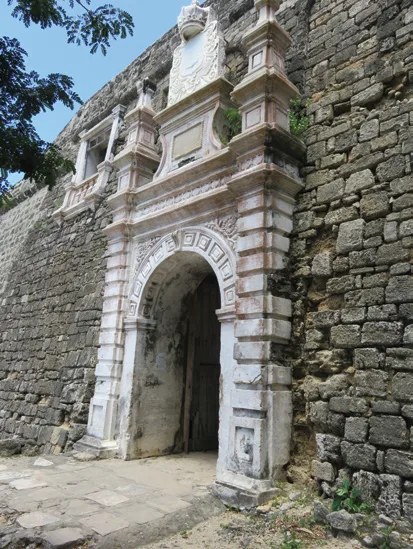
When approaching UNESCO World Heritage Site Ilha de Moçambique (Island of Mozambique) from the ocean aboard a dhow, the looming walls of the massive Fort São Sebastião (Fort San Sebastian), built in the 16th century, now proclaim the site’s extraordinary appeal as a place to walk through history, rather than a frankly terrifying statement of colonial power.
Arriving at the island in that mindset, it’s not surprising the first attraction, opposite the pier where the dhow docks, is the Palace of São Paulo, now a museum, having previously served as a Jesuit college (the scholars had differed in opinion with local leaders before getting kicked out), and the governor’s residence.

As a house, it is certainly regal, featuring a number of guest rooms, each decorated in a different colour of the Portuguese flag, with beds of increasing height – eventually a small ladder is needed to clamber onto the mattress – to signify the importance of the guests invited to stay there. The King’s bedroom, created in case the monarch visited, which he never did, has the highest bed of all, with the sleeping surface probably four feet off the floor. The late Mozambican President Samora Michel slept in this room once, with his bodyguard accidentally breaking the chair outside (the damaged furniture remains in the passage to commemorate the occasion) while rapidly rising to face an imagined interloper.
Such presidential scale is evident throughout the huge residence. The dining room seats 22, and there is a ballroom where young girls were sometimes paraded for dignitaries. The appalling modern echoes of that latter note are added to more colonial-era cruelty in another room, where finely crafted Indian furniture from Goa – with which Ilha de Moçambique was closely linked under Portuguese rule as part of the Indian Ocean trade routes – is carved in exquisite detail that can never be replicated because the artists responsible had their hands amputated to ensure the furniture’s exclusivity.
Cultural canvas

Close by, Fort São Sebastião is a formidable presence. While much of it has crumbled to some extent, the gigantic ramparts are intact, and some structures inside have been restored for use by a university and an archaeological research unit. Despite its impressive size, picturing it housing 2,000 soldiers at one point makes it feel almost claustrophobically intimate.
On a tuk-tuk tour leaving from the fort’s arched entrance, the knowledgeable driver hoots to greet the residents he knows (which seems to be just about everybody). The tour showcases the island’s multiculturalism, including the Indian Garden, which is not as grand as the name suggests, though it includes a large tree that is home to a colony of fruit bats. The central market still bears marks of cyclone damage from a few years ago and is half empty – the real retail action is on nearby streets, where shopkeepers sit and, like the driver, greet passers-by without nagging anyone to peruse their wares.
The crumbling architecture has a rustic charm that strongly recalls Havana, including a chapel, the Church of San Antonio, that sits right on the edge of town, with a sandy open square and a couple of windswept trees in front of it – a location just begging to be the setting for the opening scene of a Bond or Tarantino film.
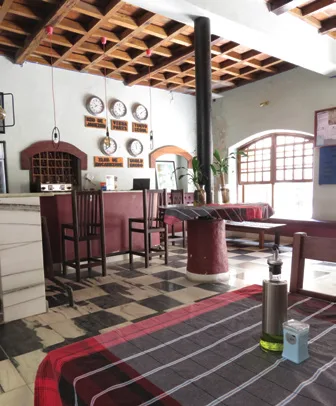
Lunch at Café Central includes air-conditioning, a necessity in the brutal, humid heat of Mozambique’s summer and, if you ask nicely, a tour of the hotel it’s part of, an Escher-like architectural complexity with a rooftop pool with portholes in its walls, through which partygoers in a venue on the other side can watch swimmers float by (if everyone’s ok with that).
The entire island radiates a sense of history, though the ambition and cruelty of colonialism are at odds with the friendly, casual pace of the current community.
Perspectives without people
Leaving the picturesque but still bustling urban area, other islands within sight of Ilha de Moçambique offer distinct experiences. The privately owned Ilha Sete Paus (colloquially ‘seven of clubs’ or ‘seven sticks’ – there were only seven trees on the small, scrubby landmass when it was named) is used – and then only with permission – for beach barbeques and snorkelling by a couple of local lodges. Its only permanent inhabitants, occupying some very low-key infrastructure, are a small cohort of soldiers tasked with keeping unofficial visitors from using the coves around the island. They patrol regularly, with a couple of peacocks for company.
Across the bay, on Ilha de Goa, the noble bones of a late 19th-Century lighthouse remain as a dominating feature for any ships or boats approaching this stretch of coastline; its broad red and white stripes and relative height – just over 30m – is not much in a city full of skyscrapers, but it’s plenty on a small, flat island. Climbing to the top guarantees wonderful views: like so much magnificent architecture in this area, parts of the Victorian building are crumbling, but it’s still structurally sound and a working platform for the modern electric light that is the new standard for lighthouses up and down the coast.
The past flows through and over the bays, islands and peninsulas here and immersing yourself in it for a while is richly fascinating, giving you plenty to think about once you’ve returned to a spot on the beach.
Text and photography | Bruce Dennill
Coral Lodge is an excellent base from which to explore Ilha de Moçambique and surrounds. For more information, go to corallodgemozambique.com.

Return visit to Big Five lodge adds layers to hospitality experience
Visiting a safari lodge for a second time is a wonderful rarity. And when such a property comes with five-star accommodation, food, service and wildlife sightings, it becomes hard to leave; there’s an overwhelming feeling of coming home. And being in the absolute lap of luxury isn’t bad either.
Creating something beyond the norm is what sets a lodge apart from others – stillness and a deep connection to nature. Refined hospitality is at the core of the guest stay, and sitting at breakfast or lunch with a view of the active watering hole, personal butlers know what you want to order before you do. The pace at Monwana Game Lodge is unhurried, with days and activities tailor-made to your needs. A spa treatment? Yes, please! Spa therapist Mildred is adept at applying just the right pressure during the 60-minute relaxing massage. When asked whether it’s considered a compliment to fall asleep, she replies with, “Yes, absolutely, even better when you snore!”
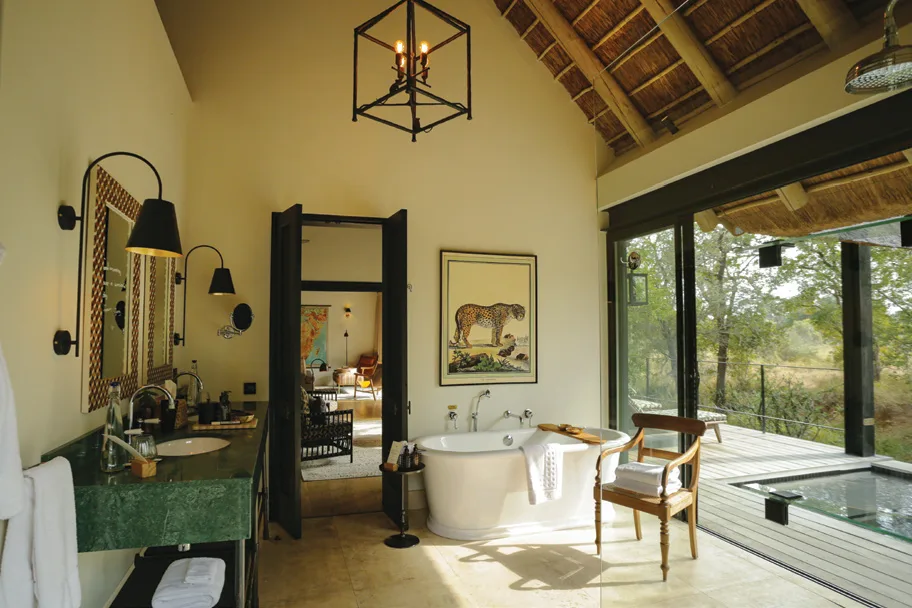
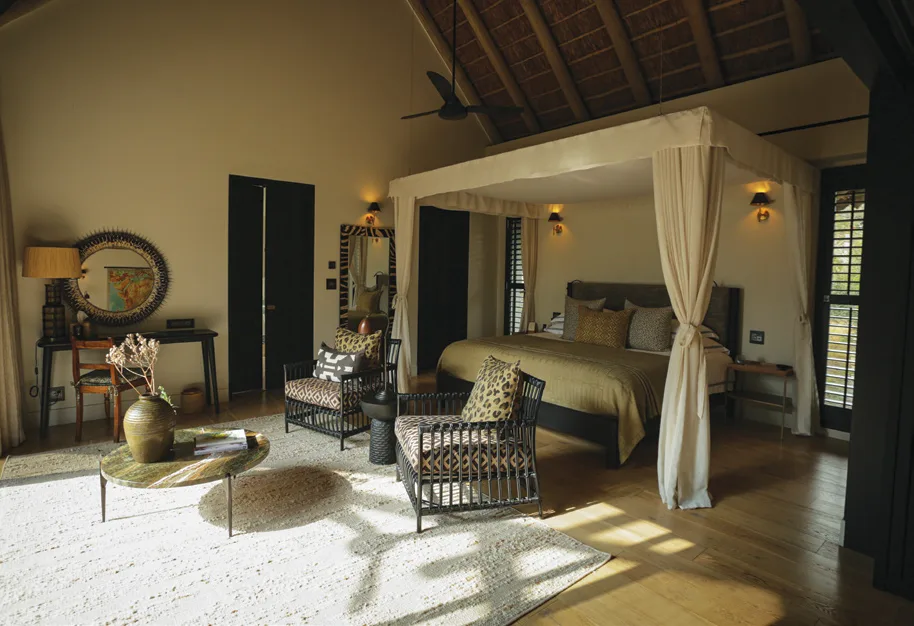
The suites are architectural marvels, with a contemporary look honouring the natural surroundings. Earthy textures give way to expansive spaces, with every single creature comfort catered for.
Branch managers
The evening game drive heralds the most beautiful sunset as field guide Almero brings the vehicle to a stop. Tracker Nic has discreetly disclosed to Almero in Shangaan that the most elusive of them all has been found – a leopard. Having been on numerous safaris, a number of standout phrases in Shangaan have stuck, and when hearing the words mfazi yingwe, the excitement is real.
Female leopard Saseka is sitting pretty in a path next to a tree. She starts yawning, an indication that she is about to get active. A second yawn reveals her perfect teeth, and then the big stretch is followed by her getting up and moving towards the tree. Pausing at the base, she looks up in preparation for scaling the bark. Her calculation is spot-on as she does so with ease and impeccable grace. In the fork are the remains of an impala carcass, which by now resembles a dried piece of meat – and it’s rather smelly.
That doesn’t deter Saseka, as leopards don’t seem to mind that their freshly caught venison starts to decay a few days later. The fact that she’s brought down an impala and managed to hoist it into a tree indicates that she is a successful hunter and can fend for herself. With the sun’s rays glistening in her eyes, she glares towards the base of the tree, and it’s evident that she is keeping a close watch on her prized possession. Is there a hyena lurking for scraps? Her metallic blue eyes are focused on a rustle in the bushes, but there is nothing. She repositions herself, gets comfortable and settles in for the night.
On the way back to the lodge, another leopard has been found. He too has an impala kill in a tree, but it’s dark, and Almero and Nic will attempt to find him again the following morning. Dinner is a delicious feast with an interactive barbecue on the outside sala deck, consisting of salads, side dishes, meats and malva pudding for dessert.
Before sunrise, the misty morning is the perfect temperature for any big cat – they love the cooler weather. Heading back to the tree where the leopard was seen, Nic indicates to Almero that he is no longer there. There is also no carcass anymore. The consensus is that he might have dropped it and hyenas made off with it, as there are drag marks in the road. Just as we’re about to leave the area, Nic signals to Almero to stop as the large male leopard is draped over the branch of a marula tree – with his kill! How on earth he managed to do this is a mystery, but spending more than an hour with this imposing specimen is a wonderful privilege.
Scouting for cubs
Two female cubs have been born to the Monwana lion pride, consisting of five females, and the Black Dam pride, where three males rule – or so they think. When Almero hears that the females were busy taking down a ‘dagga boy’ (a big old grumpy male buffalo), he makes his way to the sighting. It’s not an easy thing to watch, but the lions need to eat in order to produce nutrient-rich milk for the cubs.

Clearly exhausted from the chase and the takedown, one of the females is lying in the shade, her breathing quick and laboured. The other three are gorging themselves on the carcass, with a few snarls audible every so often. Which begs the question – where is the fifth female? Perhaps she has gone to fetch the cubs so that they can also enjoy the fruit, or rather, the meat of their labour?
When we return in the afternoon, two small shapes are visible in the road. It’s the cubs! They are adorable and playful as only cubs can be. Fixing their gaze on Burchell’s starlings in the distance, they want to practise their hunting skills but get distracted when their mom shows up. Will they get a chance to feed with the females tucking in so vigorously? The simple answer is yes. With tempers flaring. And canines exposed.
Text and photography | Heléne Ramackers
For more information or to book a stay, go to more.co.za/monwana.
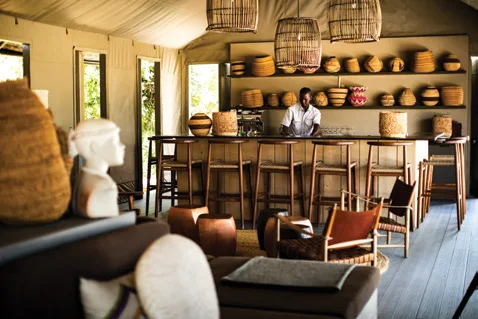
Elephants and adventure are constant companions in luxury tented camp in western Zimbabwe
In a remote area of the southern part of Zimbabwe’s Hwange National Park, the Linkwasha Airstrip has a lounge tent that’s perfectly positioned to aid visitors’ transition from the Caravan aircraft to the waiting Land Cruiser. This, of course, depends on guests’ impatience to see wildlife, as the transfer to Wilderness Linkwasha Camp is essentially the first game drive of any visit.
The first elephant is spotted within minutes. It’s soon evident that this will be a regular feature of the landscape, with Hwange having one of the largest elephant populations on Earth.
A winding extinct riverbed eventually widens into rolling savannah as a message comes in about two cheetah brothers that have been seen walking towards the area where the camp is located. Casting around for them involves meeting more elephants, very relaxed around the vehicle, before it is announced that the big cats have failed to read the script and wandered into a different area.
The guide adapts quickly to this impromptu schedule change and the cheetahs are soon tracked down, using the road as a clear, no-stress channel from which to peruse the surrounding territory for likely prey. Glossy and gorgeous, the brothers weave across the road, paying no attention whatsoever to their audience. A strong smell at one point indicates another elephant – this time a large bull in musth – which, happily, keeps its distance.
Joining us on the final approach to camp is a long string of yet more elephants, moms and tots this time, including two tiny newcomers, hardly bigger than a large dog. They all reach the waterhole in front of the camp at about the same time as we arrive at reception.
Warmth, in terms of both hospitality and lit fireplaces (inside and out) is immediate and the evening concludes with a meal for which some staff join guests, filling in social gaps and encouraging or endorsing mutual learning – including a gently teasing exchange about the correct pronunciation of the word ‘quesadilla’…
Walking in wonder
Hwange, early in the morning, is cold. Four layers plus a poncho and hot water bottle are required for the early drive, on which it is soon discovered that the big sightings of the previous evening have, predictably, shifted positions. Searching for cats – those cheetahs again, but also lions – is interwoven into a meander towards a wide plain dotted with wildebeest, zebra, ostrich and giraffe, with glorious birdlife reflected in the surface of the waterholes they spend their time in. There are a handful of duck species, plus spoonbills, yellow-billed storks, grey herons and several others. A kill from the previous day is stripped almost clean, still attended by jackals and hooded and white-headed vultures, pecking and nibbling at the now scattered remains.
Parking on the edge of the plain, guide Peter, rifle on his shoulder, leads guests into the surrounding woodland. He provides fascinating insight into botany, zoology and local lore including making devil thornleaves into functional soap by crushing them and then adding a little water. Elephants are almost always in our sightline, with a number of fallen acacias providing potential barriers or retreats – never needed thanks to Peter’s awareness and experience.
There is whispered excitement as the spoor of a male leopard is spotted. It appears to have just vacated the area. Sadly, though, careful as we are, the cat is an expert at fading away and remains unseen.
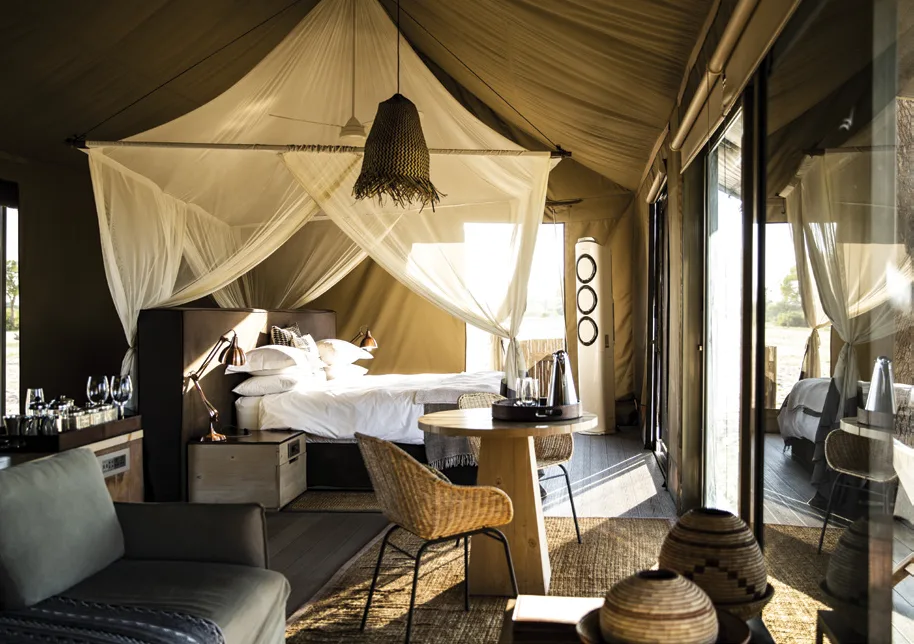
Back at camp, cheeky yellow-billed hornbills lurk between breakfast tables, looking for an opportunity to grab sweet strawberries and other delicacies as guests cross-pollinate their conversations as they process their morning’s experiences. Then a siesta before the next activity includes a guaranteed view through the floor-to-ceiling windows of a magnificent luxury safari tent, with zebras and elephants criss-crossing the space, eager to keep their appointments.
Conservation and complexity
The afternoon drive stars some familiar characters. The cheetah brothers are now filling up after finally making a kill – a young wildebeest they’re happy to share. Both are munching away near the animal’s throat and chest, working their way towards the heart and other prized organs. As they enthusiastically engage with their task, one of the cats manages to get his entire head inside the carcass. A couple of vegetarians on the vehicle look away, making strange but understandable groans.
Sundowners are enjoyed between a waterhole and the railway that runs up this side of the park, which hints at the history and stories that have happened in destinations along this fabled line, which was built at the beginning of the 20th Century and extends to the famous Zambezi crossing at Victoria Falls before continuing into Zambia and beyond.
The elusive leopard from the previous evening teases with some new tracks suggesting that it was heading to one of the waterholes for a drink, but instead we see some smaller creatures – an African wildcat, springhares and a white-tailed mongoose.
At a final dinner, Peter joins us for a chat, at length, about the complexities of conservation, from hunting to guiding to the value of companies that prioritise the whole person when dealing with employees and communities – educating people in effective agriculture, tourism and hospitality, building schools and sponsoring education programmes. All of this propagates an understanding of how complex the long game is – and how valuable.
There is much to muse on during the walk to the end of the boardwalk, with the moonlight softening the textures of the trees and grass, including how much more there is to see and learn on the next visit.
Text | Bruce Dennill
Photography | Bruce Dennill and crookesandjackson
For more information or to book a stay at Wilderness Linkwasha, go to wildernessdestinations.com.

Flagship SUV model succeeds where it matters – making driving endlessly enjoyable

The first impression of the Toyota RAV4 PHEV is that it is a good-looking machine, in an urban SUV-meets-Iron Man sort of way. There are pleasing buttresses on either side of the bonnet that, from the driver’s seat, draw the eye towards the centre of the lane and give a good sense of where the front corners of the car are – beyond what the multiple cameras tell you.
The inside trim features a combination of common sense and luxury. The centre console and dashboard are not over-complicated, with practicalities such as a non-slip deck for two cellphones and an armrest storage area that opens from both sides, minimising distraction when your passenger can’t remember what they did with the house keys or a tissue or a bit of change for the car guard. And there are clearly labelled buttons to change drive modes, control the climate and manually bring up the view the parking cameras are seeing, should you want to check a particular space carefully.
The infotainment screen is more immediately useful and intuitive than most competitor options, sparing drivers the hassle of too much ‘help’ in terms of AI-driven suggestions. You occasionally have to hold down one touch-screen button to get to a second function, but otherwise it’s pretty plain sailing. Such efficient design extends to what would have been called a gear lever once. Here, it’s a short pinch knob that is easy to nudge into position for the handful of automatic functions it is required to serve, rather than taking up space for no reason as a more traditional stick-shift appendage.
Straight ahead, behind the wheel, you’re able to click through the options until you have the information you want and nothing more – a rev counter, a digital speed readout, a map you can glance down at or other specifics about various drive modes. The heads-up projection of your speed and the speed limit is excellent, impossible to miss or ignore.
Set your seat position on an initial drive, and the system will move it back when you shut down the car to make exiting easier and reset it when you press the start button or plug in your seatbelt – it’s like having an attentive waiter at a good restaurant.
Quiet and cultured
The PHEV starts in EV mode, and it is crazily, suspiciously, eerily quiet. Sitting inside, you will doubt yourself, despite having pressed the start button just seconds before. The video-only rearview mirror takes a little getting used to. Not only does it make whatever’s behind you look much closer than it is, but you also can’t check on kids in the back seat without turning around.
The ride is notably smooth, with tight handling that makes the vehicle feel smaller than it is and muscle in reserve, accelerating powerfully with no pause when you need to get through a gap or have an open stretch in front of you. The sunroof doesn’t quite allow you to feel the wind in your hair in such moments, but letting the sun in through the glass adds ambience and warmth, particularly if you’re a passenger with nothing much else to focus on and a now much more interesting view. And the vent option certainly freshens up the cabin without the noise or security concerns of an open window.
A school run where the children are used to being fetched in a Corolla sees the RAV4 greeted with wide eyes and big smiles as the comfort and technology provide thrills that help remind drivers of what part of getting a good car should be about – feeling like it’s a fun, fancy toy that is enjoyable to engage with.
Adding that reminder to an outing, like taking the family for coffee and cake at a hilltop café, reinforces that performance, while important, is only part of what makes a car a significant asset.
More is better
Ultimately, both the standard experience of and strongest recommendation for this vehicle is that it makes you want to drive it more and for longer. It’s easy to operate, it’s comfortable and it’s blessedly free of things that are distracting or time-consuming wherever they are in the world. Even the alarm chimes for seatbelts left unplugged are pleasant, and, with the EV/hybrid technology automatically taking care of improved fuel consumption and environmental friendliness, both the pleasure of the driving experience and ensuring your skills are carried out safely can be focused on. Which keeps you relaxed. Which makes the drive more enjoyable. It’s a happy cycle, and if you have to put in a few extra miles to validate the chunky price tag via the savings from driving in full electric or hybrid modes, you won’t mind doing so.
Text | Bruce Dennill
Photography | Supplied
For more information, go to toyota.co.za.
A couple of days away can be a brilliant alternative to a children’s birthday gift
They were at the hotel pool. Six-year-old twins. “We’re turning seven tomorrow,” they said to anyone who would listen. Giddy with anticipation. But not for a traditional birthday party. They knew there wasn’t going to be mountains of reused gift bags holding plastic presents. No tables of sweets or party favours. And yet they were over the moon.
They were already negotiating who would go on what ride and which play area they would visit when they were done swimming. The subject of presents didn’t even come up. Nearby, their mom sat sipping wine poolside. She had somehow bypassed the stress of party planning. A small parenting miracle. Genius.
They were here for a mini-vacation rather than a single-day celebration because there’s something magical about swapping a backyard party for a weekend retreat. At a casino or a mall, instead of one hour of sugar-fuelled fun and another hour of frantic clean-up, kids and adults alike can enjoy a world of entertainment. There could be interactive play zones and arcades. Look out for cinema experiences, including those catering specifically for kids and possibly a renovated fun park with rides for children of all ages, even the young at heart. There is a rotating selection of shows and, of course, a range of dining options where birthday meals are special without being stressful.
As the twins excitedly explained their birthday plan to anyone who would listen (pool first, then arcade, movie later), it became clear that their celebration wasn’t a single moment but a whole weekend of fun.
Multiple positives
For a parent, it’s the relief of having everything under one roof. There’s no frantic driving from one activity to another and no juggling schedules, just uninterrupted family time. But is taking your kid away rather than throwing the usual birthday bash something they will be ok with? Or actually want? For parents, spending less on physical gifts and more on shared experiences makes sense. A family escape leaves a lasting memory, captured in photos and stories, not a pile of toys that might be forgotten or broken in a matter of days.
Unlike themed parties, a resort can also provide enjoyment for all ages, whether that’s busy toddlers, screen-obsessed teenagers or over-stressed adults. And with accommodations, meals and entertainment all in one place, everyone can focus on being present rather than managing logistics. In some places, it’s common to see three generations under one roof: grandparents enjoying a quiet coffee while the little ones explore play zones, parents catching up over lunch
Unlike traditional birthday parties, where the focus is often on the children, a resort getaway encourages shared moments between all family members.
Mini-getaways like these can even be cheaper than full-fledged parties at home. Try it, and you might find that it becomes something of a tradition. Your little ones start looking forward to these moments each year, not for the presents they might receive but for the experience itself. The twins at the pool recounted a few of the adventures they had in the past, clearly core memories for them. You may find your own kids asking in future not “What am I getting?” but “Where are we going?”
These experiences also introduce a subtle but important lesson that celebrations don’t have to revolve around material things. Kids learn that celebrations are about people, time and experience, not just presents. And for kids, they actually provide them with the one thing they really want but won’t put on their wish list: quality time with those people they love most in the world.
Find a good balance
Try to balance child-led and adult-led activities. Allowing kids to choose an activity gives them a sense of ownership but also makes them feel like the getaway is actually about them and their birthday. Let the resort and any restaurant know you’re celebrating a birthday. From decorations to singing, complimentary meals or ice creams and surprise treats in hotel rooms, your little one will be delighted and surprised at every turn.
Take the time to pause, enjoy and prioritise really being present. Put the screens away if you can and just enjoy the moment. Try doing a big birthday bash one year and a vacation the next, alternating between children so each one feels like they aren’t missing out while still enjoying the best of both worlds each year.
Choose a venue that isn’t too far from home or the airport so you don’t have to juggle maddening car rides with small kids and also to allow extra friends or family that live nearby to join for a day on the rides or a birthday meal.
Look for a venue that offers something for all ages on site where you can choose to do as little or as much as you want without needing to leave. You want a safe but stimulating environment for children, with space for you to relax.
Text and photography | Janine Avery
For more information, go to muckrack.com/janine-avery-1.
Quiet spaces in busy national park camp give visitors a place to reflect
Most people come to Skukuza with one thing in mind: the Big Five. It’s the heartbeat of the Kruger National Park – a hub for game drives, river crossings and incredible sightings. It’s a place of drama, movement and noise. But beneath the roar of lions and the click of cameras lies a quieter side of Skukuza – one that doesn’t thunder across your field of view.
It’s the side of the bush where books wait on dusty shelves, and seedlings grow in neat rows under the Lowveld sun. This is the Skukuza most visitors miss, the one filled not with animal encounters but with stillness, knowledge and connection. You just need to know where to look.
Tucked quietly behind the staff village, shaded by trees and flanked by bird calls, the Skukuza Library – or, to give it its official title, the Stevenson-Hamilton Memorial Library – is easy to miss. It’s not large or flashy, but step inside, and you’re in a different kind of Kruger.
The silence here is full of meaning, the sort usually reserved for museums or temples. Shelves stretch with everything from weathered field guides, local history books and children’s wildlife titles to bush war memoirs and rare volumes on flowers, tracking and bird life. Among the collection you might stumble across journals from early park wardens or the occasional novel left behind by a guest long ago.
It’s the kind of place where a ranger might pop in to page through a manual on animal tracking while a curious tourist browses a warden’s journal. There’s something magical about reading the story of the Kruger while you’re in it.
There’s a deep stillness inside the library, similar to that breathless moment just before a kudu steps into view. You don’t come here to escape the bush – you come to understand it more deeply. It’s a different kind of game drive, into the quiet corners of your mind.
Growth industry
Just a short walk from the library lies another of Skukuza’s secret sanctuaries: the Indigenous Nursery. Indigenous plants are grown here not only for sale but for conservation projects throughout the park. Rows of marula, knobthorn, wild sage, buffalo thorn and impala lily grow in black plastic bags, waiting to be planted back into the soil that shaped them. Some plants are medicinal; others attract pollinators such as bees and butterflies that help the plants reproduce, and all have stories rooted deep in the Kruger.
Visitors can stroll through the rows and let their senses adjust from the chaos of the road to the calm of rooted things. It’s the kind of place where time slows down. The nursery feels like Kruger in miniature: a place where you don’t just see nature but begin to understand how deeply it’s connected.
Together, the bushveld library and the Indigenous Nursery offer something rare in a place known for adrenaline and awe. They remind us that not all stories in the Kruger roar across the road or leave tracks in the dust.
Text | David Batzofin
Photography l Dellex, licensed under CC BY-SA 3.0 and S. Koopman (public domain).
For more information, go to travelandthings.co.za.

Rugby star Vincent Tshituka knows life doesn’t play fair for everyone…
Utility forward Vincent Tshituka has now played two tests for the Springboks, the games being almost exactly a year apart and both of them held at Loftus Versfeld in Pretoria.
Tshituka made his international debut on 5 July 2025 against Italy, the Springboks winning 42-24. His second cap came in the 2026 42-28 win over Scotland at the same venue. The other similarity between the two games is that both of them took place at a time when the storm clouds of xenophobia had been gathering menacingly over South Africa.
In July 2025, severe hostility was being expressed against foreign nationals, with the Human Sciences Research Council and Afrobarometer publishing research that showed that between 42 and 73% of South Africans opposed immigration, due to their distrust of migrants, blaming them for the high unemployment rate, crime and the economic decline of the country. And then, recently, a wave of protests and deadly unrest swept across the country since the ‘deadline’ of 30 June announced by anti-migrant groups for undocumented foreign nationals to leave South Africa. More than 25,000 immigrants have fled the country in terror, returning to the African states they left due to a lack of hope and opportunity.
Born in the Democratic Republic of the Congo in September 1998, Tshituka arrived in South Africa with his parents and siblings as refugees from the Second Congo War in 2002. He went to school at Northcliff High School in Johannesburg, but his rugby career took off at the University of Johannesburg. He was chosen for Lions age-group teams from 2016 and made his Super Rugby debut for the senior team in 2019. An athletic, hard-hitting forward, Tshituka soon made waves and, within three years, he had not only signed to join the Sharks alongside Siya Kolisi and Eben Etzebeth, but was also being spoken about for future national honours.
This was when his career hit an obstacle; he was not yet a South African citizen and, so, could not represent any of the national teams. The Department of Home Affairs, which oversees citizenship, has long been a shambles and it was not until 2024 that Tshituka gained his residency. Even then, he had to wait another year and for the intervention of SA Rugby president Mark Alexander for the documents he needed to be eligible to play for the Springboks to arrive.
Beyond backgrounds
Tshituka, a devout man, noted how rugby has changed his life for the better, but he also expressed his sadness over how sections of South African society are treating refugees and asylum seekers who have arrived in the country like his family once did.
“The demonstrations didn’t create anxiety for me or my family, but they definitely caused us sorrow and pain. To see and witness these protests is sad and it keeps recurring. You can see that there is a good intention behind some of the marches, at their root, but it always gets exaggerated and falls into a chaotic space and then women, children and the elderly get hurt. It never brings solutions,” Tshituka said.
“Our lives all have different starting points and no one has the ability to choose where they begin their life; it never is your choice. What do you do with your situation? For example, someone like Siya Kolisi – he didn’t allow where he came from to dictate where he is today. Twenty years ago, he would have been written off. So, your background does not dictate your intention or who you are as a person. I am just as much South African as I am Congolese. South Africa is now more my home and I am a very proud Springbok.
“My Springbok debut – wow! – it was one of the best days of my life, an incredible moment for me and my family and all who supported me. Putting on the jersey for the first time, representing South Africa and then singing the national anthem and spotting my family in the Loftus crowd is something I will never forget.”
Versatility helps
Tshituka’s return to the Springbok squad this year has also made the 27-year-old more aware of where his game needs to grow.
“When you come into an environment like this, it exposes where you fall short as a player,” he said. “I’ve had time for some real reflection and I know I want to be here and I know the work required to stay here. I just need to continue grafting to be selected. It’s been a challenging season with the Sharks, but good for me because I feel my game has grown immensely. The one area I need to grow is my awareness. I’ve been good at reacting to stuff on the field instead of being proactive. At this level, you need to be more proactive.
“I enjoy playing at number four too. I’ve done my fair share of it with the Sharks. Obviously, it’s a completely new standard required to do it at the international level. There was a time when I was not so sure about playing lock, but now I wear that jersey with pride.
“Because there are so many quality players in the Springbok squad, selection gets harder, so naturally they will favour hybrid players because they can cover more than one position. As a player, you need to create some value for yourself, but you don’t want to be a jack of all trades and master of none. A team can’t just have hybrids. But with such a high demand to get into the squad, you really have to be excellent and offer more value,” he said.
There is a third position Tshituka has some experience of playing and that is wing, where he first started playing rugby back at school. He only played rugby because his first choice, football, was not played at that school.
“I was a soccer fan and I hoped to be the best goalkeeper, but they didn’t have soccer at Northcliff,” he remembers. “But I loved team sport, so I played rugby. I started at wing but then had a growth spurt and moved to the forwards. I love all things competitive.”
Text | SportsBoom
Photography l Jonathan James McMillan
For more information, go to sportsboom.co.za.

Sharing your child’s triumphs online comes with a number of risks
Almost half (47%) of parents surveyed in South Africa regularly post photos, videos, or updates about their children on social media platforms, according to Kaspersky’s Growing Up Online survey. While family content remains popular, privacy settings and motivations behind sharing vary significantly.
Among those who post about their children, 82% locally limit visibility to friends, friends of friends or followers. However, 18% of surveyed parents in South Africa maintain fully public accounts, making such content accessible to anyone online.
The main reason parents share content featuring their children is to preserve memories, followed by pride in their children’s achievements. At the same time, social influence also plays a role: 10% admit they post because others do the same and 9% say they like how they appear in the photos or videos. Additionally, 6% acknowledge that they share content about their children to attract more followers or increase engagement, believing such posts generate more likes.
Notably, around a third of local respondents say they ask their children for permission before publishing content about them, while approximately a tenth admit they proceed with posting regardless of whether the child agrees.
It can be difficult for parents to distinguish between harmless sharing and content that may unintentionally compromise a child’s safety. What feels like a proud family moment today can contribute to a permanent digital footprint tomorrow. That is why it is important to pause and reconsider the urge to share – especially when the motivation is popularity or engagement. Online attention is temporary, but the risks can be long-term.
Unintentional risk
When parents overshare information about their children online, they may unintentionally expose sensitive details such as full names, dates of birth, school locations or daily routines. This information can be exploited for identity theft, social engineering, fraud or even physical safety risks. Publicly available photos and videos may also be misused, altered or redistributed without consent, contributing to long-term digital footprint issues and reputational harm.
To safeguard children’s data and share safely, limit access to your social media accounts and make them visible to friends only (but always mind that you add to the list of friends the people you know personally). Do not forget about general safety settings such as two-factor authentication and a secure password. Do not share the materials that may cause any harm for your child, like the contacts of your child, the name of their school and similar information.
Maintain open and trusting relationships with your children. Talk to them about digital hygiene and online safety and lead by example by practising responsible and mindful behaviour on social media yourself. Consider a reliable security solution that helps to guard your family and private data, plus protects your children online and beyond.
Text | Seifallah Jedidi
Photography l Odua Images
Seifallah Jedidi is Head of Consumer Channel in the Middle East, Türkiye and Africa at Kaspersky. For more information, go to kaspersky.co.za.

Lowering spend on fuel is achievable with a bit of awareness and practising good driving habits
The uncertainty of current economic events and possible ongoing increases in the cost of petrol and diesel mean saving fuel at every opportunity is vital. Avoiding speeding or idling often are simple ways to do this, but there are other, less commonly discussed aspects of car maintenance and ownership that influence fuel consumption.
If you use low-quality engine oil with the incorrect viscosity, the pistons and other moveable parts are placed under more pressure, which uses more fuel. Check your manual or ask your dealership for the correct engine oil and do not neglect to change your oil at the correct mileage.
Tyre condition is important. Bad tyres have less traction and use more fuel, as they spin faster to maintain speed. Low tyre pressure and wheels that are not correctly aligned can also consume more fuel. This is besides the other risk factors associated with tyres not in good condition.
Simple strategies
Avoiding short trips – less than 5km – is ideal, as these consume more fuel because the vehicle has not warmed up yet. This is especially true for older engines, but modern fuel-injected vehicles also run richer and less efficiently during the first few minutes of operation. Where possible, combine your errands and get all your chores done on the same day to get more kilometres from your tank.
Failure to replace spark plugs or fuel and air filters can increase fuel consumption. Worn fuel injectors also burn fuel faster. Do not neglect to replace faulty parts or neglect to service your vehicle on time.
Remember to focus on basic skills. Driving in the wrong gears results in driving with high RPMs, while accelerating harshly from a standstill or driving in high gears up hills or around corners uses more fuel. Manual vehicle drivers with poor clutch control or worn clutches can also cause increased consumption. Every effort made to conserve fuel makes a difference and if all of these are combined, the effect will be even greater.
Text | Eugene Herbert
Photography l Beast 01
Eugene Herbert is CEO of MasterDrive.
For more information, go to masterdrive.co.za.
Expert risk cover guidance is essential for protecting businesses in an increasingly complex business environment
The pace of industry evolution has arguably never been higher, creating greater pressure on leadership, employees, infrastructure and resources than ever before. The speed at which industries are growing is matched by the speed at which risks develop and escalate, constantly exposing business owners to new challenges that could potentially threaten their organisations.
Changing weather patterns and the spark of social unrest have added the potential for liability claims, fire risks, business interruption, fleet accidents and specialised industries to a list of risks which previously only had to take into consideration damage to buildings or equipment.
Trusted advisors
As risks have evolved, so have insurance policies – and for a business owner, one of their greatest risk management allies is their insurance broker, who can provide expert guidance in tailoring insurance around industrial and risk evolution.
The best brokers don’t simply provide access to insurance cover – they serve as trusted advisors who help business owners understand the risk landscape their organisation faces and identify the most appropriate insurance solutions for their unique needs.
Brokers who take time to understand the uniqueness of each business and the risks it faces can provide valuable expertise that helps businesses make informed decisions about protecting their operations, assets and financial future.
Understanding need, anticipating risk
One of the most important services brokers offer is a comprehensive needs analysis. Since every business – even within the same industry – is different, risk exposures can vary significantly depending on an array of variables including the scale, location and nature of its operations.
By identifying potential vulnerabilities, brokers can recommend tailored insurance solutions that address the specific risks a business faces, taking into account factors which owners may not have considered.
Brokers also provide ongoing advice as businesses grow and change. As the organisation adds new services, upgrades its facilities, acquires new assets, expands into different markets and grows its team, cover needs to be updated to cover new risk exposures and avoid a critical mistake – underinsurance.
Reliable support
Brokers are also invaluable partners in the claim process when a loss occurs. While a business focuses on recovery and continuity, having a reliable broker navigating the claims process on their behalf can remove additional stress and save time. Brokers act as advocates for their clients with insurers, assisting with submitting claims, keeping them updated on progress and helping facilitate smoother claims resolution.
Auto&General understands that businesses require flexible and comprehensive solutions to address a broad range of risks, and our commercial offering is designed to support businesses across various sectors, with cover options tailored to their unique operational requirements. Our brokers are empowered as our partners to meet clients’ needs, from tailoring their policies, through claims, to resolution.
Speak to us or your broker
To learn more about Auto&General’s commercial insurance solutions, visit www.autogen.co.za or speak to your broker about finding the right cover for your business. Together, Auto&General, your broker and your business can build a risk management solution that supports your organisation today – and into the future.
Text | Supplied
Photography | Shutterstock
Anxiety is a common – and challenging – mental health condition
Your heart is pounding. Your stomach is in knots. Your shoulders feel locked in tension, and exhaustion hangs over you, yet medical tests show nothing physically wrong. For millions of South Africans, anxiety doesn’t stay confined to the mind – it shows up powerfully in the body as psychosomatic symptoms, with real physical sensations that can include chest discomfort, headaches, digestive upset and chronic fatigue.
These mind-body interactions are more than discomforting. Left unmanaged, anxiety can significantly impair daily functioning, reduce productivity at work and erode overall quality of life, while increasing the risk of additional health complications.
What starts as emotional strain can quietly become a broader health problem. When stress becomes chronic, the nervous system remains on high alert. Over time, that constant ‘fight-or-flight’ response starts to wear the body down.
Growing concern
Globally, an estimated 4.4% of people currently live with an anxiety disorder – ranking among the most common mental health conditions worldwide. In South Africa, anxiety disorders are similarly prevalent.
A national survey found that anxiety disorders were the most common class of lifetime mental health conditions, affecting around 15.8 % of adults. This is brought on by several factors, including poverty, unemployment, HIV/AIDS, a history of political and social upheaval and trauma from exposure to violence and abuse. Women are also more likely than men to experience these conditions, consistent with global patterns.
One of the most common clinical forms is generalised anxiety disorder (GAD) – a condition characterised by excessive, persistent worry occurring more days than not for at least six months, often accompanied by physical symptoms, such as muscle tension, sleep disturbance and irritability.
Psychosomatic symptoms are physical signs of anxiety that are real and measurable. They can include muscle tension, trembling and jaw clenching; headaches or migraines; upset stomach, nausea, diarrhoea or constipation; fatigue, restlessness and sleep difficulty; and sweating, rapid heart rate or shortness of breath. These physical reactions aren’t imagined. They’re the body’s stress response – shortterm protective mechanisms that become dysfunctional when anxiety is persistent.
While understanding these physiological responses is important, managing anxiety effectively often requires a comprehensive approach. This may include psychotherapy and medical treatment options tailored to the individual’s needs.
Expert input
In clinical practice, first-line antidepressant therapies for anxiety, including SSRIs and SNRIs, are widely recommended because of their strong evidence base and favourable benefit-risk profile. These medications work by regulating key neurotransmitters involved in mood and stress responses. However, their effects are not immediate. Relief typically takes 2-4 weeks, and sometimes up to six, to become fully apparent, leaving some patients struggling with ongoing symptoms that affect daily functioning. That waiting period can be particularly challenging for patients. When physical symptoms, like palpitations or gastrointestinal distress, are severe, patients naturally want faster relief.
During this time, healthcare providers may prescribe short-term adjunctive treatments to bridge the gap. Some fast-acting agents, while effective, can cause central nervous system depression, including drowsiness, dizziness and slowed reactions. Other non-benzodiazepine options work differently, helping regulate the stress response without the same level of sedation or dependency risk.
It’s important that treatment decisions are individualised. A healthcare professional will consider symptom severity, functional impairment and overall health profile before recommending the most appropriate approach.
Good habits
While clinical treatment should always be guided by a healthcare professional, individuals can adopt evidencebased strategies that help reduce anxiety and its psychosomatic impact:
Despite its high prevalence, anxiety remains undertreated globally. According to the World Health Organization (WHO), only about one in four people with an anxiety disorder receives any treatment at all. Stigma and lack of awareness are major barriers. But understanding that anxiety has both emotional and physical components is the first step toward seeking help. The more conversations about anxiety are normalised, the more likely people are to seek appropriate support.
Text | Abdurahmaan Kenny
Photography l Nenad Cavoski
Abdurahmaan Kenny is Product Manager: Branded Generics for Pharma Dynamics. For more information, go to pharmadynamics.co.za.

Coastal region adds birds to beaches as a major reason to visit
The KwaZulu-Natal Mid-South Coast has long been considered one of South Africa’s best birding regions, thanks to its subtropical climate, coastal forests and diverse habitats.
There are a number of incredibly diverse biomes in this region, and dedicated collaborative efforts are seeing more spaces being reclaimed for birdlife and wildlife.
Through extensive environmental rehabilitation and indigenous planting, previously degraded land has been transformed into a thriving coastal forest ecosystem. The return of abundant birdlife is one of the clearest indicators of that success.
Renishaw Hills in Scottburgh is a key birding location, showing how biodiversity can rebound when there’s intentional rehabilitation. Tim McClurg, an avid birder who has lived there for eight years, explains that indigenous planting has created multiple ecological niches: “The area has been transformed from a barren tract of exhausted soil into a botanical paradise. The varied indigenous plantings have provided many niches, which have been occupied by a host of new species, and biodiversity has skyrocketed. This supports resident and migratory species, while its proximity to other major reserves also strengthens wildlife corridors across the region.”
McClurg, who has been a member of BirdLife South Africa since 1985, has been documenting the progress of a resident crowned eagle chick, drawing interest from fellow enthusiasts. He says that while the local birding group is informal, members stay connected and share sightings regularly.
Unreserved enjoyment
The 60ha TC Robertson Nature Reserve in Scottburgh was established in 1989 and named after conservationist Dr Thomas Chalmers Robertson. Situated near the river mouth, it combines wetland, forest and estuarine habitats. TC Robertson forms part of the greater South Coast Birding Route and protects valuable riverine and coastal forest habitat. Its manageable size and accessibility make it ideal for both beginner and experienced birders, while its mix of ecosystems supports a transitional bird community between Afromontane and coastal forest species.
The Vernon Crookes Nature Reserve in Umzinto, established in 1973, includes grassland, forest and wetland habitats across rolling hills, making it one of the most diverse birding environments in the region. With around 300 bird species recorded, Vernon Crookes is a critical conservation area supporting both grassland- and forest-dependent birds. Its habitat diversity provides refuge for several threatened and iconic species, making it a vital contributor to bird conservation in the area.

Text | Barto van der Merwe
Photography | Tony Campbell
Barto van der Merwe is Managing Director of Renishaw Property Developments. For more information, go to renishawhills.co.za.


KZN Mid-South Coast bird list (for starters)
Reminding travellers and customers of their bookings can have a huge impact on the bottom line
For hospitality businesses, a reservation is more than just a booking – it represents a prepared room, a reserved table, an allocated guide or a planned experience. When guests fail to arrive, the opportunity to monetise that space is lost.
If a restaurant with 80 reservations per evening experiences a modest 10% no-show rate, that’s eight empty tables during peak service. A 10% loss in turnover is a significant impact on any business, not to mention the sunk costs on meal preparation and staffing that cannot be recovered. Similarly, hotels and guesthouses rely on occupancy to remain profitable. A room left vacant due to an unconfirmed booking represents lost income that cannot be resold or easily refilled at the last minute.
Across the hospitality sector – from dining to accommodation and excursions to events – no-shows quietly erode profitability, especially over peak seasons. Yet many businesses still rely on passive confirmation processes that do little to reduce the risk.
Reservation confirmations and reminders should be viewed as critical operational communications. A simple message confirming the date and time of a booking can significantly increase the likelihood that guests arrive as planned. Alternatively, it’s a timely reminder if the booking cannot be made, allowing time to redirect it to other waiting customers.
Reaching the target
SMS remains one of the most effective ways for hospitality businesses to communicate with guests for the following reasons:
When guests actively confirm their booking via SMS, hospitality businesses gain greater visibility over their reservations. Confirmed bookings mean more predictable occupancy and table management, fewer last-minute gaps in service, better preparation for staffing and operations, and improved guest flow and service delivery.
Even confirmed reservations benefit from a gentle reminder. Travel plans change, busy schedules intervene and guests may simply forget. A timely reminder reinforces commitment to the booking, reduces genuine forgetfulness, allows guests to notify staff of delays or cancellations and gives businesses a chance to refill cancelled slots or rooms.
For hotels, restaurants and tour operators, it’s a small step that can make a significant difference – ensuring bookings turn into arrivals and reservations turn into revenue.
Text | Richard Simpson
Photography l Drazen Zigic
Richard Simpson is Managing Director of BulkSMS. For more information, go to bulksms.com.
Properly handling the unwanted output of airport processes impacts on security, the environment and more
For many businesses operating within airports, waste management feels like a facilities issue. It is often delegated to site managers or outsourced contractors. Yet for ground handlers, maintenance providers, catering companies and logistics operators, waste management is increasingly a governance concern. Environmental law governs how waste is stored, transported and treated and disposed of, and liability can extend well beyond the airport perimeter.
Airports generate complex waste streams. Maintenance operators handle oils, solvents, hydraulic fluids and contaminated components. Catering businesses manage food waste, packaging and international galley waste subject to biosecurity controls. Ground handlers deal with damaged cargo packaging, chemical residues and general operational refuse. Each category may be regulated differently depending on its classification.
Environmental legislation typically imposes obligations on the waste generator. This means the business that produces the waste retains legal responsibility even if collection and disposal are outsourced. Waste must be correctly classified, stored safely on site and transferred using licensed carriers. Disposal must occur at authorised facilities, and documentation must be maintained to demonstrate compliance.
The risk lies in the assumption that outsourcing transfers responsibility. In many cases it does not. If a contractor illegally dumps hazardous material or transports it without proper authorisation, regulators may still pursue the original generator. Traceability requirements demand oversight of the entire chain from storage to final disposal. Delegation does not eliminate accountability.
Shortfall costs
Financial exposure can be significant. Non-compliance may result in fines, operational restrictions, suspension of permits or costly remediation directives. Beyond direct penalties, environmental incidents can interrupt service contracts with airlines or airport authorities. For businesses operating on tight margins, even a temporary suspension can have immediate commercial consequences.
Reputation is equally critical. Airlines and airport operators increasingly assess environmental compliance as part of procurement and renewal processes. Sustainability reporting is no longer confined to large corporates. Service providers are often required to demonstrate responsible waste practices to retain contracts. A compliance failure can undermine years of relationship building.
Practical risk management does not require complex systems, but it does require structure. Contracts with waste service providers should clearly allocate responsibilities and require proof of licensing and compliance. Internal procedures should address waste segregation, safe storage and documentation. Regular audits of service providers and record reviews can identify weaknesses before regulators do.
Waste management should feature in risk registers, compliance reports and operational reviews. When treated as a governance issue rather than a facilities task, it becomes part of business resilience.
In a highly regulated and highly visible industry, what happens to waste after it leaves the hangar, kitchen or loading bay can directly affect licences, contracts and reputation. Effective waste management is therefore not simply about disposal. It is about protecting the business itself.
Text | Molisa Cheda
Photography l 4045
Molisa Cheda is Founder and Managing Director of Vanguard Legal. For more information, go to vanguardlegal.co.za.

Different registration protocols could significantly reduce phone-based fraud and other crimes
Biometric registration of SIM cards would help stop rampant SIM-swap fraud and protect consumers’ bank accounts from billions in theft. Parliament should change the Regulation of Interception of Communications and Provision of Communication-Related Information Act (RICA) to enforce biometric SIM card registration for all SIM cards, including prepaid cards.
Telecommunications fraud costs the country more than R5.3 billion a year, according to the Communications Risk Information Centre’s 2025 Telecommunications Sector Report, with close to 60% of mobile banking fraud linked to SIM-swap attacks.
SIM-swap fraud allows criminals to hijack a person’s phone number and intercept one-time two-factor authentication passwords used for banking and other financial services. Once a number is transferred to a new SIM under criminal control, victims can be locked out of their phones, while criminals attempt to access their bank accounts. This vulnerability persists largely because SIM cards can still be registered easily because RICA does not require biometric verification.
The solution to SIM swap fraud is straightforward: require biometric verification when SIM cards are activated and when SIM swaps are requested, using a live photo taken by the applicant and matched to the user’s ID in the Department of Home Affairs database and their ID picture. The technology already exists and is widely used by banks for digital customer verification.
Meeting the challenge
Biometric SIM registration is already used in countries including Thailand, Nigeria, Uganda, Mozambique, India, the UAE and Peru, demonstrating that it is both practical, widespread and effective.
A SIM card today is the gateway to banking apps, one-time passwords, messaging platforms and financial transactions. Yet millions of SIM cards remain anonymously or fraudulently registered, creating an open door for criminal syndicates.
South Africa distributes more than 150 million SIM cards each year, and many are not correctly registered. At present, individuals can register hundreds or even thousands of SIM cards. Reasonable limits on the number of SIMs registered per person, together with biometric verification and tamper-proof packaging, would dramatically reduce fraud.
Tamperproof packaging can hide SIMs’ unique identifying information and prevent the bulk registration of SIM cards.
Updating RICA to mandate biometric registration and tamper-proof packaging will not eliminate crime, but it would close one of the most widely exploited gaps in South Africa’s digital security system and better protect millions of people who rely on their phones to access their money.
Text | Johan van Graan
Photography l New Africa
Johan van Graan is a senior telecommunications industry executive.
Knowing water systems intimately enables better mine management
With water constraints tightening across Africa and climate variability placing new pressures on mine infrastructure, mining operations can rely on water balance modelling to improve planning and reduce risk. Mines that understand their water systems in detail are the ones best positioned to manage costs, support compliance and design resilient infrastructure.
A water balance sits at the centre of designing the right infrastructure, managing environmental risk and ensuring long-term efficiency. It accounts for water flow entering or leaving a site, whether through rainfall, groundwater, run-off, evaporation, piping networks or storage facilities. In the mining sector – where operations may span hundreds of hectares and incorporate multiple water systems – these balances become critical tools for understanding both present conditions and future requirements.
A well-built water balance allows testing regarding whether proposed storage dams, stormwater channels, pipelines or pumping systems can really handle the volumes they will face. This becomes even more important when mines are expanding production or rethinking their water management strategies. Most water flows can be measured directly, but others – such as rainfall contributions and catchment run-off – must be simulated. This combination of field data and modelling gives hydrologists a complete view of how water moves through a mining site.
When building a water balance, there are often gaps in monitoring networks or losses the mine didn’t know about or is unable to measure. The balance becomes a diagnostic tool. It highlights where instrumentation needs to be upgraded and often reveals hidden inefficiencies or unnecessary water losses. Such insights can help mining teams avoid oversizing infrastructure or misallocating capital to systems that will not meet long-term requirements.
Looking forward
Beyond understanding current conditions, forecasting is where water balances bring major value to infrastructure planning. Climate-linked modelling is increasingly important for mines across Africa, as some regions may see reduced annual rainfall but more intense storm events, while others may face longer dry spells. Even if annual rainfall appears stable on paper, climate predictions show that the timing and intensity could change. That affects storage sizing, spillway design and the security of supply.
Stochastic modelling – using multiple simulated climate or rainfall scenarios – helps quantify risk in statistical terms. Mines can then weigh risk against capital costs and decide what level of security is financially acceptable.
With regulators, investors and financial institutions adopting stricter expectations around water use, mines are under growing pressure to demonstrate transparent and responsible water management. An accurate water balance is often central to these requirements.
Automated reporting systems can feed daily, weekly or monthly dashboards for operational staff. These systems also support licensing, environmental authorisations and industry accreditation programmes, where water stewardship is becoming a prerequisite for maintaining social licence and investor confidence. The financial benefits of water balances are significant. As climate change causes shifts to extreme rainfall events, the cost of storage infrastructure to contain these extreme events escalates. Additionally, as water tariffs rise and energy-intensive pumping becomes more expensive, identifying opportunities for water reuse or reducing treatment volumes can translate directly into savings.
Text | Simon Bruton
Photography l Aerial Viewer
Simon Bruton is a senior hydrologist at SRK Consulting South Africa. For more information, go to srk.co.za.

Focusing on work goals at the expense of workforce wellbeing guarantees problems
Much attention is focused on the conditions in which people live. Far less attention is given to the conditions in which people work. In many workplaces, the day has become fragmented across meetings, messages, emails, dashboards and deadlines. Together these demands keep people mentally switched on from morning to evening.
When focused work cannot happen during the day, many try to catch up after hours, blurring the boundary between work and personal time. When this becomes a daily pattern, strain accumulates while people still believe they are delivering.
Over the past three decades, organisations have built faster and more connected systems around advancing technology. Work now moves at extraordinary speed, with teams coordinating instantly across time zones and expectations of responsiveness steadily increasing. Artificial intelligence is accelerating this shift further by automating tasks, processing vast amounts of information and increasing the speed at which organisations operate and adapt.
But people do not function like systems that can run continuously without pause. Human performance depends on rhythm. People can sustain pressure when periods of effort are balanced with recovery. Most people are not conditioned to operate under continuous strain. When natural pauses disappear through constant interruption, continuous responsiveness and rising expectations, people are required to sustain levels of pressure that the mind and body struggle to maintain.
When people begin to struggle at work, the problem is often framed as a personal development issue. Employees are expected to become more resilient or manage stress more effectively. Support may appear only once performance has already begun to decline and mistakes start to increase. By that stage, the effects are usually already visible to colleagues and teams.
Change the culture
Responsibility, deadlines and accountability are part of meaningful work. Yet the strain people experience at work is often shaped by the environment they work in. Organisations often talk about culture as what shapes how people behave at work. In practice, however, it is the daily pressures and expectations people face, together with how work is organised and structured, that determine what people are actually able to do. When those realities conflict with what organisations expect from their employees, sustained performance becomes difficult.
When these conditions persist, the consequences extend beyond the individual. Organisations begin to see declining engagement, higher staff turnover, more frequent absence and reduced productivity. Work-related stress therefore affects both people and organisational performance, making it a critical organisational issue rather than simply an individual concern.
The opportunity is to organise work in ways that allow people to sustain performance over time. This shift also changes how we understand culture in organisations.
Culture ultimately comes from how work actually gets done, especially under pressure. It is shaped by what people are able to do, what they believe works, and what the organisation ultimately accepts. When work environments allow people to perform well under pressure, healthier patterns begin to emerge.
People function far better when expectations are realistic, when they have some influence over how they approach their work and when the environment provides enough clarity and support for them to adapt to change.
Text | Ashwin Rajah
Photography l DC Studio
Ashwin Rajah is the founder of Mindset Matters. For more information, go to mindsetmatters.pro.
Coaching can help prevent disengagement in the workplace
Competitors cannot replicate an engaged, supported and psychologically safe workforce. In an environment where others can replicate products, technology and even strategy, business seeks the competitive edge. How to do this remains a deliberate leadership imperative: how engaged are your employees?
Disengagement is rarely dramatic. It does not usually begin with resignation letters or formal grievances. It begins with quiet dissatisfaction. Subtle withdrawal. Reduced discretionary effort. This all erodes performance at a systemic level. Yet, even the most robust engagement survey and well-designed performance management system cannot fully resolve one critical variable: the internal psychological experience of the individual.
When people are working under sustained pressure, have unresolved tension or perceived misalignment, their engagement falters. What looks like indifference is often unprocessed stress. And stress, left unattended, becomes disengagement.
Global research continues to confirm that disengagement has measurable financial impact. Gallup reports that disengaged employees are associated with 18% lower productivity, 15% lower profitability, 37% higher absenteeism and increased safety incidents and turnover. These are not soft metrics but operational outcomes.
Neuroscientific research further demonstrates that prolonged stress reduces cognitive flexibility and problem-solving capacity (Rock & Page, 2009). When individuals operate in defensive neurological states, innovation declines and compliance rises. This situation quickly becomes one where people are working under duress. A workforce under duress does not rebel. It complies, resulting in the passively complacent workforce that we have mentioned before. While compliance sustains operations, it does not drive innovation and growth.
Build confidence
Coaching is often misunderstood as reserved for executives. It is also used at times as a punishment when the manager is not satisfied with the employees’ work. In reality, it is a structured mechanism for restoring agency and psychological safety, which are two core drivers of engagement. The International Coaching Federation (ICF) reports that 86% of organisations experience positive ROI from coaching, 70% see measurable improvements in performance and 80% report improved confidence amongst participants.
Confidence influences initiative and initiative, in turn, drives contribution and discretionary effort. Contribution and the willingness to use discretionary effort to go beyond what is required in a role are what fuel organisational innovation, performance and growth.
Coaching operates at the intersection of human capacity and business performance. It should be made available to all employees, at all levels of the organisation.
Autonomy is a foundational driver of intrinsic motivation. Allowing individuals to select a coach they relate to builds trust. Trust reduces defensiveness, which, in turn, enables self-reflection, which is a cornerstone for growth. Allowing an employee to choose a coach from organisationally approved coaches signals respect and empowerment from the manager. Experience has shown that agency reignites engagement.
Safe spaces
Amy Edmondson’s work on psychological safety demonstrates that performance improves when individuals feel safe to speak candidly without fear of negative consequences. This is where coaching comes in, as it provides a confidential environment, space to explore frustrations, opportunity to test new perspectives and reflection without reputational risk.
When internal conversations feel constrained, coaching becomes the safe container that prevents dissatisfaction from calcifying into passivity. Psychological safety cannot be considered indulgence; it is the bedrock of performance infrastructure.
Employees under pressure resist vague development initiatives and may even resist opportunities for training and upskilling, citing insufficient time available. Clearly defined coaching engagements are, however, personal, which elicits more interest. Coaching is structured within agreed time frames and workload realities are respected while maintaining focus on the agreed outcomes of the coaching. Time-bound coaching signals intentionality, measurable progress and professional accountability. It also avoids the perception of endless intervention with no specific, measurable impact.
Standardised training delivers knowledge whereas coaching facilitates insight and personal growth. Through structured dialogue, individuals strengthen, among other things: positive communication, emotional regulation, conflict navigation, strategic thinking, confidence in decision making and purpose alignment.
When behavioural change is internally generated rather than externally imposed, it results in ownership by the employee, which translates to discretionary effort – going above and beyond.
React to signals
In complex and rapidly shifting markets, organisations cannot afford to treat the passive, complacent workforce as an inevitable by-product of pressure. It is a signal, and one that demands intentional response.
A modern people strategy recognises that sustainable performance is built at the intersection of data, leadership capability, system design and individual support. Engagement surveys diagnostics reveal where engagement is declining, but leadership actively reshapes culture. Performance frameworks reinforce behaviour whereas coaching restores the individual capacity required to thrive within that system. When these levers operate in isolation, progress is fragmented. When integrated intentionally, they create alignment between purpose and performance, between values and behaviours, between individual wellbeing and organisational success.
Coaching should not be viewed as an isolated developmental intervention. It is a strategic enabler within a broader people ecosystem: one that improves organisational engagement, strengthens resilience and converts potential into measurable performance.
Text | Lynne Derman
Photography l People Images
Dr Lynne Derman is Group Director: People and Talent at 21st Century. For more information go to 21century.co.za.

New ways of banking are becoming entrenched across Africa
The future of digital banking and insurance in Africa is being shaped by forces that are transforming how people access, use and trust financial services. A growing mobile-first population expects experiences that are seamless, personalised and inclusive.
Many banking relationships now begin – and often remain – on devices, prompting institutions to prioritise digital channels and design services for customers who may never visit a branch.
Beyond convenience, mobile adoption is a powerful driver of financial inclusion, extending essential services to previously underserved communities and turning connectivity into opportunity.
In South Africa, digital adoption continues to grow, with millions of customers engaging through online channels and banks investing in scalable platforms that provide broader access and richer experiences. Beyond South Africa, embedded finance is gaining traction across the continent, moving beyond basic payments to integrate lending, insurance and other financial products into everyday digital interactions through e-commerce ecosystems and mobile wallets.
AI is playing a central role in this evolution. A growing proportion of financial institutions in South Africa are actively employing AI, particularly within banking, as they look to enhance operational efficiency, personalise customer experiences and strengthen risk management. AI-driven tools now support fraud detection, compliance monitoring and customer service automation, while insurers are exploring similar technologies to improve claims processing and service delivery.
Across Africa, fintech and financial services are leveraging AI to broaden access to affordable credit, automate risk assessment and tailor products for individuals who were previously excluded from formal financial systems. When combined with alternative data sources and bias detection frameworks, AI can support more inclusive lending and customised insurance offerings that reflect people’s real circumstances.
Reaching new areas
The emphasis on personalisation is not limited to customer-facing features. AI-driven credit scoring and fraud detection systems are helping institutions better understand risk and deploy services more confidently, while digital identity solutions and automated compliance tools are making regulatory adherence more efficient.
These technologies are not just improving service delivery in urban centres; they are unlocking pathways to financial participation for rural and lower-income customers by reducing barriers to entry and simplifying onboarding.
Yet with opportunity comes risk, and the rapid rise of digital banking and insurance has made cyber security a top strategic priority. Financial institutions across the continent have reported significant cyber threats, driven in part by the very technologies that power digital services. Phishing, social engineering and other sophisticated attacks are increasingly common, prompting banks to enhance their defences with real-time monitoring, advanced fraud detection systems and strengthened infrastructure.
For insurers, digital transformation is reshaping how products are designed, underwritten and delivered. Digital platforms and AI are enabling microinsurance and usage-based models that make protection more affordable and relevant for lower-income segments. Personalised policy offerings, intelligent claims processing and automated customer support are helping the insurance sector deepen engagement and drive inclusion in a market where penetration has historically lagged.
Text | Nitesh Singh
Photography l People Images
Nitesh Singh is Financial Services and CMT lead for Accenture, South Africa. For more information, go to accenture.com.
Be careful how much time is taken to investigate office allegations
Employees may be suspended from duty for various reasons. The employer may want to make the employee’s working circumstances so uncomfortable that he or she resigns. This motive is both illegitimate and legally dangerous. The employer may need to investigate serious allegations made against the employee.
Where the employee is in a position of official or unofficial power, the precautionary suspension may be necessary in order to ensure that their presence at the workplace will not interfere with the investigation. This is a legitimate reason for suspension, but the employee must be on full pay during the suspension period.
The employer may have a need to avert the danger of the employee repeating the alleged offence while the investigation is underway. For example, if the employee is being investigated for allegedly assaulting a colleague, a precautionary suspension may be merited to avert the possibility of a repeat assault. Again, the employee must be on full pay during the suspension period and the danger in question must be real.
In the case of punishment of the employee by the employer after he or she has been found guilty of a serious offence, the employee is normally suspended without pay.
Beyond the limit
Where the purpose of a suspension is precautionary, the law does not allow the employer to use it to punish the employee. This is because, at this early stage, the employee has not been proven guilty of any offence. The suspension may only be used to avert a danger while the employer prepares for the disciplinary hearing.
In the matter between Thembani Banda vs Department of Planning, Monitoring and Evaluation (Lex Info 15 April 2026. Labour Appeal Court case no: A2025-092122), the employer placed Banda on a precautionary suspension for eight months.
The bargaining council arbitrator ordered the employer to lift the suspension due to its unreasonably long duration. However, the arbitrator declined to award Banda compensation and the Labour Court upheld this decision. The Labour Appeal Court disagreed. It had been common cause that the protracted susspension had caused the employee and her family emotional distress and had necessitated that she be treated by a psychologist and with medication. Her claim that she had not been told what she was being accused of also appears not to have been disputed.
The court therefore awarded Banda compensation and ordered the employer to pay her costs. While there may have been a good reason for the precautionary suspension, the case report is silent on this. Although it is not known whether the suffering caused to Banda was intended by the employer, she did suffer due to the protracted suspension and the employer was penalised for this because precautionary suspensions may not be punitive.
This finding is an important message to employers to ensure that they understand the legal limits of the use of precautionary suspensions.
Text | lvan lsraelstam
Photography l ASDF Media
lvan lsraelstam is Chief Executive of Labour Law Management Consulting. Contact him on 011 888 7944 or 082 852 2973, or at ivan@labourlawadvice.co.za.

For any information, go to labourlawadvice.co.za.
New electronic pre-flight step adds a step to traveller planning
Border and customs compliance has always been something you dealt with at the airport. Not anymore. South Africa’s new mandatory online traveller declaration, which came into effect on 1 July 2026, is the latest signal in a global shift that has been building for years.

Governments now want your information before you even board your flight and, for business travellers running on tight itineraries and even tighter margins, that shift has consequences. The SARS traveller declaration is a fundamental change in when compliance happens. The border has moved, and it’s moved to 24 hours before departure. Business travellers who don’t adjust their pre-trip habits and routine are going to feel it.
South Africa is joining a growing cohort of governments that have decided the old model of processing travellers at the point of entry is too slow, too manual and too reactive. The UK’s electronic travel authorisation (ETA), now required for millions of previously visa-exempt visitors, must also be secured before boarding. The EU’s European travel information and authorisation system (ETIAS), expected to launch in late 2026, adds a pre-departure authorisation layer for travellers who previously needed nothing more than a valid passport. Across Asia, countries including Thailand and Indonesia have introduced or expanded digital arrival and declaration systems (the Thailand Digital Arrival Card and All Indonesia Arrival Card, respectively) that replace the paper cards travellers once filled in on the plane. Ethiopia, meanwhile, requires all arriving and transiting passengers to complete an online traveller’s health declaration form before arrival at Addis Ababa Bole International Airport.
The architecture is different in each case (some are entry authorisations, others are customs declarations or health declarations), but the direction is identical.
Necessary disclosures
What we’re seeing globally is the rise of the smart border. Information moves ahead of the traveller. That’s better for governments and ultimately better for travellers who are prepared. But it creates a new category of risk for anyone who treats pre-trip admin as an afterthought.
The new SARS traveller declaration is a manageable addition to the pre-trip checklist for leisure travellers with a suitcase of personal belongings. They simply complete it within 24 hours of departure, keep the confirmation on their phone and proceed as normal.
However, for business travellers, it’s slightly more complex. The declaration requires passport details, travel information, contact details and – critically – disclosure of any goods, currency or items that fall outside personal use. Business equipment, product samples, gifts intended for clients, commercial goods and cash above the R100,000 threshold all require declaration. Allowances cannot be combined between travellers, and goods exceeding the duty-free threshold trigger further customs assessment.
Importantly, this is not a form to rush through. SARS has been unambiguous on the consequences – failure to declare or making a false declaration can result in delays, detention of goods, penalties or enforcement action under customs legislation. For a business traveller catching an early morning flight to close a deal, none of those outcomes are acceptable.
If samples or goods get held at customs, the real cost is the stress and disruption that ripples into expos, meetings and other commitments. That’s why the declaration needs to be part of the travel workflow rather than something forgotten about until check-in.
Share the burden
The uncomfortable truth for many SMEs is that the systems designed to streamline border processing actually increase the pre-trip burden on anyone without a managed travel programme. Leisure travellers have time and flexibility; large corporates have compliance infrastructure. SMEs and smaller businesses (the ones most likely to be sending their MD on a last-minute flight to Nairobi or their sales lead to a trade show in Frankfurt) are most exposed to the gap between ‘booked’ and ‘compliant’.
The new normal for business travel looks something like this: a traveller needs not just a valid passport and a booking confirmation, but potentially (depending on their passport) an ETA or ETIAS authorisation, a completed customs declaration and documented details of any goods or currency they’re carrying – all resolved before they reach the airport.
Managed travel was always about more than getting the best fare. It was about making sure the trip actually works. That’s truer now than it’s ever been. A good travel booker is securing flights while, more importantly, ensuring their travellers are actually ready to travel.
The companies that will navigate this new landscape most effectively are those that treat compliance as part of the travel booking process rather than a separate responsibility left to the traveller to figure out alone.
The practical adjustment is straightforward, even if the habit change takes time. Add the SARS traveller declaration to your pre-trip checklist alongside passport validity, visa requirements, online check-in and boarding pass. Complete it within 24 hours of departure, keeping the confirmation accessible. If you’re carrying business equipment, commercial goods or significant currency, give yourself time to complete the declaration accurately.
More broadly: check entry requirements for each and every destination earlier than you used to. The era of the paper form at the airport is ending. The new compliance window opens long before departure and, for business travellers, that window needs to be part of the plan.
Text | Herman Heunes
Photography l Pixel-Shot
Herman Heunes is General Manager at Corporate Traveller South Africa. For more information, go to corporatetraveller.co.za.
Employees feeling like they’re not properly compensated impacts businesses in a number of ways
No one shows up to work for free, but in South Africa, nearly half of working professionals feel grossly underpaid, and 48% believe their salaries are not a true reflection of the work they do.
Even though Stats SA’s Quarterly Employment Survey (QES) for Q3 2025 showed average salaries reaching record highs, many South Africans are still living paycheque to paycheque. Data from Standard Bank, based on over 400,000 clients, reveals that 21% of clients have R1,000 or less by payday, while 28% are in overdraft when the month ends. As costs increase, a growing number of higher earners are finding themselves one emergency away from financial distress.
While inflation is out of employers’ control, salaries are not. Small and medium-sized businesses (SMEs) face an uphill battle when it comes to competing with larger corporations on pay, but getting salaries right has never been more crucial.
Around 80% of SMEs set salaries primarily based on their budget rather than what the market pays. The result is a mismatch between employer expectations and candidate expectations, costing time, money and talent that these small businesses cannot afford.
Common mistakes SMEs make include relying on generic online salary searches, often from the US, without taking industry or role specifics into account. Some pay below-market salaries, expecting employees to grow into higher roles, only to risk losing them to competitors. Others fail to document or update salary ranges regularly, which can create confusion and inequity over time.
When salaries are below market, hiring timelines lengthen and top candidates slip away.
Meet the standard
While the hybrid remote work model is slowly softening geographic differences, benchmarking ensures fair pay regardless of location and assists with retention. Research shows employees who feel underpaid are more likely to leave, creating costly turnover cycles. SMEs that align salaries with market data save both recruitment time and money.
Another significant pay difference is between sectors, with those that require scarce skills in science, technology, engineering and mathematics (STEM) or higher qualifications commanding higher salaries due to talent competition, in comparison to call centres and commission-based sales roles that rely heavily on incentives.
Salary benchmarking is an HR exercise but also a valuable business growth strategy. One of the biggest benefits is in helping to close South Africa’s gender pay gap. While some progress has been made, South African women still earn roughly 24% less than men on average, according to a Discovery Corporate report. Like in most places in the world, this divide often reflects structural issues rather than direct discrimination. Women frequently take remote or hybrid roles to balance work and family, sometimes accepting slightly lower pay in exchange for flexibility.
Companies can start closing the gap by conducting regular gender pay audits, publishing results internally and linking leadership bonuses to measurable progress in representation and pay equity. SMEs should also be transparent with candidates, share salary ranges and the rationale behind offers at the interview and offer stage and offer additional benefits where possible.
Text | Sasha Knott
Photography l Elnur
Sasha Knott is CEO of Job Crystal. For more information, go to jobcrystal.com.
Changing how technology is used in reward programmes needs to take human behaviour into account
Innovation has become one of the most frequently used – and least interrogated – words in business. In practice, it has increasingly become shorthand for technology: AI, automation, platforms, dashboards and data at scale.
To be clear, these developments are powerful. They’re reshaping how organisations operate, communicate and grow, often at remarkable speed. But there is a quiet risk embedded in it. When innovation is treated as something that exists primarily in tools and systems, it becomes easy to mistake novelty for impact.
History suggests a more nuanced truth: the most meaningful innovation in incentive and loyalty marketing has never been driven by technology alone. It has always emerged at the intersection of human insight and enabling capability. In fact, incentive and loyalty marketing itself began as an innovation.
At their core, incentive and loyalty programmes were built on a radical idea that emerged in the mid-20th Century: that behaviour could be influenced by understanding what motivates people. Drawing on early work in organisational psychology and management thinking, organisations began to move beyond purely transactional models of reward towards more intentional approaches to motivation and recognition.
As digital tools entered the picture, innovation accelerated. Points-based systems transformed loyalty by introducing flexibility and choice. Digital platforms enabled scale, speed, consistency and always-on engagement. Data allowed programmes to be measured, refined and iterated in ways that were previously impossible.
Success in partnership
These advances have succeeded best when they’ve supported behavioural insight. Points work not simply because they’re convenient, but because they tap into powerful psychological dynamics like progress, autonomy and deferred gratification. Digital engagement increases participation because it shortens feedback loops and makes recognition more immediate.
Each technological leap unlocked new possibilities but, at every stage, impact depended on how well those capabilities were aligned with human behaviour. When they aren’t, programmes stall. Across the industry, this is visible in loyalty programmes with high enrolment but low active participation, incentive schemes that deliver short-term spikes followed by disengagement or platforms rich in features but poor in sustained usage.
In recent years, the innovation equation has subtly shifted. Increasingly, technology has become the starting point rather than the enabler. Organisations select platforms first and then attempt to fit programmes into their constraints. Procurement processes are often led by system capability rather than behavioural intent. Features multiply, data volumes grow – but outcomes don’t always follow.
This is not an argument against technology. On the contrary, modern incentive and loyalty programmes depend on it and are enormously more powerful thanks to it. But technology alone cannot create relevance, motivation or meaning. Those still require design, judgement and an understanding of people.
Innovation in this sense is quieter, but more powerful. It’s visible in thoughtful programme architecture rather than feature density, and intelligent curation rather than endless choice. It requires organisations to balance art and science: behavioural understanding alongside data, creativity alongside rigour, judgement alongside technology.
Text | Andrew Solomon
Photography l Rawpixel.com
Andrew Solomon is Marketing Director of the Achievement Awards Group. For more information, go to awards.co.za.
Mentorship builds skills, relationships and sustainability
In South Africa, mentorship is more than a developmental tool. It is increasingly understood as a bridge to equity, resilience and long-term leadership sustainability. Across the majority of industries, women remain under-represented in senior and executive roles, often encountering systemic barriers that slow progression despite experience and capability. Against this backdrop, mentorship has emerged as one of the more practical mechanisms for strengthening inclusive leadership pipelines.
Women in leadership mentorship initiatives offer insight into how structured support can influence leadership outcomes. When mentorship is treated as strategy rather than symbolism, it begins to shape not only individual progression but also how leadership capacity is built and sustained.
Structured mentorship recognises that leadership journeys are not linear. Women at different stages of their careers face distinct challenges, and effective mentorship responds to this reality rather than applying a uniform solution.
Earlier in their leadership journeys, many women require support that builds confidence, visibility and access to decision-making environments. At more senior levels, the focus often shifts to strategic influence, peer engagement and navigating organisational complexity. Addressing both stages within mentorship design helps sustain leadership pipelines and reduces attrition at critical transition points.
Mentorship is often described as knowledge transfer. In practice, its value lies elsewhere. It creates space for perspective, judgement and challenge – qualities that are difficult to develop through formal training alone. More evolved mentorship models increasingly incorporate reciprocal elements, allowing learning to move in both directions. Emerging leaders bring insight into changing workplace expectations, while experienced leaders offer institutional context and strategic perspective. This exchange broadens organisational thinking and supports more resilient leadership decision making.
Guided process
Not all mentorship initiatives deliver meaningful change. Informal or lightly structured approaches often struggle to move beyond intent. By contrast, mentorship that is deliberately designed, facilitated and supported is more likely to influence progression and retention.
Confidence, communication and leadership presence are consistently identified as areas where women benefit from targeted support. When mentorship addresses these dimensions intentionally, its impact becomes tangible. Measurement matters. Tracking outcomes such as progression, retention and leadership influence shifts mentorship from a perceived ‘soft’ initiative to a strategic leadership tool.
One of mentorship’s most significant contributions is cultural. Creating environments where women can lead with confidence, collaborate across functions and challenge established norms begins to reshape how leadership is practised. This shift is gradual and uneven, but it accumulates. As women progress, many assume mentorship roles themselves, reinforcing inclusive leadership behaviours across teams and organisations. Over time, mentorship becomes embedded not as a programme, but as part of leadership culture.
Mentorship does not offer quick fixes. It is slower than slogans and less visible than targets. As a strategy, however, it creates the conditions for inclusive leadership to develop with consistency and credibility, strengthening organisations while contributing to a leadership landscape that better reflects the country itself.
Text | Natasha Naidoo
Photography l Fizkes
Natasha Naidoo is Director Industrial Adhesives at Henkel South Africa. For more information, go to henkel.co.za.
Booking work travel yourself means being aware of a number of hidden costs
A recent example researched via search engines suggested that a flight between Johannesburg and Cape Town, booked in advance, plus two nights ́ stay in the Foreshore, a client dinner with drinks and a daily per diem of around R500 should equal a business trip that may not be cheap, but is a justifiable cost of doing business. So why can the final bill often end up a third (or more) more expensive when you book it yourself?
The problem is that most people don’t budget for the hidden costs beyond the search engine. If you aren’t tracking the invisible spend – including change fees, ground transport, parking and other extras – you aren’t really managing your budget.
If you run a small or medium-sized business, you might still have ‘2019 prices’ in mind. Many entrepreneurs remember a time when you could fly to Durban for a weekend, stay in a four-star hotel, enjoy meals and entertainment and still come in under R10,000.
Those days are gone. Not because of reckless spending or splurging on luxuries, but because of changing times and hikes in the total cost of travel. A recent Global Business Travel Forecast by the Global Business Travel Association (GBTA) noted that global travel prices were at a historical high last year, with spending hitting R25.75 trillion by the end of 2025. While this seems like a staggering price to pay for a seat at the table, 86% of trips are still considered worthwhile when it comes to achieving business objectives. This increase in spend is being driven by higher operating costs across airlines and hotels, plus persistent geopolitical volatility.
Peripheral extras
Capacity issues impose a ‘scarcity premium’ on travellers in South Africa. Since the exit of some domestic carriers and the restructuring of international carriers, seat capacity has been constrained. This means last-minute, semi-flexible airfare now costs much more.
While hotel room rates in major hubs have shown some relief, rates can still surge during peak business weeks – with big events like Mining Indaba and G20 requiring minimum-night stays.
Then add the peripheral costs. Ground transport includes parking, tolls, last-minute e-hailing, rentals, data and other associated costs. Fuel is another factor: the price ripples through the entire economy. Between car rentals, fuel costs and e-hailing surcharges, a business can spend a good deal even before accounting for meals and ‘convenience’.
Admin is another cost. According to global studies, reconciling trip expenses is a major pain point with nearly a quarter of travellers struggling to submit claims on time – or losing their receipts completely.
DIY booking feels disciplined because it looks like you’re avoiding fees and middlemen. In practice, going it alone means you have no negotiating power because SMEs often pay retail prices.
Regrets down the line
The ‘search trap’ is real: you book the lowest fare you can see, only to realise later it’s non-refundable and excludes luggage and charges for any changes. SMEs often get caught out because they focus on optimising their bookings for the cheapest fare, not for the reality of how business diaries actually work in practice. The costs you don’t see upfront are the ones that blow the budget. When the client moves the meeting, you have no flexibility. You have to repurchase.
And don’t forget compliance: If you can’t produce the right documentation, you can’t claim back. SARS requires a valid tax invoice, which must include identification details, the wording “Tax Invoice”/“VAT Invoice” and prescribed particulars. If your booking system doesn’t reliably deliver compliant invoices, the ‘cheaper’ option can end up costing you more in unrecovered VAT and time spent on paperwork.
For international trips, a sudden currency swing between approval and payment can inflate a travel budget overnight. Managing this fluctuation is not about cutting out the coffee at the airport or reducing the per diem; it is about professionalising your travel programme. By using data to spot saving opportunities and leveraging the expertise (and buying power) of a partner who understands local volatility, SMEs can ensure that every rand spent on the road delivers a measurable return.
A travel management company can really help. Not by making travel cheap again, but by pooling demand for better rates, tightening paperwork and building in flexibility so that a change in plans doesn’t necessitate a repurchase. You can DIY a trip. Just don’t confuse “I did it myself” with “I saved money”. Because the savings can disappear as quickly as the last-minute changes and spontaneous decisions rack up.
Text | Herman Heunes
Photography l CC7
Herman Heunes is GM of Corporate Traveller South Africa. For more information, go to corporatetraveller.co.za.
Ageism remains one of the last widely accepted and largely overlooked forms of bias in modern workplaces
While discrimination based on race, gender and other protected characteristics has faced increasing scrutiny and accountability, age-related prejudice – particularly against ‘mature’ candidates – continues to persist and is often justified or ignored.
As AI tools become integral to applicant tracking systems (ATS), these inherent human biases are being amplified at scale, leading to discriminatory practices that disproportionately affect older job seekers. But judicial and regulatory challenges globally are increasingly bringing these questionable processes into focus, and local companies should take note.
South African firms should heed the warning being signalled by global developments and proactively address risks to both avoid legal pitfalls and unlock untapped talent. Escalating concerns over AI-induced discrimination are highlighted in global cases, including a high-profile ongoing lawsuit in the United States against Workday, where plaintiffs allege that AI-powered applicant tracking systems (ATS) exhibit bias through disparate impact on older candidates. And in Europe, new regulations under the EU AI Act emphasise that operators cannot evade liability by claiming ignorance or solely blaming vendors when using high-risk screening software in recruitment.
As the end-user, organisations bear full responsibility for understanding how these technologies function and ensuring compliance with anti-discrimination laws.
Perpetuating biases
Historically, hiring involved greater human oversight, but now, AI’s role in scaling applications is exacerbating underlying problems. With thousands of resumes flooding in for a single role, manual screening is impractical, pushing reliance on applicant tracking systems that prioritise based on past hiring data. This creates a feedback loop: if organisations have favoured younger demographics in the past, AI systems learn and replicate these preferences, ranking candidates under 40 higher while sidelining those with decades of experience.
AI doesn’t create bias out of thin air; it amplifies existing human ones. If your shortlists consistently feature younger profiles, the system will train itself to favour them, perpetuating ageism at scale. Add to this the unconscious biases of younger screeners who may view 50-year-olds as ‘over the hill’ or corporate assumptions about retirement ages, and you have a systemic barrier that’s both unfair and shortsighted.
Age bias is frequently rationalised with phrases like organisations ‘needing a 10-year runway’ or perceptions over higher salaries. Yet, seasoned candidates – particularly women entering their prime in their fifties with freedom from family commitments – bring unparalleled attributes: institutional knowledge, wisdom, maturity, extensive networks and intuitive leadership.
Companies are truly missing a beat by dismissing older candidates based on outdated assumptions about energy, tech-savviness or cost. From a commercial standpoint, overlooking mature talent also severely limits access to a competitive pool, especially as retirement ages rise and longevity shifts.
Leading companies are recognising this by rehiring retirees as contractors, gaining an edge through retained expertise. Diverse teams, including age diversity, lead to better strategies and decisions and drive superior outcomes. Ageism isn’t just unethical – it’s bad for business.
Text | Debbie Goodman
Photography l Fizkes
Debbie Goodman is CEO at Jack Hammer Global. For more information, go to jhammerglobal.com.
Looking ahead to see how wealth will transfer to the next generation is essential
Wealth is more than a number on a balance sheet or the value of a portfolio. It goes beyond inheritance, privilege or status. It carries memory, meaning and responsibility. For those who have already built significant wealth, the real test isn’t accumulation – it’s how effective that wealth is structured, protected and directed so that its impact outlives those who created it.
The rise of private wealth is becoming an undeniable part of the African story. There are now around 122,500 millionaires, a figure expected to rise by 65% over the next decade, says the Henley & Partners Africa Wealth Report 2025. That’s a far cry from the late 20th Century when many economies were stagnating. Today, more than a third of this wealth sits in South Africa.
When private wealth grows this quickly, what happens to it matters because how it’s managed, invested and protected has a bearing on economic direction. Banks sit at the heart of this.
Most family fortunes don’t disappear because of markets – they are more likely to decline through poor planning, succession or intergenerational disputes. Protecting wealth requires more than a will. It takes clear governance structures that survive leadership transitions, legal and fiduciary arrangements that work across jurisdictions and decision-making processes that prevent value from eroding over time.
Pick a direction
Across Africa, more families are formalising these structures through family constitutions, trusts and foundations to keep wealth organised and aligned with shared goals. This gives founders the means to protect what they’ve built and their successors the footing to grow it further. In a recent survey of 317 global family offices, just over half reported having a formal estate- or wealth-transfer plan in place compared to the previous year, suggesting that even among many wealthy families, governance remains a work in progress.
Enduring wealth is usually tied to purpose. For many families, philanthropy has become a deliberate part of how they plan their legacy. Philanthropy is also becoming a core part of how families plan for succession. Younger inheritors want transparency, tangible results and a link to the values they’ve grown up with, while older generations see structured giving as a way to keep those values at the heart of the legacy as wealth changes hands.
For many families, business is both the bedrock of their wealth and the engine that drives it. Across Africa, family enterprises are central to job creation, infrastructure investment and innovation, which is often woven into the fabric of their communities. As these family businesses expand, private banks play a critical role by facilitating cross-border transactions, connecting families to global markets and providing the expertise needed to turn capital into long-term influence.
At the same time, investment strategies are changing as more families are looking for returns that also deliver social and environmental impact, directing capital to areas like renewable energy, sustainable farming and digital infrastructure.
Text | Amol Prabhu
Photography l Chaylek
Amol Prabhu is Country CEO, Africa, Barclays Private Bank and Wealth Management. For more information, go to privatebank.barclays.com.
Using AI in arbitration proceedings requires caution and discipline
AI is no longer an abstract, futuristic concept in arbitration proceedings. It has already entered the hearing room (albeit, in most cases, unannounced), comfortably seated itself at the tribunal table and proceeded to (with alarming speed) hand down the award. It is not leaving anytime soon. So how do we make sure it behaves?
AI tools are being used in arbitral practice to review documents, organise evidence and assist with early-stage drafting and legal research. The main appeal of using AI is speed, accessibility and cost. Where e-discovery platforms once required dedicated specialists and budgets fit for large-scale litigation, practitioners can now conduct early case assessments across thousands of documents using legal-grade AI tools at a fraction of the cost and time.
However, that accessibility brings its own problems. Arbitral institutions are catching up, but slowly. The Association of Arbitrators (Southern Africa) and the Chartered Institute of Arbitrators (Ciarb) have issued guidelines on the use of AI in arbitration proceedings, but no clear and definitive rules have been issued governing the use of AI in South Africa.
Internationally, where rules governing AI usage in arbitrations exist, they have not always kept up with the pace at which AI technology is developing. This is problematic because where AI usage policies contain gaps, people are left to make their own choices and often turn to tools that were never built for legal work. This gives rise to ‘shadow AI’, where individuals use prohibited consumer tools on personal devices for legal research, drafting and document management.
General-purpose AI tools may draft fluently, but they are not designed to understand legal privilege, confidentiality or the standards of accuracy on which legal outcomes depend, which may end up compromising the integrity of the entire arbitral process.
Where’s the accountability?
Data security is the most immediate concern. Using a general-purpose AI tool available freely to the public, without proper data processing agreements in place, risks exposing confidential client information. That information could end up feeding the AI’s training data and surfacing in someone else’s query later. Legal-grade AI tools must meet recognised security standards. This is a professional obligation.
Algorithmic bias is subtler but equally serious. AI systems are typically trained on historical data, and that data reflects the assumptions and inequalities of the world from which it is drawn. In arbitration, distortions could affect everything from how an arbitrator is selected to how facts are analysed, often without anyone realising it.
Hallucination is the generation of inaccurate or fabricated content. This is not a theoretical risk. It has already played out in courtrooms. The most obvious example is fabricated case citations, and South African courts have already seen practitioners file submissions referencing cases that do not exist. But the more insidious risk lies in the subtler errors: a real case cited with the wrong court, a finding slightly mischaracterised or facts quietly adjusted to fit the argument being advanced. These errors are more difficult to catch because they look correct from the outset.
Skills atrophy may be the least discussed risk of all. If AI does all the thinking and the lawyer simply applies the output to their work, that is not legal advice – it is delegation without accountability. Saving two hours on research should prompt a lawyer to reinvest part of that time to independently interrogate the AI’s reasoning within the context of the matter. Lawyers are appointed as trusted advisers accountable for their advice. “My AI said so” is not a defence.
Proper process
Under the New York Convention, courts can refuse to enforce an arbitral award where the arbitral process was procedurally unfair. AI usage opens up new avenues for precisely these kinds of challenges. A party could challenge an award on the basis that the tribunal used flawed AI analysis, produced reasoning that cannot be adequately explained, or handed over judgment that should have been exercised by a human being.
The enforcement threshold for arbitral awards remains high. Even with party consent to AI use, courts can still refuse enforcement if, for example, AI reasoning is opaque or raises credible, due process or public policy doubts.
Courts will likely also look to whether the tribunal exercised independent judgment. In this context, where AI is used as a tool (and not as a decision-maker) with proper oversight, it is unlikely to constitute a procedural defect. The emerging consensus is clear: AI can assist arbitrators, but it cannot make decisions for them.
High risk
The concept of an AI arbitrator refers to the use of an automated system or algorithm to determine the outcome of a dispute, without a human decision-maker reviewing or approving that determination. Current soft law and institutional guidelines treat AI usage in dispute resolution as high risk and specifically require meaningful human oversight at every stage of the process. The American Arbitration Association’s International Centre for Dispute Resolution (AAA-ICDR) recently launched its AI arbitrator for documents-only construction disputes, yet even this cutting-edge development underscores the need for a human arbitrator to review and refine the AI-generated
Even where both parties consent to an AI arbitrator, a court asked to enforce the resulting award could still refuse enforcement, particularly where the AI’s reasoning cannot be examined, traced or adequately explained.
In South Africa, the Association of Arbitrators’ guidelines on the use of AI in arbitral proceedings provide that AI can assist with organising, drafting, translating and summarising, subject always to proper disclosure and verification. But the authority to decide must remain with a human being. Legitimacy in arbitration is not derived from the quality of the output alone; it is derived from the accountability of the person who uses it.
This sentiment is echoed by the Ciarb guidelines, which are unequivocal in the view that arbitrators should not relinquish their decision-making powers to AI. The guidelines view AI’s role as supportive, assisting with accurate and efficient processing of submitted information.
Text | Priyesh Daya, Brittany Leroni and Caitlin Leahy
Photography l Toey Andante
Priyesh Daya is a Partner, Brittany Leroni is a Senior Associate and Caitlin Leahy is a Candidate Attorney at Webber Wentzel. For more information, go to webberwentzel.com.
Pushing back against the status quo can have positive results
Our greatest limitations in business and life are not imposed by circumstance but by our unconscious attachment to the status quo. This ‘Conformity Coma’ is an unconscious attachment that shapes decisions, strategy and culture without deliberate intent. In a business environment defined by rapid technological change, shifting customer expectations and relentless competition, drifting is not neutral. It is costly.
The central argument is clear. Competitive advantage no longer comes from executing established playbooks better than everyone else. It comes from knowing when to question the playbook itself.
Status quo bias is not a theoretical concept. It is a measurable force in markets. Customers stick with default options. Employees remain in disengaging roles. Companies persist with legacy systems and outdated processes because replacing them feels risky or inconvenient. Leaders defend strategies that once worked but no longer do.
This is not irrational in every context. Defaults reduce complexity. Habits create efficiency. Institutional memory prevents chaos. The problem arises when familiarity becomes a proxy for effectiveness.
Markets do not reward comfort. They reward relevance. And relevance demands the ability to detect when what once worked has quietly stopped working.
Organisations trapped in the status quo rarely collapse overnight. They decline gradually through incremental underperformance, missed inflection points and slow erosion of strategic clarity.
Be open to change
Consistency is widely valued in leadership. It signals stability and discipline. But blind consistency can lock companies into outdated strategies. Executives double down on products that once drove growth. Teams persist with processes that no longer scale. Leaders cling to identity narratives built in a different market era.
The sunk cost effect further entrenches this pattern. After investing time, capital and reputation into a direction, walking away feels like failure. Yet in business, the refusal to pivot often proves more expensive than the pivot itself. Strategic discipline requires the ability to separate commitment from attachment. Rational defiance asks a difficult question: if we were starting today, would we make the same choice?
Organisations are social systems. Alignment is necessary. But compliance can quietly replace critical thinking. Groupthink emerges in executive teams. Industry norms go unchallenged. Benchmarking substitutes for original strategy. Leaders pursue initiatives because competitors are doing so, not because they are strategically sound.
Compliance is especially powerful in high-performing cultures. When everyone appears confident in the direction, dissent feels disruptive. Yet some of the most consequential strategic failures in history were not caused by lack of intelligence. They were caused by lack of dissent. Rational defiance in business is not rebellion for its own sake. It is the structured encouragement of principled challenge. It requires creating environments where questioning assumptions is a responsibility, not a risk.
Complacency rarely announces itself. It shows up as incrementalism. Margins erode slightly. Engagement dips gradually. Innovation pipelines thin out. Instead of questioning the model, teams optimise within its existing boundaries.
Over time, ‘how we do things here’ becomes a constraint rather than a strength. Markets, however, do not stand still. Technological disruption, particularly in AI-driven transformation, is compressing strategic timelines. Business models that were stable for decades are now vulnerable within years. Complacency is not passive. It is an active decision not to re-examine assumptions.
Taking a stand
Rational defiance is the deliberate decision to challenge the status quo when doing so creates superior outcomes. The emphasis on ‘rational’ matters. This is not about contrarian branding or impulsive disruption. It is about disciplined, evidence-based questioning of defaults.
In practice, it looks like re-examining long-held assumptions about customer behaviour, redesigning default processes rather than layering fixes onto legacy systems, incentivising constructive disagreement at senior levels, testing unconventional ideas through structured experimentation and separating identity from strategy so the organisation can evolve. It is a mindset that treats the current state not as sacred but as provisional.
Every organisation operates within a set of defaults: legacy systems, cultural norms, incentive structures and strategic narratives. The critical question for leaders is whether those defaults are consciously chosen or unconsciously inherited. Drift is easy. It requires no courage. It preserves short-term comfort. But it compounds strategic risk.
Rational defiance is harder. It demands clarity, data and the willingness to unsettle established patterns. Yet it is also the foundation of renewal, innovation and sustained competitive advantage. In a market defined by acceleration, the greatest risk is not moving too boldly. It is floating in a direction you never deliberately chose. The organisations that thrive in the next decade will not be the most compliant. They will be the most consciously defiant.
Text | Henk Pretorius
Photography l Voronaman
Henk Pretorius’s new book Rational Defiance: A Guide to Clear Thinking, Bold Action and Living on Your Own Terms, published by Lioncrest Publishing, is available now.
For more information, go to henkpretorius.com.
With multiple challenges to goods travelling across borders arriving safely, full and careful preparation is needed
Imagine a shipment of critical medical supplies leaving Shanghai for Johannesburg. The cargo travels by sea, then by air, governed by international aviation rules and finally by road before reaching the hospital. Any delay or misstep along the way can have serious consequences.
Beneath the visible movement of containers and pallets lies a complex legal framework that often determines whether efficiency is realised or disrupted. In today’s world of geopolitical uncertainty, supply chain disruption and stricter regulations, legal risk has become a central concern for businesses moving goods across borders.
Every shipment passes through multiple legal regimes. A container may start under maritime law, move by air governed by the Montreal Convention and then travel by road under domestic transport rules. Each has its own rules on liability, deadlines and required documentation, and understanding which applies if cargo is damaged or delayed is rarely straightforward, particularly where multimodal transport is governed by a single overarching transport contract.
Customs compliance adds another layer of complexity. Import and export declarations, tariff classifications, valuations and rules of origin are governed by national legislation aligned with international frameworks such as the World Trade Organization. Mistakes can lead to financial penalties, shipment detention or audits. Many customs authorities now use automated systems to flag discrepancies, making attention to detail more important than ever.
Responsibility within logistics contracts is often spread across multiple parties. Bills of loading, air waybills, forwarding agreements and warehouse contracts can contain different clauses on liability, deadlines and dispute resolution. Confusion frequently occurs at handover points, such as when goods move from a shipping line to a freight forwarder or warehouse. Even a gap of a few hours in documented custody can determine who is responsible if something goes wrong.
Complex journey
Insurance coverage does not automatically protect against all risks. Cargo policies vary depending on the mode of transport and type of coverage. If contractual liability exceeds insured limits, businesses may face financial loss. Assuming broad coverage without reviewing contractual terms can also create false confidence.
Sanctions and export control rules add further complexity. Companies must ensure that goods do not pass through restricted jurisdictions or involve sanctioned entities. Non-compliance can result in financial penalties, reputational damage or even criminal liability.
The takeaway is clear: legal risk in logistics is a business risk. Companies that integrate legal oversight into contracts, insurance, customs processes and regulatory checks are better positioned to handle disruption. Reviewing transport documents, liability structures and compliance systems regularly can prevent surprises and protect operational efficiency.
The practical message is straightforward. Understanding who is responsible at each stage, checking documentation and aligning insurance with contractual obligations is essential. Legal clarity and proactive management are not just defensive measures but a competitive advantage.
Text | Molisa Cheda
Photography l Jacktamrong
Molisa Cheda is Founder and Managing Director of Vanguard Legal. For more information, go to vanguardlegal.co.za.
Keeping files and information safe includes proper preparation
Research conducted by Kaspersky’s market research centre shows that most people prefer to keep important info stored digitally. The majority of respondents from South Africa (87%) claim they store sensitive personal data like ID, financial details, healthcare-related info or photo archives in electronic format – computers, hard drives, cloud solutions and government digital services.
Each storage method has its own advantages and limitations. Physical media can be lost or suffer damage; external hard drives are not always convenient to use on the go; and cloud services, while being accessible, are vulnerable to unauthorised access.
There is no universal approach to data storage, nor is it necessary to back up every single file. Nonetheless, cultivating a regular backup routine is strongly recommended, particularly for sensitive data or files that cannot be regenerated or recovered through other means. According to the popular 3-2-1 backup strategy, you should have at least three copies of important data, store it on two different storage types and make at least one copy off-site (cloud or external physical location).
The most sensitive data like passwords, ID or financial details require special attention. Use a dedicated security solution like a password manager, which, apart from securely keeping users’ credentials and bank cards, has a special secret vault functionality aimed at storing important documents, for example, scanned passports or IDs and PDF files, addresses and notes.
Lock up securely
According to the research, 99% of respondents from South Africa take at least some measures to protect their personal data storages, which is a good sign. However, 30% of local respondents use quick-to-remember passwords to safeguard their personal data. Relying solely on simple passwords leaves your digital vaults vulnerable to brute force attacks. That’s why experts recommend enabling two-factor authentication (2FA) wherever it is available or adopting passkey technology. Passkeys can be stored securely in a password manager and accessed seamlessly from any authorised device.
Continuously remembering to perform backups can be cumbersome. To streamline the process, enable the built-in backup service on every device you use (like iCloud for iPhone/iPad/Mac or Google Drive/OneDrive for Android/Windows). Test it once a month or two by restoring a single file, just to be sure the backup works. Backup copies of data can be easily saved on removable drives or in cloud storage in an encrypted format.
Treat backup like any other workflow. Tag your files as critical, important or low priority. Automate real-time backups for the critical stuff, schedule weekly or monthly backups for the rest. And for sensitive data like passwords and IDs, use a dedicated solution with a secret vault to keep it secure.
Text | Marina Titova
Photography | MarutStudio
Marina Titova is Vice President for Consumer Business at Kaspersky. For more information, go to kaspersky.co.za.
Business interruptions can cripple companies if not planned for properly
In a world where risk is constantly evolving, traditional approaches to business protection are no longer enough. Business interruption (BI) insurance has long been a cornerstone of resilience, designed to safeguard companies against financial loss when operations are disrupted by physical damage such as fire, floods or storms.
But recent years have shown that the most serious business threats can stem from grid instability, cyber-related shutdowns, supply chain failure, regulatory shutdowns, infrastructure collapse and large-scale communication outages.
As organisations grapple with the sheer scale of these events, it has become clear that BI coverage must evolve to meet the realities of a more interconnected, unpredictable and risk-exposed world.
BI insurance for both physical damage and non-damage triggers has been around for decades. A BI policy would step in to cover the income lost during downtime, and the model works well. However, the magnitude and scale of non-damage business interruption events often fall outside the intent and capacity of conventional covers, and that’s where the gap between insured and uninsured losses – the so-called ‘protection gap’ – is widening. While extensions exist, they were never built for events of this scale, and many businesses are finding themselves exposed.
To remain relevant, BI insurance must evolve to embrace a more flexible, functional approach that is complemented by a robust risk management strategy. This shift requires innovation in policy design, risk modelling and data analytics.
For example, a factory that is fully operational but unable to produce due to a key supplier’s shutdown still faces the same financial pain as if its own site had been destroyed.
Constant vulnerability
The current geopolitical landscape, large-scale cyber incidents and regulatory restrictions have laid bare just how vulnerable modern businesses are to non-damage disruptions. Industries dependent on complex global supply chains are hit hardest, as logistical bottlenecks cascade across markets. It highlights the fact that businesses need to spend time formulating a comprehensive insurance approach that will be able to protect the business in the next global shock.
Businesses must also embrace proactive risk management through consulting and scenario planning. Moving from a passive model of relying solely on coverage to an active model of building resilience means adopting business continuity plans (BCPs), stress-testing operations and using predictive analytics to anticipate vulnerabilities.
Advances in data and analytics are transforming risk management. Predictive modelling, AI-driven simulations and real-time monitoring tools provide valuable insights into potential disruption scenarios. For insurers, these technologies improve underwriting and help design more innovative products, while offering businesses visibility into weak points and early warning signs, enabling pre-emptive action before disruptions escalate.
At the same time, alternative capital sources and public-private cooperation will be critical in financing large-scale risks that exceed the capacity of traditional insurance markets. Building resilience at scale will require partnerships that bridge industries, governments and insurers.
Text | Milicent Msiza
Photography l Cagkan Sayin
Milicent Msiza is a Strategic Risk Consultant at Aon South Africa. For more information, go to aon.co.za.
Leading employees with mental health challenges means awareness of what is not immediately evident
In today’s rapidly evolving workplace, employee wellbeing can no longer be viewed through a narrow or purely physical lens. Mental health and invisible disabilities, once considered private or peripheral, are now central to organisational sustainability, productivity and inclusion.
Employers and HR leaders have a responsibility to create environments where employees feel safe, seen and supported, even when their challenges are not immediately visible.
A useful starting point is understanding the role of structured workplace health support. Health risk management services help organisations navigate health-related risks, absenteeism and incapacity.
This includes verifying medical conditions that may qualify as disabilities under employment legislation and guiding employers on appropriate accommodations. The aim is not merely compliance but enabling employees to remain healthy, engaged and productive.
Worried about attitudes
Mental health disorders often go unnoticed at work. Stigma remains a significant barrier to disclosure; many employees fear discrimination, job loss or being perceived as weak. Others are unaware that support structures even exist. The cost of this silence is staggering. South Africa loses more than R250 billion annually due to untreated mental health conditions. Depression affects over a quarter of the population, and mental health-related absenteeism costs the economy billions more in lost productivity. Indirect costs such as presenteeism, reduced performance and team disruption can be four times higher than salary costs.
Access to mental healthcare further complicates the picture. South Africa has only 600-700 psychiatrists, with just 25-30% in the public sector, leaving roughly 200 specialists serving most of the population. With about 0.31 psychiatrists and one psychologist per 100,000 people, the treatment gap is severe. Cultural beliefs, economic inequality and limited healthcare infrastructure deepen the challenges.
Impact on output
Invisible disabilities are conditions that are not immediately apparent but significantly impact a person’s ability to function at work. These include mental health conditions such as anxiety and depression, chronic illnesses like fibromyalgia and lupus and neurodivergent conditions such as ADHD or autism.
Two employees with the same diagnosis may function very differently. For instance, while one employee with diabetes may work without limitation, another may experience debilitating fatigue or unpredictable complications.
While experiences differ, invisible disabilities often fall into overlapping groups, including pain and fatigue conditions, neurological conditions, cognitive impairments, neurodevelopmental conditions and mental health conditions. Stigma and lack of awareness continue to hinder inclusion. Destigmatisation requires education, empathy and leadership modelling.
Since COVID-19, trauma-informed leadership has gained prominence. This approach acknowledges that employees carry unseen emotional burdens, loss, financial stress, violence or systemic inequality, all of which influence behaviour and performance.
The shift is from asking “What’s wrong with you?” to “What happened to you?”
Trauma-informed leadership prioritises psychological safety, trust and empowerment. Embedding these principles into onboarding, performance management and policies is critical, particularly in South Africa, where historical and socioeconomic trauma remains pervasive.
Once in a while
Some invisible disabilities are episodic, meaning symptoms fluctuate. Conditions like lupus may be manageable on some days and debilitating on others. Employees often hide these conditions for fear of being seen as unreliable. Yet silence prevents access to reasonable accommodation.
Flexible arrangements such as remote or hybrid work options, flexible or adaptable schedules and adjusted deliverables during flare-ups can make an enormous difference. Managers play a central role in creating the psychological safety needed for employees to disclose their needs.
Employers sometimes struggle with balancing performance expectations and accommodation needs. However, with transparent communication and mutual respect, these challenges become manageable. Reasonable accommodation is not about lowering standards; it is about enabling employees to meet them in ways aligned with their health realities. When implemented effectively, it boosts engagement, performance and retention.
Intersectionality is vital. Disability experiences are shaped by race, gender and socioeconomic status, particularly in South Africa’s unequal landscape. Access to mental healthcare remains uneven, especially in under-resourced communities.
Policies for everyone
Forward-thinking organisations are reframing wellbeing in several important ways:
Text | Myrna Sachs
Photography | Miljan Zivkovic
Myrna Sachs is Head: Health Management Solutions at Alexforbes. For more information, go to alexforbes.com.
As youngsters look to make money out of online content, they need to be steered
More than 30% of Gen Alpha children say they aspire to become social media creators, with studies showing that around 32% of 12-15-year-olds already name ‘YouTuber’ as their dream job. For many children, digital creators are role models and their desire to shine online emerges even before adolescence. In such a situation, parental involvement becomes not just helpful, but vital.
When parents take an active role by learning how platforms work, setting up privacy and security features together and having open conversations about boundaries, this shared digital journey turns potential risks into teachable moments and empowers children to explore their creativity with confidence.
If a child says, “I want to be a YouTuber,” it might trigger parental concern. But the safest first step isn’t shutting it down – it’s opening up a dialogue. Ask your child why they want to create an online presence and what they want to post, and learn more about children’s latest internet interests. This approach does two important things: first, it demonstrates that you take their interests seriously, building trust. Second, it gives you a chance to introduce safety topics naturally, like privacy settings, content boundaries and handling attention online.
To make those conversations easier and more engaging, start with age-appropriate resources. These help children learn the basics of digital hygiene in a fun and simple way. It introduces key cyber-security concepts through relatable language and colourful illustrations, making it easier for children to understand how to spot scams, protect their data and stay safe while exploring their creativity online.
Encourage teamwork
Instead of handing over a phone and letting your child figure it out alone, take time to set up accounts together. Whether it’s YouTube, TikTok, Instagram or another platform, sit down and go through the steps side by side. Help your child choose appropriate privacy settings (for example, who can see posts, comment or message them), turn off location tagging by default, use a strong, unique password and enable two-factor authentication (2FA) for extra protection. This not only reduces the risk of hacking or exposure but also teaches your child good digital hygiene habits from the beginning.
When children get excited about posting content online, they often want to share everything: where they are, what they’re doing and who they’re with. But part of growing up online is learning that not all information belongs in the public eye. Help your child understand the difference between creating and consuming fun content versus being exposed to potentially dangerous or damaging material or activities. That means not sharing a home address, school name or uniform, daily schedules, vacation plans or places they regularly visit. These details can unintentionally make them easier to track, especially when paired with photos, location tags or timestamps.
Once your child starts posting under a screen name, it’s important to stay aware of how visible and searchable they are online. A simple way to do this is to google their alias regularly. Search their username or social media handle and see what comes up. Are there personal photos, location tags or comments that reveal more than they should? Has someone copied their content or tried to impersonate them?
Brand awareness
As would-be young influencers start gaining visibility, they may begin receiving messages from supposed brands or accounts offering free products, sponsorships or collaboration opportunities. To a child, this can feel like a dream come true but, in many cases, it’s a scam. Teach your child to treat every unexpected offer with caution. Fake ‘collabs’ often come via DMs or emails and may include links that lead to phishing sites designed to steal login credentials, personal data or even bank information. Some scammers also ask for upfront ‘shipping fees’ for fake gifts or try to trick children into installing malicious apps.
Help them spot red flags, such as poor grammar or urgent tone (“act now!”), requests for personal info or passwords, suspicious links or sketchy websites and unverified accounts pretending to be real brands.
For younger children, it’s best if all business-related interactions – including reading DMs, evaluating brand offers and responding to collaboration requests – are handled by parents. Discuss together what kind of brands are appropriate to work with and explain why some offers may not be as harmless as they seem.
As your child builds an audience, they may attract not only fans, but also people with inappropriate or manipulative behaviour. Unfortunately, online grooming is a real threat, especially for young, open and trusting creators who share details about their lives. Explain that not everyone who seems nice online has good intentions. Groomers often act like supportive friends – praising content, offering help or pretending to have similar interests. Over time, they may ask for personal details, private photos or try to move the conversation to less secure platforms (like private chats, video calls or encrypted messengers).
Teach your child the warning signs:
Most importantly, make sure they know they can come to you without fear of punishment.
When a child wants to become an influencer, it’s their way of expressing identity and creativity. As adults, our role is to support that ambition while making sure they understand the digital risks that come with visibility. Tools can help parents stay involved without being intrusive by offering insights into their child’s online activity, managing screen time and alerting them to potential dangers. With the right support and open conversations, it’s possible to help young creators build their voice without compromising their safety.
Text | Anna Larkina
Photography l People Images
Anna Larkina is a Privacy Expert at Kaspersky.
For more information, go to kaspersky.co.za.
Peace of mind – built on what is valued most – has become the most important part of travelling for work
Business travellers are now craving simplicity above all else. After years of uncertainty, geopolitical tension, visa delays and more, travel has moved beyond securing the most competitive rate. Yes, price is important, but so are ease, comfort and peace of mind. This year is all about real value and, more specifically, determining what ‘success’ looks like in your travel programme.
A recent FCM white paper – Should Price Still Be Your Guide in 2026? – makes a compelling case for rethinking how companies measure travel programme success. It starts with solving operational pain points like booking friction, data gaps and policy compliance, then measuring what actually matters: traveller experience, safety and security, wellness and wellbeing, sustainability, faster reporting, solid supplier relationships and fewer policy violations. Companies optimising solely on price will build programmes that look efficient on paper but fail in practice.
Business travel is on the up. Interestingly, conferences and events now account for 63% of business travel, with meetings coming in second at 53%. Companies are sending people to more events, investing in team culture, client relationships, talent retention and strategic growth – which means more people are on the move and the stakes are higher than ever before.
But what do travellers value? Put simply: convenient flight times and check-ins, easy bookings and expense management and better work-life balance. Plus 24/7 support when needed.
Human input
At a time when AI promises to streamline everything, the travel industry is rediscovering the value of human expertise. And not only when things go wrong – but for planning and execution too. It was a hot topic at ITB Berlin 2025, where speakers explained that while algorithms excel at aggregating data, they often lack a sense for the exceptional. In the words of Christine Brisch of MairDumont, a European travel media company, the answers AI delivers are only ever as good as the prompt you give it. “Inspiration and surprise? Missing in action.”
The same principle applies to corporate travel. AI can flag potential disruptions, suggest alternate routes, surface cost patterns and even identify savings opportunities. But navigating visa stickiness for a critical trip? Securing last-minute accommodation during a major event? Understanding which ‘premium’ hotel features actually matter in Riyadh versus Reykjavik? That requires context, relationships and judgement that algorithms can’t replicate.
AI has put an extraordinary spectrum of choice – flights, accommodation, add-ons – at our fingertips. So much so, it’s overwhelming. What matters now is curated choice: a booking platform that simplifies the process by presenting a small number of options that are trusted, vetted and on-policy. Even better if travellers can personalise their experience within those guardrails.
Travellers increasingly expect choice. They want to choose flights that fit in with their family schedules. They want a consistent travel experience, so they lean towards hotel chains they know and trust. And they want to add in ‘bleisure’ time to get out and explore. There is nothing more ‘luxurious’ than a business trip that works for you too.
This is reflected in Amadeus’s 2026 Travel Trends, where the ‘Pick ’n’ Stay’ trend sees travellers selecting and customising every detail of their stay – from room features (like soundproofing, block-out blinds, workspace setup) to amenities – rather than choosing generic room types, allowing for tailored experiences and higher guest satisfaction.
Keep it simple
Simplicity is key. Platforms that work effortlessly. Trips that unfold without friction. Personal choice, yes, but within agreed parameters that make decision making easier, not more difficult. And time to rest and recoup. So how do travel managers actually deliver what corporate travellers need? It’s down to policy, systems and suppliers. If you haven’t looked at your travel policy in years, now’s the time. Frequent flyers need different support than occasional travellers. Long-haul trips have different considerations to domestic hops. Tailored rules improve both compliance and satisfaction.
Next up? Visibility. You can’t manage what you can’t see. Invest in platforms that allow for real-time reporting, dashboards that surface spending patterns before they become budget problems and risk management software solutions that bolster your duty of care.
Work with a travel management company that values strong relationships and leverages data to negotiate rates based on your actual travel patterns. This includes securing perks and waivers for your most frequent travellers. It makes a massive difference, especially when you work with travel partners and providers who can communicate clearly and act decisively in a crisis.
Finally, invest in expertise. Whether it’s navigating visa complexities, managing event-driven demand spikes or ensuring duty of care during disruption, industry know-how remains irreplaceable.
Any travel manager can say ‘stop spending’, but the best in the business know how to make every rand – or loyalty point – work harder. When company travel budgets get squeezed, the game isn’t just about less spend, but smarter spend. That means scrutinising the details that most ignore (right down to WiFi receipts and seat upgrades) while ensuring your travellers are happy, productive and on their game.
Business travel now demands more from travel managers. But for those willing to rethink value – and treat business travel as an investment rather than an expense – the payoff is significant: programmes that work for both the business and its travellers.
Text | Mummy Mafojane
Photography l Roman Samborskyi
Mummy Mafojane is GM of FCM South Africa.
For more information, go to fcmtravel.co.za.
Cook this delicious dish over a summer braai fire
Takes one hour; serves six.
Ingredients
Grilled prawns and buttery corn tortillas
Soy, apricot and chilli-spiced snoek
Method
Soy, apricot and chilli-spiced snoek

Change up the familiar butter-and-apricot-glaze snoek by adding soy sauce for an umami punch and a rich caramelised result. Braai or bake – it’s up to you.
Less than 45 minutes; serves four to six.
Text | Supplied
Photography | Shutterstock and supplied
For more information, go to grannymouse.co.za.

Wanting to know can make things happen – or reveal your personality
There are two types of people in the world. Those who delete a document, unopened, when they realise it was sent to them by mistake. And those who open it first, before deleting it. I know which group I belong to. I also know which group I tell people I do.
Recently, on a large WhatsApp group I’m on, somebody made a mistake that could happen to any of us. Several private documents found their way onto the group. Within moments the sender realised, apologised profusely and deleted them and everyone agreed to move on. Crisis averted. Except it left me wondering about the people. Some admitted they’d opened the attachments. Others proudly declared they hadn’t. They’d seen they weren’t intended for them and had simply ignored them.
I want to believe those people exist. I also want to believe everyone washes behind their ears, flosses every evening and has actually read the terms and conditions before clicking “I agree”.
The truth is that curiosity is one of humanity’s greatest design features. We’re a species that slows down to look at car accidents. We watch people arguing in Woolworths as though we’ve accidentally wandered into live theatre. If somebody whispers, “Don’t look now,” every fibre of our being immediately wants to look now. We’re not nosy. We’re conducting research.
There’s a reason the saying “curiosity killed the cat” has survived for centuries. Although most people forget the second half, “but satisfaction brought it back.” Curiosity isn’t the problem. It’s one of the reasons we’ve survived as a species. It persuaded Christopher Columbus that there might be something beyond the horizon. It sent Ferdinand Magellan’s expedition around the world. It drove Ernest Shackleton to Antarctica and Sir Edmund Hillary up Everest. It inspired scientists to ask impossible questions and engineers to build rockets capable of leaving earth.
If nobody had ever been curious, we’d still believe the world ended at the edge of the map.
It’s why children ask “Why?” every 23 seconds. It’s why journalists have jobs. It’s why detectives solve crimes. It’s why scientists discover things nobody knew yesterday. It’s why we read the comments before the article. Why we slow down when we pass a house with police cars outside. And why the phrase “I’ve got something to tell you” can derail an entire afternoon. Admittedly, not every question advances civilisation.
The WhatsApp incident simply exposed that there are really three kinds of people. Those who didn’t open the documents. Those who did. And those who opened them and now insist they didn’t. Of course, there is a line. Reading something obviously shared in error isn’t something to celebrate, and respecting another person’s privacy matters.
But if you’ve ever accidentally overheard a conversation in a restaurant, noticed an intriguing email subject line on someone else’s laptop or glanced just a fraction too long at the shopping basket of the person in front of you at Checkers, then welcome. You’re human. We’re endlessly fascinated by what we don’t yet know. The only difference is that some of us are curious enough to admit it.
Text | Howard Feldman
Photography | Antonio Guillem
Follow Howard Feldman on X: @HowardFeldman
Skyways delivers bespoke advertising campaigns for brands to real people. We connect the brand to the passenger at a unique moment in the sky where they have 50% higher recall. These campaigns sit across our award-winning magazines, digital, video and targeted digital solutions.
For all advertising Inquiries, contact Gill Johnston
at +27 83 455 2397 or gill@panorama.co.za