
Magnificent cascades are features of fishing destinations along the Zambezi River
There’s something exciting about fishing on the Upper Zambezi – and that’s coming from someone who doesn’t fish at all! Just being there is part of the experience. Out on the water, my husband casts his line into the river. He’s hoping to land a tigerfish, a giant cousin to the piranha and probably the most coveted game fish on the continent. With interlocking, razor-sharp teeth, tigerfish are fierce predators, known for their speed, agility and ferocity, and have a reputation for putting up a serious fight.
The first tug on the line comes surprisingly quickly, a sharp, aggressive pull that seems to come out of nowhere. What follows is a battle. In a bid to escape, the fish leaps and thrashes, jumping high out of the water, then diving to the depths, trying to dislodge the hook from its mouth. The unpredictable, sudden jerks make it challenging to keep the line taut.
The goal now is to tire out the fish while avoiding getting tangled in underwater debris. The fish starts circling the boat, trying to figure out its next move. The head breaks the surface of the water, shaking wildly, trying to dislodge the hook. This is the moment we’ve been waiting for. The net slides beneath the fish, lifting it out of the water. The hook is removed from its mouth with pliers while avoiding all those teeth, and after a quick weigh on the scale and a photo for posterity, the fish is released back into the water, where it disappears from sight. After countless more casts and probably as many misses as successes, we head back to camp to compare notes with the other fishermen over drinks by the fire.
Swimming and sightseeing

Lumbe Pools Camp is a special spot, situated on the banks of not one but two rivers – the Lumbe and the Zambezi. With just five open-air chalets, this is the only permanent lodge on this stretch of the Upper Zambezi. It feels wonderfully remote, a space where guests might have the river pretty much to themselves.
This is a place that attracts serious fishermen, but while the fishing is thrilling, it’s also a great place for families. Some of the real magic lies in its natural swimming spots – small beaches and clear pools, perfect for cooling off and fabulous for swimming and snorkelling. It’s possible to spend hours in these pools with a mask and snorkel, following schools of tiny fish as they scoot between the rocks and getting up close to the cormorants and darters that sun themselves on the rocks, seemingly oblivious to human presence.
Dragging ourselves away from the camp and the river one day, we head upstream to the nearby Sioma Ngonye Falls. Walking towards the top of the falls, the rocks underfoot resemble giant ginger biscuits – flat, golden-brown, cracked and crinkled. Water seeps under and through the gaps, trickling tiny streams and creating the occasional shallow pool. Clumps of papyrus sway in the breeze, and here and there, brave shrubs and small trees cling to the rocks, sending their roots down deep, anchoring themselves for when the rains return and the water levels rise again.

The Sioma Ngonye Falls mark the transition point in the Zambezi’s flow from the Kalahari sand floodplain to the basalt rock that stretches all the way to the Victoria Falls, some 300km away. This transition from sand to rock creates a quirky geological phenomenon: not all of the water flows over the falls; some diverts into underground tunnels beneath the rocks to either side. Walking across these rocks, it’s possible to feel the vibration of the river through the soles of our shoes – gushing and grumbling and flowing beneath the surface.
At the edge of the falls, the river sheds its serene demeanour and, sucking in its belly, tumbles over a horseshoe-shaped layer, cascading over the 20m drop in spectacular fashion. The water flows fast, but not too fast for visitors to venture in. Drinks in hand, we sit in the rock pools, water bubbling and swirling like a giant jacuzzi. A pair of local fishermen, below the falls, are setting up huge reed fish traps to catch any fish washing over the edge of the falls. Deciding to try his luck, my husband trudges downstream with his rod, casting over and over again, with zero success.

Scottish explorer and missionary David Livingstone stumbled upon the Sioma Falls in 1853, during his travels northwards from Botswana, writing, “The islands above the falls are covered with foliage as beautiful as can be seen anywhere. Viewed from the mass of rock that overhangs the fall, the scenery was the loveliest I had seen.”
Captivated by the scenery, Livingstone rests here for some time. During his stay, local villagers share tales of an even more magnificent waterfall farther south. Intrigued by their accounts, he sets off on a journey along the eastern bank of the Zambezi. It was this chance encounter at Sioma Ngonye Falls that would eventually, two years later, lead Livingstone to the Victoria Falls.
Departing Sioma Ngonye Falls and Lumbe Pools Camp, we follow the Zambezi downstream, but by road. After five hours, on not-very-good roads, the town of Livingstone and the Zambian side of the Victoria Falls come into view.
Clifftop vistas

Victoria Falls is the boundary between the upper and middle Zambezi, and it is here that the river seems to pause for a moment, swelling and surging, before plunging 108m into the depths of the Batoka Gorge. Millions of litres of water cascade over the edge every second, falling with a thunderous roar – a dazzling white curtain that sends plumes of mist skyward.
The impact of all this falling water is ferocious. At the base of the falls, a churning cauldron of foam and spray fills the air with a constant rumble. The cliffs of the Batoka Gorge, dark and imposing, tower above, framing the falls, their jagged edges a stark contrast to the dynamic, flowing water. The zig-zagging gorge is a geological marvel, carved out by the Zambezi River over millions of years. The sheer cliffs, some rising as high as 250m, are a testament to the river’s relentless force.
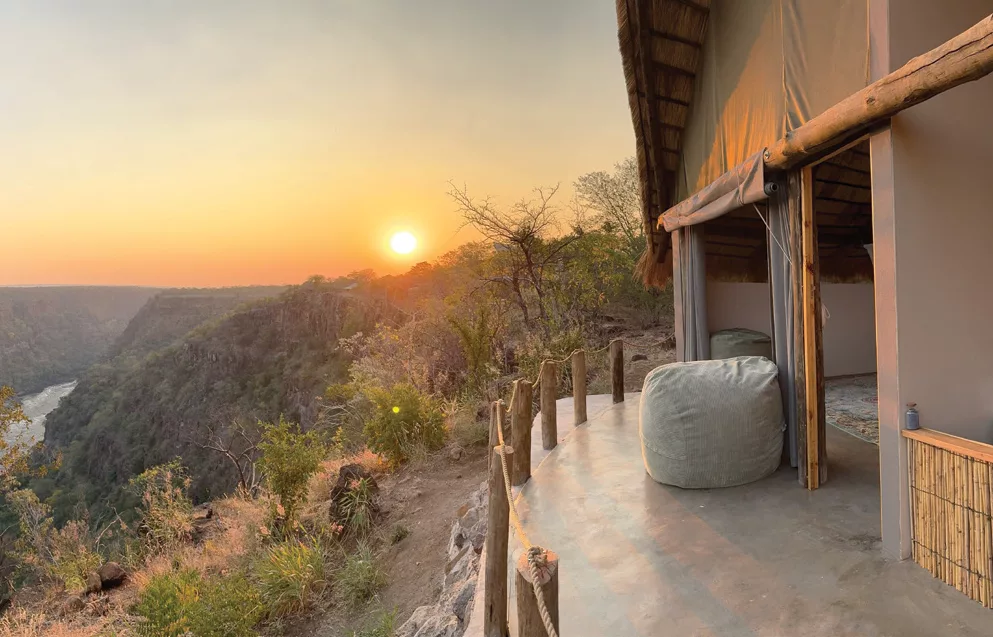
Perched dramatically on the edge of the gorge, around 11km downstream, Taita Falcon Lodge sits 230m above the Zambezi, with panoramic views over the turbulent river below. At sunrise, the light creeps into the gorge and into the rooms, casting a golden hue over everything it touches. At sunset, a hike along the rim of the gorge ends at a lookout to watch the sun go down. Far below, the river shimmers in shades of orange and pink, while overhead birds soar – Taita falcons, for which the lodge is named.
Text and photography | Sarah Kingdom
For more information or to book a stay, go to lumbepoolscamp.com and taitafalcon.com.