
A passion for animals inspires an author to venture into a high-risk situation

Crossing the line
Every step I took felt like an eternity. From the corner of my eye, I could see soldiers with assault rifles aimed at me. I have faced many life-threatening moments with gorillas, lions and charging elephant bulls, but I had less control over this situation.
Suddenly I remembered the final warning of the security police, who said: “Once you cross that line, we have no jurisdiction over you. You are on your own. Are you certain you want to cross the line?”
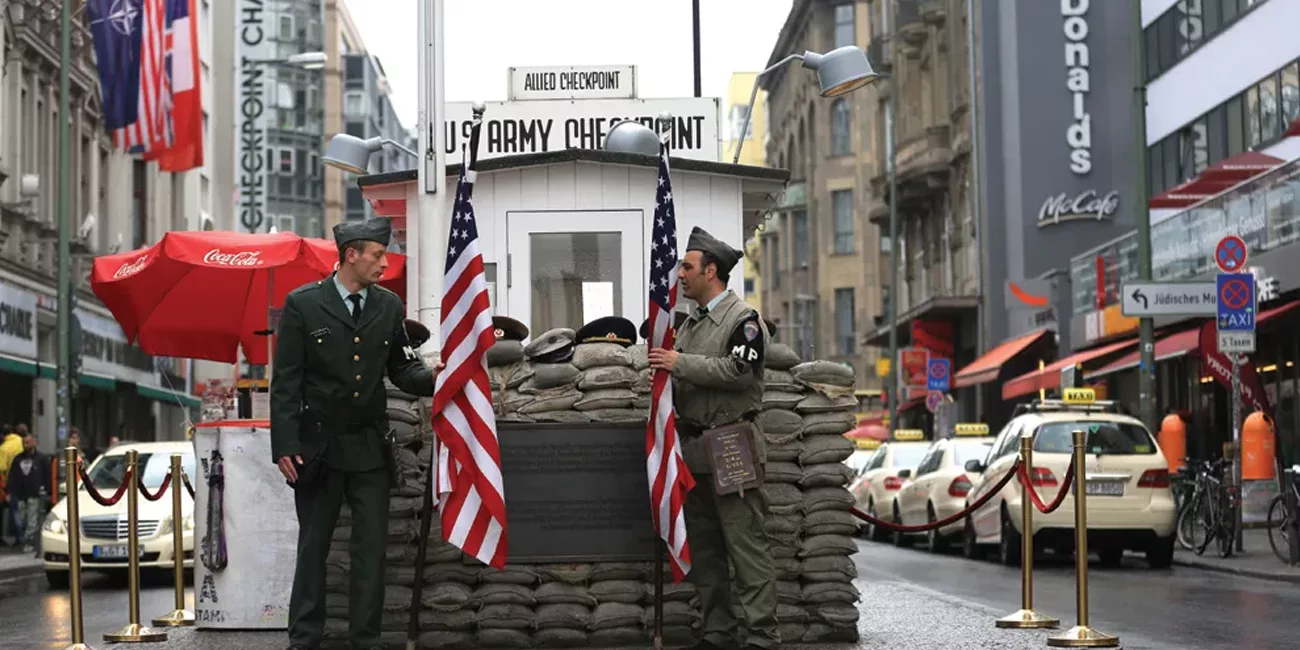
The previous year, I had paid a visit to my colleague, Dr. Klös, director of the Berlin Zoo in the beautiful, modern city of West Berlin. Like most tourists, I paid a visit to Checkpoint Charlie (the United States customs control point between West and East Berlin) and found a modest double-storey museum close to the infamous Berlin Wall. The museum was officially opened on 14 June 1963 and displays numerous photographs of the often unsuccessful, fateful attempts by East Berliners trying to escape the horrendous life under communist control. The second storey is mostly a lookout point where the visitor can get a glimpse of what happened on the other side of the wall. All one could really see at that time were numerous cranes, leaving the impression of vast construction development.
How did this all come about? After the end of World War II and following the Potsdam Conference, it was decided to divide Germany into four occupied zones under the jurisdiction of the four allies – the United States of America, Great Britain, France and Russia. Berlin, situated in the Russian-occupied zone, had lost its status as the capital of Germany, which was temporarily replaced by Bonn in the western zones. Berlin itself was also divided into the four occupied zones. The reason for this subdivision was based on Germany being held accountable for starting both World War I as well as World War II. Allied forces occupied the four sectors, thereby hopefully preventing the possibility of another World War.
After the division of the city of Berlin into the four sectors, a mass migration of more than 3.5 million East Germans defected to the Western Sector. This had an immediate effect on the remaining population, as both skilled and unskilled Germans moved to the West. This not only resulted in a serious loss of manpower but also a considerable brain-drain. In order to curb this movement, the East Bloc sector decided to construct the Berlin Wall. The wall was promptly constructed in 1961 and consisted of a guarded concrete barrier encircling West Berlin, basically creating an isolated island of the four small zones in the middle of the Russian-occupied socialist eastern half of the former German state.
During the time the wall existed, more than 10,000 people tried to escape into West Berlin, of which an estimated 5,000 succeeded. More than 200 were shot or committed suicide. The East Bloc justified the construction of the wall as a protection of its population from fascist elements and officially referred to the wall as the ‘Anti-Fascists Protection Rampart’. In contrast, the West Berlin government referred to the wall as ‘The Wall of Shame’, an extension of the symbolisation of the ‘Iron Curtain’ and the start of the Cold War.
The Berlin Wall consisted of two walls. The area between the two was approximately 100m wide. This area was commonly referred to as ‘The Death Strip’. The strip contained hundreds of guarded watchtowers, miles and miles of anti-vehicle trenches, guard dog runs, flood lights, and trip wire machine guns. Anybody found in the Death Strip could be and generally was shot. After almost 30 years, the wall was demolished on 9 November 1989.
The Berlin Wall, like so many other atrocities since the beginning of time, should surely be regarded as a crime against humanity. People were killed or mutilated; families, friends and loved ones were separated; and individuals were encouraged by State Security in East Germany to spy on and denunciate each other. The effect it had on human beings is indescribable.
Why is it necessary to declare war? It is often motivated by would-be rulers who wish to demonstrate their capacity to control other human beings. The tragedy is that, in the battle for supremacy, innocent people lose their lives.
One of the monumental occasions in the history of warfare must certainly be the Christmas Truce between British and German soldiers on 24 December 1914, when soldiers from both sides left their bunkers and joined together in no-man’s-land to celebrate the coming of Christmas, singing Silent Night and other Christmas carols. Peace and goodwill to all. But alas, after they returned to their respective trenches, they were once again ready to kill one another the following day. This truce was so incredible that many believe it to be a myth that never happened.
Text | Willie Labuschagne
Photography | bodrumsurf and supplied
Of Man and Beast by Willie Labuschagne, published by Tracey McDonald Publishers, is available now. This excerpt is published by permission.