Adventurer and writer David Bristow unspools the legend of Harry Wolhuter, one of the Sabi Game Reserve’s first-ever rangers
As a young man, Wolhuter loved most to go on hunting trips to the Lowveld. He eagerly joined commandos when word was sent out by the Transvaal Government. They were a kind of people’s army where each man had to be mounted and armed and carry his own supplies for the duration of a campaign against various ‘rebellions’ by indigenous people in the old Boer Republic.
When the Anglo-Boer War erupted, he joined a private regiment raised by a maverick and flamboyant cavalry officer, Colonel Steinacker – Steinacker’s Horse. Their theatre of war was the Sabi reserve, the original chunk of land that later became the Kruger National Park. Here, they patrolled in the hope of intercepting Boer forces, either hunting for game meat or bringing in arms from Mozambique.
And so it was that when the old Sabi Game Reserve was revived after that war in 1902, Harry Wolhuter was the very first ranger employed by the reserve’s first warden, Major James Stevenson-Hamilton.
Wolhuter chose Pretoriuskop as his base, owing to its relatively high elevation that would minimise the risk of malaria. His principal task in the early years was to set up guard posts as far north as the Olifants River, then the northern boundary of the Sabi reserve, and to conduct regular patrols to the outlying pickets. The Boers had shot out the game of the area to such an extent that seldom were any large animals seen other than an occasional steenbok or reedbuck. The first elephants seen in the park made a furtive entrance along the Olifants River only in 1910.
Patrols consisted of the ranger on horseback followed by a line of police constables who tended a procession of donkeys. They would be attended by various dogs from the large pack the ranger kept at his home camp, M’timba. These dogs, usually numbering around 20 at any one time, were all close to wild and were what Wolhuter described as ‘lion dogs’.
August of 1903 found Wolhuter on the return leg of a patrol to the Olifants River with three policemen in his posse and three ‘Boer dogs’ (mongrels usually with Mastiff, Ridgeback and Terrier strains). It was afternoon in the dry season, and they were making for a waterhole some 30km distant. Wolhuter knew the trail well from his days with Steinacker’s Horse and decided to ride ahead in order to get to the water before dark. One dog named Bull followed its master while the other two remained with the pack train.
Darkness fell and the ranger kept on towards the water as they’d had none since leaving the Olifants early that morning. The rider gave no heed to predators because he had not before seen any thereabouts. Also, much of the grass and herb cover had been recently burnt. So, when he heard two animals leap out of a patch of long grass, he assumed it was reedbuck, which he knew liked to lie up in the long grass along the Metsimetsi River.
However, when he heard rustling approaching, he knew instinctively it meant trouble. It was two fully grown male lions and they were readying to pounce.
Wolhuter had no time to draw his rifle from its scabbard as the lions closed in for the attack. He turned his horse tightly round and dug in his spurs. One lion was already so close the horse had no time to spring off as the carnivore leapt up. “I felt a terrific impact behind me as the lion alighted on the horse’s hindquarters.”
The horse bucked and plunged and finally broke free, but not before sustaining severe wounds and knocking the rider from his saddle. His rifle went flying and the ranger landed on top of the second lion that was making to seize the horse by its head. The horse fled off into the night with the first lion in hot pursuit and Bull running and barking after it, while the second lion grabbed and bit down hard on Wolhuter’s right shoulder; then started dragging him towards the dry Metsimetsi riverbed.
The lion’s claws kept raking wounds into the man’s lame right arm as it walked. Spurs on Wolhuter’s boots acted like brakes along the stony ground, which would cause the lion to give impatient jerks, causing more excruciating pain and lacerations.
“I certainly was in a position to disagree emphatically with Dr Livingstone’s theory, based on his own personal experience, that the resulting shock from the bite of a large carnivorous animal so numbs the nerves that it deadens all pain; for, in addition to this was the mental agony as to what the lion would presently do with me; whether he would kill me first or proceed to dine off me while I was still alive!”
Then, through the pain, the prey remembered his knife. A problem was that it had never fit snugly into the sheath on his belt and twice previously it had fallen out when he’d taken a spill while galloping after game. What were the chances it would still be there after all the commotion of the previous few minutes?
Text | David Bristow
Photography | Supplied and photopia
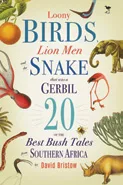
Loony Birds, Lion Men and the Snake That Was a Gerbil: 20 of the Best Bush Tales From Southern Africa by David Bristow, published by Jacana, is available now.
This excerpt is published by permission.