 Revered photographer finds a fascinating premise for imposing new book
Coffee table books are massively expensive to publish and tough to market because of their price and size. So you’ve put out Going Dutch, an absolutely enormous tome with a chunky price tag – why this choice and this theme?
Obie Oberholzer My Dutch publisher and I get along. We’re both a bit funny – maybe this was in my favour. The limitations of our market didn’t come into it for him, so he did it for love. And the money comes back to me and just about pays for petrol.
[RMB founders] GT Ferreira and Paul Harris were varsity mates of mine and have always showed an interest in my work – I actually started doing books like this because GT asked me to. He thought it was a good idea.
As for the theme, if you’re travelling in Africa, your best companion is a sense of humour. Some of the towns I visited here make you shake your head. Comparing them to their mother cities is unavoidable – and that’s the spine of the book. It’s all to do with respecting the past. So much has been lost in these towns. For instance, why is Dordrecht there? It’s only a church now, but it was more before. We don’t want these towns to go to waste.

You’ve gone with a big, bold font in this book, where in the past you’ve used your handwriting for the text. Do you think there’s a difference in how the stories come across as a result?
No. When I started to type, I realised I have a little bit more to say. I have nice handwriting, but it’s more difficult to read. Even if I just did the captions like that now, I realise that people don’t read them like that anymore.
For me, it’s about the humour, the happy-sad and the not obvious. And this format, with the bold type and the colours used, makes the text difficult to not read.
History taught versus history learnt via travel and experience: how much are educators or travellers missing the point from your point of view?
I adore any means of travelling – and travellers. As soon as you go over horizons, there are new things to learn. There needs to be more indulgence in the places you visit, in what happens there and in its people. Why is that place there? Has it changed over the years and decades? Have you changed since you were last there?
With this theme – lucky me – I got to go to beautiful places in Holland. And while there, I found stories. I went into a dress shop. The mannequin was white; the cashier was Nigerian. So we chatted and I was able to get some detail. I went into a church and the minister showed me a huge bullet hole that was out of sight for the general visitor; a reminder of a battle back in history sometime. In moments like that, I take notes for my captions.
You developed your own, distinctive storytelling style many years ago, and that, in part, determines the format and themes of your books. What do you feel is the best way to read or appreciate a book like Going Dutch?
I lived in Germany for a while. A picture editor there told me about the importance of intrigue – creating something that people won’t just page past; something that forces you to read the caption and which might take you deeper into the text.
To enjoy the book, think about it like this. You don’t look at an artwork in pieces. If you just flip through the book, you’ll only get about 40% of what’s going on. On these research trips, I have incredibly limited time. I can’t cover a whole city, so I find specifics to give readers an idea of the place. Our visual education is very low in most ways, but we still see with our minds.

You had the idea for this book over a decade ago. How did it develop or influence your itineraries or cultural processing in that time frame?
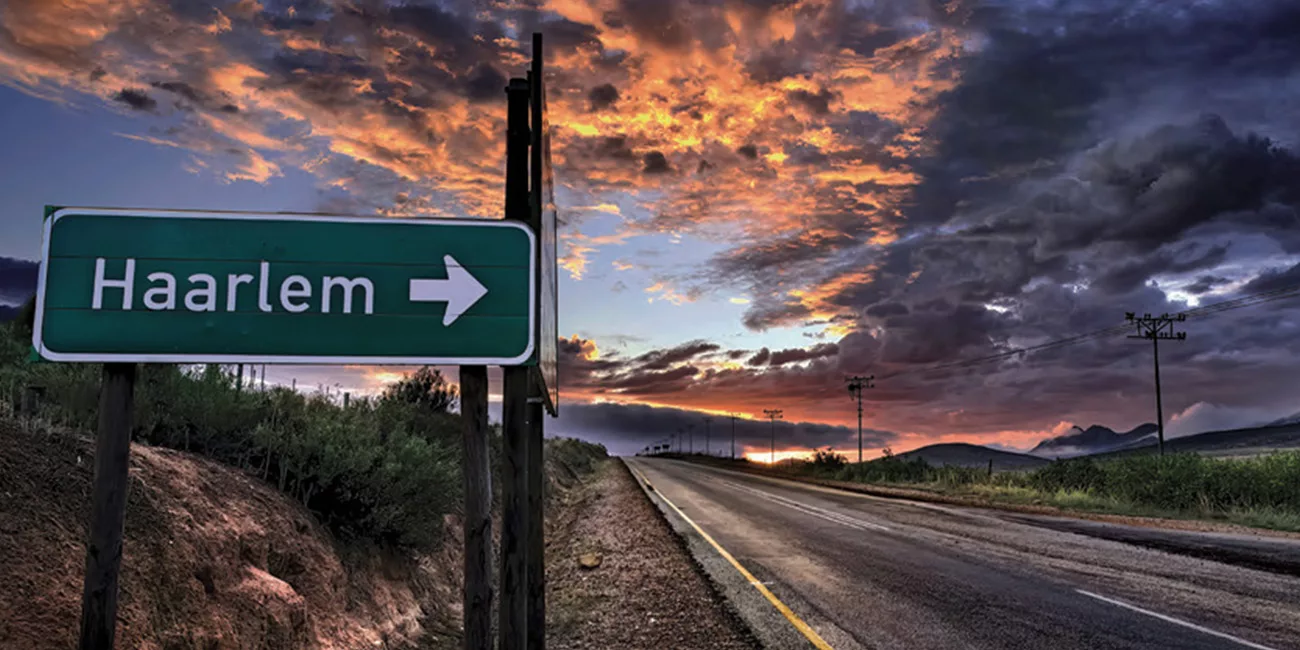
It partly grew through travel for magazine assignments and working for a picture agency in Germany. I did a story on Haarlem – the South African version – which is just across the mountains from Nature’s Valley, where I live. Then I did one on Dordrecht, which gave me the ideas to compare the cities. My Dutch publisher thought it was a great idea. He said, “Come and do the Netherlands first.”
I write like I photograph – it’s haphazard. My wife, Lynn, does corrections. I don’t know grammar, but I can link the photographs and the stories.
With social media meaning that everyone sees so many more photos than they used to, are you influenced to consider techniques or options you haven’t before?
I just do what I’m good at. Photography has in some ways come to an end. You can just add or take away stuff now. I think photographs should look like photographs – like what’s there. I use Photoshop to clean up or enhance contrast, but that’s all.
When I look at a scene, I can see the end result. When I walk around, anywhere, I’m conjuring up images.
You’re a details guy. The small stuff is as important as (or more important than) the subject of the picture. What role does light play in determining what catches your eye – reflections, halos, starbursts – even before you lift the camera?
Light is the governing factor. I’m going from 3D to 2D. If the subject needs enhancement, light is the best way to do that. When I’m packing for a trip, I have a range of torches that I take with me. I don’t take pics so much as make pics. Where I can, I like to take my time. Painters start with something blank and add to it. Photographers start with everything and take away from what’s there – isolate for impact.
Text | Bruce Dennill
Photography | Obie Oberholzer
For more information, go to obieoberholzer.net.