The Kruger National Park’s wildest region is also its most peaceful
Most travellers think they know Kruger National Park. Wide-open savannahs, scattered bush camps and bleary-eyed breakfasts at Afsaal. But there’s a slice of Kruger that defies that idea entirely. In the northernmost reaches of the park is a concession so little-visited that it challenges everything you think you know about Kruger. This is Pafuri.
Pafuri isn’t easily reached, and it’s not meant to be. Here, the wilderness feels vast, raw and untouched – a frontier in every sense of the word. This 26,000ha area is owned by the Makuleke community, who were forcibly removed from the land in the 1960s and fought tirelessly to have it returned in 1998. Now, members of the community work as game rangers, trackers and staff at Pafuri Camp. The Makuleke community’s successful land claim is one of South Africa’s proudest conservation stories. Their ownership means that every visitor contributes to the preservation of the land and the empowerment of the local people. The pride in reclaiming their history runs deep. Every detail, from the guided walks to meals prepared around a boma fire, holds a piece of the Makuleke story, contributing to an experience that feels more rooted and authentic than anywhere else in Kruger.

Unlike the south of the park, Pafuri isn’t filled with vehicles jostling for prime views of lions and elephants. Instead, it offers something quieter and more reflective. While members of the public can drive along the stretch of main road that runs to the Pafuri gate, you’ll have to stay at one of the few camps in the huge area to explore any further.
Return Africa Pafuri Camp feels like a true hideaway. It’s tucked alongside the banks of the Luvuvhu River, disappearing into the bushveld around it. It’s not built to stand out but to settle in, which is part of the charm. The camp is simple yet elegant, with luxury tents and wooden walkways that keep visitors close to nature.

But the real luxury is in its setting. It’s designed to blend into the landscape and its surrounds, which means that all you really focus on is what’s outside: the slow flow of the river from the open-sided pool and dining area, the chirps of the bushveld filtering in through the tent at dawn, and at night, the low, resonant grunt of hippos.
Historical refuge

Pafuri is one of South Africa’s richest birding destinations and a true paradise for enthusiasts. Here, you’ll find rare species like the Pel’s fishing owl – known for its striking orange plumage – and the grey-headed parrot.
The Narina trogon, with its deep red belly and green back, is another gem seen in this region. Even if you don’t know your black-throated wattle-eyes from your racket-tailed rollers, it’s impossible to ignore the life and movement that fills the air.
The wildlife isn’t the only thing that sets this region apart from the rest of Kruger. Here, baobabs dominate the skyline, holding the stories of the Makuleke people who once lived among them. Some of the trees are thousands of years old, their hollow trunks gnarled and wide as they tower over the land. These giants have seen empires rise and fall, and walking among them, you feel that history. Some are hollow, once used as shelters by sangomas – traditional healers – before being left to stand silent and empty.
And while the south has its game-filled savannahs, Pafuri has the fever tree forest. Over 14km of yellow-green bark glow under the African sun. It’s the largest fever tree forest in Africa and the trees form an almost enchanted canopy, a shady refuge for elephants and buffalo on the hottest of days.
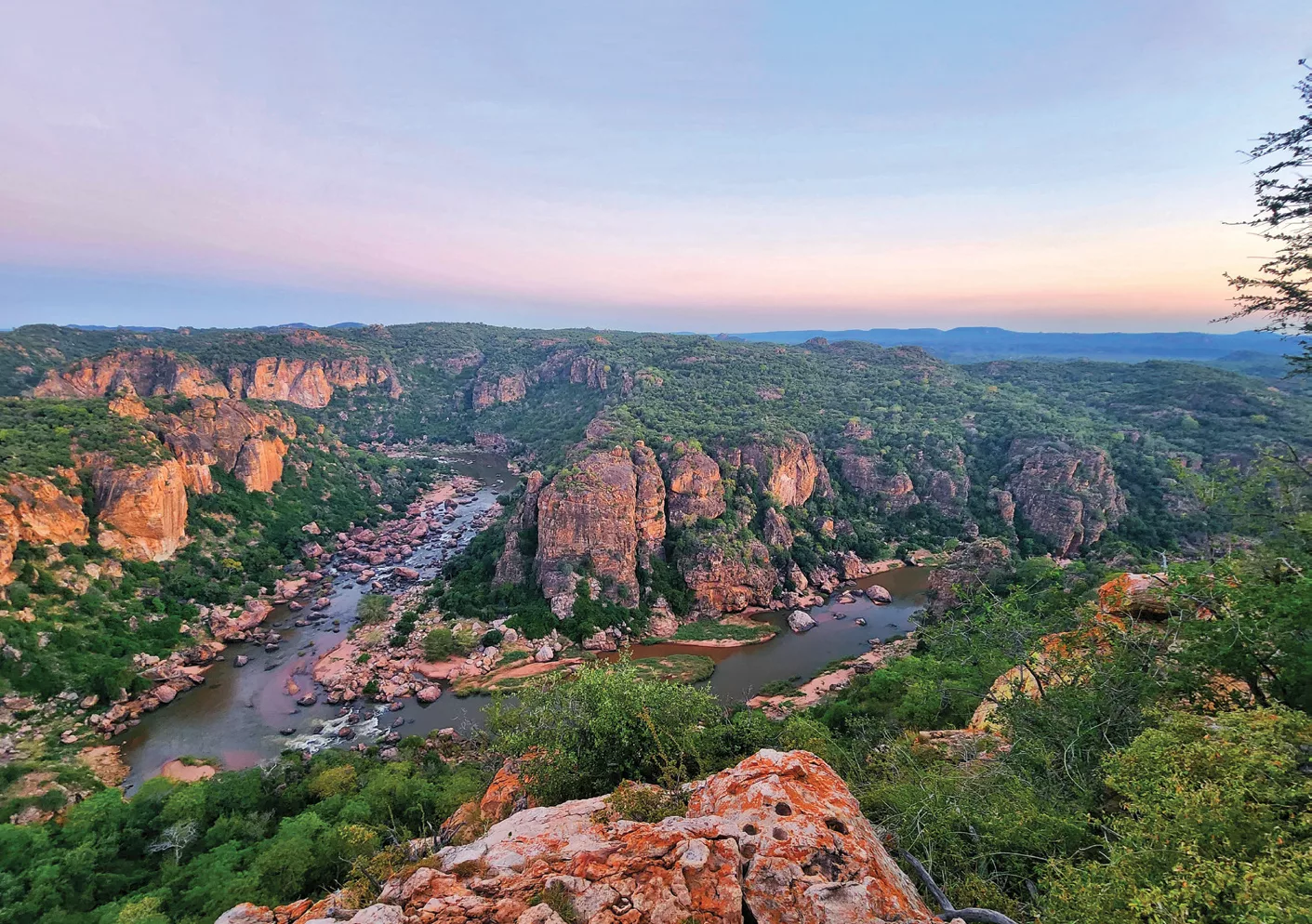
If you’re fortunate enough to spend a few contemplative days here, one of the views that will stay with you for a lifetime is that of Lanner Gorge. It’s almost completely unknown to the public, but the gorge is breathtaking – a dramatic canyon carved by the Luvuvhu River over thousands of years, with cliffs plunging steeply down to the riverbed below. Standing on its edge, looking out across the expanse, visitors receive another reminder that this part of Kruger has stayed wild, untamed and uncompromised.
A relaxed reality

Then there’s Crook’s Corner, where the Luvuvhu and Limpopo rivers converge. This spot was once notorious for smugglers and poachers taking advantage of the porous borders with Zimbabwe and Mozambique. Today, the lawless reputation is long gone. The only crowds are the crocodiles basking on the banks and countless hippos at their loudest as you join them at the watering hole for a sundowner.
Staying at the camp is worth more than a day or two. It’s an experience of immersion and the kind of restorative slow safari that can only be had far away from the madding crowd. You’re not here to tick off the Big Five or set off for a quick, two-night getaway from the city. There’s no rush to see it all. It’s about sitting with the land, letting it tell its story in its own time. You’ll see things differently here – the way the fever trees glow at sunset, the echo of elephants as they rumble past in the distance and the feeling of being a part of something old and sacred.
The experience is a departure from the typical safari-as-usual mindset. Pafuri Camp doesn’t try to offer a curated, polished, ‘guaranteed to see leopard’-type experience. And that’s why it matters. For those who are willing to wander beyond the well-trodden routes and want more than just another week in the bush, this is Kruger as it should be: wild, authentic and unforgettable. A last outpost holding tight to what wilderness truly means. And for that, it’s worth the journey.
Text and photography | Sophie Baker
For more information or to book a stay, go to returnafrica.com.