Mozambican beach lodge is a superb centre for exploring natural beauty and complex histories
The first view of Nacala from the aircraft is of the huge cranes on the quay of the deep-water harbour and the long stretch of Fernao Veloso Bay beyond. The transfer to Coral Lodge, on the other side of the Nacala Peninsula, where the beaches face the Indian Ocean, is an adventure itself, especially close to town, where the trucks carrying materials to and from the port share the roads, on which tar and potholes often share top billing.
 Visiting just after the rainy season means green lushness is everywhere, with the roadside farms – rice, cassava (a starchy root vegetable) and cashews in plentiful supply should visitors come around. Ironically, for generous sorts, both Ramadan and Lent are in full swing…
Towards the end of the drive, the busy shopping street in the village of Lumbo simply ends in a boom, beyond which extends the 3km-long, one-lane bridge to Ilha de Moçambique, the country’s timeworn ex-capital city. As you pass under the boom, you switch instantly from a bustling, contemporary African town to the essence of Mozambique: fishermen in pirogues and dhows on either side of the bridge, heading straight into 500 years of crumbling colonial history, where you are greeted by ancient banyan trees, residential areas almost below the level of the road because rock and sand was removed there to build the massive Fort of São Sebastião at the other end of the island. But there will be time to explore all of this later. For now, the Coral Lodge dhow is waiting at the end of a long pier…
In good taste
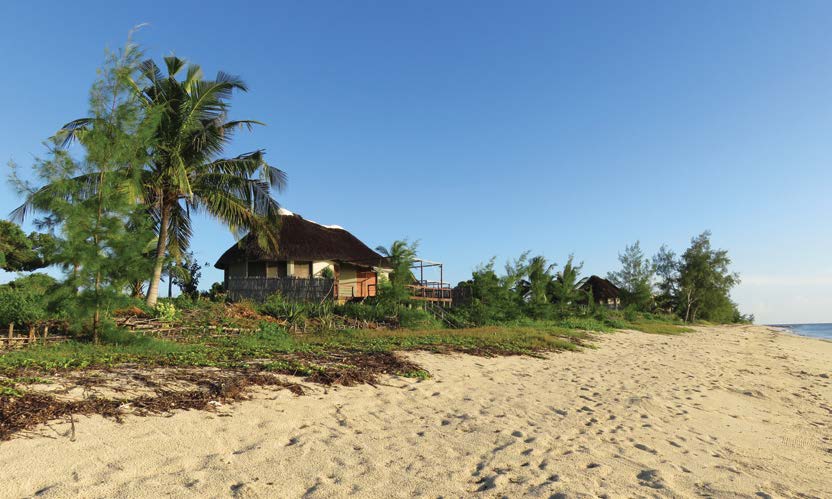
The welcoming party on arrival includes manager Fernando Crux and a couple of the five friendly dogs that pad around the property. Guests pass a pool bordered by sun loungers and go through the dining and bar areas before reaching the villas, spread out in two diverging lines – one along the beach and the other looking out over mangroves and back towards the mainland.
The villas are large, figure eight-shaped spaces with a lounge and a two-seater table for in-room meals in one bulb and a four-poster bed shrouded in a mosquito net in the other. There is no glass in the windows, which are open spaces filled with fine mosquito protection, so air flow is controlled with adjustable shutters.
The first dinner sets the tone for the dining offering for the rest of the stay – high-spec cooking without the haute cuisine fuss. Flavourful picanha steaks, black beans, rice and salad, followed by passion fruit mousse, are a tasty final chapter in a day that ends with dropping off to sleep to the sound of the surf, just 20m away.
Happiness and heartache

Early morning cons: the sun is bright at 4:45am – and genuinely hot by 5:30am. Early morning pros: the beach is empty, the wind is gentle and the shell bank is prodigious. There’s no need to search for your favourites. Simply stop and crouch down and you’ll find an array of cowries, cone and slipper shells, parts of conches, sea urchins, scallops and much more. Overhead in the casuarina trees, olive bee-eaters keep you company. On the beach, godwits (migratory waterbirds with upturned beaks) skim over the shallows. And the Coral Lodge property extending a couple of kilometres down the coast means all of this can be achieved in private – a rare privilege.
Adding historical to natural exploration means stepping into a little 4×4 that looks modest but handles the considerable furrows and challenges of the roads with surprising ease. The road out of the lodge runs along the edge of a large mangrove swamp on one side and the land side of Chocas Mar, a long, beautiful beach, on the other. The area directly off the beach, until recently relatively pristine, has now become a hotspot for Mozambique’s politicians and well-to-do citizens and businesspeople, who have already built or are busy building holiday homes.
This insight into one extreme of the country’s society is followed by another. In nearby Mossuril, just behind an area in which a number of schools are situated, there’s a long concrete ramp down to Mossuril Bay, where a couple of kids are having a casual swim. A small red sign at the top of the incline recognises that this was the ramp down which slaves were led to small boats before being ferried out to large ships that transported them to Brazil, Cape Verde and other markets. It’s hard to shake the feeling that ghosts are still watching from the railings above.
Old-school elegance

On the return journey, the village of Cabeceira Grande has a couple of notable centrepieces. The former Governor’s Palace was also a holiday or weekend residence (away from the bustling busyness of Ilha de Moçambique). Now a hollowed-out ruin, it’s still an incredible structure, with walls four feet thick, burrowed into in one spot where someone was hunting for a rumoured treasure.
Today, tree roots are spreading over the walls, in equal parts holding the 300-year-old structure together and pushing segments of it apart. Inside the governor’s old bedroom, it’s probably 10–15 degrees cooler than it is outside, with a magical view over the mangroves and the ocean beyond. He knew what he was doing, choosing this spot to escape to.
Literally just around the corner, a church built in 1579 still serves the community, even after 2025’s cyclones caused a beam to fall near the door of the building. Nossa Senhora dos Remédios (Our Lady of Remedies) still, however, has a healing peace that gives its name some credence.
Reasons to relax
Resting back at the lodge involves stepping into the blood-warm pool and enjoying the view of the lagoon as you swim. Watch where you stand – it’s a saltwater pool, and what you thought was a casuarina seed might be a crab that wandered up from the beach for a change of scene. Speaking of which, there is a massage plinth on the sand just below the beach, surrounded by shell mobiles and strings of cowries that move in the wind, making a lovely rippling sound. This soundtrack is infinitely preferable to the usual spa ‘music’, which is generally whales with indigestion or similar. There are gentle aural changes as the tide comes in and subtle shifts in light as the sun descends.
It is only left to meander up to a raised deck near the bar area or a new games room (with a huge billiard table, among other activities) towards the gate for a sundowner with other guests or perhaps lodge management, swapping stories about the complexities of running a resort and the dreams of what is to come. And once your thirst is quenched, a bonfire-lit meal under the pair of baobabs, entertained by a local dance troupe and their trio of drummers, serenades you towards sleep with lyrics that run the gamut from social histories about the actions of Vasco da Gama to statements of appreciation for the lodge and its management and what they have contributed to the community. Like the whole cultural experience here, it is entertaining, fascinating – and significant.
Text and photography | Bruce Dennill
For more information or to book a stay, go to corallodgemozambique.com.