Airlink founder Rodger Foster looks back at the airline’s relationship with Skukuza Airport
I visited Skukuza Airport (SZK) when it was operated by South African National Parks (SANParks) in the late 1980s and early 1990s during my days as a freelance part-time charter pilot. I then had the fortune of a weekly flight into SZK at dawn and out at dusk (by special permission) in order to conduct site visits to the Biyamiti Camp and Pretoriuskop Camp, both of which were under construction – Biyamiti holistically and Pretoriuskop with significant alterations. The potential for SZK to be developed into more of a tourist gateway than it was at the time was palpable.
During my frequent visits, I enviously noted the infrequent Comair operations, initially with a DC3 Dakota, then a Fokker F27 and then eventually an ATR42 aircraft around 1995 until around 1998, when Comair handed the commercial scheduled public transport role at Skukuza to SA Express using a Dash8-300B aircraft. This operation was halted when both Skukuza Airport and the Nelspruit Municipal Airport gave way to Kruger Mpumalanga International Airport (KMIA) at Primkop, which was an industrial offset initiative funded by [global technology company] ABB.
The purpose of closing Skukuza to all commercial air traffic was that this traffic would be redirected to KMIA. While a small portion of air traffic was rerouted, in essence, the closure of Skukuza spawned an increase in charter traffic, which ultimately took the form of a ‘programmed’ charter, which was de facto scheduled public transportation. In any event, all commercial traffic should have been redirected, but wasn’t.
Facing headwinds
It became clear that the traffic visiting hospitality destinations within the SZK catchment preferred accessing their destinations via SZK. Airlink launched a legal challenge with the aim of having the ban on commercial traffic rescinded or, alternatively, to totally close SZK to all commercial air traffic – charters included. While this challenge was underway, recognising that the lodges within the Sabi Sand Reserve were within the catchment, Airlink launched air services to MalaMala in anticipation that lodges such as MalaMala, the Lions Sands lodges, Kirkmans, Londolozi and Singita would all benefit from the scheduled public air services that were emplaced at MalaMala.
Airlink prevailed with its litigation and succeeded in having the ban lifted in 2011. Pressurised by Airlink, SANParks initiated a request for proposal (RFP) for the Skukuza Airport to be rebuilt and then operated by a private sector operator in a public-private partnership.
The bids closed in July 2013, and in August 2013, SANParks announced that Airlink was the successful bidder. Our architect, Oliver Wills, presented the spectacular concept design that was embodied in the bid, and he transformed the concept into submission and working plans between August and November 2013. The airport site was handed over to Airlink on 1 December 2013.
The entire terminal infrastructure, other than the skeleton of the main rotunda, was razed to ground zero and the site was cleaned during December 2013, ready for reconstruction to an all-new design, with the building works commencing in January 2014. Under the project management leadership of a Nelspruit-based quantity surveyor, Jacques Hoffman, the building works were fast-tracked to completion with the official opening being on 2 June 2014, when the first scheduled Airlink flights arrived and departed, despite the building works still being in the final throes of completion and defect rectification.
It has subsequently taken Airlink more than 10 years to develop route traffic between Johannesburg and Skukuza and Cape Town and Skukuza to the point of sustainable viability. There have been myriad speed bumps and potholes that have manifested along the journey, the most significant of which have been the perennial security fence breaches by elephants lured by marula fruit inside the airport precinct and, of course, the October 2024 fire, after a runaway controlled burn in the Kruger National Park ignited the roofing thatch, which gutted the main rotunda.
Integrated vision

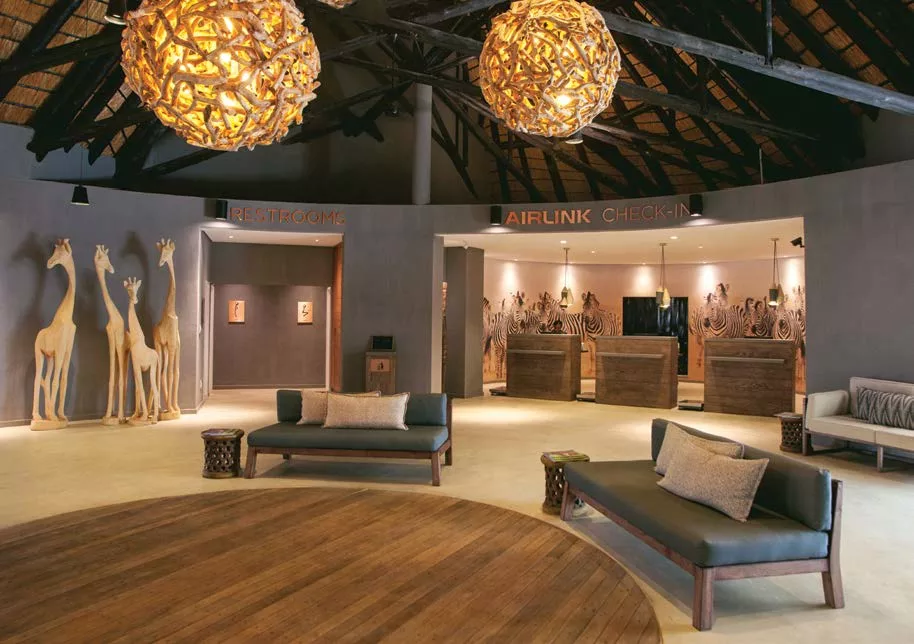
Why include the trees within the architecture? We wanted the building to emulate an upmarket game lodge as being the most inviting access gateway to and from our customers’ hospitality destination. Integration of the building holistically within the environment was an imperative, and the trees that have been included in the design as natural features are spectacularly beautiful.
Under my stewardship as CEO of Airlink, the redevelopment of Skukuza Airport was not merely an infrastructure project – it was a strategic vision to redefine the arrival experience into the Kruger National Park. In 2013, Airlink successfully secured the bid to redevelop and operate the airport, following our direct engagement with SANParks. Recognising both the tourism potential of seamless air access into the Park and the inadequacy of the previous facility, we were instrumental in persuading SANParks to initiate the RFP process. The objective was clear: create an airport worthy of its setting – one that would serve as a gateway, not an intrusion. It was intentional that the building should not compete with the bush but emerge from it. In appointing architect Oliver Wills, we guided a design philosophy rooted in environmental sensitivity, sustainability and authenticity.

The decision to incorporate indigenous timber elements was neither decorative nor incidental – it was foundational. The striking living tree timber columns that define the terminal interior were inspired by and purposefully included to evoke (and harmonise with) the surrounding woodland savannah. The structural design draws on the natural vertical rhythm of indigenous trees found in the Kruger ecosystem – tall, textured, organic forms that filter light and create dappled shade.
The building form uses natural fabric, including timber beams, and the living tree columns blend with the concept of a forested interior canopy. This achieves several deliberate outcomes:
- Contextual integration: The terminal feels like an extension of the bushveld rather than a man-made imposition.
- Psychological transition: Arriving passengers experience a seamless shift from aircraft to wilderness; the architecture begins the safari before the vehicle does.
- Natural light and climate sensitivity: The living tree structures support wide overhangs and shaded canopy, reducing heat load while maximising natural light.
- Sustainability ethos: The use of the trees, timber and natural materials aligned with SANParks’ environmental mandate and Airlink’s long-term operating philosophy.
The result is an airport that is not only operationally efficient, having functioned faultlessly since becoming fully operational in June 2014, but emotionally resonant. It captures a sense of place. The building does not announce itself: it belongs.
Text | Rodger Foster
Photography | Courtesy of Airlink
Skukuza Airport is a public-private partnership between the Skukuza Airport Management Company Pty Limited (which is owned by Airlink and Lion Sands) and SANParks, alongside the Sabi Sand Pfunanani Trust and Conservation South Africa.