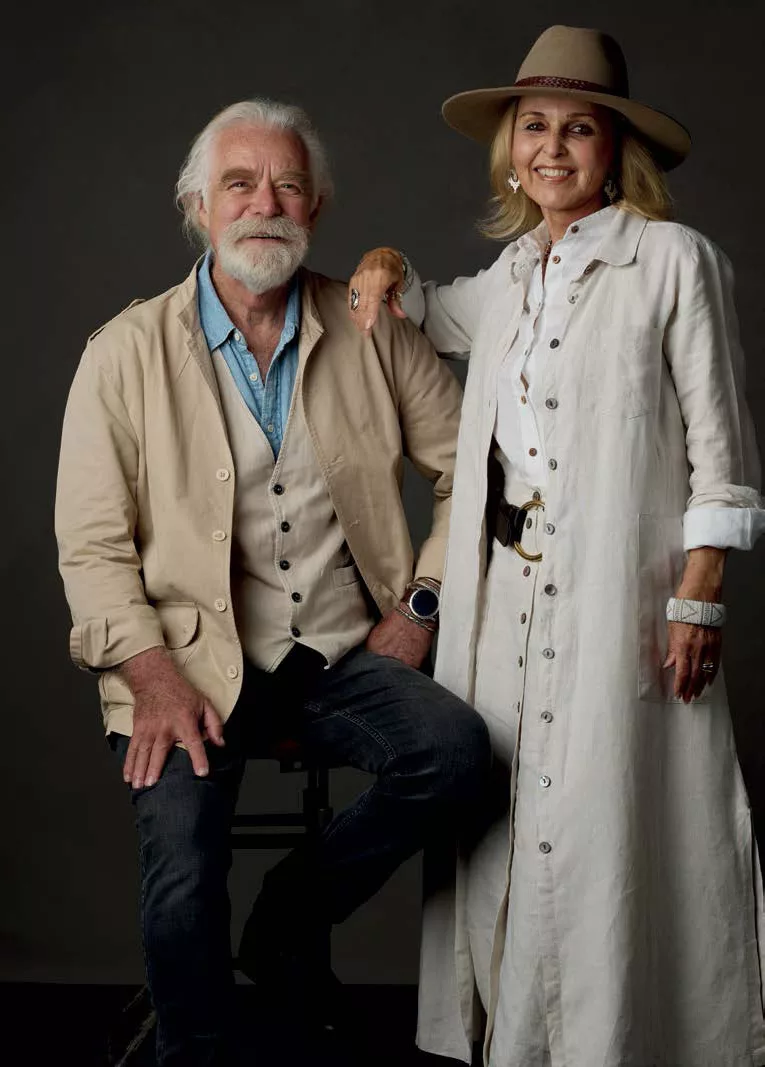

 A journalist at heart, Joanne Joseph also enjoys storytelling through the written word
You grew up in Chatsworth, KwaZulu-Natal. What are your fondest childhood memories?
Joanne Joseph I have a number of wonderful childhood memories. We lived in a small house in Chatsworth, but it was one that was bursting at the seams with love, affection and security. My fondest memories involve having my wonderful grandparents around, my brother and my father’s music, my mom’s remarkable leadership as the glue of the family and her amazing cooking as well. It was a happy home, and those are memories I would never trade. I sometimes wish I could return to it in real time to relive, as those were some of the happiest times of my life.
From being the first voice on YFM while a full-time student to Classic FM – did all these slots serve as stepping stones for what you would eventually become, a television news anchor?
It was, thanks to the mentorship of senior journalists along the way, that I was able to actually apply the skills to be able to integrate myself into the world of journalism. Every one of those stepping stones was so important in teaching me what I needed to know and taking me to the next level to be able to eventually become a television news anchor.
Journalism can also be considered storytelling. How did you end up writing your first book, Drug Muled, in 2013?
While I was working at eNCA, a story broke about a young woman who had carried drugs into Thailand in her dreadlocks as a drug mule. We needed to get a sense of what her experience was like on that side. Being arrested, being imprisoned and being tried. We thought someone to give us the most accurate picture of this was a person who had gone through exactly the same process a number of years before. Her name was Vanessa Goosen, a convicted drug mule who had just returned to South Africa from the same prison. What was initially planned as a five-minute interview ended up being a 20-minute interview. The information she gave us was so absorbing, and it was at that point that I had the realisation that her narrative was one that contained so many fascinating elements, it would make for a wonderful book. I discussed it with a publisher, and she agreed that it would make a great book.
Then came Children of Sugarcane, published in 2021, a novel that has garnered high acclaim.
I’m relieved that Children of Sugarcane received such a warm reception from so many communities in South Africa and abroad. It took quite a long time to write – nine years of investment intermittently. I’m glad that, at the end, it was acknowledged as the type of novel that I hope falls into the idea of a collective history, the many histories in our country and the rich histories of so many different communities merging into part of the cornerstones of our identity.
What was the inspiration behind that book?
My great-grandmother was the inspiration for Children of Sugarcane. She arrived here with her younger siblings in the 1880s, and as indentured workers, they were all set to work on the Natal Government Railways. The work would have been gruelling and torturous in many aspects. We know that life was extremely difficult for them, but unfortunately, my great-grandmother’s history was much too scant in the archives for me to flesh that out into a non-fiction narrative. That is how it became a fictional narrative, but one that drew in a number of stories of courageous women who had shared much the same history as my great-grandmother.
How much research goes into your books?
There’s a great deal of research that goes into writing in general. My first book involved a lot of interviews with Vanessa Goosen and various other officials who were reachable at the time and who’d experienced this ordeal along with her. With my second book, I consulted a number of history books and academics who were well versed in the field of indenture. I was fortunate to be able to draw on our wonderful academic tradition, both written and vocally in this area, that brings the story to life in terms of the historical detail.
Do you get writer’s block, and if yes, how do you deal with it?
I don’t think of writer’s block in the way it’s conventionally thought of. When the periods of inspiration come around, I lock in and I write for long periods of time. When I’m in that mindset or the zone, I’m able to write for extended time frames that last several weeks. At the end of that, I feel that I’ve done a useful piece of writing, and I just let that writing rest for a while until the next period when I feel like that again.
And procrastination tactics?
I think I’m a master of procrastination. It can be ‘let me run an hour long on the treadmill’ and then get so exhausted that I can’t write anymore. Or ‘let me go cook something delicious for the family’. These are all excuses that can’t last long, and, at some point, the pressure must build up to the point where I absolutely have to do something. I sometimes feel working under pressure is much better, and I’m less likely to procrastinate, which I’ll sometimes do deliberately.
Text | Heléne Ramackers
Photography | Emil Wessels
Children of Sugarcane by Joanne Joseph, published by Jonathan Ball Publishers, is available now.