Wildlife drama is balanced by lodge pampering at South Luangwa lodge
Sunning themselves on the riverbank, four hippos are fast asleep. The overcast day has allowed them to linger a while longer, until one lifts its head. It’s face to face with a puku, which doesn’t look like too much of a threat. The puku, on the other hand, seems intrigued by this grey and pink blob that appears, for now, to be immobile.
Continuing to graze, the puku glances over to the four rock-like shapes that now appear even more comfortable than they previously did, with some lying on their sides, taking full advantage of the balmy temperature outside the water.
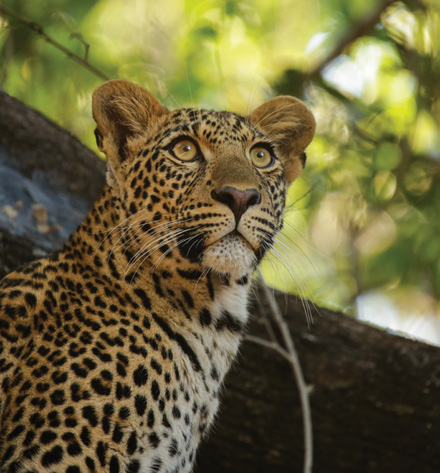
Suddenly, pandemonium erupts with Egyptian geese alarming, helmeted guinea fowl screeching and pukus whistling – all indications of something that should not be there. Having just finished a peaceful lunch at Time + Tide Chinzombo in Zambia’s South Luangwa National Park, the hysterical wildlife frenzy attracts our attention. Assistant camp manager Malama rushes over, pointing in the direction of a fallen tree stump. “Look, there’s a leopard!” he excitedly exclaims. “Wait, there’s another one.” Lucy the leopard’s two cubs are walking along the riverbank, splitting off in different directions. Nobody appears to appreciate their presence, especially the vervet monkeys that are vocalising with increased vigour.
Seeking the sound
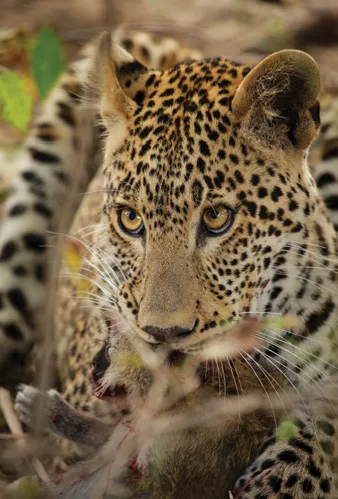
Malama tracks down George, Chinzombo’s safari guide, who whisks us across the perennial Luangwa River in an aluminium boat, whereafter we clamber into the game drive vehicle to investigate why there is so much fussing and fury. Following the sound, one cub is spotted hotfooting it into an impenetrable area. To find the other cub, George only has to point the vehicle towards the mayhem involving the vervet monkeys and guinea fowl to find where the rosetted cat is hiding in the foliage of a tree. He is holding something in his mouth and is incredibly nervous, glancing up into the large tree every so often with big yellow eyes. This is all too much for him. The noise from the vervet monkeys is overwhelming and it becomes clear why they are shouting at him – he has caught one of their troop and has started feeding on what is possibly a family member. Indicating that he has had enough of this primate furore, the cat takes his meal to enjoy it in peace somewhere quiet.
Spotter Manuel joins the afternoon game drive and the cub is found again, still feeding on whatever is left of his prized possession. He has positioned himself in the shade of a sausage tree with mom Lucy close by, camouflaged in the dropseed grass. After every few bites, he emits a number of deep growls, which George calls ‘mocking behaviour’, indirectly letting his mom know that he is not sharing his food. At sunset, the cub is in a different spot, enjoying the last rays of warmth on his gorgeous coat. He sits up and starts vocalising, calling for his mother with two short calls. She doesn’t respond, as he is of the age where he is close to becoming independent and will soon need to fend for himself, which he has proved he can do today, given the shape of his round white belly.
Privacy and pampering
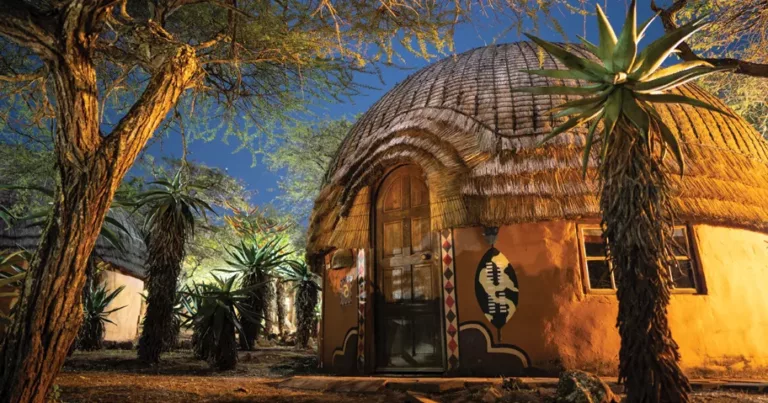
With only six safari tents and a luxury family tent set along a bend in the Luangwa River, it’s hard to beat the feeling of being so close to nature while luxuriating in a private haven of tranquillity. This is no ordinary tent – it’s large, with a bedroom, coffee station, mini-bar, writing desk, wardrobe, freestanding bath, shower, double vanities and flush loo. The large outside deck has different seating options from which to watch the parade of wildlife strolling by – or that can be done from a private pool. Meals are served in the main dining area, with Head Chef Webby ensuring that guests are well fed and all dietary foibles are catered for.
A complimentary treat for guests is a 20-minute in-room (on-deck) spa treatment. Therapist Vastina goes to work on de-knotting my shoulders with her healing hands, using a fragrant stress relief oil. Feeling relaxed, the time has come for the afternoon game drive. Spanning 9,050km², South Luangwa National Park is a popular destination for both tourists and locals. Anticipation is palpable when news gets shared that a big cat has been spotted. Zambia’s endemic Thornicroft’s giraffe, statuesquely making its way across the open plains, causes more excitement. The wildlife never disappoints here.
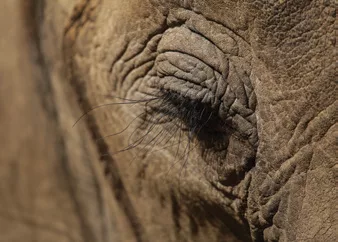
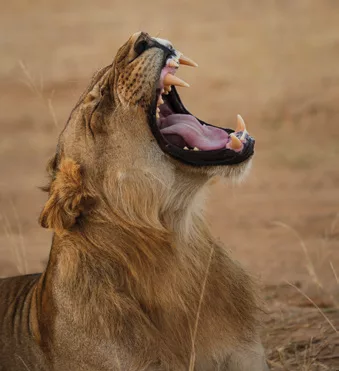
Finding the Chichele pride of lions as the sun is starting to set gives new meaning to being in the right place at the right time. The lions are having a wonderful catnap and, one by one, they become aware of an unusual smell, sitting upright to sniff the air. An elephant has just crossed a shallow part of the Luangwa River and, as he ascends onto the sandbank, he looks like he’s wearing long socks. Catching wind of the lions, he trumpets loudly and charges away with his ears flapping and his tail in the air. Turning towards us, George gives a wry smile and says, “At least the elephant woke up the lions – this is nature in its purest form!”
Text and photography | Heléne Ramackers
For more information or to book, visit timeandtideafrica.com. Heléne Ramackers’s flights between Cape Town and Lusaka on Airlink were sponsored by cazenove+loyd.
For more information, go to cazloyd.com.