A road trip around Namibia delivers adventure, wildlife interactions and epic landscapes
It was shortly before midnight, and we were snoozing happily in our roof-mounted tent after a steak on the braai and a beer or two when there was suddenly a metallic bang close outside, bringing me straight out of my slumber while Mia slept on unperturbed.
My initial reaction was that a hyena must have raided the dustbin that came with each of the excellent campsite pitches at Waterberg Wilderness. So, grabbing a torch, I opened up the tent door a little to see who our uninvited guest might be. There, munching on the bone from one of the steaks that he had liberated from the dustbin, was the scrumhalf of the animal world – the infamous honey badger. In over a decade of exploring Africa, I had never seen one in the flesh, and here he was, nonchalantly treating all onlookers with utter disdain. I cautiously climbed down and spent about half an hour trying to get some decent images of him, armed with a torch and an iPhone, gradually getting closer until the animal mentioned, in very comprehensible honey badger language, that I should give him some space. So, I went back to bed – only to be woken again about an hour later to find a porcupine climbing out of the dustbin, which he had knocked over in order to get access. Enough was enough. I sent him on his way, keeping well clear of his quills, before weighing down the dustbin lid with rocks.
Various friends had returned from road trips in Namibia with eyes glowing as they recalled stories of adventure in a true African wilderness, and I had become increasingly envious. Finally, the opportunity arose with Mia, my now 13-year-old daughter, keen to join me on a week-long, self-driving road trip to see if the reality would live up to the hype. As I began the logistics, it became clear that a lot of the self-drive companies were already fully booked, so it was decided, much to my wife’s bemusement, that I was going to contradict my usual casual approach to travel and plan this one in minute detail. Days of plotting routes and booking campsites ensued, and by the time we departed, we were as ready as we could be.
Distance driving

Windhoek’s Hoseah Kutako International Airport is a little like George Airport – compact and swift to get through, with a couple of cafés making it a pleasant place to wait for arrivals. We were met after clearing customs by someone from the 4×4 rental company, who took us through the requisite paperwork and offered a detailed and necessary guide to the practicalities of the vehicle, including the rooftop tent that was to be home.
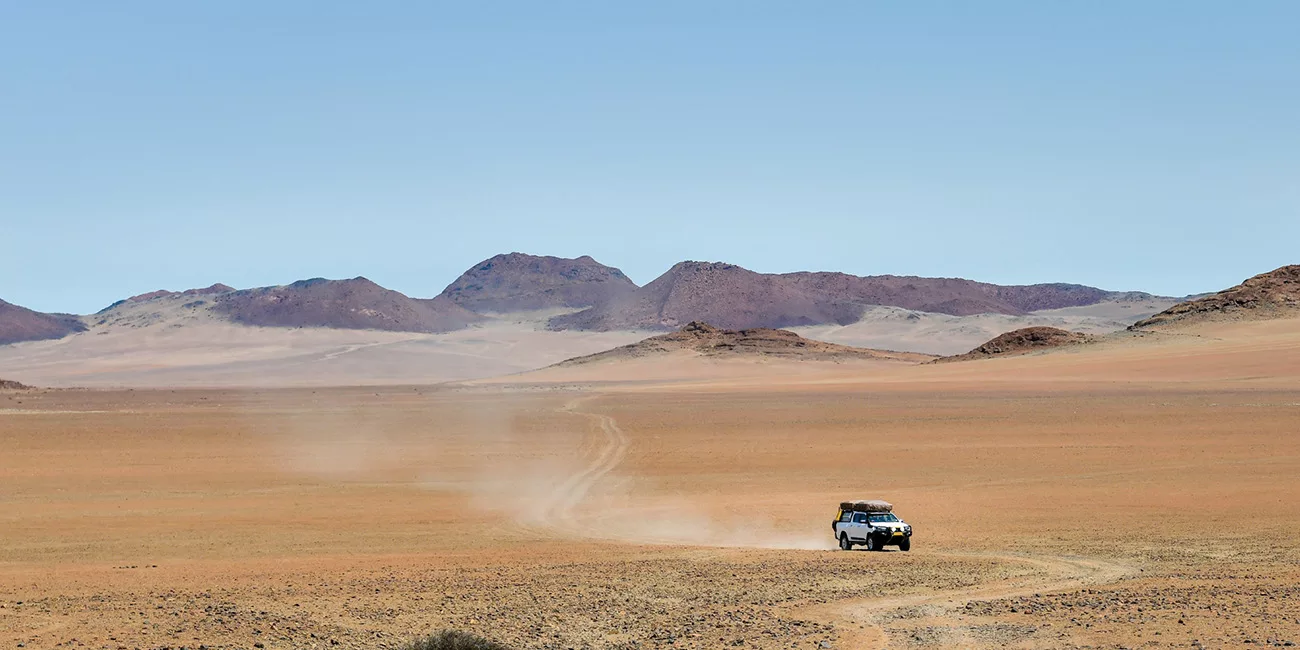
Namibia is approximately three times the size of South Africa with only about 4% of the population, which means it’s a country of vast openness and frequently uninhabited places and spaces. The roads are pristine and largely devoid of traffic, which makes driving a real pleasure. There are one or two unusual rules, though, which we found out when fined R500 for not having the correct lights on in the daytime – exacerbated by an 80 km round trip to pay the fine. Moral of the story? Put your lights on when starting your vehicle. The detour was worth it. Camping at the Waterberg Plateau, despite our nocturnal visitors, was fantastic, with a cooling swimming pool, immaculate ablutions, and some interesting scenic walks – including one taking us around key elements of the Battle of Waterberg, where the German colonists and the Herero tribe of Namibia fought for their independence.
Our second night, after about four hours of driving, mostly on the slower but still excellent gravel roads, brought us to Twyfelfontein, set in the Damaraland Desert. The difference in temperature from Waterberg was stark. With a lack of recent rain, it was dry as a bone, but nonetheless, we were fascinated to visit the living museum of the Damaraland and learn how the Damara people have lived and flourished in this hostile environment, knowing the benefits and dangers of every creature, tree, bush, and shrub. We were a little less lucky with our campsite this night. The one we had hoped to book was already fully booked, and with time against us, we unfortunately didn’t have time to visit the other major attractions, such as the petrified forest or ‘organ pipes’ this time.
Sand and sea

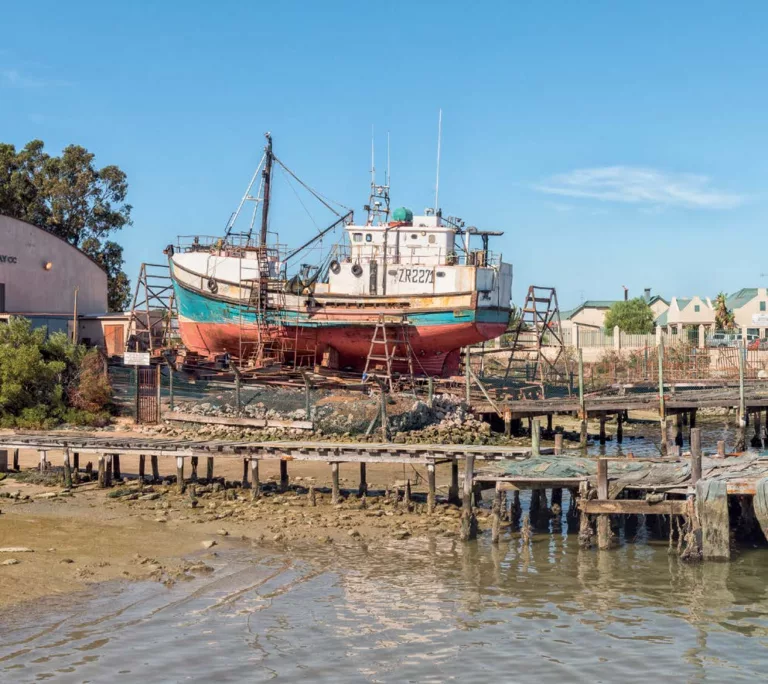
It was now time to head into the Skeleton Coast National Park. Crossing through the park is free of charge. This stretch was a long drive, and even after turning left as we drew near to the coast, it was some time before we finally found ourselves hugging the wild Atlantic Ocean. The area is named for the bones of whales and seals but has also become synonymous with the skeletons of ships, though only some of these are accessible in order to protect the delicate environment. We stopped a few times, once to check out the oil rig that was deserted in the 1970s and at a couple of the shipwrecks that are in contrasting states of repair but definitely worth a look at if time allows, if only to imagine how intimidating it must have been to be washed up in such a desolate place. By one wreck, we found tracks that were definitely indicative of a recent predator passing, which we subsequently established was the reclusive brown hyena.
After a long drive, we arrived in the seaside town of Swakopmund, enveloped in a mist reminiscent of English seaside towns, particularly with its wooden pier jutting out into the ocean. Dinner was at the Brewer and Bistro, which does a good steak as day turns into night. Our first and only full day in Swakopmund was a day of exploration and adventure. Desert Explorers took us out into Dorob National Park to learn about its inhabitants. Realising how many venomous Peringuey’s adders were concealed just below the sand around us was a sobering reality, but the almost translucent web-toed gecko was considerably less alarming.
Arguably the highlight of the entire trip was the two hours of zooming up and down the sand dunes on quad bikes. As we built up our confidence, our guide took us to ever more challenging heights, culminating in a picture-postcard pause on the sand dunes above the Atlantic breaking on the beach.
Not far behind, though, was the following morning with an 8 a.m. meeting at the quaint waterfront area in Walvis Bay. After a short but informative drive with engaging Pelican Point Kayaking guide Schalk, we arrived near the lighthouse and transferred into stable double kayaks, launching into the Atlantic, where we drifted between seals, which appeared to be flying from the water adjacent to the craft. It soon became part of the fun, interspersed with their occasional nibbles on the paddles.
Dune and dusted

After a stunning drive through a visually absorbing landscape, we arrived at the Sesriem campsite, ready for our ascent of the Big Daddy dune the next day. It is still a 60 km drive to the car park, including an off-road sand section, but after parking in the designated area, we completely missed the track that would have led us off to the dune ascent and instead decided to cross the preserved Deadvlei salt pan to ascend what appeared to be a path on the far side and climb there. We had a sheer climb up the sand, which I found far more challenging than Mia did – she scooted up like a desert goat. After rolling and running down again, it was time to head back to Windhoek, stopping at the quirky Solitaire for a coffee and a nibble before the long drive.
Text & Photography | Simon Marsh
For more information, go to pelican-point-kayaking.com.