
Stone Town’s gorgeous home entrances are just part of its multi-layered charm
Zanzibar has a way of lingering in the mind long after the sand has been shaken from your shoes. Aside from the stunning beaches and warm sea, Stone Town will remain etched most deeply in your memory, a living museum where history, culture and commerce swirl together in humid island air.
If you arrive expecting a tropical paradise, you’ll certainly find it. Turquoise waters, palm-fringed beaches and the ever-present hum of boats slicing through the Indian Ocean. But venture inland and Stone Town offers something richer, more textured: an island story written in coral stone and carved teak.
Walking tour
The best way to explore Stone Town is on foot, which is fortunate, because most of its labyrinthine alleys are far too narrow for cars. Even bicycles can be a hazard if you’re not paying attention. One moment you’re admiring the play of sunlight on faded plaster, the next you’re flattening yourself against a wall to avoid an oncoming cyclist who has impressive balance and questionable brakes.
The first thing that catches your eye, though, are the doors. Magnificent, towering wooden creations – some so intricately carved that they seem almost alive. Each tells a story. Some suggest an Indian influence, decorated with brass studs that once served to repel charging elephants. Others are pure Swahili, adorned with geometric designs and Arabic calligraphy that hint at the religious devotion and social status of the original owners.
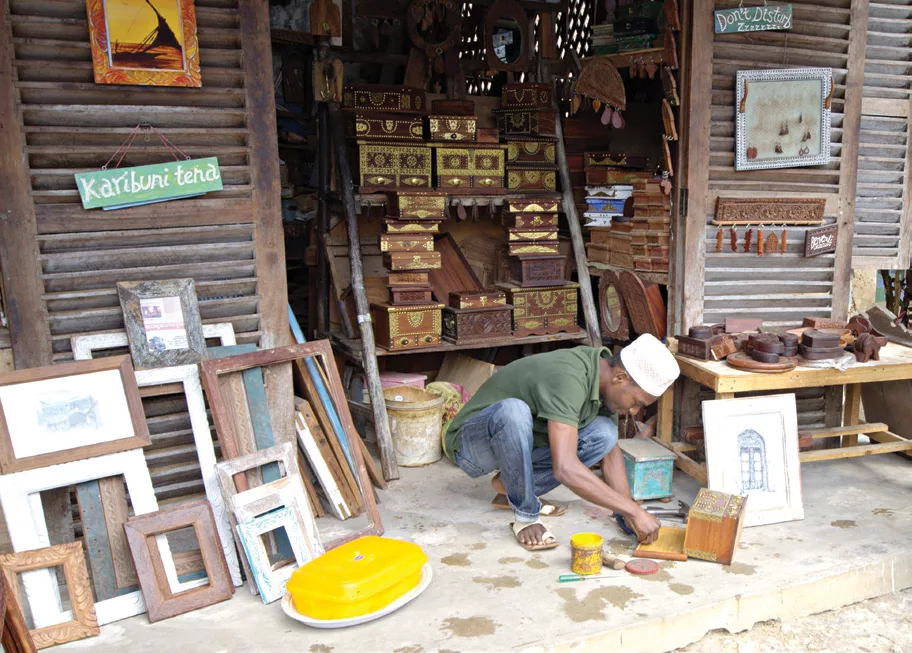
In their day, these doors announced wealth, faith and lineage before a word was ever spoken. Today, they announce something else: endurance. Many have outlived the houses, the owners and even the reason why they were built. Zanzibar is so protective of these cultural treasures that the original doors cannot be exported. Tourists can, however, commission new carvings – beautiful reproductions crafted by local artisans whose skill continues an unbroken tradition dating back centuries. Supporting these craftspeople is one of the most meaningful souvenirs a traveller can bring home. Each purchase helps keep alive a lineage of artistry that could so easily fade under the weight of mass production.
Hear, hear!
Stone Town’s days are framed by sound. The first call to prayer, just before dawn, echoes hauntingly across the rooftops. It’s a moment of stillness before the day unfolds, with fishermen heading to sea, stallholders setting out fruit and the narrow lanes filling with life.
Make a habit of heading out early with a camera, before the heat turns the air to syrup and tourists flood the alleys. Wandering at this hour, the city feels almost intimate, as if it’s stretching and waking, letting you glimpse its private moments.
As the day brightens, the rhythm changes. The calls to prayer punctuate the hours like a heartbeat, reminding you that faith here is not a quiet or hidden affair. Between them, the calls of vendors selling spices, scarves and carved trinket boxes fill the air.
Some buildings stand proud, others slump gracefully into disrepair, their once-grand facades now ghostly reminders of past prosperity. It’s tempting to see this decay as sadness, but look closer and you’ll see beauty in the resilience, life carrying on around crumbling walls, laughter echoing through broken windows.
As dusk falls, Stone Town transforms again. The oppressive heat fades, lanterns flicker to life and the night market at Forodhani Gardens becomes a theatre of scent and sound. The smoke from charcoal grills mingles with the salty breeze as vendors call out their menus – octopus skewers, Zanzibari pizzas and freshly squeezed sugarcane juice.
For the adventurous, there’s always a seafood table groaning under the weight of lobster, prawns and fish fresh from the ocean. You choose your catch, they grill it while you watch and you eat it on a paper plate under the stars. There’s a sense of community here – locals, tourists and wanderers from every corner of the world, gathered together in the warm night air.
The art of the deal
Out of season, Stone Town slows to a friendlier pace. The local craftspeople, with fewer customers to attend to, are more inclined to talk and to barter. Bartering here isn’t combat; it’s conversation. A dance between buyer and seller, where both sides need to feel they’ve won something.
Mass-produced trinkets can be bargained down with enthusiasm, but when you find a piece that’s clearly handmade – a carved mask, a woven basket or a delicate piece of jewellery – remember that your discount comes directly from the artist’s pocket. The most rewarding moments are often the chats that follow a sale: a laugh shared, a photo taken and a sense that, for a moment, commerce became connection.
I spent half an hour talking to a woodcarver who, during the quieter months, barely earned enough to feed his family. He laughed easily, though, and told me that visitors’ curiosity meant as much to him as their cash. “If they remember my face,” he said, “maybe they will tell someone else.” That is the true economy of travel: human stories shared like currency.
Stone Town was once a hub of trade and tragedy, where ivory, spices and human lives changed hands. The ghosts of that history are still here if you care to listen. Yet, somehow, the city hums with life and humour, with people who find joy in the everyday.
Yes, you’ll find coffee shops with WiFi and Western menus and, yes, you can stand outside the house where Freddie Mercury was born. But if you want the real Zanzibar, turn down the alleyways that don’t appear on maps. Talk to the people. Watch the craftsmen at work. Smell the spices. Listen to the sea.
Stone Town is where Zanzibar’s heart beats – steady, soulful and full of life.

Text and photography | David Batzofin
For more information, go to visitzanzibar.go.tz and travelandthings.co.za.